
Ubiquitous describes something that is present or found everywhere at the same time. It is commonly used to talk about things that appear frequently or seem to exist in every place. Ubiquitous meaning refers to being widespread, ever-present, or encountered almost everywhere.
The confusion often comes from its unfamiliar spelling and pronunciation. People frequently search for the ubiquitous definition, how to pronounce ubiquitous, ubiquitous examples, or how to use ubiquitous in a sentence. But here’s the good news: once you understand its meaning, it’s a simple and powerful word that can make your vocabulary more precise and expressive.
In this guide, you’ll discover the Ubiquitous Meaning, learn its correct pronunciation, definition, synonyms, and real-life examples, and see how to use it naturally in different contexts. You’ll also explore common mistakes to avoid so you can use ubiquitous with confidence in both speaking and writing.
What Does Ubiquitious Mean?
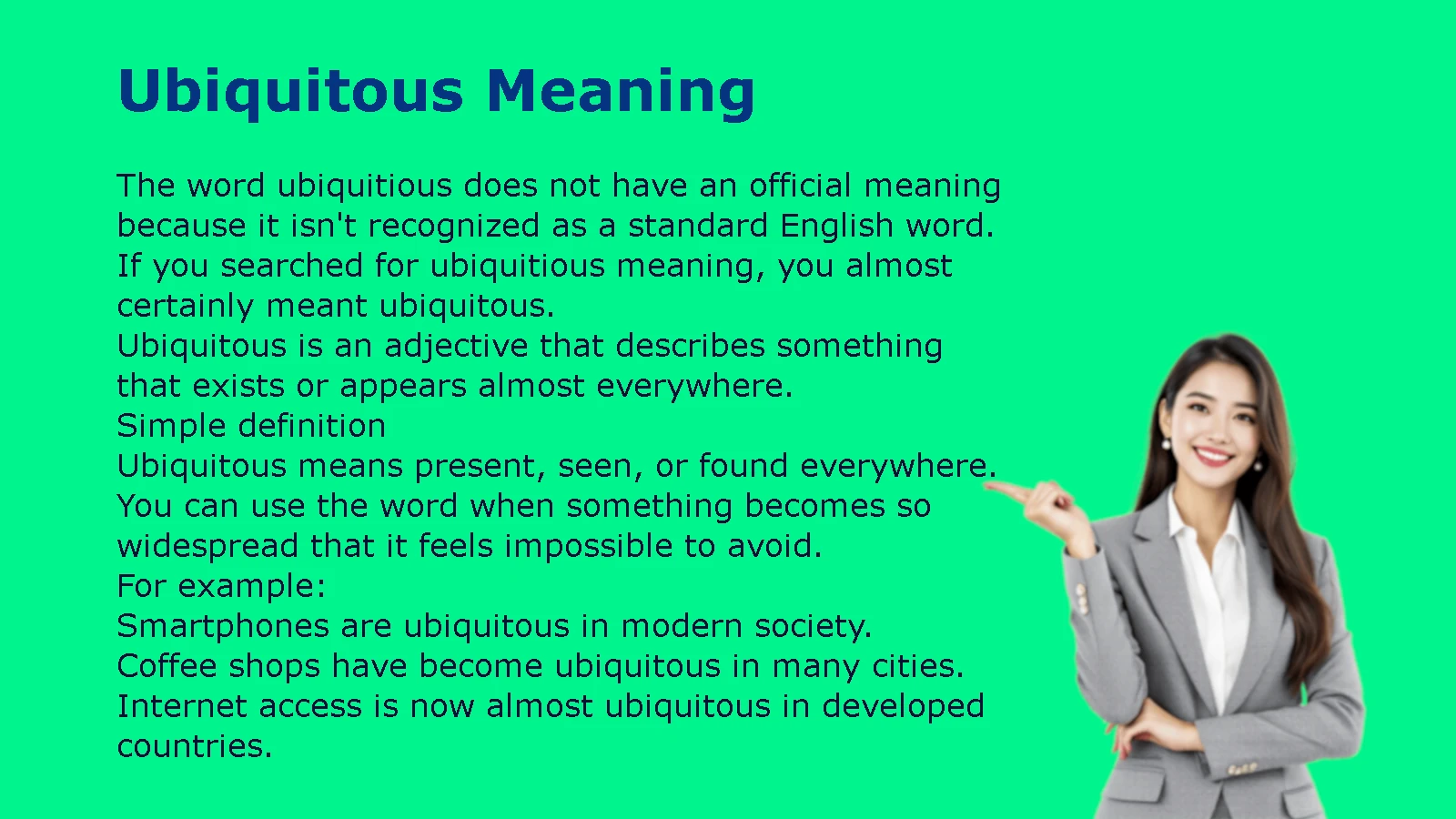
The word ubiquitious does not have an official meaning because it isn’t recognized as a standard English word. If you searched for ubiquitious meaning, you almost certainly meant ubiquitous.
Ubiquitous is an adjective that describes something that exists or appears almost everywhere.
Simple definition
Ubiquitous means present, seen, or found everywhere.
You can use the word when something becomes so widespread that it feels impossible to avoid.
For example:
- Smartphones are ubiquitous in modern society.
- Coffee shops have become ubiquitous in many cities.
- Internet access is now almost ubiquitous in developed countries.
The word doesn’t always mean something literally exists everywhere. Instead, it often emphasizes that something is extremely common or widespread.
Ubiquitous Meaning
Dictionary Definition
Most major English dictionaries define ubiquitous in nearly the same way:
| Dictionary Style Definition | Meaning |
| General English | Existing or being everywhere at the same time |
| Everyday Meaning | Found almost everywhere |
| Simple Definition | Very common or widespread |
In everyday conversation, people often use the word to describe trends, technology, products, ideas, or behaviors that have become part of daily life.
Pronunciation
IPA Pronunciation
/juːˈbɪkwɪtəs/
Easy phonetic spelling
yoo-BIK-wih-tuhs
Break it into syllables:
u · biq · ui · tous
Many spelling mistakes happen because the pronunciation doesn’t clearly reveal how the word is written.
Part of Speech
| Feature | Information |
| Word | Ubiquitous |
| Part of Speech | Adjective |
| Meaning | Present or found everywhere |
Because it’s an adjective, ubiquitous describes nouns.
Examples:
- ubiquitous technology
- ubiquitous advertising
- ubiquitous smartphones
- ubiquitous influence
Word Origin (Etymology)
Understanding where a word comes from often makes it easier to remember.
The word ubiquitous traces its roots to the Latin word ubique, which means “everywhere.”
Later, the term developed into Medieval Latin ubiquitas, meaning presence everywhere. It entered English in the early nineteenth century and gradually became common in academic writing before spreading into everyday language.
Here’s the evolution:
| Time | Word | Meaning |
| Latin | ubique | Everywhere |
| Medieval Latin | ubiquitas | Presence everywhere |
| English | ubiquitous | Existing everywhere |
Even today, the original Latin meaning remains almost unchanged.
What Does Ubiquitous Really Mean?
Many learners think ubiquitous simply means “common.”
While that’s partly true, there’s a subtle difference.
Consider these examples:
| Word | Meaning |
| Common | Happens often |
| Frequent | Happens many times |
| Widespread | Found across many places |
| Ubiquitous | Seems to be everywhere |
For example, rain is common in some cities. Wi-Fi, however, is ubiquitous because people expect to find it nearly everywhere they go.
That difference makes the word stronger than simply saying something is common.
Is “Ubiquitious” a Real Word?
No.
Ubiquitious is not a recognized English word.
It doesn’t appear as a standard spelling in major dictionaries because it’s simply a misspelling of ubiquitous.
Why do people spell it wrong?
Several reasons explain the mistake.
The pronunciation is misleading
When spoken aloud, many people hear an extra “i” near the end of the word.
As a result, they type:
- ubiquitious ❌
instead of
- ubiquitous ✅
The spelling looks more natural
English contains many words ending in:
- -itious
- -icious
- -tious
Examples include:
- ambitious
- nutritious
- superstitious
Because of those familiar patterns, many writers assume ubiquitious follows the same spelling rule.
It doesn’t.
People rarely write the word
Unlike words such as “important” or “beautiful,” ubiquitous isn’t used every day.
When people finally need it, they often rely on how it sounds instead of remembering its spelling.
Spell check usually fixes it
Modern search engines and writing software often recognize ubiquitious as a misspelling.
That’s why searching for the incorrect spelling usually leads to articles about ubiquitous instead.
Ubiquitous vs. Ubiquitious
This comparison clears up the confusion immediately.
| Feature | Ubiquitous | Ubiquitious |
| Correct spelling | ✅ Yes | ❌ No |
| Standard English word | Yes | No |
| Found in dictionaries | Yes | No |
| Accepted in academic writing | Yes | No |
| Safe to use professionally | Yes | No |
| Meaning | Present everywhere | Misspelling |
The correct sentence
✔ Smartphones are ubiquitous today.
Incorrect sentence
✘ Smartphones are ubiquitious today.
Whenever you’re writing for school, work, or publication, always use ubiquitous.
How to Use Ubiquitous Correctly
The word works best when something is extremely widespread.
Think about products, technology, habits, trends, or ideas that people encounter almost everywhere.
For example:
- Smartphones
- Internet access
- Advertising
- Coffee shops
- Streaming services
- Traffic lights
- QR codes
Each of these exists in so many places that calling them ubiquitous feels natural.
Ubiquitous in Everyday Conversation
You don’t need formal writing to use this word.
Here are a few natural examples.
- Smartphones have become ubiquitous.
- Fast food restaurants are ubiquitous across the country.
- Online shopping is now ubiquitous.
- Video calls became ubiquitous during remote work.
- Digital payments are becoming increasingly ubiquitous.
Notice how the adjective appears before or after the noun it describes.
Ubiquitous in Business
Business professionals often use ubiquitous when discussing markets, products, and technology.
Examples:
- Cloud computing has become ubiquitous in modern organizations.
- Smartphones are now a ubiquitous business tool.
- Digital advertising is ubiquitous across social platforms.
- Artificial intelligence is becoming ubiquitous in customer service.
The word sounds professional without being overly technical.
Ubiquitous in Education
Teachers and researchers frequently use the word when describing broad trends.
Examples include:
- Internet access has become ubiquitous in classrooms.
- Online learning platforms are ubiquitous in higher education.
- Digital textbooks are increasingly ubiquitous.
Academic writing often favors ubiquitous over simpler words like “common” because it conveys a stronger sense of widespread presence.
Ubiquitous in Technology
Technology provides some of the best examples.
Consider how quickly innovations spread.
Today, many people describe these as ubiquitous:
| Technology | Why It’s Considered Ubiquitous |
| Smartphones | Nearly everyone carries one |
| Wi-Fi | Available in homes, offices, and public spaces |
| GPS | Built into phones and vehicles |
| Search engines | Used daily by billions |
| QR codes | Found in restaurants, payments, and advertisements |
| USB charging | Available almost everywhere |
These technologies aren’t literally everywhere. Still, they’re so widespread that the word fits perfectly.
Ubiquitous in Media
Media often uses the word to describe famous brands, trends, or cultural movements.
Examples:
- Streaming services are ubiquitous in modern entertainment.
- Social media has become ubiquitous worldwide.
- Memes are ubiquitous across the internet.
- Podcasts have become ubiquitous among commuters.
The word highlights just how deeply something has entered everyday life.
When Should You Use “Ubiquitous”?
Use ubiquitous when all of these are true:
- Something appears in many places.
- Most people recognize it.
- It has become part of everyday life.
- It feels almost impossible to avoid.
For example:
| Situation | Is “Ubiquitous” Appropriate? |
| Smartphones | ✅ Yes |
| Wi-Fi | ✅ Yes |
| Electricity | ✅ Yes |
| Air | ❌ No (literally everywhere, so “ubiquitous” isn’t usually the best choice) |
| A local restaurant | ❌ No |
| A neighborhood event | ❌ No |
The word works best for things that are widely distributed, not things that naturally exist everywhere.
Words Commonly Used With Ubiquitous
Native English speakers often pair ubiquitous with certain nouns.
Here are some of the most common collocations.
| Ubiquitous + Noun | Example |
| technology | Ubiquitous technology has changed communication. |
| internet | Ubiquitous internet access supports remote work. |
| advertising | Ubiquitous advertising influences consumer behavior. |
| smartphones | Smartphones are ubiquitous in modern society. |
| computing | Ubiquitous computing connects devices seamlessly. |
| surveillance | Ubiquitous surveillance raises privacy concerns. |
| influence | Social media has a ubiquitous influence on culture. |
| presence | The company’s ubiquitous presence strengthens its brand. |
Learning these combinations helps your writing sound more natural.
Common Situations Where You’ll See the Word
Although ubiquitous appears in everyday conversation, it’s especially common in certain fields.
Technology
Developers often discuss ubiquitous computing, where computing power blends into everyday environments instead of existing only inside traditional computers.
Marketing
Brands aim for ubiquitous visibility, meaning customers recognize them almost everywhere they look.
Business
Companies describe products as ubiquitous when they dominate a market or become household names.
Science
Researchers use the word to describe organisms, chemicals, or natural processes found across many environments.
News
Journalists frequently describe smartphones, social media, AI tools, and internet access as ubiquitous because these technologies affect billions of people.
Quick Recap
Before moving on, here’s what you should remember.
| Question | Answer |
| Is ubiquitious correct? | ❌ No |
| Correct spelling | Ubiquitous |
| Meaning | Present or found everywhere |
| Part of speech | Adjective |
| Origin | From the Latin word ubique, meaning “everywhere” |
| Common use | Describing things that are widespread or nearly everywhere |
Example Sentences Using Ubiquitous
The best way to learn a new word is to see it in context. Since ubiquitous means “present or found almost everywhere,” you’ll often see it used to describe technology, businesses, trends, ideas, and everyday objects.
Here are practical examples from different situations.
Everyday Examples
- Smartphones are ubiquitous in modern life.
- Coffee shops have become ubiquitous in large cities.
- Wi-Fi is now ubiquitous in hotels and airports.
- Online shopping has become ubiquitous worldwide.
- Streaming services are ubiquitous in many households.
Business Examples
- Cloud computing is ubiquitous across the technology industry.
- Digital payments have become ubiquitous in retail stores.
- QR codes are ubiquitous in restaurant menus.
- Email remains a ubiquitous communication tool.
- Mobile apps play a ubiquitous role in customer engagement.
Academic Examples
- Researchers describe bacteria as ubiquitous because they exist in many environments.
- The internet has become ubiquitous in higher education.
- Artificial intelligence is becoming ubiquitous in scientific research.
- Digital libraries provide ubiquitous access to educational resources.
- Climate discussions have become ubiquitous in environmental studies.
Media and Culture Examples
- Social media has a ubiquitous influence on modern culture.
- Podcasts have become ubiquitous among commuters.
- Streaming platforms are ubiquitous in entertainment.
- Memes are ubiquitous across the internet.
- Smartphones make photography ubiquitous in everyday life.
Common Mistakes People Make
Even advanced English speakers occasionally misspell or misuse ubiquitous. Understanding these common mistakes helps you avoid them.
Adding an Extra “i”
This is the most common error.
❌ ubiquitious
✅ ubiquitous
Many people hear an extra syllable when the word is spoken, which leads them to insert another “i.”
Confusing the Ending
Some writers mistakenly use endings such as:
- ubiquitously ❌
- ubiquitious ❌
- ubiquitus ❌
The correct forms are:
- ubiquitous
- ubiquitously
- ubiquity
Using It for Everything
Remember, ubiquitous doesn’t simply mean “popular.”
For example:
Smartphones are ubiquitous. ✔
This restaurant is ubiquitous. ❌
Unless the restaurant has locations almost everywhere, the word doesn’t fit.
Confusing It With “Omnipresent”
These words are similar but not identical.
Omnipresent often suggests being literally present everywhere or having a spiritual or abstract presence.
Ubiquitous usually refers to something that’s extremely widespread.
Example:
- Smartphones are ubiquitous.
- In many religions, God is considered omnipresent.
Synonyms of Ubiquitous
Sometimes another word fits your sentence better. Here are the closest synonyms.
| Synonym | Meaning | Best Used For |
| Widespread | Found across many places | General writing |
| Prevalent | Common in a population | Research and statistics |
| Common | Frequently seen | Everyday English |
| Universal | Existing almost everywhere | Broad concepts |
| Omnipresent | Present everywhere | Formal or religious contexts |
| Pervasive | Spreading throughout | Ideas and influence |
| Ever-present | Always noticeable | Informal writing |
| Extensive | Covering a large area | Reports and analysis |
Example Comparisons
| Sentence | Better Choice |
| Smartphones are _____ today. | Ubiquitous |
| The disease became _____ in the region. | Prevalent |
| The company’s influence is _____. | Pervasive |
| The internet is _____ across the country. | Widespread |
Each synonym has a slightly different shade of meaning, so choose the one that best matches your context.
Antonyms of Ubiquitous
These words express the opposite idea.
| Antonym | Meaning |
| Rare | Not seen often |
| Scarce | Limited in number |
| Uncommon | Not frequently found |
| Unusual | Different from what’s typical |
| Exceptional | Standing out from the ordinary |
| Isolated | Existing in only a few places |
| Unique | One of a kind |
Examples
- Snow is rare in tropical countries.
- The mineral is scarce in nature.
- The animal is found only in isolated regions.
- The painting is unique.
Ubiquitous in Different Contexts
The meaning stays the same, but the way people use ubiquitous changes depending on the subject.
Technology
Technology evolves quickly, and successful innovations often become ubiquitous.
Examples include:
- Smartphones
- Wi-Fi
- GPS
- Search engines
- Cloud computing
- QR codes
These tools have become everyday essentials for millions of people.
Business
Businesses use ubiquitous to describe products, services, or brands with broad market reach.
Examples:
- A globally recognized logo.
- A payment method accepted almost everywhere.
- Software used across multiple industries.
Companies often strive for a ubiquitous presence because familiarity builds customer trust.
Education
Schools and universities increasingly rely on digital tools.
Examples include:
- Online classrooms
- Learning management systems
- Educational apps
- Digital textbooks
These technologies have become ubiquitous in many educational settings.
Science
Scientists frequently use ubiquitous when discussing organisms or substances that occur across many environments.
Examples include:
- Certain bacteria
- Water vapor
- Microplastics
- Dust particles
The word helps explain widespread natural phenomena.
Nature
Some plants and animals appear in so many regions that scientists describe them as ubiquitous.
For example:
- Dandelions
- Houseflies
- Pigeons
They’re found across numerous countries and climates.
Pop Culture
Entertainment trends spread rapidly through the internet.
Today, you could describe these as ubiquitous:
- Social media influencers
- Streaming services
- Viral memes
- Emoji
- Podcasts
Their widespread presence makes the word a natural fit.
Memory Trick to Spell Ubiquitous Correctly
Because ubiquitous is difficult to spell, many people benefit from a simple memory trick.
Remember the Latin Root
The word comes from ubique, meaning everywhere.
Keeping that origin in mind makes the spelling easier to recall.
Break It Into Parts
Instead of memorizing one long word, divide it:
Ubi + quit + ous
Notice there’s no extra “i” before -ous.
Think of This Sentence
“Ubiquitous is everywhere, but the extra ‘i’ isn’t.”
It’s a simple reminder that helps many learners avoid the most common spelling mistake.
Practice Tip
Write the word several times while saying it aloud:
- ubiquitous
- ubiquitous
- ubiquitous
Repeating both the spelling and pronunciation strengthens long-term memory.
Related Words
Learning related forms helps expand your vocabulary.
| Word | Part of Speech | Meaning | Example |
| Ubiquity | Noun | The state of being everywhere | The ubiquity of smartphones has changed communication. |
| Ubiquitous | Adjective | Present everywhere | Smartphones are ubiquitous today. |
| Ubiquitously | Adverb | In a way that is everywhere | Wi-Fi is ubiquitously available in many public places. |
| Ubiquitousness | Noun | The quality of being widespread | The ubiquitousness of digital technology is remarkable. |
Knowing these forms makes your writing more flexible and natural.
Frequently Asked Questions
What does ubiquitous mean in simple words?
Ubiquitous means found or seen almost everywhere. It describes something so common that you encounter it in many different places.
Is “ubiquitious” correct?
No. Ubiquitious is a spelling mistake.
The correct spelling is ubiquitous.
Is ubiquitous positive or negative?
Neither.
It’s generally a neutral adjective. The context determines whether it has a positive or negative tone.
Positive
- High-speed internet has become ubiquitous.
Negative
- Plastic waste has become ubiquitous.
What is the difference between ubiquitous and omnipresent?
Both suggest widespread presence, but they’re used differently.
| Ubiquitous | Omnipresent |
| Extremely common | Present everywhere |
| Often used for technology, trends, and products | Often used in religion, philosophy, or abstract ideas |
| Everyday English | More formal |
Can a person be described as ubiquitous?
Yes.
You can describe someone as ubiquitous if they seem to appear everywhere.
For example:
The celebrity was ubiquitous during the awards season.
This doesn’t mean they were literally everywhere. It means they appeared constantly in the news, social media, and public events.
What is the noun form of ubiquitous?
The noun form is ubiquity.
Example:
The ubiquity of smartphones has transformed communication.
What is the adverb form of ubiquitous?
The adverb is ubiquitously.
Example:
Wireless internet is ubiquitously available in many airports.
Why do people spell ubiquitous as ubiquitious?
The mistake happens because English pronunciation can be misleading.
Many words end with -itious, such as:
- ambitious
- superstitious
- nutritious
As a result, people naturally assume ubiquitous follows the same pattern even though it doesn’t.
Quick Summary
Here’s a quick reference you can revisit anytime.
| Topic | Answer |
| Correct spelling | Ubiquitous |
| Incorrect spelling | Ubiquitious |
| Part of speech | Adjective |
| Meaning | Present or found everywhere |
| Origin | Latin ubique (“everywhere”) |
| Noun form | Ubiquity |
| Adverb form | Ubiquitously |
| Common mistake | Adding an extra “i” before -ous |
Final Thoughts
If you searched for ubiquitious meaning, the most important takeaway is simple: ubiquitious isn’t the correct spelling. The word you’re looking for is ubiquitous, an adjective that means present, appearing, or found almost everywhere.
Although it’s easy to misspell because of its pronunciation, remembering its Latin root and breaking it into smaller parts can make the correct spelling much easier to recall. Once you understand its meaning, you’ll notice ubiquitous in news articles, business reports, academic writing, and everyday conversations describing technologies, trends, products, and ideas that have become nearly impossible to avoid.
The next time you want to describe something that’s widespread or seems to be everywhere, use ubiquitous with confidence. It’s the correct word, it’s widely recognized, and it’s a valuable addition to your English vocabulary.