
Couch potato means a person who spends a lot of time sitting or lying on a couch, usually watching TV or doing very little physical activity. It is an informal phrase often used humorously to describe someone who has a lazy or inactive lifestyle.
If you’re searching for “couch potato meaning,” “what does couch potato mean,” or “couch potato definition,” you’re likely looking for its simple meaning and how to use it in a sentence. In everyday English, couch potato usually describes someone who spends long periods relaxing in front of the television or another screen instead of being physically active. It can be used playfully about yourself or teasingly about someone else.
| Question | Answer |
|---|---|
| What does couch potato mean? | A person who spends a lot of time sitting around and watching TV or doing little physical activity. |
| What is the meaning of couch potato? | An inactive or lazy person who spends much of their free time relaxing on a couch. |
| Is couch potato an insult? | Not always. It is often used humorously or playfully, but it can sound critical depending on the context. |
| What is a synonym for couch potato? | Lazy person, inactive person, homebody, or loafer. |
What Does “Couch Potato” Mean?
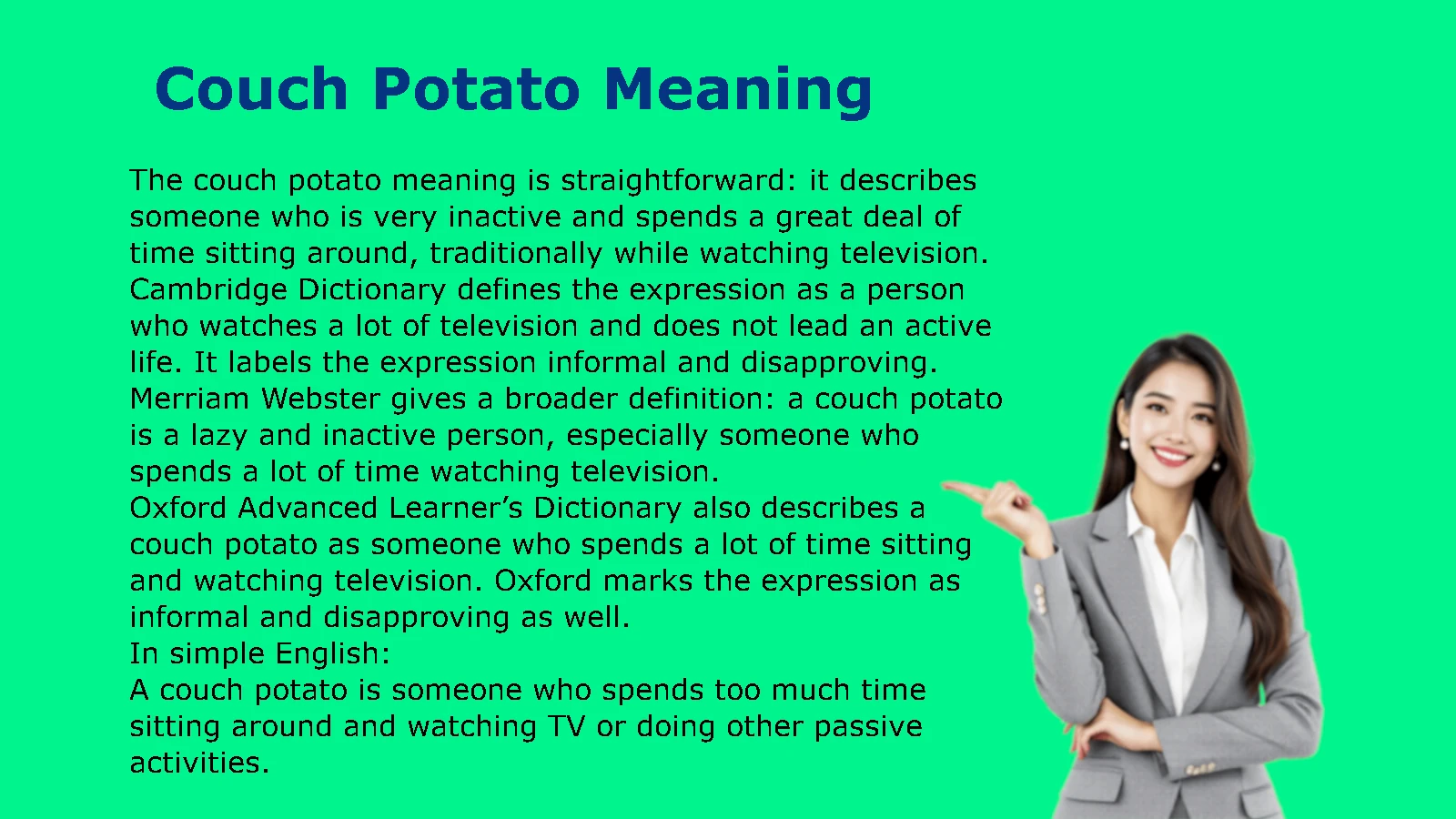
The couch potato meaning is straightforward: it describes someone who is very inactive and spends a great deal of time sitting around, traditionally while watching television.
Cambridge Dictionary defines the expression as a person who watches a lot of television and does not lead an active life. It labels the expression informal and disapproving.
Merriam Webster gives a broader definition: a couch potato is a lazy and inactive person, especially someone who spends a lot of time watching television.
Oxford Advanced Learner’s Dictionary also describes a couch potato as someone who spends a lot of time sitting and watching television. Oxford marks the expression as informal and disapproving as well.
In simple English:
A couch potato is someone who spends too much time sitting around and watching TV or doing other passive activities.
The word “potato” isn’t meant literally. It creates a funny image of a person planted on a couch, much like a potato sitting in one place.
Couch Potato Meaning in Simple English
Think about this situation.
Someone gets home from work on Friday evening. Instead of going out, exercising, doing a hobby, or meeting friends, they sink into the couch. One movie becomes two. Two become three. Before they know it, several hours have passed.
That person might describe themselves by saying:
“I was a complete couch potato this weekend.”
The expression doesn’t necessarily mean the person is inactive all the time. It can describe a temporary period of doing very little.
For instance:
- “I turned into a couch potato during my vacation.”
- “After finals, I spent two days being a couch potato.”
- “My brother is a couch potato whenever his favorite team plays.”
The key idea is extended inactivity, especially passive entertainment.
Couch Potato Definition at a Glance
| Feature | Details |
| Expression | couch potato |
| Part of speech | Noun |
| Plural | couch potatoes |
| Meaning | An inactive person who spends a lot of time sitting around, especially watching TV |
| Register | Informal |
| Tone | Often humorous, teasing, or mildly disapproving |
| Origin | American English |
| First known use | 1976 |
| Typical context | Television, entertainment, inactivity, leisure |
Merriam Webster confirms both the plural form couch potatoes and the 1976 first known use.
Is “Couch Potato” an Insult?
Couch potato can be an insult, but it isn’t necessarily offensive. The meaning depends heavily on the speaker, relationship, and context.
Because the expression suggests laziness and inactivity, calling someone a couch potato can sound critical. However, people frequently use it playfully when talking about themselves or close friends.
Consider these examples:
Playful:
“I ordered pizza, turned on Netflix, and became a couch potato for the evening.”
Here, the speaker is making fun of their own behavior.
Teasing:
“Come on, couch potato. Let’s go outside.”
A friend might say this jokingly to encourage someone to get off the sofa.
More critical:
“He’s become a couch potato and never wants to leave the house.”
In this sentence, the speaker clearly sees the person’s inactivity as a problem.
So, before using the term for another person, consider the relationship and tone. In a friendly conversation, it can sound lighthearted. In a professional or unfamiliar setting, inactive person or sedentary person may sound more neutral.
Is “Couch Potato” a Negative Word?
Usually, yes, at least to some degree.
The expression carries an implication of too much inactivity. That’s why major learner dictionaries often mark it as disapproving. Cambridge and Oxford both do so.
Still, the negative force isn’t fixed. Someone can happily call themselves a couch potato without feeling insulted.
For example:
“I’m proud to be a couch potato on Sunday.”
The speaker isn’t seriously criticizing themselves. They’re emphasizing that they want a lazy day.
Where Did the Term “Couch Potato” Come From?
The origin of couch potato goes back to the United States in the 1970s.
Merriam Webster records the first known use as 1976.
The phrase is generally credited to Tom Iacino, who used the expression among friends. Cartoonist Robert Armstrong then helped popularize it through his artwork and the Couch Potatoes group. Historical accounts connect the phrase with the television culture of the period and an earlier humorous expression, “boob tuber.”
The wordplay makes the origin especially memorable.
Television was sometimes called the “boob tube” in American slang. Someone who spent too much time watching it could therefore be humorously called a “boob tuber.” A potato is a tuber, so the expression evolved into the much catchier couch potato.
The 1976 Origin Story
The commonly cited story traces the phrase to Tom Iacino and his friend Robert Armstrong.
Iacino reportedly used “couch potato” during a telephone conversation with friends in 1976. Armstrong, an underground cartoonist, recognized the comic potential of the phrase and developed the image of a potato lounging on a couch.
That visual helped give the expression a memorable identity.
A 1992 report based on The Oxford Dictionary of New Words described the phrase as a humorous coinage attributed to Iacino and noted Armstrong’s role in popularizing it.
The important point is that the phrase wasn’t created as an ancient proverb or traditional idiom. It emerged from 1970s American popular culture, particularly the era’s television viewing habits.
Couch Potato Origin Timeline
| Year | Development |
| 1976 | The first known use of “couch potato” is recorded |
| Late 1970s | The phrase begins spreading beyond its original circle |
| 1980s | The expression becomes increasingly familiar in American English |
| 1990s | Major dictionaries and reference works document its meaning and history |
| Today | The phrase remains common in informal English |
Merriam Webster’s dictionary entry gives 1976 as the first known use.
Why Is It Called a “Couch Potato”?
The name works because it combines two simple images.
Couch represents sitting, reclining, and lounging.
Potato creates the humorous image of something sitting in one place without doing anything.
There’s also a linguistic connection to the word tuber. Potatoes are tubers, while “boob tuber” was an earlier humorous expression for someone who watched television constantly.
Put those ideas together and the phrase becomes easy to visualize:
Person + couch + inactivity + television = couch potato
That’s part of the reason the expression has lasted. It’s vivid. You don’t need a dictionary to imagine what a “couch potato” looks like.
How to Use “Couch Potato” in a Sentence
Couch potato is a countable noun. You can talk about one couch potato or several couch potatoes.
The expression commonly appears after verbs such as be, become, turn into, call, and remain.
Using “Be a Couch Potato”
This is one of the most common structures.
- “My brother is a couch potato.”
- “I’m not usually a couch potato.”
- “He’s a real couch potato on weekends.”
The phrase describes a person’s typical behavior or a particular period of inactivity.
Using “Become a Couch Potato”
Use become when someone starts behaving this way.
- “She became a couch potato after retiring.”
- “I don’t want to become a couch potato.”
- “He became a couch potato during the winter.”
This construction suggests a change from a more active lifestyle to a less active one.
Using “Turn Into a Couch Potato”
Turn into is more conversational and often adds a humorous tone.
- “I turned into a couch potato during my vacation.”
- “He’s turning into a couch potato.”
- “Don’t turn into a couch potato just because it’s raining.”
This wording works particularly well in casual conversations.
Using “Call Someone a Couch Potato”
You can also use the expression as a label.
- “His friends call him a couch potato.”
- “Don’t call me a couch potato!”
- “She jokingly called her brother a couch potato.”
Because the phrase can sound critical, the relationship between the speakers matters.
Couch Potato Example Sentences
A few well chosen examples show how flexible the expression can be.
Everyday Examples
- “I was a couch potato all Saturday and watched old movies.”
- “My dad becomes a couch potato whenever football season starts.”
- “She doesn’t want to spend every evening as a couch potato.”
- “We were couch potatoes during the storm.”
- “After a long week, I enjoyed being a couch potato for a few hours.”
Humorous Examples
- “The remote control practically became part of my couch potato routine.”
- “I planned to clean the house, but the couch won.”
- “Three episodes later, I realized I’d become a couch potato.”
- “Saturday turned me into a professional couch potato.”
- “My couch potato skills are strongest on rainy Sundays.”
Negative or Critical Examples
- “He’s become such a couch potato that he rarely goes outside.”
- “His parents don’t want him to become a couch potato.”
- “Spending every free hour in front of the TV can make you look like a couch potato.”
Self Description
Self use often softens the expression:
“I’m going to be a couch potato tonight.”
That doesn’t necessarily mean the speaker thinks they’re lazy. They may simply want to relax after a demanding day.
Couch Potato vs. Lazy Person
Although couch potato and lazy person overlap, they aren’t exact synonyms.
A lazy person is someone who generally avoids effort or activity. The term can apply to work, school, chores, exercise, or responsibilities.
A couch potato, on the other hand, specifically emphasizes sitting around and passive leisure, especially television viewing.
| Expression | Main idea | Typical tone |
| Couch potato | Inactive person who spends a lot of time lounging or watching TV | Informal, humorous or critical |
| Lazy person | Person who avoids effort or work | More directly critical |
| Sedentary person | Person whose lifestyle involves little physical activity | Neutral or formal |
| Idler | Person who spends time doing little or nothing | Literary or somewhat old fashioned |
| Slacker | Person who avoids work or responsibility | Informal and negative |
Merriam Webster lists several related terms for couch potato, including idler, loafer, sluggard, and slacker.
The Important Difference
Imagine two people.
Person A avoids doing homework, refuses to help with chores, and regularly avoids work.
That person is lazy.
Person B works hard all week but spends Saturday afternoon lying on the couch watching movies.
Calling Person B a couch potato for the afternoon can be playful.
The distinction matters because couch potato describes a pattern of passive leisure, while lazy can describe a broader attitude toward effort.
Couch Potato vs. Sedentary
Sedentary is more neutral and much broader than couch potato.
A sedentary lifestyle involves spending substantial time sitting or being physically inactive. Someone might have a sedentary lifestyle because their job requires them to sit at a desk for hours.
That person isn’t necessarily lazy.
For example:
“She has a sedentary job.”
This statement doesn’t criticize her character.
Compare it with:
“She’s a couch potato.”
The second sentence suggests that she chooses to spend a lot of free time sitting around and may carry a judgment about her habits.
| Word | Meaning | Tone |
| Couch potato | Person who spends lots of time lounging or watching TV | Informal, often disapproving |
| Sedentary | Involving a lot of sitting or little physical activity | Neutral |
| Lazy | Avoiding effort or activity | Negative |
| Inactive | Not physically active | Neutral |
This distinction becomes especially useful in professional writing. If the goal is to describe behavior objectively, sedentary or inactive usually works better than couch potato.
Is “Couch Potato” Slang?
Couch potato is an informal expression that originated as American slang.
Cambridge and Oxford both classify it as informal.
It works naturally in:
- Casual conversations
- Text messages
- Social media
- Humorous writing
- Informal articles
- Friendly conversations
It isn’t usually the best choice for:
- Academic papers
- Medical reports
- Formal business writing
- Official documents
- Professional assessments
For example, this sounds casual:
“He’s become a couch potato.”
A more formal version would be:
“He has developed a sedentary lifestyle.”
The second sentence communicates the idea without the humorous judgment attached to couch potato.
Is “Couch Potato” a Noun?
Yes. Couch potato is a noun.
It refers to a person rather than an activity.
Examples:
- “My sister is a couch potato.”
- “He’s becoming a couch potato.”
- “The couch potatoes stayed home.”
- “Don’t be such a couch potato.”
Because it is a noun, you normally use an article or determiner when referring to one person:
- a couch potato
- the couch potato
- that couch potato
- my couch potato brother
You wouldn’t normally say:
“He is couch potato.”
Instead, say:
“He is a couch potato.”
What Is the Plural of Couch Potato?
The plural is couch potatoes.
The word potato takes the standard plural potatoes.
| Singular | Plural |
| a couch potato | couch potatoes |
| one couch potato | two couch potatoes |
| that couch potato | those couch potatoes |
Examples:
- “My friends are couch potatoes.”
- “The house was full of couch potatoes during the movie marathon.”
- “Weekend couch potatoes finally left the sofa.”
Merriam Webster explicitly lists couch potatoes as the plural form.
Couch Potato or Potato Couch?
The correct expression is couch potato.
Potato couch doesn’t have the same established meaning.
The order matters because couch potato is a fixed noun phrase. It describes a person who spends too much time sitting around.
For example:
“He became a couch potato after the holidays.”
Not:
“He became a potato couch.”
The second version sounds like a piece of furniture made from potatoes. That’s a different picture altogether.
Is “Couch Potato” One Word or Two?
Write it as two words: couch potato.
The plural is also written as two words:
couch potatoes
Examples:
- “He’s a couch potato.”
- “They became couch potatoes.”
Avoid writing it as couchpotato in standard English.
Couch Potato Synonyms
There isn’t one perfect synonym because couch potato combines inactivity, lounging, and a strong association with television.
However, several words come close.
Lazy Person
This is the broadest everyday alternative.
“He’s a lazy person.”
Unlike couch potato, it doesn’t specifically suggest television or sitting on a couch.
Sedentary Person
This is a more neutral alternative.
“She leads a sedentary lifestyle.”
Use this when you want to describe inactivity without sounding insulting.
Idler
An idler is someone who spends time doing little or nothing.
It is grammatically correct but less common in everyday American conversation.
Slacker
A slacker is someone who avoids work or responsibility.
It overlaps with couch potato, but the focus is different. A slacker may avoid work without spending much time watching television.
Layabout
A layabout is someone who is habitually idle or lazy.
It has a more old fashioned flavor than couch potato.
Lounger
A lounger can describe someone who spends a lot of time relaxing or sitting around. It doesn’t necessarily imply laziness.
Related Expressions to “Couch Potato”
Some expressions describe the activity rather than the person.
Veg Out
Veg out means to relax in an extremely passive way, often while watching television.
“I’m going to veg out in front of the TV tonight.”
Someone who regularly does this might be called a couch potato.
Sit Around
This is a simple, neutral phrase.
“We spent the afternoon sitting around.”
It doesn’t carry the same humorous image.
Vegetate
Vegetate can mean to spend time passively without doing much.
“He spent the weekend vegetating in front of the television.”
This word can sound more literary or critical than sit around.
Modern Couch Potato Meaning
The traditional couch potato meaning centers on television, but entertainment habits have changed dramatically since the phrase appeared in 1976.
People now stream movies and shows, watch sports online, scroll through social media, play video games, and consume other digital entertainment from their couches.
The expression has adapted naturally.
A person doesn’t have to watch traditional broadcast television to fit the modern idea of a couch potato. The broader concept is spending excessive leisure time sitting around and consuming passive entertainment.
Still, television remains part of the core dictionary meaning. Cambridge and Oxford continue to define the expression specifically around spending a lot of time watching television.
This creates an interesting linguistic shift: the word survived even as the technology changed.
The couch stayed. The screen changed.
A Simple Case Study: Is Someone Really a Couch Potato?
Consider two examples.
Case Study: The Weekend Viewer
Alex works five days a week. On Saturday, Alex watches movies for six hours and barely leaves the couch.
Calling Alex a couch potato for the day would be perfectly natural in a casual conversation.
However, the phrase doesn’t necessarily mean Alex is lazy as a person.
Case Study: The Habitual Viewer
Now imagine Jordan spends nearly every evening sitting on the couch watching shows. Jordan regularly turns down activities because they would rather stay home and watch television.
Calling Jordan a couch potato more strongly matches the traditional meaning.
The difference is pattern and context.
One lazy afternoon doesn’t automatically define someone’s lifestyle. The expression often becomes more fitting when inactivity is habitual.
Common Mistakes With “Couch Potato”
Even a familiar expression can cause a few usage problems.
Mistake: Treating It as a Formal Term
“The patient is a couch potato.”
That sounds inappropriate in formal or medical writing.
Better:
“The patient has a sedentary lifestyle.”
Mistake: Assuming It Always Means “Lazy”
The term can suggest laziness, but it more specifically points to passive inactivity.
Someone can work extremely hard and still spend an evening as a couch potato.
Mistake: Using the Wrong Plural
Incorrect:
“They are couch potatos.”
Correct:
“They are couch potatoes.”
Mistake: Assuming Television Is Always Required
Television remains central to the traditional dictionary definition. However, modern informal use can apply the expression more broadly to someone who spends excessive leisure time lounging and consuming passive entertainment.
When Should You Use “Couch Potato”?
Use couch potato when you want a casual, vivid way to describe someone who spends a lot of time sitting around, especially watching television.
It’s particularly useful when the tone is:
- Humorous
- Friendly
- Conversational
- Lightly critical
- Self deprecating
For example:
“I’m going to be a couch potato tonight.”
That sounds natural because the expression fits a relaxed setting.
When Should You Avoid It?
Avoid it when you need a neutral or professional description.
Instead of:
“The report says employees are becoming couch potatoes.”
Use:
“The report says employees are becoming increasingly sedentary.”
The second version is more precise and appropriate for formal writing.
Couch Potato Meaning in Everyday Conversation
The expression remains useful because it packs a fairly detailed idea into two words.
Compare:
“He spends a lot of his free time sitting on the couch watching television and rarely does anything active.”
with:
“He’s a couch potato.”
The second sentence is much shorter. It creates an immediate mental picture and communicates the speaker’s attitude at the same time.
That’s what makes idiomatic language powerful.
A good idiom doesn’t simply describe something. It gives the description a personality.
Frequently Asked Questions About Couch Potato Meaning
What does couch potato mean?
Couch potato means a person who spends a lot of time sitting around, especially watching television, instead of leading an active life. The phrase is informal and can sound humorous or mildly disapproving.
Is couch potato an insult?
It can be. The phrase suggests inactivity and can imply laziness. However, people often use it jokingly about themselves or close friends.
Is couch potato slang?
Yes. Couch potato is an informal expression that originated in American English. Major dictionaries classify it as informal.
What is the plural of couch potato?
The plural is couch potatoes.
Example:
“The couch potatoes spent the entire afternoon watching movies.”
Why is it called a couch potato?
The expression combines couch, which represents lounging, with potato, which creates the image of something sitting still. The phrase also connects to the older television expression boob tuber, because potatoes are tubers.
When was couch potato first used?
Merriam Webster records the first known use in 1976.
Who coined the term couch potato?
The term is generally credited to Tom Iacino, while cartoonist Robert Armstrong played an important role in popularizing it. Historical accounts connect their story to California in 1976.
Can you call yourself a couch potato?
Yes. Self description is common and often humorous.
“I was a couch potato all weekend.”
In this context, the phrase usually sounds lighthearted rather than harsh.
What is another word for couch potato?
Depending on context, alternatives include lazy person, inactive person, sedentary person, idler, loafer, slacker, and layabout. These aren’t perfect synonyms because each emphasizes a slightly different idea. Merriam Webster lists several related terms, including idler, loafer, and slacker.
What is the opposite of a couch potato?
There isn’t one exact fixed antonym. Depending on the context, you could say:
- Active person
- Fitness enthusiast
- Go getter
- Active lifestyle
- Doer
The best choice depends on whether you’re describing someone’s personality, habits, or physical activity.
Does couch potato only refer to watching TV?
Traditionally, television is central to the expression’s meaning. Modern informal usage can extend the idea to other passive forms of entertainment and prolonged lounging.
Is couch potato formal English?
No. It is best suited to informal English. For formal writing, terms such as sedentary, inactive, or physically inactive are usually more appropriate.
Key Facts About “Couch Potato”
| Fact | Answer |
| Meaning | An inactive person who spends a lot of time sitting around, especially watching TV |
| Part of speech | Noun |
| Plural | Couch potatoes |
| Language variety | American English origin |
| Register | Informal |
| Tone | Often humorous or disapproving |
| First known use | 1976 |
| Common association | Television and passive leisure |
| Correct spelling | Couch potato |
| Formal alternative | Sedentary or inactive person |
Merriam Webster, Cambridge, and Oxford all support the core definition and informal usage of the expression.
Final Thoughts on Couch Potato Meaning
The couch potato meaning is simple but more nuanced than it first appears. A couch potato is an inactive person who spends a lot of time sitting around, traditionally watching television.
The expression is informal and often carries a humorous or mildly negative tone. You might use it to tease a friend, describe your own lazy Sunday, or criticize someone’s habit of spending too much free time on the couch.
Its history is just as interesting. The phrase emerged in 1976 and is generally credited to Tom Iacino, with Robert Armstrong helping popularize it. Its clever connection to television slang and the idea of a potato sitting motionless helped turn a playful phrase into a lasting part of everyday English.
The easiest way to remember it is this:
A couch potato is someone who spends too much time sitting around, especially watching TV.
If you need a casual and colorful expression, couch potato fits the bill. If you need a neutral or professional term, sedentary person or inactive person is usually the better choice.