
Acumen refers to the ability to make quick, accurate judgments and understand situations clearly, especially in business or practical matters. It describes sharp insight, strong decision-making skills, and the ability to recognize opportunities or solve problems effectively. Acumen meaning is the quality of having keen understanding and good judgment.
The word can be confusing because many people search for acumen definition, acumen pronunciation, and acumen examples to understand how it is used in real conversations. And here’s the kicker: having professional acumen is not just about intelligence—it’s about having the insight and practical judgment to make smart choices.
In this guide, you’ll learn the complete meaning of acumen, discover its origin, understand the difference between acumen and intelligence, and see useful acumen examples in sentences. You’ll also learn how to pronounce acumen and explore common phrases like business acumen and financial acumen.
By the end, you’ll have a clear understanding of this powerful word and know exactly when to use acumen in your writing and conversations.
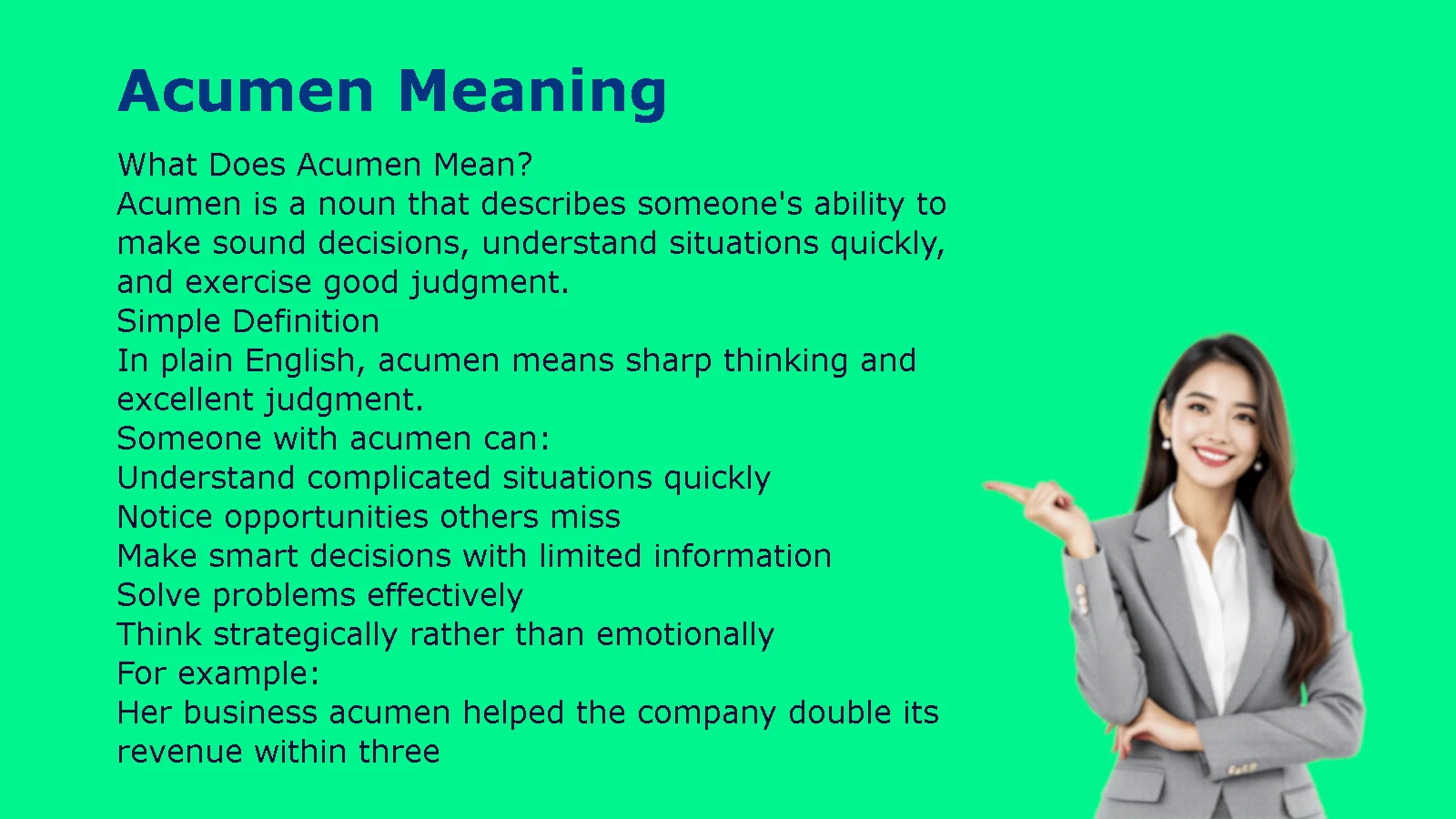
What Does Acumen Mean?
Acumen is a noun that describes someone’s ability to make sound decisions, understand situations quickly, and exercise good judgment.
Simple Definition
In plain English, acumen means sharp thinking and excellent judgment.
Someone with acumen can:
- Understand complicated situations quickly
- Notice opportunities others miss
- Make smart decisions with limited information
- Solve problems effectively
- Think strategically rather than emotionally
For example:
Her business acumen helped the company double its revenue within three years.
This sentence doesn’t mean she was merely intelligent. It means she used practical judgment, strategic thinking, and experience to achieve impressive results.
Dictionary-Style Meaning
Acumen (noun):
The ability to make accurate judgments and quick decisions, especially in a particular area such as business, finance, politics, or leadership.
The word often suggests practical intelligence, not just academic knowledge.
What Makes Acumen Different From Intelligence?
People sometimes confuse acumen with intelligence, but they aren’t the same.
| Intelligence | Acumen |
| Ability to learn and understand information | Ability to apply knowledge wisely |
| Often measured through reasoning and learning | Measured through sound judgment and decisions |
| Can be theoretical | Is practical and experience-based |
| Focuses on knowledge | Focuses on effective decision-making |
For example, someone may have a high IQ but struggle to make practical business decisions. Another person might not have advanced academic qualifications yet consistently make smart investments and lead successful teams. The second person demonstrates acumen.
Acumen Pronunciation
Many English learners hesitate when pronouncing this word because they don’t hear it often.
US Pronunciation
uh-KYOO-muhn
UK Pronunciation
uh-KYOO-muhn
The pronunciation is nearly identical in both American and British English.
Phonetic Spelling
/əˈkjuː.mən/
A simple way to remember it is:
“uh” + “cue” + “mun”
Part of Speech
| Word | Part of Speech |
| Acumen | Noun |
Unlike many English words, acumen functions only as a noun.
Examples:
- She has remarkable business acumen.
- His financial acumen impressed investors.
- Their leadership acumen transformed the organization.
Is Acumen Countable?
Generally, acumen is an uncountable noun.
Correct:
- She has great business acumen.
- His financial acumen is impressive.
Less common:
- The various acumen required for different industries.
Most native speakers simply use acumen without adding an or making it plural.
What Is the Origin of the Word Acumen?
Understanding a word’s history often makes its meaning easier to remember.
The word acumen comes from the Latin word acūmen, which originally meant:
- Sharp point
- Sharpness
- Sting
- Pointed tip
Ancient Romans used it to describe the sharp point of a needle or spear.
Over time, the meaning became metaphorical.
Instead of referring to physical sharpness, it came to describe mental sharpness. Someone with acumen has a “sharp mind” capable of seeing details, recognizing patterns, and making wise decisions.
That figurative meaning entered English during the 16th and 17th centuries and remains unchanged today.
Today, the word almost always refers to someone’s ability to think clearly and judge situations accurately.
When Do People Use the Word “Acumen”?
Although acumen appears in many settings, it is most common in professional communication.
You’ll often hear it in:
- Business meetings
- Leadership discussions
- Financial reports
- Performance reviews
- Job interviews
- Academic writing
- News articles
- Executive biographies
Let’s explore these situations.
Business
This is the most common use.
Business leaders regularly praise employees for their business acumen.
Example:
She demonstrated exceptional business acumen by expanding into international markets before competitors.
Here, acumen means she understood market trends and made a smart strategic decision.
Finance
Investors and financial analysts frequently use the term.
Example:
His financial acumen helped him identify profitable investments during uncertain economic conditions.
This refers to strong judgment rather than luck.
Leadership
Great leaders often possess leadership acumen.
They know:
- When to delegate
- How to motivate teams
- How to resolve conflicts
- When to change direction
- How to evaluate risks
Example:
Her leadership acumen earned the respect of employees across the company.
Strategic Planning
Organizations value employees who think beyond today’s problems.
Example:
Their strategic acumen allowed them to anticipate industry changes years before competitors.
Entrepreneurship
Successful entrepreneurs often rely on acumen.
Instead of guessing, they:
- Analyze customer behavior
- Spot market gaps
- Reduce unnecessary risks
- Allocate resources wisely
Example:
His entrepreneurial acumen turned a small startup into a global brand.
Academic Writing
Researchers sometimes use acumen to describe intellectual judgment.
Example:
The scholar’s analytical acumen strengthened the credibility of the research.
Everyday Conversations
Although less common, you may hear the word casually.
Example:
Grandma has incredible shopping acumen. She always finds the best deals.
Examples of Acumen in a Sentence
Reading examples helps you understand how native speakers naturally use the word.
Business Examples
- Her business acumen impressed every investor.
- Their commercial acumen helped increase annual profits.
- Strong business acumen separates successful entrepreneurs from average managers.
- The CEO’s market acumen guided the company through economic uncertainty.
Finance Examples
- His financial acumen allowed him to build wealth steadily.
- Investors admired her investment acumen.
- Financial acumen becomes more valuable during market downturns.
- Their budgeting acumen reduced unnecessary expenses.
Leadership Examples
- Her leadership acumen inspired the entire organization.
- Good managers develop leadership acumen through experience.
- The director demonstrated remarkable organizational acumen.
- Political acumen helped him negotiate difficult agreements.
Workplace Examples
- She earned a promotion because of her professional acumen.
- His technical acumen solved problems others couldn’t.
- Team members respected her decision-making acumen.
- Their operational acumen improved efficiency across departments.
Everyday Conversation Examples
- Mom’s cooking acumen surprises everyone.
- His travel acumen helps him plan amazing vacations.
- She has social acumen and always knows what to say.
- My grandfather’s practical acumen comes from decades of experience.
Different Types of Acumen
The word acumen often appears alongside another noun that specifies the area in which someone excels.
These combinations are called collocations. Learning them helps you sound more natural.
Business Acumen
Business acumen refers to understanding how businesses operate and how decisions affect growth, profitability, customers, and long-term success.
Someone with business acumen can:
- Understand markets
- Analyze competition
- Increase profits
- Improve operations
- Recognize business opportunities
Example
Her business acumen helped the company enter three new international markets.
Financial Acumen
Financial acumen means understanding money, investments, budgeting, and financial planning.
People with financial acumen typically:
- Read financial statements
- Evaluate investment risks
- Manage budgets
- Forecast future performance
- Improve profitability
Example
His financial acumen helped the company avoid unnecessary debt.
Commercial Acumen
Commercial acumen focuses on recognizing opportunities that improve business performance.
It includes:
- Customer needs
- Market demand
- Sales strategies
- Pricing decisions
- Profit generation
Example
The sales manager’s commercial acumen significantly increased annual revenue.
Strategic Acumen
Strategic acumen is the ability to think ahead and plan for long-term success.
It involves:
- Setting priorities
- Evaluating future risks
- Planning growth
- Understanding industry trends
- Making informed long-term decisions
Example
Her strategic acumen positioned the organization ahead of its competitors.
Political Acumen
Political acumen isn’t limited to government.
It also refers to understanding relationships, influence, negotiation, and organizational dynamics.
People with political acumen know how to:
- Build alliances
- Resolve disagreements
- Influence decisions
- Navigate complex organizations
Example
His political acumen helped unite opposing groups.
Technical Acumen
Technical acumen combines specialized knowledge with practical judgment.
Rather than simply understanding technology, it involves applying technical expertise to solve real-world problems efficiently.
Example
Her technical acumen allowed the engineering team to complete the project ahead of schedule.
Legal Acumen
Legal professionals often earn praise for their legal acumen.
It refers to:
- Understanding laws
- Interpreting regulations
- Anticipating legal risks
- Providing practical legal advice
Example
His legal acumen protected the company during contract negotiations.
Marketing Acumen
Marketing acumen means understanding customer behavior, branding, advertising, and market trends.
Professionals with marketing acumen know how to:
- Identify target audiences
- Create compelling campaigns
- Measure performance
- Improve customer engagement
- Increase brand awareness
Example
Her marketing acumen helped launch one of the company’s most successful products.
Why Different Types of Acumen Matter
Acumen isn’t a single skill. Instead, it describes sharp judgment within a specific field.
Someone may have exceptional financial acumen but limited marketing expertise. Another person may excel in leadership while lacking technical acumen. That’s why the word often appears with another noun to clarify the area of strength.
Understanding these common combinations will help you recognize the word in articles, job postings, interviews, business books, and everyday professional conversations. In the next part, you’ll learn the best synonyms and antonyms of acumen, how it differs from similar words like intelligence and wisdom, common collocations, and the most frequent mistakes people make when using it.
Synonyms of Acumen
Although many words have a meaning similar to acumen, none are exact substitutes. Each emphasizes a different quality. Some focus on intelligence, while others highlight experience, perception, or judgment.
Choosing the right synonym depends on the context.
| Synonym | Meaning | Best Used When |
| Insight | Deep understanding of people or situations | Explaining hidden patterns or ideas |
| Discernment | Ability to judge well | Evaluating options carefully |
| Judgment | Skill in making sensible decisions | General decision-making |
| Wisdom | Knowledge gained through experience | Life lessons and maturity |
| Shrewdness | Clever practical thinking | Business and negotiations |
| Savvy | Practical knowledge and awareness | Informal conversations |
| Perception | Ability to notice details | Observation and analysis |
| Sharpness | Mental quickness | Fast thinking |
| Expertise | Specialized knowledge | Professional skills |
| Intelligence | Ability to learn and reason | General mental ability |
Insight
Insight refers to seeing beneath the surface and understanding why something happens.
Example:
Her insight into customer behavior improved the company’s marketing strategy.
Unlike acumen, insight doesn’t always involve making decisions. It focuses more on understanding.
Discernment
Discernment means recognizing subtle differences and making thoughtful choices.
Example:
The editor showed remarkable discernment when selecting the winning manuscript.
Discernment often appears in discussions about taste, ethics, and careful evaluation.
Judgment
Judgment is one of the closest synonyms to acumen.
Example:
Good judgment prevented the company from making a costly mistake.
The difference is that judgment can refer to a single decision, while acumen describes a consistent ability to make sound decisions.
Wisdom
Wisdom develops through experience, reflection, and learning.
Example:
Her wisdom guided the family through difficult times.
A wise person may have acumen, but wisdom covers broader life experiences rather than expertise in one field.
Shrewdness
Shrewdness emphasizes practical cleverness, especially in business.
Example:
His shrewdness helped him negotiate a better contract.
Some people view shrewd as slightly more calculating than acumen, which usually carries a positive professional tone.
Savvy
Savvy is a more informal alternative.
Example:
She’s tech-savvy.
While savvy sounds conversational, acumen is more formal and suitable for professional writing.
Antonyms of Acumen
The opposite of acumen involves poor judgment, weak decision-making, or a lack of practical understanding.
| Antonym | Meaning |
| Ignorance | Lack of knowledge or awareness |
| Foolishness | Poor judgment |
| Naivety | Lack of experience |
| Incompetence | Inability to perform effectively |
| Shortsightedness | Failure to think ahead |
| Ineptitude | Lack of skill or ability |
| Poor judgment | Consistently making bad decisions |
Examples
- His naivety made him trust fraudulent investment schemes.
- Poor judgment caused the project to fail.
- Financial ineptitude left the company struggling with debt.
Is Acumen a Positive Word?
Yes. Acumen has a strongly positive meaning.
Calling someone “accomplished” praises what they have achieved. Calling someone acumen-driven or saying they possess great acumen praises how they think and make decisions.
People usually use the word to recognize someone who:
- Thinks strategically
- Makes wise decisions
- Solves problems effectively
- Learns quickly
- Understands complex situations
- Leads others successfully
Because of these qualities, acumen frequently appears in performance reviews, recommendation letters, executive biographies, and job descriptions.
Example
Her commercial acumen makes her one of the company’s strongest leaders.
That sentence is a genuine compliment.
Common Phrases That Use Acumen
The word acumen rarely appears alone. Native speakers usually pair it with another noun.
These combinations are common in business, education, government, and professional communication.
| Phrase | Meaning |
| Business acumen | Understanding how businesses succeed |
| Financial acumen | Skill in managing money |
| Commercial acumen | Understanding profit and markets |
| Strategic acumen | Long-term planning ability |
| Political acumen | Skill in influence and negotiation |
| Leadership acumen | Effective leadership judgment |
| Entrepreneurial acumen | Ability to recognize business opportunities |
| Professional acumen | Sound judgment within a profession |
| Technical acumen | Practical technical expertise |
| Legal acumen | Strong legal judgment |
Business Acumen
One of the most common expressions.
It includes:
- Understanding markets
- Managing finances
- Leading teams
- Creating profitable strategies
Example:
Employers increasingly value candidates with strong business acumen.
Financial Acumen
Financial acumen involves making smart financial decisions.
Example:
Investors appreciated her financial acumen during market volatility.
Strategic Acumen
Strategic acumen focuses on future planning instead of short-term success.
Example:
His strategic acumen helped the organization expand globally.
Entrepreneurial Acumen
Entrepreneurs constantly evaluate opportunities and risks.
Example:
Her entrepreneurial acumen transformed a small idea into a thriving company.
Acumen vs Similar Words
Many English learners use these words interchangeably, but each has a distinct meaning.
Acumen vs Intelligence
| Acumen | Intelligence |
| Practical judgment | Mental ability |
| Experience-based | Learning-based |
| Decision-focused | Knowledge-focused |
| Often developed through experience | Often associated with reasoning ability |
Example
A brilliant scientist may possess extraordinary intelligence.
A successful CEO usually combines intelligence with business acumen.
Acumen vs Wisdom
| Acumen | Wisdom |
| Professional judgment | Life experience |
| Specific expertise | Broad understanding |
| Strategic thinking | Mature perspective |
Wisdom often develops over decades.
Acumen can develop much faster through focused learning and practical experience.
Acumen vs Insight
Insight helps you understand.
Acumen helps you decide.
Someone may understand a problem perfectly yet struggle to choose the best solution.
Acumen bridges that gap.
Acumen vs Expertise
Expertise refers to knowledge gained through education or practice.
Acumen refers to applying that knowledge effectively.
For example:
A software engineer may possess technical expertise.
A technology executive combines that expertise with strategic acumen to lead an entire company.
Acumen vs Savvy
Savvy sounds casual.
Acumen sounds professional.
Compare these examples:
- She’s marketing savvy.
- She has exceptional marketing acumen.
Both are correct, but the second fits formal writing and business communication better.
How to Use Acumen Correctly
Although acumen isn’t difficult to use, many learners place it incorrectly in a sentence.
Here are the most natural grammar patterns.
Pattern 1
Have + acumen
Example:
- She has remarkable business acumen.
- They have financial acumen.
Pattern 2
Demonstrate + acumen
Example:
- He demonstrated exceptional leadership acumen.
Pattern 3
Show + acumen
Example:
- The manager showed strategic acumen during the crisis.
Pattern 4
Possess + acumen
Example:
- Successful entrepreneurs possess commercial acumen.
Pattern 5
Develop + acumen
Example:
- Experience helps professionals develop business acumen.
Using Acumen in Resumes
Employers frequently look for evidence of practical decision-making.
Instead of writing:
Good at business.
Write:
Demonstrated strong business acumen by increasing annual revenue by 28%.
Adding measurable achievements makes the statement much stronger.
Using Acumen in Interviews
Interviewers often ask questions that reveal your business or leadership acumen.
Example:
Tell us about a difficult decision you made.
The interviewer isn’t only evaluating the result.
They’re evaluating your reasoning process.
Using Acumen in Professional Emails
Example:
Thank you for sharing your insights. Your strategic acumen helped clarify the project’s direction.
The sentence sounds professional without being overly formal.
Common Mistakes When Using Acumen
Even advanced English speakers occasionally misuse the word.
Here are the most common errors.
| Incorrect | Correct |
| She is very acumen. | She has great acumen. |
| He speaks with acumenly. | He speaks with good judgment. |
| Acumen is an adjective. | Acumen is a noun. |
| She has many acumens. | She has considerable acumen. |
Mistake: Using Acumen as an Adjective
Wrong:
She is acumen.
Correct:
She has exceptional acumen.
Or:
She is highly perceptive.
Mistake: Confusing Acumen With Intelligence
Someone may be intelligent but lack practical judgment.
Likewise, someone with average academic ability can display remarkable business acumen through experience.
Mistake: Using Acumen for Physical Skills
Acumen describes mental sharpness.
Not physical talent.
Incorrect:
His football acumen made him run faster.
Correct:
His tactical acumen helped him read the game better.
Mistake: Overusing the Word
Because acumen sounds sophisticated, some writers repeat it too often.
Instead, alternate with related terms like:
- judgment
- expertise
- insight
- strategic thinking
- decision-making
- discernment
Varied vocabulary makes your writing smoother and easier to read.
Words Commonly Paired With Acumen (Collocations)
Native English speakers naturally combine acumen with certain adjectives.
Learning these collocations helps your writing sound more fluent.
| Collocation | Example |
| Business acumen | She has excellent business acumen. |
| Financial acumen | His financial acumen impressed investors. |
| Commercial acumen | Commercial acumen drives profitable decisions. |
| Strategic acumen | Strategic acumen supports long-term growth. |
| Political acumen | Political acumen strengthened negotiations. |
| Entrepreneurial acumen | Entrepreneurial acumen fueled innovation. |
| Leadership acumen | Leadership acumen inspired employee confidence. |
| Technical acumen | Technical acumen solved complex engineering problems. |
| Legal acumen | Legal acumen protected client interests. |
| Exceptional acumen | Exceptional acumen earned industry recognition. |
| Keen acumen | Keen acumen identified hidden opportunities. |
| Considerable acumen | Considerable acumen guided major investments. |
These pairings appear frequently in business books, annual reports, executive profiles, and professional recommendations.
Why Acumen Matters in Business and Leadership
In today’s workplace, technical knowledge alone isn’t enough. Organizations also need people who can interpret information, weigh risks, and make sound decisions under pressure. That’s where acumen becomes a competitive advantage.
Better Decision-Making
People with strong acumen gather relevant facts, consider multiple outcomes, and choose the most effective course of action. Instead of reacting emotionally, they make informed decisions based on evidence and experience.
Example
A retail manager notices declining sales in one region. Rather than cutting prices immediately, they analyze customer behavior, identify a shift in demand, and adjust the product mix. That thoughtful response reflects business acumen.
Stronger Risk Assessment
Every important decision carries some level of risk. Acumen helps leaders recognize potential challenges before they become costly problems.
Professionals with strong judgment often:
- Identify warning signs early
- Evaluate possible consequences
- Prepare backup plans
- Balance risk with opportunity
This proactive approach reduces expensive mistakes and improves long-term stability.
Strategic Thinking
Acumen encourages leaders to look beyond immediate results. Instead of focusing only on today’s numbers, they consider how current decisions will affect future growth.
For example, a company may invest in employee training even if it increases short-term costs. Leaders with strategic acumen understand that stronger skills can improve productivity, innovation, and retention over time.
More Effective Leadership
Successful leaders earn trust by making consistent, well-reasoned decisions. Employees are more likely to follow someone who demonstrates fairness, clear thinking, and confidence during uncertain situations.
Leadership acumen includes the ability to:
- Set realistic goals
- Prioritize competing demands
- Resolve conflicts constructively
- Communicate decisions clearly
- Adapt to changing circumstances
These qualities create stronger teams and healthier workplace cultures.
Career Advancement
Many promotions depend on more than technical ability. Employers often look for professionals who understand the broader goals of the organization and can contribute to long-term success.
Developing business, financial, or strategic acumen can help you:
- Take on leadership roles
- Improve problem-solving skills
- Gain credibility with colleagues
- Build confidence in decision-making
- Increase your value within an organization
Professionals who consistently demonstrate sound judgment often become trusted advisors and future leaders.
Real-World Case Study: Business Acumen in Action
Imagine two sales managers facing a sudden decline in customer orders.
Manager A immediately reduces prices across all products without investigating the cause. Sales increase briefly, but profit margins shrink significantly.
Manager B studies customer feedback, market trends, and competitor activity. The analysis reveals that customers are seeking faster delivery rather than lower prices. Instead of offering discounts, the manager improves logistics and delivery times. Customer satisfaction rises, sales recover, and profits remain healthy.
The second manager demonstrates business acumen by identifying the root problem and choosing a solution based on careful analysis rather than assumptions.
Quick Summary
If you only remember a few things about acumen, make them these:
| Topic | Key Takeaway |
| Meaning | Acumen is the ability to make quick, accurate decisions and exercise sound judgment. |
| Part of Speech | Noun |
| Pronunciation | uh-KYOO-muhn (/əˈkjuː.mən/) |
| Origin | From the Latin acūmen, meaning “sharp point” or “sharpness.” |
| Common Uses | Business, finance, leadership, marketing, law, politics, and professional communication |
| Positive or Negative? | Positive. It praises someone’s practical intelligence and decision-making. |
| Common Phrase | Business acumen |
| Similar Words | Insight, judgment, wisdom, discernment, savvy, expertise |
| Opposite Words | Ignorance, foolishness, naivety, incompetence, poor judgment |
Key Facts About Acumen
Here are some important facts that summarize everything you’ve learned.
- Acumen is always a noun.
- It describes practical intelligence, not just academic knowledge.
- The word usually appears in professional or formal writing.
- “Business acumen” is by far the most common collocation.
- Employers often mention acumen in job descriptions, performance reviews, and leadership evaluations.
- Acumen develops through experience, observation, continuous learning, and thoughtful decision-making.
- The word has a positive connotation and is commonly used as a compliment.
How to Develop Acumen
Unlike natural talent, acumen can be strengthened over time. Every important decision you make helps refine your judgment, especially when you learn from both successes and mistakes.
Here are practical ways to build stronger acumen in any field.
Learn From Real Experience
Experience teaches lessons that books alone cannot.
Instead of avoiding difficult situations, view them as opportunities to improve your judgment.
Ask yourself:
- What worked?
- What didn’t?
- Why did this decision succeed or fail?
Reflecting on outcomes helps sharpen future decisions.
Study Successful People
Observe professionals who consistently make smart decisions.
Notice how they:
- Gather information
- Evaluate risks
- Communicate clearly
- Adapt to change
- Solve problems under pressure
Their decision-making process often matters more than the final outcome.
Improve Critical Thinking
Before making an important decision, challenge your assumptions.
Consider questions like:
- What evidence supports this choice?
- What could go wrong?
- Are there better alternatives?
- What happens in the long term?
This habit strengthens analytical and strategic acumen.
Expand Your Knowledge
Acumen grows when knowledge meets experience.
Read widely in your field.
For example:
- Business professionals can study finance, leadership, and marketing.
- Investors can learn economics and risk management.
- Managers can improve communication and organizational behavior.
Broader knowledge leads to better judgment.
Seek Feedback
Sometimes other people notice blind spots that you miss.
Ask trusted colleagues or mentors:
- How would you have handled this situation?
- What could I improve next time?
Constructive feedback accelerates growth.
Practice Decision-Making
Good judgment improves with repetition.
Instead of postponing every difficult decision, practice making informed choices based on available evidence.
Over time, your confidence and accuracy will improve.
Common Contexts Where You’ll See the Word “Acumen”
The word appears across many industries.
| Industry | Example |
| Business | Business acumen helped increase profits. |
| Finance | Financial acumen reduced investment risk. |
| Marketing | Marketing acumen improved campaign performance. |
| Technology | Technical acumen solved complex software issues. |
| Healthcare | Clinical acumen supported faster diagnoses. |
| Law | Legal acumen strengthened contract negotiations. |
| Education | Academic acumen enhanced research quality. |
| Politics | Political acumen built strong alliances. |
| Sports | Tactical acumen led to better game strategies. |
Although the specific field changes, the core meaning stays the same: excellent judgment and practical decision-making.
Famous Examples of Acumen
Many well-known leaders are often praised for their acumen because of their ability to recognize opportunities and make effective decisions.
Warren Buffett
Warren Buffett is widely recognized for his investment and financial acumen. His disciplined approach to value investing and long-term decision-making has helped him build one of the world’s most successful investment records.
Satya Nadella
As CEO of Microsoft, Satya Nadella demonstrated strong strategic and leadership acumen by shifting the company’s focus toward cloud computing and artificial intelligence, helping drive significant business growth.
Indra Nooyi
During her tenure as CEO of PepsiCo, Indra Nooyi became known for her business acumen and long-term strategic planning. She championed healthier product offerings while maintaining strong financial performance.
These examples show that acumen isn’t about luck. It combines knowledge, experience, careful analysis, and sound judgment.
Frequently Asked Questions
What does acumen mean in simple words?
In simple terms, acumen means having good judgment and the ability to make smart decisions quickly. It often refers to practical thinking rather than academic intelligence.
Is acumen a compliment?
Yes. Calling someone accomplished recognizes what they have done, while saying they have acumen compliments how they think. It suggests they make thoughtful, effective decisions and understand complex situations well.
What is business acumen?
Business acumen is the ability to understand how a business operates and make decisions that improve growth, profitability, and long-term success.
It includes skills such as:
- Strategic thinking
- Financial awareness
- Market understanding
- Problem-solving
- Leadership
Is acumen the same as intelligence?
No.
Intelligence refers to the ability to learn, reason, and understand information.
Acumen refers to using that knowledge wisely to make practical decisions.
Someone may be highly intelligent but lack business acumen. Likewise, someone with average academic ability may develop exceptional acumen through experience.
Can acumen be learned?
Yes.
Although some people naturally develop strong judgment early in life, acumen improves through experience, continuous learning, observation, and reflection.
Many successful leaders strengthen their acumen over years of solving real-world problems.
How do you use acumen in a sentence?
Here are a few examples:
- Her business acumen helped the company expand internationally.
- Investors respected his financial acumen.
- The director demonstrated exceptional leadership acumen during the crisis.
- Their strategic acumen gave them a competitive advantage.
What are the best synonyms for acumen?
Some of the closest synonyms include:
- Insight
- Discernment
- Judgment
- Wisdom
- Shrewdness
- Expertise
- Savvy
- Perception
Each has a slightly different meaning, so choose the one that best fits your context.
What is the opposite of acumen?
Common antonyms include:
- Ignorance
- Foolishness
- Naivety
- Incompetence
- Poor judgment
- Shortsightedness
- Ineptitude
All of these describe weak decision-making or a lack of practical understanding.
Is acumen a formal word?
Yes.
Acumen is considered a formal English word. It frequently appears in:
- Business reports
- Executive biographies
- Academic writing
- Job advertisements
- Performance reviews
- Professional emails
In casual conversation, people often use alternatives such as savvy, good judgment, or sharp thinking.
What part of speech is acumen?
Acumen is a noun.
It describes a quality or ability rather than an action.
Correct:
- She has remarkable business acumen.
Incorrect:
- She is acumen.
Final Thoughts
Understanding the acumen meaning is about more than memorizing a dictionary definition. The word represents the ability to think clearly, judge wisely, and make effective decisions, especially in professional or specialized settings.
From business acumen and financial acumen to leadership and strategic acumen, the term consistently describes people who combine knowledge with practical application. They don’t simply gather information—they use it to solve problems, recognize opportunities, and make informed choices.
As you expand your vocabulary, acumen is a valuable word to know because it captures a quality that employers, leaders, and professionals admire across industries. Whether you’re writing a resume, preparing for an interview, reading business news, or improving your English, understanding how to use acumen correctly will help you communicate with greater precision and confidence.