
Have you ever received a message that says “NGL” and wondered what it means? While NGL Meaning may seem confusing at first, this popular abbreviation has become common in texts, chats, and social media. Its meaning can also depend on the tone and context of the conversation.
NGL stands for “Not Gonna Lie.” People use it to introduce an honest opinion, confession, or statement. It is an informal expression often used before saying something truthful, surprising, or slightly personal.
Examples:
- NGL, that movie was really good.
- NGL, I was nervous before the interview.
The confusion is understandable. People often search for what does NGL mean, NGL meaning in text, NGL meaning in chat, or what does NGL mean on social media because this abbreviation can introduce a compliment, criticism, opinion, or confession. And here’s the kicker: although NGL usually means “Not Gonna Lie,” its tone can change depending on what comes after it.
In this guide, you’ll learn the complete NGL Meaning, its definition, pronunciation, correct usage, and examples in sentences. You’ll also discover NGL meaning in texting, NGL meaning on social media, how to use it in a conversation, and the difference between NGL, TBH, and other popular internet abbreviations.
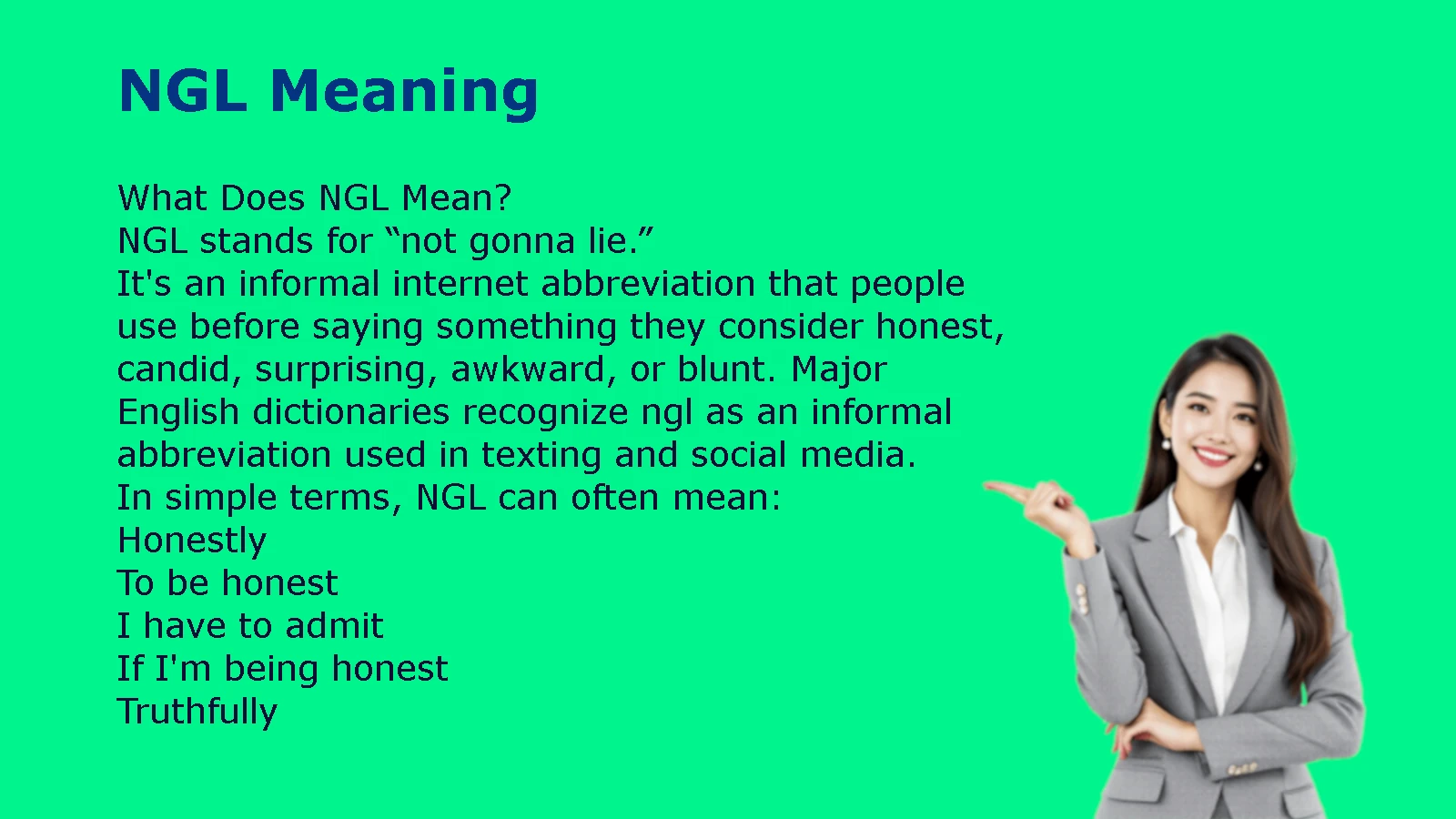
What Does NGL Mean?
NGL stands for “not gonna lie.”
It’s an informal internet abbreviation that people use before saying something they consider honest, candid, surprising, awkward, or blunt. Major English dictionaries recognize ngl as an informal abbreviation used in texting and social media.
In simple terms, NGL can often mean:
- Honestly
- To be honest
- I have to admit
- If I’m being honest
- Truthfully
However, these alternatives aren’t perfect substitutes in every sentence. NGL has a distinctly casual, conversational feel.
NGL Meaning in Simple Words
Think of NGL as a small warning before an honest statement.
Someone might write:
“NGL, I’m exhausted.”
That means:
“Honestly, I’m exhausted.”
Or:
“NGL, I didn’t expect you to win.”
This means:
“To be honest, I didn’t expect you to win.”
The abbreviation doesn’t necessarily mean the speaker has been lying. In everyday online conversation, it usually works as a conversational signal that the following statement is frank or sincere.
What Does NGL Mean in Texting?
In texting, NGL usually introduces an honest thought or reaction.
Because texting lacks facial expressions, voice tone, and body language, short expressions like NGL can help establish the intended tone. A message such as “That was weird” can sound blunt. Adding “NGL” signals that the writer is being candid about their reaction.
For example:
“NGL, I thought you were going to say no.”
“NGL, that pizza was better than I expected.”
Each message expresses something the speaker genuinely wants to admit.
How NGL Changes a Text Message
Compare these two messages:
Without NGL:
“I don’t like this song.”
With NGL:
“NGL, I don’t really like this song.”
The second version sounds more like a candid reaction. It can also feel slightly softer because the writer frames the criticism as a personal admission.
That doesn’t mean NGL automatically makes criticism polite. The statement still matters.
For example:
“NGL, your idea makes no sense.”
That’s still blunt.
So, NGL signals honesty, but it doesn’t magically remove a harsh tone.
What Does NGL Mean on Social Media?
On social media, NGL is commonly used to introduce opinions, reactions, confessions, and personal observations.
You’ll often see it in:
- Comments
- Captions
- Posts
- Replies
- Memes
- Short-form videos
- Online discussions
The abbreviation works particularly well in social media because those platforms favor short, conversational language.
NGL in Comments
A person might comment:
“NGL, this is one of your best posts.”
Here, NGL emphasizes that the compliment is genuine.
Another example:
“NGL, I wasn’t expecting that ending.”
The person is sharing an honest reaction.
Or:
“NGL, this looks so good.”
The phrase adds a casual sense of enthusiasm.
NGL in Social Media Captions
NGL can also make a caption sound more personal.
Examples include:
- “NGL, this was the best part of the trip.”
- “NGL, I could eat this every day.”
- “NGL, I almost didn’t post this.”
- “NGL, this view never gets old.”
- “NGL, today was exactly what I needed.”
The abbreviation makes the caption sound more like something you’d say to a friend than something you’d write in a formal statement.
How Do You Use NGL in a Sentence?
The most common position for NGL is at the beginning of a sentence.
NGL at the Beginning of a Sentence
This is the most natural and recognizable pattern:
“NGL, I’m pretty tired.”
“NGL, that was hilarious.”
“NGL, I really like this.”
“NGL, you did a great job.”
A comma often follows NGL when it functions as an introductory phrase.
NGL in the Middle of a Sentence
You can also place NGL later in a sentence, especially in casual online writing.
For example:
“That was, ngl, one of the funniest things I’ve seen.”
This construction is less common than putting NGL at the beginning or end, but people may use it for emphasis.
NGL at the End of a Sentence
Some people place NGL at the end:
“That movie was actually pretty good, ngl.”
“You handled that really well, ngl.”
“I wasn’t expecting to enjoy it that much, ngl.”
In this position, NGL often works like a final emphasis marker.
The meaning remains essentially the same: the speaker is emphasizing that the statement is genuine or candid.
NGL Examples in Different Situations
Context does most of the work when interpreting internet slang. Here are some common situations where you might see NGL.
| Situation | Example | Meaning |
| Opinion | “NGL, I love this.” | Honestly, I love this. |
| Compliment | “NGL, you look great.” | I genuinely think you look great. |
| Criticism | “NGL, I didn’t like it.” | Honestly, I didn’t like it. |
| Confession | “NGL, I was scared.” | I admit I was scared. |
| Surprise | “NGL, I didn’t expect that.” | That genuinely surprised me. |
| Agreement | “NGL, you’re right.” | I have to admit you’re right. |
| Excitement | “NGL, I’m so excited.” | Honestly, I’m very excited. |
| Disappointment | “NGL, I expected more.” | Honestly, I’m disappointed. |
| Humor | “NGL, that was ridiculous.” | That’s my honest reaction. |
| Appreciation | “NGL, thanks for helping me.” | I genuinely appreciate your help. |
This shows why NGL isn’t inherently positive or negative. The words that follow it determine the message.
Is NGL Positive or Negative?
NGL is neutral.
The abbreviation itself doesn’t tell you whether the speaker has something good or bad to say.
Consider these examples:
“NGL, you look amazing.”
Positive.
“NGL, I didn’t enjoy the movie.”
Negative.
“NGL, I forgot about the appointment.”
Neutral or mildly negative, depending on the situation.
This matters because some people assume that NGL always introduces criticism or a “hard truth.” It can certainly do that, but modern casual usage is broader. Dictionaries describe it as an abbreviation used for admissions, criticism, complaints, and other candid statements.
Does NGL Always Mean “I’m About to Say Something Bad”?
No.
That’s one of the easiest mistakes to make when learning the slang.
Someone might say:
“NGL, this is the best cake I’ve ever had.”
Nothing negative follows.
Another person might write:
“NGL, you’re really good at this.”
Again, the message is positive.
NGL simply puts a spotlight on the speaker’s sincerity.
Does NGL Mean “Honestly”?
Often, yes.
In many conversations, “honestly” is the closest natural replacement for NGL.
For example:
“NGL, I don’t want to go.”
can become:
“Honestly, I don’t want to go.”
Likewise:
“NGL, that was fun.”
can become:
“Honestly, that was fun.”
Still, the two expressions aren’t identical in style.
Honestly works in both casual and more polished writing. NGL belongs mainly to informal digital communication.
Common Alternatives to NGL
Depending on the sentence, you can replace NGL with:
- Honestly
- To be honest
- If I’m being honest
- I have to admit
- Truthfully
- I’ll admit
- Seriously
- For real
The best choice depends on the tone.
For example, “I have to admit” can sound more deliberate than NGL, while “honestly” works in a much wider range of situations.
NGL vs. TBH
NGL and TBH are extremely similar.
- NGL = Not gonna lie
- TBH = To be honest
Both abbreviations can introduce an honest opinion, confession, or reaction.
NGL Example
“NGL, this game is harder than I expected.”
TBH Example
“TBH, this game is harder than I expected.”
The basic meaning is almost identical.
The difference usually comes down to style and phrasing rather than a strict difference in meaning.
NGL has a particularly casual, conversational flavor because it comes from the spoken phrase “not gonna lie.” TBH is equally informal online, but its expanded form, “to be honest,” also fits more naturally into ordinary speech and writing.
NGL vs. TBH Comparison
| Feature | NGL | TBH |
| Full form | Not gonna lie | To be honest |
| Tone | Casual | Casual |
| Common use | Texts and social media | Texts and social media |
| Introduces an opinion | Yes | Yes |
| Introduces a confession | Yes | Yes |
| Can introduce criticism | Yes | Yes |
| Formal writing | Usually avoid | Usually avoid |
In everyday texting, you can often use either one without changing the basic message.
NGL vs. IMO
IMO means “in my opinion.”
It serves a different purpose from NGL.
NGL emphasizes honesty or candidness, while IMO explicitly identifies something as the speaker’s opinion.
Compare:
“NGL, this is the best restaurant in town.”
The writer emphasizes that the statement is sincere.
Now compare:
“IMO, this is the best restaurant in town.”
The writer emphasizes that this is a personal opinion.
You can even combine them:
“NGL, IMO, this is the best restaurant in town.”
That isn’t necessary in most cases, though. One abbreviation usually gets the job done.
Quick NGL vs. IMO Comparison
| Abbreviation | Meaning | Main Function |
| NGL | Not gonna lie | Signals honesty or candidness |
| TBH | To be honest | Signals an honest statement |
| IMO | In my opinion | Identifies a personal opinion |
This distinction becomes useful when you’re trying to understand the exact tone of a short message.
Is NGL Formal or Informal?
NGL is informal internet slang.
It’s appropriate for relaxed conversations where abbreviations are expected.
Good Places to Use NGL
You can comfortably use NGL in:
- Text messages
- Casual group chats
- Social media comments
- Social media captions
- Online communities
- Messages to friends
- Casual conversations
Places to Avoid NGL
You generally shouldn’t use NGL in:
- Academic essays
- Formal business reports
- Job applications
- Legal documents
- Professional proposals
- Formal letters
- Most workplace emails
For example, instead of writing:
“NGL, I think this proposal needs more work.”
in a formal report, write:
“Honestly, I think this proposal needs more work.”
Or, better yet:
“The proposal would benefit from additional revisions.”
The right language depends on the audience.
What Does NGL Mean From a Girl or Guy?
When someone asks, “What does NGL mean from a girl?” or “What does NGL mean from a guy?”, the answer is usually the same.
NGL doesn’t have a special meaning based on the sender’s gender.
The surrounding message matters much more.
For example:
“NGL, you look amazing.”
could be a simple compliment.
It could also be flirtatious, depending on the relationship and conversation.
Meanwhile:
“NGL, that movie was terrible.”
has nothing inherently romantic about it.
So don’t treat NGL as a hidden signal of attraction. Context, wording, timing, and the relationship between the people involved matter more than the abbreviation itself.
Is NGL Flirty?
NGL isn’t inherently flirty.
However, people can use it in flirtatious messages.
For example:
“NGL, I’ve been thinking about you all day.”
That message could carry romantic interest.
But:
“NGL, this pizza is amazing.”
obviously doesn’t.
The abbreviation simply introduces the statement. The statement itself determines the tone.
NGL in Flirty Messages
Some examples include:
- “NGL, you looked really good tonight.”
- “NGL, I was hoping you’d text me.”
- “NGL, talking to you makes my day better.”
- “NGL, I think I have a crush on you.”
These messages can sound romantic because of their content, not because NGL secretly means “I like you.”
How to Reply When Someone Says NGL
You don’t need a special response to NGL.
Instead, respond to the statement that follows it.
If You Agree
“NGL, that movie was great.”
Reply:
“Right? I wasn’t expecting to like it that much either.”
If You Disagree
“NGL, I didn’t like the ending.”
Reply:
“Really? I thought the ending was the best part.”
If Someone Confesses Something
“NGL, I was nervous.”
Reply:
“I could tell, but you handled it well.”
If Someone Compliments You
“NGL, you did a great job.”
Reply:
“Thanks! That means a lot.”
The key is simple: NGL doesn’t require a special response.
Treat it as part of the sentence.
Common NGL Phrases and Examples
Because NGL is flexible, you’ll see it paired with many different sentence patterns.
“NGL, I…”
This construction usually introduces a personal feeling, thought, or admission.
Examples:
- “NGL, I was nervous.”
- “NGL, I really enjoyed it.”
- “NGL, I forgot about the deadline.”
- “NGL, I didn’t expect that.”
- “NGL, I want to go back.”
“NGL, That Was…”
This pattern often introduces a reaction to something that already happened.
Examples:
- “NGL, that was hilarious.”
- “NGL, that was awkward.”
- “NGL, that was impressive.”
- “NGL, that was harder than I thought.”
- “NGL, that was one of the best concerts I’ve seen.”
“NGL, You…”
This pattern often appears in compliments, criticism, or personal observations.
Examples:
- “NGL, you look great.”
- “NGL, you were right.”
- “NGL, you handled that really well.”
- “NGL, you surprised me.”
“NGL, I Didn’t…”
This version often introduces an admission.
Examples:
- “NGL, I didn’t understand the question.”
- “NGL, I didn’t think we’d win.”
- “NGL, I didn’t want to leave.”
- “NGL, I didn’t expect you to remember.”
“NGL, This Is…”
This structure works well for reactions and opinions.
Examples:
- “NGL, this is really good.”
- “NGL, this is harder than it looks.”
- “NGL, this is exactly what I needed.”
- “NGL, this is my favorite part.”
What Does Lowercase “ngl” Mean?
Lowercase “ngl” means exactly the same thing as uppercase “NGL.”
You might see:
- NGL, that was great.
- ngl, that was great.
- Ngl, that was great.
All three mean:
“Not gonna lie, that was great.”
Online communication often ignores standard capitalization. People may choose lowercase because it feels quicker, more relaxed, or more natural in a chat.
The capitalization doesn’t create a different slang definition.
Does NGL Have Other Meanings?
Yes. Context matters because NGL can refer to things other than the slang abbreviation.
In energy and petroleum contexts, NGL can mean “natural gas liquids.” Dictionaries list this as a separate meaning.
Natural gas liquids are hydrocarbons separated from natural gas during processing. Common examples include ethane, propane, butanes, and natural gasoline.
So compare these:
“NGL, I didn’t expect the movie to be that good.”
Here, NGL means “not gonna lie.”
Now:
“The facility produces NGLs from natural gas.”
Here, NGLs refers to natural gas liquids.
The subject makes the intended meaning clear.
NGL as an App Name
There’s another important distinction. NGL is also the name associated with an anonymous messaging app.
The app’s name comes from the phrase “Not Gonna Lie,” but when someone talks about an NGL link, an NGL app, or sending anonymous questions through NGL, they’re referring to the service rather than simply using the slang abbreviation. The service launched in 2021 and became known for anonymous messages and questions shared through social media.
That distinction matters when interpreting search results or online conversations.
For example:
“Send me your NGL link.”
This likely refers to the anonymous messaging service.
But:
“NGL, I loved your post.”
uses NGL as slang for “not gonna lie.”
NGL Meaning in Different Contexts
The easiest way to understand NGL is to look at how the same abbreviation changes slightly with context.
In a Friendly Conversation
“NGL, I missed hanging out with everyone.”
Meaning: Honestly, I missed spending time with everyone.
In a Debate
“NGL, your argument makes sense.”
Meaning: I have to admit that your argument makes sense.
In a Review
“NGL, the first half was slow.”
Meaning: Honestly, I thought the first half was slow.
In a Compliment
“NGL, you crushed that presentation.”
Meaning: Honestly, you did an excellent job.
In a Confession
“NGL, I was worried.”
Meaning: I admit that I was worried.
In a Joke
“NGL, I opened the fridge three times and still found nothing.”
Here, NGL adds a conversational, self-aware tone to an ordinary observation.
A Simple Case Study: Understanding NGL From Context
Imagine receiving this message:
“NGL, I thought you were going to cancel.”
At first glance, you might wonder whether the person is criticizing you.
But look at the structure.
NGL = the person is signaling honesty.
“I thought you were going to cancel” = the actual information.
The message isn’t necessarily an accusation. The speaker may simply be admitting what they expected.
Now change the message:
“NGL, I’m really glad you came.”
The tone changes completely.
The abbreviation stays the same. The statement changes the emotional meaning.
This is why reading the entire message matters more than translating NGL by itself.
Why Do People Use NGL?
NGL is short, but it does useful conversational work.
It Signals Candidness
The abbreviation tells the reader that the writer wants to sound straightforward.
It Adds Personality
Compare:
“I love this.”
with:
“NGL, I love this.”
The second feels more conversational and spontaneous.
It Introduces an Admission
NGL works especially well when someone is revealing something they might normally keep to themselves.
“NGL, I was jealous.”
It Can Soften a Blunt Statement
NGL can frame criticism as a personal reaction:
“NGL, I didn’t really enjoy the presentation.”
However, it doesn’t guarantee that the statement will sound gentle. If the following words are harsh, the message can still come across as rude.
Is “Not Gonna Lie” Grammatically Correct?
“Not gonna lie” is a common informal expression, but it isn’t formal standard English.
The word “gonna” represents the conversational pronunciation of “going to.”
In casual speech, people frequently say:
“I’m gonna call you later.”
In formal writing, the standard form is:
“I’m going to call you later.”
The same principle applies to NGL.
You wouldn’t normally write out “not gonna lie” in a formal academic essay. Instead, use “honestly,” “to be honest,” or another suitable phrase.
That informal quality is part of what gives NGL its relaxed internet tone.
Can You Use NGL in Professional Messages?
You can physically type NGL into a workplace chat, but whether you should depends on the audience and workplace culture.
A casual team chat might tolerate:
“NGL, that deadline is tight.”
A formal client email should probably say:
“To be honest, that deadline is quite tight.”
Or, more professionally:
“The proposed deadline may be difficult to meet.”
The goal isn’t to avoid casual language at all costs. It’s to match your language to the situation.
Common Misunderstandings About NGL
NGL Doesn’t Mean Someone Was Lying Before
The phrase literally contains the word “lie,” but using NGL doesn’t automatically accuse anyone of dishonesty.
It generally functions as a conversational expression meaning:
“I’m going to be candid about this.”
NGL Isn’t Always Negative
It can introduce praise, excitement, affection, disappointment, criticism, or a simple observation.
NGL Doesn’t Automatically Mean Flirting
The content of the message determines whether a romantic tone exists.
NGL Isn’t Formal English
It’s internet slang. Use a more standard phrase when you’re writing for a formal audience.
NGL and TBH Aren’t Completely Different Concepts
They overlap heavily. Both can introduce an honest statement.
NGL Meaning: Quick Reference Table
| Question | Answer |
| What does NGL mean? | Not gonna lie |
| What does NGL stand for? | Not gonna lie |
| What does NGL mean in texting? | Honestly / To be honest |
| Is NGL slang? | Yes |
| Is NGL informal? | Yes |
| Is NGL positive or negative? | Neither; context determines the tone |
| Is NGL flirty? | Not by itself |
| Is NGL the same as TBH? | Very similar |
| What does TBH mean? | To be honest |
| What does IMO mean? | In my opinion |
| Can NGL be used in formal writing? | Usually, no |
| Does “ngl” mean something different from “NGL”? | No |
| Can NGL have other meanings? | Yes, including natural gas liquids in energy contexts |
| Can NGL refer to an app? | Yes, depending on context |
Frequently Asked Questions About NGL Meaning
What does NGL stand for?
NGL stands for “not gonna lie.” It’s an informal abbreviation commonly used in texts, social media, and online conversations.
What does NGL mean in texting?
In texting, NGL usually means “honestly,” “to be honest,” or “I have to admit.” It often introduces an opinion, confession, reaction, or candid statement.
What does NGL mean on Instagram?
On Instagram, NGL generally means “not gonna lie.” People use it in captions, comments, replies, and messages to emphasize an honest opinion or reaction.
If someone mentions an NGL link, however, they may be referring to the anonymous messaging service rather than the abbreviation itself.
What does NGL mean on Snapchat?
On Snapchat, NGL can mean “not gonna lie” when used in ordinary text. As with other platforms, the surrounding message determines the meaning.
Is NGL slang?
Yes. NGL is informal internet slang. Dictionaries classify the expression as informal and associate it with social media and text messaging.
Is NGL rude?
Not by itself.
NGL can introduce something kind:
“NGL, you’re really talented.”
It can also introduce criticism:
“NGL, that wasn’t very good.”
The words that follow NGL determine whether the message sounds friendly, blunt, funny, critical, or serious.
Is NGL the same as TBH?
They’re very close.
NGL means “not gonna lie.”
TBH means “to be honest.”
Both commonly introduce candid opinions or statements.
Can you use NGL in formal writing?
It’s best to avoid it in formal writing.
Use alternatives such as:
- Honestly
- To be honest
- In my view
- I have to admit
- It is worth noting
The appropriate replacement depends on what you’re trying to say.
What does NGL mean from a girl or guy?
It generally means the same thing regardless of who sends it: “not gonna lie.”
Don’t assign a romantic meaning to NGL automatically. Look at the rest of the message and the context of the conversation.
Is NGL always used before a negative statement?
No.
It can introduce positive, negative, neutral, surprising, or humorous statements.
“NGL, this is amazing.”
is just as valid as:
“NGL, I didn’t like it.”
What does lowercase “ngl” mean?
Lowercase ngl means the same thing as uppercase NGL: “not gonna lie.”
Capitalization usually reflects personal typing style rather than a different definition.
What does NGL mean in business or energy?
In the energy industry, NGL can mean “natural gas liquids.” This is completely different from the internet slang meaning.
What does an NGL link mean?
An NGL link can refer to a link associated with the NGL anonymous messaging service. That’s different from simply using NGL as the slang abbreviation “not gonna lie.”
Final Takeaway: NGL Meaning
NGL means “not gonna lie.” It’s a casual abbreviation people use in texts, social media posts, comments, and online chats to signal that they’re about to share an honest opinion, admission, reaction, or confession.
The simplest translation is often “honestly” or “to be honest.”
For example:
“NGL, I really liked that movie.”
means:
“Honestly, I really liked that movie.”
Remember that NGL itself isn’t positive, negative, rude, or flirty. The rest of the message gives it meaning.
Also keep context in mind. In internet slang, NGL means “not gonna lie.” In energy discussions, it can mean “natural gas liquids.” When someone mentions an NGL link or app, they may be talking about the anonymous messaging service.
Once you know the context, the abbreviation is pretty straightforward.
NGL, there’s not much mystery left.