
Have you ever come across the word “ferine” and wondered what it means? While ferine meaning may seem unfamiliar at first, this descriptive word has a clear connection to wild animals, untamed behavior, and a lack of domestication.
Ferine is an adjective that means wild, untamed, or resembling a wild animal. It can describe an animal that has not been domesticated or a person whose behavior seems fierce, severe, or uncontrolled.
Examples:
- The ferine wolf disappeared into the forest.
- His ferine behavior made everyone uncomfortable.
The confusion is understandable. People often search for what does ferine mean, ferine definition, ferine meaning in English, or ferine meaning in a sentence because the word is uncommon in everyday conversation. Depending on the context, ferine can describe something literally wild or figuratively severeand animal like.
In this guide, you’ll learn the complete ferine meaning, its definition, pronunciation, part of speech, origin, and correct usage. You’ll also discover synonyms, antonyms, example sentences, and the difference between ferine, feral, and wild.
What Does Ferine Mean?
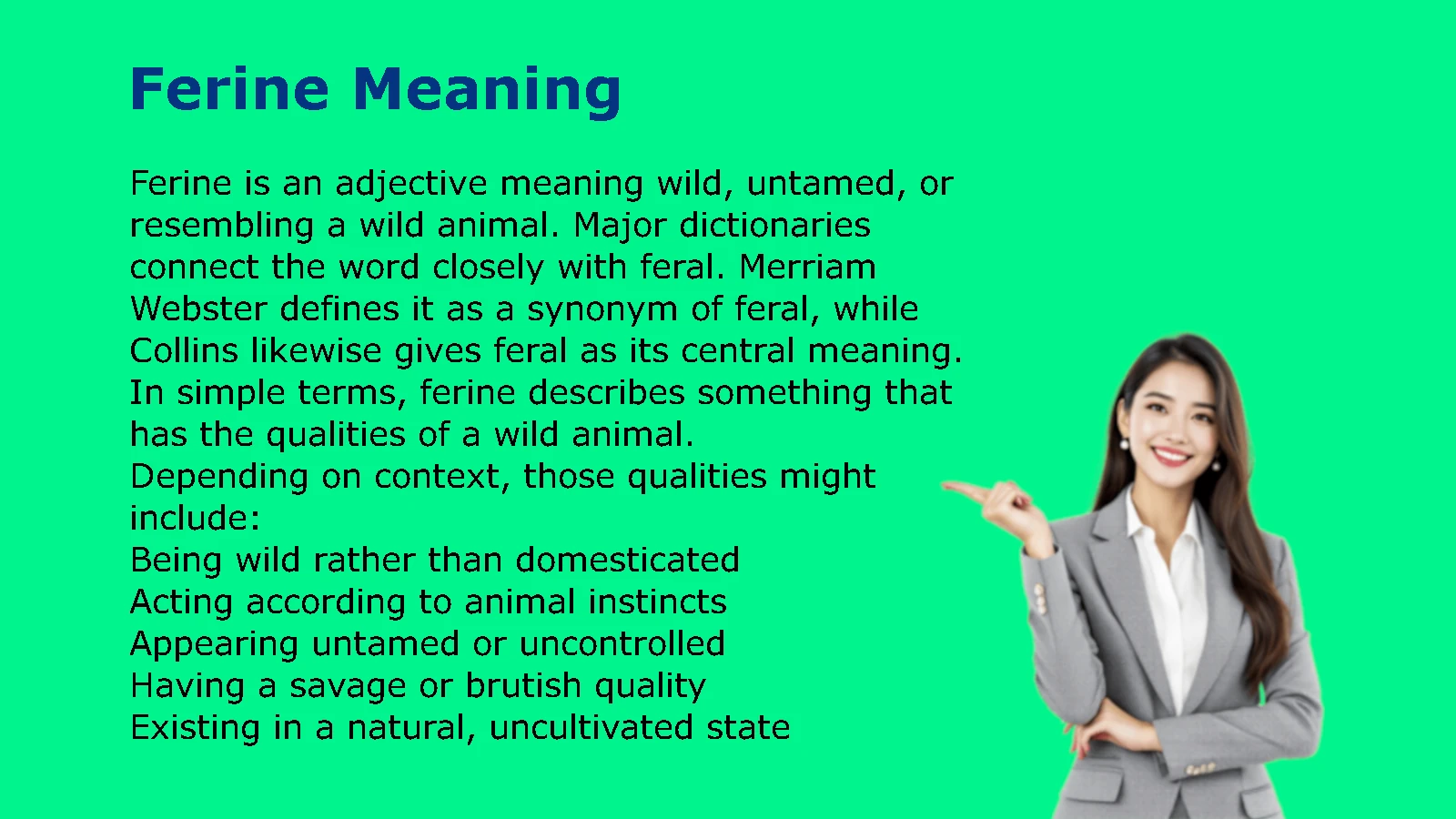
Ferine is an adjective meaning wild, untamed, or resembling a wild animal. Major dictionaries connect the word closely with feral. Merriam Webster defines it as a synonym of feral, while Collins likewise gives feral as its central meaning.
In simple terms, ferine describes something that has the qualities of a wild animal.
Depending on context, those qualities might include:
- Being wild rather than domesticated
- Acting according to animal instincts
- Appearing untamed or uncontrolled
- Having a severe or brutish quality
- Existing in a natural, uncultivated state
- Showing behavior that seems animal-like
The word doesn’t always mean “violent.” That’s an important distinction. A ferine animal might simply be wild. A ferine person, however, could be described as rough, instinctive, severe, or animal-like depending on the context.
Ferine Meaning in Simple English
A simple definition of ferine is:
Ferine = wild or like a wild animal.
Think of the difference between a trained dog and a wild wolf. Both belong to the canine family, but the wolf lives according to its own instincts. Describing something as ferine emphasizes that kind of untamed quality.
Consider these examples:
- The ferine animal avoided the village.
- His ferine instincts helped him survive in the wilderness.
- The novel gives the character a ferine appearance.
- The forest had a dark, ferine beauty.
Each sentence uses the word slightly differently. The underlying idea remains the same: wildness or animal like behavior.
Ferine Definition and Core Meaning
The exact shade of meaning depends on what ferine describes.
When it refers to an animal, the meaning tends to be straightforward. It suggests that the animal is wild, untamed, or living in a natural state.
When it describes a person, the word becomes figurative. It may suggest that the person behaves in a way that seems instinctive, severe , brutish, or respectful.
Merriam Webster’s thesaurus places ferine near words such as feral, severe, bestial, brutish, animalistic, and barbaric. That range shows why context matters.
| Context | What ferine suggests |
| Animal | Wild or untamed |
| Human behavior | Animal-like or instinctive |
| Appearance | Wild or beast-like |
| Nature | Uncultivated or untamed |
| Literature | A strong sense of wildness |
| Personality | Uncontrolled, severe, or instinctive |
The word can therefore move from a neutral description of nature to a strongly negative description of human conduct.
Ferine as an Adjective
Ferine is an adjective. That means it normally modifies a noun.
For example:
- ferine creature
- ferine animal
- ferine behavior
- ferine instincts
- ferine nature
- ferine appearance
- ferine character
You wouldn’t normally use ferine as a standalone noun in modern everyday English.
Compare these sentences:
Correct:
The explorer encountered a ferine creature.
Correct:
The character displays ferine instincts.
Less natural:
The creature is a ferine.
The adjective works best when it directly tells you something about a person, animal, thing, or quality.
Ferine Pronunciation
The American pronunciation is commonly given as /ˈfɪrˌaɪn/, roughly FEER eye n. Some dictionaries also record a shorter pronunciation ending in an unstressed -in sound. Collins lists American pronunciations including /ˈfɪraɪn/ and /ˈfɪrɪn/, while Dictionary.com gives /ˈfɪər aɪn, -ɪn/.
A useful approximation is:
ferine → FEER eye n
The word has two syllables in its common pronunciation.
Don’t confuse ferine with feline. They look similar, but they have completely different meanings.
- Ferine = wild or animal-like
- Feline = relating to cats or resembling a cat
Cambridge defines feline as relating to the cat family or behaving like a cat.
Ferine Etymology and Word Origin
The history of ferine reaches back to Latin.
The English adjective comes from Latin ferīnus, meaning “pertaining to wild animals.” Latin ferīnus comes from fera, meaning a wild animal or wild beast.
The deeper root is ferus, a Latin word associated with being wild. This root gives ferine its central idea: something connected with the untamed animal world.
Merriam Webster records 1640 as the first known use of ferine in English. Other etymological sources place its English use in the early 17th century, while Dictionary.com and Collins give earlier historical dating information for the word’s development.
The difference between these dates is worth noting. Dictionary sources don’t always date a word in exactly the same way because they may track different evidence or senses. The safest conclusion is that ferine entered English centuries ago and has remained an uncommon literary adjective.
A Historical Definition of Ferine
Noah Webster’s 1828 dictionary defined ferine with three compact words:
“Wild; untamed; severe.”
That historical definition still captures the heart of the word remarkably well.
Ferine vs. Feral
Ferine and feral are close synonyms, but they don’t always feel identical.
Feral is much more common in modern English. It often describes an animal that was once domesticated or belongs to a domestic species but now lives independently of human control. It can also describe human behavior figuratively.
Ferine has a broader literary sense of being wild or characteristic of a wild animal. Collins directly treats it as another word for feral.
| Word | Basic meaning | Typical impression |
| Ferine | Wild or animal-like | Literary and descriptive |
| Feral | Wild or undomesticated | Common and modern |
| Wild | Not tame or controlled | Very broad |
| Untamed | Not controlled or domesticated | Emphasizes lack of control |
For example:
- The feral cat lived behind the warehouse.
- The character had a ferine quality.
The first sentence sounds ordinary and modern. The second sounds more literary.
Is Ferine the Same as Feral?
Not exactly, although they overlap heavily.
If you simply want to tell someone that an animal is living wild, feral will usually sound more natural.
If you’re writing a novel, essay, review, or descriptive passage and want to emphasize an animal-like or untamed quality, ferine can provide a more distinctive tone.
Ferine vs. severe
severe is another close synonym, but it often carries a stronger negative meaning.
severe can suggest violence, cruelty, brutality, or a lack of civilization. Ferine can suggest those qualities in certain contexts, but its basic meaning centers more on wildness and animal-like character.
Compare:
- The ferine creature lived deep in the forest.
- The severe creature attacked without warning.
The first sentence emphasizes wildness. The second emphasizes aggression.
This distinction becomes even more important when describing people.
Calling someone’s behavior ferine may suggest that it is instinctive or animal-like. Calling it severe can imply cruelty or violence.
Ferine vs. Bestial
Bestial also overlaps with ferine, particularly when you describe a person’s behavior.
However, bestial often carries a stronger sense of brutality, degradation, or behavior considered extremely inhuman.
For example:
- The animal displayed ferine instincts.
- The attack was described as bestial.
The first focuses on animal-like instincts. The second can imply shocking brutality.
Merriam Webster’s thesaurus places bestial, animalistic, brutish, severe, and feral among words associated with ferine.
So while these words overlap, they aren’t interchangeable in every sentence.
Ferine Synonyms
The best synonym for ferine depends on the meaning you want to emphasize.
Synonyms for Wild or Untamed
- wild
- feral
- untamed
- undomesticated
- severe
These work especially well when discussing animals or natural environments.
Synonyms for Animal Like
- animalistic
- bestial
- beastly
- brutish
- wolfish
These words become more useful when you’re describing behavior, personality, or appearance.
Synonyms for Uncontrolled Behavior
- severe
- brutish
- unruly
- instinctive
- respectful
Not every synonym has the same emotional force. Wild can sound neutral or even positive, while brutish and bestial usually sound negative.
Merriam Webster lists a broad group of related terms, including feral, severe, bestial, beastly, brutish, and animalistic.
Ferine Antonyms
The opposite of ferine depends on the context.
- tame
- domesticated
- trained
- docile
- respectful
- refined
- cultivated
- polished
- gentle
For example:
| Ferine | Possible antonym |
| A ferine animal | A tame animal |
| Ferine behavior | respectful behavior |
| A ferine creature | A domesticated creature |
| A ferine appearance | A refined appearance |
| Ferine instincts | Controlled behavior |
There isn’t one perfect antonym for every use. Tame works well against wild, while respectfulworks better against a figurative sense involving human behavior.
How to Use Ferine in a Sentence
Because ferine is uncommon, seeing it in context makes its meaning much easier to understand.
Ferine Used for Animals
The ferine wolf disappeared into the trees before the hunters could approach.
Here, ferine emphasizes that the wolf is wild and avoids human control.
A ferine creature watched from the edge of the clearing.
The word gives the creature an untamed quality without specifying exactly what kind of animal it is.
Ferine Used for People
The novel portrays its protagonist as ferine, independent, and suspicious of civilization.
Here, ferine doesn’t mean that the protagonist literally becomes an animal. It describes a personality that seems wild and resistant to social control.
His ferine manner made him seem more comfortable in the wilderness than in the city.
This figurative use creates a strong contrast between nature and civilization.
Ferine Used for Behavior
The animal’s ferine instincts took over when it sensed danger.
In this sentence, the word points to instinctive behavior.
The fighter’s ferine intensity changed the mood of the entire arena.
This use is more figurative. The writer uses ferine to suggest something raw, aggressive, and animal-like.
Ferine Used for Nature
The northern landscape had a stark, ferine beauty.
Here, ferine doesn’t necessarily mean dangerous. Instead, it presents the landscape as untouched, wild, and free from human influence.
That’s one of the most interesting things about the word. Wildness can be threatening or beautiful depending on the context.
Ferine Examples in Different Contexts
The following examples show how the word can shift slightly depending on what it modifies.
| Context | Example sentence | Meaning of ferine |
| Animal | The ferine wolf avoided the settlement. | Wild |
| Creature | A ferine creature emerged from the cave. | Untamed or animal-like |
| Behavior | His ferine behavior shocked the guests. | Animal-like or respectful |
| Instinct | She relied on ferine instincts to survive. | Raw and instinctive |
| Appearance | His ferine features gave him a wild appearance. | Beast-like or untamed |
| Nature | The valley retained its ferine beauty. | Wild and untouched |
| Literature | The author creates a ferine image of nature. | Powerful, wild, and untamed |
Is Ferine a Positive or Negative Word?
Ferine doesn’t have one fixed emotional tone.
When you use it for an animal, the word can be relatively neutral. You’re simply describing something as wild or untamed.
When you use it for a person, however, the word can become negative. It may suggest someone lacks restraint or behaves like an animal.
Yet writers can also use ferine positively when they want to celebrate freedom, instinct, independence, or a connection with nature.
Consider these two sentences:
The prisoner became ferine after years of isolation.
Here, the word suggests a loss of social restraint.
Now consider:
She possessed a ferine freedom that made the wilderness feel like home.
Here, ferine suggests independence and a natural resistance to convention.
The surrounding words determine the emotional effect.
Is Ferine a Common Word?
No. Ferine is relatively uncommon in modern everyday English.
Most speakers would choose wild, feral, untamed, animal-like, or severe depending on the context.
That doesn’t make ferine useless. In fact, its rarity can make it useful in literary and descriptive writing.
Imagine that you’re describing a character who has spent years living alone in a remote forest. You could write:
He looked wild.
That’s clear, but broad.
Or:
He had a ferine appearance.
The second version creates a more specific literary impression. It suggests not only wildness but also something animal-like.
The trick is to use the word when its nuance matters. Don’t choose a rare word merely because it sounds sophisticated. Choose it because it says something the simpler word doesn’t quite capture.
Common Collocations With Ferine
A collocation is a combination of words that commonly appear together.
Because ferine is uncommon, its collocations tend to occur more often in literary, descriptive, or formal writing.
Some useful combinations include:
- ferine nature
- ferine behavior
- ferine creature
- ferine animal
- ferine instincts
- ferine appearance
- ferine character
- ferine quality
- ferine beauty
- ferine ferocity
For example:
The character’s ferine nature made him difficult to predict.
The landscape had a strange ferine beauty.
The animal’s ferine instincts kept it wary of humans.
Merriam Webster provides an example involving “ferine ferocity”, demonstrating how the word can emphasize an intensely animal-like quality.
Ferine in Literature and Descriptive Writing
Rare adjectives often survive because they give writers a particular shade of meaning. Ferine is a good example.
The basic adjective wild can describe almost anything from an untamed horse to an exciting party. Ferine narrows the image toward wild animals and animal-like qualities.
That distinction makes it useful in literary description.
Imagine a writer describing a character who lives outside conventional society. The writer could call the character wild. But ferine suggests something more primal. It can make readers picture instinct, physicality, independence, and a lack of domestication.
The word also works beautifully for landscapes.
Beyond the last settlement stretched a ferine wilderness.
The sentence doesn’t simply tell you that the wilderness is wild. It gives the landscape an almost animal presence.
Why Writers Choose Ferine
A writer might choose ferine when they want to suggest:
- Instinct over reason
- Nature over civilization
- Wildness over domestication
- Freedom over restraint
- Animal qualities over refined behavior
- Primal energy over social convention
That makes the word especially useful in fiction, poetry, historical writing, fantasy, nature writing, and literary criticism.
Ferine and Human Behavior
One of the more interesting uses of ferine involves people.
When applied to a person, the adjective becomes metaphorical. The person isn’t literally a wild animal. Instead, the writer sees something animal-like, instinctive, severe, or untamed in the person’s behavior.
For example:
After years in isolation, the character developed a ferine distrust of strangers.
The sentence suggests that the character responds to threats through instinct rather than social expectations.
Another example:
The crowd took on a ferine energy when the gates opened.
Here, the crowd isn’t literally animalistic. The writer compares its uncontrolled excitement to animal behavior.
This figurative use can be powerful, but it can also sound harsh. If you’re describing a real person rather than a fictional character, consider whether wild, intense, instinctive, or unruly would communicate the idea more fairly.
Ferine and the Idea of Domestication
The easiest way to understand ferine is to picture the spectrum between domesticated and wild.
DOMESTICATED
↓
TAME
↓
CONTROLLED
↓
UNTAMED
↓
FERAL
↓
FERINE
↓
WILD / PRIMAL
This isn’t a scientific scale. It simply illustrates the conceptual territory surrounding the word.
A domesticated animal lives closely with humans and has adapted to human control. A feral animal lives independently. A ferine description pushes the image toward the broader idea of wild animal nature.
That distinction becomes especially useful when you’re analyzing figurative language.
Ferine vs. Wild: Which Word Should You Use?
In most everyday situations, wild is the better choice.
It’s shorter, more familiar, and understood immediately.
Use ferine when you want a more specific or literary effect.
| If you mean… | Better choice |
| A wild animal | Wild or feral |
| A natural landscape | Wild or untamed |
| Animal-like behavior | Ferine or animalistic |
| Brutal behavior | severe or bestial |
| A literary description | Ferine |
| Ordinary conversation | Wild or feral |
For example, saying “I saw a ferine dog” may sound unnecessarily formal in casual conversation. “I saw a wild dog” is much more natural.
In a novel, however, ferine might be exactly the word a writer wants.
Common Mistakes When Using Ferine
Treating Ferine as a Direct Synonym for Violent
Ferine does not automatically mean violent.
It primarily relates to wildness and wild animal characteristics. Violence may appear in the context, but the word itself doesn’t require it.
Confusing Ferine With Feral
The words overlap, but feral is much more common and has especially strong modern associations with animals living wild after domestication.
Ferine has a more literary and generalized sense.
Assuming Ferine Only Describes Animals
It can describe people, behavior, instincts, appearance, and even landscapes in figurative writing.
Using Ferine in Every Situation
Because the word is uncommon, forcing it into ordinary sentences can make the writing sound unnatural.
Instead of:
My ferine cat is sleeping on the sofa.
Simply write:
My wild cat is sleeping on the sofa.
Use ferine when its particular meaning adds something.
Confusing Ferine With Feline
These words sound somewhat alike, but they have unrelated meanings.
Feline relates specifically to cats. Ferine relates to wildness or wild animals.
Ferine vs. Feline
This mix-up deserves special attention because the spellings are so close.
Feline comes from Latin felinus, from felis, meaning cat. Merriam Webster defines it as relating to cats or resembling a cat.
Ferine, by contrast, comes from Latin ferīnus, connected with wild animals.
| Word | Meaning | Example |
| Ferine | Wild or animal-like | The creature had a ferine quality. |
| Feline | Relating to cats or cat-like | She moved with feline grace. |
A feline creature is cat-like.
A ferine creature is wild or characteristic of a wild animal.
That’s a small spelling difference with a big change in meaning.
Words Related to Ferine
The vocabulary surrounding ferine forms a useful semantic group.
Wildness
- wild
- untamed
- feral
- severe
- uncultivated
Animal Qualities
- animalistic
- bestial
- brutish
- beastly
- instinctive
Lack of Refinement
- respectful
- unrefined
- crude
- barbaric
- rough
These words overlap, but each carries its own tone.
For instance, untamed can sound positive when describing nature. Barbaric usually expresses strong disapproval. Animalistic focuses on animal behavior, while feral commonly emphasizes wildness.
A Quick Case Study: Choosing the Right Word
Consider this sentence:
The character lived alone in the mountains and distrusted every visitor.
Suppose the goal is to describe the character as independent and wild.
Option 1: Wild
The character had a wild nature.
Clear and simple, but broad.
Option 2: Feral
The character had a feral nature.
Stronger. It suggests that the character has moved away from normal social behavior.
Option 3: Ferine
The character had a ferine nature.
More literary. It emphasizes the character’s animal-like and untamed qualities.
Option 4: severe
The character had a severe nature.
Much harsher. It may imply cruelty or violence.
The best word depends on the exact image you want the reader to form.
That’s the real value of understanding ferine. A thesaurus may give you ten synonyms, but those words don’t create identical pictures in the reader’s mind.
Ferine Meaning at a Glance
| Feature | Details |
| Word | Ferine |
| Part of speech | Adjective |
| Core meaning | Wild, untamed, or characteristic of a wild animal |
| Pronunciation | Commonly /ˈfɪrˌaɪn/ |
| Origin | Latin ferīnus, from fera / ferus |
| Closest common synonym | Feral |
| Other synonyms | Wild, untamed, severe, bestial, animalistic |
| Possible antonyms | Tame, domesticated, respectful, refined |
| Tone | Literary, descriptive, and context dependent |
| Common use | Describing wild animals, behavior, instincts, or figurative wildness |
| Modern frequency | Uncommon |
Frequently Asked Questions About Ferine Meaning
What does ferine mean?
Ferine means wild, untamed, or characteristic of a wild animal. It can describe animals directly or describe people, behavior, appearance, and instincts figuratively.
What is a simple synonym for ferine?
The simplest synonyms are wild, untamed, and feral. The best choice depends on context.
Is ferine the same as feral?
They have very similar meanings, and dictionaries commonly define ferine in relation to feral. However, feral is much more common in modern English, while ferine often has a more literary or descriptive feel.
Can ferine describe a person?
Yes. When ferine describes a person, it usually works figuratively. It can suggest that the person seems wild, instinctive, severe, or animal-like.
Is ferine a negative word?
Not always. It can describe wildness neutrally or even positively when discussing nature and freedom. When applied to human behavior, however, it can carry a negative suggestion of brutality, lack of restraint, or respectfulbehavior.
What is the opposite of ferine?
Depending on context, possible opposites include tame, domesticated, respectful, cultivated, gentle, and refined.
Is ferine commonly used in English?
No. Ferine is an uncommon word, especially compared with wild and feral. It tends to appear more naturally in literary, descriptive, or formal writing.
What is the origin of ferine?
Ferine comes from Latin ferīnus, meaning something pertaining to wild animals. It is related to Latin fera, meaning a wild animal or wild beast.
What is the difference between ferine and feline?
Ferine means wild or animal-like. Feline means related to cats or resembling a cat. The two words look similar but have different origins and meanings.
What does ferine mean in literature?
In literature, ferine often describes something primal, untamed, instinctive, or animal-like. Writers can use it to describe characters, creatures, landscapes, emotions, or behavior.
Can ferine mean severe?
It can overlap with severe, especially when describing animal-like or brutal behavior. However, ferine primarily emphasizes wildness and animal character, while severe more readily suggests violence or cruelty.
Final Takeaway: Ferine Meaning
Ferine means wild, untamed, or characteristic of a wild animal. It is an adjective with roots in Latin ferīnus, and English has used it for centuries. Merriam Webster records its first known English use as 1640.
The word is most useful when ordinary terms such as wild or feral don’t quite capture the image you want. Ferine can suggest raw instinct, animal-like behavior, untamed nature, or a quality that exists outside the boundaries of domestication and civilization.
The simplest way to remember it is:
Ferine = wild or like a wild animal.
If you’re describing a wild creature, ferine can emphasize its untamed nature. If you’re describing a person, it can suggest instinctive or animal-like behavior. And when you’re writing about nature, it can evoke something powerful, untouched, and free from human control.
In short, ferine is a precise literary word for wildness with an animal edge. It isn’t the word to reach for in every casual conversation, but when the right context calls for it, it can paint a much sharper picture than the ordinary word wild.