
Blowhard meaning of blowhard refers to a person who talks loudly and boasts excessively about themselves or their achievements. The word is often used to describe someone who exaggerates their importance, opinions, or abilities to impress others.
The confusion is understandable. People also look for the definition of blowhard, blowhard pronunciation, blowhard examples, and how to use blowhard in a sentence to avoid misusing the term. But here’s the kicker: understanding the word’s tone and context can help you use it naturally without offending someone unintentionally.
The good news? It’s easier than you might think.
In this guide, you’ll discover the complete Blowhard Meaning, learn the blowhard definition, explore its origin, synonyms, pronunciation, and see real-life examples that show exactly how to use blowhard correctly in everyday conversations and writing.
By the end, you’ll know when the word fits, what it implies about a person’s behavior, and how to recognize it whenever you come across it.
What Does Blowhard Meaning Really Mean?
Dictionary Definition of Blowhard
A blowhard is a person who boasts loudly and frequently, often exaggerating their abilities, importance, or achievements. The word almost always carries a negative meaning because it suggests arrogance without substance.
Most major English dictionaries describe a blowhard as someone who:
- Talks excessively about themselves
- Brags about accomplishments
- Speaks with exaggerated confidence
- Often tries to impress others
- Says more than they can actually prove
Unlike someone who simply enjoys conversation, a blowhard constantly draws attention to themselves.
Simple definition: A blowhard is someone who talks big but often has little evidence to support their claims.
Blowhard Meaning in Plain English
Imagine a coworker who claims they could run the entire company better than the CEO, yet struggles to complete their own assignments.
Or think about someone who constantly says things like:
- “Nobody works harder than me.”
- “I’m the best player here.”
- “Everyone asks for my advice.”
- “I could have been famous if I wanted.”
Those statements alone don’t automatically make someone a blowhard. However, when a person repeatedly exaggerates themselves and seeks admiration through loud self-promotion, people may describe them as one.
Is Blowhard Always an Insult?
Yes—but usually a mild one.
Calling someone a blowhard criticizes their behavior rather than attacking their character. It implies that they:
- Boast too much
- Overestimate themselves
- Love hearing themselves talk
- Try too hard to impress others
Depending on tone and context, the word can sound humorous, sarcastic, or openly critical.
For example:
“Everyone likes Mark, but he can be a bit of a blowhard during meetings.”
That sentence criticizes Mark’s habit of bragging without sounding extremely offensive.
Everyday Meaning of Blowhard
Today, English speakers often use blowhard when describing people who:
- Constantly exaggerate accomplishments
- Dominate conversations
- Speak confidently about subjects they barely understand
- Act as though they’re always right
- Enjoy showing off
The word focuses more on behavior than personality.
Someone may behave like a blowhard during one discussion without always being one.
Pronunciation of Blowhard
Correct pronunciation helps you recognize the word in conversation and use it naturally.
| Feature | Information |
| Word | Blowhard |
| IPA | /ˈbloʊˌhɑːrd/ |
| Phonetic spelling | BLOH-hard |
| Syllables | Blow • hard |
| Part of speech | Noun |
Pronunciation Tips
Break the word into two simple parts:
Blow + Hard
Stress the first syllable.
Examples:
- BLOW-hard
- BLOW-hard politician
- He’s such a BLOW-hard.
Part of Speech
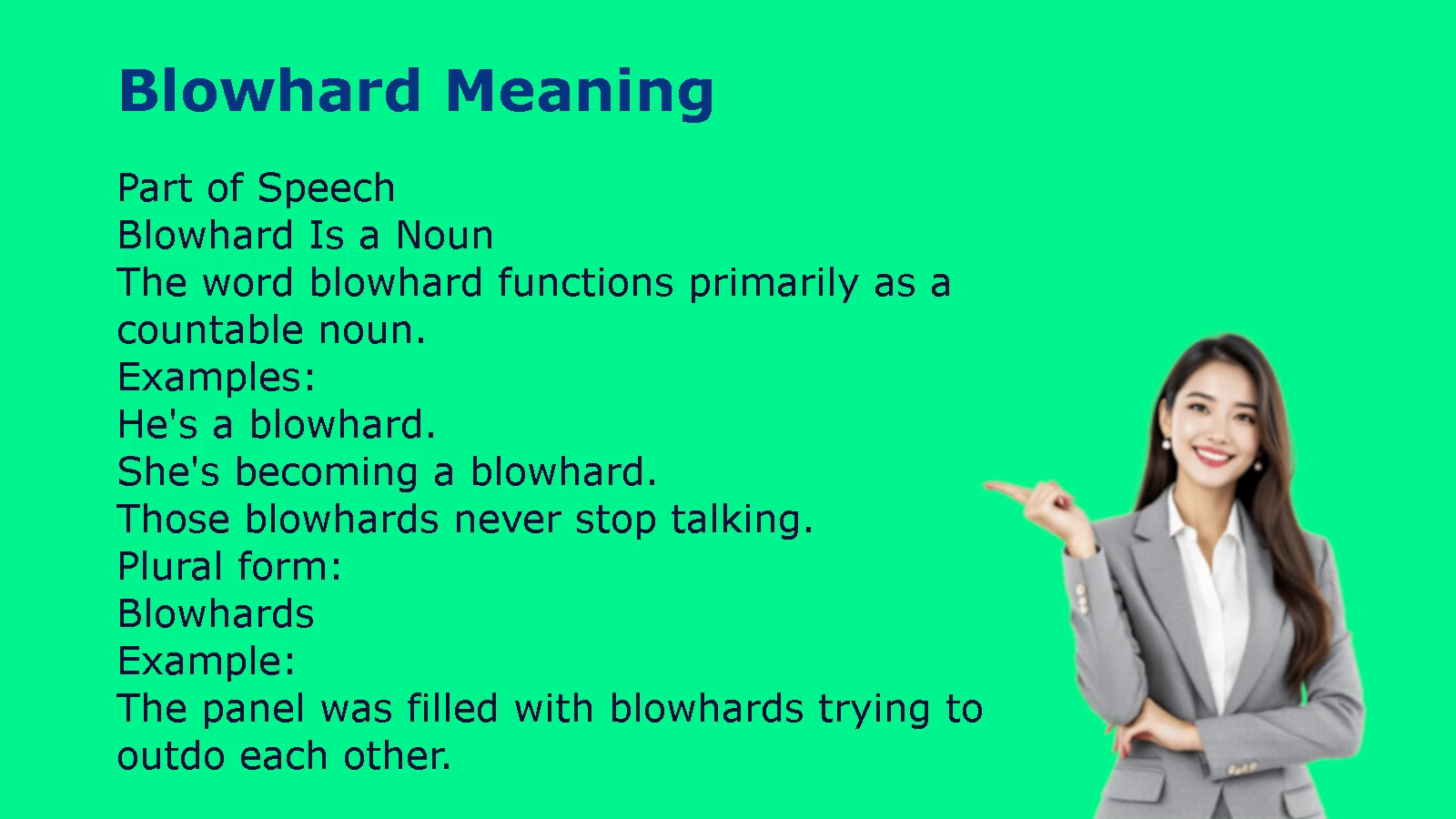
Blowhard Is a Noun
The word blowhard functions primarily as a countable noun.
Examples:
- He’s a blowhard.
- She’s becoming a blowhard.
- Those blowhards never stop talking.
Plural form:
Blowhards
Example:
The panel was filled with blowhards trying to outdo each other.
Can Blowhard Be Used as an Adjective?
Not normally.
Native speakers don’t usually say:
❌ a blowhard speech
Instead, they say:
- a boastful speech
- an arrogant speech
- a pompous speech
Or:
- He is a blowhard.
Related Word Forms
| Word | Part of Speech | Meaning |
| Blowhard | Noun | A person who boasts loudly |
| Boast | Verb | To speak proudly about achievements |
| Boastful | Adjective | Full of bragging |
| Boastfully | Adverb | In a bragging manner |
| Boaster | Noun | Someone who brags |
Origin and Etymology of Blowhard
The history of blowhard reveals why the word paints such a vivid picture.
Where Did Blowhard Come From?
The word combines two familiar English words:
- Blow
- Hard
In older English, blow could mean to talk loudly, boast, or brag, not just move air.
When combined with hard, the image becomes someone who “blows” loudly with words rather than actions.
It’s a colorful metaphor that compares excessive boasting to a powerful gust of wind.
First Recorded Use
Language historians generally trace blowhard to American English in the early 20th century, with published evidence appearing during the 1910s and 1920s.
Its popularity grew because the word vividly described loud, boastful personalities in politics, business, and everyday life.
Unlike many slang terms that disappear after a few years, blowhard has remained part of modern English for more than a century.
Evolution of the Meaning
Interestingly, the core meaning has changed very little.
Originally, the word described someone who:
- Talked loudly
- Bragged constantly
- Overstated achievements
Today, it still carries those same ideas.
Modern usage simply extends the term to online spaces, television personalities, influencers, and public figures who rely more on dramatic claims than proven results.
Why the Word Still Works Today
English has many words for arrogance, but blowhard creates a memorable mental picture.
It doesn’t just suggest pride.
It suggests someone making a lot of noise.
That’s one reason journalists and authors still enjoy using it.
Characteristics of a Blowhard
Understanding the blowhard meaning becomes much easier when you recognize the common behaviors associated with the word.
Not every confident speaker is a blowhard. Confidence backed by skill is generally respected. A blowhard, however, often replaces evidence with exaggerated self-praise.
Here are the most common traits.
Talks Constantly About Personal Success
Blowhards frequently redirect conversations toward themselves.
For example:
Friend:
“I finally finished my first marathon.”
Blowhard:
“That’s nice. I’ve always been naturally athletic.”
Instead of celebrating others, they shift attention back to themselves.
Exaggerates Achievements
A blowhard often stretches the truth.
Examples include:
- Inflating job titles
- Claiming unrealistic accomplishments
- Taking credit for team successes
- Embellishing personal stories
This exaggeration may not always be intentional. Sometimes it’s simply habitual.
Loves Being the Center of Attention
Attention fuels many blowhards.
They often:
- Interrupt conversations
- Speak louder than everyone else
- Tell long stories
- Offer opinions on every subject
Their goal isn’t always to inform.
Often, it’s to impress.
Speaks With Absolute Certainty
One hallmark of a blowhard is complete confidence, even when they’re wrong.
Common phrases include:
- “Trust me.”
- “I already knew that.”
- “There’s only one right answer.”
- “I’m never wrong.”
Ironically, genuine experts often acknowledge uncertainty and remain open to learning.
Rarely Listens
Conversation works both ways.
A blowhard usually focuses on speaking rather than listening.
They may:
- Interrupt others
- Ignore different viewpoints
- Change the topic
- Dismiss opposing opinions
This habit often makes conversations frustrating.
Values Appearance Over Substance
Many blowhards care more about looking impressive than actually being knowledgeable.
For example, they might:
- Use complicated words unnecessarily
- Quote famous people incorrectly
- Speak confidently about unfamiliar topics
- Avoid admitting mistakes
Quick Reference Table
| Characteristic | Typical Blowhard Behavior |
| Conversation | Dominates discussions |
| Confidence | Often exaggerated |
| Self-promotion | Constant |
| Listening | Usually poor |
| Humility | Rare |
| Evidence | Often weaker than the claims |
| Goal | Impress others |
How to Use Blowhard Correctly
Knowing the blowhard meaning is only half the battle. Using the word naturally requires understanding the situations where it fits best.
Use It to Describe Behavior, Not Just Personality
Calling someone a blowhard usually comments on how they behave, especially when they brag excessively or dominate conversations with exaggerated claims.
Examples:
- “The guest speaker sounded like a blowhard after claiming he’d solved every problem in the industry.”
- “He became a blowhard whenever the conversation turned to sports.”
- “Nobody questioned her experience until she started acting like a blowhard.”
Notice that the focus stays on boastful behavior rather than appearance or intelligence.
Appropriate Everyday Situations
You might hear blowhard used when discussing:
- Office meetings
- Political debates
- Television commentators
- Sports fans
- Social gatherings
- Online arguments
- Business networking events
The word fits informal conversation far better than formal reports or academic writing.
Formal vs. Informal Usage
| Situation | Is Blowhard Appropriate? | Notes |
| Casual conversation | ✅ Yes | Common and natural |
| Opinion articles | ✅ Yes | Frequently used in editorials |
| Political commentary | ✅ Yes | Often describes boastful public figures |
| Fiction and novels | ✅ Yes | Useful for character development |
| Academic papers | ❌ Usually no | Too informal and subjective |
| Business reports | ❌ No | Prefer neutral language |
Tips for Using the Word Naturally
Keep these best practices in mind:
- Use blowhard for repeated patterns of boasting, not isolated moments.
- Avoid using it when someone is simply confident or enthusiastic.
- Consider your audience because the term can sound dismissive.
- Pair it with specific examples if you’re describing someone’s behavior.
For example:
“He wasn’t disliked because he was successful. People called him a blowhard because every conversation became a speech about his own achievements.”
Example Sentences Using Blowhard
Seeing the word in context is one of the best ways to understand the blowhard meaning. The examples below show how native English speakers naturally use the term in different situations.
Casual Conversation Examples
In everyday speech, blowhard usually describes someone who constantly boasts or exaggerates.
Examples:
- “Everyone avoids sitting next to Tom because he’s such a blowhard.”
- “She isn’t rude, but her brother can be a real blowhard.”
- “Don’t pay much attention to him. He’s just a blowhard.”
- “The party became exhausting once the blowhard started talking.”
- “Nobody asked about his vacation, yet he spent an hour bragging about it.”
Notice that the word often appears with phrases like:
- a real blowhard
- such a blowhard
- acting like a blowhard
- sounds like a blowhard
These combinations are common in spoken English.
Workplace Examples
Professional settings also provide situations where someone may privately describe another person as a blowhard.
Examples:
- “Our new consultant came across as a blowhard because he dismissed everyone’s ideas.”
- “The manager valued results more than flashy speeches from blowhards.”
- “Clients usually recognize a blowhard after a few meetings.”
- “His presentation sounded impressive at first, but many employees thought he was simply a blowhard.”
Although the word appears in office conversations, it rarely belongs in formal reports or emails.
Political Commentary Examples
Journalists and opinion writers sometimes use blowhard when discussing public figures known for dramatic speeches.
Examples:
- “Critics dismissed the candidate as a blowhard.”
- “Supporters admired his confidence, while opponents called him a blowhard.”
- “The debate quickly turned into a contest between competing blowhards.”
Because the word expresses an opinion, it appears more often in editorials than in objective news reporting.
Literary Examples
Novelists often use blowhard to build memorable characters.
Example:
“The wealthy merchant was a charming host, but everyone knew he was also a terrible blowhard.”
A single word immediately tells readers a great deal about the character’s personality.
Social Media Examples
Modern internet conversations have given the word fresh life.
Examples:
- “Every comment he posts makes him sound like a blowhard.”
- “The thread turned into a battle between internet blowhards.”
- “People eventually stop listening to online blowhards.”
The internet rewards attention, which partly explains why the term remains popular.
Is Blowhard an Offensive Word?
Many learners wonder whether blowhard counts as a rude word.
The short answer is yes—but only mildly.
Unlike profanity or slurs, blowhard criticizes someone’s behavior rather than using obscene language. Even so, most people wouldn’t appreciate being called one.
How Offensive Is It?
You can think of the word on a spectrum.
| Word | Strength of Insult | Typical Use |
| Chatty | Very mild | Friendly description |
| Show-off | Mild | Informal criticism |
| Blowhard | Moderate | Criticizes boastfulness |
| Arrogant fool | Strong | Direct insult |
| Profanity | Very strong | Highly offensive |
Compared with stronger insults, blowhard is relatively restrained.
Context Makes a Difference
The same word can sound playful or harsh depending on the speaker.
For example:
“My uncle’s a lovable blowhard.”
This sounds affectionate.
Compare it with:
“You’re nothing but a blowhard.”
That version sounds confrontational.
Tone matters just as much as vocabulary.
Regional Differences
The word is understood throughout the English-speaking world, especially in:
- The United States
- Canada
- The United Kingdom
- Australia
- New Zealand
American English uses it more frequently than most other varieties.
Should You Use It?
Ask yourself three questions:
- Is the conversation informal?
- Am I criticizing behavior rather than attacking someone personally?
- Will using this word improve communication?
If the answer to the last question is “no,” a more neutral description may work better.
Blowhard vs. Similar Words
English contains many words describing boastful people. Each one has a slightly different meaning.
Understanding those differences helps you choose the most accurate word.
Blowhard vs. Braggart
A braggart constantly boasts about achievements.
A blowhard also boasts, but usually in a louder, more dramatic, and more attention-seeking way.
| Blowhard | Braggart |
| Loud and overbearing | Mainly boasts |
| Often dominates conversations | Focuses on bragging |
| Usually dramatic | Usually self-promoting |
Blowhard vs. Boaster
A boaster is anyone who brags.
A blowhard goes further by acting self-important while speaking loudly and confidently.
Think of every blowhard as a boaster, but not every boaster as a blowhard.
Blowhard vs. Bigmouth
A bigmouth usually reveals secrets or talks too much.
A blowhard talks too much about themselves.
Example:
- A bigmouth shares confidential information.
- A blowhard shares endless stories about their greatness.
Blowhard vs. Loudmouth
These words look similar but describe different behaviors.
A loudmouth speaks loudly and often says inappropriate things.
A blowhard focuses on self-promotion and exaggerated confidence.
Blowhard vs. Know-it-all
A know-it-all believes they have the answer to everything.
A blowhard wants admiration more than accuracy.
Some people fit both descriptions, but the meanings are not identical.
Blowhard vs. Windbag
These two words overlap more than any others.
A windbag talks endlessly.
A blowhard talks endlessly while bragging.
The difference lies in the boasting.
Blowhard vs. Show-off
A show-off impresses people through actions.
A blowhard impresses people through words.
Someone showing off an expensive car isn’t necessarily a blowhard.
Someone talking about that car for an hour probably is.
Comparison Table
| Word | Main Meaning | Talks Too Much | Brags | Negative Tone |
| Blowhard | Loud, boastful person | ✔ | ✔ | High |
| Braggart | Habitual bragger | Sometimes | ✔ | Moderate |
| Boaster | Someone who boasts | Sometimes | ✔ | Moderate |
| Windbag | Talks endlessly | ✔ | Sometimes | Moderate |
| Bigmouth | Talks carelessly | ✔ | Rarely | Moderate |
| Loudmouth | Loud and obnoxious | ✔ | Sometimes | High |
| Know-it-all | Thinks they know everything | Sometimes | Sometimes | Moderate |
| Show-off | Displays abilities to impress | Rarely | Sometimes | Mild |
Synonyms of Blowhard
Several English words carry similar meanings.
Direct Synonyms
- Braggart
- Boaster
- Windbag
- Gasbag
- Loudmouth
- Show-off
- Egotist
- Self-promoter
Near Synonyms
These words overlap but don’t mean exactly the same thing.
- Arrogant person
- Narcissist
- Egoist
- Swaggerer
- Self-important person
- Attention seeker
- Grandstander
Informal Alternatives
Depending on context, native speakers also say:
- Full of hot air
- Full of yourself
- All talk
- Big talker
- Talks a big game
Formal Alternatives
In academic or professional writing, these choices often fit better:
- Self-aggrandizing individual
- Boastful speaker
- Self-important individual
- Overconfident personality
- Excessively self-promotional person
Antonyms of Blowhard
The opposite of a blowhard isn’t someone who never speaks.
It’s someone whose confidence matches humility.
Common Antonyms
- Humble person
- Modest person
- Reserved individual
- Self-effacing person
- Unassuming leader
- Down-to-earth individual
Comparison Table
| Blowhard | Opposite |
| Brags constantly | Speaks modestly |
| Seeks attention | Lets actions speak |
| Exaggerates achievements | States facts honestly |
| Dominates conversations | Listens carefully |
| Values image | Values substance |
Common Phrases Related to Blowhard
Several idioms express ideas similar to the blowhard meaning.
Full of Hot Air
Meaning:
Someone talks impressively but lacks substance.
Example:
“Most investors realized he was full of hot air.”
All Talk, No Action
Meaning:
Someone promises much but delivers little.
Example:
“He claimed he would finish the project in a day, but he was all talk and no action.”
Full of Yourself
Meaning:
Someone thinks very highly of themselves.
Example:
“Ever since winning the award, he’s been full of himself.”
Talks a Big Game
Meaning:
Someone makes impressive claims before proving anything.
Example:
“The rookie talked a big game before the championship.”
Empty Boasting
Meaning:
Praising yourself without evidence.
Example:
“Customers quickly recognized the empty boasting.”
Examples of Blowhard in Literature and Media
Authors and journalists appreciate the word because it quickly creates a vivid personality.
Instead of writing three sentences describing arrogance and constant bragging, one word often does the job.
In Fiction
Novelists frequently use blowhard for characters who:
- Overestimate themselves
- Provide comic relief
- Create conflict
- Challenge the main character
Readers immediately understand what type of person they’re dealing with.
In Newspapers
Opinion columns occasionally describe public figures as blowhards, especially when discussing politics, sports, or business.
Straight news reports, however, usually avoid the word because it expresses judgment rather than objective fact.
In Television
Comedy series often feature at least one blowhard character.
These personalities:
- Talk confidently
- Interrupt everyone
- Make unrealistic promises
- Eventually embarrass themselves
The humor comes from the gap between confidence and reality.
Why Writers Like the Word
The word is:
- Short
- Memorable
- Visual
- Expressive
- Instantly understandable
It paints a picture without requiring lengthy explanation.
Blowhard in Popular Culture
The blowhard meaning has remained remarkably stable, making the word useful across generations.
Today, it appears in conversations about celebrities, sports commentators, internet personalities, and political figures.
Politics
Political debates often produce accusations of being a blowhard because candidates sometimes rely on dramatic promises and bold rhetoric.
Supporters may see confidence.
Opponents may hear empty boasting.
Sports
Sports fans sometimes call athletes or commentators blowhards when they make extravagant predictions before games.
Examples include:
- Predicting impossible victories
- Claiming unmatched greatness
- Constantly praising themselves
Business
In business settings, genuine expertise usually earns respect.
By contrast, a blowhard may rely on buzzwords, exaggerated claims, and self-promotion rather than measurable results.
Successful organizations generally reward credibility over loud confidence.
Social Media
Platforms that reward attention can unintentionally encourage blowhard behavior.
Common signs include:
- Constant self-promotion
- Exaggerated success stories
- Speaking as an expert on every topic
- Refusing to admit mistakes
- Seeking validation through dramatic claims
Not everyone with a strong online presence is a blowhard, of course. The distinction lies in whether the confidence reflects genuine knowledge and experience or merely creates the appearance of expertise.
“Confidence attracts attention, but credibility earns trust.”
That simple idea captures the difference between a respected expert and a blowhard.
Common Mistakes When Using Blowhard
Even after learning the blowhard meaning, many English learners misuse the word. Most mistakes happen because people confuse confidence with arrogance or assume the term applies to anyone who talks a lot.
Understanding these differences will help you use blowhard accurately and naturally.
Mistaking Confidence for Being a Blowhard
Confidence isn’t the same as boastfulness.
A confident person believes in their abilities and usually supports their claims with actions. A blowhard, on the other hand, often exaggerates achievements or constantly seeks attention.
Consider these examples:
Confident person:
“I’ve worked on similar projects before, and I believe I can help.”
Blowhard:
“Nobody in this company knows as much as I do. They’d be lost without me.”
The first statement expresses confidence. The second suggests arrogance and self-importance.
Assuming Every Talkative Person Is a Blowhard
Some people simply enjoy conversation.
They tell stories, ask questions, and keep discussions lively. That doesn’t make them blowhards.
A blowhard typically:
- Talks mainly about themselves.
- Overstates accomplishments.
- Rarely listens.
- Seeks admiration.
Someone who talks frequently while also listening and respecting others isn’t a blowhard.
Using the Word Without Evidence
Calling someone a blowhard should be based on repeated behavior, not one isolated comment.
For example:
If a friend proudly shares a promotion, that isn’t boasting. They’ve earned the achievement.
If they spend every conversation exaggerating their success and dismissing everyone else’s accomplishments, the description becomes more appropriate.
Using Blowhard in Formal Writing
Because blowhard is informal and opinionated, it usually doesn’t belong in:
- Academic essays
- Scientific papers
- Business reports
- Legal documents
Instead, use more neutral language such as:
- Overconfident
- Self-promotional
- Boastful
- Self-important
These alternatives sound more professional.
Forgetting That Context Matters
Friends sometimes use blowhard jokingly.
In other situations, the same word may seriously offend someone.
Always consider:
- Your relationship with the listener
- The setting
- Your tone of voice
- Whether criticism is necessary
Choosing words carefully often leads to better conversations.
When Should You Use the Word Blowhard?
The blowhard meaning becomes especially useful when describing behavior that combines excessive talking with exaggerated self-confidence.
The word fits naturally in informal English, especially when discussing personalities rather than objective facts.
Appropriate Situations
You might use blowhard when someone consistently:
- Brags about their achievements.
- Dominates conversations.
- Claims expertise without evidence.
- Constantly seeks admiration.
- Makes unrealistic promises.
- Belittles others to appear superior.
Example:
“The salesman sounded more like a blowhard than a trusted adviser.”
Situations Where Another Word Fits Better
Sometimes another word communicates the idea more precisely.
| Situation | Better Word |
| Someone simply talks a lot | Talkative |
| Someone shares secrets | Bigmouth |
| Someone interrupts people | Loudmouth |
| Someone genuinely succeeds | Confident |
| Someone enjoys attention | Show-off |
| Someone constantly brags | Blowhard |
Choosing the most accurate word makes your writing stronger.
Tips for Respectful Communication
Although blowhard isn’t considered profanity, it still labels someone’s behavior negatively.
Before using it, ask yourself:
- Am I describing repeated actions?
- Is there a more neutral alternative?
- Will using this word improve the discussion?
Many situations benefit from describing behavior instead of labeling people.
For example:
Instead of saying:
“He’s a blowhard.”
You could say:
“He often exaggerates his accomplishments.”
The second version sounds more objective while communicating the same idea.
Blowhard Meaning in Real Life
Understanding the blowhard meaning becomes easier when you see how the word applies in everyday situations.
Case Study: The Workplace
Imagine a new employee joins a marketing team.
On the first day, they claim they can double company revenue within a month. They interrupt experienced coworkers, dismiss existing strategies, and insist they’ve solved problems that no one else understands.
After several weeks, their actual performance doesn’t match their promises.
Colleagues may privately describe this person as a blowhard because their confidence consistently exceeds their demonstrated ability.
Case Study: Sports
A professional athlete predicts they’ll easily defeat every opponent before a tournament.
If they perform well, fans may simply view them as confident.
If they repeatedly lose while continuing to make extravagant claims, commentators may describe them as a blowhard.
The difference lies in whether actions support the words.
Case Study: Social Media
An online influencer posts daily about being the “world’s leading expert” on nearly every topic.
They rarely provide evidence, ignore constructive criticism, and constantly exaggerate achievements.
Followers may eventually stop taking their claims seriously because excessive self-promotion reduces credibility.
Quick Summary Table
| Topic | Key Point |
| Definition | A person who boasts loudly and excessively |
| Part of Speech | Noun |
| Tone | Informal and mildly insulting |
| Typical Behavior | Bragging, exaggerating, dominating conversations |
| Common Contexts | Everyday speech, politics, sports, media |
| Formal Writing | Usually avoided |
| Opposite | Humble, modest, self-effacing |
Frequently Asked Questions About Blowhard Meaning
What does blowhard mean?
A blowhard is someone who talks loudly and confidently about themselves while exaggerating their abilities, achievements, or importance. The word usually suggests that their claims exceed reality.
Is blowhard an insult?
Yes, but it’s generally considered a mild insult.
It criticizes boastful behavior rather than using offensive or vulgar language.
Is blowhard slang?
Not exactly.
Blowhard is an established English word found in major dictionaries. Although it’s informal, it isn’t considered slang.
What is the difference between a blowhard and a braggart?
Both words describe someone who boasts.
However, a blowhard usually speaks more loudly, dominates conversations, and seeks attention, while a braggart simply boasts about achievements.
Can a confident person be called a blowhard?
Not necessarily.
Confidence is based on genuine ability and realistic self-belief.
A blowhard typically exaggerates accomplishments and constantly seeks admiration.
What is the opposite of a blowhard?
Common opposites include:
- Humble person
- Modest individual
- Self-effacing person
- Down-to-earth leader
- Reserved speaker
These people allow their actions to speak for themselves.
Is the word blowhard commonly used today?
Yes.
Although it isn’t an everyday word for everyone, blowhard still appears in:
- Newspapers
- Opinion articles
- Political commentary
- Television
- Novels
- Everyday conversation
Its meaning has remained remarkably consistent over the past century.
What are the best synonyms for blowhard?
Some of the closest synonyms include:
- Braggart
- Boaster
- Windbag
- Gasbag
- Loudmouth
- Show-off
- Self-promoter
Each carries slightly different shades of meaning, but all relate to excessive self-promotion.
Key Takeaways
- Blowhard describes a person who boasts loudly and frequently.
- The word is an informal noun with a mildly negative tone.
- A blowhard often exaggerates achievements, dominates conversations, and seeks admiration.
- Confidence alone doesn’t make someone a blowhard. The defining trait is excessive self-promotion that isn’t supported by actions.
- Common synonyms include braggart, boaster, windbag, and gasbag, while common opposites include humble, modest, and self-effacing.
- The word remains common in journalism, fiction, politics, sports, and everyday English.
- Choosing blowhard carefully helps communicate criticism of behavior without resorting to stronger insults.
Conclusion
The blowhard meaning is simple on the surface, yet it captures a very specific type of behavior. A blowhard isn’t just someone who enjoys talking or feels confident. Instead, the word describes a person whose loud self-promotion, exaggerated claims, and constant need for attention overshadow genuine accomplishments.
Because the term has existed in English for more than a century, it has proven remarkably durable. It still appears in newspapers, novels, television, political commentary, and everyday conversations because it paints an immediate picture of someone who makes a great deal of noise without always providing equal substance.
Learning words like blowhard also helps you understand the subtle differences between similar terms such as braggart, boaster, windbag, and show-off. Those distinctions make both your speaking and writing more precise.
The next time you encounter someone who seems to believe every conversation should revolve around their achievements, you’ll understand exactly why English speakers might describe them as a blowhard. Just remember to use the word thoughtfully. In many situations, explaining someone’s behavior with specific examples communicates your point more effectively than applying a label alone.