
Inchoate describes something that has just begun to develop and is not yet fully formed or organized. It is often used to describe ideas, plans, emotions, or projects in their early stages. Inchoate meaning refers to something incomplete, undeveloped, or still taking shape.
The challenge is that many people confuse inchoate meaning with words like incomplete, undeveloped, or unfinished, even though each has a slightly different nuance. But here’s the kicker: knowing the exact meaning and context can help you use the word more accurately and expand your vocabulary.
In this guide, you’ll discover the inchoate meaning, inchoate definition, how to pronounce inchoate, inchoate synonyms, inchoate in a sentence, and the difference between inchoate and similar words. You’ll also find simple examples and practical tips to help you remember and use the word with confidence.
By the end, you’ll know exactly what inchoate means, when to use it, and why it appears in both everyday English and specialized writing.
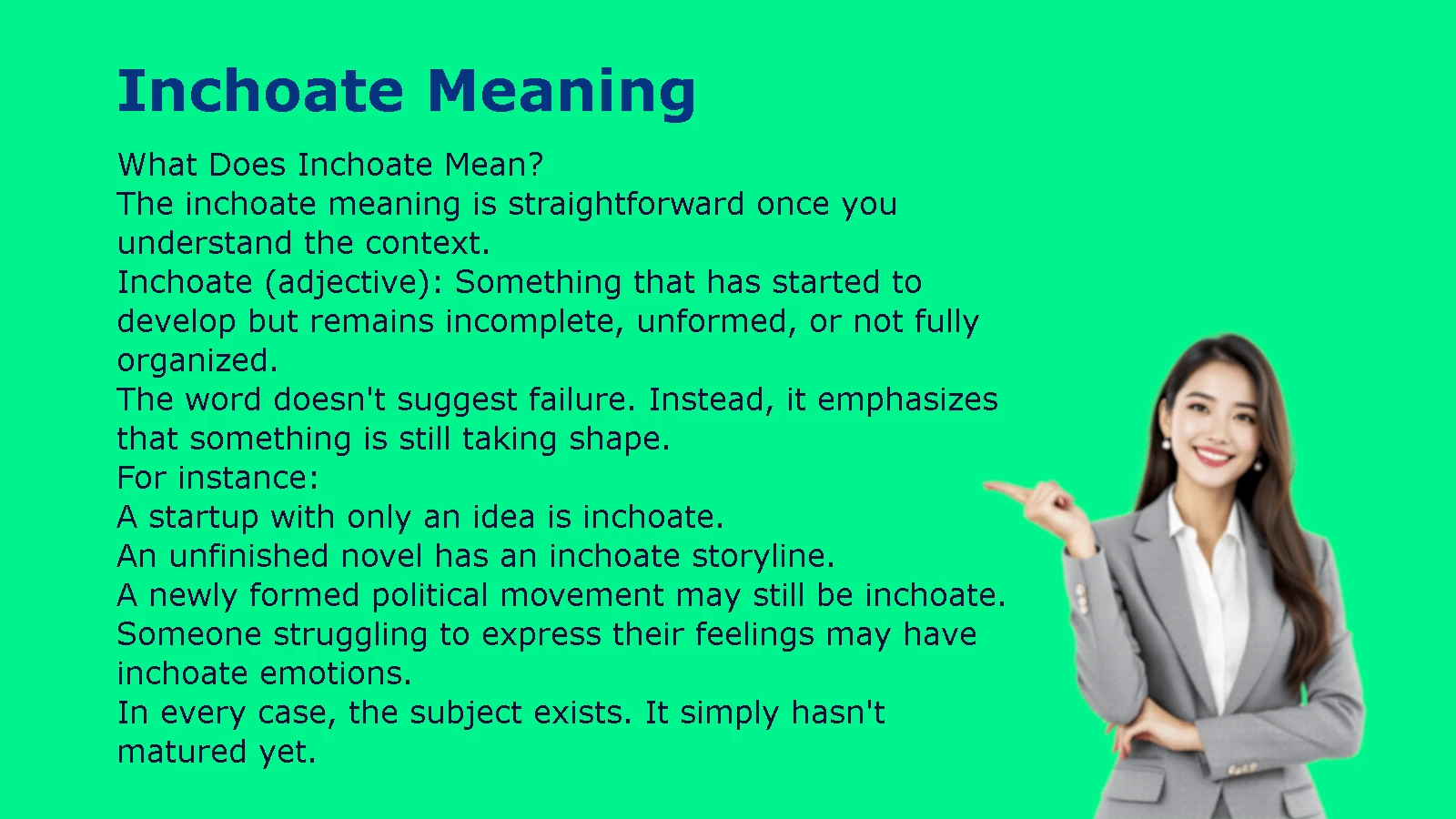
What Does Inchoate Mean?
The inchoate meaning is straightforward once you understand the context.
Inchoate (adjective): Something that has started to develop but remains incomplete, unformed, or not fully organized.
The word doesn’t suggest failure. Instead, it emphasizes that something is still taking shape.
For instance:
- A startup with only an idea is inchoate.
- An unfinished novel has an inchoate storyline.
- A newly formed political movement may still be inchoate.
- Someone struggling to express their feelings may have inchoate emotions.
In every case, the subject exists. It simply hasn’t matured yet.
Simple Definition
In plain English, inchoate means:
- Just beginning
- Still developing
- Not fully formed
- Incomplete
- Unorganized
- In its early stages
Think of it as the stage between nothing and finished.
Quick Facts About the Word
| Feature | Details |
| Word | Inchoate |
| Part of Speech | Adjective |
| Pronunciation | in-KOH-it |
| Meaning | Begun but not fully developed or organized |
| Difficulty Level | Advanced English vocabulary |
| Common Contexts | Law, literature, business, psychology, politics, education |
| Opposite | Complete, developed, mature, organized |
Why Do People Search for “Inchoate Meaning”?
People usually encounter this word unexpectedly because it isn’t common in everyday conversations.
You might see it in:
- Court judgments
- College textbooks
- Research papers
- Editorial articles
- Novels
- Business reports
- Political commentary
Since the word sounds unusual, many readers look up its meaning immediately.
How to Pronounce Inchoate
Although inchoate looks complicated, its pronunciation is fairly simple.
Standard Pronunciation
in-KOH-it
IPA Pronunciation
/ɪnˈkoʊət/
Syllable Breakdown
in • cho • ate
The stress falls on the second syllable:
in-KOH-it
Pronunciation Tips
Many English learners try to pronounce every letter separately.
Instead:
- Say “in.”
- Add “KOH.”
- Finish with “it.”
The ending sounds like “it,” not “ate.”
Common Pronunciation Mistakes
| Incorrect | Correct |
| in-CHO-at | in-KOH-it |
| in-CO-hate | in-KOH-it |
| in-CHO-ate | in-KOH-it |
Taking a moment to hear the pronunciation from a trusted dictionary can also help reinforce the correct stress pattern.
Inchoate Meaning in Simple Words
Dictionary definitions can sound formal. Here’s the same idea in everyday language.
Imagine trying to bake a cake.
You have flour, eggs, sugar, and butter sitting on the counter.
Nothing has been mixed yet.
The cake isn’t finished.
It isn’t even in the oven.
At this point, the cake is still inchoate.
The same idea applies to many parts of life.
Examples
- An author has several rough chapters but no finished novel.
- A company has investors but hasn’t launched its product.
- A student has an interesting research idea but hasn’t started writing.
- A community project has volunteers but no official structure.
Each one exists in an early, unfinished form.
Think of It as a Journey
Every project moves through stages.
Idea
│
▼
Early Development (Inchoate)
│
▼
Growing
│
▼
Completed
The word inchoate belongs in the second stage.
It describes the point where something has started but still needs significant development.
What Can Be Inchoate?
One of the reasons this word is useful is its flexibility.
It applies to many different situations.
Ideas
Many inventions begin as inchoate ideas.
Someone might recognize a problem but still need time to create a workable solution.
Plans
Businesses often begin with inchoate plans before writing detailed proposals.
At this stage, goals exist, but strategies remain unclear.
Organizations
A nonprofit group may start with only a few volunteers.
Before leadership, funding, and procedures develop, the organization remains inchoate.
Emotions
People sometimes struggle to explain their feelings.
Those unclear emotions are often described as inchoate emotions.
For example:
She sensed an inchoate fear she couldn’t fully explain.
Movements
Political and social movements often begin with scattered ideas.
Only later do they become organized campaigns.
Theories
Scientists sometimes discuss inchoate theories that require additional research before gaining acceptance.
Everyday Examples of Inchoate Meaning
The easiest way to understand a vocabulary word is to see it in action.
Here are original examples covering different situations.
Everyday Life
- His travel plans remained inchoate because he hadn’t booked anything.
- The child’s artistic talent was obvious, although it was still inchoate.
- They shared an inchoate dream of moving abroad.
Workplace
- The startup began with an inchoate business model.
- Management rejected the proposal because the strategy remained inchoate.
- Her presentation introduced several inchoate ideas worth exploring.
Education
- The student’s argument was interesting but still inchoate.
- Researchers described the theory as inchoate because evidence remained limited.
- His essay contained several inchoate thoughts that needed clearer organization.
Politics
- The movement remained inchoate during its first year.
- Voters supported the inchoate campaign despite its lack of leadership.
Literature
- The novel explores the inchoate ambitions of young artists.
- The author’s early work reveals an inchoate writing style that later became distinctive.
Inchoate in a Sentence
Below are more examples that demonstrate how naturally the word fits into different contexts.
| Sentence | Context |
| Her business idea was promising but still inchoate. | Business |
| The committee rejected the inchoate proposal. | Workplace |
| Scientists continued refining the inchoate theory. | Science |
| He struggled to describe his inchoate emotions. | Psychology |
| Their movement remained inchoate for several years. | Politics |
| The artist’s earliest paintings revealed an inchoate style. | Art |
| His speech reflected an inchoate understanding of economics. | Education |
| The software project was still in its inchoate phase. | Technology |
| Their friendship grew from an inchoate connection into lifelong trust. | Relationships |
| The startup evolved from an inchoate concept into a global company. | Business |
Common Collocations With Inchoate
Some words naturally appear with inchoate more often than others.
These combinations are called collocations.
| Phrase | Meaning |
| Inchoate idea | An idea that isn’t fully developed |
| Inchoate plan | An unfinished strategy |
| Inchoate theory | A theory still being developed |
| Inchoate movement | A newly emerging movement |
| Inchoate organization | A group lacking full structure |
| Inchoate emotion | A feeling that isn’t fully understood |
| Inchoate desire | A vague wish or longing |
| Inchoate concept | An early-stage concept |
| Inchoate ambition | A goal that isn’t clearly defined |
| Inchoate project | A project still in its planning phase |
Learning these combinations helps you use the word naturally rather than forcing it into sentences.
When Should You Use the Word “Inchoate”?
Although inchoate is accurate, it isn’t always the best choice.
Because it’s a formal word, it works best in certain settings.
Academic Writing
Researchers often describe early theories or incomplete evidence as inchoate.
Example:
The hypothesis remains inchoate pending additional experiments.
Business Writing
Companies sometimes use the word when discussing projects still under development.
Example:
The proposal remains inchoate until the budget receives approval.
Journalism
News articles occasionally describe emerging political movements or economic trends as inchoate.
Example:
Analysts believe the coalition is still inchoate.
Literature
Novelists frequently use inchoate to describe emotions, relationships, dreams, or identities that haven’t fully formed.
Example:
She carried an inchoate hope that life would improve.
Everyday Conversation
In casual conversations, simpler words often sound more natural.
Instead of saying:
My vacation plans are inchoate.
Most people would simply say:
- My plans are unfinished.
- My plans are still coming together.
- I’m still figuring things out.
Choosing the right word depends on your audience.
Inchoate Meaning in Law
Outside everyday English, inchoate has a specific legal meaning. While the general idea remains the same—something that has begun but isn’t complete—the law applies it to certain criminal offenses.
An inchoate crime is an offense where a person takes serious steps toward committing a crime, even if the intended crime never happens.
For example:
- Someone plans a bank robbery and recruits others.
- A person attempts to commit a crime but fails.
- Someone encourages another person to commit a crime.
In each case, the law may treat the conduct as a separate offense because the criminal activity has already begun.
Note: Laws vary by country and jurisdiction. The following information explains the concept in general terms and isn’t legal advice.
What Does Inchoate Mean in Legal Terms?
In legal language, inchoate refers to preparatory or incomplete criminal conduct.
Unlike completed crimes, inchoate offenses focus on the intent and the actions taken before completion.
Common Inchoate Crimes
| Crime | Simple Explanation |
| Attempt | A person tries to commit a crime but doesn’t complete it. |
| Conspiracy | Two or more people agree to commit a crime, and at least one takes a step toward it in many jurisdictions. |
| Solicitation | A person encourages, requests, or hires someone else to commit a crime. |
Why Does the Law Recognize Inchoate Crimes?
The legal system doesn’t always wait for harm to occur.
Instead, it may intervene when someone’s conduct demonstrates a clear intention to commit a criminal act.
This approach aims to:
- Protect public safety.
- Prevent greater harm.
- Hold people accountable for dangerous criminal planning.
Origin and Etymology of Inchoate
Understanding a word’s history often makes its meaning easier to remember.
Inchoate comes from the Latin word inchoatus, which means “begun” or “just started.” It derives from the Latin verb inchoare, meaning “to begin.”
The word entered English in the 16th century and has kept much of its original meaning ever since.
Although everyday speech has changed dramatically over the centuries, inchoate still refers to something that exists only in its early stages.
Etymology at a Glance
| Stage | Word |
| Latin Verb | inchoare (“to begin”) |
| Latin Participle | inchoatus |
| Middle English Influence | Formal scholarly writing |
| Modern English | Inchoate |
One reason the word survives today is its precision. Few English words express the exact idea of “started but not yet fully formed” as clearly.
Synonyms of Inchoate
No two words share exactly the same meaning. Although many synonyms overlap with inchoate, each carries its own nuance.
Close Synonyms
| Synonym | Best Used When |
| Nascent | Something has recently emerged. |
| Incipient | Something is beginning to appear. |
| Embryonic | Very early development. |
| Rudimentary | Basic but incomplete. |
| Developing | Progress is actively occurring. |
| Emerging | Becoming visible or important. |
| Forming | Taking shape gradually. |
| Preliminary | Existing before the final version. |
Contextual Synonyms
These words sometimes replace inchoate, depending on the sentence.
- Incomplete
- Unfinished
- Unformed
- Unorganized
- Fragmentary
- Partial
- Rough
- Initial
- Early-stage
- Half-developed
Which Synonym Should You Choose?
| If You Mean… | Better Word |
| Just beginning | Incipient |
| Recently appearing | Nascent |
| Basic structure exists | Rudimentary |
| Still incomplete | Inchoate |
| First draft | Preliminary |
| Growing steadily | Developing |
Choosing the right synonym helps your writing sound more precise.
Antonyms of Inchoate
Antonyms describe the opposite idea.
If inchoate means incomplete, these words describe something that has reached maturity or completion.
| Antonym | Meaning |
| Complete | Nothing is missing. |
| Finished | Fully done. |
| Developed | Fully formed over time. |
| Mature | Reached full growth. |
| Organized | Properly structured. |
| Refined | Improved through revision. |
| Established | Firmly recognized. |
| Fully formed | Entirely developed. |
Example Comparisons
- Inchoate plan → Completed plan
- Inchoate theory → Established theory
- Inchoate organization → Fully organized institution
- Inchoate concept → Refined concept
Inchoate vs Similar Words
Many English learners confuse inchoate with several related adjectives.
Although they overlap, they aren’t interchangeable in every context.
Inchoate vs Incipient
Both describe beginnings.
The difference lies in development.
| Inchoate | Incipient |
| Already exists but isn’t fully developed | Just beginning to appear |
| Suggests incompleteness | Suggests emergence |
Examples
- The company had an inchoate business model.
- The disease was still in its incipient stage.
Inchoate vs Nascent
Both describe early stages.
However, nascent usually emphasizes new growth rather than incompleteness.
| Inchoate | Nascent |
| Not fully formed | Newly emerging |
| Focuses on incomplete development | Focuses on new appearance |
Example
A nascent industry may already have organized businesses.
An inchoate industry may still lack clear structure.
Inchoate vs Rudimentary
These words overlap but emphasize different ideas.
| Inchoate | Rudimentary |
| Still forming | Basic version already exists |
| May lack organization | Has limited features |
Example
- An inchoate idea hasn’t been fully developed.
- A rudimentary machine works, but only in a simple way.
Inchoate vs Immature
These words shouldn’t be confused.
| Inchoate | Immature |
| Describes development | Often describes behavior or lack of maturity |
| Neutral meaning | Frequently negative |
Example:
- The proposal was inchoate.
- His response was immature.
Common Mistakes When Using Inchoate
Because inchoate is uncommon, writers sometimes misuse it.
Avoid these common errors.
Using It for Finished Things
Incorrect:
The completed building was inchoate.
Correct:
The building plans were still inchoate.
Confusing It With “Chaotic”
Chaotic means disorganized.
Inchoate means incomplete.
Something can be organized and still be inchoate.
Assuming It Only Applies to Law
Legal writing uses the word often.
However, writers also use it in:
- Literature
- Psychology
- Business
- Politics
- Philosophy
- Education
Using It as a Noun
Incorrect:
The project was an inchoate.
Correct:
The project was inchoate.
Remember, inchoate is an adjective.
Overusing It
Because it’s a formal word, repeating it throughout an article or conversation can sound unnatural.
Sometimes words like unfinished, developing, or early-stage communicate the idea more clearly.
Is Inchoate Positive or Negative?
Interestingly, inchoate is usually neutral.
The surrounding context determines whether it carries a positive or negative tone.
Positive Context
An inchoate startup could become the next successful company.
Example:
Their inchoate vision eventually transformed an entire industry.
Neutral Context
Many academic discussions use the word objectively.
Example:
Researchers described the hypothesis as inchoate.
Negative Context
Sometimes incompleteness creates problems.
Example:
The committee rejected the inchoate proposal because it lacked evidence.
Frequently Asked Questions
What does inchoate mean in simple terms?
It means something has started but isn’t fully developed, organized, or completed.
How do you pronounce inchoate?
The standard pronunciation is:
in-KOH-it
Is inchoate a positive word?
Not by itself.
It’s generally neutral. The surrounding sentence determines whether it sounds positive, negative, or simply descriptive.
What is an example of an inchoate idea?
A rough business concept without detailed planning is an inchoate idea.
What is the opposite of inchoate?
Common antonyms include:
- Complete
- Finished
- Mature
- Developed
- Established
- Organized
Is inchoate used only in law?
No.
Although it’s common in legal writing, the word also appears in literature, journalism, psychology, education, business, and academic research.
Can inchoate describe people?
Usually, no.
The word more often describes ideas, emotions, organizations, theories, plans, movements, and projects rather than people themselves.
Is inchoate a formal word?
Yes.
You’ll encounter it more often in formal or professional writing than in everyday conversation.
Key Takeaways
- Inchoate means begun but not fully developed or organized.
- It’s an adjective, not a noun.
- The word comes from the Latin inchoare, meaning “to begin.”
- Common contexts include law, literature, business, politics, psychology, and academic writing.
- In legal terminology, inchoate crimes involve actions taken toward committing a crime before the crime is completed.
- Close synonyms include nascent, incipient, rudimentary, embryonic, and developing, though each has a slightly different meaning.
- Common antonyms include complete, mature, refined, developed, and established.
- The word usually has a neutral tone and simply describes something that remains in an early stage of development.
Conclusion
The inchoate meaning centers on one simple idea: something has begun, but it hasn’t reached its final form. That definition applies across many fields, from business and education to literature and law. An inchoate idea may grow into an innovation. An inchoate movement can become a major social force. Even an inchoate emotion can become clearer with time.
While the word is more formal than everyday alternatives like unfinished or developing, it conveys a level of precision that few other adjectives match. Understanding when and how to use inchoate will strengthen your vocabulary and make formal writing more accurate. The next time you encounter the word in a book, article, or legal document, you’ll know that it points to something that’s real, already underway, and still taking shape.