
Cheapskate means a person who is unwilling to spend money, even when spending it would be reasonable or necessary. It is an informal word that usually has a negative meaning and suggests that someone is excessively careful or stingy with money.
If you’re searching for “cheapskate meaning,” “what does cheapskate mean,” or “cheapskate definition,” you’re likely looking for its simple meaning and how to use it in a sentence. In modern English, cheapskate describes someone who tries hard to avoid spending money or paying their fair share. It can be used jokingly among friends, but it may also sound insulting when used seriously.
| Question | Answer |
|---|---|
| What does cheapskate mean? | A person who is unwilling to spend money. |
| What is the meaning of cheapskate? | Someone who is excessively unwilling to spend or share money. |
| Is cheapskate a negative word? | Usually, yes. It often suggests that someone is stingy or unfair with money. |
| What is a synonym for cheapskate? | Miser, skinflint, penny pincher, tightwad, or stingy person. |
What Does Cheapskate Mean?
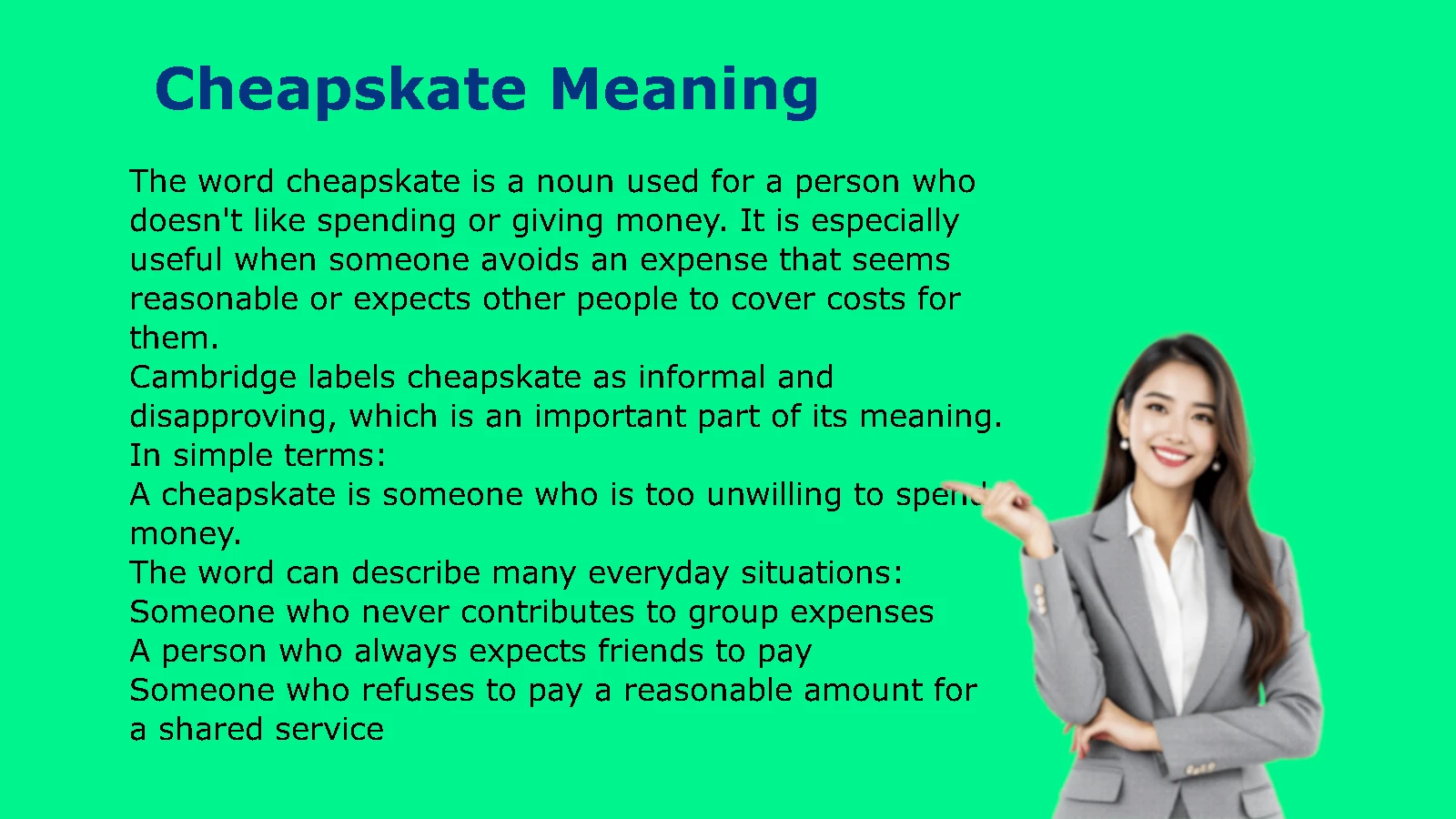
The word cheapskate is a noun used for a person who doesn’t like spending or giving money. It is especially useful when someone avoids an expense that seems reasonable or expects other people to cover costs for them.
Cambridge labels cheapskate as informal and disapproving, which is an important part of its meaning.
In simple terms:
A cheapskate is someone who is too unwilling to spend money.
The word can describe many everyday situations:
- Someone who never contributes to group expenses
- A person who always expects friends to pay
- Someone who refuses to pay a reasonable amount for a shared service
- A customer who deliberately avoids paying what they owe
- A person who has plenty of money but refuses to spend it when appropriate
- Someone who gives an unusually small amount when a reasonable contribution is expected
The central idea isn’t simply saving money. It’s being stingy.
For instance, imagine four friends order dinner together. Three people pay their portions, while the fourth person claims they forgot their wallet despite having money. If that happens repeatedly, the friends might call that person a cheapskate.
On the other hand, someone who says, “Let’s cook at home because restaurants are outside my budget this week,” isn’t necessarily a cheapskate. That’s simply a financial choice.
Cheapskate Meaning in Simple Words
The easiest way to remember the definition is:
Cheapskate = a person who doesn’t want to spend or contribute money, especially when it would be reasonable to do so.
Consider these examples:
- “He’s a cheapskate.”
He is unwilling to spend money. - “Don’t be a cheapskate.”
Stop being unnecessarily stingy. - “She’s too much of a cheapskate to replace her broken phone.”
She refuses to spend money even though replacing it may be reasonable. - “My roommate is a cheapskate and never buys household supplies.”
The roommate avoids contributing to shared expenses.
The word usually communicates judgment. That’s why it can sound insulting when directed at someone.
Is Cheapskate a Negative Word?
Yes. Cheapskate is generally a negative and disapproving word.
Cambridge explicitly labels it informal disapproving, and Collins likewise marks the term as expressing disapproval.
Calling someone a cheapskate suggests that you think the person is being unfairly stingy, rather than simply careful with money.
Compare these two sentences:
“Maria is frugal.”
“Maria is a cheapskate.”
The first sentence can be a compliment. It may suggest that Maria budgets carefully, avoids waste, and makes smart financial decisions.
The second sentence criticizes Maria. It suggests that she doesn’t want to spend money even when spending would be reasonable.
Frugal vs. Cheapskate
| Word | Basic meaning | Usual tone | Example |
| Frugal | Careful about spending | Positive or neutral | “He’s frugal and saves most of his income.” |
| Cheapskate | Unwilling to spend or contribute | Negative | “He’s a cheapskate who never pays his share.” |
| Miser | Extremely unwilling to spend money | Negative | “The miser kept his money locked away.” |
| Tightwad | A stingy person | Informal and negative | “Don’t be a tightwad.” |
| Penny pincher | Someone extremely careful about spending | Usually informal | “She’s a real penny pincher.” |
The dividing line often comes down to fairness.
A frugal person might skip an expensive restaurant because they want to save money. A cheapskate might go to the restaurant, eat the food, and then leave everyone else to pay the bill.
That’s a big difference.
Cheapskate Examples in Everyday Sentences
The word appears naturally in conversations about money, bills, purchases, gifts, and shared expenses.
At a Restaurant
“Don’t be a cheapskate. You ordered the steak, so you should pay your share.”
The criticism comes from avoiding a fair expense rather than from choosing an inexpensive meal.
Among Friends
“Jake is such a cheapskate that he never buys a round of drinks.”
Here, the speaker suggests that Jake benefits from other people’s generosity without returning the favor.
When Splitting a Bill
“She’s being a cheapskate by refusing to pay her portion of the bill.”
The phrase pay her portion makes the context clear. The issue isn’t whether she has to spend a lot. It’s whether she should contribute fairly.
At Home
“My roommate is a cheapskate. He uses everyone else’s groceries but never replaces them.”
This example shows that cheapskate can involve small everyday expenses rather than major purchases.
At Work
“The owner is such a cheapskate that he won’t replace the broken office chairs.”
Here, the word expresses frustration with someone who refuses to spend money on something employees reasonably need.
When Shopping
“He’s not a cheapskate. He just waits for sales before buying clothes.”
This example is useful because it shows when not to use the word. Looking for discounts doesn’t automatically make someone a cheapskate.
With Gifts
“He bought a thoughtful gift, so nobody could fairly call him a cheapskate.”
Price isn’t always the issue. A person can spend modestly while still being generous.
How to Use Cheapskate in a Sentence
Cheapskate works primarily as a noun. It normally refers to a person.
Here are several common sentence patterns.
“Someone Is a Cheapskate”
This is the simplest structure.
“Tom is a cheapskate.”
“My uncle is a cheapskate.”
“That guy is such a cheapskate.”
These sentences directly label the person as stingy.
“Such a Cheapskate”
This structure adds emphasis.
“He’s such a cheapskate that he won’t even replace the broken light bulb.”
“She’s such a cheapskate that she always waits for someone else to pay.”
The phrase such a cheapskate often appears in casual conversation because it expresses strong annoyance or disbelief.
“Don’t Be a Cheapskate”
This is common when someone wants another person to spend or contribute.
“Don’t be a cheapskate. Buy your sister a birthday card.”
“Don’t be a cheapskate. We all contributed to the trip.”
Because the word is informal, this construction fits casual conversations better than formal business writing.
“A Cheapskate + Noun”
You can also use cheapskate directly before a noun as an informal description.
“That cheapskate manager refuses to replace the equipment.”
“My cheapskate roommate never buys cleaning supplies.”
This usage carries the same negative judgment.
Cheapskate vs. Cheap
The words cheap and cheapskate look closely related, but they don’t serve the same grammatical role.
Cheap can describe the price, quality, behavior, or attitude associated with something or someone.
Cheapskate is a noun that refers to a person who is stingy with money.
Compare:
“This shirt is cheap.”
This normally means the shirt costs little. Depending on context, cheap can also suggest poor quality.
Now consider:
“He’s a cheapskate.”
This means he is unwilling to spend money.
The distinction becomes clearer in a table:
| Expression | What it describes | Example |
| Cheap | Something that costs little | “The ticket was cheap.” |
| Cheap | Sometimes poor quality | “The material feels cheap.” |
| Cheap | Sometimes stingy behavior | “Don’t be cheap.” |
| Cheapskate | A stingy person | “He’s a cheapskate.” |
So you wouldn’t normally call a low priced product a cheapskate.
You can call a person a cheapskate because the word describes their behavior toward money.
Cheapskate vs. Frugal: What’s the Difference?
One of the most important distinctions surrounding cheapskate meaning is the difference between frugal and stingy.
A frugal person tries to get good value from money. A cheapskate tries to avoid spending money, even when the expense is fair or necessary.
Consider two people buying coffee.
Person A:
“I’ll make coffee at home today. I’m saving for a vacation.”
Person B:
“I’ll let everyone else buy coffee. I never pay when I can get someone else to do it.”
Person A sounds frugal.
Person B sounds like a cheapskate.
Why Context Matters
The same action can look different depending on the circumstances.
Suppose someone buys a used laptop instead of a new one. That doesn’t make them a cheapskate. They might simply want good value.
Now imagine someone uses a friend’s laptop for months and refuses to contribute anything toward repairs after damaging it. Calling that person a cheapskate makes much more sense.
The word often appears when saving money affects other people.
A Simple Rule
Use frugal when the focus is on:
- Saving money wisely
- Avoiding waste
- Finding good value
- Planning a budget
- Spending carefully
Use cheapskate when the focus is on:
- Refusing a fair expense
- Avoiding responsibility
- Making others pay
- Being excessively stingy
- Keeping money at someone else’s expense
In short:
Frugal means careful with money. Cheapskate means stingy with money.
Cheapskate Synonyms
Several words can replace cheapskate, although they don’t all have exactly the same nuance.
Tightwad
Tightwad is one of the closest informal synonyms. It describes someone who doesn’t like spending money.
“My brother is such a tightwad that he refuses to split the bill evenly.”
Cambridge lists tightwad as a US slang synonym for cheapskate and also marks it as disapproving.
Miser
A miser is someone who is extremely unwilling to spend money and often hoards wealth.
“The miser lived simply despite having a large fortune.”
A miser can be more extreme than a typical cheapskate.
Skinflint
Skinflint refers to a very stingy person.
“The skinflint refused to spend money on basic repairs.”
It sounds somewhat old fashioned compared with cheapskate, although it remains an established English word.
Penny Pincher
A penny pincher is someone who is extremely careful about spending money.
“He’s a penny pincher who compares every price before buying anything.”
This expression can sound playful, depending on context.
Scrooge
Scrooge comes from Ebenezer Scrooge, the famously miserly character in Charles Dickens’s A Christmas Carol.
It can describe a person who is stingy or ungenerous.
“Don’t be a Scrooge. It’s Christmas.”
Because of the literary reference, Scrooge often carries a stronger association with a lack of generosity.
Comparison of Cheapskate Synonyms
| Synonym | Main idea | Tone |
| Cheapskate | Avoids spending money | Informal, negative |
| Tightwad | Extremely stingy | Informal, negative |
| Miser | Hoards money and dislikes spending | Strongly negative |
| Skinflint | Very stingy | Negative |
| Penny pincher | Carefully controls spending | Informal, sometimes playful |
| Scrooge | Stingy or ungenerous | Negative, often humorous |
Merriam Webster’s thesaurus also lists words such as miser, tightwad, skinflint, penny pincher, and Scrooge among words related to cheapskate.
Antonyms of Cheapskate
The opposite of a cheapskate is generally someone who is generous or willing to spend freely.
Useful opposites include:
- Generous person
- Spender
- Big spender
- Spendthrift
- Prodigal
However, these words aren’t perfect opposites in every context.
Generous
A generous person willingly gives money, time, gifts, or other resources.
“She’s generous and always helps friends when they need support.”
Big Spender
A big spender is someone who spends a lot of money.
“He’s a big spender when he travels.”
This doesn’t necessarily mean the person is generous. Someone can spend heavily on themselves without giving much to others.
Spendthrift
A spendthrift spends money freely and often wastefully.
“His spendthrift habits left him with very little savings.”
Interestingly, a spendthrift and a cheapskate sit at opposite ends of the spending spectrum.
| Cheapskate | Opposite idea |
| Avoids spending | Spends freely |
| Holds onto money | Gives or spends money |
| May avoid fair contributions | Willing to contribute |
| Stingy | Generous |
| Extremely reluctant to pay | Comfortable spending |
Merriam Webster’s thesaurus lists spendthrift, spender, prodigal, waster, wastrel, profligate, and squanderer as antonyms or near antonyms.
Is “Cheapskate” One Word or Two?
The standard modern spelling is cheapskate, written as one word.
You may occasionally encounter cheap skate or cheap-skate, especially in historical material. Etymological sources record the expression in both open and closed forms.
For modern writing, however, cheapskate is the clearest choice.
Correct Modern Form
He is a cheapskate.
Less Common Historical Form
He is a cheap skate.
If you’re writing an article, email, school assignment, or social media post today, use cheapskate as one word.
Cheapskate Pronunciation
The standard pronunciation is:
/ˈtʃiːp.skeɪt/
It sounds like:
CHEEP-skayt
Cambridge gives the pronunciation as /ˈtʃiːp.skeɪt/ in both its British and US entries.
The word has two clear parts:
- cheap
- skate
The primary stress falls on the first part.
If you already know how to say cheap and skate, the pronunciation is straightforward.
Cheapskate Word Origin and History
The history of cheapskate goes back to the late 19th century in American English.
Merriam Webster gives 1898 as the first known use of the word. Etymonline dates examples to around 1896, while Collins places the origin around 1895–1900. These dates differ slightly because dictionaries use different evidence and methods for identifying the earliest recorded use.
The word combines cheap with skate.
The first part is relatively easy to understand. Cheap has long been associated with low cost and later developed a sense connected with stinginess. Merriam Webster traces the noun cheap back to Old English cēap, meaning trade or a purchase.
The second part is more uncertain.
Historical sources connect skate with older slang referring to a person, including a contemptible or unpleasant person. Oxford says the word may refer to a worn out horse or a mean, contemptible, or dishonest person and notes that the ultimate origin is unknown.
Etymonline similarly discusses an older slang sense of skate and notes uncertainty around its ultimate origin.
So the safest explanation is:
Cheapskate combines cheap, in the sense of stingy or inexpensive, with an older slang use of skate for a person. The exact history of skate remains uncertain.
That is more accurate than claiming there is one proven explanation for every part of the word.
Can Cheapskate Be Used as a Verb?
Although the noun is much more common, cheapskate can also function as an informal verb.
Dictionary.com records the verb forms cheapskated and cheapskating, meaning to act in a stingy or miserly way.
For example:
“He cheapskated his way through the project.”
However, this usage is much less common than the noun.
For most everyday writing, the noun is the natural choice:
“He’s a cheapskate.”
rather than trying to force the verb into the sentence.
The noun is also the form most learners will encounter in ordinary conversation.
Common Mistakes With Cheapskate
Understanding the definition is only half the job. Knowing when not to use the word can make your writing much more accurate.
Mistake: Calling Every Frugal Person a Cheapskate
Saving money doesn’t automatically make someone a cheapskate.
“She cooks at home because she wants to save money.”
That’s frugal, not necessarily cheap.
The word becomes more appropriate when the person’s behavior becomes excessively stingy or unfair.
Mistake: Treating Cheapskate as a Compliment
In normal usage, cheapskate is disapproving.
Saying:
“You’re such a cheapskate!”
usually isn’t praise.
Someone might use it jokingly among close friends, but the underlying word still carries a negative meaning.
Mistake: Assuming a Cheap Product Is a Cheapskate
A product can be cheap.
A person can be a cheapskate.
You wouldn’t normally say:
“This phone is a cheapskate.”
Instead:
“This phone is cheap.”
Or, if you’re criticizing its quality:
“This phone feels cheap.”
Mistake: Thinking a Low Income Makes Someone a Cheapskate
The word describes behavior, not someone’s income level.
A person with a limited budget may have perfectly good reasons for avoiding an expense. Calling that person a cheapskate simply because they can’t afford something misses the point.
The term is more closely connected to unwillingness to spend than to an inability to spend.
Mistake: Using It in Formal Writing
Because cheapskate is informal and disapproving, it isn’t always appropriate for professional or academic writing.
Instead of:
“The company is being a cheapskate.”
a formal report might say:
“The company is unwilling to fund the necessary repairs.”
The second version communicates the issue without using a casual insult.
Cheapskate in Different Contexts
The meaning stays consistent, but the tone can change depending on the situation.
In Casual Conversation
“My brother is such a cheapskate.”
This sounds natural and conversational.
As a Joke
“I bought the movie tickets. Now it’s your turn, cheapskate.”
Among friends, the word may be playful rather than seriously insulting. Tone of voice and the relationship between the speakers matter.
In an Argument
“You’re a cheapskate. You never pay for anything.”
Here, the word becomes openly insulting.
In Writing
“The article described him as a notorious cheapskate.”
This is still informal, but it can work in journalistic or conversational writing.
In Professional Communication
It’s usually better to choose a more precise description:
- unwilling to contribute
- reluctant to spend
- unwilling to cover the cost
- overly cost conscious
- unwilling to pay a fair share
The right choice depends on whether the goal is to describe behavior neutrally or express criticism.
A Practical Case Study: Frugal or Cheapskate?
Imagine two coworkers, Daniel and Ryan.
Daniel earns a modest salary and wants to save for a house. He brings lunch from home, compares prices before making purchases, and waits for sales. When his coworkers go out for dinner, he pays his share of the bill.
Ryan earns a comfortable salary. He orders the most expensive food at group dinners, but when the bill arrives, he claims he only has cash and asks everyone else to cover him. He also borrows household supplies without replacing them.
Who is the cheapskate?
Ryan.
Daniel is practicing frugality. He controls his spending without shifting his financial responsibility onto other people.
Ryan, however, avoids reasonable expenses while benefiting from other people’s money. That behavior fits the core idea behind cheapskate.
This example highlights an important point: being inexpensive isn’t the same as being unfair.
Cheapskate Meaning: Quick Facts
| Fact | Answer |
| Meaning | A stingy or miserly person |
| Part of speech | Noun |
| Plural | Cheapskates |
| Tone | Informal and usually disapproving |
| Pronunciation | /ˈtʃiːp.skeɪt/ |
| Modern spelling | Cheapskate |
| Origin | Late 19th century American English |
| First known use according to Merriam Webster | 1898 |
| Common synonyms | Tightwad, miser, skinflint, penny pincher |
| Common opposite | Generous person, spender, spendthrift |
| Related verb | Cheapskate, cheapskated, cheapskating |
| Main idea | Unwillingness to spend or contribute money |
The dictionary evidence supports the central definition across major English references.
Frequently Asked Questions About Cheapskate Meaning
What does cheapskate mean?
Cheapskate means a person who is stingy or unwilling to spend money, especially when they should reasonably contribute to a cost or expense.
Is cheapskate an insult?
Usually, yes. Cheapskate is an informal, disapproving word. It can be used jokingly between friends, but it normally criticizes someone’s unwillingness to spend or contribute money.
Is being a cheapskate the same as being frugal?
No. Frugal usually means careful and sensible with money. Cheapskate suggests excessive stinginess, particularly when someone avoids a fair expense or makes other people pay.
What is another word for cheapskate?
Common synonyms include tightwad, miser, skinflint, penny pincher, and Scrooge. The exact nuance varies between them.
Is cheapskate one word?
Yes. Cheapskate is the standard modern spelling. Historical sources also record forms such as cheap skate, but the closed form is standard today.
What is the opposite of cheapskate?
Depending on the context, opposites include generous person, spender, big spender, and spendthrift. A generous person gives freely, while a spendthrift tends to spend money freely or wastefully.
How do you pronounce cheapskate?
The standard pronunciation is /ˈtʃiːp.skeɪt/. It sounds like CHEEP-skayt.
What is the plural of cheapskate?
The plural is cheapskates.
“The restaurant was full of cheapskates who refused to leave a reasonable tip.”
Can cheapskate be a verb?
Yes, although this use is uncommon compared with the noun. Dictionary.com records cheapskated and cheapskating for acting in a stingy or miserly way.
When did the word cheapskate originate?
The word dates to the late 19th century in American English. Merriam Webster gives 1898 as its first known use, while other sources place early recorded usage around 1895–1900 or 1896.
Final Thoughts on Cheapskate Meaning
The simplest way to understand cheapskate meaning is to think about stinginess rather than simple saving.
A cheapskate is someone who doesn’t want to spend or give money, especially when paying or contributing would be reasonable. The word is informal and normally carries a disapproving tone.
The difference between cheapskate and frugal is especially important. A frugal person tries to use money wisely. A cheapskate avoids spending even when that choice becomes unfair to others.
Remember these three points:
- Cheapskate is a noun for a stingy person.
- It usually has a negative or disapproving tone.
- It describes unwillingness to spend or contribute rather than simply having a small budget.
So, if someone compares prices, waits for sales, and sticks to a budget, frugal may be the better word. If someone repeatedly lets others pay while refusing to contribute, cheapskate fits much better.
That small distinction can make a big difference in everyday English.