
What Is the Accuse Meaning?
The accuse meaning is to claim or state that someone has done something wrong, illegal, or dishonest. The word accuse is commonly used when a person is blamed for an action or formally charged with an offense.
Examples:
- She accused him of stealing her wallet.
- They accused the company of breaking environmental laws.
The confusion often comes from its different contexts. Many people search for the accuse definition, accuse pronunciation, how to use accuse, or the difference between accuse and similar words like blame or charge. And here’s the kicker: using the wrong word can completely change the meaning and tone of your sentence.
In this guide, you’ll learn the Accuse Meaning, its definition, correct pronunciation, part of speech, and how to use accuse in a sentence with clear, real-life examples. You’ll also discover common synonyms and antonyms, the difference between accuse vs blame, and mistakes to avoid when using this word.
What Does Accuse Mean?
The word accuse means to say or claim that someone has done something wrong, illegal, dishonest, or harmful.
In simple words, when you accuse someone, you point out that you believe they are responsible for a problem or wrongdoing.
Simple definition:
Accuse means to say that someone has done something wrong, especially a crime, mistake, or dishonest action.
For example:
- Sarah accused Tom of breaking the window.
- The company was accused of misleading customers.
- The police accused the suspect of stealing money.
In each example, someone makes a claim about another person’s actions.
However, an accusation does not always mean the person is guilty. A person may be accused of something and later proven innocent.
Accuse Meaning in Different Contexts
The meaning of accuse can slightly change depending on the situation.
| Context | Meaning | Example |
| Everyday conversation | Claim someone did something wrong | She accused her brother of taking her phone. |
| Workplace | Claim someone made a mistake or acted unfairly | The employee accused the manager of unfair treatment. |
| Legal setting | Claim someone committed a crime | The defendant was accused of fraud. |
| Public discussions | Blame someone publicly | The politician was accused of corruption. |
What Does It Mean to Accuse Someone?
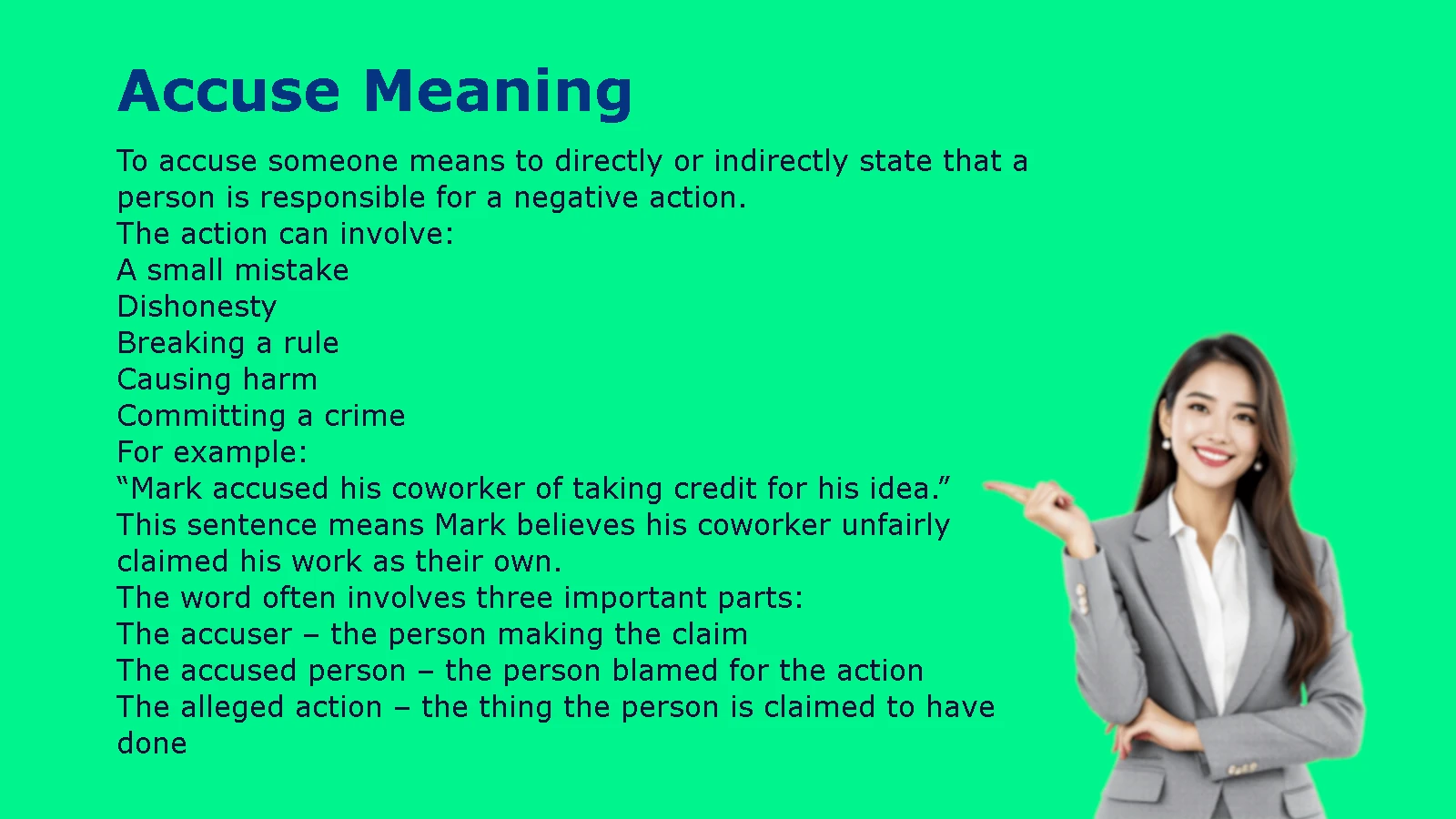
To accuse someone means to directly or indirectly state that a person is responsible for a negative action.
The action can involve:
- A small mistake
- Dishonesty
- Breaking a rule
- Causing harm
- Committing a crime
For example:
“Mark accused his coworker of taking credit for his idea.”
This sentence means Mark believes his coworker unfairly claimed his work as their own.
The word often involves three important parts:
- The accuser – the person making the claim
- The accused person – the person blamed for the action
- The alleged action – the thing the person is claimed to have done
Example:
“The customer accused the company of providing poor service.”
- Accuser: Customer
- Accused: Company
- Alleged action: Providing poor service
Accuse Meaning in Legal Situations
In legal language, accuse has a more serious meaning. It refers to claiming that someone committed a crime or broke the law.
For example:
“The man was accused of robbery.”
This statement means authorities or another person claimed that the man committed robbery. It does not mean a court has proven him guilty.
A person remains legally innocent until proven guilty.
This difference matters because:
- An accusation is a claim.
- Evidence supports or challenges the claim.
- A court decides guilt or innocence.
Accusation vs Conviction
| Term | Meaning |
| Accusation | A claim that someone did something wrong |
| Investigation | A process of gathering information |
| Charge | A formal legal claim |
| Conviction | A court decision that someone is guilty |
For example:
Someone may be accused of theft, charged with theft, and later convicted or found not guilty.
Pronunciation of Accuse
The pronunciation of accuse is:
uh-KYOOZ
Phonetic spelling:
/əˈkjuːz/
The word has two syllables:
- uh
- KYOOZ
The stress falls on the second syllable.
Common pronunciation mistake:
Some people pronounce it like:
❌ ACK-yooz
The correct pronunciation is:
✅ uh-KYOOZ
Example:
“Don’t accuse someone without knowing the facts.”
Pronunciation breakdown:
uh-KYOOZ someone
Part of Speech of Accuse
The word accuse is a verb.
A verb shows an action, and accusing is an action where someone makes a claim against another person.
Forms of Accuse
| Form | Word | Example |
| Base form | accuse | They accuse him of lying. |
| Third person singular | accuses | She accuses her brother of cheating. |
| Present participle | accusing | He is accusing me unfairly. |
| Past tense | accused | They accused him yesterday. |
| Past participle | accused | She was accused of fraud. |
Noun and Adjective Forms of Accuse
The word accuse has several related forms that appear frequently in English.
Accusation (Noun)
Accusation means a claim that someone has done something wrong.
Examples:
- The accusation shocked everyone.
- He denied the accusation.
- The company faced several accusations.
Accuser (Noun)
An accuser is the person who makes an accusation.
Example:
The accuser provided evidence during the investigation.
Accused (Noun)
The accused refers to the person who has been blamed or charged with wrongdoing.
Example:
The accused appeared in court.
Accusatory (Adjective)
Accusatory describes words, actions, or tones that suggest blame.
Example:
She gave him an accusatory look after finding the missing document.
Origin and Etymology of Accuse
The word accuse has a long history that goes back to Latin.
It comes from the Latin word:
accusare
meaning:
“to call to account” or “to blame”
The word entered English through Old French during the Middle Ages.
Word History:
| Language | Word | Meaning |
| Latin | accusare | To call to account, blame |
| Old French | acuser | To accuse or blame |
| Middle English | accuse | To charge with wrongdoing |
Over time, the meaning developed from simply blaming someone to making a formal claim of wrongdoing.
Today, English speakers use accuse in both casual and serious situations.
How to Use Accuse Correctly in a Sentence
One of the most important grammar rules is this:
Accuse Someone of Something
The correct structure is:
Accuse + person + of + action or thing
Correct examples:
✅ She accused him of lying.
✅ They accused the company of fraud.
✅ The teacher accused the student of cheating.
Incorrect examples:
❌ She accused him for lying.
❌ They accused the company about fraud.
The preposition of always follows accuse when you mention the reason for the accusation.
Common Sentence Patterns With Accuse
Accuse Someone of + Noun
Use this pattern when the wrongdoing is a thing or action.
Examples:
- The manager accused the employee of dishonesty.
- The police accused him of theft.
- She accused her friend of betrayal.
Accuse Someone of + Verb Ending in -ing
This is one of the most common structures.
Examples:
- He accused me of cheating.
- She accused them of wasting time.
- They accused the company of hiding information.
The -ing form works like a noun because it describes the action being blamed.
Be Accused of
The passive form be accused of is very common, especially in news and formal writing.
Examples:
- The politician was accused of corruption.
- The athlete was accused of using illegal substances.
- The company was accused of violating safety rules.
Real-Life Examples Using Accuse
Here are examples from different situations:
Everyday Life
- My sister accused me of eating her dessert.
- He accused his friend of forgetting their agreement.
- The child accused his brother of breaking the toy.
School
- The teacher accused the student of copying answers.
- The student was accused of cheating during the exam.
Workplace
- The employee accused the manager of unfair treatment.
- The customer accused the business of poor communication.
Legal Situations
- The suspect was accused of stealing confidential information.
- The company was accused of violating regulations.
Social Media
- The influencer was accused of sharing false information.
- Users accused the account of spreading rumors.
Accuse Meaning: Common Collocations, Synonyms, Antonyms, and Similar Words
Common Collocations With Accuse
A collocation is a group of words that naturally appear together in English. Learning common collocations with accuse helps you sound more fluent and understand how native speakers use the word.
The verb accuse is often followed by words related to wrongdoing, dishonesty, or responsibility.
| Collocation | Meaning | Example |
| accuse someone of lying | Claim someone is not telling the truth | She accused him of lying about the situation. |
| accuse someone of cheating | Claim someone acted dishonestly | The player was accused of cheating. |
| accuse someone of theft | Claim someone stole something | The employee was accused of theft. |
| accuse someone of fraud | Claim someone used deception for personal gain | The company was accused of fraud. |
| accuse someone of wrongdoing | Claim someone did something improper | The official was accused of wrongdoing. |
| falsely accuse someone | Blame someone without truth or evidence | He was falsely accused of the crime. |
| wrongly accuse someone | Make an incorrect accusation | They wrongly accused her of damaging the equipment. |
| publicly accuse someone | Make a claim openly | The actor publicly accused the producer of misconduct. |
| accuse someone directly | Clearly state blame | She directly accused him of breaking the rules. |
| accuse someone unfairly | Blame someone without good reason | He felt he was unfairly accused. |
Why Collocations Matter
Using the right word combinations makes your English sound natural.
For example:
❌ He accused her for cheating.
✅ He accused her of cheating.
❌ They accused him about stealing money.
✅ They accused him of stealing money.
The phrase accuse someone of something is the standard pattern used by English speakers.
Synonyms of Accuse
Several words have meanings close to accuse, but each one carries a slightly different idea. Choosing the right synonym depends on the situation.
Blame
Blame means to say that someone caused a problem or is responsible for something negative.
Example:
The manager blamed the team for missing the deadline.
Difference between accuse and blame:
- Accuse usually suggests wrongdoing.
- Blame focuses more on responsibility.
Compare:
She accused him of stealing her wallet.
This suggests she believes he committed theft.
She blamed him for losing the wallet.
This suggests she thinks he caused the problem, even if he did not steal it.
Allege
Allege means to claim that something happened without confirming whether it is true.
This word appears frequently in news reports and legal writing.
Example:
The company allegedly ignored safety rules.
The word allege is useful when writers want to report a claim without stating it as a proven fact.
Accuse vs Allege
| Word | Meaning | Common Use |
| Accuse | Claim someone did something wrong | Everyday speech and legal discussions |
| Allege | Claim something happened without proof | News and formal writing |
Example:
- The victim accused the man of theft.
- The newspaper reported that he allegedly committed theft.
Charge
Charge means to officially accuse someone of a crime.
This word is stronger and more formal than accuse.
Example:
Police charged the suspect with fraud.
Accuse vs Charge
| Accuse | Charge |
| Can happen in everyday situations | Usually connected to law |
| May come from anyone | Usually comes from authorities |
| Does not require a formal process | Often involves legal action |
Example:
A coworker can accuse you of making a mistake.
Only authorized officials usually charge someone with a crime.
Implicate
Implicate means to show that someone may be involved in something wrong.
Example:
The evidence implicated him in the robbery.
Unlike accuse, implicate often focuses on evidence or connections.
Accuse vs Implicate
| Word | Main Idea |
| Accuse | Directly claim someone did something wrong |
| Implicate | Suggest involvement through evidence |
Example:
She accused her neighbor of stealing.
This is a direct claim.
The fingerprints implicated the suspect.
This suggests evidence connects the person to the crime.
Denounce
Denounce means to publicly criticize or condemn someone or something.
Example:
Leaders denounced the unfair policy.
While accuse focuses on wrongdoing, denounce focuses on expressing strong disapproval.
Incriminate
Incriminate means to make someone appear guilty of a crime.
Example:
The documents could incriminate the suspect.
This word often appears in criminal investigations.
Antonyms of Accuse
Antonyms are words with opposite meanings.
The opposite of accusing someone is often defending, clearing, or proving their innocence.
| Antonym | Meaning | Example |
| Defend | Protect someone from blame | The lawyer defended the accused person. |
| Exonerate | Officially clear someone from blame | New evidence exonerated him. |
| Acquit | Declare someone not guilty | The jury acquitted the defendant. |
| Absolve | Free someone from responsibility | The investigation absolved her of blame. |
| Vindicate | Prove someone was right or innocent | The results vindicated the employee. |
| Excuse | Forgive a mistake | The teacher excused the student. |
Accuse vs Blame: What Is the Difference?
Many English learners confuse accuse and blame because both involve pointing out responsibility.
However, they are not always interchangeable.
Accuse
Accuse usually suggests a person believes someone committed a wrong action.
Example:
The customer accused the waiter of stealing money.
The customer believes the waiter committed a dishonest act.
Blame
Blame means someone is responsible for a problem or bad result.
Example:
The coach blamed the weather for the canceled game.
The weather is responsible for the problem, but nobody committed a crime.
Quick Comparison
| Feature | Accuse | Blame |
| Suggests wrongdoing | Usually yes | Sometimes |
| Used for crimes | Common | Less common |
| Used for mistakes | Sometimes | Very common |
| Emotional impact | Stronger | More general |
Accuse vs Allege: Understanding the Difference
Both words involve claims, but they have different levels of certainty.
Accuse
An accusation directly points toward a person.
Example:
She accused her coworker of stealing files.
Allege
An allegation reports a claim without confirming it.
Example:
The report alleged that the company ignored safety concerns.
When Should You Use Each Word?
Use accuse when:
- Someone personally makes a claim.
- The situation involves direct blame.
- You are describing someone’s action.
Use allege when:
- Reporting information from another source.
- Writing about legal matters.
- Avoiding a statement of confirmed guilt.
Accuse vs Charge: Key Differences
These words are closely connected but are not identical.
Accuse
A person can accuse another person in many situations.
Examples:
- A friend accuses another friend of lying.
- A customer accuses a business of poor service.
Charge
A legal authority usually charges someone.
Examples:
- Police charged the suspect with theft.
- Prosecutors charged the defendant with fraud.
Simple Rule:
Every charge is an accusation, but not every accusation is a charge.
Is Accuse Always a Negative Word?
Yes, accuse almost always carries a negative meaning because it involves claiming someone did something wrong.
However, the seriousness depends on the situation.
Compare these examples:
“My brother accused me of eating his cookies.”
This is a small, everyday disagreement.
“The company was accused of financial fraud.”
This is a serious legal matter.
The word itself remains negative, but the consequences vary.
Common Grammar Mistakes With Accuse
Mistake: Using the Wrong Preposition
Many learners incorrectly use for or about after accuse.
Incorrect:
❌ She accused him for cheating.
Correct:
✅ She accused him of cheating.
Mistake: Confusing Accuse With Blame
Incorrect:
❌ The rain accused the weather of ruining the picnic.
Correct:
✅ The family blamed the weather for ruining the picnic.
Weather cannot intentionally do something wrong, so blame works better.
Mistake: Forgetting the Object
Incorrect:
❌ She accused of lying.
Correct:
✅ She accused him of lying.
The verb usually needs someone who receives the accusation.
Mistake: Assuming Accused Means Guilty
Incorrect idea:
He was accused of theft, so he stole something.
Correct understanding:
He was accused of theft, but the accusation still needs proof.
An accusation is not the same as a fact.
Related Words and Forms of Accuse
Understanding related words helps you expand your vocabulary.
| Word | Type | Meaning | Example |
| Accuse | Verb | Claim someone did wrong | They accused him of cheating. |
| Accusation | Noun | A claim of wrongdoing | The accusation was serious. |
| Accuser | Noun | Person making the claim | The accuser gave evidence. |
| Accused | Noun/Adjective | Person blamed for wrongdoing | The accused appeared in court. |
| Accusatory | Adjective | Showing blame | Her accusatory tone upset him. |
| Accusingly | Adverb | In a blaming manner | He looked at her accusingly. |
“Accuse” in Everyday English
The word appears in ordinary conversations more often than many people realize.
Family Situations
Example:
“My brother accused me of hiding the remote.”
This does not necessarily involve serious wrongdoing. It simply means he believed his brother was responsible.
Friendships
Example:
“She accused her friend of ignoring her messages.”
This shows emotional conflict rather than a legal issue.
Workplace
Example:
“The employee accused the company of unfair treatment.”
Workplace accusations often involve policies, communication, or professional behavior.
Online Conversations
Example:
“Users accused the brand of misleading advertising.”
Social media can spread accusations quickly, which is why careful language matters.
Case Study: Why the Difference Between Accusation and Proof Matters
Imagine a company employee gets accused of leaking confidential information.
At first:
- A manager makes an accusation.
- An investigation begins.
- Evidence is collected.
- The facts are reviewed.
The employee may later be:
- Found responsible
- Cleared of wrongdoing
- Given a warning
- Formally disciplined
The important lesson is that an accusation starts a process; it does not finish one.
Accuse Meaning: Legal Usage, Examples, FAQs, and Final Takeaways
Accuse in Legal English
The word accuse has a particularly important role in legal language. In courtrooms, news reports, and official documents, the word must be used carefully because an accusation can affect a person’s reputation, career, and personal life.
In a legal context, to accuse someone means to claim that the person committed a crime or violated a law. However, an accusation alone does not prove guilt.
For example:
“The defendant was accused of fraud.”
This sentence means someone claimed the defendant committed fraud. It does not mean a court has already decided that the defendant is guilty.
A legal process requires:
- Evidence
- Investigation
- A fair hearing
- A decision from a court or authorized body
The Difference Between an Accusation and a Conviction
Many people confuse these terms, but they describe different stages.
| Term | Meaning | Example |
| Accusation | A claim that someone did something wrong | He was accused of stealing money. |
| Investigation | A search for facts and evidence | Police investigated the complaint. |
| Charge | A formal statement of criminal wrongdoing | The suspect was charged with theft. |
| Trial | A legal process to examine evidence | The case went to trial. |
| Conviction | A decision that someone is guilty | The court convicted him of the crime. |
| Acquittal | A decision that someone is not guilty | The jury acquitted her. |
The key point is simple:
Being accused does not mean being guilty.
A fair legal system separates claims from proven facts.
Why People Should Use the Word Accuse Carefully
Words have power. An accusation can damage someone’s reputation even before facts are confirmed.
For example:
“The employee stole money.”
This statement presents the action as a fact.
However:
“The employee was accused of stealing money.”
This statement only reports that a claim was made.
The second sentence is more accurate when the truth has not yet been established.
This difference matters in:
- Journalism
- Workplace communication
- Legal documents
- Public statements
- Social media discussions
Accuse Meaning in News Writing
News organizations often use words like accused, alleged, and claimed because journalists must separate facts from unproven statements.
Examples:
- The official was accused of accepting illegal payments.
- The company allegedly violated environmental rules.
- The suspect denied the accusations.
These words help readers understand that an investigation or legal process may still be ongoing.
Accuse Meaning in Workplace Communication
Accusations often appear in professional environments when people disagree about responsibility, actions, or behavior.
Common workplace accusations include:
- Accusing someone of missing deadlines
- Accusing someone of dishonesty
- Accusing someone of taking credit for another person’s work
- Accusing someone of breaking company policies
However, professional communication usually works better when people focus on facts rather than personal attacks.
Compare:
❌ “You always lie about your work.”
✅ “The report contains information that does not match the original data. Can we review it together?”
The second approach addresses the issue without creating unnecessary conflict.
Accuse Meaning in Everyday Conversations
In casual conversations, accuse does not always involve serious wrongdoing.
Sometimes people use it jokingly.
Examples:
“I accuse you of stealing the last slice of pizza.”
This playful accusation is not a serious claim. It simply creates humor.
Other everyday examples:
- “She accused me of being too picky.”
- “My friend accused me of arriving late on purpose.”
- “The child accused his sister of breaking the toy.”
The seriousness depends on the situation and tone.
Common Expressions Related to Accuse
English has several expressions connected to blame and responsibility.
Point the Finger At
Meaning:
To blame someone for a problem.
Example:
Everyone started pointing the finger at the manager after the mistake happened.
Lay the Blame On
Meaning:
To say someone is responsible for something bad.
Example:
The company tried to lay the blame on the contractor.
Throw Someone Under the Bus
Meaning:
To sacrifice or blame someone to protect yourself.
Example:
He threw his coworker under the bus to avoid punishment.
Face Accusations
Meaning:
To deal with claims that someone did something wrong.
Example:
The organization faced accusations of unfair practices.
Make an Accusation
Meaning:
To formally or informally claim wrongdoing.
Example:
She decided to make an accusation after discovering the problem.
Quick Reference Table: Accuse Meaning
| Category | Information |
| Word | Accuse |
| Part of speech | Verb |
| Pronunciation | uh-KYOOZ |
| Meaning | To claim someone did something wrong |
| Common pattern | Accuse someone of something |
| Preposition used | Of |
| Past tense | Accused |
| Noun form | Accusation |
| Person making claim | Accuser |
| Person blamed | Accused |
| Opposite meanings | Defend, clear, exonerate |
| Common mistake | Using “accuse for” instead of “accuse of” |
Frequently Asked Questions About Accuse Meaning
What does accuse mean in simple words?
Accuse means to say that someone did something wrong.
For example:
“She accused him of breaking the rules.”
It means she claimed he broke the rules.
What is the difference between accuse and blame?
Accuse usually suggests wrongdoing, while blame means saying someone is responsible for a problem.
Example:
- She accused him of stealing.
- She blamed him for the mistake.
Stealing involves a possible crime, while a mistake may simply involve responsibility.
What preposition comes after accuse?
The correct preposition is of.
Correct:
✅ He accused her of lying.
Incorrect:
❌ He accused her for lying.
Is accuse a negative word?
Yes. Accuse usually has a negative meaning because it involves claiming that someone did something wrong.
However, the seriousness depends on the situation.
A playful accusation about eating cookies is very different from an accusation of fraud.
What is the noun form of accuse?
The noun form is accusation.
Examples:
- The accusation surprised everyone.
- He denied the accusation.
- The investigation examined the accusations carefully.
What is the adjective form of accuse?
The adjective form is accusatory.
Example:
Her accusatory tone made the conversation uncomfortable.
It describes speech, behavior, or expressions that suggest blame.
Can you accuse someone without proof?
Yes, people can make accusations without proof. However, an accusation does not automatically mean the claim is true.
In serious situations, evidence is needed to determine whether the accusation is accurate.
Is accuse formal or informal?
The word accuse works in both formal and informal situations.
Formal examples:
- The company was accused of violating regulations.
- The defendant was accused of fraud.
Informal examples:
- My brother accused me of taking his charger.
- She accused me of forgetting her birthday.
What is the opposite of accuse?
Common opposites include:
- Defend
- Exonerate
- Acquit
- Clear
- Vindicate
These words describe protecting someone from blame or proving innocence.
How do lawyers use the word accuse?
Lawyers use accuse when discussing claims that someone committed a crime or wrongdoing.
They carefully separate:
- Allegations
- Evidence
- Charges
- Verdicts
A lawyer may say:
“The defendant has been accused of theft, but the evidence must be examined before reaching a conclusion.”
How to Remember the Meaning of Accuse
A simple way to remember accuse is:
Accuse = A claim against someone.
Think of the phrase:
“Someone points a finger and says, ‘You did this.’”
That person is making an accusation.
However, remember that pointing a finger does not always reveal the truth. Facts and evidence decide what really happened.
Final Takeaway: Understanding the Meaning of Accuse
The word accuse means to claim that someone has done something wrong. It appears in everyday conversations, workplace discussions, news reports, and legal situations.
The most important grammar rule is:
Accuse someone of something
Examples:
- She accused him of lying.
- They accused the company of fraud.
- He was accused of breaking the rules.
Remember these key points:
- Accuse is a verb.
- Accusation is the noun form.
- Accusatory describes a blaming tone.
- Accuse does not mean someone is automatically guilty.
- Evidence separates a claim from the truth.
Once you understand the accuse meaning, similar words like blame, allege, charge, and implicate become much easier to use correctly. This small but powerful word can change the meaning of a sentence, so choosing it carefully helps you communicate with accuracy and confidence.