
Have you ever come across the word “forsooth” in an old book, poem, movie, or dramatic conversation and wondered what it actually means? While forsooth meaning may seem mysterious at first, this unusual word has a surprisingly simple meaning and a long history in the English language.
Forsooth is an old fashioned adverb that means “indeed,” “truly,” or “in truth.” It was once used to emphasize that something was true or to express agreement. Today, you’ll mostly find it in historical writing, literature, poetry, or humorous speech rather than everyday conversation.
Examples:
- Forsooth, you have spoken the truth.
- Forsooth, I never expected such a result.
The confusion is understandable. People often search for what does forsooth mean, forsooth definition, forsooth meaning in a sentence, or how to use forsooth because the word sounds unfamiliar to modern English speakers. And here’s the kicker: although it sounds grand and dramatic, forsooth essentially means something as simple as “indeed” or “truly.”
In this guide, you’ll learn the complete Forsooth Meaning, its definition, pronunciation, origin, correct usage, and examples in sentences. You’ll also discover its synonyms, whether forsooth is still used today, and why this distinctive word often appears in historical and humorous contexts.
Forsooth Meaning in Simple English
The simplest definition of forsooth is:
Forsooth = in truth, indeed, truly, or in fact.
The word generally strengthens or emphasizes what someone has just said. Oxford describes it as an adverb used to emphasize a statement, particularly to express surprise, while labeling it “old use or humorous.”
Here are a few straightforward translations:
| Forsooth | Modern English |
| Forsooth, he is honest. | Indeed, he is honest. |
| Forsooth, the rumor is true. | In fact, the rumor is true. |
| She is, forsooth, a remarkable woman. | She is truly a remarkable woman. |
| Forsooth, what a strange idea! | Indeed, what a strange idea! |
The important point is that forsooth doesn’t usually introduce a completely different idea. Instead, it adds emphasis to an existing statement.
Think of it as an old-fashioned spotlight. The sentence already works without it. The word simply draws attention to what follows.
What Does Forsooth Mean?
The word forsooth has a few closely related meanings:
- In truth
- Indeed
- In fact
- Truly
- Certainly
- Surely, in some contexts
Merriam-Webster defines it primarily as “in truth” and “indeed.” It also notes that the word can imply contempt or doubt, especially in later usage.
That last point matters because forsooth doesn’t always express sincere agreement.
Consider these two sentences:
Forsooth, you have spoken wisely.
This could mean:
Indeed, you have spoken wisely.
Now compare:
A genius, forsooth!
The second sentence may sound sarcastic. The speaker could actually mean:
“A genius? I don’t think so.”
That contrast makes the word more interesting than a simple synonym for “indeed.”
Forsooth Definition and Part of Speech
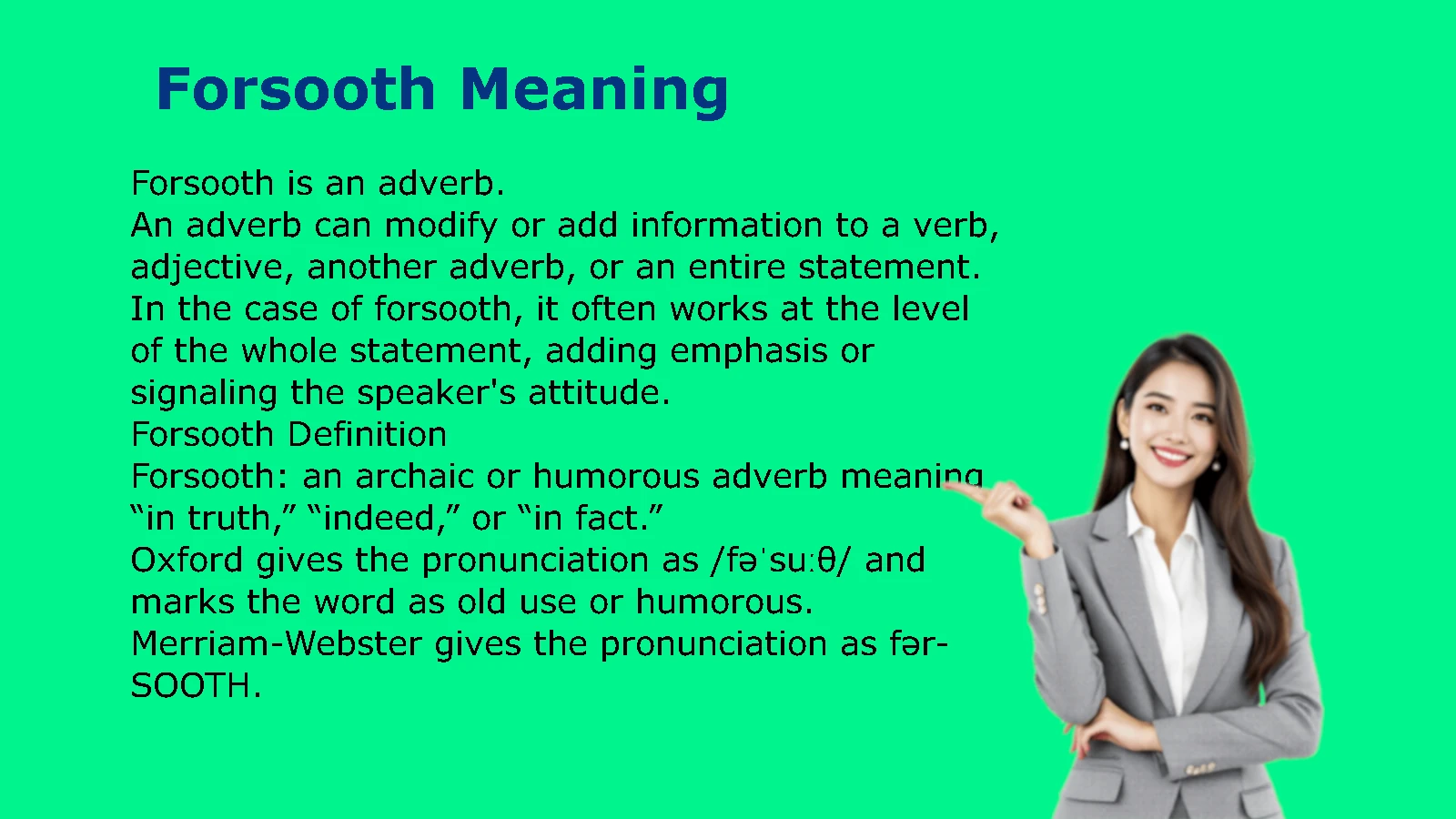
Forsooth is an adverb.
An adverb can modify or add information to a verb, adjective, another adverb, or an entire statement. In the case of forsooth, it often works at the level of the whole statement, adding emphasis or signaling the speaker’s attitude.
Forsooth Definition
Forsooth: an archaic or humorous adverb meaning “in truth,” “indeed,” or “in fact.”
Oxford gives the pronunciation as /fəˈsuːθ/ and marks the word as old use or humorous.
Merriam-Webster gives the pronunciation as fər-SOOTH.
Is Forsooth an Adverb?
Yes.
Examples include:
- Forsooth, I believe you.
- He was, forsooth, the bravest man there.
- A wise decision, forsooth.
In each case, forsooth modifies the overall statement rather than naming a person, object, or action.
How Do You Pronounce Forsooth?
The word forsooth is pronounced roughly like:
fur-SOOTH
The second syllable receives the main stress.
Cambridge gives the US pronunciation as /fɔːrˈsuːθ/ and the UK pronunciation as /fəˈsuːθ/. The final sound is the same “th” sound heard in think.
Forsooth Pronunciation Breakdown
For-sooth
- for → sounds approximately like “fur” in many American pronunciations
- sooth → sounds like “sooth” in the word soothing
- Stress → SOOTH
So you can remember it as:
fur-SOOTH
The word sooth itself is important because it helps explain the word’s history.
Forsooth Etymology and Origin
The history of forsooth stretches back more than a thousand years.
Merriam-Webster traces the word through Middle English for soth to Old English forsōth, combining for with sōth, meaning “sooth” or truth. It records the first known use as occurring before the 12th century.
Oxford similarly traces forsooth to Old English forsōth, from for plus sooth, meaning “genuine” or “true.”
The basic historical idea is therefore closely connected with truth.
What Does “Sooth” Mean?
The word sooth once meant truth, reality, or what is true.
It is now archaic when used in that sense, but it survives in a few familiar English words.
For example:
- Soothsayer literally relates to someone who tells the truth or foretells what is true.
- Soothe has a historical connection with the idea of confirming or showing truth.
Merriam-Webster explains that sooth survives primarily in words such as soothe and soothsayer, even though the standalone word has largely disappeared from everyday English.
The etymology also explains why forsooth feels so closely tied to words such as truly and indeed.
Forsooth Through History
| Period | Form | Basic idea |
| Old English | forsōth | Truly, in truth |
| Middle English | forsothe / for soth | In truth, indeed |
| Early Modern English | forsooth | Indeed, certainly, in truth |
| Modern English | forsooth | Archaic, humorous, or ironic “indeed” |
The exact historical development of the word is more complicated than simply translating for + sooth word for word. However, major dictionaries agree on its Old English origin and its connection with sooth, meaning truth.
Is Forsooth an Archaic Word?
Yes.
Modern dictionaries generally classify forsooth as archaic or old-fashioned. Oxford labels it “old use or humorous,” while Collins identifies it as archaic and notes its later ironic use.
That doesn’t mean the word is incorrect.
It means that most modern speakers don’t normally use it in everyday English.
For example, you probably wouldn’t say:
“Forsooth, could you pass the salt?”
Unless you’re deliberately trying to sound like a medieval knight at dinner.
You’d simply say:
“Could you pass the salt?”
The first sentence is grammatically possible, but the style is intentionally strange.
Why Does Forsooth Sound So Old-Fashioned?
Language changes constantly. Words that once sounded ordinary can eventually become rare, literary, comic, or archaic.
Today, English speakers normally use expressions such as:
- Indeed
- Really
- In fact
- Truly
- Certainly
- Honestly
Because these alternatives remain common, forsooth has acquired a strong historical flavor.
Modern writers often use that flavor deliberately.
Forsooth in Modern English
Although forsooth is uncommon in everyday speech, it hasn’t disappeared.
Instead, modern writers and speakers often use it for humor, irony, satire, parody, or exaggerated drama. Merriam-Webster specifically notes that contemporary use often plays on the word’s archaic character.
For example:
Forsooth, I shall conquer this mountain of laundry!
The speaker probably isn’t making a serious historical statement. The exaggerated vocabulary creates a comic effect.
Another example:
He calls himself an expert, forsooth.
Here, forsooth can signal skepticism.
The word works almost like a costume. Put it on an ordinary sentence and suddenly the sentence sounds as though it belongs in a castle.
Forsooth Examples in Sentences
The easiest way to understand forsooth is to see how context changes its tone.
Forsooth Meaning “Indeed”
Forsooth, the old legend was true.
Meaning:
Indeed, the old legend was true.
Forsooth, you have made an excellent choice.
Meaning:
Indeed, you have made an excellent choice.
She was, forsooth, the finest musician in the town.
Meaning:
She was truly the finest musician in the town.
Forsooth Meaning “In Truth”
Forsooth, I had never witnessed such courage.
Meaning:
In truth, I had never witnessed such courage.
Forsooth, the journey was harder than anyone expected.
Meaning:
In truth, the journey was harder than anyone expected.
Forsooth Used Sarcastically
The word becomes more interesting when the speaker doesn’t genuinely believe the statement.
A brilliant plan, forsooth!
This could mean:
“A brilliant plan? Hardly.”
He calls himself a hero, forsooth.
Depending on context, the speaker might be mocking that claim.
You expect me to believe that, forsooth?
Here, the word can reinforce disbelief.
Merriam-Webster specifically identifies contempt and doubt as possible implications of forsooth.
How to Use Forsooth in a Sentence
Because forsooth functions as an adverb, you have some flexibility with its position.
At the Beginning
Forsooth, the story is true.
This position gives the word a strong, dramatic effect.
In the Middle
He was, forsooth, the greatest warrior in the kingdom.
Here, the word interrupts the sentence and emphasizes the claim.
At the End
That was a foolish decision, forsooth.
This placement can sound particularly theatrical or sarcastic.
In a Question
You call that justice, forsooth?
The word can add disbelief or mockery.
The key is context. If you use forsooth in a modern sentence, readers will probably notice it. That’s not necessarily a problem. In fact, that unusual quality is often the reason writers choose it.
Forsooth and Shakespeare
Many people associate forsooth with Shakespeare, and that association has a real basis.
William Shakespeare used the word in several plays. Merriam-Webster, for example, cites its appearance in King Lear and As You Like It.
In King Lear, Shakespeare wrote:
“Yes, forsooth, I will hold my tongue”
That short example shows the word working as an emphatic expression in dialogue.
Shakespeare also used it in As You Like It, where it appears in a passage concerning Rosalind.
However, there’s an important distinction:
Forsooth did not originate with Shakespeare.
The word existed centuries before him. Its Old English roots go back to before the 12th century, and historical evidence places it in English well before the Elizabethan period.
So calling forsooth a “Shakespearean word” is useful if you mean a word associated with Shakespearean language. It would be inaccurate if you mean a word Shakespeare invented.
Case Study: Why “Forsooth” Can Sound Sarcastic
Consider this sentence:
Forsooth, you are the wisest person alive.
At first glance, it sounds like sincere praise.
Now imagine someone says it immediately after a friend makes an obviously terrible decision.
The meaning changes:
Forsooth, you are the wisest person alive.
Now the speaker probably means:
“That was incredibly foolish.”
This example demonstrates an important feature of forsooth: the word itself doesn’t always determine the speaker’s attitude.
Tone, context, punctuation, and surrounding words matter.
That makes forsooth especially useful in satire and comedy. A writer can use a solemn, archaic expression to make an ordinary or ridiculous situation sound absurdly grand.
Forsooth vs. Indeed
Indeed is probably the closest common modern equivalent of forsooth.
| Feature | Forsooth | Indeed |
| Basic meaning | In truth; certainly | In truth; certainly |
| Part of speech | Adverb | Adverb |
| Common today | Rare | Common |
| Tone | Archaic, humorous, ironic | Neutral to formal |
| Typical use | Literary or playful | Everyday and formal writing |
Compare:
Forsooth, that is a remarkable achievement.
with:
Indeed, that is a remarkable achievement.
The core meaning is similar. The tone isn’t.
Indeed blends into modern English. Forsooth stands out.
Forsooth vs. Really
Really is another possible substitute, especially when forsooth means “truly” or “in fact.”
Forsooth, you believe him?
can sometimes become:
Really, you believe him?
However, really has many other uses that forsooth doesn’t share. It can express surprise, doubt, emphasis, or disbelief in modern conversational English.
So while they can overlap, they aren’t perfect substitutes.
Forsooth vs. In Truth
In truth is one of the closest semantic matches.
Forsooth, the accusation was false.
becomes:
In truth, the accusation was false.
The second sentence still sounds somewhat formal or literary, but it doesn’t have the deliberately archaic quality of forsooth.
Forsooth vs. Verily
Verily is another old-fashioned word meaning something like truly or indeed.
Both words can create a historical or biblical sounding tone.
| Word | Meaning | Modern tone |
| Forsooth | In truth; indeed | Archaic, humorous, ironic |
| Verily | Truly; certainly | Archaic, solemn, literary |
| Indeed | Truly; certainly | Modern |
| Truly | In truth; genuinely | Modern |
| In fact | Actually | Modern |
| Really | Actually; truly | Casual |
If you’re writing ordinary modern prose, indeed, truly, or in fact will usually sound more natural.
If you’re deliberately creating an old-fashioned voice, forsooth or verily may fit.
Forsooth Synonyms
The best forsooth synonyms depend on the sentence.
Merriam-Webster’s thesaurus lists alternatives such as frankly, honestly, actually, indeed, really, truthfully, verily, certainly, in truth, in fact, truly, and undoubtedly.
Synonyms Meaning “In Truth”
- Indeed
- In truth
- Truly
- Truthfully
- Honestly
- In fact
- Actually
- In reality
Synonyms Meaning “Certainly”
- Certainly
- Surely
- Definitely
- Assuredly
- Undoubtedly
- Unquestionably
- Positively
Best Modern Substitutes
If you want a natural modern replacement, choose based on context:
Forsooth → indeed
Forsooth, the claim is correct.
Indeed, the claim is correct.
Forsooth → in fact
Forsooth, she knew the answer.
In fact, she knew the answer.
Forsooth → truly
Forsooth, he was a remarkable leader.
Truly, he was a remarkable leader.
Forsooth → really
Forsooth, you did that yourself?
Really, you did that yourself?
The replacement doesn’t need to be exact in every situation. The goal is to preserve the intended meaning and tone.
Is Forsooth Formal or Informal?
Calling forsooth simply “formal” misses the point.
It’s better described as archaic, old-fashioned, literary, humorous, or ironic.
For example:
Indeed, your proposal deserves consideration.
This could appear in a formal business setting.
But:
Forsooth, your proposal deserves consideration.
would sound bizarre unless the writer deliberately wanted a comic or theatrical effect.
So forsooth isn’t simply a more formal version of indeed. It belongs to a different stylistic register.
Is Forsooth a Positive or Negative Word?
Neither.
The word itself doesn’t carry a fixed positive or negative meaning.
Its basic function relates to truth, certainty, and emphasis. However, context can make it sound approving, skeptical, mocking, or sarcastic.
Compare:
Forsooth, you have done well.
This sounds positive.
Now consider:
A fine excuse, forsooth.
This sounds doubtful or sarcastic.
Merriam-Webster specifically recognizes the possibility of contempt or doubt in its modern use.
Therefore, don’t assume that forsooth always means enthusiastic agreement.
Is Forsooth Still Used Today?
Yes, but rarely in ordinary conversation.
Its modern uses tend to fall into a few categories:
- Humor
- Satire
- Parody
- Fantasy
- Historical fiction
- Theatrical dialogue
- Playful exaggeration
- Ironic commentary
For instance:
Forsooth, the cat has demanded another serving of tuna.
The sentence is funny precisely because the language sounds far more grand than the situation deserves.
The cat isn’t ruling a medieval kingdom. It simply wants dinner.
That contrast creates the joke.
When Should You Use Forsooth?
Use forsooth when the unusual, old-fashioned tone serves a purpose.
It can work well when you want to:
Create a Historical Voice
Forsooth, the king has returned from battle.
Add Comic Drama
Forsooth, I have conquered the final level!
Signal Sarcasm
A master of organization, forsooth.
Mimic Old-Fashioned Speech
Forsooth, good traveler, where dost thou go?
The last example combines several archaic features. That’s appropriate if the goal is parody or historical flavor.
When Should You Avoid Forsooth?
Avoid it when clarity and natural modern English matter more than stylistic effect.
For example, these contexts usually don’t need it:
- Business emails
- Academic papers
- Technical instructions
- Job applications
- Customer service messages
- Medical information
- Everyday conversation
- Professional reports
Instead of:
Forsooth, your application has been received.
write:
Your application has been received.
Or, if emphasis matters:
Indeed, we have received your application.
The modern versions communicate the information without distracting the reader.
Common Mistakes With Forsooth
Because forsooth is unusual, writers sometimes misunderstand how to use it.
Mistake: Treating It as a Noun
Forsooth is primarily an adverb, not a noun.
Incorrect:
“The forsooth of the story was obvious.”
Better:
“Forsooth, the story was true.”
Mistake: Assuming It Always Means “Yes”
The word can express truth or emphasis, but it doesn’t simply mean yes.
Depending on context, it can even express skepticism.
Mistake: Using It Everywhere
Adding forsooth to every sentence doesn’t make writing sound more sophisticated.
It makes the writing sound like a medieval theater rehearsal.
One well-placed use can be effective. Ten can become distracting.
Mistake: Assuming Shakespeare Invented It
Shakespeare used forsooth, but the word predates him by centuries.
Forsooth in Different Contexts
Context determines whether the word sounds sincere, comic, or sarcastic.
| Context | Example | Likely effect |
| Historical fiction | “Forsooth, the army approaches.” | Period flavor |
| Comedy | “Forsooth, the pizza is cold!” | Comic exaggeration |
| Satire | “A brilliant leader, forsooth.” | Sarcasm |
| Shakespearean study | “Forsooth appears in several plays.” | Historical discussion |
| Casual conversation | “Forsooth, pass the salt.” | Deliberately silly |
| Business email | “Forsooth, your request was received.” | Unnatural |
This table reveals the central rule: the word isn’t inherently bad or unusable. It simply has a strong stylistic signal.
A Closer Look at Forsooth and Tone
Words don’t carry meaning in isolation. They also carry social and historical associations.
“Indeed” has a broad range of modern uses. It can sound neutral, formal, emphatic, or slightly old-fashioned depending on the sentence.
“Forsooth,” however, immediately announces itself.
When readers see it, they may expect:
- A historical setting
- A joke
- A theatrical speaker
- Sarcasm
- Deliberate archaic language
- A fantasy setting
That’s why a single word can influence the entire sentence.
Consider:
Indeed, the warrior was brave.
This sounds like ordinary narration.
Now:
Forsooth, the warrior was brave.
The reader may imagine a narrator wearing a cloak and standing beside a roaring fire.
The dictionary meaning barely changed. The voice changed dramatically.
Forsooth vs. Other Archaic Words
English contains many words that survive mainly because literature, history, or humor keeps them alive.
| Word | Modern meaning | Typical tone |
| Forsooth | Indeed; in truth | Archaic or humorous |
| Verily | Truly | Archaic or solemn |
| Methinks | I think | Archaic |
| Perchance | Perhaps | Literary or archaic |
| Hark | Listen | Archaic or dramatic |
| Alas | Expresses sorrow or regret | Literary |
| Wherefore | Why | Archaic |
| Henceforth | From now on | Formal/literary |
These words aren’t interchangeable.
For example, methinks means “it seems to me” or “I think.” Hark means “listen.” Wherefore means “why,” despite the common misconception that it means “where.”
Forsooth, by contrast, centers on truth, certainty, and emphasis.
A Practical Example: Rewriting a Sentence With Forsooth
Suppose the original sentence is:
Indeed, the old house was haunted.
You can replace indeed with forsooth:
Forsooth, the old house was haunted.
Now compare the tone:
| Version | Tone |
| Indeed, the old house was haunted. | Neutral or literary |
| In fact, the old house was haunted. | Direct |
| Truly, the old house was haunted. | Emphatic |
| Forsooth, the old house was haunted. | Archaic, dramatic, possibly humorous |
The facts remain the same.
The voice changes.
That’s one of the most useful things to understand about archaic vocabulary. These words don’t just tell readers what something means. They can tell readers how the speaker wants to sound.
Is Forsooth a Real Word?
Yes.
Forsooth appears in major English dictionaries, including Merriam-Webster, Oxford, Collins, and Dictionary.com. These sources agree on its core meaning and identify its archaic or old-fashioned character.
The fact that a word sounds strange doesn’t make it fake.
English has thousands of words that remain in dictionaries despite becoming rare in ordinary speech. Some survive in literature, specialized fields, regional varieties, historical writing, or humorous usage.
Forsooth belongs to that group.
Frequently Asked Questions About Forsooth
What does forsooth mean?
Forsooth means “in truth,” “indeed,” “in fact,” or “truly.” It is an adverb that emphasizes a statement. In modern English, it often sounds archaic, humorous, or ironic.
What is a modern synonym for forsooth?
The closest everyday synonyms include indeed, truly, in fact, really, actually, and honestly. The best choice depends on the sentence and intended tone.
Is forsooth still used?
Yes. However, modern speakers rarely use it in ordinary conversation. Today, it appears mainly in humorous, ironic, literary, historical, or deliberately old-fashioned contexts.
Is forsooth a Shakespearean word?
Shakespeare used forsooth in works including King Lear and As You Like It. However, the word existed long before Shakespeare and traces back to Old English.
Is forsooth a formal word?
Not exactly. Archaic or old-fashioned is more accurate. It can appear in literary writing, but it doesn’t function as a normal formal alternative to indeed.
What does forsooth mean in modern English?
In modern English, it still means “in truth,” “indeed,” or “in fact.” However, speakers often use it for humor, irony, sarcasm, or an intentionally old-fashioned effect.
How do you pronounce forsooth?
In American English, it is commonly pronounced approximately fur-SOOTH, with the stress on the second syllable. Cambridge gives the US pronunciation as /fɔːrˈsuːθ/.
Is forsooth a positive word?
No. It isn’t inherently positive or negative. Context can make it sincere, skeptical, sarcastic, or humorous.
What does “sooth” mean in forsooth?
Sooth historically means truth or reality. It forms the second part of forsooth and helps explain why the word means “in truth” or “indeed.”
Can you use forsooth in everyday conversation?
You can, but it will probably sound playful or theatrical. If you simply want to communicate naturally, indeed, really, or in fact will usually work better.
Final Takeaway: Forsooth Meaning
The forsooth meaning is straightforward even though the word itself sounds unusual.
Forsooth means “in truth,” “indeed,” “in fact,” or “truly.” It functions as an adverb and has roots in Old English, where it was connected with the word sooth, meaning truth or what is true.
Today, however, forsooth is archaic or old-fashioned. Writers and speakers usually choose it for a particular effect rather than because it happens to be the most natural word available.
Its modern uses often involve:
- Humor
- Irony
- Sarcasm
- Historical writing
- Fantasy
- Parody
- Dramatic dialogue
If you want a normal modern synonym, use indeed, in fact, truly, really, or certainly, depending on the context.
If you want your sentence to sound as though a medieval scholar just kicked open the door and announced the truth, however, forsooth is ready for duty.
Quick Reference
| Question | Answer |
| Forsooth meaning | In truth; indeed; in fact |
| Part of speech | Adverb |
| Pronunciation | fur-SOOTH |
| Origin | Old English forsōth |
| Related word | Sooth |
| Modern status | Archaic, old-fashioned, humorous |
| Common modern use | Humor, irony, satire, literary writing |
| Closest synonym | Indeed |
| Opposite | No single exact antonym |
| Used by Shakespeare? | Yes |
| Invented by Shakespeare? | No |