
Have you ever seen the phrase “as is” in a product listing, contract, or everyday conversation and wondered exactly what it means? While As Is Meaning may seem straightforward, this common phrase can have different implications depending on the context, situation, and way it is used.
As is generally means in its current condition, without changes, repairs, improvements, or guarantees. It is often used when someone accepts something exactly as it is, including any existing flaws, problems, or limitations.
Examples:
- The car is being sold as is.
- You can use the document as is without making any changes.
The confusion is understandable. People often search for what does as is mean, as is meaning in a contract, as is meaning in real estate, or as is meaning in a sentence because the phrase can have different meanings in everyday English and legal or business contexts. And here’s the kicker: accepting something “as is” can sometimes mean accepting its imperfections along with its benefits.
In this guide, you’ll learn the complete As Is Meaning, its definition, pronunciation, correct usage, and examples in sentences. You’ll also discover as is meaning in contracts, as is meaning in real estate, when to use the phrase, and the difference between as is, as it is, and other similar expressions.
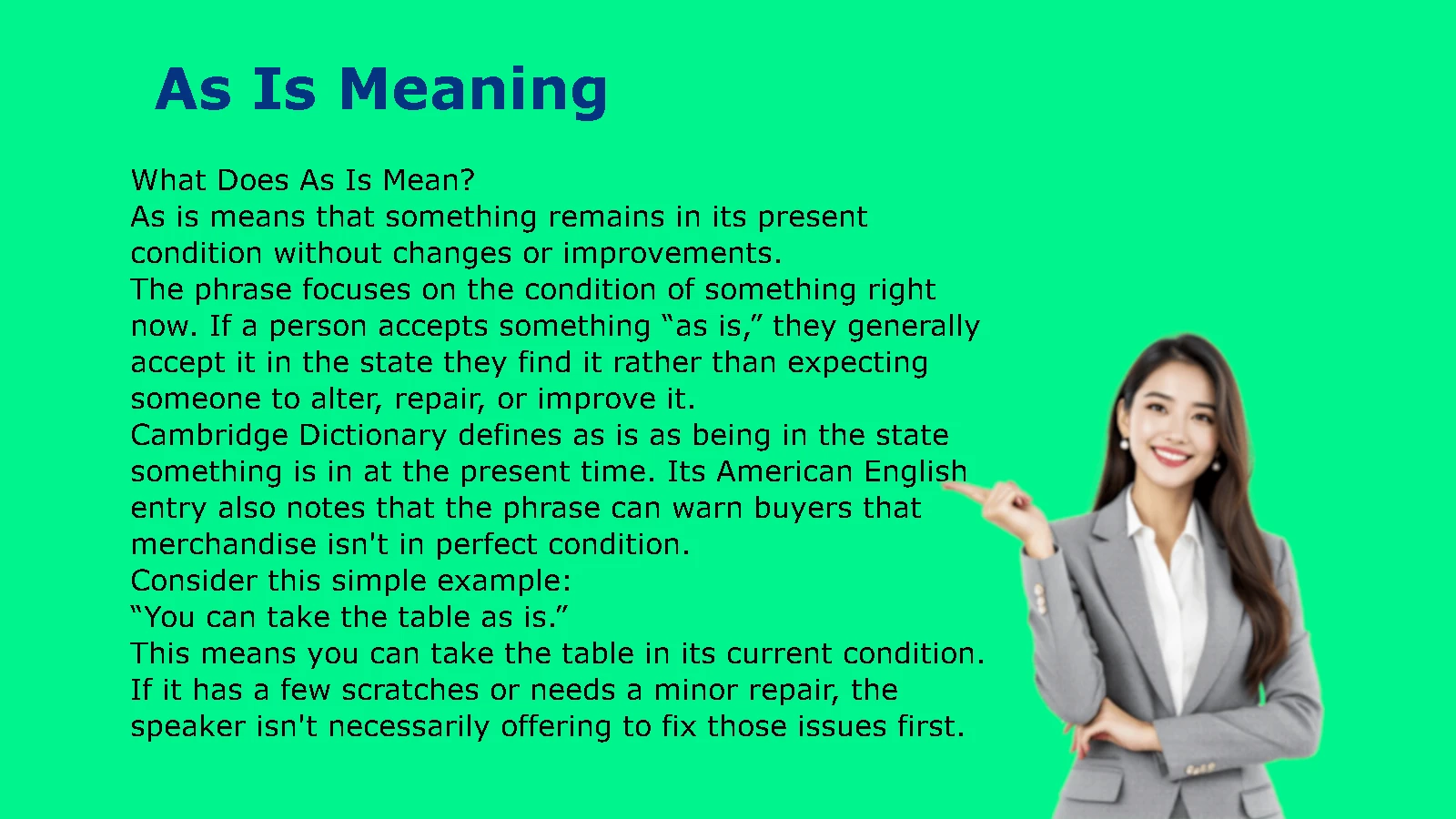
What Does As Is Mean?
As is means that something remains in its present condition without changes or improvements.
The phrase focuses on the condition of something right now. If a person accepts something “as is,” they generally accept it in the state they find it rather than expecting someone to alter, repair, or improve it.
Cambridge Dictionary defines as is as being in the state something is in at the present time. Its American English entry also notes that the phrase can warn buyers that merchandise isn’t in perfect condition.
Consider this simple example:
“You can take the table as is.”
This means you can take the table in its current condition. If it has a few scratches or needs a minor repair, the speaker isn’t necessarily offering to fix those issues first.
The phrase doesn’t automatically mean something is broken or defective. That’s an important distinction.
A perfectly functional item can still be sold as is. The phrase simply emphasizes that the item will remain in its existing condition.
Simple Definition of As Is
| Term | Meaning |
| As is | In the current condition |
| As is condition | The condition something has at the present time |
| Sold as is | Sold in its existing condition |
| Take it as is | Accept it without expecting changes |
| As is basis | Provided or accepted in its current condition |
Merriam Webster records the first known use of as is in the sense of its current condition in 1895.
As Is Meaning in Everyday English
In everyday English, as is usually has a straightforward meaning: leave something the way it currently is.
You don’t need a contract or a sale for the phrase to work. People use it when they want to describe something without changes.
For example:
- “You can eat the cake as is.”
- “I’ll submit the document as is.”
- “The room looks fine as is.”
- “You can use the computer as is.”
- “Let’s keep the design as is.”
- “I’ll send the report as is.”
- “Take the recipe as is and adjust it later.”
In each sentence, the phrase tells you that no immediate modification is expected.
Example: “The Report Is Fine As Is”
Imagine a coworker asks whether a report needs another round of editing.
You might say:
“I think the report is fine as is.”
Here, as is doesn’t mean the report contains errors. Instead, it means the report already works in its present form and doesn’t need additional changes.
That’s different from saying:
“The report is defective.”
The first statement concerns whether changes are needed. The second describes a problem with the report itself.
As Is Meaning in Buying and Selling
The phrase becomes more significant when you see it in a sales transaction.
When a seller says an item is “sold as is,” the seller generally means that the buyer is purchasing the item in its current condition rather than expecting the seller to make repairs or improvements.
Cambridge gives merchandise sold “as is” as a commercial use of the phrase and notes that it can warn buyers that an item isn’t in perfect condition.
You might see as is used for:
- Used cars
- Furniture
- Appliances
- Electronics
- Tools
- Collectibles
- Used machinery
- Secondhand equipment
- Real estate
What “Sold As Is” Tells the Buyer
A seller using this phrase may be signaling several things:
- The item is being sold in its current condition.
- The seller doesn’t plan to make certain repairs before the transaction.
- The buyer should inspect the item carefully.
- The buyer shouldn’t automatically expect improvements after purchase.
- The transaction may limit certain warranties or remedies, depending on the applicable law and contract.
That last point matters.
“As is” doesn’t have one universal legal effect in every transaction. The contract, applicable law, type of transaction, and other statements made by the seller can all matter.
What Does “As Is” Mean on a Used Car?
Used cars provide one of the clearest examples of the phrase.
Suppose a listing says:
“2016 sedan, sold as is.”
The seller is generally telling potential buyers that the vehicle will be sold in its existing condition. The seller isn’t promising to restore the car or fix every problem before the sale.
That doesn’t mean you should assume the car has a serious defect. It means you need to evaluate its condition rather than assuming the seller will correct problems later.
Before buying an as is vehicle, a sensible buyer might:
- Inspect the exterior and interior.
- Check the tires and visible mechanical components.
- Review maintenance records.
- Check the vehicle history.
- Test drive the car.
- Have an independent mechanic inspect it.
- Ask specific questions about known problems.
- Read the sales agreement carefully.
The basic principle is simple: don’t let two words replace due diligence.
A Practical Used Car Example
Imagine two cars have similar prices.
Car A comes with a seller’s warranty covering certain repairs.
Car B costs less but comes with an as is agreement.
The lower price on Car B might reflect the greater risk the buyer accepts. If the buyer discovers an expensive problem after the purchase, the buyer’s options may differ from those available under a warranty.
The phrase therefore isn’t merely descriptive in a transaction. It can affect how the parties understand their respective responsibilities.
As Is Meaning in Real Estate
You may also encounter as is when buying or selling a house.
An as is property generally means the buyer agrees to purchase the property in its current physical condition rather than requiring the seller to make requested repairs before closing.
For example:
“The house is being sold as is.”
This could mean the seller doesn’t intend to repair the cracked tile, repaint the bedrooms, replace an aging appliance, or address other issues before the transaction.
However, as is doesn’t automatically mean that a seller can ignore every legal obligation.
Real estate transactions are governed by applicable laws, disclosures, contracts, and other rules. The precise effect of an as is clause depends on the circumstances and jurisdiction.
Why Property Buyers Should Pay Attention
An as is sale makes inspection especially important.
A prospective buyer may want to consider:
- A professional home inspection
- Roof condition
- Plumbing
- Electrical systems
- Heating and cooling systems
- Foundation and structural concerns
- Water damage
- Mold or moisture issues
- Appliances
- Property disclosures
- Permit history where relevant
- The exact language of the purchase agreement
The key lesson is straightforward: an as is label should encourage careful inspection, not blind acceptance.
As Is Meaning in Contracts
In contracts, as is can become more than an ordinary description.
An as is clause can state that a buyer accepts an item in its existing condition and without certain promises about its quality. Merriam Webster’s Legal Dictionary describes an as is clause as a provision stating that the buyer accepts the item in its presently existing condition without modification or repair.
Cornell Law School’s Legal Information Institute similarly explains that an as is term in a sales contract generally concerns the buyer accepting a product in its current condition. It also notes that such clauses can disclaim implied warranties while not necessarily eliminating express warranties.
That distinction is crucial.
Implied vs. Express Warranties
An implied warranty can arise from the circumstances or law even when the seller doesn’t make a specific promise.
An express warranty, by contrast, generally comes from an explicit statement or promise about the product.
For example, suppose a seller says:
“This machine is sold as is, but the motor was replaced last month.”
The as is language and the specific statement about the motor can raise different questions. You shouldn’t assume that the general phrase automatically erases every specific representation made by the seller.
That’s why reading the entire agreement matters.
What an As Is Clause Can Do
Depending on the transaction and applicable law, an as is clause may:
- Establish that the buyer accepts the current condition.
- Reduce or disclaim certain implied warranties.
- Shift some risk of defects toward the buyer.
- Make inspection more important.
- Clarify that the seller won’t make certain repairs.
- Define the condition under which the item is being transferred.
But it doesn’t automatically override every legal requirement or every promise made elsewhere in an agreement.
Is As Is Always a Legal Term?
No.
As is is an ordinary English expression as well as a phrase used in legal and commercial settings.
You can say:
“The painting looks great as is.”
There’s nothing particularly legal about that sentence.
You can also see:
“Property sold as is.”
Now the phrase appears in a transaction where the wording may have contractual consequences.
The difference comes from context.
Think of “as is” as a tool. In everyday speech, it can simply describe the current state of something. In a contract, the same words can help define the parties’ agreement.
As Is vs. As It Is
People often confuse as is with as it is because the expressions overlap in meaning.
They aren’t always interchangeable.
As Is
As is usually emphasizes the current condition of something.
“Leave the furniture as is.”
This means leave the furniture in its current state.
As It Is
As it is can also mean in its current condition, but it has additional uses.
For example:
“As it is, we don’t have enough time to finish.”
Here, as it is means something closer to given the current situation or under the circumstances.
Compare these examples:
| Expression | Example | Meaning |
| As is | “Leave the room as is.” | Leave it unchanged |
| As it is | “As it is, we’re already late.” | Given the current situation |
| As is | “The furniture is sold as is.” | Sold in its current condition |
| As it is | “The system is difficult as it is.” | Already difficult under current circumstances |
So, while the phrases can overlap, as is more directly emphasizes an existing condition.
As Is vs. As-Is
Should you write as is or as-is?
The answer depends on how the phrase functions in the sentence.
“As Is” as an Adverbial Phrase
When the phrase follows a verb and describes the condition in which something remains or is accepted, as is is commonly written as two words.
Examples:
- “Leave it as is.”
- “I’ll use the document as is.”
- “The seller provided the equipment as is.”
“As-Is” as a Modifier
You may see as-is with a hyphen when it works as a compound modifier before a noun.
Examples include:
- as-is sale
- as-is condition
- as-is basis
- as-is purchase
For instance:
“The buyer agreed to an as-is sale.”
The exact style can vary by publication or legal drafting convention, so consistency matters.
What Does “On an As-Is Basis” Mean?
“On an as-is basis” means something is provided or accepted in its current condition, without expected modifications or improvements.
Businesses often use this phrase in agreements, listings, and commercial transactions.
For example:
“The equipment is provided on an as-is basis.”
The basic message is that the equipment comes in its existing condition.
However, don’t automatically interpret the phrase as meaning “the seller has no responsibility for anything whatsoever.” Contract language can contain additional warranties, representations, exclusions, or obligations.
When the stakes are high, the surrounding language matters far more than one familiar phrase.
Common Phrases With As Is
Several expressions use as is in slightly different ways.
Sold As Is
Sold as is means an item is being sold in its current condition.
“The used refrigerator is sold as is.”
This is especially common in secondhand sales.
Take It As Is
Take it as is means accept something in its current state.
“You can take the desk as is.”
In casual conversation, this doesn’t necessarily have legal implications.
Leave It As Is
Leave it as is means don’t change or modify something.
“The design looks good. Leave it as is.”
Accepted As Is
Accepted as is means someone accepts something in its existing condition.
“The equipment was accepted as is.”
This wording can appear in both ordinary and formal contexts.
Provided As Is
Provided as is means something is supplied in its current form.
“The sample data is provided as is.”
The phrase appears frequently when a provider doesn’t promise that the material will be customized or improved.
As Is, Where Is
As is, where is adds another idea: the item is being sold in its existing condition and at its current location.
Cambridge’s Business English Dictionary identifies as is, where is as a commercial expression used when something is sold in its present condition and at the place where it currently is.
For example:
“The machinery will be sold as is, where is.”
That wording can be particularly relevant when moving the item would involve transportation, dismantling, or additional costs.
As Is in Technology and Software
You can also encounter as is in technology.
A company might provide software, data, an API, documentation, or another digital resource as is.
For example:
“The sample code is provided as is.”
In plain English, that means the provider is giving you the code in its current form rather than promising to modify it for your particular needs.
You might also see language such as:
“The data is provided as is without guarantees regarding completeness.”
The exact effect depends on the terms governing the service or product.
For users, the practical lesson remains the same: read the terms rather than relying on the label alone.
As Is Meaning in Business Communication
The phrase can also help businesses communicate efficiently.
Suppose a manager reviews a draft and says:
“Send it as is.”
The manager probably means the draft doesn’t need further edits.
That differs from:
“Send it after you fix the formatting.”
The first instruction accepts the current version. The second requires changes.
Here are some natural workplace examples:
- “The client approved the design as is.”
- “Please forward the document as is.”
- “The data can be used as is.”
- “We’ll keep the current process as is.”
- “The presentation is ready as is.”
In these examples, as is often saves several words while communicating the same idea.
Examples of As Is in Sentences
Context gives the phrase its practical meaning. Here are examples from different situations.
Everyday Examples
“The soup tastes good as is.”
Meaning: The soup doesn’t need additional ingredients.
“You can leave the picture as is.”
Meaning: Don’t change the picture.
“The room is comfortable as is.”
Meaning: The room doesn’t need adjustments.
Shopping Examples
“The chair is being sold as is.”
Meaning: The buyer receives the chair in its current condition.
“This laptop is sold as is with no repairs.”
Meaning: The seller isn’t promising to repair it before the sale.
Workplace Examples
“The report is ready as is.”
Meaning: No additional editing is needed.
“Send the proposal as is.”
Meaning: Send the current version without changing it.
Real Estate Example
“The property is offered for sale as is.”
Meaning: The buyer should understand that the property is being offered in its current condition, subject to the agreement and applicable law.
Technology Example
“The software is provided as is.”
Meaning: The software is supplied in its existing form, with the precise limitations determined by the applicable terms.
What As Is Does Not Automatically Mean
The phrase often gets misunderstood because people treat it as if it has one fixed meaning in every situation.
It doesn’t.
As is does not automatically mean:
- The item is broken.
- The item is worthless.
- The seller can make any statement without consequences.
- The buyer has no rights under any circumstances.
- Every warranty disappears automatically.
- The seller can ignore applicable laws.
- The buyer should skip an inspection.
- The item has hidden defects.
- The transaction is necessarily unfair.
The exact consequences depend on the surrounding circumstances.
For legal transactions, the contract and applicable law deserve careful attention. Cornell’s Legal Information Institute specifically notes that an as is provision can disclaim implied warranties while distinguishing those from express warranties.
Common Mistakes When Using As Is
A few mistakes appear again and again.
Assuming As Is Means Defective
This is probably the most common misunderstanding.
An item can be perfectly usable and still be sold as is.
For example, a retailer might sell a display model as is because it has been handled or displayed. That doesn’t necessarily mean the item is unusable.
Assuming As Is Means No Rights
Another mistake is treating the phrase as an absolute legal shield.
Contract law is more complicated than that. Specific terms, warranties, representations, consumer protection rules, and other laws can affect the transaction.
Confusing As Is With As It Is
Although they can overlap, the expressions aren’t identical in every sentence.
As is usually focuses on an existing condition.
As it is can describe an existing situation or introduce a consequence based on current circumstances.
Using As-Is Everywhere
The hyphenated form isn’t automatically correct in every sentence.
Compare:
“Leave the equipment as is.”
with:
“This is an as-is sale.”
The grammatical role changes, so the punctuation can change too.
Case Study: Buying an As Is Used Appliance
Imagine someone finds a used washing machine for $150. The listing says:
“Works, but sold as is.”
The buyer could interpret this as a warning to inspect the appliance carefully.
Before purchasing, the buyer checks the power connection, runs a short cycle, examines the hoses, looks for visible leaks, and asks whether the machine has known problems.
The buyer discovers that the machine makes a loud noise during the spin cycle.
At that point, the buyer has useful information. The buyer can decide whether the lower price justifies the risk.
The lesson isn’t that as is means “bad product.” The lesson is that the buyer should evaluate the existing condition rather than expecting the seller to make it better later.
Case Study: An As Is Property
Now consider a house listed as “sold as is.”
During an inspection, the buyer discovers an aging roof and an outdated electrical panel. The buyer now has concrete information about the property’s condition.
Instead of assuming that the seller will automatically fix these issues, the buyer reviews the contract and considers the available options under the applicable law.
The important point is that “as is” describes the basis of the transaction, but the phrase doesn’t replace the rest of the legal and factual analysis.
Synonyms and Alternatives for As Is
There isn’t one perfect synonym for as is in every context.
The best alternative depends on what you want to communicate.
| Alternative | Best Use | Example |
| In its current condition | Formal or clear writing | “The item is sold in its current condition.” |
| In its present condition | Formal writing | “The property remains in its present condition.” |
| In its current state | General English | “The project works in its current state.” |
| Without changes | Simple explanations | “Leave the design without changes.” |
| Without modification | Technical or formal writing | “The file can be used without modification.” |
| Without repairs | Sales involving physical goods | “The vehicle is sold without repairs.” |
| As it stands | Everyday and informal English | “The plan works as it stands.” |
These alternatives aren’t always exact replacements.
For example, without repairs is narrower than as is. A product could be sold as is even if it doesn’t need repairs.
As Is vs. Similar Expressions
Several phrases sound similar but communicate different ideas.
| Phrase | Main Meaning |
| As is | In the current condition |
| As it is | In the current state or under current circumstances |
| As it stands | According to the current situation or version |
| Without modification | With no changes |
| As seen | In the condition observed, often in sales contexts |
| With all faults | Accepted with defects or shortcomings included |
| Buyer beware | The buyer should exercise caution and investigate |
The differences become especially important in formal transactions.
Is “As Is” the Same as “No Warranty”?
Not necessarily.
The expressions can overlap, especially in sales agreements, but they aren’t automatically identical.
An as is clause generally addresses the condition in which something is accepted or sold. A warranty concerns a promise or assurance about the item.
Cornell’s Legal Information Institute explains that an as is sale can disclaim implied warranties while noting that express warranties are treated differently.
So, if a contract contains both an as is provision and a specific warranty, you shouldn’t assume one phrase cancels the other.
Read the complete agreement.
Frequently Asked Questions About As Is
What does as is mean in simple terms?
As is means in the condition something currently has, without changes or modifications.
If someone says, “Take it as is,” they generally mean you should accept it in its present condition.
Does as is mean something is damaged?
No.
Something can be sold or used as is even when it works properly. The phrase describes the condition or basis of acceptance. It doesn’t automatically establish that an item is damaged.
What does sold as is mean?
Sold as is generally means the seller is offering the item in its existing condition rather than promising to repair or improve it before the sale.
The legal consequences can depend on the contract and applicable law.
What does as is mean on a car?
It generally means the buyer accepts the vehicle in its current condition. The buyer should inspect the car carefully and review the purchase agreement before completing the transaction.
What does as is mean in real estate?
It generally means a property is being offered in its existing condition and the seller isn’t agreeing to make requested repairs simply because the buyer would prefer them.
However, real estate laws and disclosure requirements vary, so the phrase doesn’t automatically eliminate every seller obligation.
Is as is one word?
No. As is is normally written as two words when used as the phrase itself.
You may see as-is when the expression functions as a compound modifier, such as “an as-is sale.”
What is another way to say as is?
Depending on the context, you can say:
- In its current condition
- In its present condition
- In its current state
- Without modification
- Without changes
- As it stands
The best choice depends on the sentence.
What does take it as is mean?
Take it as is means accept something in its current condition without expecting changes or improvements.
What does as is, where is mean?
As is, where is generally means something is sold in its existing condition and at its current location. Cambridge identifies it as a commercial expression.
Quick Reference: As Is Meaning
| Question | Short Answer |
| What does as is mean? | In its current condition |
| What does sold as is mean? | Sold in its existing condition |
| Does as is mean damaged? | No |
| Is as is a legal term? | It can be used in legal agreements, but it’s also ordinary English |
| What does as is basis mean? | Something is provided or accepted in its existing condition |
| Is as is hyphenated? | Usually two words as a phrase; hyphenation can occur when it modifies a noun |
| Is as is the same as as it is? | Not always |
| Does as is always remove warranties? | No; the effect depends on the contract and applicable law |
| What is a synonym for as is? | “In its current condition” is a close alternative |
Final Takeaway: As Is Meaning
The simplest as is meaning is “in the condition something is currently in, without changes or modifications.” Merriam Webster, Cambridge Dictionary, and other major reference sources support this core definition.
In everyday conversation, the phrase is usually easy to understand:
“Leave it as is.”
That means don’t change it.
In buying and selling, however, as is deserves closer attention. A phrase such as “sold as is” generally tells the buyer that the item is being offered in its current condition. In contracts, an as is clause can also affect warranties and the allocation of risk, depending on the agreement and applicable law.
The most important point is this: as is doesn’t automatically mean defective, worthless, or free from every legal obligation. Context determines what the phrase communicates and what consequences it may have.
When you see as is, think of one simple idea first: what you see is the condition being offered now. If money, property, or a formal agreement is involved, go one step further. Check the details, inspect what you’re receiving, and read the complete terms rather than relying on two words alone.