
What Is the Hanged Meaning?
Hanged is the past tense and past participle of hang when referring to execution by hanging or death by suspension. In most other situations, such as hanging a picture, clothes, or decorations, the correct word is hung.
Examples:
- The criminal was hanged for his crimes.
- She hung the painting on the wall.
Understanding the hanged meaning helps
The confusion often begins when people search for the meaning of hanged, hanged definition, hanged pronunciation, or hanged vs hung. And here’s the kicker: using the wrong word can change the meaning of your sentence, especially when talking about legal history, executions, or everyday situations.
In this guide, you’ll learn the Hanged Meaning, discover the correct usage of hanged, understand when to use hanged vs hung, and see clear hanged examples in sentences. You’ll also learn how to pronounce hanged, explore its origin, and understand why dictionaries reserve hanged for a very specific context.
Hanged Meaning
The hanged meaning is straightforward but very specific.
Hanged is the past tense and past participle of the verb hang only when it means executing someone by suspending them with a rope around the neck.
In every other situation, the correct past tense is hung.
| Word | Meaning | Example |
| Hanged | Executed by hanging | The prisoner was hanged after the trial. |
| Hung | Suspended or attached | She hung the painting above the fireplace. |
This distinction makes hang one of the few English verbs with two accepted past tense forms, each serving a different purpose.
Pronunciation
- Hanged: /hæŋd/
- Rhymes with banged and ranged
Part of Speech
| Form | Word |
| Verb | Hang |
| Past Tense | Hanged (execution only) |
| Past Tense | Hung (all other meanings) |
| Past Participle | Hanged / Hung |
Quick Answer
Hanged means executed by hanging, usually after a legal sentence or in historical accounts. Although both hanged and hung come from the verb hang, hanged is reserved for executions involving people. For every other meaning, including hanging objects, clothing, decorations, or artwork, hung is the correct choice.
What Does Hanged Mean?
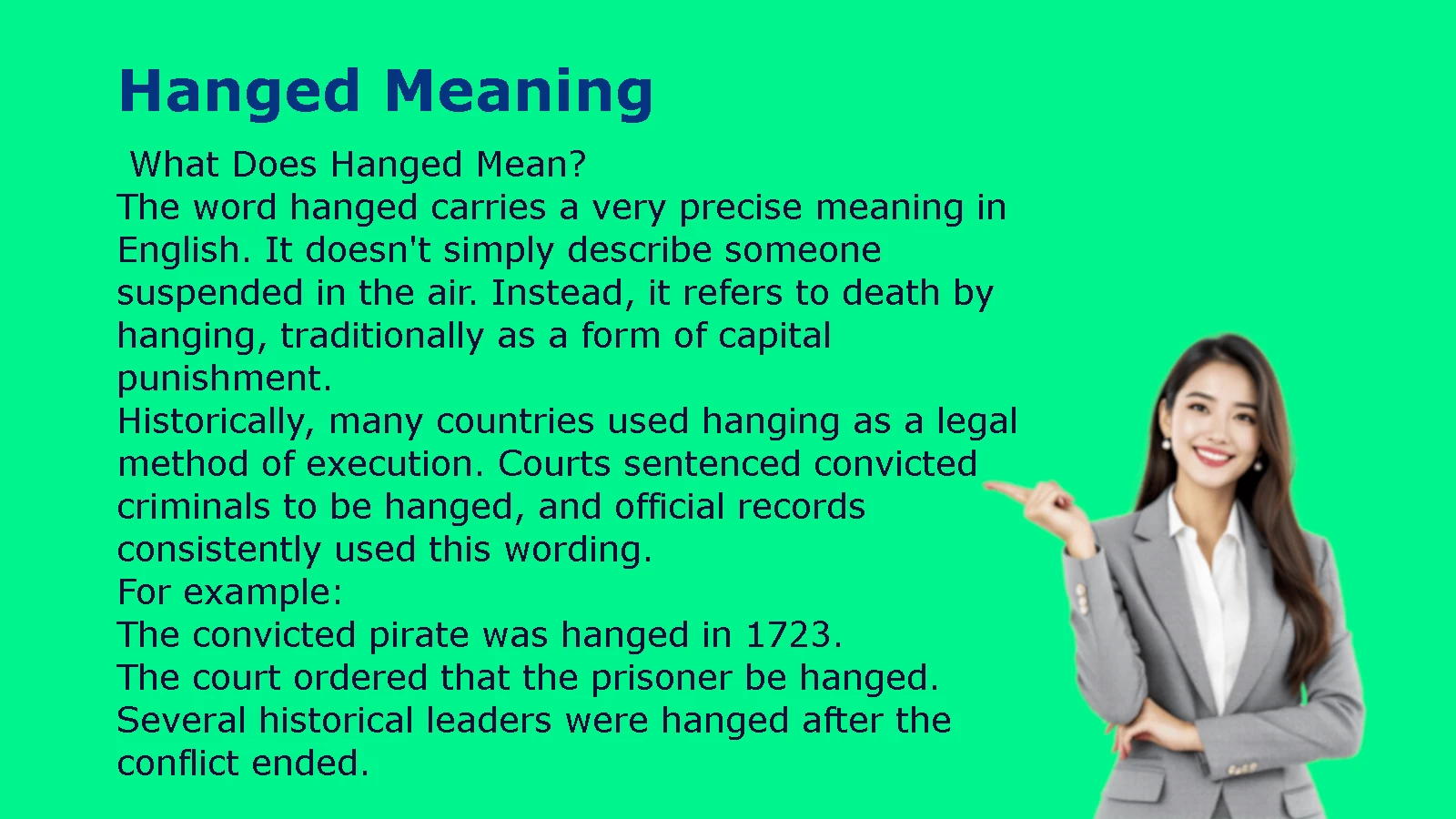
The word hanged carries a very precise meaning in English. It doesn’t simply describe someone suspended in the air. Instead, it refers to death by hanging, traditionally as a form of capital punishment.
Historically, many countries used hanging as a legal method of execution. Courts sentenced convicted criminals to be hanged, and official records consistently used this wording.
For example:
- The convicted pirate was hanged in 1723.
- The court ordered that the prisoner be hanged.
- Several historical leaders were hanged after the conflict ended.
In modern English, the word appears mostly in:
- History books
- Legal documents
- Historical fiction
- News reports discussing historical events
- Academic writing
Outside these contexts, you’ll rarely encounter it in everyday conversation.
Historical Meaning
For hundreds of years, hanged described one of the most common forms of judicial execution.
Countries including England, the United States, Canada, Australia, and many others once used hanging as an official punishment for serious crimes.
Because legal records repeatedly used phrases like:
- “was hanged”
- “to be hanged by the neck”
- “sentenced to be hanged”
the form became fixed in English grammar.
Even after many countries abolished hanging as capital punishment, the grammatical distinction remained.
Modern Legal Meaning
Today, some legal systems still use or recognize hanging as a method of execution, although many nations have abolished capital punishment altogether.
When discussing those legal contexts, writers still use hanged rather than hung.
For instance:
- He was hanged following his conviction.
- The sentence stated that the defendant would be hanged.
These examples follow standard English grammar because they refer to execution rather than simply suspending someone.
Is “Hanged” a Real Word?
Yes. Hanged is absolutely a real word and remains grammatically correct.
Some learners assume hung has completely replaced hanged, but that’s incorrect.
Major dictionaries continue to list hanged as the correct past tense of hang when referring to execution.
The important point is that hanged has a very narrow use.
Think of it as a specialized grammatical exception rather than the default past tense.
Why Does English Keep This Exception?
English changes over time, yet some distinctions survive because they improve clarity.
Imagine these two sentences:
- The prisoner was hung yesterday.
- The prisoner was hanged yesterday.
The second sentence immediately tells readers the person was executed.
The first sentence could confuse readers because hung usually means suspended rather than executed.
Keeping hanged for executions removes ambiguity.
Hanged vs Hung: What’s the Difference?
This is where many English learners—and even native speakers—make mistakes.
Although both words come from the same verb, they don’t mean the same thing.
| Hanged | Hung |
| Used only for executions | Used for everything else |
| Refers to a person executed by hanging | Refers to suspending objects or people without the meaning of execution |
| Legal and historical contexts | Everyday English |
| Rarely used in conversation | Used daily |
The Simple Grammar Rule
Remember this one sentence:
If someone died as a legal execution, use “hanged.” Otherwise, use “hung.”
That’s the rule nearly every style guide follows.
Examples of “Hanged”
- The outlaw was hanged after the trial.
- The king ordered that the traitor be hanged.
- Several prisoners were hanged during the nineteenth century.
- Historical records confirm they were hanged.
Examples of “Hung”
- She hung a mirror in the hallway.
- We hung Christmas lights on the roof.
- He hung his coat by the door.
- The artist hung her paintings in the gallery.
- They hung colorful banners across the street.
Notice how none of these involve execution.
Memory Trick
A simple way to remember the difference is this:
| Situation | Correct Word |
| Person executed | Hanged |
| Picture on a wall | Hung |
| Clothes on a hanger | Hung |
| Curtains | Hung |
| Decorations | Hung |
| Historical execution | Hanged |
If you’re talking about an object, your answer will almost always be hung.
When Should You Use “Hanged”?
You should use hanged only when discussing execution by hanging.
Because the word has such a limited purpose, it usually appears in formal or historical writing.
H3: Legal Context
Legal documents often preserve traditional wording.
Examples include:
- The judge sentenced the prisoner to be hanged.
- Court records state that he was hanged.
- The execution was carried out by hanging.
Although modern legal systems vary around the world, historical legal language still uses hanged.
H3: Historical Writing
History books frequently use this form because they describe real events.
Examples:
- The rebel leader was hanged in the town square.
- Several pirates were hanged after capture.
- The convicted spy was hanged during wartime.
Using hung here would be grammatically incorrect because the sentence describes execution.
H3: Fiction and Literature
Historical novels, mystery stories, and courtroom dramas often use hanged when depicting executions.
Example:
The sheriff announced that the outlaw would be hanged at sunrise.
Because the sentence involves capital punishment, hanged is the correct choice.
When Should You Use “Hung” Instead?
Fortunately, this rule is much easier.
Use hung for nearly every ordinary situation.
That includes anything suspended, displayed, attached, or dangling.
Here are common examples:
- Hung a picture
- Hung a painting
- Hung a clock
- Hung curtains
- Hung a flag
- Hung decorations
- Hung lights
- Hung a sign
- Hung clothes
- Hung towels
- Hung a wreath
- Hung artwork
- Hung shelves
- Hung a mobile over a crib
- Hung wind chimes
- Hung stockings by the fireplace
Everyday Sentence Examples
- She hung fresh curtains in the bedroom.
- They hung family photos along the staircase.
- The restaurant hung handmade artwork on every wall.
- He hung his backpack on a hook.
- Volunteers hung banners before the festival began.
These examples reflect the way most people use the verb hang in everyday conversation.
Examples of “Hanged” in Sentences
Seeing the word in context makes the rule much easier to remember.
Formal Examples
- The court ruled that the criminal would be hanged.
- According to official records, the prisoner was hanged after the verdict.
- The sentence specified that the execution would be carried out by hanging.
Historical Examples
- The accused witch was hanged during the seventeenth century.
- Several rebels were hanged after the uprising failed.
- Historical documents reveal that the pirate captain was hanged upon capture.
News-Style Examples
- The museum exhibit explains why prisoners were hanged centuries ago.
- Researchers uncovered documents describing how convicted criminals were hanged under the old legal system.
Literature-Inspired Examples
The condemned man stood silently, knowing he would be hanged at dawn.
This sentence reflects the traditional literary use of the word and preserves its historical meaning.
Examples of “Hung” for Comparison
Understanding both forms side by side helps prevent mistakes.
| Sentence | Correct Word | Why? |
| She ___ a painting in the hallway. | Hung | An object is suspended. |
| The prisoner was ___ after the trial. | Hanged | Refers to execution. |
| They ___ colorful lights across the street. | Hung | Decorations are suspended. |
| Historical records say the outlaw was ___. | Hanged | Execution context. |
| He ___ his jacket behind the door. | Hung | Clothing is suspended. |
The comparison shows that the distinction depends entirely on meaning, not on the subject or sentence structure.
Why Is “Hanged” an Exception in English Grammar?
English contains many irregular verbs, but hang is unusual because it has two accepted past tense forms, each tied to a different meaning.
Centuries ago, hanged served as the regular past tense of hang in nearly every context. Over time, everyday speech shifted toward hung because it sounded simpler and became more common in ordinary conversation.
However, legal and historical language preserved hanged for executions. Court records, government documents, and historical accounts continued using the older form, and that usage eventually became a fixed grammatical rule.
Today, this distinction helps readers understand the intended meaning immediately. If a sentence says someone was hanged, readers recognize it as an execution. If it says something was hung, they understand it was simply suspended or displayed.
That small difference carries significant meaning, which is why modern dictionaries, grammar guides, and style manuals continue to recognize both forms while assigning each a distinct purpose.
Common Mistakes People Make with Hanged and Hung
Even experienced writers occasionally confuse hanged and hung because both come from the same verb. The mistake usually happens when people assume hung works in every situation. In reality, the context determines which word you need.
Let’s look at the most common errors and how to avoid them.
Mistake 1: Using Hung for an Execution
❌ The prisoner was hung after the trial.
✅ The prisoner was hanged after the trial.
Since the sentence describes a legal execution, hanged is the only correct choice.
Mistake 2: Using Hanged for Everyday Objects
❌ She hanged the picture above the sofa.
✅ She hung the picture above the sofa.
Pictures, mirrors, clocks, and decorations are hung, not hanged.
Mistake 3: Assuming Both Words Are Interchangeable
Some learners think both forms are acceptable because they appear in dictionaries. While both are legitimate words, they don’t share the same meaning.
Compare these sentences:
- The portrait was hung in the museum. ✔️
- The outlaw was hanged after the trial. ✔️
Switching the words changes the sentence from correct to incorrect.
Mistake 4: Ignoring Historical Context
Historical writing often discusses punishments carried out centuries ago. In those cases, the correct word remains hanged.
Example:
❌ The pirate was hung in 1715.
✅ The pirate was hanged in 1715.
The date doesn’t change the grammar. If the sentence refers to execution, use hanged.
Mistake 5: Misusing the Word in Figurative Expressions
Many English idioms use hung, not hanged.
For example:
- Hung out to dry
- Hung by a thread
- Hung up on someone
None of these expressions involve execution, so hanged would be incorrect.
Quick Correction Table
| Incorrect | Correct | Why |
| The prisoner was hung. | The prisoner was hanged. | Refers to execution. |
| She hanged the painting. | She hung the painting. | Objects are hung. |
| They hanged decorations. | They hung decorations. | Decorations are suspended. |
| The king ordered him hung. | The king ordered him hanged. | Execution context. |
| We hanged lights outside. | We hung lights outside. | Lights are objects. |
Memory Trick to Remember Hanged vs Hung
Grammar rules stick better when you attach them to something memorable. Fortunately, this one is simple.
People executed = Hanged
Everything else = Hung
That’s the rule in a nutshell.
Another easy trick is to ask yourself one question before writing:
“Did someone die as a punishment?”
- If yes, write hanged.
- If no, write hung.
It takes only a second, yet it prevents one of the most common grammar mistakes in English.
Visual Memory Chart
| Situation | Word to Use |
| Court-ordered execution | Hanged |
| Historical execution | Hanged |
| Picture on a wall | Hung |
| Coat on a hook | Hung |
| Christmas lights | Hung |
| Mirror | Hung |
| Flag | Hung |
| Curtains | Hung |
| Artwork | Hung |
If you remember nothing else from this guide, remember that table.
A Simple Story to Help You Remember
Imagine you’re decorating your living room.
You hung new curtains.
You hung family photographs.
Now imagine you’re reading a history book about an old criminal trial.
The prisoner was hanged.
Different situation. Different word.
The contrast makes the rule easy to recall.
Synonyms of Hanged
Since hanged has such a specific meaning, only a few words work as true substitutes. Some appear in legal writing, while others fit historical or literary contexts.
| Synonym | Best Used In | Notes |
| Executed | Legal, news, history | Closest general synonym |
| Put to death | Formal writing | Neutral expression |
| Sentenced to death | Before execution | Refers to the legal decision, not the act itself |
| Judicially executed | Academic writing | Highly formal |
| Capital punishment carried out | Legal discussions | Describes the process rather than the action |
Synonyms in Sentences
- The prisoner was executed after the appeal failed.
- The convicted murderer was put to death according to the law at that time.
- He was sentenced to death, although the punishment was later delayed.
Notice that each sentence changes the wording while keeping the overall meaning.
Words That Are Not Synonyms
Some words seem similar but actually describe different situations.
| Word | Why It Isn’t a True Synonym |
| Strangled | Death caused by pressure on the neck, not necessarily hanging. |
| Lynched | Illegal killing by a mob rather than a court-ordered execution. |
| Choked | Refers to blocked airflow, not execution. |
| Suspended | Means hanging without implying death. |
Understanding these differences improves both accuracy and clarity.
Antonyms of Hanged
Antonyms depend on context because hanged describes a legal punishment.
Here are several words with opposite meanings.
| Antonym | Meaning |
| Acquitted | Found not guilty |
| Released | Freed from custody |
| Pardoned | Officially forgiven |
| Spared | Saved from punishment |
| Exonerated | Proven innocent |
| Freed | Allowed to leave captivity |
Examples
- The suspect was acquitted because of insufficient evidence.
- The governor pardoned the prisoner.
- She was released after the investigation ended.
- The defendant was exonerated decades later through DNA evidence.
These words don’t simply mean “not hanged.” Instead, they describe legal outcomes that prevent or reverse punishment.
Idioms and Expressions Related to Hang
Many English expressions use the verb hang, yet none of them use hanged because they don’t refer to execution.
Understanding these idioms helps you recognize the difference instantly.
Hang in There
Meaning: Stay patient or don’t give up.
Example:
Hang in there. Things will improve soon.
Hang On
Meaning: Wait for a moment.
Example:
Hang on while I check the schedule.
Hang Around
Meaning: Spend time in a place without a specific purpose.
Example:
Teenagers often hang around the park after school.
Hang Up
This expression has several meanings.
End a Phone Call
She hung up before I finished speaking.
Attach Something to a Hook
He hung up his jacket.
Emotional Meaning
He’s still hung up on his first love.
In the last example, hung up means emotionally attached or unable to move on.
Hang by a Thread
Meaning: To be in great danger or uncertainty.
Example:
The company’s future hung by a thread after losing its biggest customer.
Hung Out to Dry
Meaning: Left without support during a difficult situation.
Example:
The employee felt hung out to dry after management refused to defend him.
Hang Fire
Meaning: Delay taking action.
Example:
Let’s hang fire until we receive more information.
Hang Over Someone
Meaning: Continue affecting someone emotionally or mentally.
Example:
The mistake hung over him for years.
Common Phrasal Verbs with Hang
| Phrasal Verb | Meaning | Example |
| Hang on | Wait | Hang on a minute. |
| Hang around | Stay nearby | We hung around after the game. |
| Hang out | Spend time socially | They hang out every weekend. |
| Hang up | End a call | She hung up quickly. |
| Hang back | Hesitate | He hung back before answering. |
| Hang together | Unite | The team hung together under pressure. |
These expressions appear in everyday English far more often than hanged, making them useful for learners to master.
Real-World Examples of Hanged in Literature, History, and Law
Because hanged belongs to a specialized category, you’ll mostly encounter it in historical records, legal writing, biographies, and classic literature.
Here are a few examples that illustrate correct usage.
Historical Writing
The rebel leaders were hanged after the uprising was suppressed.
This sentence accurately describes a historical execution.
Several pirates were hanged at London’s Execution Dock during the eighteenth century.
Again, the context is judicial punishment.
Legal Writing
Court records traditionally used wording such as:
The defendant was sentenced to be hanged by the neck until dead.
Although modern legal systems often use different forms of punishment, this wording appears in historical statutes and archived court documents.
Literature
Many classic novels use hanged correctly when describing executions.
For example:
The condemned man knew he would be hanged at sunrise.
The sentence immediately signals that the character faces execution rather than simply being suspended.
Case Study: Why One Word Can Change the Meaning of a Sentence
Imagine a museum preparing two exhibit descriptions.
Version A
The prisoner was hung after his conviction.
Some visitors may pause because hung usually describes objects like paintings or decorations. The sentence sounds awkward and may create confusion.
Version B
The prisoner was hanged after his conviction.
This wording clearly communicates that the person was executed following a legal judgment.
The change involves only one letter, yet it completely removes ambiguity.
That’s exactly why English preserves the distinction between hanged and hung.
Expert Insight
“Use hanged only when referring to execution. For all other meanings of hang, use hung.”
This guidance appears consistently across respected English grammar references and editorial style recommendations. It remains one of the clearest examples of how context—not just verb tense—determines the correct word choice.
Frequently Asked Questions About Hanged Meaning
What is the meaning of hanged?
The meaning of hanged is executed by hanging, usually as a legal or historical form of capital punishment. It is the correct past tense and past participle of hang only when referring to an execution.
Example:
The convicted criminal was hanged after the court’s final decision.
If the sentence doesn’t involve an execution, hung is almost always the correct word.
Is it hanged or hung?
Both words are correct, but they have different meanings.
- Use hanged when talking about a person executed by hanging.
- Use hung when talking about objects or anything suspended.
| Situation | Correct Word |
| A prisoner executed | Hanged |
| A picture on a wall | Hung |
| A coat on a hook | Hung |
| A historical execution | Hanged |
| Holiday decorations | Hung |
The meaning of the sentence determines the correct choice.
Why do we say hanged instead of hung?
English preserved hanged as a special grammatical form to distinguish executions from ordinary uses of hang.
Without this distinction, sentences could become confusing.
Compare these examples:
- The prisoner was hanged. ✔️ (Executed)
- The jacket was hung. ✔️ (Suspended)
Using different words keeps the meaning clear.
Can a picture be hanged?
No.
A picture should always be hung.
Correct examples include:
- She hung the painting in the living room.
- They hung family photographs on the wall.
- We hung a large mirror above the fireplace.
Because these sentences involve objects rather than executions, hung is the only correct choice.
Is “He was hung” grammatically correct?
It depends on the intended meaning.
If you mean the person was executed, then no.
✔️ He was hanged.
If you mean someone or something was suspended without the idea of execution, hung is correct.
Context always determines the right word.
Is hanged still used today?
Yes.
Although executions by hanging are uncommon in many countries today, hanged remains the standard word in:
- History books
- Academic writing
- Legal discussions
- Historical documentaries
- Historical fiction
- News reports about historical events
Modern English still recognizes the distinction because it provides precision.
Why is hanged only used for people?
The special form developed through centuries of legal and historical usage.
Courts consistently used phrases like:
- to be hanged
- was hanged
- hanged by the neck
As hung became the preferred past tense in everyday English, legal language continued using hanged for executions.
Eventually, this difference became a fixed grammar rule.
What is the difference between hanged and hung in grammar?
The difference comes down to meaning, not verb tense.
| Word | Use |
| Hanged | Execution by hanging |
| Hung | Everything else |
This distinction makes hang unusual because it has two accepted past tense forms with different meanings.
Is hang an irregular verb?
Yes.
The verb hang is considered an irregular verb because it has two accepted past tense and past participle forms.
| Base Form | Past Tense | Past Participle |
| Hang | Hung / Hanged | Hung / Hanged |
However, each form applies to a different context.
Which form appears more often in everyday English?
Without question, hung is far more common.
People use it every day when talking about:
- Hanging pictures
- Hanging curtains
- Hanging lights
- Hanging clothes
- Hanging decorations
- Hanging signs
- Hanging artwork
By contrast, hanged appears mainly in historical, legal, and educational contexts.
Quick Grammar Summary
If you only remember one thing from this guide, make it this table.
| If You’re Talking About… | Use This Word |
| Capital punishment | Hanged |
| Court-ordered execution | Hanged |
| Historical execution | Hanged |
| A picture | Hung |
| A mirror | Hung |
| Clothes | Hung |
| Curtains | Hung |
| Decorations | Hung |
| Artwork | Hung |
| Holiday lights | Hung |
This simple rule works in almost every situation.
Common Examples at a Glance
Correct
- The prisoner was hanged.
- The pirate was hanged in 1718.
- The judge ordered the execution, and the sentence was carried out.
- She hung a painting.
- He hung his jacket.
- They hung colorful lights.
- We hung a new clock in the kitchen.
Incorrect
- ❌ The prisoner was hung after the trial.
- ❌ She hanged the curtains.
- ❌ They hanged a mirror above the fireplace.
- ❌ We hanged Christmas decorations.
These mistakes are easy to avoid once you know the rule.
Case Study: A Student’s Grammar Mistake
Imagine a college student writing a history essay.
They write:
The captured pirate was hung in 1720.
Their professor marks the sentence as incorrect.
The student revises it:
The captured pirate was hanged in 1720.
Now the sentence follows standard English grammar and accurately describes a historical execution.
Later in the essay, the student writes:
The museum hung portraits of famous sailors.
This sentence is also correct because portraits are objects, not people facing execution.
The lesson is simple: the same verb changes based on the context.
Why This Grammar Rule Still Matters
At first, the difference between hanged and hung may seem minor. However, precision matters in writing.
Using the correct form:
- Improves clarity.
- Demonstrates strong grammar skills.
- Prevents misunderstandings.
- Makes historical and legal writing more accurate.
- Helps students succeed in exams and assignments.
- Builds confidence in professional communication.
Even native English speakers occasionally mix up these words, which makes learning the distinction worthwhile.
As the novelist Mark Twain famously observed:
“The difference between the almost right word and the right word is really a large matter.”
That idea fits this grammar rule perfectly. One extra letter changes the entire meaning of a sentence.
Key Takeaways About Hanged Meaning
Here’s a quick recap of everything you’ve learned.
- Hanged means executed by hanging.
- It is the correct past tense of hang only in the context of execution.
- Hung is the correct form for pictures, clothes, signs, decorations, artwork, and every other ordinary use.
- The distinction has existed for centuries and remains part of modern English grammar.
- Most dictionaries and style guides continue to preserve this rule.
- Understanding the difference helps you write more accurately and confidently.
Final Thoughts on Hanged Meaning
The hanged meaning is one of the clearest examples of how English grammar preserves history through language. While most verbs have a single past tense, hang follows a rare exception that depends entirely on context.
Whenever you’re describing a legal or historical execution, hanged is the correct choice. In nearly every other situation, hung is the word you need.
It’s a small distinction, yet it carries significant weight. Choosing the right form not only improves your grammar but also ensures your writing communicates exactly what you intend.