
What Is the Waked Meaning?
Waked is a less common past tense and past participle of wake. It is mainly used in older, literary, or regional English. In modern English, woke is the usual past tense, while woken is the standard past participle.
Examples:
- She waked before sunrise. (literary)
- He woke up early for work.
- The baby was woken by the loud noise.
The confusion comes from the fact that waked is a valid past tense of wake in certain contexts, but it’s far less common than woke or woken. And here’s the kicker: using the wrong form can make your writing sound unnatural or grammatically incorrect.
In this guide, you’ll discover the Waked Meaning, learn the definition of waked, understand waked vs woke vs woken, and see waked examples in real sentences. You’ll also learn when to use waked, how to pronounce waked, whether waked is a real word, and why modern English usually prefers other forms of the verb.
Waked Meaning
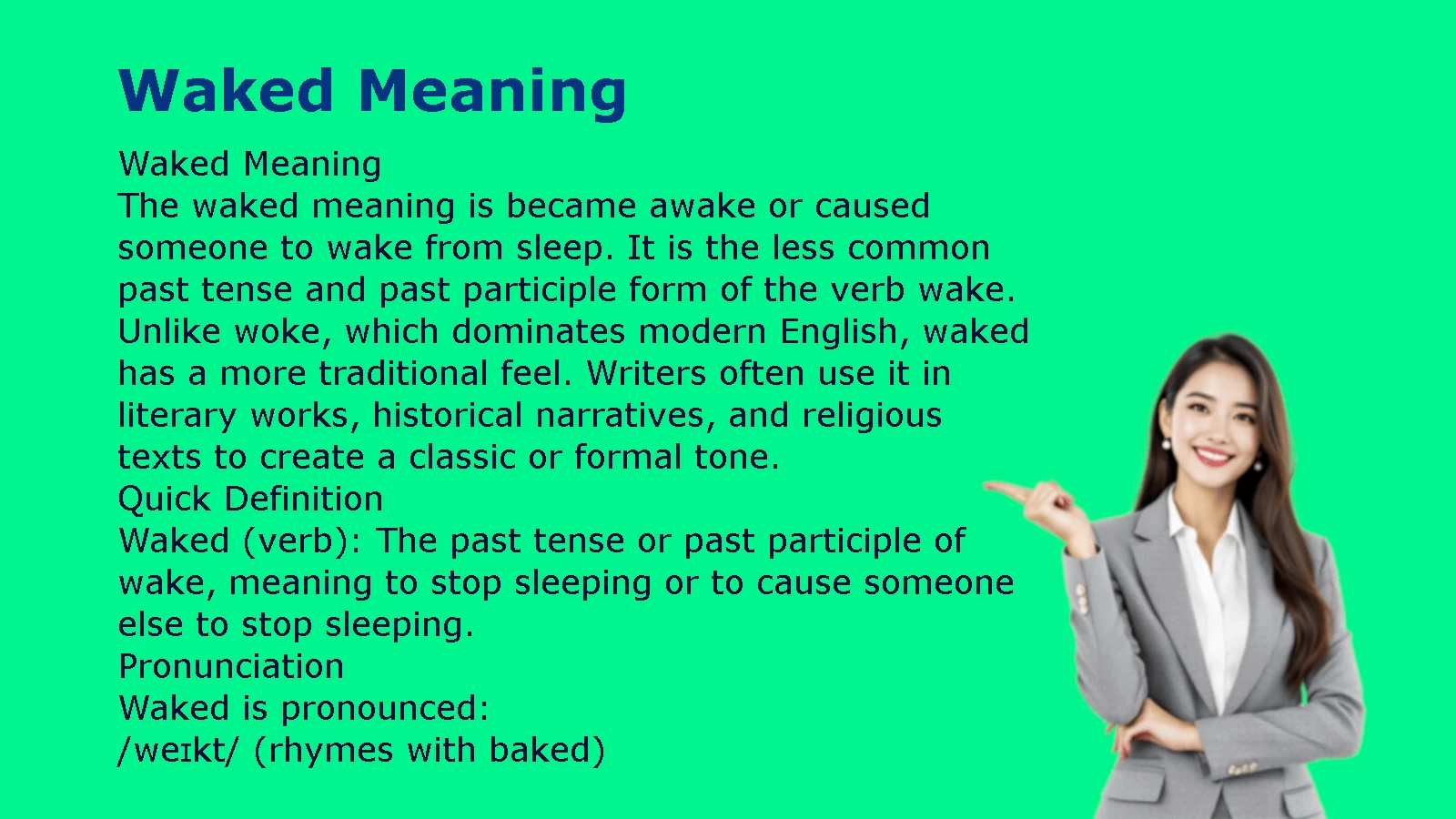
The waked meaning is became awake or caused someone to wake from sleep. It is the less common past tense and past participle form of the verb wake.
Unlike woke, which dominates modern English, waked has a more traditional feel. Writers often use it in literary works, historical narratives, and religious texts to create a classic or formal tone.
Quick Definition
Waked (verb): The past tense or past participle of wake, meaning to stop sleeping or to cause someone else to stop sleeping.
Pronunciation
Waked is pronounced:
/weɪkt/ (rhymes with baked)
Part of Speech
| Feature | Details |
| Word | Waked |
| Part of Speech | Verb |
| Verb Form | Past tense and past participle of wake |
| Pronunciation | /weɪkt/ |
| Meaning | Became awake or caused someone to wake |
| Usage | Less common in modern English |
| Status | Grammatically correct |
Featured Snippet Answer
Waked means became awake or caused someone to wake. It is a correct but less common past tense and past participle of wake. In modern English, woke and woken are usually preferred, but waked still appears in literature, historical writing, and some formal contexts.
What Does Waked Mean?
At its core, waked describes the moment when someone stops sleeping or when another person or event causes that change.
Think of it as another accepted past form of wake. The meaning stays the same. Only the style and frequency of use differ.
For example:
- She waked before sunrise.
- The thunder waked the entire neighborhood.
- They had waked before anyone else arrived.
Each sentence describes someone becoming awake or being awakened.
Waked as the Past Tense of Wake
When used as a simple past tense, waked refers to an action that happened in the past.
Examples:
- He waked early to watch the sunrise.
- The baby waked after hearing the dog bark.
- We waked before dawn and packed our bags.
- She waked feeling refreshed.
- I waked suddenly because of a loud noise.
Although every sentence above is correct, most native speakers today would naturally replace waked with woke.
Compare them:
| Less Common | More Common |
| She waked early. | She woke early. |
| I waked suddenly. | I woke suddenly. |
| They waked at dawn. | They woke at dawn. |
The meaning doesn’t change. Only the preferred wording does.
Waked as the Past Participle
Waked also functions as a past participle, usually after helping verbs like has, have, or had.
Examples:
- The alarm had waked everyone.
- She has waked several times during the night.
- They had waked before the rooster crowed.
Modern English speakers usually prefer woken in these situations.
For example:
| Less Common | Preferred Today |
| She has waked. | She has woken. |
| They had waked. | They had woken. |
| Everyone has waked. | Everyone has woken. |
Again, both forms are grammatically acceptable. However, woken sounds much more natural in present-day English.
Active and Causative Meanings
The verb wake has two closely related meanings, and waked can express either one.
To become awake
Examples:
- I waked before my alarm.
- She waked smiling.
- The child waked from a pleasant dream.
To cause someone else to become awake
Examples:
- The thunder waked the campers.
- A phone call waked him at midnight.
- The barking dog waked everyone in the house.
Understanding these two uses makes it easier to recognize waked wherever it appears.
Is Waked a Real Word?
Yes. Waked is absolutely a real word.
Some people assume it is incorrect because they rarely hear it in conversation. That assumption is understandable, yet it isn’t accurate. Major English dictionaries recognize waked as a legitimate form of wake.
The confusion comes from the fact that English allows more than one past form for some verbs.
For example:
| Base Verb | Accepted Past Forms |
| Learn | Learned / Learnt |
| Dream | Dreamed / Dreamt |
| Burn | Burned / Burnt |
| Kneel | Kneeled / Knelt |
| Wake | Waked / Woke |
English has never been perfectly uniform. Many verbs developed different forms over hundreds of years, and some survived longer than others.
Today, woke became the dominant past tense in standard English, while waked remained an accepted but less common alternative.
Why Does Waked Still Appear?
There are several reasons.
It Preserves an Older Style
Many classic authors preferred waked because it matched the language of their time.
You may encounter it in:
- Classic novels
- Historical biographies
- Religious writing
- Older newspapers
- Poetry
It Creates a Literary Tone
Some modern authors intentionally choose waked because it sounds timeless.
Consider these examples:
- The forest waked beneath the morning mist.
- The village slowly waked as church bells echoed through the valley.
- She waked to the distant sound of waves crashing against the shore.
The sentences carry a softer, more poetic rhythm than they might with woke.
Some Regional Varieties Still Use It
Language changes differently across regions.
Although uncommon, waked continues to appear in certain dialects and local speech patterns, especially where older forms have remained in everyday use.
That doesn’t mean it’s incorrect. It simply reflects the natural diversity of English.
Common Myth About Waked
Many learners believe only woke is correct.
That’s false.
Here’s the truth.
| Statement | Correct? |
| Waked is a real word. | ✅ Yes |
| Waked is grammatically correct. | ✅ Yes |
| Woke is more common today. | ✅ Yes |
| Waked is always wrong. | ❌ No |
| Woken is usually preferred as the past participle. | ✅ Yes |
Understanding this distinction helps you read older texts with confidence and avoid assuming that every unfamiliar word is a mistake.
Waked vs. Woke vs. Woken
This is where many people get confused.
All three words come from the verb wake, yet each serves a slightly different grammatical role.
Quick Comparison Table
| Word | Grammar Role | Example |
| Wake | Base verb | I wake early every day. |
| Wakes | Present tense | She wakes before sunrise. |
| Waking | Present participle | They are waking now. |
| Waked | Past tense or past participle (less common) | He waked before dawn. |
| Woke | Preferred past tense | He woke before dawn. |
| Woken | Preferred past participle | He has woken already. |
Understanding the Difference
Think of the three forms as belonging to the same family.
- Wake is the original verb.
- Woke is the standard past tense in modern English.
- Woken is the standard past participle.
- Waked can function as both the past tense and past participle, although it sounds more traditional.
Here’s a side-by-side comparison:
| Sentence with Waked | Modern Equivalent |
| She waked early. | She woke early. |
| They had waked before sunrise. | They had woken before sunrise. |
| The noise waked me. | The noise woke me. |
| Everyone has waked. | Everyone has woken. |
Each pair conveys the same meaning. The difference lies in style and frequency rather than correctness.
Which Form Sounds More Natural Today?
In contemporary American English and most modern British English writing:
- Woke is the preferred past tense.
- Woken is the preferred past participle.
- Waked remains correct but appears far less often.
If you’re writing an academic paper, business email, blog post, or everyday message, woke and woken will usually sound more familiar to your readers.
However, if you’re reading older literature, studying English grammar, or writing historical fiction, you’ll likely encounter waked and recognize it as a valid choice rather than an error.
Is Waked Grammatically Correct?
Yes, waked is grammatically correct. The confusion comes from the fact that English accepts more than one past form of wake. While woke and woken dominate modern English, waked hasn’t disappeared. It remains a recognized form in major dictionaries and grammar references.
The key is understanding correctness versus common usage.
A word can be grammatically correct even if people rarely use it in everyday conversation. The same applies to waked.
Why Do People Think Waked Is Wrong?
Most English speakers grow up hearing sentences like:
- I woke up early.
- She has woken already.
- We woke before sunrise.
Since these forms appear far more often, waked sounds unusual. However, unusual doesn’t mean incorrect.
Think of it like older words that still appear in literature. They’re perfectly valid, even if they aren’t part of daily speech.
Grammar at a Glance
| Verb Form | Traditional Form | Modern Preferred Form |
| Base | Wake | Wake |
| Present | Wakes | Wakes |
| Present Participle | Waking | Waking |
| Past Tense | Waked / Woke | Woke |
| Past Participle | Waked / Woken | Woken |
Which Form Should You Use?
The answer depends on your audience.
| Situation | Best Choice |
| Everyday conversation | Woke |
| School essays | Woke / Woken |
| Business writing | Woke / Woken |
| Journalism | Woke / Woken |
| Historical fiction | Waked can work well |
| Poetry | Waked may fit the rhythm |
| Religious writing | Waked sometimes appears |
If your goal is natural, modern English, choose woke and woken. If you’re aiming for a classic or literary style, waked is still an acceptable option.
How to Use Waked in a Sentence
Using waked isn’t difficult once you understand its role. It simply replaces woke in some sentences while keeping the meaning unchanged.
The biggest difference is tone. Waked often sounds more formal, old-fashioned, or poetic.
Everyday Examples
Although less common today, these sentences are grammatically correct.
- I waked before my alarm clock rang.
- She waked feeling energetic.
- The children waked at sunrise.
- We waked to birds singing outside.
- He waked with a smile.
Modern speakers would usually say:
- I woke before my alarm clock rang.
- She woke feeling energetic.
Examples That Show Someone Was Awakened
Sometimes waked means someone else caused the action.
Examples:
- The loud thunder waked everyone.
- My phone waked me at midnight.
- The baby’s cry waked the entire family.
- A passing train waked the campers.
- The bright sunlight waked him.
Notice that the subject isn’t waking up. Instead, it causes another person to wake.
Literary Examples
This is where waked often shines.
Examples:
- The ancient city waked beneath a crimson dawn.
- She waked to the whisper of falling rain.
- The lonely castle waked as the bells echoed across the valley.
- Nature slowly waked after a long winter.
- The village waked one window at a time.
These examples create a softer, more descriptive rhythm than their modern counterparts.
Formal Writing Examples
Although uncommon, waked can appear in formal or historical writing.
Examples:
- The soldiers waked before first light.
- The monks waked for morning prayer.
- The travelers waked before beginning their journey.
- The household had waked before sunrise.
- Every servant had waked by dawn.
25 Example Sentences Using Waked
Examples often teach grammar better than rules. The following sentences show how waked fits naturally in different situations.
Daily Life
- I waked earlier than usual today.
- She waked before her children.
- We waked to a beautiful sunrise.
- The dog waked everyone in the house.
- He waked after hearing his name.
- My alarm waked me at six.
- They waked feeling refreshed.
- The baby waked twice during the night.
School and Work
- The students waked early for the field trip.
- She waked before her morning meeting.
- The teacher waked before dawn to prepare lessons.
- We had waked before the bus arrived.
- He waked ready for the interview.
- The office slowly waked as employees arrived.
Literary and Creative Writing
- The forest waked beneath golden sunlight.
- The old mansion waked with the sound of distant bells.
- She waked from a dream she couldn’t remember.
- The sea waked under the morning breeze.
- Every flower waked with the coming spring.
- The kingdom waked to a new era.
Historical Style
- The village waked before the church bell rang.
- Every farmer waked before sunrise.
- The army had waked long before dawn.
- The castle waked slowly after the long night.
- The city waked as merchants opened their shops.
When Should You Use Waked?
Although woke is the standard choice today, there are situations where waked feels more appropriate.
Literary Writing
Many novelists use waked to create atmosphere.
Example:
She waked to the scent of wild roses drifting through the open window.
Historical Fiction
If your story takes place centuries ago, waked helps create an authentic voice.
Example:
Every villager waked before the first rooster crowed.
Poetry
Poets often choose words for rhythm as much as meaning.
Example:
The earth waked beneath the morning light.
Religious Writing
Some older religious translations and devotional works include waked because it reflects traditional English.
Discussions About Grammar
When explaining English verb forms, it’s important to include waked because it remains an accepted form.
When Should You Avoid Waked?
Being correct doesn’t always mean being the best choice.
Most readers expect modern English. In those situations, woke and woken improve clarity.
Everyday Conversation
Instead of:
I waked late today.
Most people naturally say:
I woke late today.
Business Communication
Professional writing benefits from familiar language.
Better:
- I woke early to prepare the report.
- She has woken already.
Journalism
News organizations favor current usage.
Example:
Residents woke to heavy snowfall.
Academic Writing
Unless you’re discussing historical grammar, instructors generally expect modern verb forms.
Social Media and Online Writing
Readers process familiar language faster.
That’s why you’ll almost always see woke instead of waked.
Common Mistakes with Waked
Understanding the most common mistakes helps you avoid awkward sentences.
Mistake 1: Mixing Past Tense and Present Perfect
❌ She has woke already.
✅ She has woken already.
Mistake 2: Using Woken Without a Helping Verb
❌ She woken early.
✅ She woke early.
Mistake 3: Assuming Waked Is Incorrect
❌ “Waked isn’t a real word.”
✅ Waked is a correct but uncommon form of “wake.”
Mistake 4: Using Present Tense Incorrectly
❌ Yesterday I wake at six.
✅ Yesterday I woke at six.
or
✅ Yesterday I waked at six.
Mistake 5: Mixing Styles
Example:
❌ He waked early and has woke already.
Correct:
✅ He woke early and has woken already.
or
✅ He waked early and has waked already.
Keeping the verb forms consistent creates smoother writing.
Synonyms of Waked
No synonym perfectly replaces waked, but several words express similar ideas depending on the context.
Synonyms Meaning “Became Awake”
| Word | Best Used When |
| Woke | Everyday English |
| Awoke | Formal or literary writing |
| Rose | Getting out of bed |
| Stirred | Beginning to wake |
| Opened one’s eyes | Descriptive writing |
Example:
- She awoke before sunrise.
- He stirred at the sound of rain.
Synonyms Meaning “Caused Someone to Wake”
| Word | Meaning |
| Awakened | Caused someone to wake |
| Roused | Woke someone suddenly |
| Disturbed | Interrupted sleep |
| Alerted | Drew attention or woke someone |
| Shook awake | Physical action |
Examples:
- The explosion roused the neighborhood.
- The bright light awakened the child.
- The loud music disturbed everyone’s sleep.
Idioms and Common Expressions Related to Wake
The verb wake appears in many everyday expressions. Learning these phrases helps you understand natural English more easily.
Wake Up
Meaning: Stop sleeping.
Example:
I usually wake up at six every morning.
Wake Someone Up
Meaning: Cause another person to stop sleeping.
Example:
Please wake me up before you leave.
Wake-Up Call
This phrase has two meanings.
Literal Meaning
A phone call or alarm that wakes someone.
Figurative Meaning
An event that makes someone realize an important truth.
Example:
Losing the match was a real wake-up call for the team.
Wide Awake
Meaning: Completely awake and alert.
Example:
Even at midnight, she was wide awake.
Wake to Reality
Meaning: Accept the truth after ignoring it.
Example:
The company finally woke to reality after sales declined.
Wake From Sleep
A common expression used in books and everyday speech.
Example:
He woke from sleep after hearing footsteps outside.
These idioms show how versatile the verb wake has become. Even though waked itself is uncommon, the verb family remains one of the most frequently used in everyday English.
Origin and History of Waked
The story behind the waked meaning is a fascinating example of how English evolves over time. Although woke dominates modern speech, waked actually has deep historical roots.
The verb wake comes from the Old English word wacian, which meant to be awake, stay awake, or watch. Another related Old English verb, wacan, meant to awaken or to arise. Over time, these closely related verbs merged, giving English several accepted past forms.
During Middle English and Early Modern English, writers freely used both waked and woke. There was no strict rule requiring one form over the other.
As English became more standardized in the 18th and 19th centuries, woke gradually became the preferred simple past tense, while woken became the preferred past participle. Even so, waked never disappeared. It remained a valid form and still appears in dictionaries, literature, and some regional dialects.
Timeline of the Word
| Time Period | Development |
| Old English | Wake developed from wacian and related verbs. |
| Middle English | Both waked and woke appeared in writing. |
| Early Modern English | Writers used multiple past forms interchangeably. |
| 18th–19th Century | Woke became the dominant past tense. |
| Modern English | Waked remains correct but is much less common. |
Why Did Woke Become More Popular?
Languages naturally simplify over time. As more people used woke, publishers, educators, and dictionaries reflected that preference. Eventually, it became the form most speakers recognized.
That doesn’t erase waked from the language. Instead, it places the word in a more specialized role.
Today, you’ll most often see waked in:
- Historical novels
- Classic literature
- Poetry
- Religious writing
- Grammar discussions
- Older legal and historical documents
Quick Grammar Cheat Sheet
If you only remember one table from this guide, make it this one.
| Verb Form | Word | Example |
| Base Form | Wake | I wake early every day. |
| Third-Person Singular | Wakes | She wakes before sunrise. |
| Present Participle | Waking | They are waking now. |
| Simple Past | Woke (preferred), Waked (less common) | She woke early. / She waked early. |
| Past Participle | Woken (preferred), Waked (less common) | She has woken. / She has waked. |
Easy Rule to Remember
Use this simple guide:
- Wake = Present
- Woke = Most common past tense
- Woken = Most common past participle
- Waked = Correct but uncommon alternative for both past tense and past participle
When you’re unsure, woke and woken are usually the safest choices for modern English.
Practical Case Study: Choosing the Right Verb Form
Imagine two writers working on different projects.
Writer A: News Reporter
Sentence:
Residents woke to heavy rain this morning.
This choice feels natural because news writing favors modern, widely accepted language.
Writer B: Historical Novelist
Sentence:
Before the first bell rang, the village waked beneath a pale autumn sky.
Here, waked creates a timeless atmosphere that suits historical fiction.
What We Learn
The two writers communicate the same idea, but they choose different verb forms based on audience, tone, and purpose.
| Writing Type | Better Choice |
| News article | Woke |
| Business email | Woke |
| School assignment | Woke |
| Blog post | Woke (unless discussing grammar) |
| Historical novel | Waked |
| Poem | Waked may enhance style |
| Grammar guide | Mention both forms |
The lesson is simple: grammar and style work together. A word can be correct while still being uncommon in everyday use.
Expert Insight
“Grammar isn’t only about correctness. It’s also about choosing the form that best fits your audience and purpose.”
That idea explains why waked continues to exist. It isn’t competing with woke. Instead, it serves a different stylistic role.
Modern English values clarity and familiarity, which is why woke appears more often. Literature, however, often values rhythm, tradition, and voice. That’s where waked still has a place.
Frequently Asked Questions About Waked Meaning
What is the waked meaning?
Waked means became awake or caused someone to wake. It is a correct but less common past tense and past participle of the verb wake.
Is waked a real word?
Yes. Waked is a real English word recognized by major dictionaries. Although it appears less often than woke, it remains grammatically correct.
Is waked or woke correct?
Both are correct.
However:
- Woke is the preferred simple past tense in modern English.
- Waked is a less common alternative that often appears in literary or historical contexts.
Is waked old-fashioned?
It can sound old-fashioned because most speakers now prefer woke. That said, waked is still accepted in standard English and hasn’t become obsolete.
Can waked be used as a past participle?
Yes.
For example:
- The loud music had waked the neighbors.
However, most modern speakers would naturally say:
- The loud music had woken the neighbors.
Why do dictionaries still include waked?
Dictionaries describe the language rather than dictate it. Since waked still appears in published works and remains grammatically valid, reputable dictionaries continue to list it.
Is waked used in American English?
Yes, but only occasionally.
Most American English speakers use:
- Woke for the simple past.
- Woken for the past participle.
You may still encounter waked in literature, grammar books, or historical writing.
Is waked used in British English?
Yes, although it is uncommon there as well. British English also favors woke and woken in everyday writing and speech.
Which sounds more natural today?
For most situations:
- I woke early.
- She has woken already.
These are the forms native speakers expect in modern English.
Can I use waked in creative writing?
Absolutely.
If you’re writing poetry, historical fiction, or a story with a traditional tone, waked can create a distinctive voice.
Example:
The ancient forest waked beneath the silver moonlight.
Common Takeaways
If you’ve read this far, here’s a quick summary of the most important points.
- Waked is a real English word.
- It means became awake or caused someone to wake.
- It functions as both a past tense and past participle.
- Woke is the preferred past tense in modern English.
- Woken is the preferred past participle.
- Waked often appears in literature, poetry, and historical writing.
- Both forms are grammatically correct, but they serve different stylistic purposes.
Quick Reference Table
| Question | Answer |
| Is waked correct? | ✅ Yes |
| Is waked common today? | ❌ No |
| Preferred past tense | Woke |
| Preferred past participle | Woken |
| Can waked still be used? | ✅ Yes |
| Best for everyday English | Woke / Woken |
| Best for historical or literary writing | Waked can be an effective stylistic choice |
Final Thoughts on Waked Meaning
Understanding the waked meaning becomes much easier once you recognize that English often preserves older verb forms alongside newer, more common ones. Waked is one of those surviving forms. It remains grammatically correct, yet modern speakers usually choose woke and woken because they sound more natural in everyday conversation.
If your goal is clear, contemporary communication, woke and woken are the safest options. They fit naturally in emails, articles, school assignments, and casual speech.
On the other hand, don’t dismiss waked as a mistake. It has a long history in English and still appears in novels, poetry, historical fiction, and discussions of grammar. In the right context, it adds a subtle literary quality that modern forms may not convey.
Knowing when to use each form will improve both your writing and your understanding of English. The next time you encounter waked in a book or article, you’ll know that it isn’t outdated or incorrect. It’s simply another valid piece of the language’s rich history