
What Does Scarce Mean?
Scarce Meaning refers to something that is limited in quantity, difficult to find, or not available in sufficient amounts. The word scarce describes resources, goods, time, or opportunities that are in short supply.
Examples:
- Clean drinking water is scarce in some regions.
- During the holiday season, tickets became scarce.
Understanding Scarce Meaning helps you use the word accurately in conversations, writing, and professional communication.
The confusion often comes from knowing when to use scarce, how it differs from words like rare, limited, or insufficient, and which situations it best describes. But here’s the kicker: understanding its exact meaning helps you use it more naturally in conversations, writing, and professional communication.
In this guide, you’ll learn the Scarce Meaning, its definition, pronunciation, part of speech, synonyms, antonyms, and how to use scarce in a sentence. You’ll also discover real-life examples, common phrases, and the difference between scarce and similar words so you can use it with confidence.
By the end, you’ll know exactly what scarce means, when to use it, and how to avoid common mistakes in everyday English.
What Does Scarce Mean?
Scarce is an adjective that describes something that is not available in enough quantity or exists in only small amounts. It often suggests that people want or need more of something than is available.
Simple Definition
Scarce means hard to find because there isn’t much of it available.
Unlike words that simply describe something as uncommon, scarce usually points to a shortage that affects people or situations.
Dictionary-Style Definition
Scarce (adjective):
- Existing in small quantities
- Difficult to obtain because supply is limited
- Insufficient to meet demand
Simple Explanation
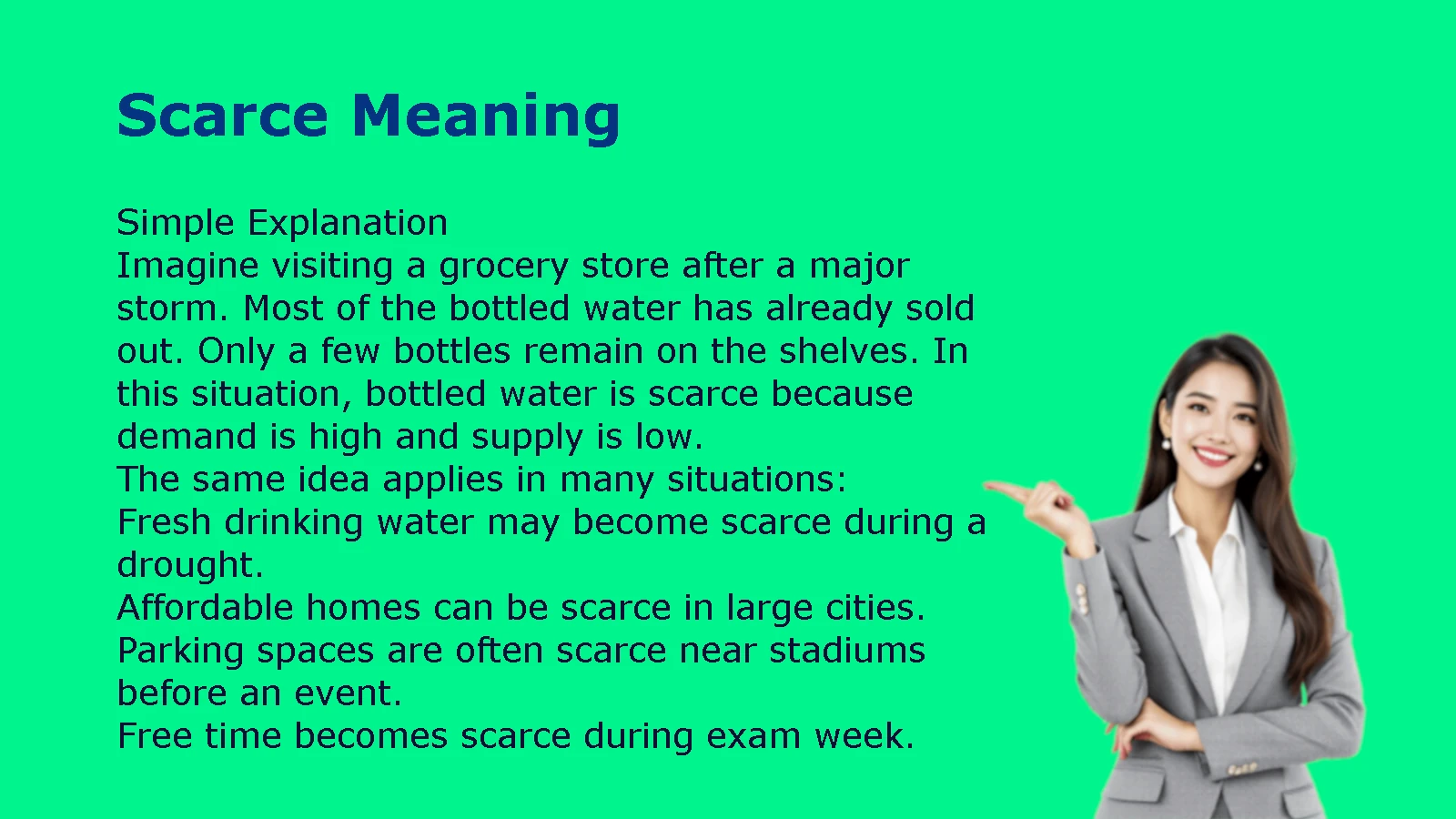
Imagine visiting a grocery store after a major storm. Most of the bottled water has already sold out. Only a few bottles remain on the shelves. In this situation, bottled water is scarce because demand is high and supply is low.
The same idea applies in many situations:
- Fresh drinking water may become scarce during a drought.
- Affordable homes can be scarce in large cities.
- Parking spaces are often scarce near stadiums before an event.
- Free time becomes scarce during exam week.
The key idea is limited availability, especially when more is needed.
Pronunciation
US: /sker(s)/
UK: /skeəs/
Easy pronunciation: skairs
Part of Speech
| Feature | Details |
| Word | Scarce |
| Part of speech | Adjective |
| Comparative | Scarcer |
| Superlative | Scarcest |
| Adverb | Scarcely |
| Noun | Scarcity |
Word Forms
Learning related forms helps you use the word naturally in different types of sentences.
| Word Form | Part of Speech | Meaning | Example |
| Scarce | Adjective | In short supply | Fresh water is scarce. |
| Scarcer | Comparative adjective | More limited | Skilled workers became scarcer. |
| Scarcest | Superlative adjective | Most limited | This was the scarcest resource. |
| Scarcely | Adverb | Hardly; barely | We scarcely had enough food. |
| Scarcity | Noun | A shortage or limited supply | Water scarcity affects millions. |
When Do You Use “Scarce”?
People use scarce whenever they want to emphasize that something isn’t available in sufficient amounts. The word appears in everyday conversations, news reports, academic writing, business discussions, and environmental studies.
Here are the most common situations.
1. When Resources Are Limited
This is the most common use of scarce.
Examples include:
- Water
- Food
- Fuel
- Land
- Energy
- Medical supplies
Examples
- Clean drinking water is scarce in some regions.
- Fuel became scarce after the storm.
- Fertile farmland is becoming increasingly scarce.
2. When Something Is Difficult to Find
Sometimes an item exists, but it’s difficult to locate.
Examples
- Affordable apartments are scarce downtown.
- Parking spaces were scarce before the concert.
- Good restaurants were surprisingly scarce in the area.
3. When Opportunities Are Limited
You can also use scarce for opportunities instead of physical objects.
Examples
- Entry-level jobs are scarce this year.
- Scholarship opportunities remain scarce.
- Volunteer positions became scarce after applications closed.
4. When Time Is Limited
Time isn’t a physical object, yet English speakers frequently describe it as scarce.
Examples
- Free time is scarce during tax season.
- Sleep becomes scarce for new parents.
- Quiet moments are scarce in a busy office.
5. In Business and Economics
Business writers often use scarce when discussing supply, labor, or financial resources.
Examples include:
- scarce resources
- scarce investment capital
- scarce skilled labor
- scarce raw materials
Example:
Skilled engineers remain scarce despite growing demand.
6. In Nature and Environmental Discussions
Environmental topics regularly include the word because natural resources can become limited.
Examples:
- scarce rainfall
- scarce wildlife habitat
- scarce freshwater supplies
- scarce natural resources
Example:
Rainfall has been scarce throughout the summer.
Examples of “Scarce” in Sentences
Seeing the word in context makes it much easier to remember.
Everyday Conversation
- Good parking spots are scarce on weekends.
- Fresh strawberries become scarce during winter.
- Seats were scarce by the time we arrived.
- Affordable flights are scarce during the holidays.
- Quiet places to study can be scarce on campus.
School and Education
- Library computers were scarce before exams.
- Research funding is often scarce.
- Classroom space became scarce after enrollment increased.
- Experienced teachers are scarce in some rural districts.
Workplace
- Skilled programmers are becoming scarce.
- Meeting rooms were scarce all afternoon.
- Hiring managers said qualified candidates were scarce.
- Office space is scarce in the city’s business district.
Business
- Raw materials became scarce after supply chain disruptions.
- Investment capital remained scarce for small businesses.
- Affordable warehouse space is increasingly scarce.
- Seasonal workers were scarce during harvest.
Nature and Environment
- Rainfall was scarce throughout the year.
- Freshwater supplies became scarce during the drought.
- Food became scarce for wildlife after the wildfire.
- Trees are scarce in desert landscapes.
News and Current Events
- Medical supplies became scarce during the emergency.
- Housing remains scarce in several fast-growing cities.
- Electric vehicle batteries rely on minerals that are sometimes scarce.
- Farmers reported scarce rainfall throughout the planting season.
Literature-Style Examples
- Hope grew scarce as winter stretched on.
- Light became scarce beneath the dense forest canopy.
- Supplies were scarce after weeks of travel.
- Warm meals were scarce during the difficult journey.
What Does “Scarce” Mean in Different Contexts?
Although the core meaning stays the same, scarce takes on slightly different shades of meaning depending on the subject.
Scarce in Economics
Economics uses the word scarce more than almost any other field because scarcity sits at the center of economic decision-making.
In economics, resources are considered scarce when they cannot satisfy every person’s unlimited wants. Since people have unlimited desires but resources remain limited, individuals, businesses, and governments must make choices about how to use what they have.
Examples of scarce economic resources include:
- Labor
- Land
- Capital
- Raw materials
- Time
For example:
Skilled labor became scarce, causing wages to rise.
A resource doesn’t have to disappear completely to be scarce. Even if it exists in large quantities, it can still be scarce if demand exceeds supply.
Scarce in Business
Businesses frequently use scarce to describe anything that limits growth or production.
Common examples include:
- Scarce talent
- Scarce funding
- Scarce inventory
- Scarce manufacturing materials
- Scarce warehouse space
For example:
Experienced cybersecurity professionals remain scarce across the industry.
Businesses often compete for scarce resources, which can increase prices or slow expansion.
Scarce in Environmental Studies
Environmental science often discusses scarce natural resources because many ecosystems depend on limited supplies of water, land, minerals, and energy.
Examples include:
- Scarce freshwater
- Scarce rainfall
- Scarce farmland
- Scarce wildlife habitats
Scientists may also examine how climate change, population growth, and pollution make certain resources even scarcer over time.
Scarce in Healthcare
Healthcare professionals often use scarce to describe medical resources that cannot meet current demand. In these situations, hospitals and public health agencies must decide how to use limited supplies as effectively as possible.
Common examples include:
- Scarce donor organs
- Scarce hospital beds
- Scarce blood supplies
- Scarce vaccines during early distribution
- Scarce medical equipment in emergencies
Examples
- Donor organs remain scarce despite growing demand.
- Rural communities often face scarce healthcare resources.
- Blood supplies became scarce after the natural disaster.
Is “Scarce” Positive or Negative?
Scarce is a neutral adjective. It doesn’t express a positive or negative opinion on its own. Instead, its tone depends on what you’re describing.
Most of the time, scarce carries a negative feeling because it refers to shortages of things people need.
Negative Examples
- Affordable housing is scarce.
- Fresh water is scarce in the region.
- Qualified workers are scarce this year.
- Medical supplies became scarce during the crisis.
Sometimes, though, the word can describe something positive that is simply uncommon or limited.
Neutral or Positive Examples
- Quiet beaches are scarce during summer.
- Free tickets are scarce for popular events.
- Genuine handwritten letters have become scarce.
The adjective itself stays neutral. The surrounding context creates the emotional tone.
Scarce vs. Rare
Many English learners treat scarce and rare as synonyms. While they overlap, they aren’t interchangeable in every situation.
Scarce focuses on limited supply or not enough availability.
Rare focuses on uncommon occurrence or unusual frequency.
Key Differences
| Feature | Scarce | Rare |
| Primary meaning | Limited supply | Uncommon or unusual |
| Focus | Not enough quantity | Doesn’t occur often |
| Often suggests demand | Yes | Not necessarily |
| Common with resources | Yes | Less common |
| Common with unique objects | Sometimes | Very common |
Examples
Scarce
- Clean drinking water is scarce.
- Parking spaces are scarce downtown.
- Affordable childcare is scarce.
Rare
- A blue diamond is rare.
- Solar eclipses are relatively rare.
- The bird is rare in this region.
Quick Tip
Ask yourself this question:
- Is there not enough of it? → Use scarce.
- Is it simply unusual or uncommon? → Use rare.
Scarce vs. Limited
Although these words share similar meanings, they emphasize different ideas.
Limited simply means something has boundaries or restrictions.
Scarce means there isn’t enough of something to satisfy demand.
Comparison
| Scarce | Limited |
| Suggests shortage | Suggests restriction |
| Often relates to supply | Can relate to quantity, time, access, or rules |
| Stronger sense of lack | More general meaning |
Examples
Scarce
- Skilled nurses are scarce.
- Water became scarce after months without rain.
Limited
- Seating is limited.
- The offer is available for a limited time.
- Access is limited to members.
Notice that limited doesn’t always suggest a shortage. It can simply describe a restriction.
Scarce vs. Shortage
These two words are closely connected, but they belong to different parts of speech.
- Scarce is an adjective.
- Shortage is a noun.
Comparison
| Scarce | Shortage |
| Adjective | Noun |
| Describes something | Names the condition |
| “Food is scarce.” | “There is a food shortage.” |
Examples
Correct:
- Fresh water is scarce.
- The town experienced a water shortage.
Incorrect:
- There is a scarce of food.
- Food shortage is scarce resources.
Synonyms of Scarce
No single synonym fits every situation. Choosing the right one depends on your context.
Common Synonyms
| Synonym | Best Used For |
| Limited | General situations |
| Insufficient | Not enough to meet a need |
| Sparse | Small numbers spread apart |
| Meager | Very small amount |
| In short supply | Business and news writing |
| Hard to find | Everyday conversation |
| Few | Countable items |
| Deficient | Formal or technical writing |
| Inadequate | Not enough for a purpose |
| Unavailable | Cannot be obtained |
Examples
- Affordable housing is limited.
- Food supplies were insufficient.
- Trees are sparse across the desert.
- Rainfall has been meager this year.
- Skilled workers are in short supply.
- Good mechanics are hard to find.
Synonyms by Context
Formal Writing
- Insufficient
- Deficient
- Inadequate
- Limited
Academic Writing
- Constrained
- Insufficient
- Limited
- Restricted
Business Writing
- In short supply
- Limited
- Restricted
- Constrained
Everyday Conversation
- Hard to find
- Limited
- Few
- Not easy to get
Antonyms of Scarce
Antonyms describe the opposite idea: having more than enough or being easy to obtain.
| Antonym | Meaning |
| Abundant | Existing in large quantities |
| Plentiful | Available in great amounts |
| Ample | More than enough |
| Sufficient | Enough to meet a need |
| Copious | Extremely plentiful |
| Readily available | Easy to obtain |
| Overflowing | More than enough, often figuratively |
Examples
- Food became abundant after the harvest.
- Parking was plentiful on weekdays.
- We had ample time to finish the project.
- The budget was sufficient for the renovation.
Common Phrases With “Scarce”
English speakers often pair scarce with certain nouns. Learning these combinations will make your writing sound more natural.
| Phrase | Meaning |
| Scarce resources | Limited natural or economic resources |
| Scarce supply | Small available quantity |
| Scarce commodity | Product that’s difficult to obtain |
| Scarce funding | Not enough financial support |
| Scarce opportunities | Few chances for success |
| Scarce jobs | Limited employment openings |
| Scarce rainfall | Very little rain |
| Scarce evidence | Limited proof |
| Scarce housing | Too few homes available |
| Scarce labor | Not enough workers |
Example Sentences
- Funding remains scarce for small nonprofits.
- Affordable housing is scarce in many cities.
- Evidence was scarce during the early investigation.
- Rainfall has been scarce throughout the season.
Common Collocations
Native speakers naturally combine scarce with certain nouns more often than others.
| Noun | Example Sentence |
| Resources | Natural resources are scarce in the area. |
| Water | Fresh water is becoming scarce. |
| Food | Food became scarce after the flood. |
| Land | Buildable land is scarce downtown. |
| Time | Time is scarce during tax season. |
| Talent | Skilled talent remains scarce. |
| Labor | Construction labor is scarce. |
| Housing | Affordable housing is scarce. |
| Funding | Research funding is scarce. |
| Materials | Raw materials became scarce. |
Idioms and Expressions Related to Scarcity
English has several expressions that communicate the idea of something being difficult to find or available in very small amounts. Although these idioms resemble scarce, each carries its own nuance.
| Expression | Meaning | How It Differs From Scarce |
| Few and far between | Very uncommon | Emphasizes infrequency rather than supply. |
| Hard to come by | Difficult to obtain | More conversational than scarce. |
| In short supply | Not enough available | Nearly identical in meaning and often interchangeable. |
| Running low | Almost depleted | Focuses on a supply that’s decreasing. |
| Thin on the ground | Existing in very small numbers | Common in British English. |
Examples
- Affordable homes are few and far between in this neighborhood.
- Good mechanics are hard to come by.
- Fresh produce is in short supply after the storm.
- We’re running low on clean drinking water.
- Qualified candidates are thin on the ground this hiring season.
How to Use “Scarce” Correctly
Using scarce correctly is straightforward once you understand its role as an adjective.
Grammar Rules
- Scarce modifies nouns.
- It usually appears after a linking verb such as is, are, become, or remain.
- It can also appear before a noun.
Correct Examples
- Water is scarce.
- Parking spaces remain scarce.
- The company faces scarce resources.
- Scarce funding delayed the project.
Common Sentence Patterns
Pattern 1
Noun + be + scarce
- Food is scarce.
- Time is scarce.
Pattern 2
Scarce + noun
- Scarce resources
- Scarce funding
- Scarce opportunities
Pattern 3
Become + scarce
- Medical supplies became scarce.
- Affordable apartments have become scarce.
Pattern 4
Remain + scarce
- Skilled workers remain scarce.
- Housing remains scarce.
Formal vs. Informal Usage
Formal
- Skilled labor remains scarce in rural communities.
- Water resources are becoming increasingly scarce.
Informal
- Parking was really scarce today.
- Free tickets are scarce these days.
The word works well in both settings, although formal writing often uses it in reports, research papers, and business documents.
Common Mistakes to Avoid
Even advanced English learners occasionally misuse scarce. Avoid these common errors.
1. Confusing “Scarce” With “Rare”
❌ Diamonds are scarce because they are unusual.
✔ Diamonds are rare because they occur naturally in small numbers.
✔ Clean drinking water may be scarce because demand exceeds supply.
2. Using “Scarce” as a Noun
❌ There is a scarce of food.
✔ There is a scarcity of food.
✔ Food is scarce.
3. Mixing Up “Scarcely” and “Scarce”
Scarce is an adjective.
Scarcely is an adverb meaning barely or hardly.
Examples:
- Resources are scarce.
- We scarcely finished before the deadline.
4. Using the Wrong Collocation
Some nouns pair naturally with scarce, while others don’t.
Natural:
- scarce resources
- scarce funding
- scarce water
- scarce opportunities
Less Natural:
- scarce happiness
- scarce kindness
- scarce excitement
Choose words that represent things that can genuinely exist in limited supply.
5. Overusing “Scarce”
Sometimes another adjective sounds more natural.
Instead of:
- Information is scarce on the website.
You might say:
- Information is limited.
- Information is incomplete.
Choosing the most precise word improves clarity.
Origin and Etymology of “Scarce”
The English word scarce traces its roots to Old French eschars and ultimately to Vulgar Latin, where it carried the idea of being limited, sparse, or difficult to obtain. English adopted the word during the Middle Ages, and its core meaning has remained remarkably consistent.
Over time, scarce became closely associated with economics, trade, and natural resources because societies often needed language to describe shortages of food, land, labor, and other essentials.
Today, the word appears in everyday conversation, journalism, academic writing, environmental science, and business.
Related Words
Learning related words expands your vocabulary and helps you express similar ideas with precision.
| Word | Part of Speech | Meaning |
| Scarcity | Noun | A state of limited supply |
| Scarcely | Adverb | Barely; hardly |
| Scarcer | Comparative adjective | More limited |
| Scarcest | Superlative adjective | Most limited |
Scarcity
Scarcity refers to the condition in which something isn’t available in enough quantity.
Example:
Water scarcity affects millions of people worldwide.
Scarcely
Scarcely means barely or hardly.
Examples:
- We scarcely noticed the mistake.
- She scarcely had time to eat lunch.
Although both words come from the same root, scarcely doesn’t always refer to limited resources.
Scarcity Mindset
A scarcity mindset describes a way of thinking in which people believe they never have enough of something, such as money, time, or opportunities. Psychologists and business experts often discuss this concept because it can influence decision-making and priorities.
Resource Scarcity
Resource scarcity refers to situations where natural or human-made resources cannot fully meet demand.
Examples include:
- Freshwater scarcity
- Energy scarcity
- Land scarcity
- Labor scarcity
Real-World Examples of Scarcity
Understanding scarce becomes easier when you connect it to real situations.
Water Scarcity
Many regions experience periods of low rainfall. As reservoirs shrink and demand grows, clean water becomes scarce.
Example
A city introduces water restrictions during a drought because freshwater supplies are scarce.
Housing Markets
Rapid population growth can create more demand than available homes.
Example
Affordable apartments are scarce in major metropolitan areas.
Skilled Workers
Many industries struggle to hire experienced professionals.
Example
Cybersecurity experts remain scarce as digital threats continue to increase.
Agricultural Production
Weather conditions can affect crop yields.
Example
Rainfall was scarce throughout the growing season, reducing the harvest.
Semiconductor Chips
Manufacturing disruptions or unexpected demand can reduce available inventory.
Example
Computer chips became scarce, delaying vehicle production and electronics manufacturing.
Quick Reference Table
| Topic | Summary |
| Meaning | Existing in limited quantities or difficult to obtain |
| Pronunciation | skairs |
| Part of Speech | Adjective |
| Comparative | Scarcer |
| Superlative | Scarcest |
| Adverb | Scarcely |
| Noun | Scarcity |
| Common Synonyms | Limited, sparse, insufficient, meager |
| Common Antonyms | Abundant, plentiful, ample |
| Typical Contexts | Resources, time, housing, jobs, funding |
| Example | Skilled workers are scarce. |
Frequently Asked Questions
What does scarce mean in simple words?
Scarce means something is available in only a small amount or is difficult to find because there isn’t enough of it.
Does scarce mean rare?
Not exactly. Scarce emphasizes a limited supply, while rare emphasizes something that’s uncommon or unusual. A rare painting may be valuable because few exist. Clean water can be scarce because demand exceeds supply.
What is the difference between scarce and shortage?
Scarce is an adjective that describes something.
- Water is scarce.
Shortage is a noun that names the condition.
- The city has a water shortage.
Is scarce a positive or negative word?
The word itself is neutral. However, it usually appears in situations that people view negatively because it often describes shortages of important resources.
What is the noun form of scarce?
The noun form is scarcity.
Example:
The region faces severe water scarcity.
What is the adverb form of scarce?
The adverb is scarcely, which usually means barely or hardly.
Example:
We scarcely finished on time.
Can people be described as scarce?
Yes. You can describe groups of people as scarce when there aren’t enough of them.
Examples:
- Skilled nurses are scarce.
- Qualified engineers remain scarce.
What is the opposite of scarce?
Common opposites include:
- Abundant
- Plentiful
- Ample
- Sufficient
- Readily available
What are some examples of scarce resources?
Common examples include:
- Fresh water
- Fertile land
- Skilled labor
- Medical supplies
- Affordable housing
- Funding
- Time
- Energy resources
Conclusion
Although scarce, rare, limited, and shortage share similar themes, they aren’t interchangeable. Scarce highlights insufficient supply, rare describes something uncommon, limited points to restrictions or boundaries, and shortage names the condition itself.
As you build your English vocabulary, pay attention to the context. Choosing the right word helps your writing sound more precise, natural, and professional. Once you recognize how native speakers use scarce, you’ll find it much easier to use the word confidently in conversations, essays, business communication, and everyday life.