
What Is the Wrung Meaning?
Wrung is the past tense and past participle of wring, which means to twist, squeeze, or press something tightly to remove liquid or force something out. It can also describe causing someone emotional pain or getting something through pressure or effort.
Examples:
- She wrung the water from the wet towel.
- He wrung his hands in worry.
- The news wrung tears from her eyes.
The confusion often comes from the unusual form of wring, especially because wrung does not look like its base verb. People commonly search for what does wrung mean, wrung meaning in English, wrung definition, how to pronounce wrung, and wrung in a sentence because the word can describe physically twisting something or expressing an emotional reaction. It can also be confused with similar sounding words such as wrong, which has a completely different meaning.
In this guide, you’ll learn the complete Wrung Meaning, discover the wrung definition, understand how to use wrung in everyday conversations and writing, and explore practical wrung examples with easy to follow explanations. You’ll also learn the correct pronunciation of wrung, common synonyms, the difference between wrung and wrong, and when the word fits naturally in different situations.
What Does “Wrung” Mean?
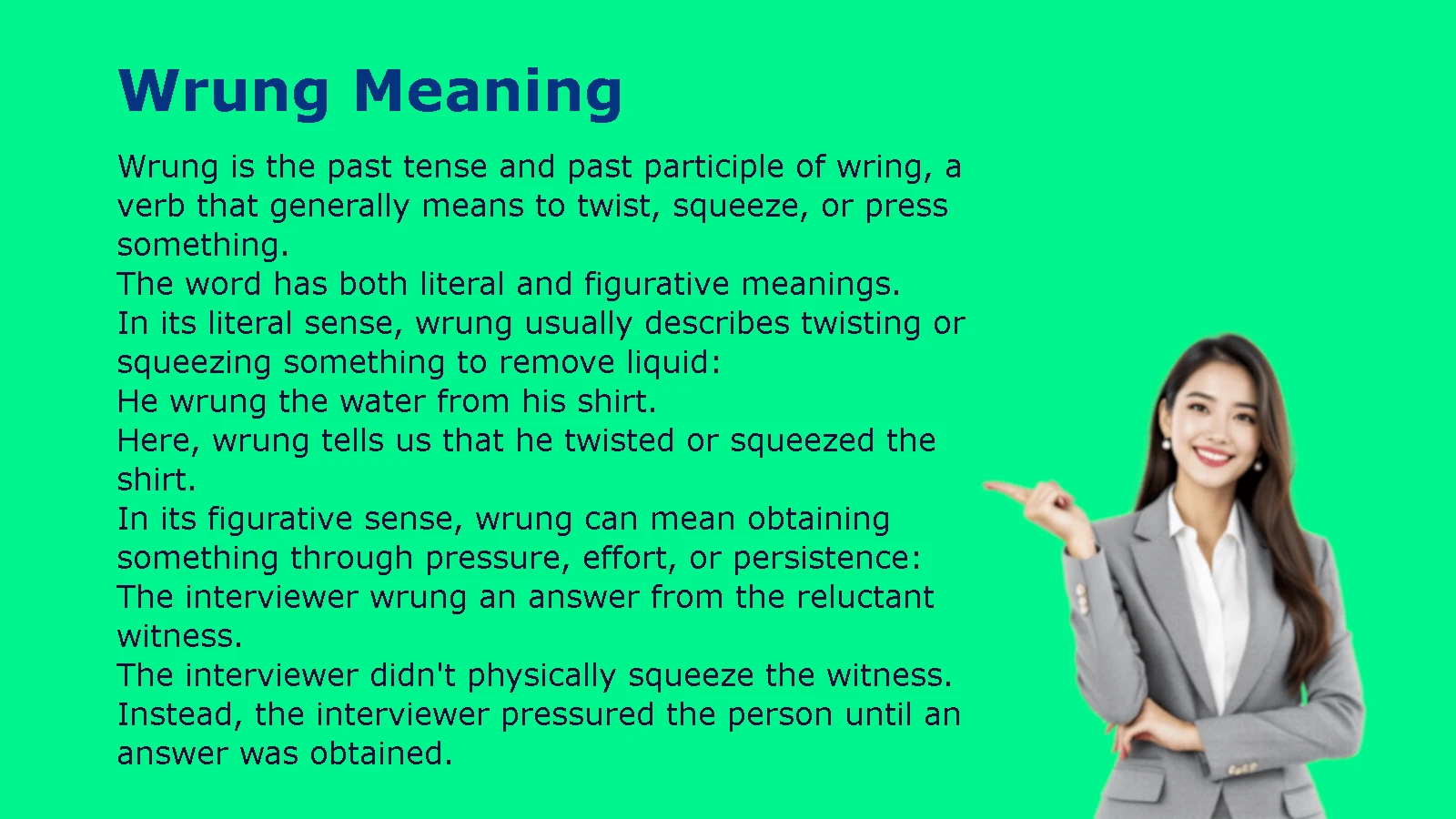
Wrung is the past tense and past participle of wring, a verb that generally means to twist, squeeze, or press something.
The word has both literal and figurative meanings.
In its literal sense, wrung usually describes twisting or squeezing something to remove liquid:
He wrung the water from his shirt.
Here, wrung tells us that he twisted or squeezed the shirt.
In its figurative sense, wrung can mean obtaining something through pressure, effort, or persistence:
The interviewer wrung an answer from the reluctant witness.
The interviewer didn’t physically squeeze the witness. Instead, the interviewer pressured the person until an answer was obtained.
Wrung Definition in Simple English
In simple terms, wrung means “twisted or squeezed” when talking about the past.
It can also mean “forced or extracted” when used figuratively.
| Meaning | Explanation | Example |
| Squeezed | Removed liquid by twisting or pressing | She wrung the towel. |
| Twisted | Turned something tightly | He wrung his hands. |
| Extracted | Obtained something through effort or pressure | They wrung information from him. |
| Deeply affected | Used in expressions involving strong emotions | Her face was wrung with grief. |
The exact meaning depends on the context.
Wrung Pronunciation
Wrung is pronounced /rʌŋ/.
It sounds exactly like “rung,” the past tense of ring.
For example:
- wrung → sounds like “rung”
- rung → sounds like “rung”
The w is silent.
This makes wrung a homophone of rung. Homophones are words that sound alike but have different meanings and spellings.
Is Wrung Pronounced Like Rung?
Yes.
Both wrung and rung are pronounced /rʌŋ/.
However, their meanings are completely different:
- Wrung comes from wring.
- Rung comes from ring.
Consider these sentences:
She wrung the water from the towel.
The phone rang three times.
The first sentence involves squeezing. The second involves making a ringing sound.
Wrung as a Part of Speech
Wrung is a verb form.
More specifically, it serves as both:
- the simple past tense of wring
- the past participle of wring
The base verb is wring.
Its principal forms are:
| Verb Form | Word | Example |
| Base form | wring | Wring the towel carefully. |
| Simple past | wrung | She wrung the towel. |
| Past participle | wrung | She has wrung the towel. |
| Present participle | wringing | She is wringing the towel. |
| Third-person singular | wrings | He wrings the cloth. |
Notice something important: wrung appears twice.
The correct pattern is:
wring → wrung → wrung
This is an example of an irregular verb because it does not form its past tense by simply adding -ed.
Wrung Verb Forms Explained
Understanding the verb forms makes the meaning much easier to recognize.
Wring
Wring is the base form.
Use it for the present tense, infinitives, commands, and after certain helping verbs.
Examples:
- I need to wring out this shirt.
- Wring the sponge before putting it away.
- You should wring the excess water from the cloth.
Wrung
Wrung is the simple past form.
Use it when the action happened in the past.
Examples:
- She wrung the towel after washing it.
- He wrung water from his clothes.
- The child wrung his hands nervously.
Wrung as a Past Participle
The same word, wrung, also works as the past participle.
It commonly appears with helping verbs such as has, have, or had.
Examples:
- She has wrung the water from the cloth.
- They had wrung out all the towels before the guests arrived.
- He had wrung his hands repeatedly.
Wringing
Wringing is the present participle or gerund form.
Examples:
- She is wringing out the wet towel.
- He stood there, wringing his hands.
- Wringing the cloth removed most of the water.
How to Use “Wrung” in a Sentence
The word wrung appears in several common constructions. The most frequent involve squeezing liquid, twisting something, or extracting something figuratively.
Wrung for Squeezing Out Liquid
This is probably the clearest physical use of the word.
When you wring something, you twist or squeeze it to force liquid out. When the action has already happened, you use wrung.
Examples:
- She wrung the wet towel.
- He wrung the water from his shirt.
- I wrung out the sponge.
- They wrung the clothes before hanging them.
- She wrung the cloth until it stopped dripping.
The phrase “wring out” is particularly common.
He wrung out the mop before cleaning the floor.
The word out emphasizes that liquid is being removed.
Wrung for Twisting Something
The meaning isn’t always limited to liquid.
Wrung can describe physically twisting something.
For example:
He wrung the cloth tightly in his hands.
The action involves twisting and squeezing the cloth.
The word can also describe twisting one’s hands, which leads to a common figurative expression.
She wrung her hands while waiting for the results.
Here, the person may literally twist or squeeze their hands because of anxiety or distress.
Wrung in a Figurative Sense
English often uses physical actions as metaphors for mental or social actions.
The idea of squeezing something until something comes out naturally developed into figurative expressions involving extracting information, reactions, confessions, or concessions.
For example:
The journalist wrung a statement from the company.
The company was not physically squeezed. The journalist used questioning or pressure to obtain the statement.
Other examples include:
- The detective wrung a confession from the suspect.
- The lawyer wrung useful information from the witness.
- The reporter wrung a response from the official.
- The negotiation team wrung a concession from the other side.
In each case, wrung means something like obtained through pressure or persistence.
Wrung to Describe Strong Emotion
You may also encounter wrung in descriptions of intense emotional states.
For example:
Her voice sounded wrung with grief.
This construction suggests that the emotion is intense and visibly affects the person.
Expressions involving wrung with emotion are more literary or descriptive than everyday expressions such as very sad or extremely upset.
You might see:
- wrung with pain
- wrung with grief
- wrung with anguish
- wrung with anxiety
The metaphor suggests that intense emotion has almost physically squeezed the person.
Wrung vs. Wring
One of the easiest ways to understand wrung is to compare it with wring.
Wring is the base verb.
Wrung is its past tense and past participle.
| Word | Role | Example |
| wring | Base/present form | I wring the towel. |
| wrung | Past tense | I wrung the towel. |
| wrung | Past participle | I have wrung the towel. |
| wringing | -ing form | I am wringing the towel. |
| wrings | Third-person present | She wrings the towel. |
Compare:
Present:
I wring the towel every morning.
Past:
I wrung the towel this morning.
Present perfect:
I have wrung the towel already.
The meaning stays related, but the verb form changes according to grammar.
Why “Wringed” Is Usually Wrong
A common mistake is using “wringed” as the past tense of wring.
For the standard verb meaning “to twist or squeeze,” the correct past form is:
wring → wrung
Not:
wring → wringed
So:
❌ She wringed the towel.
✅ She wrung the towel.
This happens because English contains many regular verbs that form the past tense with -ed, such as:
- wash → washed
- clean → cleaned
- squeeze → squeezed
But wring is irregular.
Like other irregular verbs, its form changes:
- sing → sang → sung
- drink → drank → drunk
- ring → rang → rung
- wring → wrung → wrung
That last pair can be especially confusing because ring and wring are different verbs even though their forms overlap.
Wrung vs. Rung
The difference between wrung and rung is one of the most important points to remember.
They are pronounced exactly the same, but they come from different verbs.
Wrung
Wrung is the past tense and past participle of wring.
It means twisted, squeezed, or extracted.
She wrung the water from the towel.
Rung
Rung is the past tense and past participle of ring.
It can refer to producing a ringing sound or calling someone.
The bell rang.
The telephone has rung several times.
The comparison becomes clearer in a table:
| Word | Base Verb | Meaning | Example |
| wrung | wring | squeezed or twisted | She wrung the towel. |
| rung | ring | made a ringing sound | The bell rang. |
| rung | ring | called by telephone | He has rung his friend. |
Easy Trick to Remember Wrung vs. Rung
Think of the W in wrung as connecting it to wring.
Wring → wrung
Meanwhile:
Ring → rang → rung
If you’re talking about squeezing or twisting, choose wrung.
If you’re talking about a bell, phone, alarm, or ringing sound, you’re probably looking for rung or rang, depending on the grammatical construction.
Common Phrases With “Wrung”
Several phrases make the word wrung especially common.
Wrung Out
Wrung out means squeezed or twisted to remove liquid.
Examples:
- She wrung out the towel.
- He wrung out his wet shirt.
- I wrung out the sponge before using it again.
It can also have a figurative meaning.
After working a twelve-hour shift, I felt completely wrung out.
Here, wrung out means physically or emotionally exhausted.
This metaphor comes from the literal image of squeezing a wet cloth until almost everything has been removed.
Wrung From
The phrase “wrung from” often means obtaining something through pressure or persistence.
Examples:
- The reporter wrung an explanation from the official.
- The lawyer wrung a confession from the witness.
- The investigation wrung new details from the available evidence.
The object being “wrung” is figurative.
Wrung From Someone
When something is wrung from someone, it is extracted from that person, often reluctantly.
For example:
The truth was finally wrung from him.
This implies that the person did not willingly provide the truth.
The expression can suggest pressure, persistence, questioning, or difficulty.
Wrung With Emotion
This expression describes someone deeply affected by a powerful emotion.
Examples:
- His face was wrung with pain.
- Her voice was wrung with grief.
- The speech was wrung from years of frustration.
This usage is more expressive and often appears in serious, literary, journalistic, or dramatic writing.
“Wrung Out” vs. “Worn Out”
These phrases are sometimes confused because both can describe exhaustion.
However, they are not identical.
Wrung Out
Wrung out literally means squeezed to remove liquid.
Figuratively, it can mean emotionally or physically drained.
After the stressful week, I felt completely wrung out.
Worn Out
Worn out generally means extremely tired or damaged because of continued use.
After hiking all day, we were worn out.
It can also describe an object:
These shoes are completely worn out.
The distinction is useful:
| Phrase | Literal Meaning | Figurative Meaning |
| wrung out | Squeezed to remove liquid | Drained or exhausted |
| worn out | Damaged by use | Extremely tired |
A towel can be wrung out.
A pair of shoes can be worn out.
A person can be worn out, and they can also feel wrung out.
Examples of “Wrung” in Everyday Sentences
Seeing the word in context makes its meaning much easier to remember.
Physical Examples
- She wrung the water from the towel.
- He wrung out the sponge.
- I wrung my wet shirt before hanging it up.
- They wrung the clothes by hand.
- She wrung the cloth until it stopped dripping.
- He wrung water from his sleeves.
- The cleaner wrung out the mop.
Figurative Examples
- The reporter wrung an answer from the official.
- The lawyer wrung a confession from the witness.
- The negotiations wrung a concession from the company.
- The interviewer wrung every useful detail from the source.
- The investigation wrung new information from the records.
Emotional Examples
- She looked wrung with grief.
- His voice sounded wrung with pain.
- The experience left her completely wrung out.
- He was emotionally wrung out after the ordeal.
Wrung in Different Contexts
The meaning of wrung becomes more nuanced depending on where you encounter it.
Wrung in Household and Cleaning Contexts
The physical meaning is especially common when discussing cleaning.
You may wring:
- a towel
- a mop
- a sponge
- a cloth
- wet clothing
- a rag
For example:
Wring out the mop before putting it back in the bucket.
This means to squeeze or twist the mop so excess water comes out.
Wrung in News and Formal Writing
In journalism and formal writing, wrung is often figurative.
A writer may say:
The committee wrung a concession from the minister.
This means the committee applied enough pressure or persuasion to obtain a concession.
You may also see constructions such as:
- wrung a confession from
- wrung an answer from
- wrung information from
- wrung a promise from
- wrung a concession from
These expressions are vivid because they compare extracting information or agreement with squeezing liquid from fabric.
Wrung in Literature
Writers often use wrung to communicate intensity.
Instead of saying someone was simply sad, a writer might describe their face or voice as wrung with grief.
That wording creates a stronger mental picture.
It suggests that the emotion has twisted or compressed the person physically and emotionally.
This is one reason English contains many metaphors based on physical actions. Concrete experiences such as squeezing, breaking, lifting, or falling can describe abstract ideas such as pressure, exhaustion, failure, and emotional pain.
Common Mistakes With “Wrung”
Using “Wring” Instead of “Wrung”
When describing a completed past action, use wrung.
❌ Yesterday, she wring the towel.
✅ Yesterday, she wrung the towel.
The word yesterday clearly places the action in the past.
Using “Wrung” Instead of “Rung”
Don’t use wrung when you’re talking about a telephone, bell, or alarm.
❌ The phone wrung several times.
✅ The phone rang several times.
However, rung can be correct as the past participle:
✅ The phone has rung several times.
The key distinction is:
wring → wrung
ring → rang → rung
Using “Wringed” as the Past Tense
For the standard meaning of wring, use wrung, not wringed.
❌ He wringed the shirt.
✅ He wrung the shirt.
Confusing “Wrung Out” With “Worn Out”
Remember:
Wrung out = squeezed or metaphorically drained.
Worn out = exhausted or damaged through use.
That small distinction can make your writing much more precise.
Wrung Meaning in Different Grammatical Constructions
The word can appear in several grammatical patterns.
Subject + Wrung + Object
This is the straightforward past-tense pattern.
She wrung the towel.
She = subject
wrung = past-tense verb
the towel = object
Subject + Wrung + Object + From + Person/Thing
This structure is common in figurative uses.
The reporter wrung an answer from the politician.
The reporter obtained an answer through questioning or pressure.
Subject + Has/Have/Had + Wrung
This uses wrung as a past participle.
Examples:
- She has wrung out the towels.
- They have wrung every possible detail from the report.
- He had wrung the cloth before leaving.
Wrung Out + Object
This is common for literal squeezing.
She wrung out the towel.
The phrase can also be used metaphorically:
The exhausting schedule left him wrung out.
Is “Wrung” a Word?
Yes. Wrung is a standard English word.
It is not a misspelling of rung.
It is the established past tense and past participle of the verb wring.
For example:
She wrung the water from the cloth.
Here, wrung is completely correct.
The confusion largely comes from pronunciation. Wrung and rung sound identical, but their spellings and meanings are different.
Is “Wrung” Correct English?
Yes, when it is used as the appropriate form of wring.
Correct examples include:
- She wrung the towel.
- He wrung out his shirt.
- They had wrung all the water from the cloth.
- The detective wrung a confession from the suspect.
- I have wrung out the sponge.
Incorrect or inappropriate examples include:
- She wring the towel yesterday.
- She wringed the towel yesterday.
- The telephone wrung all afternoon.
The first two misuse the past form of wring. The third confuses wrung with rang.
Word History and Origin of “Wrung”
The word wrung comes from the older history of the verb wring, which belongs to the Germanic branch of the English vocabulary.
The underlying idea has long involved twisting, squeezing, or turning something with force. Related forms appear in other Germanic languages.
English inherited the irregular verb pattern rather than replacing it with a regular -ed form.
That history helps explain why modern English uses:
wring → wrung
rather than:
wring → wringed
The unusual vowel change is a feature shared with many old English irregular verbs.
For modern learners, however, memorizing the three principal forms is more useful than memorizing the entire historical development:
wring — wrung — wrung
Synonyms for “Wrung”
The best synonym depends on the context.
When Wrung Means Squeezed
Possible alternatives include:
- squeezed
- compressed
- pressed
- twisted
- crushed
For example:
She wrung the towel.
Could become:
She squeezed the towel.
However, the alternatives aren’t always exact replacements. Wring often suggests a particular twisting motion, especially when removing liquid.
When Wrung Means Extracted
In figurative contexts, possible alternatives include:
- extracted
- obtained
- elicited
- forced
- drew out
For example:
The lawyer wrung a confession from him.
Possible alternatives include:
The lawyer extracted a confession from him.
The word wrung adds a stronger sense of pressure or difficulty.
When Wrung Means Emotionally Drained
Possible alternatives include:
- drained
- exhausted
- spent
- emotionally exhausted
- overwhelmed
Again, context matters. A synonym can preserve the basic idea while losing some of the original imagery.
Antonyms for “Wrung”
There isn’t one universal opposite of wrung because the word has several meanings.
When wrung means squeezed or twisted, possible opposites include:
- released
- loosened
- untwisted
- relaxed
When it refers to extracting something, possible opposites might include:
- withheld
- retained
- kept
- concealed
For example:
Information was wrung from the witness.
The opposite idea could be:
The witness withheld the information.
The correct antonym depends on what wrung means in the sentence.
A Quick Case Study: Understanding “Wrung” Through Context
Consider these three sentences:
Sentence A:
Maria wrung the water from the towel.
B:
The journalist wrung a response from the company.
Sentence C:
After the difficult week, Maria felt completely wrung out.
The same word family appears in all three, but the meaning shifts slightly.
Sentence A: Physical Action
Maria physically twisted the towel to remove water.
Meaning: squeezed or twisted.
Sentence B: Figurative Pressure
The journalist persisted until the company responded.
Meaning: extracted or obtained through pressure.
Sentence C: Figurative Exhaustion
Maria feels emotionally or physically drained.
Meaning: exhausted or depleted.
This demonstrates an important feature of English vocabulary: one concrete action can develop several related figurative meanings.
The underlying idea remains the same—something is being squeezed, extracted, or depleted.
Wrung Meaning: Quick Comparison
If you need a fast reference, use this table:
| Question | Answer |
| What does wrung mean? | Twisted, squeezed, or extracted through pressure |
| What is the base verb? | Wring |
| What is the past tense? | Wrung |
| What is the past participle? | Wrung |
| How is it pronounced? | Like rung |
| Is the W pronounced? | No |
| Is wringed the standard past form? | No |
| Is wrung the same as rung? | No |
| What does wrung out mean? | Squeezed to remove liquid; figuratively, drained |
| What does wrung from mean? | Obtained through pressure or persistence |
Frequently Asked Questions About Wrung Meaning
What does “wrung” mean in simple words?
Wrung means twisted or squeezed, especially to remove liquid. It can also mean obtained through pressure or effort in a figurative sense.
What is the past tense of “wring”?
The past tense of wring is wrung.
Example:
She wrung the water from the towel.
Is “wrung” pronounced like “rung”?
Yes. Wrung and rung are homophones. Both are pronounced /rʌŋ/.
Their meanings are different, however.
What is the difference between “wring” and “wrung”?
Wring is the base form of the verb.
Wrung is the simple past and past participle.
For example:
- I wring the towel.
- I wrung the towel.
- I have wrung the towel.
Is “wringed” grammatically correct?
For the standard verb wring, meaning to twist or squeeze, wrung is the standard past form.
Use:
She wrung the towel.
Not:
She wringed the towel.
What does “wrung out” mean?
Literally, wrung out means squeezed or twisted to remove liquid.
He wrung out the wet cloth.
Figuratively, it can mean completely drained or exhausted.
The long day left her wrung out.
What does “wrung from” mean?
Wrung from means something was obtained from someone or something through pressure, persistence, or effort.
The detective wrung a confession from the suspect.
What is the difference between “wrung” and “rung”?
Wrung comes from wring and means squeezed, twisted, or extracted.
Rung comes from ring and can refer to something that has rung.
Examples:
She wrung the towel.
The bell has rung.
Is “wrung” a past participle?
Yes. Wrung is both the simple past and past participle of wring.
For example:
She wrung the towel.
Simple past.
She has wrung the towel.
Past participle.
Final Takeaway on Wrung Meaning
The simplest way to remember the wrung meaning is to connect it directly to its base verb:
Wring → Wrung → Wrung
The word wrung usually means twisted or squeezed, especially when someone removes liquid from a cloth, towel, sponge, or piece of clothing.
It can also have a figurative meaning. If someone wrung a confession, answer, or concession from another person, they obtained it through pressure or persistent effort.
The pronunciation causes another common source of confusion. Wrung sounds exactly like rung, but the words aren’t interchangeable.
Remember these three points:
- Wring = the base verb.
- Wrung = the past tense and past participle of wring.
- Rung = a form of ring, not wring.
Once you connect wrung with the idea of squeezing, twisting, or extracting, the word becomes much easier to recognize and use correctly.