
Have you ever heard the word “Rang” and wondered what it really means? While Rang Meaning may seem simple, this word can have different meanings depending on the language, context, and way it is used.
Rang is commonly associated with the past tense of ring, meaning that a bell, phone, or alarm made a sound. In some contexts, rang can also have meanings in other languages, especially when used as a word for color or in names and expressions.
Examples:
- The phone rang while I was sleeping.
- The school bell rang at noon.
The confusion is understandable. People often search for what does rang mean, Rang meaning in English, Rang meaning in Hindi, or Rang meaning in text because the word can have different meanings across languages and situations. And here’s the interesting part: a single word can change meaning completely when the context changes.
In this guide, you’ll learn the complete Rang Meaning, its definition, pronunciation, origin, correct usage, and examples in sentences. You’ll also discover Rang meaning in English and Hindi, how to use rang correctly, and the difference between rang, ring, and rung.
What Does Rang Mean in English?
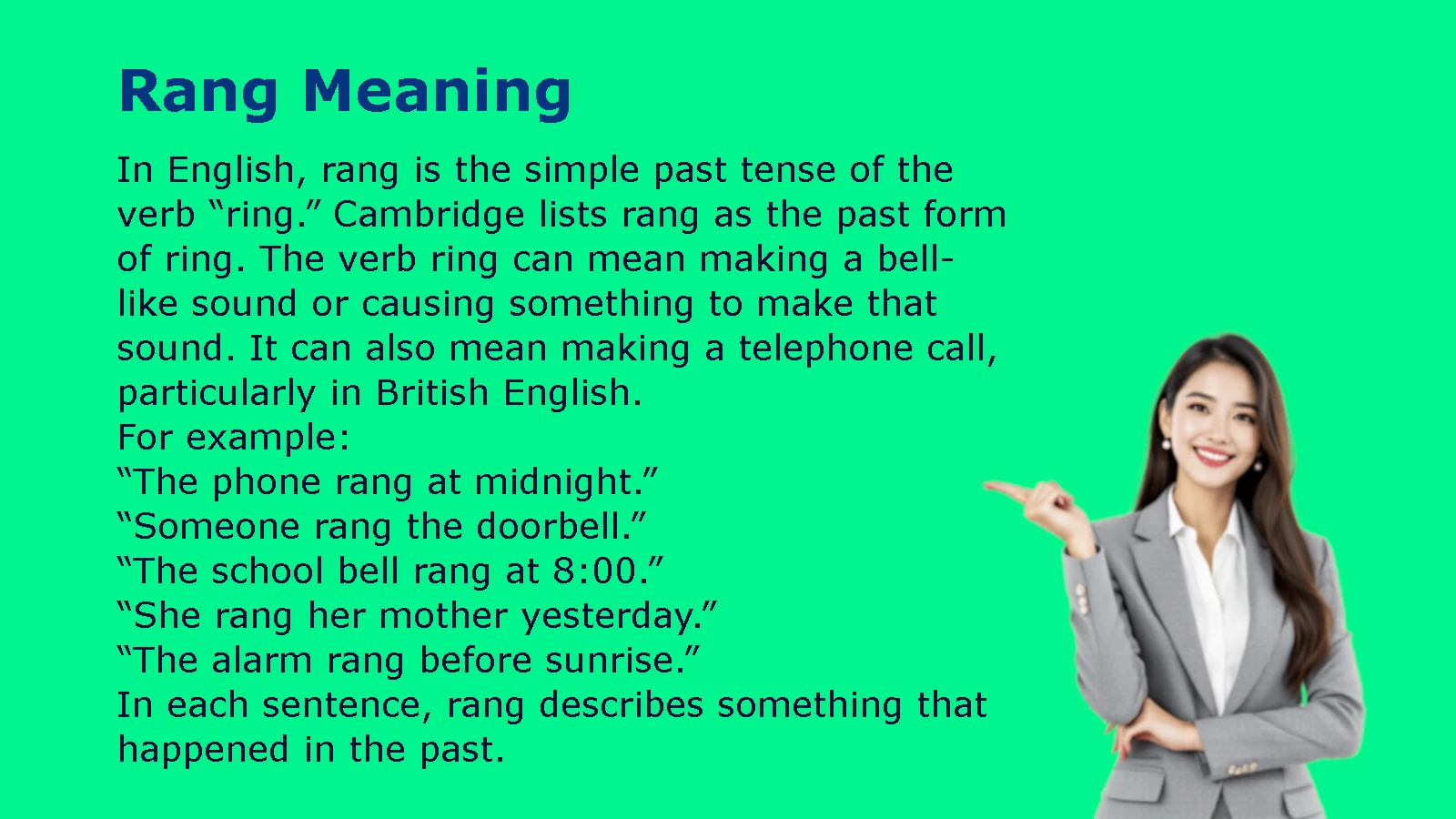
In English, rang is the simple past tense of the verb “ring.” Cambridge lists rang as the past form of ring. The verb ring can mean making a bell-like sound or causing something to make that sound. It can also mean making a telephone call, particularly in British English.
For example:
- “The phone rang at midnight.”
- “Someone rang the doorbell.”
- “The school bell rang at 8:00.”
- “She rang her mother yesterday.”
- “The alarm rang before sunrise.”
In each sentence, rang describes something that happened in the past.
Rang Meaning in Simple English
The easiest definition is:
Rang = the past tense of “ring.”
If something rings today, it rang yesterday.
Think of the verb as a three-part set:
ring → rang → rung
The forms don’t follow the regular “-ed” pattern. You don’t say ringed when you mean that a phone or bell made a sound. Instead, English uses the irregular forms rang and rung.
Ring, Rang, and Rung: What’s the Difference?
This is one of the most important points to understand.
| Word | Grammatical role | Example |
| ring | Base/present form | “I ring the bell every morning.” |
| rang | Simple past | “I rang the bell yesterday.” |
| rung | Past participle | “I have rung the bell.” |
The distinction becomes clearer when you look at complete sentences.
Ring
Use ring for the base form and present-tense situations.
- “Please ring the bell.”
- “The phone will ring soon.”
- “I usually ring my sister after work.”
Rang
Use rang when the action happened in the past.
- “The phone rang five minutes ago.”
- “She rang the bell.”
- “He rang me yesterday.”
Rung
Use rung with auxiliary verbs such as have, has, or had.
- “The phone has rung three times.”
- “She had rung the bell before I arrived.”
- “I have rung him already.”
A common mistake is saying:
“I have rang him.”
In standard English, the better form is:
“I have rung him.”
The reason is simple: rang is the simple past, while rung is the past participle.
Rang Meaning in Hindi
In Hindi, रंग (rang) generally means color. It can refer to the visible color of an object, a dye or pigment used to color something, or broader ideas connected with appearance and expression. Hindi dictionary sources list रंग as a masculine noun and connect it with coloring materials and color itself.
For example:
- लाल रंग — red color
- नीला रंग — blue color
- हरा रंग — green color
- काला रंग — black color
- सफेद रंग — white color
So if someone says “यह कौन सा रंग है?”, the basic meaning is:
“What color is this?”
Here, rang has nothing to do with the English verb ring.
Rang Meaning in Hindi With Examples
| Hindi phrase | Transliteration | English meaning |
| लाल रंग | laal rang | red color |
| नीला रंग | neela rang | blue color |
| हरा रंग | hara rang | green color |
| रंग बदलना | rang badalna | to change color |
| रंगीन कपड़े | rangeen kapde | colorful clothes |
The word can also appear in more figurative contexts. Depending on the phrase, rang may suggest a particular character, style, mood, or quality rather than a literal pigment.
That’s one reason a direct one-word translation doesn’t always capture everything the word is doing.
Rang Meaning in Urdu
In Urdu, رنگ (rang) also means color, hue, paint, pigment, dye, or complexion. Rekhta Dictionary lists rang as a masculine noun of Persian origin and gives several literal and figurative meanings.
For example:
- لال رنگ — red color
- سبز رنگ — green color
- نیلا رنگ — blue color
- رنگ بدلنا — to change color
- رنگین — colorful
Cambridge’s English-Urdu dictionary also translates colour as رنگ, confirming the basic connection between the English word color and Urdu rang.
Rang in Urdu Can Mean More Than Color
Here’s where the word gets interesting.
Urdu uses rang in several extended senses. Rekhta includes meanings associated with style, manner, appearance, condition, mood, character, beauty, liveliness, and expression.
So the word can move from something you literally see to something you figuratively experience.
For instance, describing someone’s rang may involve their appearance or complexion. In another context, rang can describe the particular style or character of something.
It’s similar to how English uses the word color figuratively:
- “That experience colored his opinion.”
- “The story has a darker color to it.”
- “She added color to the conversation.”
The languages aren’t identical, but the basic idea is comparable: color can become a metaphor for qualities beyond physical appearance.
What Is the Origin of Rang?
There are actually two different linguistic stories behind the English and South Asian uses of rang.
English Rang Comes From Ring
The English rang developed as the past tense of ring. Etymonline traces rang to Middle English usage and notes that the strong past-tense pattern developed partly by analogy with verbs such as sing → sang.
The English verb ring itself goes much further back. Its history is connected to Old English hringan, meaning to cause a bell to sound, with roots in Proto-Germanic. The modern telephone sense came much later, after telephones became part of everyday communication.
So:
ring → rang → rung
is an English grammatical development.
Rang Meaning “Color” Has a Different History
The South Asian noun rang has a separate history. Rekhta identifies رَنْگ / रंग as being of Persian origin and records its use in Urdu and Hindi with meanings including color, pigment, dye, appearance, mood, style, and related ideas.
Some Hindi dictionaries also provide a Sanskrit source for रंग, reflecting the complex historical development of vocabulary across the languages of South Asia.
The important point is this:
English “rang” and Hindi/Urdu “rang” are not simply two meanings of the same English word.
They happen to look and sound similar in Roman spelling, but they belong to different linguistic histories.
Why Does Rang Have So Many Meanings in Hindi and Urdu?
Words often expand beyond their original literal meaning.
Consider color. A physical color can affect how something looks. Over time, languages naturally use that idea to describe mood, character, style, beauty, or atmosphere.
The same broad pattern appears with rang.
Rekhta records meanings that go beyond literal color, including:
- Color
- Paint
- Pigment
- Dye
- Hue
- Complexion
- Appearance
- Style
- Manner
- Mood
- Character
- Condition
- Beauty
- Liveliness
- Entertainment or amusement
- Certain specialized meanings in cards and mathematics
You shouldn’t assume every one of these meanings applies every time you encounter rang. The surrounding words determine the intended sense.
Rang Meaning in Different Contexts
Context is the key that unlocks this word.
Rang as Color
This is the most straightforward South Asian use.
If someone talks about the rang of a shirt, flower, wall, or sky, they’re talking about its color or hue.
For example:
- “The dress has a beautiful rang.”
- “Which rang do you like?”
- “The wall changed its rang.”
In natural English translation, these sentences would normally use color, not rang, unless the writer deliberately wants to preserve the original South Asian word.
Rang as Paint or Dye
The word can also refer to a substance used to color something.
A painter might discuss the color applied to a wall. A textile worker might use dye to change the appearance of fabric.
Rekhta specifically includes meanings connected with pigment, dye, paint, and coloring material.
This gives rang a practical meaning as well as a visual one.
Rang as Complexion or Appearance
In some contexts, rang can refer to a person’s complexion or facial appearance.
This is especially important in literary and figurative language. A person’s face can appear pale, flushed, bright, dull, or changed because of emotion.
Rekhta records rang in connection with changes in facial appearance caused by emotional pressure.
For example, fear can make someone’s face appear pale. Embarrassment can cause someone to flush. A poet may describe such a change through the language of rang.
Rang as Style or Character
Sometimes rang describes the particular style, manner, or character of something.
That’s a more abstract use.
You might think of it as asking:
“What kind of character or flavor does this have?”
Rekhta includes meanings such as style, manner, nature, mood, method, and character.
This is one reason translating every occurrence of rang simply as “color” can produce a flat or inaccurate translation.
Rang in Poetry and Literature
Few words illustrate the richness of South Asian poetic vocabulary better than rang.
In Urdu poetry, color can describe far more than a physical shade. It can evoke beauty, love, emotion, spiritual experience, atmosphere, and transformation.
Rekhta’s entry for rang includes poetic examples from writers such as Faiz Ahmad Faiz and Jalil Manikpuri.
The word also appears in compounds and expressions that create vivid imagery. For example, gul-rang literally relates to the color of a flower and can carry a figurative sense of something delicate or beautiful.
This is a useful lesson for readers encountering rang in poetry:
Don’t translate poetry word for word.
A literal “color” may be technically correct while missing the emotional force of the phrase.
Rang and Holi
The connection between rang and Holi is especially strong in South Asian cultural vocabulary.
Holi is widely associated with colored powders and colored water. In Urdu and Hindi usage, rang can therefore appear in contexts referring to the festival, colored water, and the celebration itself.
Rekhta records rang in a figurative sense connected with colored water and Holi.
That gives the word a cultural layer beyond the basic dictionary definition.
When you encounter rang in a Holi-related phrase, the intended meaning may be more evocative than simply “color.” It can suggest the play, celebration, and atmosphere associated with colors.
Rang Meaning in Names, Songs, and Cultural Expressions
You’ll often encounter rang in South Asian names, song titles, poetry, films, and cultural expressions.
That’s not surprising. A word meaning color naturally lends itself to artistic language.
Color can represent:
- Beauty
- Emotion
- Love
- Celebration
- Identity
- Transformation
- Spiritual experience
- Atmosphere
- Personality
For example, the phrase rang-o-bu combines rang with bu, “fragrance.” Rekhta gives the expression meanings associated with splendor, beauty, colorfulness, and fragrance.
In artistic language, rang can therefore become a compact way of suggesting that something has life, beauty, or emotional richness.
Is Rang a Slang Word?
No. Rang isn’t inherently English slang.
In English, rang is an ordinary grammatical form: the simple past tense of ring.
In Hindi and Urdu, rang is an established vocabulary word meaning color and related concepts. It isn’t automatically slang simply because someone uses it online or writes it in Roman letters.
However, multilingual speakers often mix languages in texting and social media. Someone might write:
“This rang is beautiful.”
In that case, they may be using the South Asian word rang inside an English sentence.
Context matters.
Rang in Social Media and Texting
Online conversations make language boundaries less obvious.
A person might write:
- “Mujhe ye rang pasand hai.” — “I like this color.”
- “The phone rang.” — English: the phone made a ringing sound.
- “What rang is your favorite?” — potentially a Romanized South Asian usage of rang rather than standard English.
The spelling alone doesn’t tell you the meaning.
Look at the surrounding words.
| Example | Likely meaning |
| “The phone rang.” | Past tense of ring |
| “The bell rang.” | Past tense of ring |
| “Red rang” in a Hindi/Urdu context | Red color |
| “Rang badalna” | Change color |
| “Rang” in a poem | Could mean color, mood, style, beauty, or another figurative sense |
How Do You Pronounce Rang?
In standard American English, rang is pronounced approximately:
/ræŋ/
It rhymes closely with words such as:
- bang
- sang
- hang
- fang
The vowel is the short a sound heard in cat or map.
So the English word rang sounds roughly like:
“rang” / “raŋ”
The South Asian word written as rang in Roman script has a closely related pronunciation, although pronunciation can vary with language, accent, and regional speech.
The important distinction isn’t usually pronunciation. Context and language are what separate the meanings.
Rang vs. Ring
The difference between rang and ring is grammatical.
| Word | Meaning | Example |
| ring | Base/present form | “Please ring the bell.” |
| rang | Past tense | “She rang the bell.” |
Use ring when the action is present, habitual, infinitive, or follows a modal verb.
Examples:
- “I ring my parents every Sunday.”
- “Please ring me later.”
- “He will ring tomorrow.”
- “You should ring the office.”
Use rang for a completed past action:
- “He rang yesterday.”
- “The bell rang at noon.”
- “The alarm rang three times.”
Rang vs. Rung
This distinction causes even more confusion.
The easiest rule is:
Rang = simple past. Rung = past participle.
Compare these sentences:
Correct:
- “She rang the bell.”
- “She has rung the bell.”
- “She had rung the bell.”
Incorrect in standard English:
- “She has rang the bell.”
- “She had rang the bell.”
Here’s the pattern:
| Tense/construction | Correct form | Example |
| Present | ring | “I ring the bell.” |
| Simple past | rang | “I rang the bell.” |
| Present perfect | has/have rung | “I have rung the bell.” |
| Past perfect | had rung | “I had rung the bell.” |
| Future | will ring | “I will ring the bell.” |
Once you memorize ring → rang → rung, this irregular verb becomes much easier.
Common Mistakes With Rang
Several mistakes appear regularly when learners use this word.
Using “Rang” After Have or Has
Avoid:
“I have rang the bell.”
Use:
“I have rung the bell.”
The auxiliary have/has requires the past participle rung in this construction.
Treating Rang as a Noun in English
In standard English, rang isn’t the ordinary noun for a sound or telephone call.
You might say:
- “The phone rang.”
- “I heard the ring.”
- “I received a call.”
Don’t replace ring with rang simply because you’re describing a past event.
Assuming Every “Rang” Means Ring
This mistake becomes especially likely in multilingual content.
If you see:
रंग
you’re looking at the Devanagari spelling of a South Asian word generally associated with color.
If you see:
رنگ
you’re looking at the Urdu/Persian-script form.
Neither is the same grammatical construction as English rang.
A Quick Case Study: How Context Changes the Meaning
Imagine you see the word rang three times.
Sentence A
“The telephone rang at 7 p.m.”
Here, rang is clearly the English past tense of ring.
The meaning is:
The telephone made its ringing sound at 7 p.m.
Sentence B
“Mujhe ye rang bahut pasand hai.”
Here, rang appears in a Hindi/Urdu context.
The meaning is:
“I really like this color.”
Sentence C
“Uske chehre ka rang badal gaya.”
Here, rang is still connected with color or complexion, but the phrase describes a change in someone’s appearance.
The literal meaning and the contextual meaning work together.
This simple comparison shows why language identification should come before translation.
Common Phrases With Rang
The South Asian word rang appears in many expressions and compounds.
Some have literal meanings. Others have figurative or cultural meanings.
Rang Badalna
Rang badalna literally means to change color.
Depending on context, it can describe an actual physical change in color or a figurative change in behavior, appearance, or circumstances.
Rangin / Rangeen
Rangin or rangeen is related to rang and generally means colorful or full of color.
It can also be used figuratively for something vivid, lively, attractive, or varied. Rekhta’s entry for rangeen includes senses involving colorful appearance and lively or pleasing expression.
Rang-O-Bu
Rang-o-bu combines color and fragrance. Rekhta gives it meanings associated with beauty, splendor, colorfulness, and fragrance.
Gul-Rang
Gul-rang refers to the color of a flower and can describe shades such as pink, red, or flower-like hues. Figuratively, it can describe something delicate, beautiful, or beloved.
These expressions show how rang can act as a building block for much richer imagery.
Rang Meaning in Literature vs. Everyday Speech
The meaning of rang can shift depending on the register.
In everyday speech, it may simply mean:
color
In poetry, it can suggest:
beauty, emotion, character, mood, atmosphere, or transformation
In cultural contexts, it can evoke:
Holi, colored water, celebration, and festivity
In specialized contexts, dictionaries also record meanings related to playing-card suits and historical units of measurement.
That doesn’t mean every speaker uses all these meanings today. Dictionaries often preserve specialized or literary senses alongside everyday vocabulary.
Rang Meaning: Key Facts at a Glance
| Question | Answer |
| What does rang mean in English? | The simple past tense of ring |
| What does rang mean in Hindi? | Generally color, hue, dye, or paint |
| What does rang mean in Urdu? | Color, hue, paint, pigment, dye, plus several figurative meanings |
| Hindi spelling | रंग |
| Urdu spelling | رنگ |
| English pronunciation | /ræŋ/ |
| English verb forms | ring → rang → rung |
| Is rang English slang? | No, not inherently |
| Can rang be figurative? | Yes, particularly in Hindi/Urdu literary and idiomatic contexts |
| Does English rang mean color? | No. In standard English, it is the past tense of ring |
Frequently Asked Questions About Rang Meaning
What does rang mean?
Rang has two major meanings depending on the language. In English, it is the simple past tense of ring. In Hindi and Urdu, rang generally means color, hue, shade, paint, or dye.
What does rang mean in Hindi?
In Hindi, रंग (rang) generally means color. It can also refer to coloring material, dye, paint, and related figurative concepts.
What does rang mean in Urdu?
In Urdu, رنگ (rang) commonly means color, hue, pigment, dye, or paint. Depending on context, it can also refer to complexion, appearance, style, mood, character, condition, beauty, or liveliness.
Is rang the past tense of ring?
Yes. In English grammar, rang is the simple past tense of ring.
Example:
“The phone rang yesterday.”
Cambridge lists rang as the past tense of ring.
What is the difference between rang and rung?
Rang is the simple past form.
Rung is the past participle.
Examples:
- “The phone rang.”
- “The phone has rung.”
Is “I have rang” correct?
In standard English, no.
Use:
“I have rung.”
Use rang when you are using the simple past:
“I rang yesterday.”
Is rang an English word?
Yes. Rang is an English word because it is the past tense of ring.
However, rang is also used as a separate word in Hindi and Urdu with the meaning color and several related senses.
Does rang mean color?
Yes, in Hindi and Urdu.
It does not mean color in standard English.
In English:
“The phone rang.”
In Hindi/Urdu:
rang = color
How do you pronounce rang?
In English, rang is pronounced approximately /ræŋ/, with the same vowel sound found in bang and sang.
Is rang a slang word on social media?
Not inherently. It may appear in multilingual social media posts as the Hindi or Urdu word for color, while in English it may simply be the past tense of ring.
What does rang mean in poetry?
In Hindi and Urdu poetry, rang can have a much broader meaning than physical color. Depending on the phrase, it may suggest beauty, mood, character, style, emotional state, atmosphere, or spiritual experience.
Final Takeaway: Rang Meaning Depends on Context
The Rang meaning becomes simple once you identify the language.
In English, rang is the past tense of ring:
“The bell rang.”
In Hindi, रंग (rang) generally means color.
In Urdu, رنگ (rang) commonly means color, hue, paint, pigment, or dye, while literary and figurative usage can extend the word toward ideas such as style, mood, appearance, character, beauty, and condition.
The two uses may look identical when written in Roman letters, but they have different linguistic histories. English rang developed from the verb ring, while the South Asian noun rang has its own history and is identified by Rekhta as Persian in origin.
So, whenever you encounter rang, don’t translate it automatically. Read the sentence first. One small word can point to a ringing telephone, a beautiful color, a person’s complexion, or a much more poetic idea.