
Have you ever said something honestly and then realized it came across as rude or insensitive? That is where Tactless Meaning becomes important. While the word tactless may sound simple, it describes a person, comment, or action that can hurt or offend others because it lacks sensitivity, good judgment, or consideration.
Tactless means behaving or speaking without considering other people’s feelings or the social situation. A tactless person may tell the truth too bluntly, make an inappropriate comment, or bring up a sensitive subject at the wrong time.
Examples:
- His tactless comment made everyone uncomfortable.
- She was tactless when she asked about his personal problems.
The confusion is understandable. People often search for what does tactless mean, tactless meaning in a sentence, tactless meaning in text, or what does it mean to be tactless because the word can describe different types of insensitive behavior. And here’s the kicker: being honest does not always mean being tactful. The way you say something can matter just as much as what you say.
In this guide, you’ll learn the complete Tactless Meaning, its definition, pronunciation, synonyms, antonyms, and correct usage. You’ll also discover tactless meaning in context, examples of tactless behavior, how to use tactless in a sentence, and the difference between tactless, rude, insensitive, and blunt.
What Does Tactless Mean?
Tactless is an adjective that describes someone who doesn’t show enough sensitivity or good judgment when speaking or behaving around other people.
In simple terms, tactless means not thinking carefully about how your words or actions may affect someone else.
For example:
Asking someone, “Why haven’t you found a job yet?” after they recently lost their job can be tactless.
The question might come from curiosity rather than cruelty. Still, the timing and subject can make it uncomfortable or upsetting.
Cambridge gives the example of inviting someone’s ex girlfriend to an event as a tactless action. Oxford similarly uses a comment about someone’s hair as an example of a tactless remark.
Tactless Meaning in Simple Words
If you want an even simpler definition:
Tactless means saying or doing something without considering another person’s feelings or the social situation.
Think of tact as a social filter. It helps you decide:
- What should I say?
- How should I say it?
- Should I say it now?
- Should I say it at all?
- How might the other person feel?
A tactless person often skips that filter.
Tactless Definition
| Word | Definition |
| Tactless | Lacking sensitivity or good judgment in dealing with other people |
| Part of speech | Adjective |
| Pronunciation | /ˈtæktləs/ |
| Opposite | Tactful |
| Common synonyms | Insensitive, thoughtless, inconsiderate, rude, undiplomatic |
| Related noun | Tactlessness |
| Related adverb | Tactlessly |
Merriam Webster defines tactless as being marked by a lack of tact and lists related words such as inappropriate, indelicate, careless, injudicious, indiscreet, and undiplomatic.
Tactless Pronunciation
Tactless is pronounced:
/ˈtæktləs/
You can break it into two parts:
TACT + less
It sounds roughly like:
TAKT luhs
The first syllable receives the main stress. Both Cambridge and Oxford list the pronunciation as /ˈtæktləs/.
How to Remember the Pronunciation
The word combines tact with the suffix -less.
- Tact means sensitivity and good judgment when dealing with people.
- -less means lacking something.
So tactless literally suggests “lacking tact.”
Tactless Is an Adjective
Tactless functions as an adjective. It describes a person, comment, question, remark, action, or behavior.
For example:
- She made a tactless comment.
- That was a tactless question.
- His response sounded tactless.
- The manager’s handling of the situation was tactless.
- It was tactless to bring up the subject during dinner.
The word doesn’t necessarily describe someone’s entire personality. A person can make one tactless remark without being a permanently tactless person.
That distinction matters.
Tactless Examples in Sentences
Context makes the meaning much easier to understand. Here are examples from everyday situations.
Tactless Comments in Everyday Conversation
“You look exhausted. Did you even sleep last night?”
This might be meant as concern, but the wording can sound insensitive.
A more tactful version would be:
“You seem tired today. Is everything okay?”
The second version still communicates concern without putting the person on the spot.
Tactless Questions
“Why are you still single?”
The speaker may simply be curious. However, the question assumes that being single requires an explanation.
A better approach would be:
“How’s everything going in your personal life?”
Even better, don’t ask about someone’s romantic life unless the conversation naturally moves in that direction.
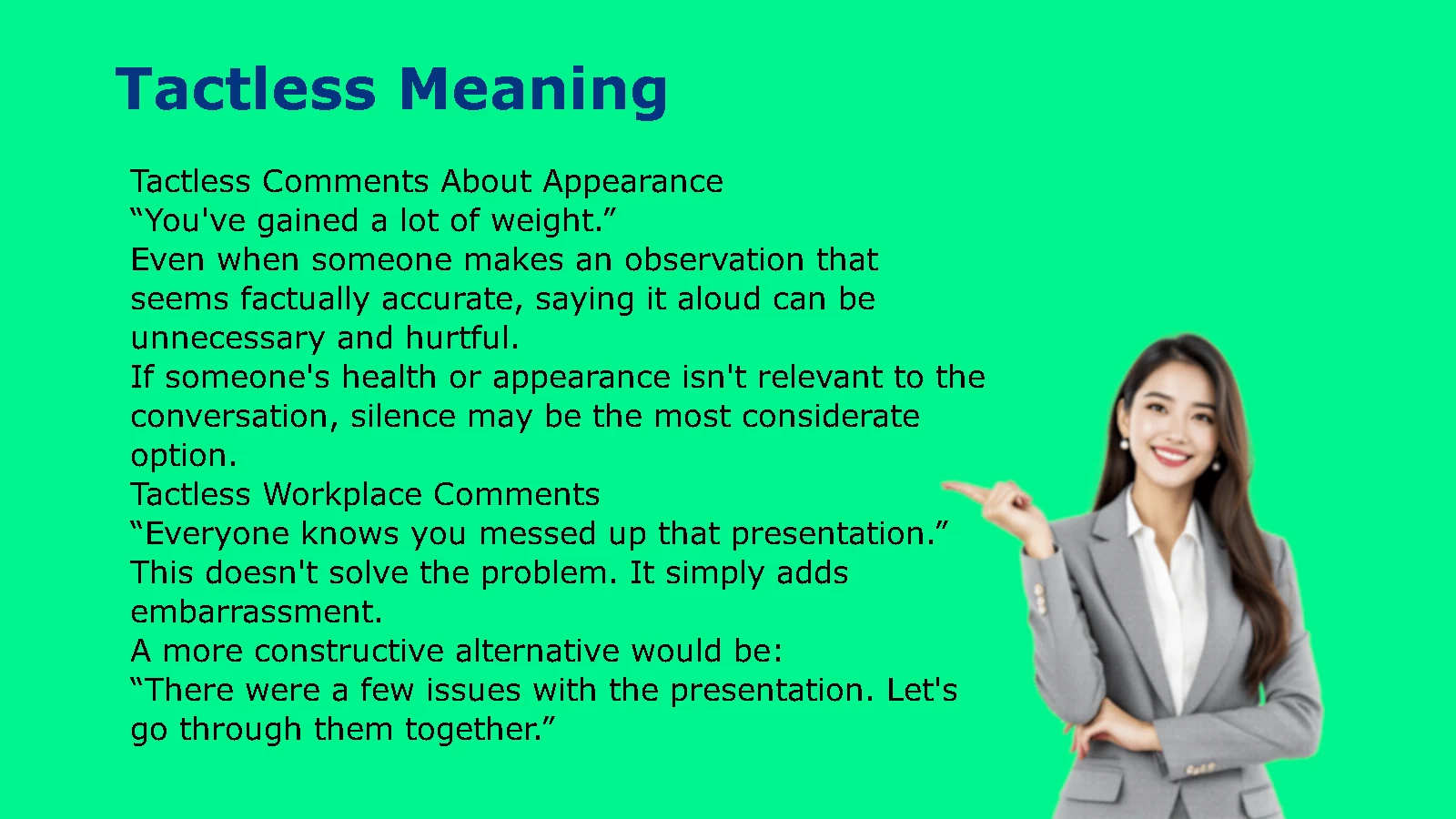
Tactless Comments About Appearance
“You’ve gained a lot of weight.”
Even when someone makes an observation that seems factually accurate, saying it aloud can be unnecessary and hurtful.
If someone’s health or appearance isn’t relevant to the conversation, silence may be the most considerate option.
Tactless Workplace Comments
“Everyone knows you messed up that presentation.”
This doesn’t solve the problem. It simply adds embarrassment.
A more constructive alternative would be:
“There were a few issues with the presentation. Let’s go through them together.”
Tactless Jokes
A joke can become tactless when it ignores the emotional tone of a situation.
For example, joking about someone’s recent loss, financial problems, or serious personal difficulty can come across as deeply insensitive.
The problem isn’t always the joke itself. Timing and context matter.
What Makes a Comment Tactless?
A comment usually becomes tactless because it ignores one or more important social factors.
Timing
A perfectly reasonable comment can become inappropriate when you make it at the wrong moment.
For example, telling someone how to improve their presentation immediately after they receive harsh criticism from their manager may feel unnecessary. Waiting until they have had time to recover can make the same feedback easier to hear.
Setting
Where you say something matters.
A private correction may be helpful. Public criticism can cause embarrassment.
Compare:
“Can I give you some feedback after the meeting?”
with:
“Everyone, look at the mistake she made.”
The second statement creates unnecessary humiliation.
Tone
Your words aren’t the only part of communication. Tone changes meaning.
“That’s interesting” can express genuine curiosity. Depending on the tone, however, it can also sound dismissive or sarcastic.
Subject
Some subjects naturally require greater sensitivity.
These may include:
- Money
- Weight
- Age
- Relationships
- Health
- Family problems
- Job loss
- Grief
- Personal appearance
- Private decisions
That doesn’t mean you can never discuss these topics. It means you should consider whether the person wants to discuss them and whether the situation calls for care.
Relationship
You may joke about something with a close friend that would sound completely inappropriate coming from a stranger.
Familiarity changes what people consider acceptable.
Tactless vs. Honest
One of the biggest misunderstandings about tactless behavior is the idea that tactlessness equals honesty.
It doesn’t.
You can tell the truth without being unnecessarily harsh.
Imagine a friend asks:
“What do you think of my new haircut?”
A tactless response might be:
“Honestly, it looks terrible.”
A more tactful response could be:
“I liked your previous style better, but if you like this one, that’s what matters.”
Both responses communicate an opinion. The second one shows more awareness of the other person’s feelings.
Honesty and Tactlessness Compared
| Honest communication | Tactless communication |
| Tells the truth respectfully | May express the truth harshly |
| Considers the listener | Often ignores the listener’s feelings |
| Focuses on useful information | May focus on criticism |
| Considers timing | May ignore timing |
| Uses appropriate language | Can use unnecessarily blunt language |
Honesty answers the question, “Is this true?”
Tact also asks, “Is it helpful to say this, and how should I say it?”
That’s the key difference.
Tactless vs. Rude
Tactless and rude overlap, but they aren’t identical.
Rude usually describes behavior that lacks politeness or shows disrespect. Tactless focuses more specifically on poor judgment or a lack of sensitivity in social situations.
For example, interrupting someone repeatedly can be rude.
Asking someone about a deeply personal problem in front of a large group can be tactless.
A single action can also be both.
| Tactless | Rude |
| Lacks social sensitivity | Lacks politeness or respect |
| Often involves poor judgment | Can involve deliberate disrespect |
| May be accidental | Can be intentional or accidental |
| Focuses strongly on context | Has a broader meaning |
A tactless person may not realize they’ve caused offense. A rude person may understand exactly what they’re doing and simply not care.
Tactless vs. Insensitive
Insensitive is one of the closest synonyms for tactless.
Both words can describe behavior that fails to account for another person’s feelings. However, insensitive often emphasizes a lack of emotional awareness, while tactless can emphasize poor judgment about what is appropriate to say or do.
For example:
“That was an insensitive thing to say after her loss.”
This focuses on the emotional impact.
“That was a tactless question to ask at dinner.”
This focuses more on the appropriateness of the question and situation.
The distinction can be subtle because the two words often work interchangeably.
Tactless vs. Blunt
Blunt means direct and not softened by polite or indirect language.
Being blunt isn’t automatically bad.
For example:
“No, I don’t agree with that plan.”
That’s blunt, but it isn’t necessarily tactless.
However:
That’s both blunt and tactless.
The difference comes down to sensitivity.
| Blunt | Tactless |
| Very direct | Lacks sensitivity |
| Can be neutral | Usually negative |
| Doesn’t necessarily offend | Often risks causing offense |
| Can be useful | Can damage communication |
Someone can be blunt but tactful.
That’s an important distinction.
Tactless vs. Inconsiderate
Inconsiderate means failing to think about other people’s needs, feelings, or convenience.
Tactless usually relates more closely to speech, social behavior, or handling delicate situations.
For example:
“He was inconsiderate and left his roommate to clean the entire house.”
That concerns someone’s actions and consideration for another person’s workload.
“She was tactless when she asked about his divorce in front of everyone.”
That concerns social judgment and sensitivity.
The meanings overlap, but the context determines which word fits better.
Tactless Synonyms
There are many synonyms for tactless, but they don’t all carry exactly the same shade of meaning.
Common Tactless Synonyms
- Insensitive
- Thoughtless
- Inconsiderate
- Rude
- Impolite
- Blunt
- Undiplomatic
- Indiscreet
- Injudicious
- Indelicate
- Crass
- Brash
- Careless
- Inappropriate
- Unwise
Merriam Webster includes terms such as inappropriate, indelicate, careless, injudicious, indiscreet, undiplomatic, and brash among its synonyms. Collins also lists insensitive, thoughtless, inconsiderate, and sharp.
Tactless Synonyms by Context
| If you mean… | Consider using… |
| Lacking emotional awareness | Insensitive |
| Failing to think about others | Inconsiderate |
| Speaking too directly | Blunt |
| Acting without enough thought | Thoughtless |
| Lacking diplomacy | Undiplomatic |
| Saying something private publicly | Indiscreet |
| Acting in poor taste | Indelicate |
| Being crude or offensive | Crass |
| Acting too aggressively | Brash |
| Making a poor judgment | Injudicious |
Choosing the right synonym gives your writing more precision. If someone reveals private information, indiscreet may fit better than rude. If someone makes a hurtful remark without considering the emotional impact, insensitive may be stronger.
Antonyms of Tactless
The main opposite of tactless is tactful.
Other useful antonyms include:
- Considerate
- Sensitive
- Diplomatic
- Thoughtful
- Polite
- Discreet
- Courteous
- Respectful
Tactless vs. Tactful
| Tactless | Tactful |
| “Why did you wear that?” | “That’s a different style than usual.” |
| “Your idea won’t work.” | “I see a few challenges with that idea.” |
| “Why don’t you have kids?” | Avoid asking such a personal question unless appropriate |
| “You look awful today.” | “You don’t seem like yourself today.” |
| Criticizes publicly | Gives sensitive feedback privately |
Being tactful doesn’t mean lying or avoiding difficult conversations.
It means handling difficult conversations with judgment.
What Is a Tactless Person?
A tactless person is someone who regularly says or does things without enough awareness of how those actions may affect other people.
However, it’s worth avoiding quick labels.
Someone who makes one awkward comment isn’t necessarily a tactless person. People misread situations. They forget themselves. They sometimes speak before thinking.
Repeated behavior gives you stronger evidence.
Signs of Tactless Behavior
A person may come across as tactless if they frequently:
- Ask highly personal questions without invitation
- Make embarrassing comments in public
- Criticize someone’s appearance unnecessarily
- Make jokes about sensitive subjects
- Interrupt serious conversations with inappropriate humor
- Point out other people’s mistakes for no useful reason
- Give unwanted opinions about personal choices
- Ignore obvious emotional cues
- Reveal private information
- Speak harshly during emotional moments
- Criticize people in front of others
- Say things that make an uncomfortable situation worse
None of these behaviors automatically proves bad intentions.
Intent and impact aren’t always the same thing.
Case Study: When Honesty Becomes Tactless
Consider a simple workplace situation.
An employee gives a presentation to a team. The presentation has several weaknesses. Afterward, a coworker says:
“That was a terrible presentation. You clearly weren’t prepared.”
The coworker may believe the criticism is honest.
Yet the statement doesn’t offer much useful guidance. It attacks the person’s performance without explaining how to improve.
Now compare it with:
“A few parts of the presentation weren’t clear. I think adding examples to those sections would make the main points easier to follow.”
The second version still communicates criticism. It simply delivers that criticism with purpose and tact.
What Changed?
| Tactless approach | Tactful approach |
| Attacks the person | Addresses the work |
| Uses absolute language | Identifies specific issues |
| Creates embarrassment | Encourages improvement |
| Offers little guidance | Provides a practical direction |
| Focuses on judgment | Focuses on solutions |
This illustrates why tact isn’t the same as being overly nice. Tactful communication can still be direct.
Tactless Comments and Better Alternatives
The easiest way to understand the word is to compare poor phrasing with better alternatives.
| Tactless comment | More tactful alternative |
| “Why are you still single?” | “How’s life going?” |
| “You’ve gained weight.” | Don’t comment on someone’s body unless there’s a genuine reason |
| “That’s a terrible idea.” | “I see some problems with that approach.” |
| “You look old today.” | “You seem tired today.” |
| “Everyone noticed your mistake.” | “Let’s figure out how to correct it.” |
| “Your house is really small.” | “Your place has a cozy layout.” |
| “Why can’t you afford it?” | “Is there another option that would work better?” |
| “You always do this wrong.” | “Let’s look at what went wrong this time.” |
The goal isn’t to replace every direct statement with sugarcoated language.
Instead, ask whether the extra harshness actually serves a purpose.
Usually, it doesn’t.
How to Use Tactless in a Sentence
The word commonly appears before nouns that describe communication or behavior.
Tactless Comment
“His tactless comment made the conversation uncomfortable.”
Tactless Remark
“She apologized for her tactless remark.”
Tactless Question
“That was a tactless question to ask during the meeting.”
Tactless Response
“His tactless response upset the customer.”
Tactless Behavior
“The manager apologized for his tactless behavior.”
Tactless Person
“He can be tactless when discussing personal matters.”
Tactless Statement
“Her tactless statement changed the mood of the room.”
These combinations sound natural because tactless often describes speech, questions, remarks, responses, and actions involving other people’s feelings.
Common Collocations With Tactless
A collocation is a combination of words that commonly appear together.
Some useful collocations include:
- tactless comment
- tactless remark
- tactless question
- tactless response
- tactless behavior
- tactless joke
- tactless statement
- tactless manner
- tactless approach
- tactless handling
For example:
“The interviewer asked a tactless question.”
“His tactless joke made everyone uncomfortable.”
“The company received criticism for its tactless response.”
These combinations help you use the word naturally rather than forcing it into a sentence.
Tactless vs. Tactfully
These words come from the same base but perform different grammatical jobs.
Tactless is an adjective:
“That was a tactless remark.”
Tactfully is an adverb:
“She handled the complaint tactfully.”
The first describes the remark. The second describes how she handled the complaint.
Related Forms of Tactless
| Word | Part of speech | Meaning | Example |
| Tact | Noun | Sensitivity and good judgment | “She handled the situation with tact.” |
| Tactful | Adjective | Showing tact | “He gave a tactful response.” |
| Tactless | Adjective | Lacking tact | “That was a tactless comment.” |
| Tactfully | Adverb | In a tactful manner | “She tactfully changed the subject.” |
| Tactlessness | Noun | The quality of lacking tact | “His tactlessness surprised everyone.” |
Oxford identifies tactlessness as the noun referring to saying or doing things likely to annoy or upset other people.
Where Does the Word Tactless Come From?
The word tactless combines tact with the suffix -less, meaning lacking or without.
Etymonline records tactless from around 1830 in the sense of being “characterized by want of tact.” The word tact itself originally related to touch and later developed its figurative sense involving discernment and diplomacy.
Merriam Webster records the first known use of tactless around 1847, while Collins dates its origin to the 1840s and 1850s. The difference reflects how dictionaries document historical usage and first known evidence.
The basic idea behind the word remains easy to understand:
tact + less = lacking tact
Is Being Tactless Always Intentional?
No.
A person can behave tactlessly without trying to hurt anyone.
Someone might:
- Speak before thinking
- Misread the mood
- Fail to notice discomfort
- Come from a communication style that values extreme directness
- Forget that a topic is sensitive
- Assume everyone shares their sense of humor
- Give advice when nobody asked for it
This is why tactless doesn’t automatically mean malicious.
Someone can have good intentions and still say something tactless.
Intent vs. Impact
Consider this statement:
“You should smile more. You’d look much prettier.”
The speaker might believe they’re offering a compliment.
The listener may instead hear criticism about their normal appearance.
The intention was positive. The impact may not be.
That’s one reason tact matters. Good communication requires more than deciding what you meant. It also requires considering how your message is likely to land.
Is Tactless a Negative Word?
Yes. Tactless generally has a negative meaning.
Calling someone’s comment tactless suggests that the person failed to show enough sensitivity or judgment.
However, the word can vary in strength depending on context.
Compare:
“That was a little tactless.”
with:
“He is an incredibly tactless person.”
The first criticizes a specific action. The second makes a much broader judgment about someone’s character.
When possible, describing the behavior rather than labeling the person can make communication more constructive.
How to Respond to a Tactless Comment
You don’t always need to confront someone who makes a tactless comment. Sometimes the easiest response is to move on.
When the comment crosses a boundary, however, a calm response can help.
Direct Responses
You might say:
- “That was a little insensitive.”
- “I’d rather not discuss that.”
- “I’m not comfortable answering that.”
- “Could you phrase that differently?”
- “I don’t think that’s appropriate to discuss here.”
- “I understand what you’re asking, but that’s personal.”
- “That comment wasn’t necessary.”
These responses set boundaries without turning the situation into a bigger argument.
When Humor Helps
Sometimes a light response can defuse an awkward question.
If someone asks:
“Why are you still single?”
You might respond:
“Apparently, the applications are still under review.”
Humor won’t work in every situation, especially when the comment is genuinely hurtful. Still, it can help redirect an awkward conversation when the relationship allows it.
How to Avoid Being Tactless
Tact isn’t a mysterious personality trait. Much of it comes down to a few practical habits.
Think Before You Speak
Before saying something potentially sensitive, pause for a moment.
Ask:
“Does this need to be said?”
If the answer is no, leave it alone.
Consider the Other Person
Try to imagine how the statement might sound from the listener’s point of view.
This doesn’t mean you need to predict every possible reaction. It simply means you shouldn’t treat your own perspective as the only one that matters.
Choose the Right Time
Timing can change the meaning of a message.
Constructive feedback during a private conversation can help someone improve. The same feedback shouted across a crowded room can embarrass them.
Read the Room
Pay attention to the mood.
If everyone is discussing a serious problem, a sarcastic joke probably won’t land well.
If someone looks uncomfortable after a question, don’t keep pushing.
Avoid Unnecessary Personal Comments
Not every observation needs to become part of the conversation.
You may notice someone’s weight, age, clothes, relationship status, or financial situation. That doesn’t mean you need to mention it.
Sometimes saying nothing is the most tactful choice.
Give Criticism With a Purpose
If criticism doesn’t help someone understand or improve something, ask yourself why you’re giving it.
Instead of:
“You’re terrible at this.”
Try:
“This section needs more detail.”
Specific feedback gives the other person something they can actually use.
A Simple Tact Test
Before making a sensitive comment, run it through this quick test:
Is it true?
↓
Is it relevant?
↓
Is it necessary?
↓
Is this the right time?
↓
Is this the right setting?
↓
Can I say it more respectfully?
↓
Speak
You don’t need to follow this checklist mechanically. The point is to create a brief pause between thinking and speaking.
That pause often prevents a tactless remark.
Tactless Meaning in Different Contexts
The meaning remains consistent, but the behavior can look different depending on the setting.
In the Workplace
A tactless employee might criticize a coworker publicly, discuss private matters in front of others, or make an insensitive comment during a difficult meeting.
Professional environments often require extra care because comments can affect trust, morale, and working relationships.
In Friendships
Friends may speak more casually with one another, but personal boundaries still matter.
A friend who repeatedly mocks someone’s insecurities may be acting tactlessly even if they call it a joke.
In Families
Family members often know sensitive details about one another. That familiarity can make tact even more important.
Bringing up an embarrassing childhood mistake at a family gathering might seem funny to one person and humiliating to another.
Online
Digital communication creates another challenge because text removes many tone cues.
A short response such as:
“Obviously.”
can sound dismissive even when the writer didn’t intend it that way.
Online conversations also make it easy to forget that a private question can become public when posted in a group.
Frequently Asked Questions About Tactless
What does tactless mean?
Tactless means lacking sensitivity or good judgment when saying or doing something that could upset, embarrass, or offend another person.
What is an example of being tactless?
Asking someone about their salary in front of a group can be tactless because it involves a personal subject and may put the person in an uncomfortable position.
Is tactless the same as rude?
Not exactly. Rude generally means impolite or disrespectful. Tactless specifically emphasizes a lack of sensitivity or judgment in dealing with people or delicate situations.
Is tactless the same as blunt?
No. Blunt means very direct. A blunt statement isn’t necessarily offensive. Tactless suggests that the speaker failed to consider how the statement might affect others.
What is the opposite of tactless?
The main opposite is tactful. Other alternatives include considerate, diplomatic, sensitive, thoughtful, polite, and discreet.
What is a synonym for tactless?
Common synonyms include insensitive, thoughtless, inconsiderate, rude, undiplomatic, indiscreet, indelicate, blunt, and injudicious. The best synonym depends on the context.
Can someone be tactless without intending to be rude?
Yes. Someone can make a tactless comment without intending to offend anyone. The problem may come from poor timing, weak social awareness, or a failure to consider the listener’s feelings.
How do you use tactless in a sentence?
You can use it to describe a person, remark, question, response, or behavior. For example:
“His tactless comment made everyone uncomfortable.”
Is tactless always a negative word?
Yes. Tactless normally expresses criticism because it suggests that someone handled a social situation without enough care or sensitivity.
What is the noun form of tactless?
The noun form is tactlessness.
For example:
“Her tactlessness surprised the entire team.”
Cambridge defines tactlessness as the quality of not being careful to avoid saying or doing something that could upset someone.
Key Takeaways About Tactless Meaning
The tactless meaning becomes much clearer when you look beyond the dictionary definition and consider real communication.
- Tactless is an adjective.
- It describes someone or something that lacks tact or sensitivity.
- A tactless person may say or do something without considering how it could affect others.
- Tactless doesn’t always mean intentionally rude.
- A person can be honest without being tactless.
- Blunt and tactless overlap, but bluntness doesn’t always involve insensitivity.
- Rude is broader than tactless and focuses more on a lack of politeness or respect.
- Insensitive is one of the closest synonyms for tactless.
- Tactful is the primary opposite.
- Related forms include tact, tactful, tactfully, and tactlessness.
- Common phrases include tactless comment, tactless remark, tactless question, tactless response, and tactless behavior.
- Good communication isn’t only about telling the truth. Timing, tone, setting, and consideration matter too.