
Have you ever seen the word “with” and wondered how many meanings it can have? While WITH Meaning may seem simple, this common English word can express connection, company, possession, tools, relationships, and much more depending on the sentence and context.
With is a preposition used to show that someone or something is together with another person or thing. It can also indicate the person or thing involved in an action, the tool used to do something, or a characteristic that something has.
Examples:
- I went to the store with my brother.
- She cut the paper with scissors.
The confusion is understandable. People often search for what does with mean, with meaning in English, with meaning in a sentence, or how to use with correctly because this small word appears in countless everyday expressions. And here’s the kicker: although with usually suggests being together or connected, its exact meaning can change based on how you use it.
In this guide, you’ll learn the complete WITH Meaning, its definition, pronunciation, correct usage, and examples in sentences. You’ll also discover the different meanings and uses of with, common phrases that include it, and how to use this versatile word correctly in everyday English.
What Does “With” Mean?
“With” is primarily a preposition. Its broadest function is to show some kind of relationship or connection between two things.
That connection can take different forms.
You might connect a person to another person:
I went with Maria.
You might connect an object to a feature:
She bought a car with leather seats.
You might connect an action to a tool:
He cut the rope with a knife.
Or you might connect an emotion to its cause:
She was trembling with fear.
So, the simplest definition of with is:
With shows a connection, association, accompaniment, possession, method, cause, or another relationship between things.
The exact meaning comes from the context.
A Quick Definition of “With”
| Use of “with” | Basic meaning | Example |
| Accompaniment | together with | I went with Anna. |
| Possession | having | A house with three bedrooms |
| Method | using | Write with a pen. |
| Contents | containing | Tea with sugar |
| Manner | showing how | She spoke with confidence. |
| Cause | because of | He cried with pain. |
| Relationship | connected to | What’s wrong with the computer? |
| Support | supporting | I’m with you. |
| Opposition | against | They argued with each other. |
| Comparison | in relation to | Compared with last year |
| Time/change | as something changes | Prices rise with demand. |
These meanings aren’t random. Most of them grow from the basic idea of connection.
“With” Meaning in Simple English
If you’re learning English, the easiest way to understand with is to ask one question:
What relationship does “with” show here?
That question quickly separates the major uses.
With = Together With Someone
When with shows that people or things are together, it means accompanied by or in the company of.
Examples:
- I went with my brother.
- She lives with her parents.
- We’re traveling with some friends.
- He came with me.
- I had lunch with my manager.
In this use, with connects people who share a place, activity, or experience.
With = Having Something
Sometimes with tells you what a person or thing has.
For example:
She is the woman with the red bag.
The phrase with the red bag identifies which woman you’re talking about.
More examples:
- A house with a swimming pool
- A man with gray hair
- A phone with a large screen
- A student with excellent grades
- A restaurant with outdoor seating
Here, with is close in meaning to having or that has.
With = Using Something
When you use with to identify a tool or instrument, it means using that thing.
Examples:
- Cut the paper with scissors.
- Open the box with a knife.
- Write with a pencil.
- Clean the glass with a cloth.
- He repaired the chair with a hammer.
In each sentence, the noun after with tells you what helped perform the action.
With = Containing Something
With can also describe what food, drinks, objects, or other things contain.
Examples:
- Coffee with milk
- Rice with vegetables
- A sandwich with cheese
- A room with two windows
- A bag with several pockets
In this sense, with means something like containing, including, or having.
Different Meanings of “With”
The word with has a surprisingly wide range of uses. Understanding these categories makes it much easier to interpret sentences correctly.
Accompaniment
With can show that someone or something is present alongside another person or thing.
I went with my friends.
This means the speaker and the friends went together.
Possession or Description
With can describe a feature or characteristic.
She is the woman with curly hair.
The phrase identifies her by something she has.
Instrument or Method
With can identify the object used to complete an action.
He opened the door with a key.
The key is the instrument.
Contents
With can show what something contains or includes.
I’d like a burger with cheese.
The cheese is an added component.
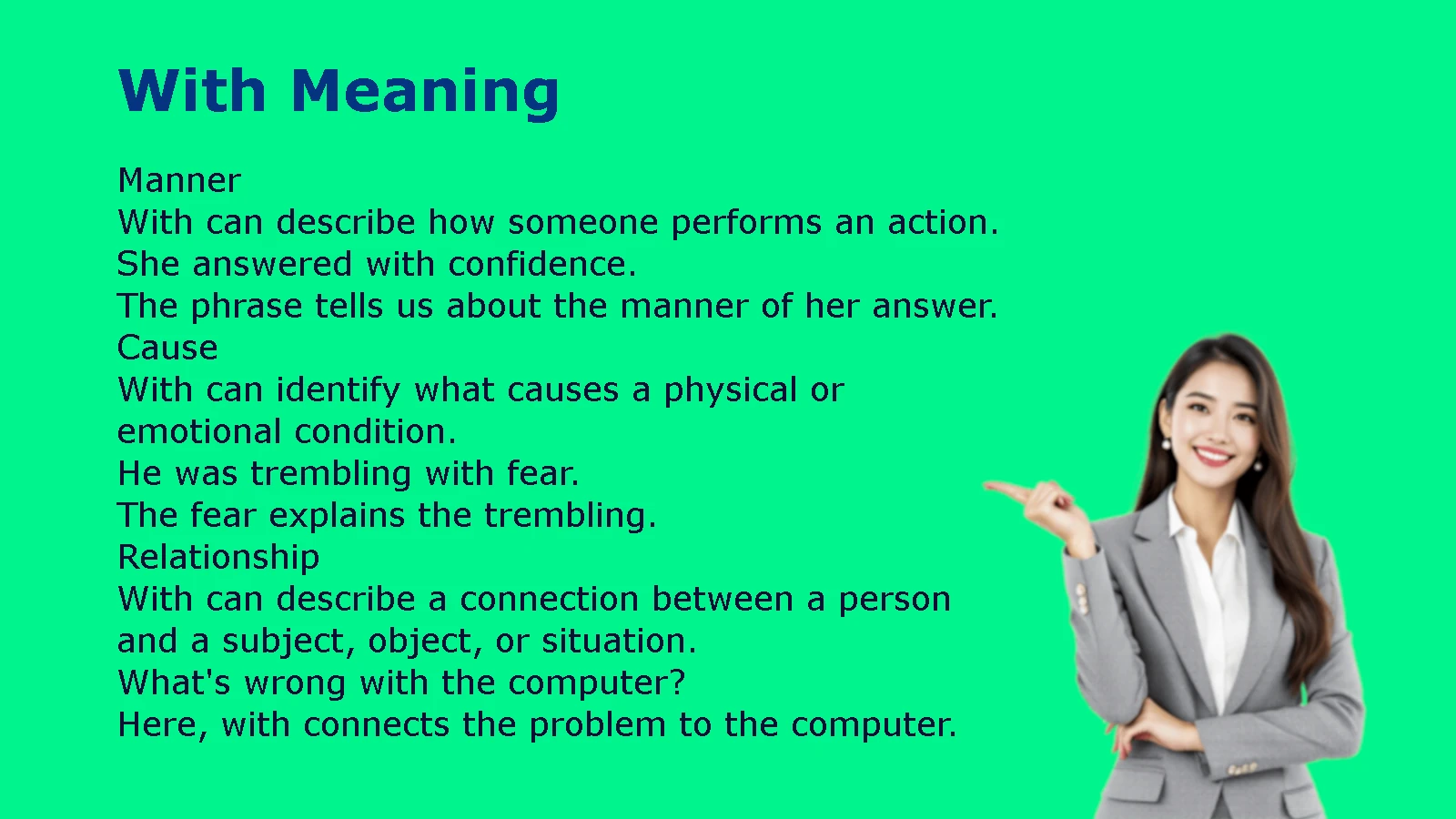
Manner
With can describe how someone performs an action.
She answered with confidence.
The phrase tells us about the manner of her answer.
Cause
With can identify what causes a physical or emotional condition.
He was trembling with fear.
The fear explains the trembling.
Relationship
With can describe a connection between a person and a subject, object, or situation.
What’s wrong with the computer?
Here, with connects the problem to the computer.
Support
With can mean that you support someone or agree with their position.
I’m with you on this decision.
In this context, with means something close to supporting or agreeing with.
Common Uses of “With”
The following uses cover many of the situations you’ll encounter in everyday English.
“With” for Accompaniment
One of the most common with meanings is together with someone or something.
Consider:
Sarah went to the store with her brother.
Sarah didn’t go alone. Her brother accompanied her.
You can use this structure with people, animals, and sometimes objects:
- I traveled with my parents.
- He went with his dog.
- She brought her notebook with her.
- We went with the original plan.
The word can also describe living arrangements:
He lives with his grandparents.
Here, with doesn’t necessarily mean that the people are doing something at exactly the same moment. It describes their shared living situation.
Cambridge identifies this as one of the central uses of with, including situations where people are together, live together, or perform an activity together.
“With” for Possession and Features
Another important with meaning is having or possessing something.
Look at this sentence:
I saw a woman with a blue umbrella.
The phrase with a blue umbrella gives additional information about the woman.
It works almost like an adjective:
a woman with a blue umbrella
You can use the same pattern for physical features, objects, characteristics, and other details.
Examples:
- A boy with brown eyes
- A house with a red roof
- A phone with a cracked screen
- A dog with a long tail
- A company with 500 employees
- A restaurant with excellent reviews
This use often answers the question “What does it have?”
For example:
What kind of apartment is it?
It’s an apartment with two bedrooms.
The phrase after with gives the feature that helps describe the noun.
“With” for Tools and Instruments
When you’re explaining what someone used to perform an action, with often identifies the instrument.
Examples:
- She painted the wall with a brush.
- He unlocked the door with a key.
- I wrote the note with a pen.
- They measured the table with a ruler.
- He fixed the bike with a wrench.
This is one area where English learners often confuse with and by.
Compare:
She cut the paper with scissors.
The scissors are the physical instrument.
Now compare:
She traveled by train.
The train describes the means of transportation.
A useful rule is:
With often points to the physical tool or instrument.
By often points to the broader means or method.
Cambridge lists this instrumental use of with under its method meaning.
“With” for Food, Ingredients, and Contents
You see this use constantly in menus, recipes, grocery descriptions, and everyday conversation.
Examples:
- Pasta with tomato sauce
- Toast with butter
- Tea with honey
- Chicken with rice
- A salad with avocado
- A sandwich with extra cheese
In these sentences, with identifies an ingredient or accompanying component.
For example:
I’ll have coffee with milk.
The milk accompanies or becomes part of the coffee.
You can also use with for things that fill or cover an object:
The box was filled with books.
The floor was covered with mud.
The table was crowded with plates and glasses.
This use extends beyond food. Cambridge specifically includes examples involving things being filled, covered, loaded, or supplied with something.
“With” for Manner
Sometimes with tells you how someone does something.
Consider:
She spoke with confidence.
The phrase with confidence describes the manner of speaking.
Other examples include:
- He answered with patience.
- She listened with interest.
- They worked with enthusiasm.
- He accepted the news with calmness.
- She closed the door with a bang.
This structure is particularly common with abstract nouns:
with + emotion, attitude, or quality
Examples:
- with confidence
- with care
- with patience
- with enthusiasm
- with excitement
- with concern
- with respect
Notice how these phrases add texture to a sentence.
Compare:
He answered.
with:
He answered with confidence.
The second sentence tells you more about the action.
“With” for Cause
Another important with meaning is because of or as a result of.
Examples:
She was trembling with fear.
He was crying with pain.
The children were jumping with excitement.
The noun after with identifies the emotion, physical sensation, or condition associated with the result.
This construction is especially common with feelings and physical reactions:
- shaking with fear
- crying with joy
- trembling with anger
- sweating with anxiety
- screaming with excitement
- wincing with pain
Cambridge classifies this use as showing something that is caused by another thing.
A Useful Comparison
Consider:
He was shaking with fear.
The fear explains why he was shaking.
But:
He spoke with confidence.
Confidence describes how he spoke.
The structure looks similar, but the relationship is different. Context does the heavy lifting.
“With” for Relationships and Connections
With can show a relationship between a person and another person, organization, object, subject, or situation.
Examples:
- What’s wrong with your phone?
- I have a problem with this software.
- She works with children.
- He has experience with large teams.
- The company has a contract with the government.
- I’m having trouble with my computer.
In these sentences, with establishes a relationship or connection.
This use appears frequently in professional English.
For example:
She works with several international clients.
The sentence doesn’t necessarily mean that she is physically beside them. It means her work involves those clients.
Cambridge includes this relational use in expressions concerning problems, involvement, popularity, work, agreements, and other connections.
“With” for Agreement and Support
In informal conversation, with can show that you support someone or share their position.
For example:
I’m with you on this.
This means:
I support you on this matter.
Similarly:
- Are you with me?
- I’m with you all the way.
- She’s with us.
- We’re with them on this decision.
The phrase with me can also have another meaning.
Are you with me?
Depending on the situation, this might mean:
- Do you understand me?
- Do you agree with me?
- Are you supporting me?
- Are you coming with me?
Context determines the intended meaning.
Cambridge specifically recognizes be with someone as an informal expression meaning to understand what someone is saying.
“With” for Opposition
Although with often suggests connection or cooperation, it can also appear in situations involving conflict.
Examples:
- I argued with my brother.
- The two teams fought with each other.
- She had a disagreement with her manager.
- The company is competing with several rivals.
Here, with identifies the other person or group involved in the conflict.
This may seem surprising at first. Why use a word associated with togetherness for conflict?
Because the underlying idea is still connection. The two sides are connected through the action, even though they oppose each other.
Cambridge includes this use under opposition and gives examples involving arguments, battles, competition, and collisions.
“With” for Comparison
You can also use with when comparing two things.
Examples:
- Compared with last year, sales are higher.
- This model is cheaper compared with the previous one.
- Her results are impressive compared with mine.
- I have nothing in common with him.
The word establishes a relationship between the things being compared.
This is particularly common in formal and academic writing.
“With” for Time and Change
With can also express change that happens alongside another change.
For example:
Prices increase with demand.
The idea is that one factor changes as another factor changes.
Another example:
This wine improves with age.
The quality changes as time passes.
You can also see this pattern in:
- Experience grows with practice.
- The problem becomes easier with time.
- Demand changes with the season.
- His confidence increased with experience.
This is a more advanced use, but it’s common in explanatory and academic writing. Cambridge includes with for changes occurring at the same rate or time as something else.
“With” as a Preposition
From a grammar perspective, with is a preposition.
A preposition connects a noun, pronoun, or other complement to another element in a sentence. Cambridge describes a preposition as a word that connects a noun, noun phrase, or pronoun to another word.
For example:
I went with Sarah.
Here:
- with = preposition
- Sarah = object/complement of the preposition
- with Sarah = prepositional phrase
Another example:
He cut the bread with a knife.
The phrase with a knife functions as a prepositional phrase that explains the instrument used.
Common Structures With “With”
You will often see these patterns:
with + noun
She came with her brother.
with + pronoun
Come with me.
with + noun phrase
A house with a large garden
with + -ing phrase in certain constructions
He left with everyone watching.
Prepositional phrases commonly begin with a preposition and are followed by a complement such as a noun phrase, pronoun, or, in some constructions, an -ing clause.
Common Phrases and Expressions With “With”
Because with is such a flexible preposition, it appears in countless everyday expressions.
“With Me”
Depending on context, with me can mean accompanied by me, supporting me, or understanding me.
Examples:
- Come with me.
- Are you with me?
- Keep this with me.
“With You”
Examples:
- I’ll go with you.
- I’m with you on that.
- I’ll be with you in a moment.
The first example indicates accompaniment. The second shows support or agreement. The third can indicate giving someone attention.
“Agree With”
I agree with you.
Use agree with when you share someone’s opinion or judgment.
You can also agree with a statement or idea:
I agree with your point.
“Deal With”
We need to deal with this problem.
Here, deal with means handle, manage, or address something.
“Work With”
I work with a team of designers.
This can mean collaborating with people.
It can also describe experience involving something:
She works with advanced software.
“Go With”
I’ll go with the blue one.
This can mean choose.
It can also mean accompany:
I’ll go with you.
“Come With”
Do you want to come with us?
This usually means accompany someone.
“Get Along With”
I get along with my coworkers.
This means having a good relationship with someone.
“With” vs. “By”
This is one of the most useful comparisons for English learners.
Both with and by can describe how something happens, but they don’t always work in the same way.
“With” for a Tool
She opened the package with scissors.
Scissors are the physical instrument.
“By” for a Method or Means
She sent the package by mail.
Mail describes the method or means of delivery.
Compare these examples:
| With | By |
| Cut it with a knife. | Travel by train. |
| Write with a pencil. | Pay by card. |
| Open it with a key. | Send it by email. |
| Clean it with a cloth. | Learn by practicing. |
There are exceptions and more advanced uses, but this distinction provides a useful starting point.
“With” vs. “To”
These two prepositions can also cause confusion.
Compare:
I went with John.
This means John accompanied me.
I spoke to John.
This means John received my speech or communication.
Another example:
She traveled with her parents.
She and her parents traveled together.
She gave the documents to her parents.
The documents moved toward her parents.
The two prepositions create different relationships.
“With” vs. “From”
With often shows association, possession, accompaniment, or method.
From often identifies a source, origin, or starting point.
Compare:
I received help from Sarah.
Sarah is the source of the help.
I worked with Sarah.
Sarah is the person I worked alongside or in collaboration with.
Another pair:
The letter came from the company.
The company is the source.
I spoke with the company.
The company is the party involved in the conversation.
Examples of “With” in Sentences
Seeing the word across different contexts makes its meaning much easier to recognize.
Everyday Conversation
- Are you coming with us?
- I left my phone with my sister.
- What’s wrong with your car?
- I’m with you on that.
- He lives with his parents.
School and Work
- She works with a small team.
- I discussed the project with my teacher.
- He completed the assignment with his classmates.
- We’re dealing with a difficult problem.
- She has experience with data analysis.
Food and Drinks
- I’d like tea with honey.
- We ordered chicken with rice.
- She made pasta with vegetables.
- I’ll have a burger with extra cheese.
Tools and Actions
- Cut the cardboard with scissors.
- Open the package with a knife.
- Write the answer with a pencil.
- Clean the screen with a soft cloth.
Emotions and Feelings
- He spoke with confidence.
- She looked at him with surprise.
- The child screamed with excitement.
- He was shaking with fear.
- She listened with patience.
A Practical Case Study: Why Context Changes the “With” Meaning
Consider the word “with” in these five sentences:
I went with David.
I wrote with a pencil.
I ate toast with butter.
I saw a man with a beard.
He was shaking with fear.
At first glance, all five sentences use the same preposition. However, each sentence creates a different relationship.
| Sentence | Meaning of “with” |
| I went with David. | Accompaniment |
| I wrote with a pencil. | Instrument |
| I ate toast with butter. | Ingredient/content |
| I saw a man with a beard. | Possession/feature |
| He was shaking with fear. | Cause |
This is why translating with into one fixed word can cause problems.
Instead, identify the relationship.
If someone asks, “What does ‘with’ mean here?”, don’t immediately search for a single synonym. Ask:
What does the phrase after “with” tell me about the rest of the sentence?
That question usually reveals the answer.
Common Mistakes When Using “With”
Even advanced English learners sometimes misuse with because its meanings overlap.
Mistake: Confusing “With” and “By”
Incorrect:
I traveled with train.
Correct:
I traveled by train.
When talking about a standard means of transportation, by is normally used.
However:
I traveled with my friend.
That’s correct because your friend accompanied you.
Mistake: Using “With” Instead of “To”
Incorrect:
I gave the book with Sarah.
Correct:
I gave the book to Sarah.
But:
I went with Sarah.
Here, with is correct because Sarah accompanied you.
Mistake: Forgetting Fixed Verb Patterns
Some verbs naturally take with.
Examples include:
- agree with someone
- argue with someone
- deal with something
- work with someone
- communicate with someone
- cooperate with someone
- interfere with something
- compare with something
These combinations are worth learning as complete phrases rather than memorizing the preposition separately.
Mistake: Assuming “With” Always Means “Together”
This is perhaps the biggest misunderstanding.
Consider:
He opened the door with a key.
The key isn’t a companion.
Or:
She was shaking with fear.
Fear isn’t traveling alongside her.
So, with does not simply mean “together.” It expresses many different relationships.
How to Understand the Meaning of “With” From Context
If you’re unsure what with means in a sentence, use this simple process.
Look at the Word After “With”
Start by identifying the noun or pronoun after with.
with Sarah
with a knife
with confidence
with fear
with cheese
The noun often gives you the clue.
Ask What Relationship It Creates
Now ask what that noun is doing in relation to the rest of the sentence.
Is it:
- a companion?
- a tool?
- an ingredient?
- a feature?
- a cause?
- a source of support?
- an opponent?
- something connected to the subject?
Replace “With” Mentally
Try replacing it with a more specific phrase.
For example:
I went with Sarah.
Could become:
I went together with Sarah.
Now consider:
I opened it with a key.
That becomes:
I opened it using a key.
And:
He was trembling with fear.
becomes:
He was trembling because of fear.
The replacement reveals the intended meaning.
Read the Whole Sentence
Never interpret with in isolation.
The same word can perform completely different grammatical jobs depending on its surroundings.
That’s normal English grammar. Prepositions are highly context-dependent.
A Quick Reference Table for “With” Meaning
| Phrase | Meaning | Simple replacement |
| with my friend | Accompaniment | together with |
| with a knife | Instrument | using |
| with blue eyes | Feature | having |
| with cheese | Ingredient | containing |
| with confidence | Manner | confidently |
| with fear | Cause | because of |
| agree with me | Agreement | share my opinion |
| work with her | Association | collaborate with |
| argue with him | Opposition | argue against/in conflict with |
| compared with last year | Comparison | in comparison to |
| improve with age | Change over time | as age increases |
| be with me | Understanding/support | understand/support |
This table captures the most useful with meanings in everyday English.
Why “With” Is Such a Flexible Word
The flexibility of with comes from the fact that it doesn’t describe one specific object or action. Instead, it establishes a relationship.
Think of with as a small grammatical bridge.
On one side, you have the main idea:
She wrote.
On the other side, you add information:
She wrote with a pen.
The bridge tells you how the pen relates to the action.
The same thing happens here:
She went with John.
John relates to the action as a companion.
She drank tea with honey.
Honey relates to the tea as an ingredient.
She spoke with confidence.
Confidence relates to the action as its manner.
She trembled with fear.
Fear relates to the physical reaction as its cause.
Once you see with as a relationship word, its many meanings become much easier to understand.
Frequently Asked Questions About “With”
What is the basic meaning of “with”?
The basic function of with is to show a relationship or connection between two things. Depending on context, that relationship can involve accompaniment, possession, method, contents, manner, cause, support, or another connection.
What does “with” mean in a sentence?
The meaning depends on context. In “I went with Tom,” it means accompaniment. In “I cut it with a knife,” it means using an instrument. In “Coffee with milk,” it means containing or including something.
Is “with” a preposition?
Yes. With is commonly classified as a preposition. It introduces phrases such as with me, with a knife, and with confidence. Cambridge describes prepositions as words that connect nouns, noun phrases, or pronouns to other words.
What are the main meanings of “with”?
The major meanings include:
- Together with someone or something
- Having or possessing
- Using a tool or instrument
- Containing or including
- Describing manner
- Showing cause
- Showing a relationship
- Showing support
- Showing opposition
- Making comparisons
- Showing change that happens alongside something else
What does “with” mean in “with me”?
It depends on context.
“Come with me” means accompany me.
“Are you with me?” can mean do you understand me.
“I’m with you” can mean I support or agree with you.
What does “with” mean in “agree with”?
In “I agree with you,” the preposition connects the speaker to the person whose opinion or position they share.
It means the speaker agrees with that person’s view.
What is the difference between “with” and “by”?
With often identifies a physical tool or instrument:
He opened it with a key.
By often identifies a method or means:
He traveled by train.
The distinction depends on the construction, so some expressions need to be learned individually.
Can “with” mean “because of”?
Yes. In expressions such as “shaking with fear” or “crying with pain,” with can indicate the cause of a physical or emotional reaction.
Can “with” mean “having”?
Yes.
A house with three bedrooms.
Here, with means that the house has three bedrooms.
Can “with” mean “using”?
Yes.
She opened the door with a key.
Here, with means using.
Why does “with” have so many meanings?
Because with doesn’t represent one narrow concept. It establishes relationships between parts of a sentence. The surrounding words determine whether that relationship expresses accompaniment, possession, method, cause, manner, contents, support, or something else.
Final Takeaway: What Does “With” Mean?
The word “with” has no single meaning that works in every sentence. Its central job is to connect ideas, people, objects, actions, conditions, and relationships.
The most important uses are:
- Accompaniment: I went with my friend.
- Possession: A house with a garden.
- Instrument: Cut it with a knife.
- Contents: Coffee with milk.
- Manner: She spoke with confidence.
- Cause: He trembled with fear.
- Relationship: What’s wrong with the computer?
- Support: I’m with you.
- Opposition: They argued with each other.
- Comparison: Compared with last year.
- Change: It improves with age.
The easiest way to understand the with meaning is to stop looking for one fixed translation. Instead, examine the relationship created by the entire phrase.
When you see with, ask yourself: Is it showing a companion, a tool, a feature, an ingredient, a cause, a manner, or another connection?
Once you start reading it that way, a deceptively small word becomes much easier to understand and use accurately.