
Have you ever heard someone describe a romantic message, movie, or speech as “sappy” and wondered what they really meant? While Sappy Meaning may seem easy to guess, this word can describe something that feels overly emotional, sentimental, or romantic depending on the conversation, tone, and context in which it’s used.
Sappy is an informal adjective used to describe someone or something that shows too much emotion, especially in a sentimental, romantic, or overly sweet way. It can describe a love story, a speech, a song, a movie, or even a person’s behavior.
Examples:
- That movie was so sappy, but I still loved it.
- He wrote her a sappy love letter for their anniversary.
The confusion is understandable. People often search for what does sappy mean, sappy meaning in text, sappy meaning in chat, or is sappy a bad word because the term can be playful, affectionate, or slightly critical. And here’s the kicker: calling something “sappy” doesn’t always mean you dislike it. Sometimes, you secretly enjoy the cheesy sweetness.
In this guide, you’ll learn the complete Sappy Meaning, its definition, pronunciation, origin, correct usage, and examples in sentences. You’ll also discover sappy meaning in texting, sappy meaning on social media, its synonyms and antonyms, and the difference between sappy, sentimental, cheesy, and emotional.
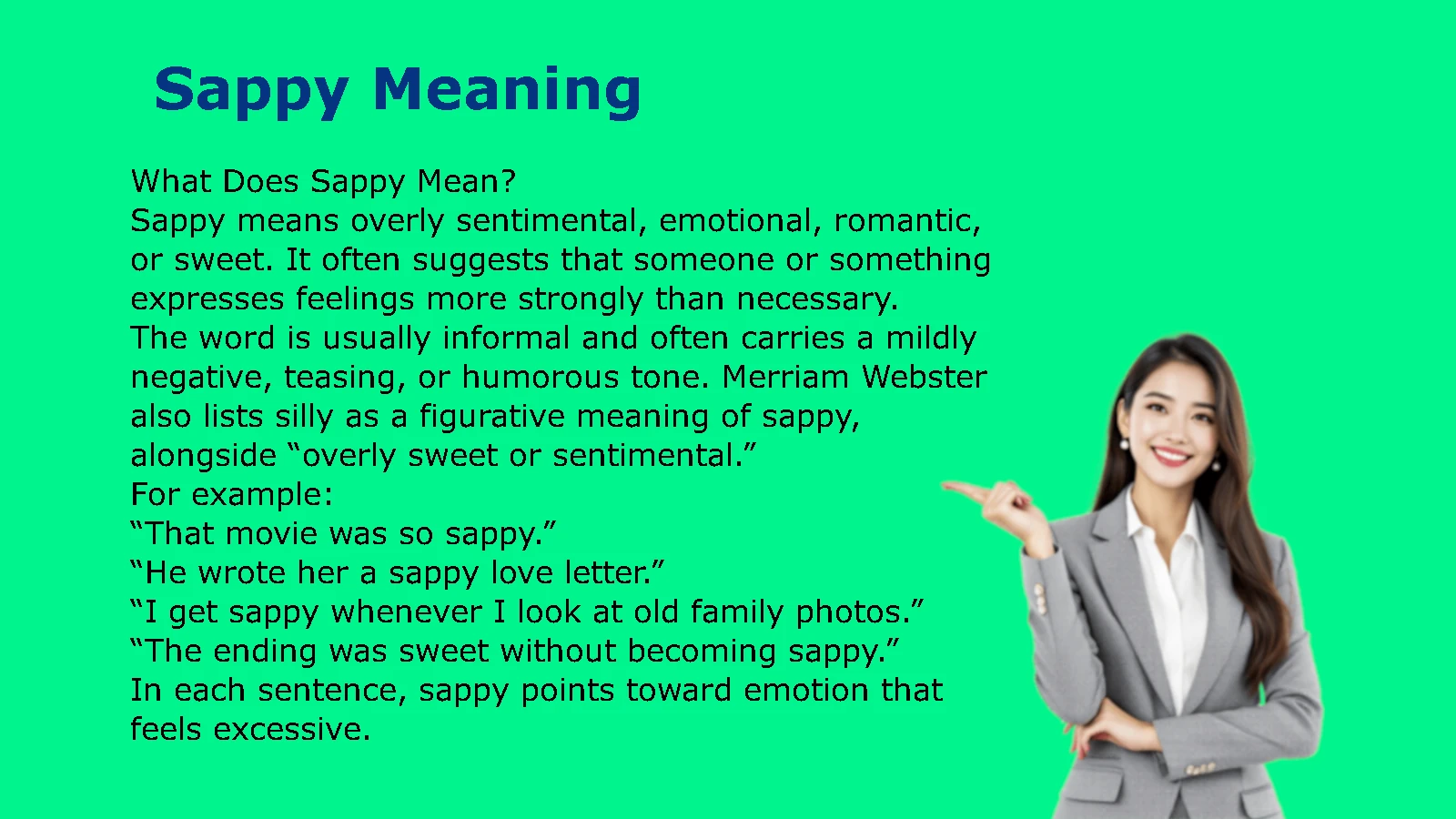
What Does Sappy Mean?
Sappy means overly sentimental, emotional, romantic, or sweet. It often suggests that someone or something expresses feelings more strongly than necessary.
The word is usually informal and often carries a mildly negative, teasing, or humorous tone. Merriam Webster also lists silly as a figurative meaning of sappy, alongside “overly sweet or sentimental.”
For example:
- “That movie was so sappy.”
- “He wrote her a sappy love letter.”
- “I get sappy whenever I look at old family photos.”
- “The ending was sweet without becoming sappy.”
In each sentence, sappy points toward emotion that feels excessive.
That doesn’t mean the emotion is fake. A person can sincerely love someone and still describe their own behavior as sappy. The word often comments on how much emotion is being expressed, not whether that emotion is genuine.
Sappy Meaning at a Glance
| Feature | Meaning |
| Word | Sappy |
| Part of speech | Adjective |
| Main meaning | Overly sentimental or emotional |
| Common tone | Informal, teasing, mildly critical |
| Common contexts | Romance, movies, songs, letters, speeches, messages |
| Closest everyday synonym | Sentimental |
| Common related words | Cheesy, mushy, corny, sentimental |
| Literal meaning | Full of or containing sap |
| Comparative | Sappier |
| Superlative | Sappiest |
| Noun form | Sappiness |
Merriam Webster confirms both the literal meanings related to sap and the figurative meanings involving excessive sentimentality or silliness.
Sappy Definition
A simple sappy definition is:
Sappy describes something that is excessively sentimental, emotional, romantic, or sweet.
The key word here is excessively.
Something sentimental makes you feel something. Something sappy may make you feel that the emotional message has been pushed too far.
Consider these two descriptions:
- “The letter was sentimental.”
- “The letter was sappy.”
The first sounds fairly neutral or even positive. The letter may have reminded someone of an important memory.
The second suggests that the letter went overboard. Perhaps it contained several dramatic declarations of love, exaggerated descriptions, or romantic clichés.
That’s the subtle difference that makes sappy useful.
What Does Sappy Mean in Different Contexts?
The meaning stays basically the same across contexts, but the thing being criticized changes.
Sappy Meaning in Love and Relationships
In relationships, sappy usually describes behavior or language that is extremely romantic or affectionate.
Someone might write a long anniversary message filled with declarations of eternal love. Their partner might find it adorable. A friend might jokingly call it sappy.
For example:
“I know this is sappy, but you really are my favorite person.”
Here, the speaker recognizes that the statement sounds intensely sentimental. The word doesn’t necessarily condemn the emotion. Instead, it acknowledges that the expression is unusually sweet.
You might also hear:
- sappy love letter
- sappy text
- sappy anniversary message
- sappy romantic gesture
- sappy couple
- sappy declaration of love
The context determines whether the word sounds affectionate or critical.
Sappy Meaning in Movies
A sappy movie is usually one that leans heavily on emotional or romantic moments.
Think of a film where:
- The couple separates.
- Sad music starts playing.
- One character gives a dramatic speech.
- They reunite in the rain.
- Everyone cries.
- The soundtrack swells.
If the emotional scenes feel excessive, viewers may call the movie sappy.
For example:
“The movie had a predictable plot and a very sappy ending.”
This doesn’t necessarily mean the movie was terrible. It means its emotional material may have felt overly sweet or obvious.
Cambridge specifically uses a romantic movie as an example of sappy.
Sappy Meaning in Songs
A sappy song usually has lyrics that are intensely romantic, emotional, nostalgic, or sentimental.
A love song might become sappy when every line focuses on eternal devotion, perfect romance, or dramatic heartbreak.
For example:
“The melody was beautiful, but the lyrics were a little sappy.”
Here, the speaker separates quality from sentimentality. The song can be musically good while still feeling emotionally overdone.
Merriam Webster’s current examples also use sappy for songs and other sentimental material.
Sappy Meaning in Conversation
People often use sappy casually when talking about their own emotions.
For example:
“I’m feeling sappy today.”
This usually means:
“I’m feeling especially emotional, affectionate, or sentimental today.”
It can be playful and self aware.
Someone might say it while looking through childhood photos, watching a romantic movie, thinking about an old friend, or celebrating a milestone.
What Does Sappy Mean When Describing a Person?
When sappy describes a person, it usually means that the person is very sentimental, affectionate, emotional, or romantic.
For example:
“He’s a sappy romantic at heart.”
This doesn’t necessarily insult him. It might simply mean that he enjoys romantic gestures and isn’t afraid to express his feelings.
Another example:
“She gets sappy whenever she talks about her kids.”
That suggests she becomes especially emotional and affectionate when discussing them.
Calling someone sappy can therefore be:
- Teasing: “You’re getting sappy again.”
- Affectionate: “He’s a big sappy softie.”
- Critical: “The character is too sappy.”
- Self descriptive: “I’m getting sappy thinking about graduation.”
The speaker’s tone matters.
A friend saying “You’re so sappy” with a smile can mean something very different from a movie critic calling a film “sappy and predictable.”
Examples of Sappy in a Sentence
Here are natural examples that show how the word works in everyday English:
- “That was such a sappy movie.”
- “He sent her a sappy Valentine’s Day message.”
- “I usually hate sappy love songs.”
- “She gets sappy whenever she talks about her grandchildren.”
- “The speech was emotional without becoming sappy.”
- “The movie’s final scene was a little too sappy for me.”
- “I’m feeling sappy after looking through these old pictures.”
- “He wrote the sappiest birthday card I’ve ever received.”
- “The commercial was sweet but not overly sappy.”
- “She loves watching sappy romantic comedies.”
- “Don’t make me get sappy on you.”
- “The song has a beautiful message without sounding sappy.”
- “Their anniversary post was incredibly sappy.”
- “I’m not usually a sappy person, but that moment got me.”
- “The ending became sappier than the rest of the movie.”
Notice how the word can describe things and people:
- sappy movie
- sappy song
- sappy message
- sappy letter
- sappy speech
- sappy romantic
- sappy person
Is Sappy a Positive or Negative Word?
Sappy is usually mildly negative, but it can also sound playful or affectionate.
The negative sense comes from the idea that something contains too much emotion. Cambridge labels the US usage as informal and describes it as extremely emotional in an embarrassing way.
However, people often use the word about themselves without serious criticism.
Compare these examples:
“That movie was painfully sappy.”
This is clearly critical.
Now compare:
“I know I’m being sappy, but I’m really proud of you.”
This is affectionate and self aware.
The second speaker isn’t rejecting emotion. They’re joking about how openly emotional they’re being.
When Sappy Sounds Negative
“The speech was sappy and predictable.”
The speaker thinks the emotion went too far.
When Sappy Sounds Playful
“Okay, this is getting sappy, but I love you guys.”
The speaker is acknowledging an emotional moment with humor.
When Sappy Sounds Affectionate
“He’s a big sappy romantic.”
The phrase can suggest warmth rather than genuine criticism.
So, don’t treat sappy as a harsh insult. Its emotional temperature depends heavily on context.
Sappy vs. Sentimental
Sappy and sentimental overlap, but they aren’t identical.
Sentimental describes strong feelings, especially feelings connected to memories, relationships, or meaningful experiences. It can be positive, neutral, or negative.
Sappy usually adds the idea that the emotion is excessive, overly sweet, or somewhat silly.
| Word | Main idea | Usual tone |
| Sentimental | Strong emotional attachment | Neutral to positive |
| Sappy | Excessively sentimental | Informal, often teasing or negative |
| Mushy | Excessively emotional or romantic | Informal |
| Cheesy | Overly obvious, clichéd, or corny | Informal |
| Corny | Predictable or lacking sophistication | Informal |
| Saccharine | Excessively sweet or sentimental | More formal, strongly negative |
Consider a family photograph.
“The photo makes me sentimental.”
This means the photo brings back meaningful emotions.
Now:
“The caption is a little sappy.”
The caption may have gone beyond simple affection and become overly sweet.
That’s the dividing line.
Sentimental describes the emotion. Sappy often critiques the way that emotion gets expressed.
Sappy vs. Cheesy
These words frequently appear together, but sappy and cheesy aren’t perfect synonyms.
Sappy focuses on excessive emotion or sentimentality.
Cheesy has a broader meaning. It can describe something that feels clichéd, corny, overly obvious, outdated, or lacking sophistication.
For example:
“The love letter was sappy.”
The problem is probably too much emotion.
“That pickup line was cheesy.”
The problem is probably that the line sounds predictable or corny.
Something can be both:
“The movie had a cheesy plot and a sappy ending.”
The plot may be predictable while the ending piles on emotional sentiment.
Sappy vs. Corny
Corny and sappy overlap when something feels overly sentimental or clichéd.
However, corny applies to more situations.
A joke can be corny.
A pickup line can be corny.
A movie can be corny.
A romantic message can be sappy.
You wouldn’t normally describe an ordinary joke as sappy because the word centers more strongly on emotion and sentimentality.
Quick Comparison
| Example | Best word |
| An overly emotional love letter | Sappy |
| A predictable joke | Corny |
| An obvious romantic cliché | Cheesy |
| A meaningful memory | Sentimental |
| An excessively sweet movie | Sappy |
| An outdated joke | Corny |
Synonyms for Sappy
Several words can replace sappy, but each carries a slightly different shade of meaning.
Emotional and Sentimental Synonyms
- Sentimental
- Mushy
- Emotional
- Touching
- Tender
- Nostalgic
These don’t all carry the same negative force.
For example, touching is usually positive, while mushy often suggests excessive emotion.
Overly Romantic Synonyms
- Lovey dovey
- Romantic
- Amorous
- Mushy
- Sweet
These work especially well when describing couples, messages, songs, or romantic gestures.
More Strongly Negative Synonyms
- Saccharine
- Mawkish
- Maudlin
- Cloying
- Schmaltzy
- Syrupy
These words generally suggest that the emotional quality has become excessive.
Merriam Webster’s thesaurus lists sentimental, schmaltzy, mawkish, saccharine, maudlin, cloying, corny, mushy, syrupy, and lovey dovey, among others, as related terms.
Antonyms for Sappy
The best opposite of sappy depends on what you want to emphasize.
Common Antonyms
- Unsentimental
- Stoic
- Reserved
- Detached
- Matter of fact
- Practical
- Unemotional
For example:
“The movie avoided a sappy ending and took a more realistic approach.”
Here, realistic or unsentimental may work better than unemotional.
Someone can have deep emotions without expressing them in a sappy way.
Where Does the Word Sappy Come From?
The history of sappy reaches back much further than its modern romantic meaning.
The literal adjective originally referred to something full of sap, especially a tree or wood. Etymonline traces sappy to Middle English sapi and earlier Old English sæpig, formed from sap.
The figurative meaning developed later.
Etymonline records the colloquial sense referring to people as foolish or foolishly sentimental from the 1660s. It suggests several possible paths for that development, including associations with being overly wet or soft and with the idea of young or “green” growth.
That history gives the modern meaning an interesting image: something soft, full, overflowing, or lacking firmness gradually became associated with excessive sentiment.
It’s a good example of how English turns a physical quality into a description of personality or behavior.
Sappy Has a Literal Meaning, Too
The emotional meaning dominates everyday American English, but sappy can still have a literal botanical meaning.
In that sense, something sappy is full of sap or contains a large amount of sap.
For example:
“The freshly cut branch was still sappy.”
Here, sappy has nothing to do with romance or emotion.
Merriam Webster lists “abounding with sap” as the first definition and also gives a meaning related to sapwood.
Literal vs. Figurative Sappy
| Sentence | Meaning |
| “The branch was sappy.” | Full of plant sap |
| “The movie was sappy.” | Overly sentimental |
| “He’s a sappy romantic.” | Very sentimental or romantic |
| “The song sounds sappy.” | Excessively emotional |
| “The wood is still sappy.” | Contains considerable sap |
Context makes the intended meaning clear.
How to Use Sappy Correctly
Because sappy is an adjective, it normally modifies a noun or follows a linking verb.
Before a Noun
- a sappy movie
- a sappy song
- a sappy letter
- a sappy speech
- a sappy message
- a sappy romantic
After a Linking Verb
- “The movie was sappy.”
- “The ending felt sappy.”
- “The song sounds sappy.”
- “He became sappy after the reunion.”
With Comparative and Superlative Forms
The standard comparative and superlative forms are:
- sappy
- sappier
- sappiest
For example:
“The sequel was sappier than the original.”
“That was the sappiest scene in the entire movie.”
Merriam Webster lists sappier and sappiest as the comparative and superlative forms.
Is Sappy Formal or Informal?
Sappy is primarily informal.
It’s a natural choice in:
- Casual conversations
- Text messages
- Social media posts
- Movie reviews
- Informal writing
- Everyday discussions about relationships
For formal writing, alternatives such as sentimental, overly sentimental, or excessively emotional may fit better.
Oxford identifies sappy as informal North American English and notes that soppy is especially common in British English.
American English vs. British English
This regional distinction is useful:
| American English | British English |
| Sappy | Soppy |
| “a sappy love song” | “a soppy love song” |
| “a sappy movie” | “a soppy movie” |
Oxford specifically lists soppy as the British English counterpart while identifying sappy as the usual North American term.
So if you’re writing for an American audience, sappy is the natural choice.
Common Phrases With Sappy
Certain combinations occur naturally because they describe situations where excessive sentimentality commonly appears.
Sappy Movie
A movie with a strong dose of romance or emotional drama.
“It’s a fun movie, but the ending gets pretty sappy.”
Sappy Love Song
A romantic song with highly sentimental lyrics.
“He secretly loves sappy love songs.”
Sappy Ending
An ending that resolves a story with an especially emotional or romantic conclusion.
“The movie would’ve been stronger without such a sappy ending.”
Sappy Message
A highly affectionate or sentimental message.
“I wrote a sappy message for her birthday.”
Sappy Speech
A speech that emphasizes emotion heavily.
“His farewell speech got a little sappy.”
Get Sappy
This informal expression means to become emotional or sentimental.
“I don’t want to get sappy, but I’m really going to miss everyone.”
Feel Sappy
This means to feel especially emotional, affectionate, or nostalgic.
“I’m feeling sappy after looking through these old photos.”
A Practical Case Study: When Is a Love Letter Sappy?
Imagine two people celebrating their tenth anniversary.
One person writes:
“Happy anniversary. I still can’t believe how quickly ten years passed. Thank you for being there through every difficult season and every good one.”
That’s sentimental. It’s warm and personal.
Now imagine the letter continues with several paragraphs describing eternal destiny, soulmates, perfect love, and how every moment apart feels like an eternity.
A reader might call that letter sappy.
The difference isn’t simply length. It’s the degree and style of emotional expression.
What Makes Something Sappy?
Usually, several features appear together:
- Heavy emotional language
- Strong romantic themes
- Repeated declarations of affection
- Idealized descriptions
- Romantic clichés
- Dramatic emotional scenes
- Very sweet or sugary wording
Merriam Webster’s example of a sappy letter specifically refers to silly romantic clichés, which captures an important part of the word’s modern use.
Sappy Doesn’t Always Mean Bad
One of the most important things to understand about sappy is that the word doesn’t automatically mean something is worthless.
A person can criticize a movie for being sappy and still enjoy it.
Someone can call their own text sappy and mean it lovingly.
A song can be unapologetically sappy and still connect deeply with its audience.
That’s why phrases such as “a little sappy but sweet” make perfect sense.
The speaker recognizes the excess while still appreciating the emotion.
In fact, sappy often works as a form of affectionate self criticism.
“This is incredibly sappy, but I don’t care.”
That sentence essentially means:
“I know this is very sentimental, but the feeling matters more to me than sounding cool.”
Sappy vs. Heartfelt
These words deserve a closer look because people often confuse them.
Heartfelt usually means sincere and deeply felt.
Sappy suggests that the emotional expression may be excessive.
A heartfelt speech can be powerful because it feels honest.
A sappy speech can lose some of that impact because it piles on emotional language.
| Description | What it suggests |
| Heartfelt | Genuine and deeply sincere |
| Sentimental | Emotionally meaningful |
| Sappy | Excessively sentimental |
| Mawkish | Excessively emotional in a tiresome way |
| Cheesy | Clichéd or overly obvious |
This distinction matters when you’re reviewing writing, music, movies, or speeches.
Calling something heartfelt is usually praise.
Calling it sappy often means the emotional dial has been turned too high.
Sappy Word Forms and Related Words
The main forms are straightforward.
Sappy
The adjective.
“That’s a sappy movie.”
Sappier
The comparative form.
“The second movie is sappier than the first.”
Sappiest
The superlative form.
“That’s the sappiest romance I’ve ever seen.”
Sappiness
The noun describing the quality or state of being sappy.
“The sappiness of the ending bothered some viewers.”
Merriam Webster defines sappiness as the quality or state of being sappy and gives sentimentality as a related meaning.
Frequently Asked Questions About Sappy
What does sappy mean in slang?
Sappy is an informal word used to describe something excessively emotional, sentimental, romantic, or sweet. It can also describe a person who becomes very sentimental.
Although people sometimes call it slang, major dictionaries generally classify the modern figurative use as informal rather than treating it as a separate slang word. Cambridge and Oxford both mark the relevant usage as informal.
Does sappy mean romantic?
It can. A sappy romantic person, movie, song, or message usually contains a lot of romantic emotion.
However, sappy isn’t limited to romance. Someone can get sappy about family, friendship, childhood memories, pets, achievements, or saying goodbye.
Does sappy mean cheesy?
Sometimes, but not exactly.
Sappy focuses on excessive emotion or sentimentality. Cheesy can describe anything that feels clichéd, corny, obvious, or lacking sophistication.
A romantic movie can be both sappy and cheesy, but the two words emphasize different flaws.
Is calling someone sappy an insult?
Not necessarily.
It can be mildly insulting when someone uses it to criticize excessive emotion. However, friends and family often use it playfully.
“You’re getting sappy again!”
Depending on the tone, that might be teasing rather than hostile.
Can sappy be positive?
Yes.
People sometimes use sappy affectionately or humorously.
For example:
“I know this is sappy, but I’m grateful for every one of you.”
The speaker acknowledges the sentimentality without rejecting it.
What does “I’m feeling sappy” mean?
It usually means “I’m feeling unusually sentimental, affectionate, emotional, or nostalgic.”
The phrase often appears during emotional moments such as reunions, anniversaries, birthdays, graduations, weddings, or farewells.
What is the opposite of sappy?
Common opposites include:
- Unsentimental
- Stoic
- Reserved
- Detached
- Matter of fact
- Practical
The best choice depends on the context.
What is the difference between sappy and sentimental?
Sentimental describes strong emotional attachment or feeling. Sappy usually suggests that the sentiment has become excessive, overly sweet, or somewhat silly.
In simple terms:
Sentimental = emotional.
Sappy = too emotional or overly sentimental.
Is sappy American English?
Sappy is especially common in North American English. Oxford notes that soppy is especially British while sappy is the usual North American form.
What is the literal meaning of sappy?
Literally, sappy means full of sap or containing a lot of sap, especially when describing plants or wood. This is the older sense from which the word developed its figurative meanings.
Sappy Meaning: Quick Summary
Sappy usually means overly sentimental, emotional, romantic, or sweet.
It’s an informal adjective that often carries a playful or mildly critical tone. You might describe a movie as sappy because it pushes the romance too hard, a song as sappy because its lyrics are excessively emotional, or a person as sappy because they openly express strong feelings.
The word can also be used literally for something full of sap, especially a plant or piece of wood.
The easiest way to remember sappy
Think of this distinction:
Sentimental makes you feel. Sappy may feel like too much.
That’s the heart of the word.
Whether someone uses sappy as a criticism or a joke depends on the situation. A sappy movie can still be enjoyable. A sappy love letter can still be sincere. Sometimes being a little sappy simply means letting your guard down and saying what you actually feel.
And honestly, there’s nothing wrong with that.