
Have you ever seen the word “wring” and wondered what it actually means? While Wring Meaning may seem simple at first, this unusual verb can describe more than just squeezing something tightly. Its meaning depends on the context and how it is used in a sentence.
Wring means to twist or squeeze something firmly, usually to remove liquid from it. It can also mean to force something out of a person or situation, such as information, money, or a response.
Examples:
- Wring the water out of the towel.
- The reporter tried to wring the truth from him.
The confusion is understandable. People often search for what does wring mean, wring meaning in English, wring meaning in a sentence, or how to use wring in a sentence because the word has both literal and figurative meanings. And here’s the kicker: wring is also commonly confused with ring and wrong, even though all three words have completely different meanings.
In this guide, you’ll learn the complete Wring Meaning, its definition, pronunciation, correct usage, and examples in sentences. You’ll also discover the difference between wring, ring, and wrong, along with common phrases and forms of the word.
Wring Meaning: What Does Wring Mean?
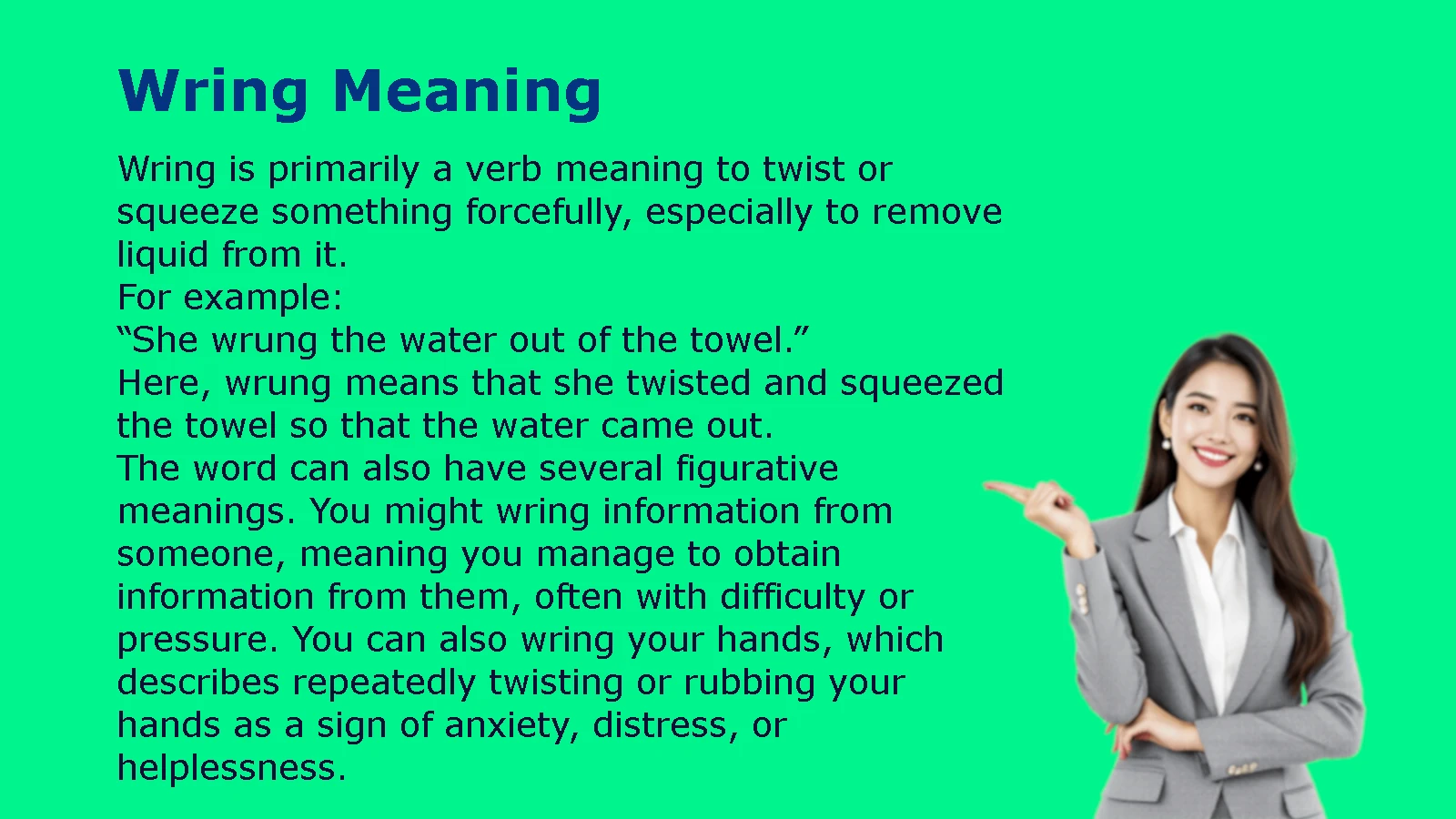
Wring is primarily a verb meaning to twist or squeeze something forcefully, especially to remove liquid from it.
For example:
“She wrung the water out of the towel.”
Here, wrung means that she twisted and squeezed the towel so that the water came out.
The word can also have several figurative meanings. You might wring information from someone, meaning you manage to obtain information from them, often with difficulty or pressure. You can also wring your hands, which describes repeatedly twisting or rubbing your hands as a sign of anxiety, distress, or helplessness.
Simple Definition of Wring
In simple terms:
Wring = to twist or squeeze something tightly, usually to remove liquid or extract something.
The word can describe both physical and figurative actions.
| Meaning | Explanation | Example |
| Twist and squeeze | Remove liquid from something | Wring the towel out. |
| Extract | Obtain something through effort or pressure | They wrung the truth from him. |
| Show distress | Twist or rub your hands anxiously | She wrung her hands in worry. |
| Cause emotional pain | Create intense emotional distress | The news wrung his heart. |
The exact meaning depends on the context.
Wring as a Verb
Wring is used as a verb rather than a noun in standard modern English.
Its most common physical use involves water or another liquid. If you wring out a cloth, you twist it tightly to force the liquid out.
For example:
- Wring the sponge out before putting it away.
- He wrung the water from his shirt.
- She wrung out the soaked towel.
- The child wrung the rainwater from his jacket.
The verb can also describe extracting something that isn’t a physical liquid.
For example:
- The journalist wrung an answer from the politician.
- The lawyer tried to wring the truth from the witness.
- The team wrung every possible advantage from the situation.
In these examples, wring suggests effort, pressure, or force.
Wring Meaning in Physical Use
The most literal meaning of wring involves twisting and squeezing something to remove liquid.
Imagine holding a soaked towel with both hands. You twist one end in one direction and the other end in the opposite direction. The pressure forces water out.
That action is wringing.
Wring Water or Liquid Out
You can wring water from:
- Towels
- Clothes
- Washcloths
- Sponges
- Rags
- Wet fabric
- Mop heads
For example:
“After washing the cloth, Maria wrung out the excess water.”
The phrase wring out is especially common when the goal is to remove liquid.
Compare these sentences:
- She squeezed the sponge.
- She wrung out the sponge.
Both can be correct, but wring out emphasizes twisting or compressing something to force liquid from it.
Wring vs. Squeeze
These words overlap, but they’re not always identical.
Squeeze has a broad meaning. You can squeeze something simply by applying pressure.
Wring usually suggests a twisting or forceful squeezing motion.
For example:
“He squeezed the orange.”
This usually means he pressed the orange to extract juice.
“He wrung out the towel.”
This suggests twisting the towel while squeezing it.
So, when you see wring, picture something being twisted tightly under pressure.
Wring Meaning in Figurative Language
English often takes a physical action and gives it a figurative meaning. Wring is a good example.
When you physically wring something, you force something out of it. English uses the same idea metaphorically when talking about information, emotions, resources, or opportunities.
Wring Information From Someone
To wring information from someone means to obtain information from them, usually with considerable effort or pressure.
For example:
“The investigators eventually wrung the truth from the suspect.”
The sentence doesn’t mean they literally squeezed the person. Instead, it means they had difficulty getting the truth and had to apply pressure or persistent questioning.
Other examples include:
- The reporter wrung a confession from the source.
- It took hours to wring an explanation from him.
- The teacher managed to wring an answer from the reluctant student.
- The detectives tried to wring information from the witness.
The expression often carries a sense that the information was not freely offered.
Wring Every Last Drop Out of Something
Another common expression is “wring every last drop out of something.”
Literally, it means extracting as much liquid as possible.
For example:
“Wring every last drop out of the cloth.”
But it can also be figurative.
You might say:
“The company tried to wring every last drop of value from the old technology.”
Here, wring means extract as much value or benefit as possible.
This expression can apply to:
- Money
- Time
- Resources
- Opportunities
- Information
- Energy
- Value
- Performance
For example:
- She wrung every last drop of enjoyment out of the vacation.
- The coach wrung every last bit of effort from the players.
- The business wrung every last dollar of value from the aging equipment.
The underlying idea remains the same: extract as much as possible.
Wring Your Hands Meaning
The expression “wring your hands” has a figurative meaning that differs from simply twisting a towel.
To wring your hands means to repeatedly twist, rub, or clasp your hands, usually because you are worried, upset, anxious, or helpless.
For example:
“The parents wrung their hands as they waited for the results.”
The parents aren’t necessarily trying to remove water from their hands. The action communicates emotional distress.
Why Does “Wring Your Hands” Mean Worry?
The expression comes from the physical gesture itself.
When people feel anxious or distressed, they may clasp, rub, twist, or squeeze their hands. Over time, this physical gesture became associated with emotional suffering and helplessness.
Today, the expression can be literal or figurative depending on context.
For example:
“She wrung her hands after washing them.”
This could literally describe twisting her hands.
But:
“The manager wrung his hands over the company’s losses.”
This is figurative. It means he was deeply worried or distressed about the losses.
Wring Your Heart Meaning
Wring someone’s heart is a less common but understandable figurative expression.
It describes something that causes deep emotional pain, distress, or sympathy.
For example:
“The heartbreaking story wrung her heart.”
The expression follows the same metaphorical pattern: something is being squeezed or twisted emotionally.
You’ll encounter more common phrases such as “break someone’s heart” or “tear at someone’s heart,” but wring can still appear in literary or expressive writing.
Wring Pronunciation
One of the easiest ways to recognize wring is by its pronunciation.
Wring is pronounced like “ring.”
The w is silent.
How to Pronounce Wring
The pronunciation is:
wring → /rɪŋ/
It has the same pronunciation as:
ring → /rɪŋ/
For example:
- Wring the towel.
- Ring the bell.
The first word means twist or squeeze. The second can mean make a ringing sound or call someone by telephone.
Why Is the W Silent?
The spelling reflects older stages of English. English once pronounced the initial w in words such as wring, write, and wrong. Over time, pronunciation changed, but the spelling remained.
That gives modern English several words beginning with wr- where the w is silent, including:
- write
- wrote
- wrong
- wrist
- wrinkle
- wrap
- wreck
- wrestle
- wring
So don’t pronounce wring as “w-ring.”
The correct pronunciation is simply “ring.”
Wring Verb Forms
Wring is an irregular verb, so its past forms don’t follow the regular -ed pattern.
| Verb form | Word | Example |
| Base form | wring | Wring the towel out. |
| Third-person singular | wrings | She wrings the cloth carefully. |
| Present participle | wringing | He is wringing the shirt. |
| Past tense | wrung | She wrung the towel. |
| Past participle | wrung | The towel had been wrung out. |
The most important form to remember is:
wring → wrung → wrung
Wring in the Present Tense
Examples:
- I wring the cloth out by hand.
- She wrings the water from the towel.
- They wring the sponge before cleaning the table.
Wring in the Present Progressive
The -ing form is wringing.
Examples:
- She is wringing out the towel.
- He was wringing his hands nervously.
- They are wringing water from their clothes.
Notice the spelling:
wring → wringing
The final consonant is not doubled.
Wring in the Past Tense
The past tense is wrung.
Examples:
- She wrung out the towel.
- He wrung the water from his shirt.
- The child wrung his hands in frustration.
Wringed vs. Wrung: Which Is Correct?
A common mistake is writing “wringed.”
For the standard verb wring, the correct past tense is wrung.
Incorrect:
“She wringed the towel.”
Correct:
“She wrung the towel.”
Incorrect:
“He wringed the water from the cloth.”
Correct:
“He wrung the water from the cloth.”
This is because wring is an irregular verb.
Think of it like other irregular verbs:
- sing → sang → sung
- ring → rang → rung
- wring → wrung → wrung
The connection between ring and wring can actually help you remember the past form.
Wring Meaning in Example Sentences
Seeing the word in context makes its meaning much easier to understand.
Everyday Examples of Wring
- Wring the towel before hanging it up.
- She wrung the water from the wet cloth.
- He wrung out his shirt after getting caught in the rain.
- The cleaner wrung the mop before using it again.
- Please wring the sponge out thoroughly.
- She was wringing water from the soaked fabric.
- He wrung his hands while waiting for the doctor.
- The workers wrung as much water from the mop as possible.
Figurative Examples of Wring
- The interviewer wrung a reluctant answer from the candidate.
- The investigators wrung information from the witness.
- The company tried to wring more value from its existing resources.
- The tragedy wrung tears from the audience.
- She wrung every last bit of enjoyment from the trip.
- The manager wrung every possible advantage from the negotiation.
These examples demonstrate why context matters. The basic idea is always related to forcefully extracting something, whether that thing is water, information, value, or emotion.
Wring vs. Ring: What’s the Difference?
Wring and ring are homophones. That means they have the same pronunciation but different meanings and spellings.
| Word | Meaning | Example |
| wring | Twist or squeeze forcefully | Wring the water from the towel. |
| ring | Make a bell-like sound | The phone began to ring. |
| ring | Call someone | I’ll ring you tonight. |
| ring | A circular band | She wore a silver ring. |
The spelling difference is small, but the meanings are completely different.
Wring Meaning vs. Ring Meaning
Use wring when you mean:
- Twist
- Squeeze
- Extract liquid
- Extract information
- Cause emotional distress
- Show anxiety through hand movements
Use ring when you mean:
- Make a bell-like sound
- Call someone
- A circular piece of jewelry
- A circular shape or object
Consider these two sentences:
Wring the towel out.
Ring the bell.
They sound almost identical when spoken, but they describe entirely different actions.
Wring vs. Ring in the Past Tense
The difference becomes especially interesting in the past tense.
Wring → wrung
Ring → rang
For example:
- She wrung the towel.
- The bell rang.
Don’t confuse wrung with rang.
A useful comparison is:
| Present | Past | Meaning |
| wring | wrung | Twist or squeeze |
| ring | rang | Make a sound or call |
| sing | sang | Produce a musical voice |
| swing | swung | Move back and forth |
Wring vs. Squeeze: What’s the Difference?
Although wring and squeeze can overlap, they aren’t perfect synonyms.
Squeeze means applying pressure to something, often by pressing it between your hands or against another surface.
Wring generally suggests twisting while squeezing.
For example:
“Squeeze the lemon.”
This focuses on pressing the lemon to release juice.
“Wring out the towel.”
This focuses on twisting and squeezing the fabric to remove water.
The distinction is subtle, but it’s useful for natural English.
When Should You Use Wring?
Use wring when the action involves:
- Twisting
- Forceful squeezing
- Extracting liquid
- Extracting something figuratively
- A traditional expression involving hands or emotional distress
If you’re simply pressing something, squeeze may be the more natural choice.
Wring Synonyms
The best synonym for wring depends on the context.
Synonyms for the Physical Meaning
Some useful alternatives include:
- Squeeze
- Twist
- Compress
- Press
- Extract
- Drain
- Crush
However, these words aren’t always interchangeable.
For example, compress emphasizes reducing something by pressure, while wring emphasizes twisting and squeezing.
Synonyms for the Figurative Meaning
When wring means obtaining something through pressure or effort, possible alternatives include:
- Extract
- Obtain
- Elicit
- Draw out
- Force
- Get
- Secure
For example:
“The reporter wrung an answer from him.”
Could become:
“The reporter elicited an answer from him.”
But the emotional effect is different. Wring often suggests that getting the answer required pressure or persistence.
Common Expressions With Wring
Several established expressions use wring.
Wring Your Hands
Meaning: To show anxiety, distress, or helplessness.
Example:
“The officials wrung their hands as the crisis continued.”
Wring Something From Someone
Meaning: To obtain information, a confession, money, or another thing through pressure or persistence.
Example:
“The lawyer wrung a confession from the witness.”
Wring Every Last Drop Out of Something
Meaning: To extract as much as possible.
Literal example:
“Wring every last drop of water from the cloth.”
Figurative example:
“The company wrung every last drop of value from the old product.”
Wring Tears From Someone
Meaning: To cause someone to cry or become deeply emotional.
Example:
“The emotional ending wrung tears from the audience.”
This construction is less common in everyday conversation but can appear in expressive or literary writing.
Common Mistakes With Wring
Mistake: Using “Wringed” Instead of “Wrung”
This is probably the most important grammar mistake to avoid.
❌ She wringed the towel.
✅ She wrung the towel.
Remember:
wring → wrung
Mistake: Confusing Wring With Ring
Because the words sound exactly alike, it’s easy to choose the wrong spelling.
❌ Ring the water out of the towel.
✅ Wring the water out of the towel.
But:
❌ Wring the doorbell.
✅ Ring the doorbell.
The physical action determines the correct word.
Mistake: Treating Wring as Identical to Squeeze
While wring can mean squeeze, it usually carries the additional idea of twisting.
You can squeeze someone’s hand without wringing it.
You can squeeze a ball without wringing it.
But when you twist and squeeze a wet cloth to remove water, wring is particularly precise.
Mistake: Misunderstanding “Wring Your Hands”
Wring your hands doesn’t normally mean washing or cleaning them.
In figurative language, it means to display anxiety, worry, distress, or helplessness.
For example:
“Instead of taking action, the officials simply wrung their hands.”
This sentence suggests that the officials were worried but weren’t doing much to solve the problem.
How to Remember the Meaning of Wring
A simple memory trick can make wring easier to remember.
Think:
WRING = TWIST + SQUEEZE
Picture yourself holding a wet towel. You twist it tightly, and water pours out.
That’s the literal meaning.
Then extend that picture to the figurative meanings:
- Wring water from a towel.
- Wring information from someone.
- Wring value from a resource.
- Wring emotion from an audience.
In each case, something is being forced out.
Remember Wring and Wrung
For the verb forms, remember:
Wring → wrung → wrung
The past tense isn’t wringed.
You can also connect wring with ring:
ring → rang → rung
wring → wrung → wrung
They’re different verbs, but the shared rung sound can help you remember the irregular form of wring.
Wring Meaning in a Quick Reference Table
| Use of “Wring” | Meaning | Example |
| Physical | Twist and squeeze | Wring the towel out. |
| Liquid extraction | Remove water or another liquid | She wrung the water from the cloth. |
| Information | Obtain information through pressure | They wrung information from him. |
| Value | Extract maximum benefit | The company wrung value from the old system. |
| Emotional | Cause deep distress | The story wrung her heart. |
| Hands | Show worry or helplessness | He wrung his hands nervously. |
A Closer Look at the Word “Wring”
The modern meaning of wring is closely tied to the idea of twisting or squeezing. Its history helps explain why the word has both literal and figurative uses.
English has long used physical actions as metaphors for mental and social experiences. When something is wrung, it is subjected to pressure until something comes out of it.
That makes the figurative uses quite logical.
If you wring information from someone, you’re metaphorically squeezing information out of them.
This is why the word can work across very different contexts while retaining one central idea: forceful extraction through pressure or twisting.
Practical Case Study: Wring in Everyday English
Imagine you have just washed a large towel.
The towel is saturated with water. Simply holding it won’t remove enough moisture. You grab both ends, twist them in opposite directions, and squeeze.
You are wringing the towel.
Now imagine a journalist interviewing someone who doesn’t want to reveal information. After several careful questions, the journalist finally gets a useful answer.
The journalist wrung an answer from the person.
The physical action and the figurative expression follow the same conceptual pattern.
In both situations, something is extracted through pressure.
That’s the central idea that connects the different meanings of wring.
Wring Meaning: Examples for Students
If you’re learning English, these examples can help you recognize the word quickly.
Physical Examples
- Wring the wet cloth before wiping the floor.
- She wrung the towel dry.
- He wrung the water out of his shirt.
- The worker wrung out the mop.
Figurative Examples
- The detective wrung information from the suspect.
- The coach wrung every ounce of effort from the team.
- The experience wrung tears from him.
- She wrung every possible benefit from the opportunity.
Idiomatic Examples
- He wrung his hands while waiting for the verdict.
- The managers wrung their hands over the unexpected losses.
These examples show that wring doesn’t always involve an actual wet object.
Frequently Asked Questions About Wring Meaning
What does wring mean?
Wring means to twist or squeeze something forcefully, especially to remove liquid. It can also mean to extract something figuratively, such as information or value.
What is the past tense of wring?
The past tense of wring is wrung.
Example:
She wrung the water from the towel.
The past participle is also wrung.
Example:
The towel had been wrung out.
Is “wringed” a word?
Wringed is not the standard past-tense form of the verb wring. The correct form is wrung.
Use:
He wrung the cloth.
Not:
He wringed the cloth.
Is wring pronounced like ring?
Yes. Wring and ring are pronounced the same: /rɪŋ/.
The w in wring is silent.
What does “wring your hands” mean?
Wring your hands means to show worry, anxiety, distress, or helplessness, usually through repeated twisting or rubbing of the hands.
Example:
The parents wrung their hands while waiting for news.
What does “wring information from someone” mean?
It means to obtain information from someone through pressure, persistent questioning, or difficulty.
Example:
The reporter wrung the information from the reluctant source.
What is the difference between wring and ring?
Wring means to twist or squeeze something. Ring can mean to make a sound, call someone, or refer to a circular object.
For example:
- Wring the towel.
- Ring the bell.
- Wear a ring.
What are the synonyms of wring?
Depending on the context, synonyms include squeeze, twist, compress, extract, press, elicit, obtain, and draw out.
However, each synonym has slightly different shades of meaning.
Final Takeaway: Wring Meaning Made Simple
The easiest way to remember the wring meaning is:
Wring means to twist or squeeze something forcefully, often to get something out.
That “something” can be literal, such as water from a towel, or figurative, such as information from a person.
The key forms are:
- Wring — present/base form
- Wrings — third-person singular
- Wringing — present participle
- Wrung — past tense
- Wrung — past participle
And don’t forget the most common spelling trap:
Wring ≠ ring
They sound identical, but their meanings are different.
If you’re talking about twisting, squeezing, or extracting, use wring. If you’re talking about a sound, a phone call, or a circular object, use ring.
Once you connect wring with the image of twisting a wet towel, the word becomes much easier to recognize and use correctly.