
Have you ever come across the word “comprehensive” and wondered exactly what it means? While Comprehensive Meaning may seem straightforward, the word can describe something that is much more than simply being complete. It often refers to something that covers all or nearly all important parts of a subject, topic, or situation.
Comprehensive means complete, thorough, and covering a wide range of details or aspects. It is commonly used when something provides broad and detailed information rather than focusing on just one part.
Examples:
- The report provides a comprehensive analysis of the problem.
- She conducted a comprehensive review of the research.
The confusion is understandable. People often search for what does comprehensive mean, comprehensive meaning in English, comprehensive meaning in a sentence, or comprehensive definition because the word can have slightly different meanings depending on the context. It can describe a report, exam, study, plan, review, explanation, or even a type of insurance. In simple terms, when something is comprehensive, it leaves very little important information uncovered.
In this guide, you’ll learn the complete Comprehensive Meaning, its definition, pronunciation, synonyms, antonyms, correct usage, and examples in sentences. You’ll also discover what comprehensive means in different contexts, the difference between comprehensive, complete, and thorough, and how to use this useful word naturally in everyday English.
Comprehensive Meaning
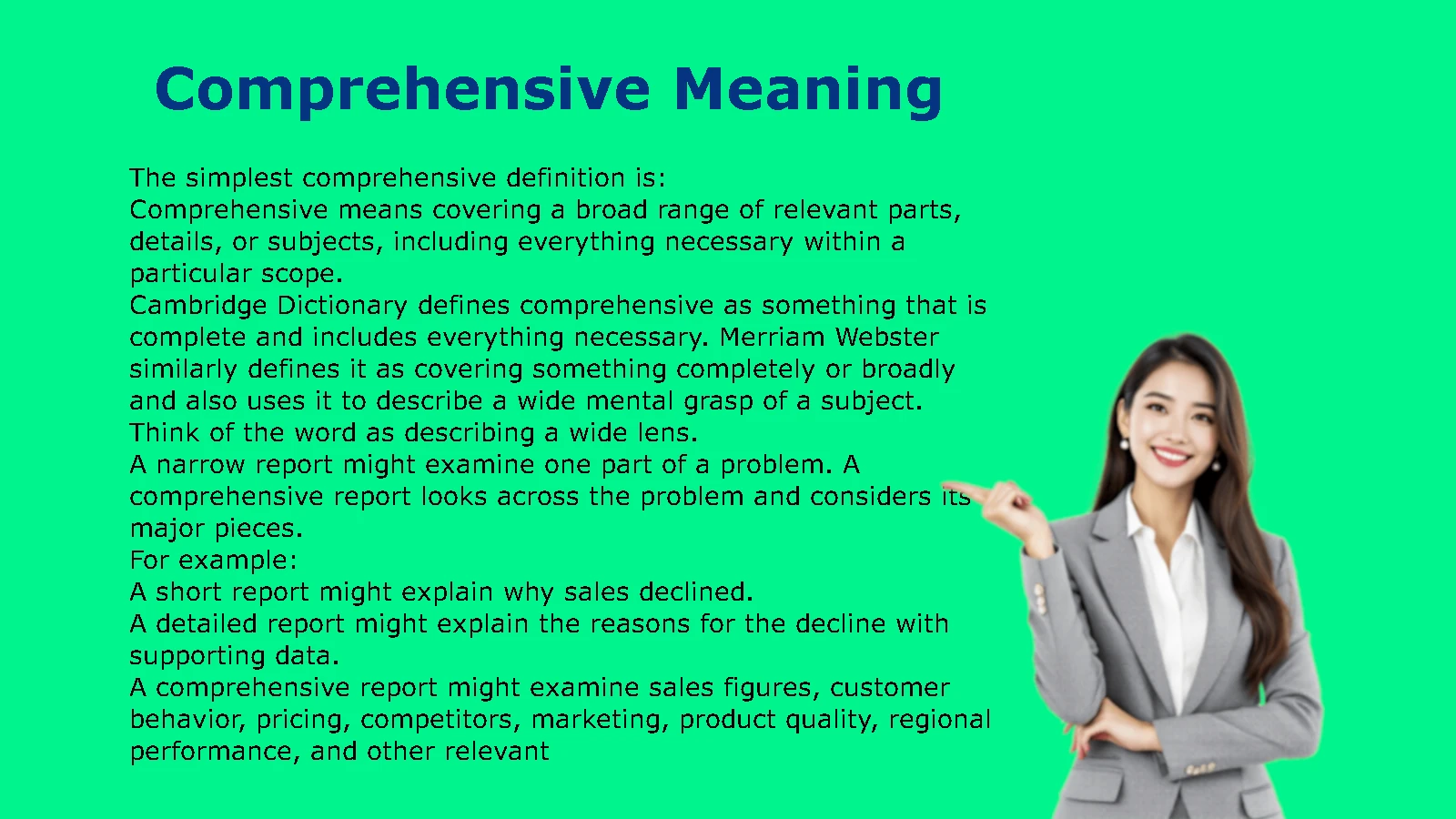
The simplest comprehensive definition is:
Comprehensive means covering a broad range of relevant parts, details, or subjects, including everything necessary within a particular scope.
Cambridge Dictionary defines comprehensive as something that is complete and includes everything necessary. Merriam Webster similarly defines it as covering something completely or broadly and also uses it to describe a wide mental grasp of a subject.
Think of the word as describing a wide lens.
A narrow report might examine one part of a problem. A comprehensive report looks across the problem and considers its major pieces.
For example:
- A short report might explain why sales declined.
- A detailed report might explain the reasons for the decline with supporting data.
- A comprehensive report might examine sales figures, customer behavior, pricing, competitors, marketing, product quality, regional performance, and other relevant factors.
That doesn’t mean the comprehensive report must contain every fact that exists. It means it covers the important ground needed to understand the subject properly.
What Does Comprehensive Mean in Simple English?
In simple English, comprehensive means covering a lot of the important parts of something.
You can remember it this way:
Comprehensive = broad coverage + important details + relevant parts
Consider these examples:
- A comprehensive study examines a subject from several relevant angles.
- A comprehensive list includes all or nearly all of the items that belong within its stated scope.
- A comprehensive review considers the major factors before reaching a conclusion.
- A comprehensive plan addresses the different areas needed to accomplish a goal.
- A comprehensive guide gives readers information across the main parts of a topic.
The exact meaning depends on context, but the central idea remains the same: wide and meaningful coverage.
Comprehensive Definition and Dictionary Meaning
Several major dictionaries agree on the central meaning while emphasizing slightly different aspects.
| Source | Core meaning |
| Cambridge Dictionary | Complete and including everything necessary |
| Merriam Webster | Covering completely or broadly; inclusive |
| Merriam Webster | Having or showing a wide mental grasp |
| Cambridge Learner’s Dictionary | Including everything |
| Etymonline | Originally connected with the idea of taking or bringing things together |
Cambridge also identifies comprehensive as an adjective and gives uses involving training, lists, guides, insurance, and education.
Merriam Webster lists thorough, extensive, full, complete, inclusive, exhaustive, broad, and encyclopedic among related words.
These definitions reveal something useful. Comprehensive isn’t simply a fancy way to say “big.” The word concerns what something covers.
A 500 page document can still be incomplete if it ignores major parts of its subject. Meanwhile, a much shorter document can be comprehensive if its scope is narrow and it covers everything important within that scope.
Comprehensive Part of Speech
Comprehensive is primarily an adjective.
An adjective describes or modifies a noun. In this case, comprehensive tells you about the scope or coverage of the thing that follows it.
Common examples include:
- comprehensive guide
- comprehensive report
- comprehensive analysis
- comprehensive study
- comprehensive review
- comprehensive plan
- comprehensive list
- comprehensive strategy
- comprehensive assessment
- comprehensive overview
- comprehensive solution
- comprehensive approach
Examples of Comprehensive as an Adjective
The researchers conducted a comprehensive study of the issue.
Here, comprehensive describes the study and tells you that the study covered the subject broadly.
We need a comprehensive plan before launching the project.
The adjective suggests that the plan should address the important areas involved in the project rather than focus on one isolated task.
Related Words
The word has several related forms:
| Word | Part of speech | Meaning |
| Comprehend | Verb | To understand something |
| Comprehensive | Adjective | Covering a broad range of relevant parts |
| Comprehensively | Adverb | In a comprehensive manner |
| Comprehensiveness | Noun | The quality of being comprehensive |
These words share a connection to the idea of understanding or taking something in as a whole.
How to Pronounce Comprehensive
The US pronunciation of comprehensive is commonly represented as:
/ˌkɑːm.prəˈhen.sɪv/
An easy pronunciation guide is:
kom-pruh-HEN-siv
The strongest stress falls on the HEN syllable.
A useful way to practice it is to break the word into three parts:
com + pre + hen + sive
Don’t try to rush through the entire word. Say each part naturally and then combine them.
Comprehensive Meaning With Examples
Examples make the meaning of comprehensive much easier to understand because the word changes slightly with the noun it describes.
Everyday Examples
She made a comprehensive list of everything she needed for the trip.
The list covers the relevant items rather than only a few obvious ones.
The website provides a comprehensive guide to caring for indoor plants.
The guide presumably covers several important areas such as watering, lighting, soil, temperature, pests, and maintenance.
We need a comprehensive understanding of the problem before making a decision.
The speaker wants more than one isolated fact. They want to understand the major factors involved.
Academic Examples
The professor assigned a comprehensive review before the final examination.
Here, comprehensive suggests that students should review the major material covered by the course.
The researchers conducted a comprehensive analysis of the survey results.
The analysis looks beyond one statistic and examines the relevant patterns in the data.
The book provides a comprehensive account of the historical period.
The book attempts to cover the important events, people, developments, and context associated with that period.
Business Examples
The company created a comprehensive marketing strategy for its new product.
Such a strategy could address the target audience, positioning, pricing, advertising, distribution, content, and performance measurement.
The manager prepared a comprehensive report for the board.
The report may bring together financial data, operational results, risks, progress, and recommendations.
Professional Examples
The attorney conducted a comprehensive review of the contract.
That suggests the attorney examined the relevant provisions rather than reading only the first few pages.
The team completed a comprehensive assessment of the project.
The assessment might consider costs, timelines, resources, risks, performance, and expected outcomes.
What Does Comprehensive Mean in Different Contexts?
The meaning stays consistent at its core, but different industries use the word in specific ways.
Comprehensive Meaning in Education
In education, comprehensive can describe something that covers a broad range of material.
For example:
- comprehensive course
- comprehensive study
- comprehensive examination
- comprehensive education
- comprehensive curriculum
A comprehensive study program may cover multiple areas instead of concentrating on one narrow subject.
There is also a specific British use of comprehensive as a noun. Cambridge Dictionary explains that a comprehensive can mean a state school in Britain for students of different ability levels, generally above age 11.
This meaning differs from the adjective.
Compare:
The course provides comprehensive education.
Here, comprehensive is an adjective.
She attended the local comprehensive.
Here, comprehensive functions as a noun in British English.
Comprehensive Meaning in Business
Businesses frequently use comprehensive when they want to communicate broad coverage.
You’ll often see phrases such as:
- comprehensive business plan
- comprehensive market analysis
- comprehensive strategy
- comprehensive financial review
- comprehensive risk assessment
- comprehensive training
- comprehensive report
Suppose a company wants to enter a new market.
A narrow analysis might examine only the size of the market. A comprehensive analysis could examine:
- Market size
- Customer segments
- Competitors
- Pricing
- Regulations
- Distribution
- Consumer behavior
- Operational requirements
- Potential risks
- Growth opportunities
That’s what makes the analysis comprehensive. It considers the major relevant areas.
Comprehensive Meaning in Research
Research often uses comprehensive to describe work that examines a subject across multiple relevant dimensions.
A comprehensive research project might include:
- Existing literature
- Primary data
- Secondary data
- Different variables
- Competing explanations
- Relevant limitations
- Historical context
- Statistical analysis
- Alternative interpretations
However, researchers should use the word carefully.
Calling research comprehensive doesn’t automatically make it comprehensive. The claim should match the actual scope of the research.
For instance, a study that examines one city shouldn’t describe itself as a comprehensive analysis of an entire country’s population unless its evidence genuinely supports that broader claim.
Comprehensive Meaning in Healthcare
Healthcare professionals may use comprehensive to describe an assessment, examination, or approach that considers multiple relevant aspects of a person’s situation.
For example:
The clinic provides a comprehensive assessment.
Depending on the setting, that might involve reviewing medical history, symptoms, relevant tests, medications, lifestyle factors, and other appropriate information.
The word doesn’t identify a specific procedure by itself. Instead, it communicates breadth of assessment or care.
That’s an important distinction because comprehensive describes scope rather than a single standardized action.
Comprehensive Meaning in Insurance
Insurance provides one of the clearest examples of how context can change the practical meaning of a word.
Comprehensive insurance generally refers to coverage that protects against certain risks beyond collision. In auto insurance, that can include specified noncollision damage such as theft, vandalism, weather related damage, or falling objects, depending on the policy and jurisdiction.
Cambridge notes that comprehensive insurance provides financial protection against most risks and specifically warns against assuming that the term means every possible risk is covered.
That’s a useful lesson about the word.
Comprehensive does not automatically mean unlimited or literally everything.
Insurance policies contain terms, exclusions, deductibles, limits, and conditions. The actual policy determines what the coverage includes.
Comprehensive Meaning in Writing
In writing, comprehensive usually signals that a piece of content covers the major aspects of a topic.
For example:
This article provides a comprehensive overview of renewable energy.
The phrase tells the reader to expect more than a quick definition.
A comprehensive article might explain:
- The basic concept
- Important terminology
- Major categories
- Practical applications
- Advantages
- Limitations
- Examples
- Comparisons
- Common mistakes
- Frequently asked questions
However, comprehensive writing shouldn’t become bloated writing.
More words don’t automatically create more coverage.
A good comprehensive resource answers the important questions efficiently. It doesn’t bury useful information under repetition.
Comprehensive Synonyms
Several words overlap with comprehensive, but each carries its own shade of meaning.
Comprehensive vs. Thorough
Thorough emphasizes careful attention and detail.
Comprehensive emphasizes breadth and coverage.
For example:
The team conducted a thorough inspection of the machine.
This emphasizes careful examination.
The team conducted a comprehensive inspection of the entire facility.
This emphasizes the range of areas examined.
A process can be both thorough and comprehensive.
Comprehensive vs. Complete
These words overlap significantly, but they don’t always mean exactly the same thing.
Complete usually focuses on having all necessary parts or on having nothing missing.
Comprehensive focuses more strongly on broad coverage.
| Comprehensive | Complete |
| Emphasizes broad coverage | Emphasizes absence of missing parts |
| Covers relevant areas | Has all required elements |
| Often suggests breadth | Often suggests finality or wholeness |
| Can apply to a broad analysis | Can apply to a finished task |
Consider these examples:
The report provides a comprehensive analysis of the industry.
The focus is on the range of topics covered.
The report is complete.
The focus is on whether anything required remains unfinished or missing.
Something can be comprehensive without containing every conceivable detail.
Comprehensive vs. Extensive
Extensive emphasizes a large amount, size, range, or scope.
Comprehensive emphasizes coverage.
For example:
The company has extensive experience in international markets.
This highlights the amount or breadth of experience.
The company conducted a comprehensive review of international markets.
This highlights the range of factors considered.
The words often work together:
The researchers conducted an extensive and comprehensive study.
In that sentence, extensive highlights scale while comprehensive highlights coverage.
Comprehensive vs. Detailed
Detailed means containing many specific pieces of information.
Comprehensive means covering a broad range of relevant areas.
A document can be detailed but narrow.
For example, a 20 page technical explanation of one engine component could contain tremendous detail while remaining narrow in scope.
A comprehensive guide to the entire engine would cover many components and systems.
So:
Detailed = depth
Comprehensive = breadth
A truly strong resource can offer both.
Comprehensive vs. Exhaustive
Exhaustive often makes a stronger claim than comprehensive.
An exhaustive search or review attempts to consider every relevant possibility or item.
Comprehensive usually means broad and sufficiently inclusive within a defined scope.
That’s why exhaustive can sound more absolute.
If you’re unsure whether every possible item has been considered, comprehensive may be the more accurate choice.
Comprehensive Synonyms and Their Differences
Here is a quick comparison of useful alternatives:
| Synonym | Main emphasis | Example |
| Thorough | Careful examination | a thorough inspection |
| Complete | Nothing necessary is missing | a complete application |
| Extensive | Large scope or amount | extensive research |
| Detailed | Many specific details | a detailed explanation |
| Inclusive | Includes many relevant groups or elements | an inclusive approach |
| Exhaustive | Attempts to cover everything | an exhaustive search |
| Broad | Wide range | a broad overview |
| All encompassing | Covers nearly every relevant area | an all encompassing strategy |
Merriam Webster’s thesaurus lists many of these terms as synonyms or close alternatives for comprehensive.
The best synonym depends on what you want to emphasize.
Comprehensive Antonyms
The opposite of comprehensive depends on the context.
Common antonyms include:
- limited
- narrow
- incomplete
- partial
- restricted
- superficial
- cursory
- selective
Comprehensive vs. Limited
A comprehensive approach considers a broad range of relevant factors.
A limited approach focuses on a smaller range.
The committee conducted a comprehensive review of the proposal.
versus:
The committee conducted a limited review of the proposal.
Comprehensive vs. Superficial
A superficial review examines something only at the surface level.
A comprehensive review attempts to cover the important areas.
For example:
A superficial analysis might focus only on the headline numbers.
A comprehensive analysis might examine the numbers, their causes, their context, and their implications.
That difference makes superficial a particularly useful antonym in academic and professional writing.
Common Collocations With Comprehensive
A collocation is a word combination that commonly appears together.
Learning these combinations can help you use comprehensive naturally.
Common Comprehensive Phrases
- comprehensive guide
- comprehensive review
- comprehensive analysis
- comprehensive study
- comprehensive report
- comprehensive list
- comprehensive plan
- comprehensive strategy
- comprehensive assessment
- comprehensive overview
- comprehensive approach
- comprehensive understanding
- comprehensive information
- comprehensive solution
- comprehensive training
- comprehensive coverage
- comprehensive examination
- comprehensive evaluation
Examples in Context
The website offers a comprehensive guide for new homeowners.
We need a comprehensive assessment before choosing a solution.
The researchers published a comprehensive review of previous studies.
She created a comprehensive list of potential suppliers.
The company developed a comprehensive strategy for reducing costs.
These phrases sound natural because the adjective fits the idea of broad coverage.
How to Use Comprehensive Correctly
Use comprehensive when you want to communicate that something covers the important parts of a subject rather than only one narrow area.
Use Comprehensive When:
- A resource covers several major aspects of a topic.
- A report brings together multiple relevant factors.
- A plan addresses different parts of a problem.
- A study examines a subject broadly.
- A list aims to include all relevant items within a defined category.
- An assessment considers multiple important factors.
Don’t Use Comprehensive Simply to Mean Long
This is one of the most common mistakes.
A long article isn’t necessarily comprehensive.
Imagine a 5,000 word article that spends 4,000 words explaining one narrow issue. It may be detailed, but it isn’t necessarily comprehensive.
On the other hand, a 2,000 word guide might cover every major question a reader has about a tightly defined topic.
The key question is:
How much relevant ground does it cover?
Not:
How many words does it contain?
Common Mistakes With Comprehensive
Mistake: Assuming Comprehensive Means Literally Everything
The word can suggest completeness, but its practical meaning depends on scope.
A comprehensive guide to beginner photography doesn’t need to explain every camera ever manufactured. It needs to cover the important areas a beginner needs to understand.
Define the scope before judging whether something is comprehensive.
Mistake: Using Comprehensive as a Synonym for Long
Length and coverage aren’t the same thing.
A short checklist can be comprehensive if it contains every item necessary for a specific task.
For example, a 15 item emergency checklist could be comprehensive for a particular procedure even though it is short.
Mistake: Assuming Comprehensive Means Perfect
A comprehensive report can still contain:
- incorrect information
- weak evidence
- outdated data
- poor reasoning
- biased interpretations
Comprehensive describes scope. It doesn’t guarantee accuracy.
That’s a crucial distinction in research, journalism, business, and education.
Mistake: Confusing Comprehensive With Detailed
A detailed explanation may explore one subject deeply.
A comprehensive explanation may cover many related subjects.
The two qualities can overlap, but they aren’t identical.
Comprehensive Word Family
The word belongs to a larger family connected with understanding and grasping ideas.
Comprehend
Comprehend is a verb meaning to understand.
She struggled to comprehend the complexity of the problem.
Comprehensive
Comprehensive is an adjective meaning broad in coverage.
The report provides a comprehensive explanation.
Comprehensively
Comprehensively is an adverb.
The issue was comprehensively examined.
Comprehensiveness
Comprehensiveness is a noun referring to the quality or degree of being comprehensive.
The comprehensiveness of the report made it useful to the research team.
Comprehensive Etymology
The history of comprehensive helps explain why the word carries its modern sense.
Etymonline traces it to French compréhensif and Late Latin comprehensivus, from Latin comprehendere, meaning to take together, unite, include, or grasp mentally.
The Latin root combines ideas associated with taking together and grasping.
That connection fits the modern meaning surprisingly well.
When you take several relevant parts together and consider them as a whole, you create a comprehensive view.
Merriam Webster records the first known use of comprehensive in English as 1614.
The word has therefore been part of English for more than four centuries.
A Practical Case Study: Comprehensive vs. Narrow Analysis
Imagine that a restaurant notices that its monthly sales have fallen.
The owner asks for an analysis.
A narrow analysis might say:
“Sales fell 12% compared with last year.”
That’s useful, but it doesn’t explain much.
A detailed analysis might break down sales by product and identify which menu items declined.
A comprehensive analysis could go much further by examining:
| Area | Question |
| Revenue | How much did sales change? |
| Products | Which items gained or lost sales? |
| Customers | Did customer behavior change? |
| Pricing | Did recent price changes affect demand? |
| Competition | Did nearby competitors change their offers? |
| Marketing | Did advertising performance change? |
| Location | Did local traffic patterns change? |
| Operations | Did hours or service affect sales? |
| Seasonality | Was the decline expected for this period? |
| Costs | Did expenses change along with revenue? |
Now the word becomes much easier to understand.
The comprehensive approach doesn’t merely produce more information. It brings together the relevant dimensions of the problem.
That’s the heart of the word.
Why Comprehensive Doesn’t Always Mean Better
Calling something comprehensive can sound positive, but broader isn’t always better.
A reader who needs a quick answer may not want a 300 page report.
A manager making a decision might need a focused analysis rather than an enormous document.
A student preparing for an exam may need a concise review sheet rather than an encyclopedic textbook.
So the goal isn’t always maximum coverage.
The goal is appropriate coverage for the purpose.
A useful rule is:
Be comprehensive enough to cover what matters, but focused enough to remain useful.
That principle applies to reports, guides, research, plans, presentations, and explanations.
Comprehensive Meaning: Quick Reference Table
| Question | Answer |
| What does comprehensive mean? | Covering a broad range of relevant parts or details |
| What part of speech is comprehensive? | Adjective |
| What is a simple synonym? | Thorough |
| What is another synonym? | Extensive |
| What is an opposite of comprehensive? | Limited or incomplete |
| Does comprehensive mean complete? | Sometimes in context, but it more strongly emphasizes broad coverage |
| Does comprehensive mean detailed? | It can involve detail, but breadth is the central idea |
| Does comprehensive mean long? | No |
| Does comprehensive mean perfect? | No |
| What does comprehensive report mean? | A report that covers the important aspects of its subject |
| What does comprehensive guide mean? | A guide that covers the major information a reader needs |
| What does comprehensive analysis mean? | An analysis that considers a broad range of relevant factors |
Frequently Asked Questions About Comprehensive Meaning
What is the simple meaning of comprehensive?
Comprehensive means covering a broad range of important parts or details of something. It often suggests that everything necessary within a particular scope has been included.
What does comprehensive mean in a sentence?
It means that the thing being described covers a broad range of relevant information or areas.
For example:
“The report provides a comprehensive analysis of the company’s performance.”
This means the report examines the company’s performance across its important areas rather than looking at only one factor.
Is comprehensive a positive word?
Usually, yes.
When people describe a guide, report, analysis, or plan as comprehensive, they generally mean that it provides broad and useful coverage.
However, the word itself doesn’t guarantee accuracy, quality, or effectiveness.
Does comprehensive mean complete?
Not always.
The two words overlap. Complete emphasizes having all necessary parts, while comprehensive emphasizes broad coverage of relevant parts.
For example:
“The application is complete.”
This means the required information has been provided.
“The report is comprehensive.”
This means the report covers the major relevant aspects of its subject.
What is another word for comprehensive?
Depending on context, alternatives include:
- thorough
- extensive
- complete
- detailed
- inclusive
- exhaustive
- broad
- all encompassing
Don’t treat these as perfect substitutes. Each one emphasizes a slightly different quality.
What is the opposite of comprehensive?
Common opposites include limited, narrow, incomplete, partial, restricted, superficial, and cursory.
The best antonym depends on what you’re contrasting.
What does comprehensive review mean?
A comprehensive review examines the major relevant aspects of a subject instead of focusing on only one small part.
For example, a comprehensive review of a product might consider its features, performance, price, reliability, usability, limitations, and alternatives.
What does comprehensive information mean?
Comprehensive information covers a broad range of relevant facts or details about a subject.
It suggests that the information gives you enough coverage to develop a well rounded understanding.
What is an example of something comprehensive?
A user manual that explains installation, setup, operation, troubleshooting, maintenance, safety, and common problems could be described as a comprehensive manual.
The important point isn’t its length. It’s the range of relevant information it covers.
What does comprehensive approach mean?
A comprehensive approach considers several relevant parts of a problem instead of trying to solve it from one angle.
For example, a comprehensive approach to improving employee performance might consider training, workload, communication, management, resources, incentives, and workplace processes.
Final Takeaway: Comprehensive Meaning
The comprehensive meaning of the word is easier to remember once you separate it from words such as long, detailed, and complete.
Comprehensive means broad in coverage.
The word can overlap with thorough, complete, extensive, detailed, inclusive, and exhaustive, but each synonym carries a different emphasis.
The most important distinction is this:
Comprehensive focuses on coverage, not simply length.
A short resource can be comprehensive if it covers everything important within a narrow scope. A huge document can fail to be comprehensive if it ignores major parts of its subject.
Once you understand that difference, you’ll have a much clearer grasp of how to use comprehensive accurately in everyday conversation, academic writing, business communication, research, and professional contexts.