
Have you ever come across the word “define” and wondered exactly what it means or how to use it correctly? While Define Meaning may seem straightforward, the word define can have different meanings depending on the context, purpose, and situation in which it is used.
Define means to explain or state the exact meaning of a word, idea, concept, or term. It can also mean to describe the main qualities or characteristics that make something clear or recognizable.
Examples:
- Can you define the word “success”?
- Her actions define her character.
The confusion is understandable. People often search for what does define mean, define meaning in English, define meaning in a sentence, or what is the definition of define because the word can be used in both everyday and more formal contexts. And here’s the kicker: define doesn’t always mean simply “give a definition.” It can also mean to describe, establish, clarify, or characterize something.
In this guide, you’ll learn the complete Define Meaning, its definition, pronunciation, word forms, correct usage, and examples in sentences. You’ll also discover synonyms for define, common phrases with the word, and the difference between define, describe, explain, and clarify.
Define Meaning
Define means to explain exactly what something means, describe its essential qualities, establish its limits, or make its shape or outline clear.
The word works mainly as a verb. Its meaning changes slightly depending on what follows it.
| Meaning of define | Explanation | Example |
| Explain meaning | State what a word, phrase, or idea means | “Can you define this term?” |
| Describe essential qualities | Explain what makes something what it is | “Several traits define good leadership.” |
| Establish limits | Set clear boundaries or conditions | “The contract defines each person’s duties.” |
| Make something clear | Make an issue, idea, or distinction more precise | “The discussion helped define the problem.” |
| Show an edge or shape | Make an outline or boundary easy to see | “The light defined the mountain’s outline.” |
| Characterize | Identify something by its important qualities | “Curiosity defines her approach to learning.” |
These meanings aren’t random. They all connect to the basic idea of making something definite or clear. Merriam Webster includes meanings such as determining essential qualities, stating the meaning of something, fixing limits, making something distinct, and characterizing it.
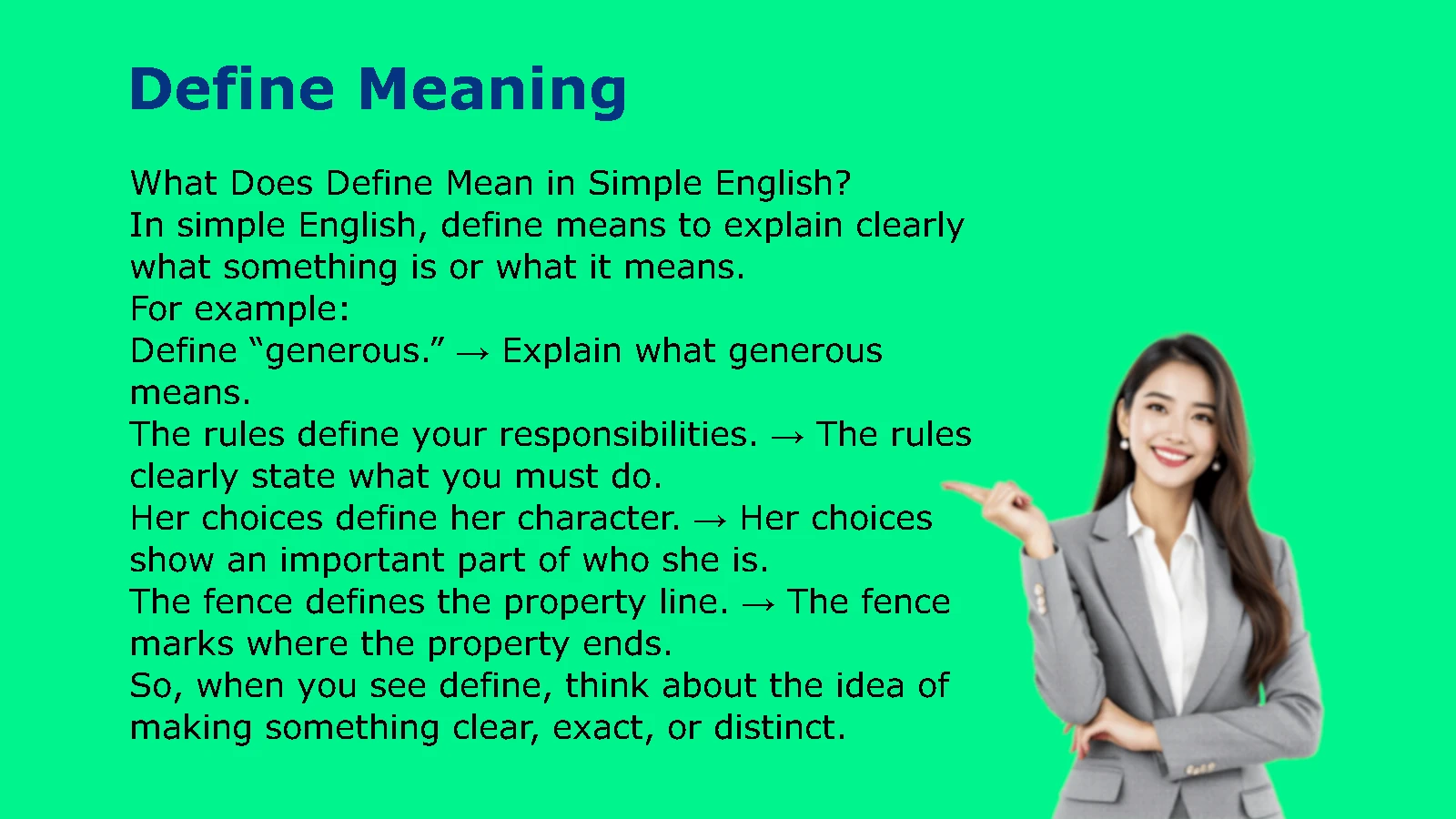
What Does Define Mean in Simple English?
In simple English, define means to explain clearly what something is or what it means.
For example:
- Define “generous.” → Explain what generous means.
- The rules define your responsibilities. → The rules clearly state what you must do.
- Her choices define her character. → Her choices show an important part of who she is.
- The fence defines the property line. → The fence marks where the property ends.
So, when you see define, think about the idea of making something clear, exact, or distinct.
Define Pronunciation
The American English pronunciation of define is:
/dɪˈfaɪn/
You can say it approximately as:
di-FINE
The stress falls on the second syllable, fine. Cambridge gives the US pronunciation as /dɪˈfaɪn/.
The pronunciation stays the same across the main uses of the verb:
- “Can you define this word?”
- “The law will define the limits.”
- “These experiences define who she is.”
The word defined, however, has the same basic pronunciation pattern with the -d ending added.
Is Define a Noun or a Verb?
Define is a verb.
More specifically, it commonly works as a transitive verb, which means it normally takes an object.
For example:
“Please define the word.”
Here, define is the verb and the word is its object.
Other examples include:
- “The teacher defined the concept.”
- “The agreement defines the terms.”
- “Experience can define your priorities.”
- “The photograph defines the subject’s outline.”
The noun connected to define is definition.
Define vs. Definition
The distinction is easy once you see how each word behaves.
| Word | Part of speech | Meaning | Example |
| define | Verb | To explain or establish meaning | “Please define the word.” |
| definition | Noun | An explanation of meaning | “What is the definition of the word?” |
You define something.
You give a definition of something.
Cambridge defines definition as a statement that explains the meaning of a word or phrase. It can also describe the features and limits of something.
The Main Meanings of Define
The best way to understand define meaning is to separate its major uses.
Define Means to Explain Meaning
This is probably the first meaning that comes to mind.
When you define a word, you explain what that word means. Dictionaries perform this task constantly.
For example:
“Can you define the word resilient?”
The speaker isn’t asking for a story about resilience. They want a clear explanation of the word.
You might answer:
“Resilient means able to recover or adapt after difficulty.”
This use appears frequently in:
- classrooms
- dictionaries
- exams
- vocabulary lessons
- academic writing
- conversations about unfamiliar terms
For example:
- “The teacher asked the students to define democracy.”
- “Can you define this scientific term?”
- “The dictionary defines the word in several ways.”
Define Means to Describe Essential Qualities
Sometimes define doesn’t mean giving a dictionary definition.
Instead, it means identifying the qualities that make something what it is.
Consider this sentence:
“Patience defines a good teacher.”
This doesn’t mean patience has a dictionary entry describing the teacher. Instead, it means patience is an important characteristic of a good teacher.
Merriam Webster describes this sense as determining or identifying the essential qualities or meaning of something.
More examples include:
- “Creativity defines her work.”
- “Trust defines a strong friendship.”
- “Attention to detail defines his writing.”
- “Consistency defines the team’s approach.”
This use often appears when people discuss character, identity, quality, leadership, success, or behavior.
Define Means to Set Limits or Boundaries
A third important meaning involves limits.
When something defines a boundary, it tells you where something starts, ends, or applies.
For example:
“The contract defines the employee’s responsibilities.”
The contract doesn’t merely describe the responsibilities. It establishes their scope and limits.
You might also say:
- “The law defines the rights of citizens.”
- “The policy defines acceptable behavior.”
- “The agreement clearly defines each party’s duties.”
- “The project guidelines define the scope of the work.”
Cambridge specifically notes that define can explain the meaning and exact limits of something.
This meaning matters in professional and legal writing because unclear boundaries can create confusion.
Define Means to Make a Shape or Edge Clear
The word can also describe something visual.
For example:
“The mountains were clearly defined against the evening sky.”
Here, define doesn’t mean explain the meaning of the mountains. It means their edges or outlines were easy to see.
Other examples include:
- “The photograph clearly defines the subject’s features.”
- “The dark border defines the shape.”
- “The wall defines the edge of the garden.”
- “The artist used shadows to define the figure.”
Cambridge lists this as another established use of define: showing clearly the edge or shape of something.
How to Use Define in a Sentence
The easiest sentence pattern is:
define + object
Examples:
- “Define the term.”
- “She defined the problem.”
- “The teacher defined the concept.”
- “The report defines the process.”
Another useful structure is:
define + object + as + description
Examples:
- “The dictionary defines the word as a type of agreement.”
- “The policy defines harassment as unwanted conduct.”
- “Scientists defined the condition as a measurable pattern.”
The structure be defined as is especially common in formal and academic English.
For example:
“The term is defined as a measurable change in behavior.”
Cambridge gives be defined as as a common construction for stating what something means.
Define in Different Contexts
The meaning of define becomes even easier to understand when you see how different fields use it.
Define in Education
Teachers often ask students to define words, theories, concepts, and terms.
For example:
“Define photosynthesis.”
The expected answer should explain what photosynthesis means rather than simply provide an example.
Other examples include:
- “Define the term ecosystem.”
- “Students must define each vocabulary word.”
- “The textbook defines the concept clearly.”
- “Can you define the difference between the two theories?”
In this context, define usually means state the meaning clearly and accurately.
Define in Business
Business writing frequently uses define when discussing goals, responsibilities, roles, standards, and objectives.
For example:
“The manager needs to define the project’s goals.”
That means the manager needs to make the goals specific enough that everyone understands them.
Common examples include:
- “Define the target audience.”
- “Define the project’s scope.”
- “The agreement defines each party’s responsibilities.”
- “The team needs to define success before measuring it.”
- “The company clearly defines its quality standards.”
Cambridge’s Business English Dictionary also uses define for stating meanings and setting precise limits around goals or objectives.
Define in Law
Legal language relies heavily on precise definitions.
A law or contract may define a term so that readers know exactly how the term applies within that document.
For example:
“The agreement defines confidential information as material that isn’t publicly available.”
The definition establishes the boundaries of the term.
Legal writing may also use phrases such as:
- “as defined by law”
- “defined terms”
- “the term is defined as”
- “clearly defined responsibilities”
- “legally defined categories”
Precision matters here because a vague word can lead to different interpretations.
Define in Science
Scientific writing uses define to establish clear meanings, measurements, categories, and conditions.
For example:
“Researchers defined the study group according to specific criteria.”
A scientific definition needs enough precision that other researchers understand exactly what the writer means.
Scientific writing may therefore use structures such as:
- “The variable was defined as…”
- “The researchers defined the condition as…”
- “For this study, success was defined as…”
- “The sample was defined by three criteria.”
The exact definition can depend on the purpose of the study. That’s why scientific articles often explain how they use a term rather than assuming every reader interprets it in exactly the same way.
Define Yourself Meaning
The phrase define yourself has a more personal meaning.
To define yourself means to establish or describe your identity, values, characteristics, or place in the world.
For example:
“Don’t let one mistake define you.”
Here, define means determine how someone is understood or characterized.
Another example:
“She defines herself as an independent artist.”
The sentence means she identifies herself as an independent artist.
You can define yourself through:
- your values
- your choices
- your goals
- your work
- your relationships
- your interests
- your beliefs
- your behavior
However, define yourself doesn’t necessarily mean that one label completely describes a person. In everyday speech, the phrase often emphasizes identity or self description.
Merriam Webster includes characterize and distinguish among the meanings of define, which helps explain this use.
What Does “Define Your Terms” Mean?
Define your terms means explain exactly what you mean by the words or ideas you’re using.
This phrase often appears during arguments, discussions, debates, and academic conversations.
Imagine someone says:
“We need more freedom.”
Another person might respond:
“Before we continue, define your terms.”
They’re asking:
What exactly do you mean by “freedom”?
The phrase helps prevent misunderstandings. Two people can use the same word while giving it different meanings.
For example, people may interpret words such as:
- success
- fairness
- freedom
- respect
- affordable
- professional
- healthy
in different ways.
Defining the terms makes the conversation more precise.
Cambridge specifically identifies define your terms as a common expression meaning to explain what you mean by the words you have used.
Define Word Forms
The main forms of define are straightforward.
| Verb form | Word | Example |
| Base form | define | “Please define the term.” |
| Third person singular | defines | “The rule defines the process.” |
| Past tense | defined | “The teacher defined the word.” |
| Past participle | defined | “The term is clearly defined.” |
| Present participle | defining | “She is defining the main issue.” |
Cambridge identifies defined as both the past simple and past participle of define.
Define
Use define with subjects such as I, you, we, they, or after modal verbs.
Examples:
- “Can you define this word?”
- “We need to define the goal.”
- “They want to define the process.”
Defines
Use defines with a singular third person subject.
Examples:
- “The contract defines the relationship.”
- “This quality defines her work.”
- “The law defines the term.”
Defined
Use defined for the simple past or as a past participle.
Examples:
- “The teacher defined the word.”
- “The contract clearly defined the responsibilities.”
- “The boundaries are clearly defined.”
Defining
Use defining as the present participle or gerund.
Examples:
- “They are defining the project’s scope.”
- “Defining the problem is the first step.”
- “Trust is a defining feature of the relationship.”
Define vs. Describe
Define and describe overlap, but they aren’t interchangeable in every situation.
To define something usually means to establish its meaning, essential nature, or limits.
To describe something usually means to tell someone what it is like.
Compare these examples:
| Define | Describe |
| “Define democracy.” | “Describe the democratic process.” |
| “The contract defines the employee’s role.” | “The manager described the employee’s role.” |
| “Define the term.” | “Describe what you saw.” |
| “The policy defines acceptable behavior.” | “The report describes the behavior.” |
Think of the difference this way:
Define draws the boundary. Describe fills in the picture.
A definition aims for precision. A description can be broader and more detailed.
For instance, if someone asks you to define a bicycle, you might say:
“A bicycle is a two wheeled vehicle powered by a rider using pedals.”
If they ask you to describe a bicycle, you might talk about its size, color, shape, wheels, handlebars, seat, and condition.
Define vs. Explain
These words also have related meanings.
Explain usually means making something understandable by giving information, reasons, or details.
Define focuses more directly on meaning, essential qualities, or limits.
Compare:
- “Can you define inflation?”
- “Can you explain why inflation happens?”
The first asks for the meaning of the term.
The second asks for a broader explanation of the process or causes.
A useful rule is:
Define tells you what something means. Explain helps you understand it.
The two verbs can overlap, especially when someone asks you to clarify an unfamiliar idea.
Synonyms for Define
The best synonym depends on the meaning you’re using.
When Define Means Explain
Useful alternatives include:
- explain
- clarify
- interpret
- specify
- state
Example:
“Can you define the term?”
Possible alternatives:
“Can you explain the term?”
“Can you clarify the term?”
These aren’t always identical, though. Clarify often suggests making something already confusing easier to understand.
When Define Means Describe
Possible alternatives include:
- describe
- characterize
- identify
- specify
- portray
For example:
“Several traits define her personality.”
You could say:
“Several traits characterize her personality.”
The nuance changes slightly, but the core idea remains similar.
When Define Means Set Limits
Possible alternatives include:
- establish
- set
- mark
- determine
- delimit
For example:
“The agreement defines the project’s scope.”
You could write:
“The agreement establishes the project’s scope.”
The second sentence emphasizes the act of establishing the limits.
Antonyms of Define
There isn’t one perfect opposite of define because the word has several meanings.
Depending on context, possible opposites include:
- confuse
- obscure
- blur
- complicate
- conceal
- leave unclear
For example:
“The instructions clearly define the process.”
A contrasting sentence might be:
“The instructions leave the process unclear.”
When define means making a visual edge clear, blur is a more direct contrast:
“The camera clearly defined the subject’s outline.”
“The movement blurred the subject’s outline.”
Define Etymology and Word Origin
The history of define explains why the modern word can refer to both meanings and boundaries.
Merriam Webster traces define through Middle English and Anglo French to Medieval Latin dēfīnīre, meaning to mark limits, determine, or give an exact description. The Latin word is connected with fīnīre, meaning to mark out boundaries or limit.
The word’s history therefore connects two ideas that still exist in modern English:
setting a boundary and making something precise.
That connection makes sense. When you define something, you draw an intellectual boundary around it. You tell people what belongs inside the concept and, often, what doesn’t.
Merriam Webster records the first known English use of define in the 14th century.
A Simple Way to Remember the Origin
Think of define as drawing a line around an idea.
Before you define something, its meaning may seem broad or fuzzy.
After you define it, the edges become clearer.
That basic idea connects naturally to:
- defining a word
- defining a concept
- defining responsibilities
- defining boundaries
- defining identity
- defining an outline
Common Grammar Patterns With Define
Learning a few common patterns can make your English sound more natural.
Define + Noun
This is the simplest pattern.
define + something
Examples:
- “Define the word.”
- “Define the problem.”
- “Define the objective.”
- “Define the relationship.”
Define + Noun + as + Description
This pattern states exactly what something means or how a term is classified.
Examples:
- “The dictionary defines the word as a type of adjective.”
- “The policy defines misconduct as a serious violation.”
- “The study defines success as achieving the target.”
This construction is especially common in academic, business, scientific, and legal writing.
Be Defined As
The passive construction be defined as is extremely common in formal English.
Examples:
- “The term is defined as a measurable change.”
- “Success is defined as meeting all three targets.”
- “The condition is defined as a persistent pattern.”
Although active voice is usually more direct, this construction can be useful when the definition itself matters more than the person giving it.
Define Something By
The pattern define something by means identifying something through a particular characteristic.
Examples:
- “People often define success by income.”
- “The company defines quality by customer satisfaction.”
- “The artist defines the style by its bold lines.”
Define Yourself As
This pattern describes self identification.
Examples:
- “She defines herself as a writer.”
- “He defines himself as an entrepreneur.”
- “They define themselves as problem solvers.”
Common Mistakes With Define
Even though define is a common word, several mistakes can make sentences awkward.
Mistake: Confusing Define With Definition
Incorrect:
“Can you give me a define of this word?”
Correct:
“Can you give me a definition of this word?”
Or:
“Can you define this word?”
Remember:
define = verb
definition = noun
Mistake: Using Define When Describe Fits Better
Consider:
“Can you define what the house looked like?”
The sentence isn’t impossible, but describe sounds more natural:
“Can you describe what the house looked like?”
However:
“Can you define the term?”
is perfectly natural because the speaker wants the term’s meaning.
Mistake: Giving a Definition That Doesn’t Clarify Anything
A definition should make an idea clearer.
For example, defining “leadership” as “the quality of being a leader” doesn’t provide much useful information.
A stronger explanation would identify what leadership involves, such as guiding people toward a shared goal, making decisions, and taking responsibility.
A good definition doesn’t simply replace one vague phrase with another.
Examples of Define in a Sentence
Here are examples covering several meanings of define.
Everyday Examples
- “How would you define happiness?”
- “Can you define that word?”
- “We need to define what we mean by success.”
- “She doesn’t want one mistake to define her.”
Academic Examples
- “Students must define each key term.”
- “The researcher defined the variables before collecting data.”
- “The textbook defines the concept in simple language.”
- “The essay should define its central argument.”
Business Examples
- “The team needs to define its goals.”
- “The contract defines each employee’s responsibilities.”
- “The company has clearly defined quality standards.”
- “The manager helped define the project’s scope.”
Legal Examples
- “The agreement defines confidential information.”
- “The statute defines the rights of the parties.”
- “The contract clearly defines the obligations of each side.”
Visual Examples
- “The sunlight defined the mountain’s outline.”
- “The dark border defines the shape.”
- “The artist used shadows to define the figure.”
- “The subject’s features were sharply defined.”
Case Study: Why Defining a Goal Matters
Consider a small marketing team preparing a new campaign.
At first, the manager says:
“We need to improve our online performance.”
That sounds reasonable, but the goal isn’t clearly defined.
What does improve mean?
More website visits? More sales? Better engagement? Lower advertising costs?
The team then defines the goal:
“Increase qualified website leads by 20% during the next campaign.”
Now the objective has a clear meaning and measurable boundary.
This example shows an important practical use of define. Defining something isn’t merely choosing words. It can turn a vague idea into something people can understand and act on.
The same principle works outside business.
Instead of saying:
“I want to get healthier.”
You might define the goal as:
“I want to walk for 30 minutes at least five days a week.”
The second statement gives the idea clearer boundaries.
Define Meaning in Everyday Conversations
In casual conversation, people often use define when they want clarification.
For example:
Person A: “He’s successful.”
Person B: “How do you define successful?”
The second person isn’t asking for a dictionary definition. They’re asking what successful means in that particular conversation.
The phrase how do you define…? is therefore useful when a word or concept can have different interpretations.
Common questions include:
- “How do you define success?”
- “How do you define friendship?”
- “How do you define a good leader?”
- “How would you define happiness?”
- “How do you define professionalism?”
These questions invite someone to explain the boundaries or essential qualities of an idea.
Why Some Things Are Difficult to Define
Not every concept has a simple definition.
Concrete objects often have relatively clear boundaries. A triangle, for example, has specific geometric properties.
Abstract concepts can be harder.
Words such as:
- love
- beauty
- success
- fairness
- freedom
- intelligence
- happiness
can mean different things to different people.
Cambridge gives examples involving concepts such as beauty and the boundaries between friendship and intimacy, showing how some ideas can be difficult to define precisely.
This doesn’t mean definitions are useless. It means the person defining the concept may need to explain its context, limits, and essential features.
What Makes a Good Definition?
A strong definition should give the reader enough information to understand the term without creating another mystery.
A useful definition often has these qualities:
- Clear: The wording is easy to understand.
- Precise: It avoids unnecessary ambiguity.
- Relevant: It focuses on the meaning that matters in context.
- Concise: It doesn’t bury the meaning under unnecessary detail.
- Accurate: It reflects how the term is actually used.
- Contextual: It recognizes when a word has different meanings.
For example, a dictionary definition may be enough for a vocabulary question. A scientific paper may need a much more precise operational definition.
The right definition depends on the reader and the purpose.
Define Meaning: Quick Reference Table
| Question | Answer |
| What does define mean? | To explain meaning, describe essential qualities, establish limits, or make an outline clear |
| Is define a noun or verb? | Verb |
| Pronunciation | /dɪˈfaɪn/ |
| Past tense | defined |
| Present participle | defining |
| Noun form | definition |
| Common structure | define + noun |
| Another common structure | define + noun + as + description |
| Related word | definition |
| Common synonym | explain, depending on context |
| Common phrase | define your terms |
| Opposite in some contexts | blur, obscure, or confuse |
Frequently Asked Questions About Define Meaning
What does define mean?
Define means to explain what something means, describe its essential qualities, establish its limits, or make its outline clear.
What is the simple meaning of define?
The simple meaning of define is to explain clearly what something is or what it means.
Is define a noun or a verb?
Define is a verb. The related noun is definition.
What is the past tense of define?
The past tense is defined.
Example:
“The teacher defined the term.”
What is the noun form of define?
The main noun form is definition.
Example:
“The dictionary provides a clear definition.”
What is a synonym for define?
Depending on the context, synonyms include explain, clarify, describe, specify, establish, characterize, determine, and identify.
No single synonym works in every sentence.
What is the difference between define and describe?
Define focuses on meaning, essential qualities, or boundaries. Describe focuses more broadly on what something is like.
How do you use define in a sentence?
You can use define + noun:
“Please define the term.”
You can also use define + noun + as + description:
“The policy defines the behavior as unacceptable.”
What does “define your terms” mean?
Define your terms means explain exactly what you mean by the words or ideas you’re using.
What does “define yourself” mean?
Define yourself means to establish or describe your identity, values, characteristics, or role.
What does “defined by” mean?
Defined by means characterized, shaped, or given meaning by a particular quality, feature, action, or circumstance.
For example:
“Her career is defined by persistence.”
This means persistence is one of the main characteristics of her career.
Is “define” the same as “explain”?
Not always. Define usually focuses on meaning, essential qualities, or limits. Explain has a broader meaning and can include reasons, causes, processes, and details.
Final Takeaway: Define Meaning in One Clear Explanation
The word define centers on one powerful idea: making something clear and definite.
So, the define meaning depends on context, but its central purpose remains the same: to make the meaning, nature, limits, or form of something clear.
Remember these four core uses:
- Define a word → explain its meaning.
- Define a concept → identify its essential qualities.
- Define a boundary → establish its limits.
- Define a shape → make its outline clear.
Once you understand these connections, expressions such as define your terms, define yourself, be defined as, and defined by become much easier to understand and use naturally.