
What Is the Specific Meaning?
Specific means clearly defined, exact, or limited to a particular person, thing, detail, or purpose. It is used when you want to point to something precise rather than something general or broad.
Examples:
- Can you give me a specific reason for your decision?
- She asked for a specific type of book.
- The teacher gave us specific instructions for the project.
The confusion often comes from how specific changes meaning depending on the context. People commonly search for what does specific mean, specific meaning in English, specific definition, and specific in a sentence because the word can describe an exact detail, particular person, clear requirement, or defined purpose. Getting the meaning right helps you communicate your ideas without leaving room for guesswork.
In this guide, you’ll learn the complete Specific Meaning, discover the specific definition, understand how to use specific in everyday conversations and writing, and explore practical specific examples with easy to follow explanations. You’ll also learn the correct pronunciation of specific, common synonyms, antonyms, and how to use the word naturally in different situations.
What Does Specific Mean?
The basic specific meaning of specific is particular, clearly identified, or relating to one definite thing rather than a broad group.
When something is specific, you can usually identify exactly what the speaker or writer has in mind.
Consider these two statements:
- “I want some fruit.”
- “I want two green apples.”
The first statement is general. It could refer to apples, oranges, bananas, grapes, or many other fruits.
The second statement is specific. It identifies the type, color, and quantity.
In simple terms:
Specific means particular rather than general.
The word can also describe information that gives enough detail to make its meaning clear.
For example:
- General: “The meeting is later.”
- Specific: “The meeting starts at 3:30 p.m. on Thursday.”
The second sentence gives the reader something concrete to work with.
Specific Meaning in Simple Words
In simple English, specific means clearly pointing to one particular person, thing, detail, place, time, reason, or situation.
You can think of it as narrowing a wide circle.
Imagine that someone says, “I saw an animal.”
That’s a huge category. It could mean a dog, cat, horse, bird, snake, or elephant.
Now compare it with:
“I saw a brown German shepherd near the park entrance.”
The meaning has become much narrower. The listener can form a much clearer picture.
Specific Meaning With an Example
Here is another simple comparison:
| General statement | Specific statement |
| I need a car. | I need a used SUV with seven seats. |
| Call me later. | Call me at 6 p.m. |
| She bought a dress. | She bought a long black evening dress. |
| He has a problem. | His laptop won’t connect to Wi-Fi. |
| We need food. | We need three pizzas for eight people. |
The specific statements don’t necessarily contain many more words. They simply contain more useful information.
Specific Definition
Specific is primarily used as an adjective.
Its central meaning is something that is particular, definite, or clearly distinguished from others.
Depending on context, the word can carry slightly different shades of meaning.
Specific Meaning as “Particular”
When specific means particular, it identifies one member or item from a larger group.
For example:
“She was looking for a specific restaurant.”
This doesn’t mean she wanted any restaurant. She had one particular restaurant in mind.
Other examples include:
- “Do you have a specific person in mind?”
- “Is there a specific color you prefer?”
- “He mentioned a specific problem.”
- “We need to choose a specific location.”
- “She asked for a specific type of software.”
In each sentence, specific narrows the possible choices.
Specific Meaning as “Clearly Defined”
Sometimes specific refers to something that has been clearly stated or defined.
For example:
“The instructions contain specific requirements.”
Here, specific requirements means clearly stated conditions or standards.
A job advertisement might say:
“Applicants must have three years of experience and a bachelor’s degree.”
Those are specific requirements because they clearly establish what the employer wants.
Specific Meaning as “Detailed or Precise”
In some contexts, specific means that information contains concrete details rather than vague statements.
For example:
- “Please give me specific examples.”
- “The teacher requested specific evidence.”
- “The report provides specific details about the incident.”
However, specific doesn’t always mean highly detailed. A statement can be specific while remaining short.
For example:
“The meeting begins at 10 a.m.”
That’s specific even though it’s only five words.
What Does It Mean to Be Specific?
When someone tells you to “be specific,” they want you to give information that clearly identifies what you mean.
Suppose your manager asks:
“What went wrong with the project?”
You could respond:
“There were some problems.”
That’s vague.
A more specific answer would be:
“The project missed its deadline because the design approval arrived four days late.”
The second response identifies what happened, why it happened, and when the delay occurred.
Being specific doesn’t mean dumping every available detail onto the listener. It means choosing the details that actually answer the question.
What “Be Specific” Usually Asks For
When someone says “be specific,” they may want you to provide:
- A person’s name
- A particular place
- An exact or approximate date
- A time
- A number
- A reason
- A concrete example
- A particular object
- A clearly defined action
- A measurable result
For example:
Vague:
“Sales increased.”
Specific:
“Online sales increased by 18% during the second quarter.”
The second sentence gives the reader something measurable.
Why Specific Information Matters
Specific information helps people make decisions.
Imagine telling a friend:
“Meet me at the mall.”
That’s technically an instruction, but it’s incomplete. Which entrance? What time? Which mall if there are several nearby?
A clearer message might be:
“Meet me at the north entrance of Centerville Mall at 4 p.m.”
Now the instruction is much easier to follow.
As a useful rule:
Good communication doesn’t simply provide more information. It provides the right information.
Specific vs. General
The clearest way to understand specific meaning is to compare specific with general.
General describes something broad or applicable to a larger group. Specific narrows that broad idea to something particular.
| Specific | General |
| One particular item | A broad category |
| Clear and focused | Broad and wide-ranging |
| Identifies details | Leaves details open |
| “A 2026 Toyota Camry” | “A car” |
| “Tuesday at 9 a.m.” | “Sometime next week” |
| “Three red roses” | “Some flowers” |
| “A chemistry teacher” | “A teacher” |
Neither approach is automatically better.
Sometimes you want to be general.
For example:
“Dogs need regular exercise.”
That’s a useful general statement.
But if you’re giving instructions to someone caring for a particular dog, you might need something more specific:
“Take Max for a 30-minute walk every morning.”
The right level of specificity depends on the purpose.
Examples of Specific and General Statements
Consider how the meaning changes as a statement becomes more specific.
Food
- General: “I want dessert.”
- More specific: “I want chocolate cake.”
- Very specific: “I want a slice of chocolate cake with vanilla frosting.”
Time
- General: “I’ll arrive later.”
- More specific: “I’ll arrive this evening.”
- Very specific: “I’ll arrive around 7:15 p.m.”
Location
- General: “Let’s meet downtown.”
- More specific: “Let’s meet at the library downtown.”
- Very specific: “Let’s meet outside the library’s main entrance.”
The progression shows an important point: specificity narrows possibilities.
Specific Meaning in Different Contexts
The word specific appears in everyday conversations, education, business, technology, writing, and many other areas.
Its core meaning stays similar, but its practical use changes with the situation.
Specific Meaning in Everyday Conversation
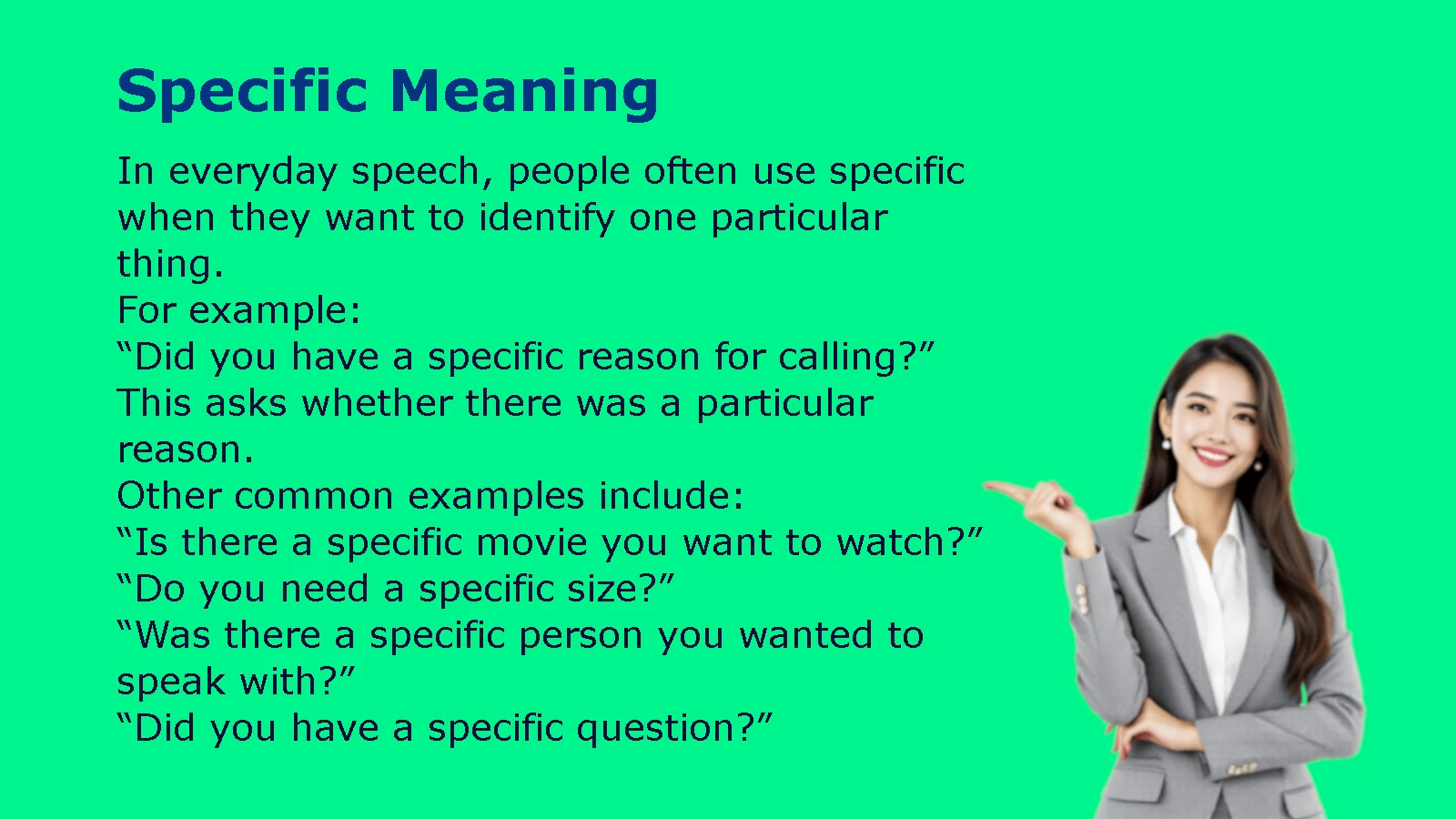
In everyday speech, people often use specific when they want to identify one particular thing.
For example:
“Did you have a specific reason for calling?”
This asks whether there was a particular reason.
Other common examples include:
- “Is there a specific movie you want to watch?”
- “Do you need a specific size?”
- “Was there a specific person you wanted to speak with?”
- “Did you have a specific question?”
These questions help narrow a conversation.
Specific Meaning in Writing
Good writing often depends on specificity.
Compare:
“The house was nice.”
with:
“The two-story house had wide windows, a red front door, and a small garden along the driveway.”
The second sentence gives the reader a clearer mental picture.
Specific details can make writing more persuasive and memorable because they give abstract ideas a concrete shape.
For example:
Weak:
“The company has many customers.”
Stronger:
“The company serves more than 10,000 customers across three states.”
The second sentence communicates a measurable fact instead of relying on a broad claim.
Specific Meaning in Work and Business
In professional communication, being specific can prevent expensive misunderstandings.
Consider an email that says:
“Please send the report soon.”
What does soon mean?
Today? Tomorrow? Before lunch?
A more specific instruction would be:
“Please send the final report by 2 p.m. Friday.”
Now the expected deadline is clear.
Business communication commonly uses phrases such as:
- Specific requirements
- Specific goals
- Specific instructions
- Specific responsibilities
- Specific deadlines
- Specific examples
- Specific information
- Specific outcomes
Specific Meaning in Academic Writing
Academic writing also benefits from specificity.
Consider this claim:
“Exercise is good for people.”
It’s broad.
A more focused statement might be:
“Regular aerobic exercise can improve cardiovascular fitness in adults.”
The second statement identifies the type of exercise, the outcome, and the population being discussed.
Specificity helps academic writers avoid making claims that are too broad to support.
Examples of Specific in Sentences
Here are natural examples showing how specific works in different situations:
- “Do you have a specific question?”
This asks whether the person has one particular question. - “She gave me specific instructions.”
The instructions clearly explain what needs to happen. - “We need a specific date before booking the venue.”
The speaker needs one definite date. - “He couldn’t remember the specific details.”
He remembered the general event but not its particular details. - “The teacher asked for a specific example.”
The teacher wants one concrete example rather than a broad explanation. - “Is there a specific reason you’re leaving?”
This asks for a particular reason. - “This tool was designed for a specific purpose.”
The tool has a particular intended use. - “Please be specific about what you need.”
The speaker wants clear information rather than a vague request. - “She has a specific goal for the next six months.”
Her goal is clearly defined. - “The instructions don’t mention a specific time.”
No definite time has been stated. - “He was looking for a specific model.”
He didn’t want just any model. - “Can you give me a specific example?”
The speaker wants a concrete case that illustrates the idea.
Specific Synonyms
Several words can have a similar meaning to specific, but they aren’t perfect substitutes in every situation.
Common synonyms include:
- Particular
- Exact
- Precise
- Definite
- Detailed
- Clearly defined
- Distinct
- Identified
- Concrete
Choosing the right synonym depends on what you want to emphasize.
Specific vs. Particular
Specific and particular are often interchangeable.
For example:
“She wants a specific brand.”
and:
“She wants a particular brand.”
Both sentences suggest that she has one brand in mind.
However, particular can sometimes emphasize selection or distinction, while specific often emphasizes clear identification.
Specific vs. Precise
Precise usually emphasizes accuracy or exactness.
For example:
“Give me a specific example.”
Here, you need a particular example.
But:
“Give me the precise measurement.”
Here, you need an accurate measurement.
A specific answer doesn’t always have to be numerically exact.
Specific vs. Exact
Exact means completely accurate or corresponding to a precise value, position, amount, or identity.
Compare:
- “I need a specific date.”
- “I need the exact date.”
The first could mean any clearly chosen date. The second suggests that the precise date matters.
For instance, “next Monday” can be specific in some contexts, while “August 17, 2026, at 9:00 a.m.” is much more exact.
Specific vs. Detailed
These words are related but different.
Specific focuses on identifying something particular.
Detailed focuses on providing many pieces of information.
For example:
“Give me a specific answer.”
means you want the answer to address a particular point.
“Give me a detailed answer.”
means you want a fuller explanation with more information.
A response can be specific without being detailed.
Specific Antonyms
The most useful antonyms for specific include:
- General
- Vague
- Broad
- Indefinite
- Unclear
- Ambiguous
Specific vs. Vague
This is one of the most important contrasts.
A vague statement doesn’t provide enough information to identify exactly what the speaker means.
For example:
“I’ll come sometime later.”
That’s vague.
Compare it with:
“I’ll come around 7 p.m.”
That’s more specific.
Specific vs. Broad
A broad statement covers many possibilities.
For example:
“She studies science.”
That’s broad.
A more specific version is:
“She studies environmental chemistry.”
The second statement narrows the field considerably.
Common Phrases With Specific
The word specific appears in many common expressions.
Be Specific
“Be specific” means provide clear, particular information.
Example:
“If you want help, be specific about the problem.”
A Specific Reason
This refers to one particular reason.
“Is there a specific reason you changed the schedule?”
A Specific Example
This means one concrete example rather than a general explanation.
“Can you give me a specific example of good customer service?”
Specific Details
These are particular facts or pieces of information.
“The police report contains specific details about the incident.”
Specific Instructions
These are clear directions about what someone should do.
“The recipe includes specific instructions for preparing the sauce.”
A Specific Person
This means one particular individual.
“I’m looking for a specific person.”
A Specific Time
This refers to a clearly identified time.
“The appointment is scheduled for a specific time.”
A Specific Purpose
This describes one particular intended use.
“The room was designed for a specific purpose.”
Specific Requirements
These are clearly defined conditions that must be met.
“The scholarship has specific requirements for applicants.”
How to Use Specific Correctly
Using specific correctly becomes easier when you understand what information you are trying to narrow down.
Use specific when you want to identify:
- A particular person
- A particular object
- A particular place
- A particular time
- A particular reason
- A particular example
- A particular requirement
- A particular purpose
- A particular type or category
For example:
“I need a specific size.”
This means you aren’t looking for just any size.
You can also use specific when describing clear requirements:
“The assignment has specific formatting rules.”
Here, the rules aren’t vague. They identify what the writer needs to do.
When Not to Use Specific
Don’t automatically use specific whenever you mean clear.
These words overlap in some situations, but they aren’t identical.
For example:
“Please make your explanation clear.”
focuses on whether the reader can understand it.
Meanwhile:
“Please provide a specific example.”
focuses on the particular example being requested.
That’s an important distinction.
Specific vs. Detailed
The difference between specific and detailed causes confusion because detailed information often contains specific information.
However, the two concepts aren’t identical.
Imagine someone asks:
“What time should I arrive?”
A specific answer could be:
“At 8 a.m.”
That’s specific but not detailed.
A detailed answer might be:
“Arrive at 8 a.m. through the east entrance, check in at the reception desk, take the elevator to the third floor, and wait outside Room 302.”
That answer contains multiple instructions.
So:
Specific = particular and clearly identified.
Detailed = containing many pieces of information.
One focuses on precision of reference. The other focuses on depth of information.
Specific vs. Precise vs. Exact
These three words are close, but each has its own emphasis.
| Word | Main idea | Example |
| Specific | Particular or clearly identified | “Give me a specific example.” |
| Precise | Highly accurate | “Give me the precise measurement.” |
| Exact | Completely accurate or identical | “Tell me the exact amount.” |
| Detailed | Containing many facts or points | “Give me a detailed explanation.” |
| General | Broad rather than particular | “Give me a general overview.” |
Here’s an easy way to remember them:
- Specific tells you which one.
- Precise tells you how accurately.
- Exact tells you the completely correct value or identity.
- Detailed tells you how much information is included.
- General gives you the wider picture.
These distinctions become especially useful in professional and academic writing.
Common Mistakes With Specific
Even though specific is a common word, several usage mistakes appear regularly.
Mistake: Confusing Specific With Exact
Consider:
“Give me a specific number.”
This could mean you don’t want a broad estimate.
But:
“Give me the exact number.”
clearly asks for the completely accurate figure.
If accuracy is the central concern, exact may be the better choice.
Mistake: Giving a General Answer When Asked to Be Specific
Suppose someone asks:
“What did you buy?”
A weak answer would be:
“Some things.”
A specific answer would be:
“I bought a laptop, a wireless mouse, and a laptop stand.”
The second answer removes uncertainty.
Mistake: Assuming Specific Means Extremely Detailed
Being specific doesn’t require a long explanation.
For example:
“The deadline is Friday.”
That’s short and specific.
Adding unrelated information wouldn’t necessarily make the answer better.
Mistake: Adding Irrelevant Details
Specific writing should be relevant, not overloaded.
Compare:
“The meeting starts at 10 a.m. in Conference Room B.”
with:
“The meeting starts at 10 a.m. in Conference Room B. The room has gray chairs, two windows, a large table, three plants, and a clock.”
The second version contains more detail, but most of it isn’t useful if the reader simply needs to know where and when the meeting occurs.
Specificity is about useful precision, not information overload.
How to Be More Specific in Your Writing
If your writing feels vague, you can make it stronger by replacing broad words with concrete information.
Name the Exact Subject
Instead of:
“The employee made a mistake.”
Write:
“The cashier entered the wrong product code.”
The second sentence identifies the action and the person involved.
Add Relevant Numbers
Instead of:
“The company grew quickly.”
Write:
“The company added 240 new customers in six months.”
Numbers can turn a broad statement into a measurable one.
Add Dates or Times
Instead of:
“The event happened recently.”
Write:
“The event took place on July 12.”
A date gives the reader a clear reference point.
Replace Vague Words
Words such as thing, stuff, soon, later, many, good, bad, nice, and a lot can sometimes make writing less precise.
For example:
“She has a lot of experience.”
could become:
“She has eight years of experience in digital marketing.”
The second version gives the reader something concrete.
Give a Clear Example
Abstract explanations become easier to understand when you add a specific example.
Instead of:
“Good communication requires clarity.”
you might write:
“For example, telling an employee to submit a report by 3 p.m. Friday is clearer than saying to submit it soon.”
The example demonstrates the principle instead of merely stating it.
Case Study: How Specific Language Prevents Confusion
Consider a simple workplace scenario.
A manager sends this message:
“Please update the sales report soon.”
The employee now has several unanswered questions:
- Which sales report?
- Which section needs updating?
- What does “soon” mean?
- Should the employee send the report back?
- Is there a deadline?
The manager could instead write:
“Please update the Q2 sales report with June figures and email the final spreadsheet to me by 4 p.m. Friday.”
Now the request contains:
- The specific document: Q2 sales report
- The specific information: June figures
- The required action: update the spreadsheet
- The delivery method: email
- The deadline: 4 p.m. Friday
The second message isn’t dramatically longer. It’s simply more specific.
That distinction matters in real communication because ambiguity can create delays, errors, and unnecessary back-and-forth.
How Specificity Improves Communication
Specific language offers several practical benefits.
It Reduces Misunderstandings
When people know exactly what you mean, they have less room to interpret your words differently.
It Makes Instructions Easier to Follow
Specific instructions tell people what to do and often clarify when, where, or how to do it.
It Strengthens Arguments
Concrete examples and measurable facts generally make an argument easier to evaluate than broad claims.
It Improves Search and Research
Specific questions usually produce more useful answers.
Compare:
“How do computers work?”
with:
“How does a CPU execute instructions stored in memory?”
The second question targets a much narrower subject.
It Makes Descriptions More Vivid
Specific details allow readers to visualize what you’re describing.
Instead of:
“The restaurant was beautiful.”
you might write:
“The restaurant had exposed brick walls, warm pendant lights, and wooden tables overlooking the river.”
Now the reader can picture the setting.
Specific Meaning in Questions
Questions can also become more useful when they’re specific.
Consider:
“Why is my computer not working?”
That’s extremely broad.
A more focused question might be:
“Why does my Windows laptop connect to Wi-Fi but fail to open websites?”
The second question identifies the operating system, device type, connection behavior, and exact problem.
Specific questions help people give specific answers.
Here are some examples:
| Vague question | Specific question |
| Why is this happening? | Why does the program close when I click Save? |
| What should I do? | What should I do if my payment fails twice? |
| Is it expensive? | Does the plan cost more than $50 per month? |
| When is it due? | Is the assignment due Friday at midnight? |
| Where is it? | Is the package at the front desk? |
The lesson is simple: a focused question creates room for a focused answer.
Specific Information vs. General Information
Both types of information have legitimate uses.
General information helps you understand a subject at a high level. Specific information helps you understand a particular part of it.
For example:
General information:
“Regular exercise supports physical health.”
Specific information:
“Walking briskly for 30 minutes can be incorporated into a weekly exercise routine.”
The first statement introduces the broad concept. The second narrows the discussion.
Good writing often moves between both levels.
It starts broad enough to establish context and then becomes specific when the reader needs concrete information.
Why Specificity Matters in SEO and Online Content
Specific language also helps online readers.
Someone searching for information usually has a particular question in mind. A useful article should address that question directly instead of hiding the answer under several paragraphs of filler.
For example, a reader searching “specific meaning” likely wants to know:
- What does specific mean?
- How is it used?
- What are its synonyms?
- What is the opposite of specific?
- Is specific the same as exact?
- How do you use it in a sentence?
A strong explanation should answer those questions clearly.
Specific headings also help readers scan an article. Instead of a vague heading such as “More About the Word,” a useful heading says “Specific vs. Precise vs. Exact.”
The reader immediately knows what information is inside that section.
A Simple Formula for Being More Specific
When you’re unsure whether your sentence is specific enough, ask yourself:
Who? What? When? Where? Why? How much? Which one?
You don’t need to answer every question every time.
Choose the questions that matter to your message.
For example:
“The company changed its policy.”
This leaves many questions unanswered.
You could make it more specific:
“The company changed its remote-work policy on August 1, requiring employees to work from the office three days a week.”
Now the reader knows:
- Who: the company
- What: remote-work policy changed
- When: August 1
- What changed: three office days per week
That’s the practical power of specificity.
Frequently Asked Questions About Specific Meaning
What is the simple meaning of specific?
The simple specific meaning is particular, clearly identified, or definite rather than general. If you identify one particular thing instead of referring to a broad category, you’re being specific.
What does “be specific” mean?
“Be specific” means give clear and particular information instead of making a vague or broad statement.
For example, instead of saying “I’ll arrive later,” you could say, “I’ll arrive at 7 p.m.”
What is an example of something specific?
“Three blue notebooks” is a specific description. It identifies the quantity, color, and type of object.
By comparison, “some school supplies” is general.
What is the opposite of specific?
The most common opposites are general, vague, broad, indefinite, and unclear.
The best antonym depends on the sentence.
Is specific the same as exact?
No. The words are related, but they emphasize different things.
Specific means particular or clearly identified. Exact means completely accurate or precise.
For example, “a specific date” identifies one date, while “the exact date” emphasizes that the date must be completely accurate.
Is specific the same as detailed?
No. Specific means particular and clearly identified. Detailed means containing many pieces of information.
Something can be specific without being long or detailed.
What is a synonym for specific?
Common synonyms include particular, precise, exact, definite, detailed, distinct, and clearly defined. However, each word has slightly different uses.
How do you use specific in a sentence?
You can use specific before a noun to identify something particular.
Examples include:
- “She gave me a specific reason.”
- “I need a specific example.”
- “Do you have a specific question?”
- “He requested a specific time.”
What does specific information mean?
Specific information means clear, particular facts rather than broad or vague statements.
For example, “the package arrived at 2:15 p.m. on Tuesday” is specific information.
Why is being specific important?
Being specific makes communication clearer. It reduces ambiguity, improves instructions, strengthens explanations, and helps people understand exactly what you mean.
Final Takeaway: Specific Meaning Explained Clearly
The core specific meaning of specific is particular, definite, or clearly identified rather than general.
When you say, “I need a specific example,” you want one concrete example. When you ask someone to “be specific,” you want them to replace vague language with useful details.
The word is closely related to particular, precise, exact, and detailed, but those terms aren’t identical. Specific focuses on identifying something particular. Precise emphasizes accuracy. Exact emphasizes complete correctness. Detailed emphasizes the amount of information provided.
The easiest way to remember the difference is this:
General gives you the big picture. Specific tells you which one.
Whether you’re writing an email, answering a question, giving instructions, studying English, or explaining an idea, specificity helps your words land exactly where you want them to.