
Have you ever heard someone use the word “tread” and wondered what it actually means? While Tread Meaning may seem simple, this word can have several meanings depending on the context in which it is used.
Tread generally means to walk on, step on, or move by placing your feet on something. It can also refer to the pattern or surface of a tire, shoe, or other object that touches the ground. In some contexts, tread can describe the way someone walks or moves.
Examples:
- Be careful where you tread on the rocky path.
- The tires have deep tread for better traction.
The confusion is understandable. People often search for what does tread mean, tread meaning in English, tread meaning in a sentence, or tread meaning in tires because the word can have different meanings depending on how it’s used. And here’s the kicker: tread can describe an action, a walking style, or even part of a tire or shoe.
In this guide, you’ll learn the complete Tread Meaning, its definition, pronunciation, parts of speech, and examples in sentences. You’ll also discover the different meanings of tread, how to use it correctly, and the difference between tread, thread, and other commonly confused words.
Tread Meaning
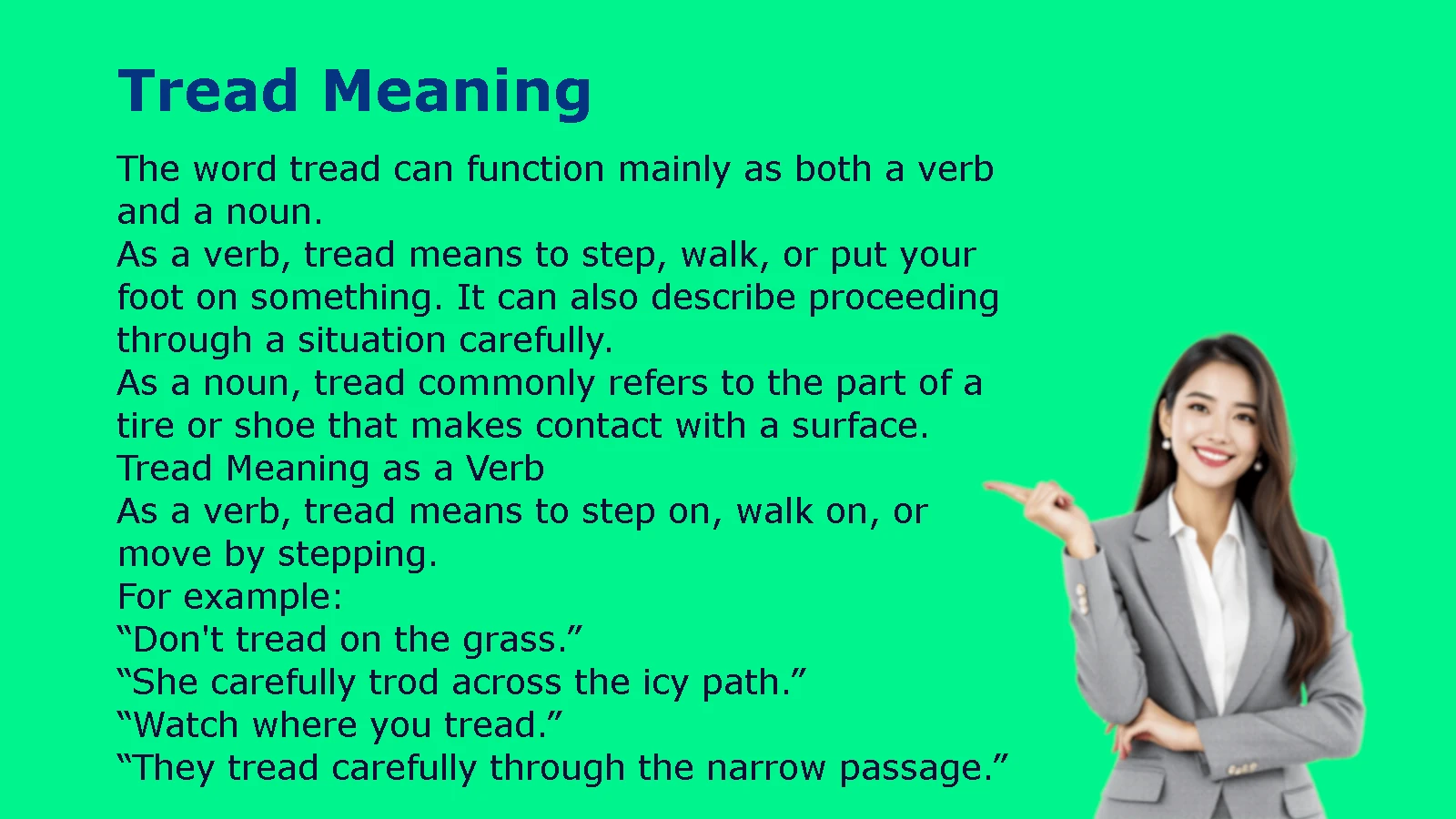
The word tread can function mainly as both a verb and a noun.
As a verb, tread means to step, walk, or put your foot on something. It can also describe proceeding through a situation carefully.
As a noun, tread commonly refers to the part of a tire or shoe that makes contact with a surface.
Tread Meaning as a Verb
As a verb, tread means to step on, walk on, or move by stepping.
For example:
- “Don’t tread on the grass.”
- “She carefully trod across the icy path.”
- “Watch where you tread.”
- “They tread carefully through the narrow passage.”
The verb can sound slightly more formal or literary than walk or step. In ordinary conversation, you would usually say, “Watch where you step.” However, tread becomes especially useful when the writer wants to emphasize how, where, or with what care someone steps.
It can also have a figurative meaning.
If someone tells you to “tread carefully” during a disagreement, they aren’t talking about your feet. They’re telling you to behave cautiously because your words or actions could create a problem.
Tread Meaning as a Noun
As a noun, tread commonly refers to a surface designed to make contact with the ground.
You’ll often hear it when discussing:
- Car tires
- Truck tires
- Bicycle tires
- Running shoes
- Hiking boots
- Work boots
- Other footwear
For example:
“These hiking boots have deep tread.”
Here, tread means the textured pattern on the bottom of the boots.
Similarly:
“The tire tread is almost completely worn.”
In this sentence, tread refers to the patterned rubber on the tire that contacts the road.
What Does Tread Mean in Simple Words?
In simple English, tread means to step or walk on something when it is used as a verb.
When it is used as a noun, tread means the part of a tire or shoe that touches the ground.
A quick way to remember it is:
Tread = step or walking surface.
| Use | Meaning | Example |
| Verb | To step or walk | “Don’t tread on the flowers.” |
| Noun | Patterned part of a tire | “The tire has worn tread.” |
| Noun | Patterned bottom of footwear | “These boots have good tread.” |
| Figurative verb | To proceed carefully | “Tread carefully with that topic.” |
This simple distinction covers most everyday uses of the word.
Tread Meaning in Different Contexts
Context matters with tread. The same word can describe a physical action, a piece of equipment, or a figurative approach to a sensitive issue.
Tread Meaning in Everyday English
In everyday English, tread often means step or walk on.
Consider:
“Please don’t tread on the flowers.”
This means:
“Please don’t step on the flowers.”
The word tread can give the sentence a slightly more deliberate feel. It emphasizes the act of placing your feet somewhere.
Another example is:
“Be careful where you tread.”
This could be a literal warning about dangerous ground.
It could also be figurative. Someone might use it when warning you about a complicated subject, political discussion, workplace conflict, or personal relationship.
Tread Meaning in Tires
In the automotive world, tread has a very specific meaning.
Tire tread is the portion of a tire’s outer surface that contacts the road. It contains grooves, channels, ribs, blocks, and other design features.
These features help a tire:
- Maintain traction
- Move water away from the contact area
- Improve braking
- Handle corners
- Maintain grip on different surfaces
- Perform under different weather conditions
The tread pattern isn’t simply decorative. Its geometry affects how the tire interacts with the road.
A tire designed for wet roads, for example, needs channels that help move water away from the contact patch. A tire designed for mud or off-road conditions may use larger and more widely spaced tread blocks to help clear mud and maintain traction.
Tread Meaning in Shoes
In footwear, tread refers to the textured pattern on the bottom of a shoe or boot.
That pattern helps provide grip.
A hiking boot may have deep, aggressive tread designed for uneven terrain. A running shoe may have a lighter pattern optimized for pavement or track surfaces. A work boot may use a tread pattern designed to provide traction on hard indoor or outdoor surfaces.
The design depends heavily on the intended use.
For example:
| Footwear | Typical tread purpose |
| Hiking boots | Grip on rocks, dirt, and uneven terrain |
| Running shoes | Traction during repeated movement |
| Work boots | Stability and grip on job-site surfaces |
| Winter boots | Grip on cold, slippery surfaces |
| Casual shoes | Everyday traction |
| Trail shoes | Grip on dirt, gravel, and uneven paths |
A shoe with worn tread may lose some of its ability to grip a surface effectively.
Tread Carefully Meaning
One of the most common figurative uses of tread appears in the expression “tread carefully.”
What Does “Tread Carefully” Mean?
Tread carefully means to act cautiously because a situation could easily cause trouble, conflict, or harm.
The expression comes from the literal idea of walking carefully across dangerous or unstable ground.
Imagine walking across a frozen lake. You wouldn’t stomp around without thinking. You’d place each foot carefully because one wrong step could cause serious trouble.
The figurative meaning works the same way.
For example:
“You should tread carefully when discussing the company’s financial problems.”
The speaker isn’t warning you about the floor. They’re warning you that the topic is sensitive.
You might hear the expression when someone is dealing with:
- A difficult coworker
- A sensitive family issue
- A controversial subject
- A workplace dispute
- A legal matter
- A fragile negotiation
- A new relationship
Examples of “Tread Carefully”
- “I’d tread carefully before making that accusation.”
- “You should tread carefully when speaking to the client.”
- “She knew she had to tread carefully around the subject.”
- “The manager is treading carefully because several employees disagree.”
- “Tread carefully; we don’t have all the facts yet.”
The phrase usually signals caution rather than fear.
Tread Lightly Meaning
Another common expression is “tread lightly.”
What Does “Tread Lightly” Mean?
Literally, tread lightly means to walk without putting much force or pressure on the ground.
Figuratively, it means to behave carefully, gently, or with limited impact.
For example:
“You should tread lightly when giving criticism.”
This means you should be thoughtful and gentle rather than harsh.
The phrase can also have an environmental meaning. Someone might say:
“We should tread lightly on the environment.”
Here, the idea is to minimize environmental damage.
This connects to broader ideas such as:
- Reducing waste
- Protecting natural areas
- Avoiding unnecessary damage
- Conserving resources
- Respecting wildlife and habitats
Tread Lightly Examples
Social context:
“Tread lightly when you bring up the disagreement.”
Workplace context:
“The new supervisor should tread lightly during the first few weeks.”
Environmental context:
“Visitors should tread lightly in protected natural areas.”
Personal context:
“He decided to tread lightly because she was already upset.”
The underlying idea is the same: don’t make a heavy impact.
Tread vs. Trod vs. Trodden
One of the trickiest parts of the word tread is its verb forms.
Is Trod the Past Tense of Tread?
Yes. Trod is a standard past-tense form of tread.
For example:
“He trod carefully across the wet floor.”
The action happened in the past, so trod is used.
Another example:
“They trod along the old road.”
This means they walked along the old road.
Is Trodden the Past Participle of Tread?
Yes. Trodden is traditionally used as the past participle of tread.
It commonly appears with auxiliary verbs such as have, has, and had.
Examples:
- “She had trodden the same path many times.”
- “The grass had been trodden flat.”
- “He has trodden this road before.”
The word trodden is especially common in literary, formal, and established expressions.
For instance, the phrase “well-trodden path” describes a path that many people have walked on. Figuratively, a well-trodden path can mean a familiar or commonly used approach.
What About “Treaded”?
You may occasionally encounter treaded, particularly in specialized or technical language.
However, when you’re talking about the traditional verb meaning “to step or walk,” trod and trodden are the forms most learners should know.
A useful grammar chart is:
| Form | Example |
| Tread | “I tread carefully.” |
| Treads | “She treads carefully.” |
| Treading | “They are treading carefully.” |
| Trod | “He trod across the field.” |
| Trodden | “They had trodden the same path.” |
Tread Synonyms
The best synonym for tread depends on the context.
Synonyms for Tread as a Verb
Common alternatives include:
- Step
- Walk
- Stomp
- Trample
- Move
- Pace
- Press
- Walk on
However, these words aren’t always interchangeable.
For example:
“Don’t tread on the flowers.”
can become:
“Don’t step on the flowers.”
But replacing tread with stomp changes the meaning because stomp suggests a forceful movement.
Similarly, trample suggests repeated or damaging stepping.
Synonyms for Tread as a Noun
When talking about tires or footwear, possible related terms include:
- Grip
- Traction
- Pattern
- Sole pattern
- Tire pattern
- Contact surface
These aren’t perfect synonyms.
For example, traction refers to the grip between a tire or shoe and a surface. Tread refers to the physical patterned portion that contributes to that grip.
That’s an important distinction.
Tread vs. Step
The words tread and step are closely related, but they’re not identical in tone or usage.
| Feature | Tread | Step |
| Basic meaning | Walk or place the foot | Put one foot down or move by foot |
| Everyday frequency | Less common | Very common |
| Formal/literary tone | Sometimes | Usually neutral |
| Tire meaning | Yes | No |
| Shoe-surface meaning | Yes | Sometimes, but not in the same technical sense |
| Figurative caution | Common | Less common in this exact sense |
For example:
“Watch where you tread.”
sounds more deliberate than:
“Watch where you step.”
Both can warn someone about where they’re putting their feet.
But tread can also refer to a physical surface:
“The tire tread is worn.”
You cannot normally replace tread with step in that sentence.
Tread vs. Walk
Walk describes movement from one place to another using your feet.
Tread can describe walking, but it often emphasizes the act of stepping or the surface being stepped on.
Compare:
“She walked through the garden.”
with:
“She tread carefully through the garden.”
The first sentence simply describes movement.
The second draws attention to the manner of movement. It suggests that she was being careful about where she placed her feet.
In everyday conversation, walk is usually the more natural choice.
In literary writing, instructions, warnings, and figurative expressions, tread can be more effective.
Tread vs. Trample
These words can overlap, but they carry different implications.
Tread can be neutral. It simply means to step or walk on something.
Trample usually suggests stepping repeatedly, forcefully, or destructively.
Compare:
“Don’t tread on the grass.”
This is a simple instruction not to step on the grass.
Now compare:
“Don’t trample the flowers.”
This suggests that stepping on the flowers could damage or crush them.
The difference is mainly about force and effect.
| Word | Typical implication |
| Tread | Step or walk on |
| Step | Place a foot on |
| Stomp | Step forcefully |
| Trample | Step on repeatedly or damage |
Common Expressions With Tread
The word tread appears in several established expressions.
Tread Carefully
Meaning: Proceed cautiously.
Example:
“Tread carefully when discussing the contract.”
This means the person should avoid careless statements or actions.
Tread Lightly
Meaning: Act gently or cautiously, often to avoid causing harm or conflict.
Example:
“Tread lightly around that subject.”
Tread on Someone’s Toes
Meaning: Interfere with someone’s responsibilities, authority, rights, or personal territory.
For example:
“I don’t want to tread on your toes, but I think we should change the plan.”
Here, the speaker isn’t literally stepping on someone’s feet. They’re saying they don’t want to interfere with the other person’s role.
This expression is particularly useful in professional settings.
A manager might say:
“I don’t want to tread on the design team’s toes.”
That means the manager doesn’t want to interfere with responsibilities that belong to the design team.
Tread on Someone
Literally, this means to step on someone.
For example:
“Be careful—you’re treading on my foot.”
Depending on context, however, it can also suggest violating someone’s boundaries or interests.
Tread Water
Tread water has a literal and figurative meaning.
Literally, it describes staying afloat in water by making movements with your arms and legs.
Figuratively, tread water means to maintain a situation without making meaningful progress.
For example:
“The company has been treading water for the past year.”
This means the company has managed to continue operating but hasn’t made significant progress.
Another example:
“I’m just treading water until I find a better job.”
The person is managing their current situation but isn’t moving toward a major improvement.
Tread Meaning in Tires
Tire tread deserves special attention because it is one of the most common technical uses of the word.
What Is Tire Tread?
Tire tread is the outer portion of a tire designed to contact the road surface.
It contains different structural elements, including:
- Grooves
- Ribs
- Tread blocks
- Channels
- Sipes on many tire designs
These components influence how the tire behaves.
A tire’s tread design is engineered for specific conditions. Passenger-car tires, performance tires, winter tires, all-terrain tires, and heavy-duty tires can have dramatically different tread patterns.
What Is Tread Depth?
Tread depth measures how much usable tread remains in the tire’s main grooves.
It is commonly measured in 32nds of an inch in the United States, although millimeters are also widely used.
A new passenger-car tire may commonly have tread depth in the general range of roughly 10/32 to 12/32 inch, although actual depth varies by tire type and manufacturer.
As tread wears down, the tire’s ability to perform in certain conditions can change.
This is especially important on wet roads. Deeper grooves generally provide more room to channel water away from the tire-road interface.
What Causes Tire Tread Wear?
Tread naturally wears as the tire contacts the road. However, uneven or accelerated wear can indicate another problem.
Common causes include:
- Underinflation
- Overinflation
- Incorrect wheel alignment
- Worn suspension components
- Improper balancing
- Aggressive acceleration
- Hard braking
- Frequent cornering
- Incorrect tire rotation
- Driving conditions
- Tire age and condition
A tire that wears mainly along its edges can suggest different conditions from one that wears heavily in the center.
Common Tire Tread Wear Patterns
| Wear pattern | Possible cause |
| Center wear | Overinflation can contribute |
| Both shoulders worn | Underinflation can contribute |
| One-sided wear | Alignment problems can contribute |
| Cupping/scalloping | Suspension or balance problems can contribute |
| Feathering | Alignment or toe-related issues can contribute |
| Uneven patches | Balance, suspension, or other mechanical issues |
These patterns are clues rather than automatic diagnoses. A professional inspection is the best way to determine the exact cause.
Tread Meaning in Shoes and Footprints
Shoe tread serves a similar basic purpose to tire tread: it creates a contact pattern that helps provide traction.
Shoe Tread
A shoe’s tread can vary significantly depending on its intended use.
A hiking boot often has deep lugs because the wearer may encounter:
- Loose dirt
- Mud
- Gravel
- Rocks
- Uneven ground
A road-running shoe may use a flatter, lighter pattern because it is designed primarily for relatively smooth surfaces.
A work boot may prioritize stable contact and resistance to slipping on the surfaces common to a particular job.
Tread Marks
A tread mark is an impression left by the patterned surface of a shoe or tire.
For example, a muddy boot may leave a recognizable tread pattern on a floor.
Tread impressions can also matter in forensic investigations. Investigators may compare an impression with the design and wear characteristics of a particular shoe or tire.
However, a tread pattern alone doesn’t automatically prove who made an impression. Investigators may consider additional factors such as size, wear, damage, individual characteristics, location, and other evidence.
Tread Meaning in Literature and Older English
The word tread has a long history in English and appears frequently in poetry, literature, religious writing, and formal prose.
You may encounter constructions such as:
- “tread upon”
- “tread the earth”
- “tread a path”
- “well-trodden path”
- “tread lightly”
These expressions can sound more poetic than ordinary conversational English.
For example, a writer might say:
“She followed a well-trodden path.”
Literally, this could describe a path used by many walkers.
Figuratively, a well-trodden path means a familiar or established approach.
The expression works because physical walking provides a clear metaphor for making choices or following established methods.
Tread Meaning in Common Sentences
The following examples show how dramatically the meaning can change with context.
| Sentence | Meaning of tread |
| “Watch where you tread.” | Watch where you step. |
| “Don’t tread on the grass.” | Don’t step on the grass. |
| “The tire has little tread left.” | The tire’s contact pattern is heavily worn. |
| “These boots have deep tread.” | The boots have a deep gripping pattern. |
| “Tread carefully around the issue.” | Proceed cautiously. |
| “Tread lightly when giving advice.” | Be gentle and careful. |
| “He trod across the field.” | He walked across the field. |
| “The grass had been trodden flat.” | People had walked over it enough to flatten it. |
| “Don’t tread on my responsibilities.” | Don’t interfere with my responsibilities. |
| “She is treading water.” | Literally, she is staying afloat; figuratively, she is making little progress. |
Tread Meaning: Grammar and Word Forms
Understanding the grammar of tread helps you use it correctly.
Tread as a Verb
The main forms are:
- Base form: tread
- Third-person singular: treads
- Present participle: treading
- Past tense: trod
- Past participle: trodden
Examples:
“I tread carefully.”
“She treads carefully.”
“They are treading carefully.”
“He trod carefully.”
“They had trodden the same path before.”
Tread as a Noun
As a noun, tread can describe a tire’s or shoe’s contact surface.
Examples:
“The tire tread is worn.”
“The boots have excellent tread.”
The plural treads may be used when referring to multiple tread surfaces or patterns in contexts where a plural is appropriate.
Tread Pronunciation
Tread is pronounced approximately like “tred.”
It is easy to confuse it with thread, especially because the spelling looks similar.
But the meanings and pronunciations are different:
- Tread: step or tire/shoe surface
- Thread: a thin strand of material, or the act of passing something through an opening
For example:
“Watch where you tread.”
is completely different from:
“The thread is too thin.”
Common Mistakes With Tread
Confusing Tread With Thread
This is one of the easiest spelling mistakes.
Tread relates to stepping, walking, tires, and footwear.
Thread usually relates to fibers, sewing, or a connected sequence of messages or ideas.
Examples:
“The tire tread is worn.”
“The thread broke while she was sewing.”
Using Tread When Walk Is More Natural
Although tread is correct, it isn’t always the most natural everyday word.
For example:
“I tread to the store every morning.”
This sounds unnatural in modern everyday English.
You would normally say:
“I walk to the store every morning.”
Tread works better when the sentence focuses on stepping, the surface being walked on, careful movement, or a figurative situation.
Confusing Tread, Trod, and Trodden
A common mistake is treating trod and trodden as interchangeable.
Compare:
Past tense:
“He trod across the field.”
Past participle:
“He had trodden across the field before.”
The auxiliary verb helps identify the construction.
Confusing Tire Tread With the Whole Tire
The tire is the entire rubber-and-structural assembly.
The tread is specifically the outer contact area designed to meet the road.
So saying “the tread is damaged” is more precise than saying “the tire is damaged” when only the contact pattern is affected.
A Practical Case Study: Understanding Tread From Context
Consider three sentences:
“The hiker checked the tread on his boots.”
Here, tread is a noun. It refers to the textured bottom of the boots.
Now consider:
“The hiker carefully trod across the slippery rocks.”
Here, trod is the past tense of the verb tread. It means he walked or stepped carefully.
Finally:
“The guide told everyone to tread carefully.”
Here, tread is a verb used figuratively. The guide is telling everyone to act cautiously.
The physical idea connects all three sentences:
feet → stepping → surface → caution
That’s the easiest way to understand why the same word appears in seemingly different contexts.
Why Tread Has So Many Meanings
At first, the different definitions of tread may seem unrelated.
But they all connect to the basic idea of contact between a foot and a surface.
From that basic concept, English developed several related uses.
A person treads when they step.
A shoe has tread where it contacts the ground.
A tire has tread where it contacts the road.
Someone can tread carefully when a situation requires caution.
Someone can tread water to stay afloat.
Someone can tread on another person’s toes by interfering with their responsibilities.
The meanings are different, but they share a common conceptual foundation.
Quick Facts About the Word Tread
Here are some useful facts to remember:
- Tread can be both a noun and a verb.
- As a verb, it can mean to step or walk on.
- As a noun, it commonly means the contact pattern of a tire or shoe.
- Trod is a standard past-tense form.
- Trodden is a traditional past participle.
- Tread carefully means to proceed cautiously.
- Tread lightly can mean to act gently or minimize impact.
- Tread water can describe staying afloat or making little progress.
- Tread on someone’s toes means to interfere with their responsibilities or territory.
- Tire tread affects traction and water management.
- Shoe tread helps provide grip on different surfaces.
- Tread is generally more formal or literary than walk when used to describe ordinary walking.
Frequently Asked Questions About Tread Meaning
What does tread mean in simple words?
Tread means to step or walk on something. As a noun, it can mean the patterned part of a tire or shoe that contacts the ground.
What does tread mean when talking about tires?
In tires, tread is the outer patterned portion that contacts the road. Its grooves and blocks help provide traction and move water away from the contact area.
What does tread mean in shoes?
Shoe tread is the patterned or textured bottom of a shoe or boot. It helps the wearer maintain grip and stability on different surfaces.
What does “tread carefully” mean?
“Tread carefully” means to act cautiously. It is often used when a topic or situation is sensitive or potentially troublesome.
What does “tread lightly” mean?
“Tread lightly” means to act gently or cautiously. It can describe physical walking, social behavior, environmental responsibility, or other situations where minimizing impact matters.
Is tread the same as walk?
Not exactly. Walk generally means moving on foot, while tread often emphasizes stepping or the surface being stepped on. Tread is also a technical noun for tire and shoe surfaces.
Is trod the past tense of tread?
Yes. Trod is a standard past-tense form of tread.
Example:
“He trod carefully across the path.”
Is trodden the past participle of tread?
Yes. Trodden is a traditional past participle of tread.
Example:
“They had trodden the path many times.”
What is the difference between tread and thread?
Tread relates to stepping, walking, tires, and footwear.
Thread can refer to a strand of material used for sewing or a connected sequence of messages or ideas.
What does “tread water” mean?
Literally, tread water means using your body movements to remain afloat without swimming forward.
Figuratively, it means maintaining your current position without making meaningful progress.
What does “tread on someone’s toes” mean?
It means interfering with someone’s responsibilities, authority, rights, or personal area of control.
For example:
“I don’t want to tread on your toes, but I’d like to suggest another approach.”
Final Takeaway: Tread Meaning
The tread meaning becomes much easier once you look at the context.
As a verb, tread means to step, walk, or place your foot on something. It can also describe moving through a sensitive situation carefully.
As a noun, tread commonly refers to the patterned surface of a tire or shoe that contacts the ground.
The word also appears in several useful expressions:
- Tread carefully = proceed cautiously
- Tread lightly = act gently or minimize impact
- Tread on someone’s toes = interfere with someone’s role or responsibilities
- Tread water = stay afloat or make little progress
When discussing grammar, remember the important forms:
tread → trod → trodden
The easiest way to remember the word is to connect all of its meanings to one central idea: stepping and contact with a surface. Once you understand that connection, whether you’re reading about a tire, a hiking boot, a difficult conversation, the meaning of tread becomes much clearer.