
Have you ever heard someone say they were “wound up” and wondered what they really meant? While Wound Up Meaning may seem simple, this phrase can describe different feelings or situations depending on the context, tone, and way it is used.
Wound up commonly means feeling very nervous, excited, tense, or unable to relax. It can also mean being very angry or upset. In another context, wound up can simply refer to something being twisted, tightened, or brought to an end.
Examples:
- I was so wound up before the interview that I couldn’t sleep.
- She got wound up after hearing the unexpected news.
The confusion is understandable. People often search for what does wound up mean, wound up meaning in text, wound up meaning in chat, or what does it mean when someone says they are wound up because the phrase can describe stress, excitement, anger, or tension. And here’s the kicker: the meaning can change based on the situation and the speaker’s tone.
In this guide, you’ll learn the complete Wound Up Meaning, its definition, pronunciation, correct usage, and examples in sentences. You’ll also discover wound up meaning in texting, how to use the phrase naturally, and the difference between wound up, worked up, stressed out, and other similar expressions.
What Does “Wound Up” Mean?
Wound up has two especially common meanings in everyday English.
| Meaning | Simple definition | Example |
| Tense or agitated | Nervous, worried, angry, or emotionally excited | “He was really wound up before the exam.” |
| Eventually ended up | Eventually arrived at or found yourself in a place, situation, or condition | “We wound up staying home.” |
Cambridge defines wound up as an adjective meaning very worried, nervous, or angry. The same dictionary also defines wind up as a phrasal verb that can mean finally being somewhere or doing something, often without originally planning to.
Merriam Webster gives the verb wind up another closely related meaning: to arrive in a particular place, situation, or condition as the result of a course of action.
So, when you see wound up, ask one simple question:
Is the sentence describing someone’s emotional state, or is it describing where something eventually ended?
That usually reveals the intended meaning immediately.
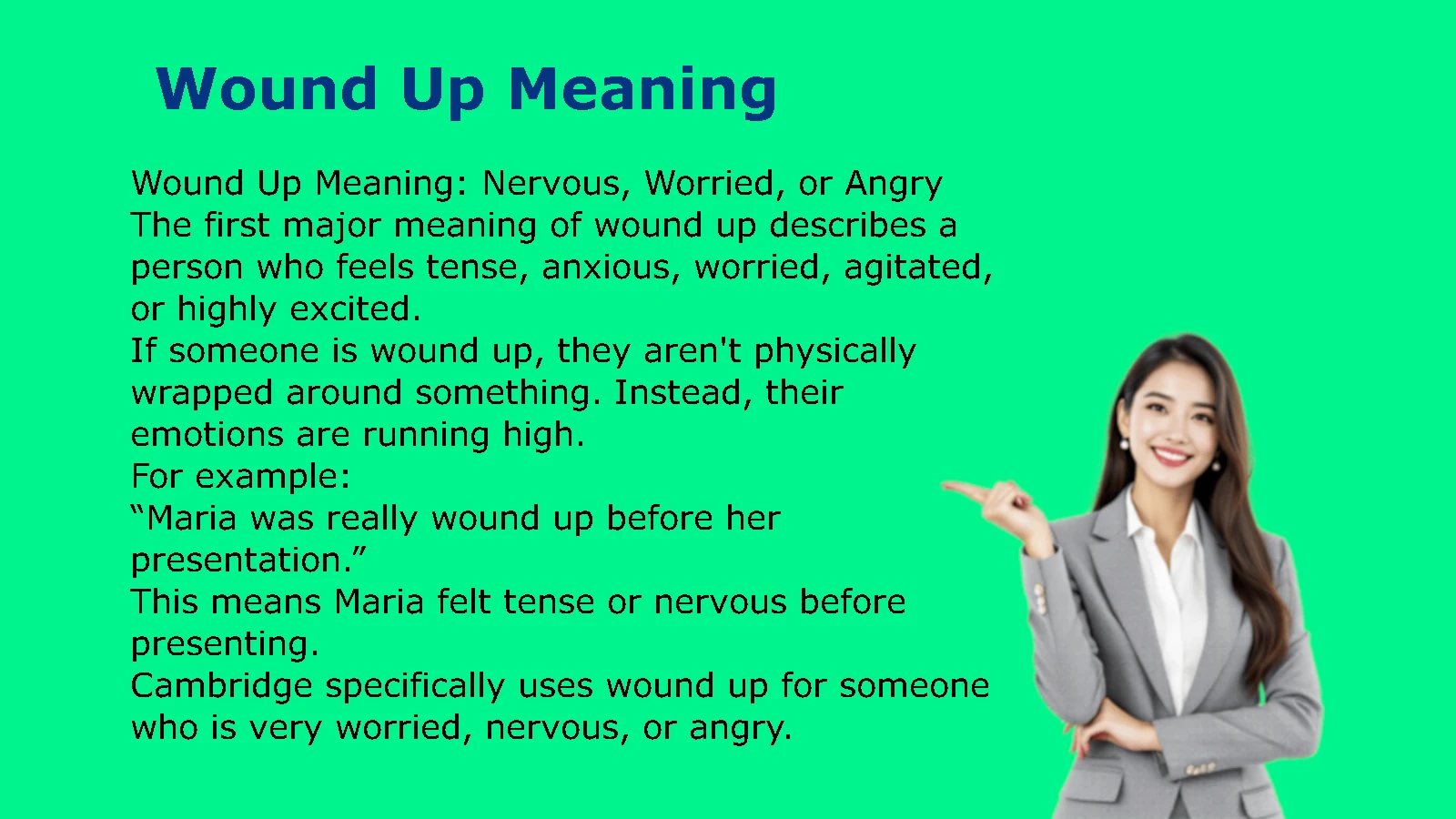
Wound Up Meaning: Nervous, Worried, or Angry
The first major meaning of wound up describes a person who feels tense, anxious, worried, agitated, or highly excited.
If someone is wound up, they aren’t physically wrapped around something. Instead, their emotions are running high.
For example:
“Maria was really wound up before her presentation.”
This means Maria felt tense or nervous before presenting.
Cambridge specifically uses wound up for someone who is very worried, nervous, or angry.
What Does “Wound Up” Mean Emotionally?
When wound up describes someone’s emotional condition, it can suggest several related feelings:
- Nervousness
- Anxiety
- Worry
- Tension
- Agitation
- Anger
- Excitement
- Restlessness
The exact emotion depends on context.
Consider these examples:
- “I was wound up before my job interview.”
→ I was nervous. - “He gets wound up whenever his team loses.”
→ He becomes upset or agitated. - “The children were completely wound up after the party.”
→ They were highly excited and unable to settle down. - “She was too wound up to sleep.”
→ She was too tense or anxious to relax.
The phrase therefore has a wider range than simply nervous.
“Wound Up” Can Describe Positive Excitement
Although wound up often carries a negative or uncomfortable feeling, context can make it closer to highly excited or overstimulated.
For example:
“The kids were wound up before Christmas morning.”
Here, the children aren’t necessarily worried or angry. They’re extremely excited and energetic.
That distinction matters. Wound up describes a heightened emotional state. The surrounding words tell you whether that energy comes from fear, anger, excitement, stress, or another strong emotion.
Wound Up Meaning “Ended Up”
The second major meaning is completely different.
Wound up can mean eventually ended up somewhere, doing something, or being in a particular situation.
This meaning comes from the phrasal verb wind up. Cambridge describes this use as finally being somewhere or doing something, especially when it wasn’t planned.
For example:
“We wound up at a coffee shop.”
This means:
“We eventually ended up at a coffee shop.”
Likewise:
“She wound up working for a nonprofit.”
This means she eventually found herself working for a nonprofit.
Merriam Webster similarly defines wind up as arriving in a place, situation, or condition at the end of a course of action.
Examples of “Wound Up” Meaning “Ended Up”
Here are several natural examples:
- “We missed the train and wound up taking a taxi.”
- “He moved several times and eventually wound up in Seattle.”
- “They started as coworkers and wound up becoming close friends.”
- “I didn’t plan to stay late, but I wound up working until midnight.”
- “She took a wrong turn and wound up in the wrong neighborhood.”
- “The discussion wound up lasting three hours.”
- “After years of traveling, he wound up living abroad.”
In each sentence, wound up points toward the eventual result.
Wound Up vs. Wound Up: How Context Changes the Meaning
The spelling stays the same, but the meaning can change dramatically.
Compare these sentences:
| Sentence | Meaning |
| “I was wound up before the test.” | I was nervous or tense. |
| “I wound up taking the test anyway.” | I eventually took the test. |
| “The children were wound up after the game.” | They were excited or agitated. |
| “We wound up at the same restaurant.” | We eventually arrived there. |
This is a good example of why English vocabulary can’t always be understood word by word. A phrase can act like a small machine whose meaning changes depending on the parts around it.
A Quick Context Test
When you encounter wound up, look at what comes next.
If it describes a person’s emotional condition, it probably means:
nervous + tense + worried + agitated
If it describes an eventual result, it probably means:
eventually + ended up + found oneself
For example:
“He was wound up about the competition.”
Emotional meaning.
“He wound up winning the competition.”
Result or outcome meaning.
That small difference in sentence structure can completely change the interpretation.
Wound Up Meaning in a Sentence
Seeing the phrase in different sentence patterns makes its uses easier to recognize.
Wound Up as an Emotional Description
Pattern:
Subject + be/get + wound up
Examples:
- “She was wound up before the meeting.”
- “Don’t get so wound up about a minor mistake.”
- “He gets wound up when people interrupt him.”
- “The players were wound up before the final.”
- “I was too wound up to concentrate.”
In these examples, wound up functions as an adjective describing a person’s state.
Wound Up as an Eventual Result
Pattern:
Subject + wound up + place/situation/action
Examples:
- “We wound up at the airport.”
- “She wound up in a difficult situation.”
- “He wound up working weekends.”
- “They wound up becoming business partners.”
- “I wound up spending more than I expected.”
This structure usually tells you what happened eventually.
Wound Up + -ing
One of the most useful patterns is:
wound up + verb-ing
For example:
- “I wound up buying the more expensive model.”
- “She wound up staying another week.”
- “They wound up canceling the trip.”
- “He wound up moving to another city.”
Here, wound up means eventually did something.
Cambridge specifically gives examples of wind up + -ing for situations in which someone eventually does something.
Wound Up + Place
You can also use wound up before a location.
Common patterns include:
- wound up at a place
- wound up in a place
- wound up somewhere
Examples:
“We wound up at a quiet beach.”
“He wound up in Chicago.”
“They wound up somewhere near the coast.”
The choice between at and in depends on the location.
Use at for a specific point, venue, or destination:
- wound up at the hotel
- wound up at the station
- wound up at a restaurant
Use in for a city, country, area, or situation:
- wound up in Boston
- wound up in Canada
- wound up in trouble
- wound up in debt
Wound Up vs. Ended Up
Wound up and ended up often overlap when they describe an eventual result.
Compare:
“We ended up staying home.”
“We wound up staying home.”
Both mean that staying home became the eventual outcome.
However, ended up is generally the more straightforward choice when you simply want to describe a final result. Wound up can feel slightly more conversational or narrative in many contexts.
Comparison Table
| Phrase | Core idea | Example |
| ended up | Eventually became or did something | “She ended up staying.” |
| wound up | Eventually became or did something | “She wound up staying.” |
| finished | Completed something | “She finished the project.” |
| concluded | Brought something to an end | “The meeting concluded.” |
| wrapped up | Finished something, often informally | “We wrapped up the meeting.” |
Merriam Webster lists ended, finished, concluded, wrapped up, closed, completed, and other words among the synonyms associated with the ending sense of wound up.
However, these words aren’t interchangeable in every sentence.
For example:
“We wound up in Denver.”
You can’t naturally replace wound up with finished:
“We finished in Denver.”
That sentence could mean something entirely different, such as completing a race in Denver.
Wound Up vs. Wound Down
Wound up and wound down can describe opposite directions of energy or activity.
When someone is wound up, they may feel energetic, nervous, excited, or agitated.
When someone winds down, they gradually become calmer or an activity gradually approaches its end.
Compare:
“The children were wound up after the party.”
“The children slowly wound down after they got home.”
The first sentence describes high energy. The second describes a gradual return to calm.
The same contrast works with activities:
- The meeting wound up. → It ended.
- The meeting wound down. → It gradually became less active before ending.
Be careful, though. Wound up has several meanings, while wound down generally focuses on reducing activity, intensity, or operation.
Is “Wound Up” Past Tense?
Yes, when wound up comes from the verb wind up, it is the past tense and past participle form of wind up.
The verb changes like this:
| Form | Example |
| wind up | “We may wind up staying.” |
| winds up | “She often winds up working late.” |
| winding up | “They are winding up the meeting.” |
| wound up | “They wound up staying late.” |
Merriam Webster lists wound up as a form of wind up.
This can feel strange because the spelling wound also appears in the noun and verb related to an injury.
That brings us to pronunciation.
How Do You Pronounce “Wound Up”?
When wound up comes from wind up, it is pronounced approximately:
/waʊnd ʌp/
The first word sounds like “wownd.”
It does not sound like the pronunciation of wound meaning an injury.
Compare:
| Word | Meaning | Pronunciation |
| wound | An injury | /wuːnd/ |
| wound | Past tense of wind | /waʊnd/ |
| wound up | Past form of wind up | /waʊnd ʌp/ |
Cambridge gives wound up the pronunciation /waʊnd ʌp/ and distinguishes it from the separate word wound.
The key is the verb wind.
When wind means to turn, twist, or wrap something, it is pronounced /waɪnd/.
Its past form is wound, pronounced /waʊnd/.
For example:
“I wind the clock.”
“I wound the clock yesterday.”
That same verb produces:
“We wind up at the station.”
“We wound up at the station.”
English spelling occasionally likes to throw a curveball. This is one of those cases.
Synonyms for Wound Up
The best synonym depends on which meaning you intend.
Synonyms for Wound Up Meaning Nervous or Tense
When wound up describes someone’s emotional state, useful alternatives include:
- Nervous
- Anxious
- Worried
- Tense
- Agitated
- Stressed
- Uptight
- Restless
- Excited
- Overexcited
- Worked up
- On edge
Examples:
“She was wound up before the interview.”
Possible alternatives:
- “She was nervous before the interview.”
- “She was anxious before the interview.”
- “She was tense before the interview.”
- “She was on edge before the interview.”
These words aren’t exact substitutes in every context. Angry, nervous, and excited describe different emotions, while wound up can cover several of them depending on the situation.
Synonyms for Wound Up Meaning Ended Up
When wound up means reaching an eventual result, alternatives include:
- Ended up
- Eventually became
- Eventually did
- Found oneself
- Landed
- Arrived at
- Finished up
- Ultimately became
- Eventually found oneself
For example:
“We wound up at the airport.”
You could say:
“We ended up at the airport.”
Or:
“We eventually found ourselves at the airport.”
The first alternative sounds the most natural in ordinary conversation.
Common Expressions With Wound Up
Certain patterns appear frequently in everyday English.
Get Wound Up
Get wound up means to become nervous, angry, excited, or agitated.
Examples:
- “Don’t get wound up over a small mistake.”
- “He gets wound up whenever traffic is bad.”
- “She got wound up before the competition.”
The phrase focuses on the change of emotional state.
Be Wound Up
Be wound up describes someone who is already in that heightened state.
Examples:
- “I’m too wound up to sleep.”
- “He was wound up after the argument.”
- “They were wound up before the big announcement.”
Wound Up Doing Something
This pattern means eventually did something.
Examples:
- “We wound up ordering pizza.”
- “She wound up accepting the offer.”
- “He wound up moving closer to his family.”
This is one of the clearest signs that wound up means ended up rather than became nervous.
Other Meanings Related to “Wind Up”
The phrase wind up has additional meanings beyond the two everyday uses discussed above.
To Finish Something
Wind something up can mean to bring an activity to an end.
For example:
“Let’s wind up the meeting.”
That means:
“Let’s finish the meeting.”
Cambridge defines wind something up as ending an activity and gives meetings and discussions as examples.
To Close a Business or Organization
In business and legal contexts, wind up can mean formally closing a business or organization.
For example:
“The company was wound up after accumulating significant debts.”
This use is more formal than the everyday conversational meaning.
Cambridge notes that wind up can refer to closing a business, while its Business English definition specifically covers formally ending a company’s operations.
So don’t assume every occurrence of wound up refers to someone’s emotions or an unexpected destination.
Usage Cases: How Context Determines the Meaning
Instead of memorizing dozens of definitions, look at how the phrase behaves in real sentences.
Usage Case: Before an Important Event
“I was really wound up before the interview.”
Meaning: nervous or tense.
The phrase describes an emotional state.
Usage Case: An Unexpected Destination
“We took a wrong turn and wound up in another town.”
Meaning: eventually arrived in another town.
The phrase describes the result of a sequence of events.
Usage Case: High Energy
“The kids were wound up after the game.”
Meaning: excited, energetic, or agitated.
The phrase describes behavior and emotional intensity.
Usage Case: An Unplanned Decision
“I went to the store for milk and wound up buying a new jacket.”
Meaning: eventually bought a jacket, even though that wasn’t the original plan.
This example captures one of the most useful shades of wound up: an outcome that develops along the way.
Usage Case: A Final Result
“After years of studying, she wound up becoming a teacher.”
Meaning: she eventually became a teacher.
Here, wound up emphasizes the final outcome of a longer process.
Wound Up vs. Wound: Don’t Confuse the Words
The spelling can create confusion because wound has two common pronunciations and different meanings.
Wound as an Injury
In:
“He has a wound on his arm.”
Wound refers to an injury and sounds like “woond.”
Wound as the Past Tense of Wind
In:
“She wound the thread around the spool.”
Wound is the past tense of wind and sounds like “wownd.”
That second meaning gives us wound up:
“We wound up staying late.”
The phrase isn’t related to an injury.
This distinction becomes especially important for English learners because the spelling alone doesn’t tell you how to pronounce the word.
How to Use “Wound Up” Correctly
The easiest way to use the phrase correctly is to identify which grammatical pattern you’re using.
Use “Wound Up” for an Emotional State
Use:
be/get + wound up
Examples:
- “She was wound up.”
- “He got wound up.”
- “Don’t get wound up.”
- “They were wound up after the argument.”
Use “Wound Up” for an Eventual Action
Use:
wound up + verb-ing
Examples:
- “I wound up staying.”
- “She wound up buying it.”
- “They wound up leaving early.”
Use “Wound Up” for an Eventual Place or Situation
Use:
wound up + in/at + place or situation
Examples:
- “We wound up in New York.”
- “He wound up at the wrong hotel.”
- “She wound up in a difficult situation.”
- “They wound up at the same restaurant.”
Common Mistake: Using the Wrong Verb Form
Because wind up is a phrasal verb, learners sometimes struggle with its forms.
Correct:
“We wound up staying.”
Not:
“We winded up staying.”
Merriam Webster notes that wound up is the standard past form, although dictionaries also record winded up as a variant.
For standard everyday writing, wound up is the safer and more widely recognized form.
Is “Wound Up” Formal or Informal?
The answer depends on the meaning.
Wound up meaning nervous, tense, or agitated is conversational and informal.
For example:
“He was pretty wound up before the game.”
In a formal report, you might instead write:
“He appeared highly anxious before the game.”
The ended up meaning is also common in ordinary conversation and informal writing:
“We wound up staying until midnight.”
In formal writing, alternatives such as ultimately, eventually, or finally may sometimes fit better.
However, wound up isn’t inherently incorrect in formal prose. Context and tone matter.
Quick Reference: Wound Up Meaning
| Question | Answer |
| What does wound up mean? | It can mean nervous, tense, worried, or agitated, or it can mean eventually ended up somewhere or doing something. |
| Does wound up mean nervous? | Yes. As an adjective, it can describe someone who is very nervous, worried, or angry. |
| Does wound up mean ended up? | Yes. As the past form of wind up, it can mean eventually arrived at, became, or did something. |
| What does wound up doing mean? | It means eventually did something. |
| How is wound up pronounced? | Usually /waʊnd ʌp/ when it comes from wind up. |
| Is wound up past tense? | Yes. It is the past tense and past participle form of wind up. |
| What is a synonym for wound up? | Depending on context: nervous, tense, anxious, agitated, ended up, or eventually became. |
| What is the opposite of wound up emotionally? | Calm, relaxed, settled, or composed. |
| What is the opposite of wound up as an eventual result? | There isn’t one exact opposite, but began, started, or set out may contrast in certain contexts. |
Frequently Asked Questions About Wound Up Meaning
What does “wound up” mean in slang?
In informal English, wound up can mean very nervous, tense, excited, angry, or agitated.
For example:
“He’s getting wound up about the argument.”
It can also mean ended up, particularly in conversational English:
“We wound up staying for another hour.”
Does “wound up” mean nervous?
Yes. When wound up functions as an adjective describing a person, it can mean nervous, worried, tense, angry, or agitated. Cambridge specifically defines the adjective this way.
Does “wound up” mean “ended up”?
Yes. Wound up is the past form of wind up, which can mean eventually reaching a particular place, situation, condition, or result.
For example:
“We wound up at home.”
This means:
“We ended up at home.”
What is another word for “wound up”?
There isn’t one universal synonym because the phrase has multiple meanings.
For the emotional meaning, try:
- Nervous
- Anxious
- Tense
- Agitated
- Worried
- Worked up
For the eventual-result meaning, try:
- Ended up
- Eventually became
- Ultimately did
- Found oneself
What is the difference between “wound up” and “ended up”?
They can mean the same thing when describing an eventual outcome.
“We wound up at home.”
“We ended up at home.”
Both mean that home became the final destination.
However, wound up has another important meaning that ended up doesn’t have:
“She was wound up before the exam.”
Here, wound up means nervous or tense.
What does “wound up doing” mean?
Wound up doing means eventually did something, often when that wasn’t the original plan.
For example:
“I wound up working late.”
This means:
“I eventually worked late.”
What does “get wound up” mean?
Get wound up means become tense, nervous, angry, excited, or agitated.
For example:
“Don’t get wound up over a small mistake.”
The speaker is telling someone not to become overly upset or tense.
Is “wound up” the same as “worked up”?
They can overlap when they describe an emotional state.
“He was worked up about the argument.”
“He was wound up about the argument.”
Both can suggest that he was emotionally agitated.
However, worked up more strongly suggests emotional upset or agitation, while wound up can also suggest nervousness, worry, or high excitement.
Is “wound up” the same as “wound down”?
No. They can point in opposite directions.
Wound up can describe heightened energy or tension.
Wound down generally describes a gradual reduction in activity or intensity.
For example:
“The children were wound up after the party.”
“They wound down before bedtime.”
Final Takeaway: Wound Up Meaning
The phrase wound up has two major everyday meanings worth remembering.
First, it can describe an emotional state:
wound up = nervous, worried, tense, angry, excited, or agitated
Second, it can describe an eventual outcome:
wound up = eventually ended up, arrived at, became, or did something
The surrounding sentence usually tells you which meaning applies.
If someone is wound up, think emotion.
If someone wound up doing something or wound up somewhere, think eventual result.
That simple distinction clears up most confusion around the phrase. Once you recognize the pattern, wound up becomes much easier to understand, pronounce, and use naturally.