
Have you ever read the phrase “isn’t” in a message and wondered exactly what it means or why it is used that way? While ISN’T Meaning may seem simple, this common contraction can have different meanings depending on the sentence, tone, and context in which it appears.
Isn’t is the contraction of “is not.” It is commonly used to show that something is not true, does not exist, or does not have a certain quality. You’ll often see it in everyday conversations, texts, emails, social media posts, and spoken English.
Examples:
- Isn’t this your book?
- She isn’t feeling well today.
The confusion is understandable. People often search for what does isn’t mean, isn’t meaning in text, isn’t meaning in chat, or how to use isn’t in a sentence because this small word can serve different purposes. And here’s the interesting part: “isn’t” can change the tone of a sentence from a simple statement to a question, doubt, or even surprise.
What Does “Isn’t” Mean?
Isn’t is a contraction of is not.
In simple terms:
is + not = isn’t
The contraction carries the same basic meaning as the two word form is not. Cambridge Dictionary defines isn’t as the short form of is not, while Merriam Webster identifies it as a contraction meaning is not.
Consider these examples:
- She isn’t at home. = She is not at home.
- The food isn’t ready. = The food is not ready.
- He isn’t my brother. = He is not my brother.
- This isn’t difficult. = This is not difficult.
- The store isn’t open. = The store is not open.
The meaning stays the same when you expand the contraction.
| Contraction | Full form | Basic meaning |
| isn’t | is not | A negative form of is |
| isn’t here | is not here | Not present here |
| isn’t ready | is not ready | Not ready |
| isn’t mine | is not mine | Does not belong to me |
| isn’t true | is not true | Not true |
The main difference between isn’t and is not usually involves style, emphasis, or rhythm rather than meaning.
What Is the Full Form of “Isn’t”?
The full form of isn’t is is not.
The apostrophe marks the contraction. It shows that letters have been omitted when the two words combine.
Is + Not = Isn’t
The basic formation looks like this:
is + not → isn’t
The apostrophe appears where part of the original form has been removed.
You can see the same general pattern in other English contractions:
- does not → doesn’t
- has not → hasn’t
- was not → wasn’t
- were not → weren’t
- cannot → can’t
- will not → won’t
However, each contraction has its own spelling pattern. Don’t assume that every contraction follows exactly the same rule.
For example, will not becomes won’t, not willn’t. English has plenty of quirks like that.
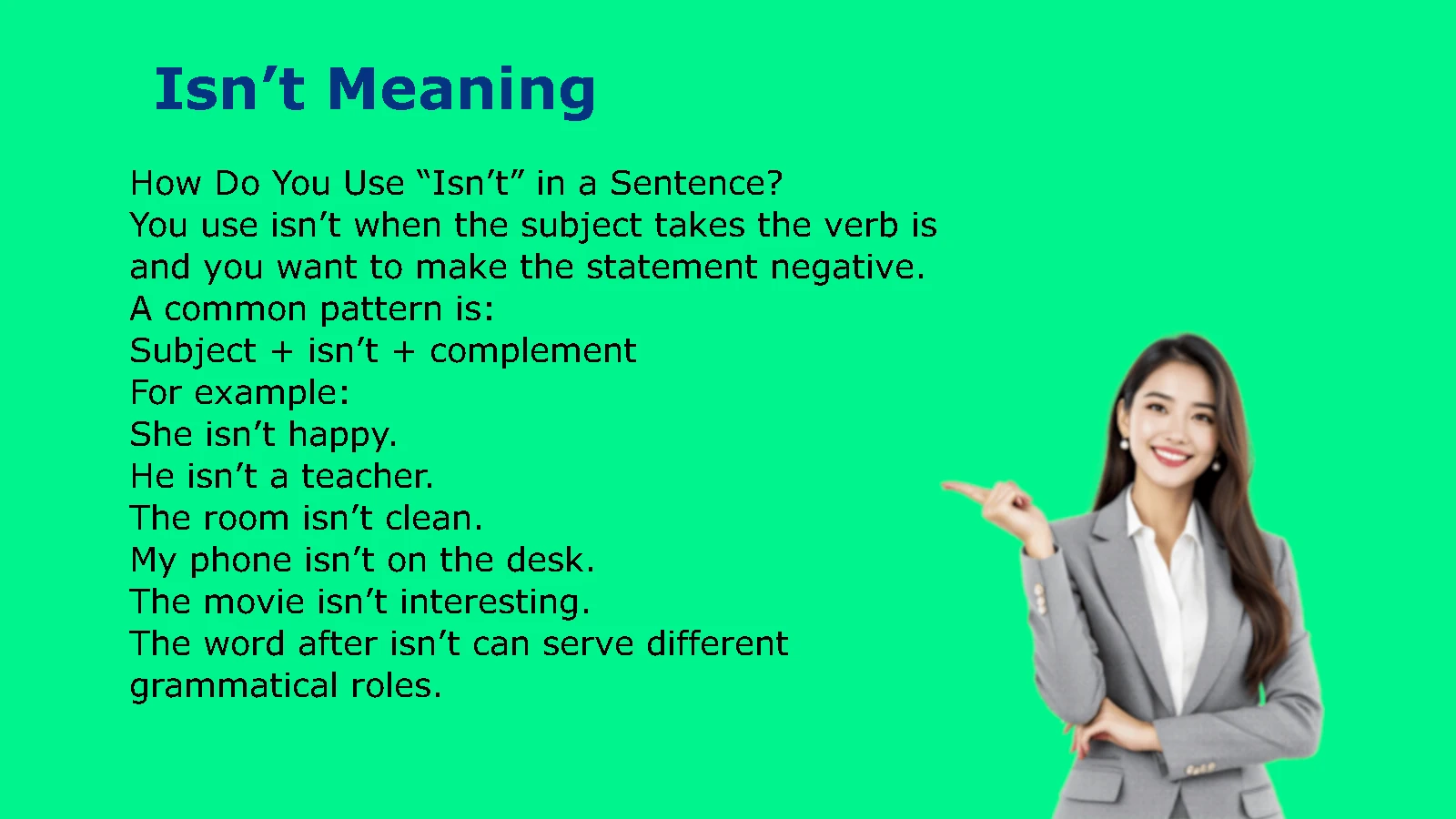
How Do You Use “Isn’t” in a Sentence?
You use isn’t when the subject takes the verb is and you want to make the statement negative.
A common pattern is:
Subject + isn’t + complement
For example:
- She isn’t happy.
- He isn’t a teacher.
- The room isn’t clean.
- My phone isn’t on the desk.
- The movie isn’t interesting.
The word after isn’t can serve different grammatical roles.
Isn’t With Adjectives
You can place an adjective after isn’t to describe a negative state or quality.
Examples:
- The test isn’t easy.
- She isn’t angry.
- The water isn’t cold.
- This explanation isn’t clear.
- The house isn’t large.
Here, isn’t connects the subject with an adjective.
Compare:
The test is easy.
with:
The test isn’t easy.
The second sentence simply negates the description.
Isn’t With Nouns
You can also use isn’t before a noun or noun phrase.
Examples:
- He isn’t a doctor.
- She isn’t my teacher.
- That isn’t the answer.
- This isn’t your book.
- John isn’t the manager.
In these sentences, isn’t tells the reader that the subject doesn’t belong to the category or identity described after it.
Isn’t With Places and Locations
Isn’t can show that someone or something isn’t in a particular location.
Examples:
- Sarah isn’t at work.
- The car isn’t in the garage.
- My wallet isn’t on the table.
- He isn’t here.
- The restaurant isn’t nearby.
The negative meaning comes from is not.
For instance:
He isn’t here.
means:
He is not here.
Isn’t With Present Participles
You can use isn’t with an -ing form to make the present progressive negative.
Examples:
- He isn’t sleeping.
- She isn’t working today.
- They aren’t coming.
- The computer isn’t working.
- The baby isn’t crying.
Notice the difference between these two structures:
He isn’t tired.
Here, tired describes his condition.
He isn’t sleeping.
Here, sleeping describes an action in progress.
Examples of “Isn’t” in Sentences
Seeing isn’t in different contexts makes its meaning much easier to understand.
Simple Everyday Examples
- This isn’t my phone.
- She isn’t home yet.
- The coffee isn’t hot.
- He isn’t ready.
- That isn’t fair.
- It isn’t raining.
- The door isn’t locked.
- My brother isn’t here.
- This isn’t the right address.
- The movie isn’t over.
Examples in Conversation
A: Is Sarah at the office?
B: No, she isn’t.
The second speaker doesn’t need to repeat the entire sentence. The context makes the meaning clear:
She isn’t at the office.
Another example:
A: Is this your bag?
B: No, it isn’t.
Again, isn’t means is not.
Examples in Work and School
- The report isn’t finished yet.
- This answer isn’t correct.
- The meeting isn’t today.
- The document isn’t complete.
- The assignment isn’t difficult.
- The teacher isn’t available right now.
These examples show why isn’t appears so often in practical communication. It lets you reject, correct, or qualify information quickly.
What Does “Isn’t” Mean in a Question?
Isn’t can appear at the beginning of a question.
In that position, the speaker often expects confirmation or believes the answer may be yes.
Examples include:
- Isn’t she your sister?
- Isn’t this your car?
- Isn’t he coming with us?
- Isn’t today your birthday?
- Isn’t that the restaurant we visited?
- Isn’t this a better option?
Consider:
Isn’t this your book?
The speaker isn’t necessarily asking from scratch. They may already suspect that the book belongs to you and simply want confirmation.
The question can therefore carry a slightly different conversational feeling from:
Is this your book?
The first question may suggest:
“I believe this is your book. Am I right?”
The second sounds more neutral.
Why Context Matters
The exact conversational meaning depends on tone and context.
For example:
Isn’t he coming?
could mean:
- “I thought he was coming. Did I misunderstand?”
- “I expected him to come. Why isn’t he here?”
- “Please confirm whether he is coming.”
The grammar stays the same, but the speaker’s intention can change.
What Does “Isn’t It?” Mean?
“Isn’t it?” commonly appears as a question tag or as part of a confirmation question.
For example:
It’s a beautiful day, isn’t it?
The speaker has already made a statement:
It’s a beautiful day.
Then “isn’t it?” invites the listener to agree or confirm it.
Other examples include:
- It’s cold today, isn’t it?
- That was a great movie, wasn’t it?
- This is your book, isn’t it?
- The view is amazing, isn’t it?
However, isn’t it? doesn’t always stand alone as a simple question.
Consider:
Isn’t it strange how quickly time passes?
Here, isn’t it strange introduces an observation. The speaker is expressing surprise and inviting agreement.
Cambridge includes examples such as “It’s rather cold today, isn’t it?”, illustrating this common conversational use.
“Isn’t” vs. “Is Not”
The words isn’t and is not have the same basic meaning.
The main difference is tone and emphasis.
| Isn’t | Is not |
| Contracted form | Full form |
| Common in conversation | Common in formal or emphatic contexts |
| Usually sounds natural and relaxed | Can sound more deliberate |
| “The answer isn’t correct.” | “The answer is not correct.” |
Compare these examples:
The door isn’t open.
This sounds natural and conversational.
The door is not open.
This can sound more deliberate or emphatic.
A speaker might emphasize not to correct someone:
“No, the door is NOT open.”
The full form can therefore carry extra emphasis even though the dictionary meaning remains the same.
Collins describes isn’t as the usual spoken form of is not, which reflects how common the contraction is in everyday English.
“Isn’t” vs. “It’s Not”
These forms can look confusing because both can express a negative statement involving it is.
Consider:
- It isn’t cold.
- It’s not cold.
Both mean:
It is not cold.
The difference lies in which part has been contracted.
It Isn’t
It isn’t cold.
Here, isn’t represents is not.
It’s Not
It’s not cold.
Here, it’s represents it is, while not remains separate.
So:
it isn’t = it is not
and:
it’s not = it is not
In many everyday sentences, both versions are perfectly natural.
Merriam Webster defines it’s as a contraction of it is or it has, which makes its distinction from isn’t important.
“Isn’t” vs. “It’s”
These two words are especially easy to confuse.
Isn’t
Isn’t = is not
Example:
The dog isn’t hungry.
Meaning:
The dog is not hungry.
It’s
It’s = it is or it has
Examples:
It’s cold.
= It is cold.
It’s been a long day.
= It has been a long day.
The apostrophe doesn’t make it’s mean the same thing as isn’t.
| Word | Meaning | Example |
| isn’t | is not | The cat isn’t outside. |
| it’s | it is | It’s outside. |
| it’s | it has | It’s been outside all morning. |
| its | possessive form of it | The cat cleaned its paws. |
“Isn’t” vs. “Its”
The difference between isn’t and its is even more important because removing the apostrophe changes the word completely.
Isn’t Means “Is Not”
The dog isn’t hungry.
= The dog is not hungry.
Its Shows Possession
The dog wagged its tail.
Here, its means that the tail belongs to the dog.
Compare:
- The company isn’t changing its policy.
- Its policy isn’t changing.
The first sentence contains both isn’t and its, but they perform different jobs.
Isn’t creates a negative verb form.
Its shows possession.
“Isn’t” vs. “Aren’t”
Both isn’t and aren’t create negative forms of the verb be, but they normally go with different subjects.
Isn’t = is not
Aren’t = are not
Examples:
- He isn’t ready.
- She isn’t here.
- The car isn’t working.
- They aren’t ready.
- We aren’t late.
- The cars aren’t working.
| Subject | Correct form | Example |
| He | isn’t | He isn’t ready. |
| She | isn’t | She isn’t here. |
| It | isn’t | It isn’t broken. |
| They | aren’t | They aren’t ready. |
| We | aren’t | We aren’t late. |
| You | aren’t | You aren’t wrong. |
There is one familiar special case worth knowing: aren’t I? is commonly used as a question tag for I am, as in:
I’m early, aren’t I?
Merriam Webster specifically records aren’t as are not and notes its use in questions such as “I’m right, aren’t I?”
“Isn’t” vs. “Wasn’t”
The difference here is mainly about time.
Isn’t = is not
Wasn’t = was not
Use isn’t for a present state or situation:
- She isn’t tired.
- He isn’t at school.
- The room isn’t clean.
Use wasn’t for a past state or situation:
- She wasn’t tired yesterday.
- He wasn’t at school yesterday.
- The room wasn’t clean this morning.
| Present | Past |
| She isn’t here. | She wasn’t here. |
| It isn’t cold. | It wasn’t cold. |
| He isn’t ready. | He wasn’t ready. |
| The store isn’t open. | The store wasn’t open. |
Merriam Webster defines wasn’t as the contraction of was not.
How Do You Pronounce “Isn’t”?
In US English, isn’t is commonly pronounced:
/ˈɪzənt/
An easy approximation for English learners is:
IZ-uhnt
Cambridge lists the US pronunciation as /ˈɪz.ənt/ and breaks it into sounds corresponding roughly to “iz-uhnt.”
Is “Isn’t” One or Two Syllables?
In standard dictionary pronunciation, isn’t has two syllables:
iz-uhnt
The first syllable sounds like the beginning of is.
The second contains a weak vowel followed by nt.
In fast conversation, however, sounds can become less distinct. Regional accents can also change the pronunciation slightly. Collins notes that some speakers in parts of the Southern and South Midland United States pronounce the middle consonant differently, producing a pronunciation closer to “id-nt.”
That variation doesn’t change the word’s meaning.
Is “Isn’t” Formal or Informal?
Isn’t is standard English. It isn’t slang, and it isn’t grammatically wrong.
People use it in everyday conversations, emails, articles, books, educational writing, and many other forms of communication.
However, is not can sometimes sound more formal or more emphatic.
Compare:
The information isn’t accurate.
with:
The information is not accurate.
The first sounds relaxed and natural.
The second can sound more deliberate, especially when the speaker wants to stress not.
When Should You Use “Isn’t”?
Use isn’t when you want natural, concise English.
For example:
- Casual conversation
- Everyday emails
- Friendly messages
- General online writing
- Dialogue
- Most ordinary prose
When Might “Is Not” Be Better?
Use is not when you want emphasis or when a particular formal style favors the full form.
For example:
This is not acceptable.
The full form makes the negative statement feel firm.
That doesn’t mean “This isn’t acceptable” is incorrect. It simply creates a slightly different rhythm and emphasis.
Common Mistakes With “Isn’t”
Most errors involving isn’t come from spelling, apostrophes, or confusion with similar words.
Writing “Isnt” Without an Apostrophe
Incorrect:
She isnt ready.
Correct:
She isn’t ready.
The apostrophe is part of the standard spelling.
Confusing “Isn’t” With “Its”
Incorrect:
The dog isnt eating because its tired.
Correct:
The dog isn’t eating because it’s tired.
Here, isn’t means is not, while it’s means it is.
If the sentence were:
The dog wagged its tail.
then its would show possession.
Confusing “Isn’t” With “It’s Not”
These forms can both be correct:
- It isn’t raining.
- It’s not raining.
Don’t treat one as grammatically correct and the other as grammatically wrong. They are different contractions that can express the same basic sentence meaning.
Using “Isn’t” With a Plural Subject
For standard English, don’t use isn’t with an ordinary plural subject.
Incorrect:
They isn’t ready.
Correct:
They aren’t ready.
Likewise:
Incorrect:
The students isn’t here.
Correct:
The students aren’t here.
The subject determines whether you need is or are.
Can “Isn’t” Be Used in Formal Writing?
Yes. Isn’t is grammatically acceptable in formal writing.
The real issue is style, not correctness.
Some academic, legal, institutional, or professional contexts may favor fewer contractions. In those situations, is not may fit the preferred style better.
For example:
The evidence isn’t sufficient to support the conclusion.
could become:
The evidence is not sufficient to support the conclusion.
The second version sounds more formal and deliberate.
However, there is no universal grammatical rule saying that contractions such as isn’t are forbidden in formal writing.
The appropriate choice depends on the publication, institution, audience, and purpose.
“Isn’t” in Everyday Conversation
You will hear isn’t constantly in natural English.
It can:
- Negate a statement
- Correct information
- Express disagreement
- Ask for confirmation
- Show surprise
- Introduce an observation
- Describe a current condition
- Say that someone or something isn’t present
Consider these short exchanges.
Example: Correcting Information
A: Mark is the manager, right?
B: No, he isn’t. Sarah is the manager.
Here, isn’t directly rejects the assumption.
Example: Confirming Information
A: Isn’t this your jacket?
B: Yes, it is.
The speaker expects the jacket may belong to the listener.
Example: Expressing Surprise
Isn’t it amazing how quickly children grow?
Here, isn’t isn’t simply delivering a negative fact. It helps form a rhetorical question that invites agreement.
Example: Describing a Condition
The printer isn’t working.
This tells someone that the printer currently fails to operate.
A single contraction can carry a surprising amount of conversational work.
A Practical Case Study: Understanding “Isn’t” in Context
Imagine a student walks into class and sees an empty seat.
The student asks:
“Isn’t Daniel here today?”
The question suggests that the student expected Daniel to be present.
The teacher replies:
“No, he isn’t.”
That short answer means:
“No, he is not here today.”
Now imagine a different conversation:
“Daniel is here today, isn’t he?”
This has a different structure. The speaker makes a statement first and then adds isn’t he? as a question tag.
The meaning is roughly:
“Daniel is here today. I believe that’s true. Do you agree?”
What This Case Shows
The word isn’t itself still means is not. What changes is its position and function in the sentence.
| Sentence | Function of isn’t |
| Daniel isn’t here. | Makes a statement negative |
| Isn’t Daniel here? | Forms a negative question |
| Daniel is here, isn’t he? | Forms a question tag |
| It isn’t true. | Negates a description |
| It isn’t working. | Negates an ongoing state or action |
This distinction matters because dictionary definitions tell you what a word means, but context tells you what the speaker is doing with it.
Can “Isn’t” Mean Something Other Than “Is Not”?
At its core, isn’t means “is not.” That remains true even when its conversational function changes.
For example:
Isn’t she beautiful?
Literally, the structure is similar to:
Is she not beautiful?
But a natural speaker usually isn’t asking for a complicated grammatical judgment. The speaker may be expressing admiration and inviting agreement.
Likewise:
Isn’t that interesting?
often communicates something like:
“That is interesting, don’t you think?”
So the dictionary meaning remains stable, while the pragmatic meaning can shift with tone, context, and sentence structure.
That’s an important distinction for English learners.
Is “Isn’t” a Contraction?
Yes. Isn’t is a contraction.
A contraction combines two words into a shorter form, usually with an apostrophe marking omitted letters.
Examples include:
- is not → isn’t
- are not → aren’t
- was not → wasn’t
- were not → weren’t
- has not → hasn’t
- have not → haven’t
- does not → doesn’t
Merriam Webster identifies isn’t specifically as a contraction and records its first known use as 1608.
That historical date doesn’t change modern usage, but it shows that isn’t has been part of written English for centuries.
Is “Isn’t” the Same as “Ain’t”?
No.
Although ain’t can sometimes represent am not, are not, or is not in informal English, it isn’t simply another standard spelling of isn’t.
For example:
He isn’t ready.
is standard English.
He ain’t ready.
is informal and belongs to different usage patterns and varieties of English.
Merriam Webster describes ain’t as an informal form that can represent several negative constructions, including is not.
Therefore, don’t replace isn’t with ain’t in formal or standard English writing just because both can sometimes express a negative form of be.
Quick Guide to “Isn’t” Grammar
Here’s the whole concept at a glance:
| Feature | Answer |
| Word | isn’t |
| Full form | is not |
| Type | Contraction |
| Main function | Forms a negative with is |
| US pronunciation | /ˈɪzənt/ |
| Common spelling mistake | isnt |
| Related contraction | aren’t |
| Past equivalent | wasn’t |
| Example | She isn’t ready. |
| Question example | Isn’t she ready? |
| Question tag | She’s ready, isn’t she? |
“Isn’t” Meaning: Quick Comparison With Similar Words
Because contractions can look alike, this comparison is useful.
| Word | Full form or meaning | Example |
| isn’t | is not | He isn’t here. |
| is not | Full form of isn’t | He is not here. |
| it’s | it is / it has | It’s cold. |
| its | Possessive form of it | The dog ate its food. |
| aren’t | are not | They aren’t here. |
| wasn’t | was not | He wasn’t here. |
| doesn’t | does not | She doesn’t agree. |
| hasn’t | has not | He hasn’t arrived. |
| ain’t | Informal negative form with several uses | He ain’t ready. |
The safest approach is simple: expand the contraction when you’re unsure.
If the sentence works with “is not,” then isn’t is probably the form you need.
Frequently Asked Questions About “Isn’t” Meaning
What does “isn’t” mean?
Isn’t means “is not.” It is the standard contraction of the verb is and the negative word not.
What is the full form of “isn’t”?
The full form is is not.
For example:
She isn’t happy.
means:
She is not happy.
Is “isn’t” a contraction?
Yes. Isn’t is a contraction of is not. Major dictionaries, including Cambridge and Merriam Webster, define it this way.
Is “isn’t” grammatically correct?
Yes. Isn’t is a standard and grammatically correct English contraction.
Is “isn’t” formal or informal?
It is standard English and can appear in many types of writing. However, is not may sound more formal or emphatic in some contexts.
What is the difference between “isn’t” and “is not”?
They have the same basic meaning. Isn’t is the contracted form, while is not is the full form.
What is the difference between “isn’t” and “it’s not”?
Both can mean “it is not” in sentences such as:
- It isn’t cold.
- It’s not cold.
The grammatical construction differs, but the basic meaning is the same.
What is the difference between “isn’t” and “its”?
Isn’t means is not.
Its is a possessive word.
Example:
The dog isn’t hungry.
The dog wagged its tail.
What is the difference between “isn’t” and “it’s”?
Isn’t means is not.
It’s means it is or it has.
Examples:
- It isn’t cold.
- It’s cold.
- It’s been cold all day.
What does “isn’t it?” mean?
“Isn’t it?” commonly asks for confirmation or agreement.
Example:
The weather is beautiful, isn’t it?
The speaker is inviting the listener to agree.
How do you pronounce “isn’t”?
In US English, isn’t is commonly pronounced /ˈɪzənt/, roughly “IZ-uhnt.” Cambridge gives the same basic US pronunciation.
Can you use “isn’t” in formal writing?
Yes. It is grammatically correct. However, some formal styles may prefer is not, especially when the writer wants a more deliberate or emphatic tone.
Can “isn’t” be used with plural subjects?
Normally, no.
Use isn’t with singular subjects that take is:
- He isn’t ready.
- She isn’t here.
- The car isn’t working.
Use aren’t with plural subjects:
- They aren’t ready.
- The cars aren’t working.
Final Takeaway: Isn’t Meaning in Simple Terms
The meaning of isn’t is straightforward:
Isn’t = is not.
It’s a standard English contraction used to make statements negative and to form questions and question tags. You can use it before adjectives, nouns, locations, and -ing forms.
For example:
- She isn’t tired.
- He isn’t a doctor.
- The keys aren’t here.
- The computer isn’t working.
- Isn’t this your bag?
- It’s a great idea, isn’t it?
The most important distinctions are worth remembering:
- isn’t = is not
- it’s = it is or it has
- its = possessive form of it
- aren’t = are not
- wasn’t = was not
When you see isn’t, try expanding it to is not. If the sentence still makes sense, you’ve understood the word correctly.
For pronunciation, the standard US form is roughly “IZ-uhnt.” For writing, use the apostrophe: isn’t, not isnt.