
Have you ever noticed someone staring at another person in an uncomfortable or unpleasant way and wondered what that behavior is called? The Leering Meaning refers to looking at someone with a staring, suggestive, or unpleasant expression, often in a way that makes the other person feel uncomfortable.
Leering is the present participle of leer, which means to look at someone in a way that can seem rude, sexual, disrespectful, or threatening. The word usually describes more than simply looking. It suggests that the person’s stare has an inappropriate or unpleasant quality.
Examples:
- He was leering at her from across the room.
- She felt uncomfortable when the stranger started leering at her.
The confusion is understandable. People often search for what does leering mean, leering meaning in text, leering meaning in a sentence, or what does it mean when someone is leering because the word describes a particular type of look rather than ordinary eye contact. And here’s the kicker: staring and leering aren’t quite the same thing. The tone and intention behind the look often make the difference.
In this guide, you’ll learn the complete Leering Meaning, its definition, pronunciation, synonyms, and examples in sentences. You’ll also discover what leering at someone means, how the word is used in different contexts, the difference between leering, staring, glaring, and gazing, and how to understand this word in everyday conversations and texts.
What Does Leering Mean?
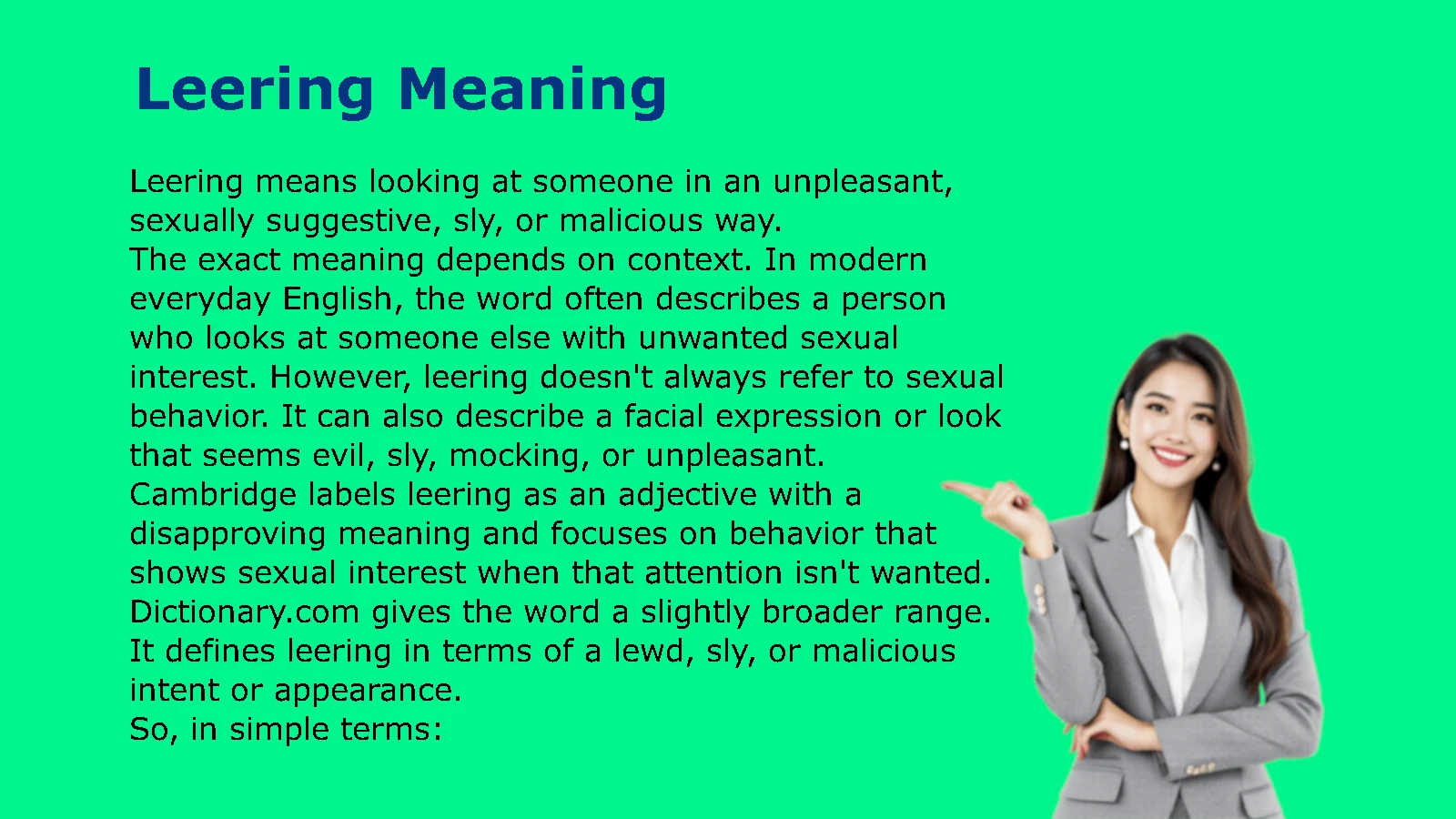
Leering means looking at someone in an unpleasant, sexually suggestive, sly, or malicious way.
The exact meaning depends on context. In modern everyday English, the word often describes a person who looks at someone else with unwanted sexual interest. However, leering doesn’t always refer to sexual behavior. It can also describe a facial expression or look that seems evil, sly, mocking, or unpleasant.
Cambridge labels leering as an adjective with a disapproving meaning and focuses on behavior that shows sexual interest when that attention isn’t wanted.
Dictionary.com gives the word a slightly broader range. It defines leering in terms of a lewd, sly, or malicious intent or appearance.
So, in simple terms:
Leering = looking in a way that feels inappropriate, suggestive, creepy, sly, or unpleasant.
Leering Meaning in Simple Words
If you need the shortest possible definition, remember this:
Leering means looking at someone in an unpleasant or suggestive way, usually with unwanted interest.
Consider the difference:
- He looked at her. → Neutral.
- He stared at her. → He looked at her for a noticeable amount of time.
- He was leering at her. → His look seemed inappropriate, suggestive, or offensive.
That final word changes the emotional picture.
Leering Definition at a Glance
| Feature | Details |
| Word | Leering |
| Base word | Leer |
| Part of speech | Present participle and adjective |
| Common meaning | Looking in an unpleasant or sexually suggestive way |
| Other meanings | Sly, malicious, lewd, or unpleasant appearance |
| Tone | Negative or disapproving |
| Common structure | Leering at someone |
| US pronunciation | /ˈlɪr.ɪŋ/ |
| Past form | Leered |
| Noun form | Leer |
| Related adverb | Leeringly |
Merriam-Webster lists the verb forms as leered, leering, and leers and also recognizes leeringly as an adverb.
What Does Leering Mean in a Sentence?
The easiest way to understand leering is to see it in context.
Here are several examples:
- The man was leering at her from across the restaurant.
- She moved away after noticing him leering at her.
- He gave her a leering grin.
- The villain wore a leering smile.
- The strange statue had a leering face.
- The character kept leering at everyone who walked past.
- She felt uncomfortable when the stranger started leering.
Notice something important. The word doesn’t merely describe where someone’s eyes are pointed. It communicates the quality or intention of the look.
Example: “He Was Looking at Her”
This sentence doesn’t tell you whether the attention was friendly, romantic, curious, accidental, or inappropriate.
He was looking at her.
Now change one word:
He was leering at her.
Suddenly, the scene feels uncomfortable. The reader expects the look to carry some kind of inappropriate, suggestive, hostile, or unpleasant quality.
That’s why leering is much stronger than looking.
Is Leering a Verb or an Adjective?
Leering can function as the present participle of the verb leer and as an adjective.
As part of a verb phrase, it describes an action:
He was leering at her.
Here, was leering forms the past progressive verb phrase.
As an adjective, it describes a noun:
He gave her a leering smile.
Here, leering describes the smile.
You can also see the adjective use in phrases such as:
- a leering grin
- a leering expression
- a leering face
- a leering look
- a leering character
- a leering villain
Dictionary.com specifically identifies leering as the present participle of leer and also lists it as an adjective.
What Does “Leer” Mean?
Leer is the base verb from which leering comes.
As a verb, to leer means to look at someone in an unpleasant way, often with sexual interest. Cambridge gives the common construction “leer at” and describes the action as an unpleasant look that usually shows sexual interest.
For example:
He leered at her.
The word can also function as a noun:
She noticed the leer on his face.
In this sentence, leer means the unpleasant or suggestive look itself.
The basic word family looks like this:
leer → leers → leered → leering
Merriam-Webster also lists leer as both a verb and noun. Its noun meaning centers on a lascivious, knowing, or wanton look.
How to Use “Leering” Correctly
The most common grammatical pattern is:
leering + at + person
For example:
- He was leering at her.
- They were leering at the performers.
- She noticed someone leering at her.
- The man kept leering at people walking past.
Oxford lists leer at somebody as the standard verb construction.
You can also place leering directly before a noun:
- a leering smile
- a leering grin
- a leering face
- a leering expression
“Leering at Someone”
The phrase “leering at someone” usually means looking at that person in an unpleasant or sexually suggestive way.
For example:
The customer was leering at the employee.
The sentence suggests more than ordinary attention. The person’s behavior has crossed into something the writer considers inappropriate or uncomfortable.
“A Leering Smile”
A leering smile is a smile that suggests something unpleasant, sly, sexually suggestive, or malicious.
For example:
The villain entered the room with a leering smile.
Here, the word doesn’t necessarily describe sexual behavior. It could simply make the character seem creepy or sinister.
Is Leering Always Sexual?
No.
This is one of the most important details to understand about the leering meaning.
Sexual interest is central to many modern uses of leering, particularly when the word describes one person looking at another person. Cambridge places strong emphasis on unwanted sexual interest.
However, dictionaries also recognize broader meanings involving slyness, malice, lewdness, or an unpleasant appearance. Dictionary.com, for example, uses leering for something that has a lewd, sly, or malicious look.
Consider these two examples:
The man was leering at the woman across the room.
This strongly suggests unwanted sexual interest.
Now consider:
A leering gargoyle stood above the doorway.
A gargoyle can’t literally express sexual interest in the normal human sense. Here, leering describes the creature’s sinister, sly, or unpleasant expression.
That’s a useful clue: context determines which part of the meaning matters most.
Leering vs. Looking
The difference between looking and leering comes down to attitude.
| Word | What it tells you |
| Looking | Someone directs their eyes toward something |
| Staring | Someone looks continuously or intensely |
| Leering | Someone looks in an unpleasant, suggestive, sly, or malicious way |
The word looking carries little judgment on its own.
She was looking at the painting.
Nothing about the sentence sounds negative.
But leering immediately adds a negative quality:
He was leering at her.
The reader now expects the behavior to be inappropriate or uncomfortable.
This distinction matters because replacing looking with leering isn’t a small stylistic change. It changes the meaning and emotional tone of the sentence.
Leering vs. Staring
Staring and leering can overlap, but they aren’t synonyms.
To stare means to look at something or someone fixedly or for a noticeable period. The reason could be curiosity, surprise, concentration, confusion, or rudeness.
To leer, however, adds a negative quality to the look.
Compare:
He was staring at the painting.
He might simply be studying it.
That could be rude, curious, admiring, or threatening. The context doesn’t tell you exactly why.
He was leering at her.
Now the writer signals that the attention is unpleasant or suggestive.
The Key Difference
Staring describes the manner or duration of looking.
Leering describes the unpleasant quality or apparent intent behind the look.
That’s why someone can stare without leering, but a person who leers will often appear to be staring in a particular, inappropriate way.
Leering vs. Ogle
Ogle is probably one of the closest common alternatives to leer when the subject involves sexual interest.
Merriam-Webster lists ogle, eye, stare, and related expressions among the synonyms of leer.
Still, the words aren’t identical.
Ogle usually focuses on looking at someone with obvious or excessive sexual interest.
Leer can carry that same sexual meaning, but it can also suggest slyness, malice, or an unpleasant facial expression.
Compare:
He was ogling the actor.
The focus is strongly on sexual or physical interest.
He was leering at the actor.
The look seems unpleasant or offensive, and sexual interest may be part of it.
The villain gave a leering grin.
Here, leering may have nothing to do with sexual attraction. It can simply make the villain seem sinister or malicious.
Leering vs. Gawking
Gawking means looking openly and often foolishly because something seems surprising, unusual, or fascinating.
For example:
Tourists stood gawking at the enormous statue.
The tourists may look rude, but the sentence doesn’t automatically suggest sexual interest or malice.
Compare that with:
The man stood leering at the woman.
The second sentence has a very different emotional charge.
| Word | Typical reason or quality |
| Look | General visual attention |
| Stare | Fixed or prolonged attention |
| Gawk | Open, often rude attention caused by surprise or curiosity |
| Ogle | Strong sexual or physical interest |
| Leer | Unpleasant, suggestive, sly, or malicious attention |
The distinctions aren’t absolute. Natural language often has overlapping edges. Still, these differences help you choose the most accurate word.
Leering vs. Gazing
Gazing usually has a much softer meaning than leering.
You might say:
She was gazing at the stars.
Or:
He gazed lovingly at his newborn daughter.
The word can suggest admiration, affection, wonder, or peaceful attention.
Leering does almost the opposite. It adds a sense of discomfort, impropriety, or menace.
Compare:
He gazed at her.
This could sound romantic.
He leered at her.
This sounds inappropriate or unsettling.
The difference shows why synonyms aren’t interchangeable simply because they all involve looking.
Leering Synonyms
The best synonym depends on the context. There isn’t one replacement that works in every sentence.
Synonyms Related to Sexual Interest
- Ogling
- Eyeing
- Staring
- Looking lasciviously
- Looking suggestively
These terms work best when the context clearly involves unwanted or excessive sexual attention.
Synonyms Related to Slyness or Malice
- Sneering
- Gloating
- Menacing
- Malicious
- Sly
- Sinister
These alternatives become more useful when leering describes a facial expression rather than direct sexual attention.
Synonyms Related to Looking
- Staring
- Watching
- Eyeing
- Gazing
- Observing
Be careful with this group. These words describe looking but don’t necessarily carry the same negative meaning.
Merriam-Webster’s thesaurus places leering alongside terms such as lascivious, prurient, suggestive, lewd, nasty, and vulgar, showing how strongly the word can connect with inappropriate or sexual behavior.
Antonyms of Leering
English doesn’t have one perfect opposite for leering. Instead, the best contrast depends on what aspect of the word you want to oppose.
Possible contrasts include:
- Looking respectfully
- Glancing
- Ignoring
- Looking away
- Avoiding eye contact
- Observing neutrally
For example:
He looked at her respectfully.
This contrasts with:
He was leering at her.
The first sentence describes ordinary attention without suggesting inappropriate intent.
Leering Pronunciation
In US English, leering is pronounced:
/ˈlɪr.ɪŋ/
A simple approximation is:
LEER ing
The first syllable sounds like the word leer, followed by the normal -ing ending.
Cambridge lists the US pronunciation as /ˈlɪr.ɪŋ/ and the UK pronunciation as /ˈlɪə.rɪŋ/.
How to Pronounce “Leer”
The base word leer is pronounced approximately like “leer.”
So:
- leer → /lɪr/
- leering → /ˈlɪr.ɪŋ/
The pronunciation is not the same as learning. The words may look somewhat similar in fast reading, but their sounds and meanings are completely different.
Word Forms of Leer and Leering
Understanding the word family makes leering easier to use correctly.
| Word form | Example |
| Leer | Don’t leer at people. |
| Leers | He often leers at strangers. |
| Leered | He leered at her yesterday. |
| Leering | He was leering at her. |
| Leer as a noun | She noticed his leer. |
| Leeringly | He smiled leeringly. |
Oxford lists leering as the -ing form of leer and gives the forms leers, leered, and leering.
Leer
The base form is leer.
He tends to leer at people.
Leers
The third person singular form is leers.
He leers at anyone who challenges him.
Leered
The past form is leered.
The stranger leered at her before leaving.
Leering
The -ing form is leering.
The stranger was leering at her.
Leeringly
Leeringly is the adverbial form.
He smiled leeringly.
This form is less common in everyday conversation, but it can appear in descriptive or literary writing.
Leering as an Adjective
When leering works as an adjective, it usually describes something that looks or feels lewd, sly, malicious, or unpleasant.
Some natural combinations include:
- leering smile
- leering grin
- leering face
- leering expression
- leering eyes
- leering character
- leering figure
For example:
The villain flashed a leering grin.
The adjective gives the grin a sinister quality.
Another example:
The old painting showed a leering figure in the background.
Here, the word helps create an unsettling visual image.
Common Phrases With “Leering”
Certain combinations occur naturally in English.
Leering at Someone
This is the most common structure.
He was leering at the woman.
It usually indicates that the person’s attention feels unwanted or inappropriate.
A Leering Look
She noticed his leering look and moved away.
This phrase emphasizes the expression itself.
A Leering Smile
The villain answered with a leering smile.
This construction often appears in fiction when a character seems sinister or sexually suggestive.
A Leering Grin
He gave a leering grin before walking away.
A grin already suggests a broad smile. Adding leering gives it a disturbing or suggestive quality.
A Leering Face
The creature’s leering face appeared in the window.
This use demonstrates that leering can describe fictional creatures, drawings, sculptures, or other nonhuman subjects.
Case Study: Why the Context Matters
Consider a fictional scene in a coffee shop.
A customer notices another person looking in her direction.
The first version says:
A man was looking at her.
Now consider:
A man was staring at her.
The situation becomes more noticeable. His attention appears prolonged.
Finally:
A man was leering at her.
Now the writer has supplied an interpretation of his behavior. The look seems unwanted, inappropriate, or suggestive.
This small vocabulary change dramatically affects the reader’s understanding.
What This Teaches
The three sentences demonstrate a useful principle:
Words describing perception often carry hidden information about attitude.
Look tells you what happened.
Stare tells you something about how long or intensely the person looked.
Leer tells you something about the unpleasant quality or apparent intention of the look.
That’s why choosing leering instead of looking can make a sentence much more precise.
Can Objects or Fictional Characters Be “Leering”?
Yes.
Although the word often describes people, writers can use leering to describe faces, statues, creatures, illustrations, and fictional characters.
For example:
A leering gargoyle guarded the entrance.
The mask had a leering expression.
A leering demon appeared in the painting.
This figurative use works because the object or creature appears to have the expression associated with a leer.
Cambridge’s examples include references to an “evil, leering face,” while Dictionary.com gives a leering gargoyle as an example of the adjective describing appearance rather than literal human behavior.
In fiction, this usage is especially useful because it creates an immediate emotional reaction. A leering face doesn’t merely look at the reader. It seems to look with bad intentions.
The History and Origin of “Leer”
The word leer has a surprisingly old history.
Oxford traces the verb to the mid-16th century, when it had the broader sense of looking sideways or askance. Oxford suggests a possible connection to an obsolete word leer, meaning “cheek,” from Old English hlēor. The proposed idea is that the original sense may have involved glancing over the cheek.
Merriam-Webster gives the first known use of the verb leer as 1530 and the noun as 1598. It also notes that the origin is probably connected with the obsolete word leer, meaning “cheek.”
Over time, the word developed the more specific sense associated with a sly, knowing, sexually suggestive, or unpleasant look.
That history helps explain why leer has a stronger meaning than a simple verb such as look. The word has long been associated with a particular kind of glance, not just the act of seeing.
“Leering” vs. “Looking”: A Quick Test
If you’re unsure whether leering fits a sentence, ask yourself three questions:
- Is someone looking at another person or something with a particular attitude?
- Does the look seem unpleasant, suggestive, sly, or malicious?
- Would “looking” sound too neutral for the situation?
If the answer to these questions is yes, leering may be the more accurate choice.
For example:
The man was looking at her.
Use this when you don’t want to make a judgment about his intentions.
The man was leering at her.
Use this when his look clearly seems inappropriate, offensive, suggestive, or unpleasant.
The distinction matters in writing because leering expresses an interpretation that looking doesn’t.
Common Mistakes With “Leering”
Using “Leering” as a Neutral Synonym for “Looking”
This is the biggest mistake.
Don’t write:
She was leering at the beautiful sunset.
Unless the sentence intentionally creates an unusual or humorous effect, leering doesn’t work as a neutral replacement for looking.
Better:
She was gazing at the beautiful sunset.
Assuming “Leering” Always Means Sexual Attraction
Sexual interest is common, but it isn’t the only possible meaning.
A leering villain may simply have a malicious or sinister expression.
Forgetting “At”
When leer describes looking directly at someone, leer at is the standard construction.
He was leering at her.
Not:
He was leering her.
Oxford specifically gives leer at somebody as the standard pattern.
Treating “Leering” as a Compliment
Leering almost always carries a negative or disapproving tone.
If someone says:
He was leering at her.
The sentence doesn’t normally praise his behavior. It suggests that his attention was inappropriate or uncomfortable.
Is “Leering” a Bad Word?
Leering isn’t a swear word or profanity.
However, it is a strongly negative descriptive word.
Calling someone’s behavior leering makes a judgment about the nature of their look. It can imply sexual impropriety, vulgarity, hostility, slyness, or malice.
Cambridge explicitly labels the term disapproving.
That’s why the word works well when a writer wants to communicate discomfort without using a vulgar expression.
For example:
The employee complained about a customer who kept leering at her.
The sentence clearly communicates that the behavior was unwelcome without needing graphic language.
Is Leering the Same as Flirting?
No.
Flirting can be playful, romantic, affectionate, or mutually welcomed.
Leering usually suggests something much less respectful.
Compare:
He was flirting with her.
This suggests romantic or playful interaction. The sentence itself doesn’t establish whether the attention was welcome, although context can.
He was leering at her.
This suggests that his way of looking was unpleasant, inappropriate, or unwanted.
The distinction is important because intent and behavior aren’t the same thing. A person might intend to flirt while another person experiences the behavior as uncomfortable. The word leering generally reflects the negative quality of the behavior as perceived or described by the speaker.
Frequently Asked Questions About Leering Meaning
What does leering mean in simple words?
Leering means looking at someone in an unpleasant, suggestive, or inappropriate way. It often involves unwanted sexual interest, but it can also describe a sly or malicious look.
What does “leering at someone” mean?
“Leering at someone” means looking at that person in an unpleasant or suggestive way. The phrase often suggests unwanted sexual attention.
Is leering always sexual?
No. It frequently refers to sexual interest, but leering can also describe a sly, malicious, sinister, or unpleasant expression.
Does leering mean staring?
Not exactly. Staring means looking fixedly or for a prolonged period. Leering adds a negative quality, such as sexual suggestiveness, slyness, or malice.
What is another word for leering?
Depending on context, alternatives include ogling, staring, eyeing, sneering, and looking suggestively. However, these words don’t have exactly the same meaning.
What is the noun form of leering?
The noun is leer.
For example:
She noticed his leer.
A leer is the unpleasant or suggestive look itself. Cambridge defines the noun as an unpleasant way of looking at someone, usually one that shows sexual interest.
How do you use “leering” in a sentence?
The most common construction is:
He was leering at her.
You can also use it as an adjective:
He gave her a leering smile.
What is the opposite of leering?
There isn’t one exact antonym. Depending on the context, opposites might include looking respectfully, glancing, ignoring, looking away, or observing neutrally.
How do you pronounce leering?
In US English, leering is pronounced /ˈlɪr.ɪŋ/. It sounds approximately like “LEER ing.”
What does a “leering smile” mean?
A leering smile is a smile that looks unpleasant, sexually suggestive, sly, or malicious. The exact meaning depends on context.
Can a fictional character have a leering face?
Yes. Writers commonly use leering to describe fictional characters, creatures, statues, masks, or images that appear to have a sinister or suggestive expression.
Is “leering” a verb or adjective?
It can be both, depending on how you use it. In “He was leering at her,” it is part of the verb phrase. In “a leering smile,” it functions as an adjective.
Leering Meaning: Key Facts to Remember
Here are the most important points in one place:
- Leering means looking in an unpleasant, suggestive, sly, or malicious way.
- The word often refers to unwanted sexual interest.
- It comes from the verb leer.
- The common structure is “leer at someone.”
- Leering can function as a present participle or adjective.
- The noun form is leer.
- The US pronunciation is /ˈlɪr.ɪŋ/.
- Leering is normally negative or disapproving.
- It isn’t simply another word for looking.
- Staring can be neutral or negative, while leering carries a stronger negative meaning.
- Ogle is a close synonym when sexual interest is the focus.
- Leering can also describe a sinister or malicious expression that has nothing to do with literal sexual behavior.
- The verb leer dates back to at least the 16th century, with Merriam-Webster recording a first known use of 1530.
Final Takeaway: What Does Leering Mean?
The simplest way to remember the leering meaning is this: leering describes a look that feels wrong, intrusive, suggestive, sly, or unpleasant.
When a person leers at someone, the word usually suggests unwanted sexual attention. However, the meaning can broaden when the word describes a face, smile, fictional character, statue, or creature. In those cases, leering may simply suggest something sinister, malicious, or disturbingly sly.
The word is much stronger than looking and more specific than staring. It tells the reader not only that someone looked but also that the look carried a troubling quality.
Remember the core pattern:
leer + at + someone
For example:
He was leering at her from across the room.
And when leering describes an expression:
The villain wore a leering grin.
Once that distinction becomes clear, the word is easy to recognize and use. Leering isn’t just looking. It’s looking with an unpleasant edge.