
Have you ever met someone who seemed completely unmoved by another person’s feelings and wondered what word best describes that behavior? Callous Meaning can be confusing because the word often describes more than simply being rude or unfriendly. It usually suggests a lack of care, sympathy, or concern for other people’s feelings.
Callous is an adjective used to describe someone who is emotionally insensitive, unkind, or unconcerned about the feelings or suffering of others. It can describe a person’s attitude, behavior, words, or actions.
Examples:
- His callous remarks hurt her feelings.
- It was callous of him to laugh at someone else’s misfortune.
The confusion is understandable. People often search for what does callous mean, callous meaning in a sentence, callous meaning in text, or what does callous mean when describing a person because the word can have different shades of meaning depending on the context and tone. And here’s the kicker: calling someone “callous” is usually much stronger than simply saying they are rude or insensitive.
In this guide, you’ll learn the complete Callous Meaning, its definition, pronunciation, correct usage, and examples in sentences. You’ll also discover callous meaning when describing a person, synonyms and antonyms, and the difference between callous, rude, cruel, and insensitive.
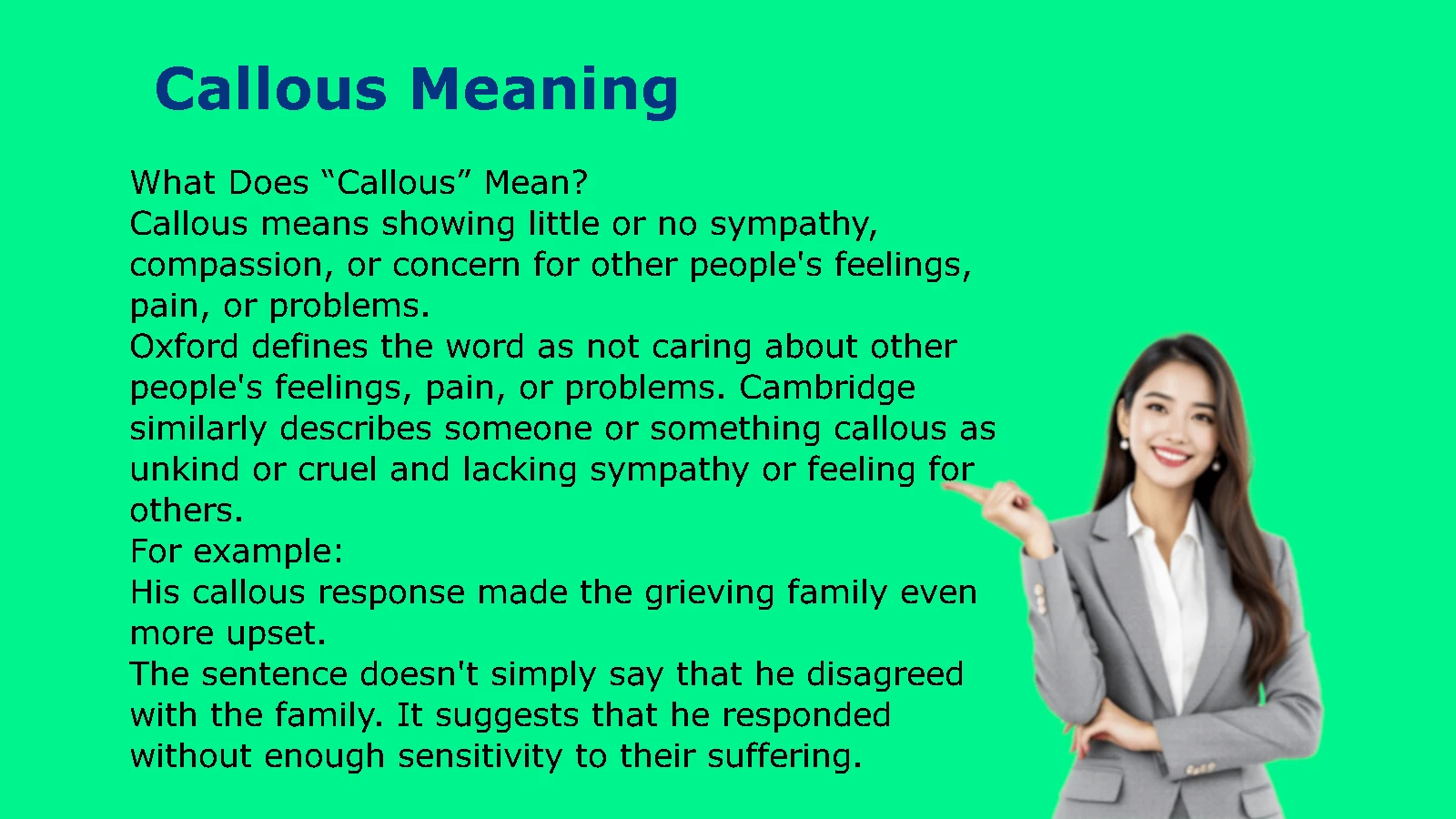
What Does “Callous” Mean?
Callous means showing little or no sympathy, compassion, or concern for other people’s feelings, pain, or problems.
Oxford defines the word as not caring about other people’s feelings, pain, or problems. Cambridge similarly describes someone or something callous as unkind or cruel and lacking sympathy or feeling for others.
For example:
His callous response made the grieving family even more upset.
The sentence doesn’t simply say that he disagreed with the family. It suggests that he responded without enough sensitivity to their suffering.
Callous Meaning in Simple Words
In simple English, callous means not caring about someone else’s pain or feelings.
Imagine a friend tells you that they’ve lost their job. Instead of asking whether they’re okay, you laugh and say, “That’s what you get for being lazy.”
That response could be called callous because it ignores the person’s distress and treats a serious situation as though it doesn’t matter.
A more compassionate response might be:
“I’m sorry. That must be stressful. Is there anything I can do?”
The difference is important. A person doesn’t have to solve another person’s problem to show compassion. Sometimes simply recognizing someone’s pain is enough.
Callous Definition and Examples
The meaning of callous becomes clearer when you see it in different contexts.
| Phrase | Meaning |
| Callous person | Someone who shows little concern for others’ feelings or suffering |
| Callous remark | An insensitive or hurtful comment |
| Callous behavior | Behavior that shows little compassion |
| Callous attitude | An emotionally cold or indifferent attitude |
| Callous decision | A decision that appears to ignore people’s suffering or needs |
| Callous treatment | Treatment that lacks care or sympathy |
| Callous disregard | A serious lack of concern for something important, especially people’s welfare |
Consider these examples:
- The manager made a callous remark about an employee’s family problems.
- His callous behavior shocked everyone at the meeting.
- The company was criticized for its callous treatment of its workers.
- She couldn’t understand how anyone could make such a callous decision.
- The politician’s callous response to the victims drew criticism.
- His callous disregard for other people’s feelings eventually damaged his relationships.
Notice a pattern. Callous often appears before nouns such as remark, attitude, behavior, treatment, disregard, and indifference. Oxford specifically identifies callous disregard and callous indifference as common combinations.
What Does It Mean to Be Callous?
To be callous means to behave as though another person’s pain or feelings don’t matter.
That doesn’t necessarily mean the person intends to cause harm. A careless comment can be callous even when the speaker doesn’t realize how hurtful it sounds.
For example, imagine someone has just failed an important exam. Their friend says:
“It’s not a big deal. Stop complaining.”
The friend may not intend to be cruel. Still, the response can seem callous because it dismisses the person’s disappointment instead of acknowledging it.
Being Callous vs. Being Direct
Being direct isn’t automatically the same as being callous.
A direct person might say:
“Your presentation needs more work before you’re ready to present it.”
That’s blunt, but it can still be respectful.
A callous version might be:
“Your presentation is terrible. Nobody wants to listen to you.”
The first statement focuses on the work. The second attacks the person and shows little concern for how the comment may affect them.
Directness concerns how clearly you communicate. Callousness concerns how little regard you show for another person’s feelings or suffering.
What Is a Callous Person Like?
A callous person typically appears emotionally indifferent to other people’s pain or problems.
That might show up in several ways:
- Dismissing someone’s genuine distress
- Making jokes about serious suffering
- Ignoring another person’s obvious emotional needs
- Showing little remorse after hurting someone
- Treating vulnerable people without compassion
- Making insensitive comments during serious situations
- Acting as though another person’s problems are unimportant
- Showing indifference to consequences that seriously affect others
However, context matters.
One insensitive comment doesn’t automatically prove that someone is a permanently callous person. People can have bad judgment, misunderstand situations, or speak without thinking.
The adjective describes behavior or an attitude, not a formal diagnosis or permanent personality category.
Callous vs. Cruel vs. Heartless vs. Insensitive
These words overlap, but they aren’t identical.
| Word | Core meaning | Main emphasis |
| Callous | Showing little sympathy | Emotional indifference |
| Cruel | Causing pain or suffering | Harm or deliberate harshness |
| Heartless | Lacking compassion | Extreme emotional coldness |
| Insensitive | Failing to consider feelings | Lack of tact or awareness |
| Unfeeling | Showing little emotion or sympathy | Emotional detachment |
| Ruthless | Showing no pity when pursuing a goal | Relentless behavior |
Callous vs. Cruel
Cruel focuses more strongly on causing pain or suffering.
Callous focuses on the lack of sympathy or concern surrounding someone’s suffering.
For example:
The cruel bully deliberately hurt the child.
The sentence emphasizes harmful action.
The teacher’s callous response to the child’s distress was shocking.
Here, the focus falls on the teacher’s lack of sympathy.
Someone can be callous without deliberately trying to hurt someone. That’s one reason the words aren’t perfect substitutes.
Callous vs. Heartless
Heartless is often stronger and more emotionally charged.
If you call someone heartless, you’re suggesting an especially severe lack of compassion.
Callous can describe a particular comment, decision, or attitude without necessarily labeling someone’s entire character.
Compare:
- “That was a callous comment.”
- “He is completely heartless.”
The first criticizes a specific action. The second makes a broader judgment about the person.
Callous vs. Insensitive
Insensitive means failing to consider another person’s feelings.
Callous usually goes a step further by suggesting a stronger lack of concern for suffering or emotional pain.
For example:
“That joke was insensitive.”
This might mean the speaker simply failed to recognize that the joke could offend someone.
“That joke was callous.”
This suggests a colder attitude toward the person’s pain.
Cambridge lists callous alongside words such as cruel, harsh, heartless, and ruthless, while its examples emphasize the absence of sympathy.
Callous Synonyms
The best synonym depends on the exact context.
Common Synonyms for Callous
- Insensitive
- Unfeeling
- Unsympathetic
- Heartless
- Cruel
- Cold
- Harsh
- Indifferent
- Unkind
- Inconsiderate
Stronger Synonyms
Some words carry a more severe meaning:
- Ruthless
- Merciless
- Pitiless
- Remorseless
- Inhumane
- Brutal
Don’t treat every synonym as interchangeable.
For example, ruthless often describes someone who will pursue a goal without mercy. Callous, by contrast, emphasizes emotional indifference or a lack of sympathy.
Synonyms in Context
| Synonym | Example |
| Insensitive | His insensitive comment embarrassed her. |
| Unfeeling | The response sounded cold and unfeeling. |
| Heartless | Her heartless reaction surprised everyone. |
| Cruel | The cruel remark caused unnecessary pain. |
| Ruthless | The ruthless leader eliminated anyone who opposed him. |
| Unsympathetic | The supervisor seemed unsympathetic to their concerns. |
The right synonym depends on what you want to emphasize. That’s why simply replacing callous with the first word in a thesaurus isn’t always a good idea.
Antonyms of Callous
The opposite of callous is someone or something that shows care, compassion, or sympathy.
Useful antonyms include:
- Compassionate
- Caring
- Sympathetic
- Sensitive
- Empathetic
- Kind
- Considerate
- Understanding
- Thoughtful
- Tender
For example:
Callous: “That’s your problem. I don’t care.”
Compassionate: “I’m sorry you’re dealing with this. How can I help?”
The difference isn’t always about solving the problem. It often comes down to whether you recognize that the other person’s experience matters.
Examples of “Callous” in a Sentence
Here are natural examples showing how callous works in everyday and formal English:
- His callous response made the situation worse.
- She was shocked by her friend’s callous attitude.
- Making fun of someone after a tragedy is callous.
- The supervisor made a callous remark about the employee’s illness.
- The decision seemed callous to the families affected by it.
- His callous behavior eventually pushed his friends away.
- The article criticized the company’s callous treatment of its workers.
- She couldn’t believe he had been so callous toward his own brother.
- The official’s callous disregard for the victims caused public outrage.
- Years of difficult experiences had left him emotionally callous.
- Her response sounded callous, even though she didn’t intend to offend anyone.
- The landlord’s callous indifference to the family’s situation attracted criticism.
Examples in Everyday Situations
At work:
“It was callous to dismiss the employee’s concerns without hearing them.”
In a friendship:
“Laughing when your friend is upset can come across as callous.”
During an argument:
“His callous comment crossed the line from disagreement into disrespect.”
Online:
“The comment section became increasingly callous after people began mocking the victim.”
In a serious situation:
“Her callous response to the family’s grief was widely criticized.”
The word works particularly well when the situation involves suffering, vulnerability, grief, hardship, or emotional pain.
Literal Meaning of Callous
Although people usually encounter callous as an emotional description, the word also has a physical meaning.
It can describe something that has become hardened or thickened, especially skin with calluses.
Merriam Webster gives the physical senses as “being hardened and thickened” and “having calluses.”
For example:
Years of manual labor left his hands callous.
In this sentence, callous doesn’t mean that the worker lacks compassion. It describes the physical condition of his hands.
Other examples include:
- The farmer’s callous hands showed years of hard work.
- Her feet became callous after repeated friction.
- The climber developed callous skin on his palms.
This literal meaning is the key to understanding the word’s history.
Figurative Meaning of Callous
The emotional meaning developed from the idea of physical hardness.
Think about skin that becomes thick and less sensitive after repeated friction. English speakers eventually applied that idea metaphorically to the mind and emotions.
A physically hardened surface becomes less sensitive to touch. In the same way, a figuratively callous person seems less sensitive to other people’s suffering.
Merriam Webster explains this connection directly: a callus is hardened skin that can become less sensitive, which helps explain how callous developed its figurative sense of being harsh or insensitive.
The metaphor is surprisingly simple:
Hard skin → reduced physical sensitivity → emotional hardness → reduced emotional sensitivity
That’s why callous is such an effective word. It doesn’t merely say that someone is unkind. It creates an image of emotional hardness.
Callous vs. Callus
Callous and callus look and sound almost identical, but they have different grammatical roles and meanings.
| Word | Meaning | Example |
| Callous | Emotionally insensitive or physically hardened | “His callous response upset her.” |
| Callus | A hardened area of skin | “She developed a callus on her hand.” |
Both words ultimately trace back to Latin terms connected with hardened skin. Merriam Webster gives callous as coming from Latin callosus and records the adjective’s first known English use in the 14th century.
An Easy Way to Remember the Difference
Use this simple memory trick:
Callus = skin.
Callous = feelings.
For example:
- I have a callus on my foot.
- He was callous toward his friend.
The words are related, but you shouldn’t use them interchangeably.
Merriam Webster defines callus as a thickened or hardened area of skin and also recognizes other specialized biological meanings.
Callous Pronunciation
Callous is pronounced:
KAL-uhs
The US pronunciation is /ˈkæl.əs/. Cambridge gives the same pronunciation for both US and UK English.
Break it into two parts:
CAL + us
The first syllable receives the main stress.
It sounds similar to callus, which is one reason spelling mistakes are common.
Pronunciation Example
Say:
KAL-uhs
Then use it naturally:
“That was a callous thing to say.”
What Part of Speech Is “Callous”?
Callous primarily functions as an adjective.
It describes a person, attitude, action, comment, decision, or behavior.
Examples:
- a callous person
- a callous remark
- a callous attitude
- a callous decision
- callous behavior
- callous treatment
The word can also function as a verb, although this use is much less common in everyday conversation.
As a verb, callous means to make something hardened.
For example:
Years of hard labor calloused his hands.
Merriam Webster lists the verb with forms including calloused, callousing, and callouses.
Callous, Callously, Callousness, and Calloused
Several related forms appear in English.
Callous
Adjective
Meaning: emotionally insensitive or physically hardened.
“His callous attitude upset the team.”
Callously
Adverb
Meaning: in a callous or insensitive manner.
“She spoke callously about the victims.”
Callousness
Noun
Meaning: a lack of sympathy or compassion.
“His callousness became obvious during the discussion.”
Calloused
Adjective
Meaning: having hardened skin.
“His calloused hands showed years of manual work.”
Callused
Adjective
Callused has the same basic physical meaning as calloused.
“Her callused fingers were rough from playing guitar.”
Merriam Webster lists callously and callousness as derivatives and records calloused as a form of the verb. Cambridge also recognizes callused and calloused in connection with callus.
How to Use “Callous” Correctly
The easiest way to use callous correctly is to connect it to a lack of emotional sensitivity.
Common combinations include:
- callous attitude
- callous behavior
- callous remark
- callous response
- callous decision
- callous treatment
- callous disregard
- callous indifference
- callous refusal
- callous approach
For example:
The company showed callous disregard for the workers’ safety.
Here, callous strengthens the phrase disregard. It tells the reader that the lack of concern wasn’t merely accidental or minor.
Another example:
Her callous indifference to his suffering damaged their relationship.
The word works especially well with abstract nouns because it describes the emotional quality behind an action or decision.
Is “Callous” Always Negative?
When callous describes emotional behavior, it is almost always negative.
Calling someone callous suggests that the person lacks an appropriate level of sympathy or concern.
For example:
His callous treatment of the injured animal was disturbing.
That’s clearly negative.
However, the physical meaning can be neutral:
His hands were callous from years of working outdoors.
Here, the word simply describes hardened skin.
This distinction matters because the same spelling can carry completely different meanings depending on context.
| Sentence | Meaning |
| She had callous hands. | Her hands were physically hardened. |
| She had a callous attitude. | She lacked emotional sympathy. |
| His callous remarks hurt her. | His comments showed little concern for her feelings. |
| His hands became calloused. | His skin hardened through repeated use or friction. |
Why Can Someone Seem Callous?
People can appear callous for many reasons, but the word itself doesn’t tell you why someone behaves that way.
Someone may be genuinely indifferent. Another person may be exhausted, distracted, socially unaware, or uncomfortable with emotional situations.
That distinction matters.
For example, suppose someone receives tragic news and responds with very little emotion. Calling the response callous may describe how it appears, but it doesn’t prove what the person feels internally.
This is why context matters when using strong words such as callous, heartless, and cruel.
A Useful Case Study
Imagine two coworkers learn that a colleague has lost a family member.
Coworker A says:
“I’m sorry to hear that. Take whatever time you need.”
Coworker B says:
“That’s unfortunate, but the deadline doesn’t care.”
Coworker B’s statement could reasonably be described as callous because it dismisses a serious personal loss in favor of a deadline.
Now imagine Coworker B had already offered support privately but was discussing the practical deadline with another manager. The same sentence might sound blunt in isolation but could carry a different meaning in context.
Words don’t exist in a vacuum. Context gives them their force.
Callous in Formal and Everyday Writing
Callous works in both casual and formal English.
In Everyday Conversation
“That was pretty callous.”
“I thought his response was callous.”
These uses are direct and natural.
In Professional Writing
“The policy has been criticized as callous toward low-income families.”
In Journalism or Academic Writing
“Critics described the decision as a callous disregard for the affected community.”
The word carries emotional weight, so writers should use it when the evidence supports the description. It shouldn’t become a decorative synonym for bad.
Word Origin and History of “Callous”
The history of callous begins with physical hardness.
Oxford traces the word to Latin callosus, meaning “hard-skinned.” It entered Middle English with its literal sense.
Merriam Webster gives the first known English use of the adjective as the 14th century and traces it through Middle English to Latin callosus, from callum/callus, referring to hardened skin.
The figurative meaning came later.
Etymonline dates the English figurative sense of callous, meaning emotionally hardened or unfeeling, to the 1670s.
That development follows a familiar pattern in language. Physical experiences often become metaphors for emotions:
- hard-hearted → emotionally unkind
- cold-hearted → lacking warmth or compassion
- thick-skinned → not easily offended
- soft-hearted → compassionate
- callous → emotionally hardened or insensitive
The metaphor behind callous is therefore quite literal in its origin: hard skin became a way of describing a hard emotional response.
Is Callous the Same as Cold?
Not exactly.
Someone can be cold without being callous.
For example, a person might have a reserved personality and rarely express emotion. That doesn’t necessarily mean they disregard other people’s suffering.
Callous carries a stronger suggestion of insensitivity or indifference to pain.
Compare:
He is emotionally cold.
This may describe someone’s reserved personality.
He was callous toward the grieving family.
This specifically criticizes his lack of sympathy toward people who were suffering.
So while cold and callous can overlap, callous usually carries more moral or emotional criticism.
Is Callous the Same as Emotionless?
No.
Emotionless means showing little or no visible emotion.
Callous means showing little sympathy or concern for other people’s feelings or suffering.
A person can be emotionless but deeply compassionate.
For example, a doctor might remain calm and emotionally controlled during an emergency while still caring deeply about a patient.
Calmness isn’t callousness.
Emotional restraint isn’t cruelty.
A lack of outward emotion doesn’t automatically mean a lack of compassion.
Common Mistakes With “Callous”
Mistake: Using “callous” to mean simply “sad”
Callous doesn’t mean sad, upset, or emotionally hurt.
Incorrect:
“She felt callous after hearing the news.”
If the intended meaning is sadness, words such as devastated, heartbroken, upset, or grief-stricken may fit better.
Mistake: Confusing “callous” with “callus”
Incorrect:
“I have a callous on my heel.”
If you’re talking about hardened skin, the noun is callus.
Correct:
“I have a callus on my heel.”
Mistake: Assuming “callous” always means intentionally cruel
Not necessarily.
A statement can be callous because it shows insufficient concern, even if the speaker didn’t deliberately intend to hurt anyone.
Mistake: Using it as a synonym for every kind of bad behavior
A dishonest person isn’t necessarily callous.
A lazy person isn’t necessarily callous.
An angry person isn’t necessarily callous.
The word specifically relates to sympathy, sensitivity, concern, or emotional responsiveness.
Frequently Asked Questions About Callous
What does callous mean in simple terms?
Callous means showing little or no concern for another person’s feelings, pain, or suffering. It can also describe something physically hardened or thickened.
Is callous a negative word?
Yes, when it describes someone’s emotional behavior or attitude. Calling someone callous usually criticizes their lack of sympathy.
The physical sense can be neutral.
What is an example of a callous person?
Someone who laughs at another person’s serious grief, dismisses someone’s suffering, or shows no concern after causing emotional harm could be described as callous.
What is another word for callous?
Common alternatives include insensitive, unfeeling, unsympathetic, heartless, cruel, harsh, and indifferent. The best choice depends on the context.
What is the opposite of callous?
Common opposites include compassionate, caring, sympathetic, sensitive, empathetic, kind, and considerate.
Does callous mean cruel?
They overlap, but they’re not identical. Cruel emphasizes causing pain or suffering, while callous emphasizes a lack of sympathy or concern for another person’s suffering.
What is the difference between callous and insensitive?
Insensitive usually means failing to consider someone’s feelings. Callous often suggests a stronger degree of emotional indifference toward pain or suffering.
How do you pronounce callous?
In US English, callous is pronounced KAL-uhs, represented in IPA as /ˈkæl.əs/.
Is callous an adjective?
Yes. Callous is primarily an adjective.
Example:
“That was a callous remark.”
It can also function as a verb meaning to make something hardened, although that use is less common.
What is callousness?
Callousness is the noun form of callous. It means a lack of sympathy, sensitivity, or concern for other people’s feelings or suffering.
Example:
“His callousness toward the victims was difficult to understand.”
What is callously?
Callously is the adverb form.
Example:
“He spoke callously about the people affected by the disaster.”
Is callous the same as callus?
No.
Callous usually describes emotional insensitivity, while callus is a noun for an area of hardened skin.
Callous: “His callous response hurt her.”
Callus: “She developed a callus on her foot.”
Can callous describe physical things?
Yes. The literal sense describes something hardened or thickened, especially skin.
“The worker’s callous hands showed years of manual labor.”
Merriam Webster records this physical meaning alongside the figurative emotional meaning.
Quick Summary of Callous Meaning
| Detail | Answer |
| Word | Callous |
| Pronunciation | KAL-uhs /ˈkæl.əs/ |
| Main part of speech | Adjective |
| Secondary part of speech | Verb |
| Main meaning | Showing little sympathy or concern |
| Physical meaning | Hardened or thickened |
| Common synonyms | Insensitive, unfeeling, unsympathetic, heartless |
| Common antonyms | Compassionate, caring, sympathetic, sensitive |
| Noun form | Callousness |
| Adverb form | Callously |
| Related word | Callus |
| Word origin | Latin callosus, “hard-skinned” |
| First known English use | 14th century |
Final Takeaway: What Does Callous Mean?
Callous means showing little sympathy, compassion, or concern for another person’s feelings, pain, or suffering.
It can describe a person, comment, attitude, decision, action, response, or behavior.
The word can also describe something physically hardened, particularly skin. That literal meaning explains the metaphor behind the emotional sense: physical hardness became a picture of emotional hardness.
If you want a quick way to remember it, keep this distinction in mind:
Callous = emotionally hard or insensitive.
Callus = a hardened area of skin.