
Have you ever come across the word “closest” and wondered exactly what it means in a particular sentence? While Closest Meaning may seem straightforward, its meaning can change depending on the context, relationship, or situation in which it is used.
Closest generally means nearest in distance, time, relationship, or similarity. It is the superlative form of close and can describe something that is physically near or something that is most similar to another idea, word, or meaning.
Examples:
- The closest store is only five minutes away.
- Choose the word with the closest meaning to “happy.”
The confusion is understandable. People often search for what does closest mean, closest meaning in English, closest meaning of a word, or words with the closest meaning because the word can describe physical distance, personal relationships, or similarity in meaning. And here’s the kicker: closest does not always refer to location. It can also mean the most similar or most nearly accurate option.
In this guide, you’ll learn the complete Closest Meaning, its definition, pronunciation, synonyms, correct usage, and examples in sentences. You’ll also discover how closest is used when comparing words and ideas, along with the difference between close, closer, and closest.
What Does “Closest” Mean?
Closest means nearest to something or someone in distance, time, relationship, similarity, degree, or effect.
The exact meaning depends on what follows the word.
Consider these examples:
| Sentence | Meaning of “closest” |
| “Where is the closest bank?” | Nearest in physical distance |
| “She is my closest friend.” | Strongest personal relationship |
| “Which number is closest to 50?” | Smallest difference from 50 |
| “This copy is closest to the original.” | Most similar to the original |
| “The closest deadline is Friday.” | Nearest in time |
So, closest doesn’t have just one fixed meaning. Instead, it expresses the highest degree of closeness.
That closeness might involve miles, minutes, numbers, ideas, people, or even resemblance.
A Simple Definition of Closest
A useful way to remember the word is:
Closest = nearest or most similar to something.
If you can replace closest with nearest without changing the basic idea, the word probably refers to physical distance or time.
If you can replace it with most similar, the sentence probably refers to resemblance, meaning, quality, or accuracy.
Closest Definition
The dictionary form close has several meanings. In the relevant adjective sense, it describes something that has little distance or difference from another thing.
Merriam Webster gives several related senses, including being near in time, space, effect, or degree, having a strong relationship, being precise, and being faithful to an original.
The word changes according to the degree of comparison:
| Degree | Word | Example |
| Positive | close | The school is close. |
| Comparative | closer | The library is closer. |
| Superlative | closest | The hospital is the closest. |
This pattern matters because closest normally identifies the greatest degree of closeness within a comparison.
For example:
- The blue house is close to the park.
- The green house is closer to the park.
- The yellow house is the closest to the park.
The first sentence simply describes proximity. The second compares two things. The third identifies the one that has the least distance among the choices.
Closest Meaning in Different Contexts
One reason people search for the closest meaning is that the word can work in several different contexts.
Closest Meaning in Distance
The most common use refers to physical distance.
If someone asks, “Where is the closest pharmacy?” they want to know which pharmacy requires the shortest trip from their current location.
For example:
“The closest grocery store is two miles away.”
Here, closest means the grocery store with the shortest physical distance.
You can use the word for:
- Stores
- Schools
- Airports
- Hospitals
- Restaurants
- Gas stations
- Bus stops
- Train stations
- Buildings
- Cities
- Roads
The important point is that closest doesn’t necessarily mean close.
A location can be the closest option even when it is quite far away.
Imagine three hospitals located 10, 20, and 35 miles away. The hospital 10 miles away is the closest hospital, even though 10 miles isn’t particularly close.
Closest Meaning in Relationships
Closest can also describe an emotional or personal relationship.
When someone says:
“She’s my closest friend.”
they aren’t talking about physical distance. They mean that the person has one of the strongest or most intimate friendships with them.
Similarly:
- “He is my closest relative.”
- “She is one of my closest colleagues.”
- “They have always been very close.”
- “My sister is the person I’m closest to.”
Cambridge Dictionary recognizes this use of close for strong relationships, including examples involving close friends and family.
In this context, closest means something like:
most emotionally connected + most trusted + most familiar
The exact shade of meaning depends on the relationship.
Closest Meaning in Similarity
Another important meaning involves similarity.
Consider this question:
“Which explanation is closest to the truth?”
The question isn’t asking which explanation sits physically nearest to anything. Instead, it asks which explanation is most similar to the truth or most nearly correct.
You can use this meaning when discussing:
- Ideas
- Opinions
- Answers
- Descriptions
- Copies
- Estimates
- Predictions
- Interpretations
- Results
For example:
“Option B is the closest answer.”
This means Option B differs the least from the correct answer.
Cambridge also uses closest approach to describe something that comes most nearly to another thing in meaning or similarity.
Closest Meaning in Time
Closest can refer to time as well as physical space.
For example:
“Friday is the closest available date.”
Here, Friday is the date that comes soonest.
You might also see:
- closest deadline
- closest appointment
- closest holiday
- closest event
- closest date
- closest opening
- closest opportunity
The idea remains the same: closest = nearest in time.
The word near works in a similar way. Cambridge explains that near can refer to distance, time, characteristics, and quality.
Closest Meaning in Approximation
Closest can also describe numbers and estimates.
Suppose the correct answer is 100 and you have these options:
- 82
- 96
- 121
- 150
The number 96 is the closest because it has the smallest difference from 100.
This use appears frequently in:
- Mathematics
- Statistics
- Science
- Measurements
- Surveys
- Estimates
- Everyday calculations
For example:
“Round the result to the closest whole number.”
Here, closest means the whole number with the smallest difference from the original value.
Closest Synonyms
The best synonym for closest depends on the context.
Common synonyms for closest
- Nearest
- Most nearby
- Most similar
- Most comparable
- Most closely related
- Most intimate
- Most connected
- Most accurate
- Nearest equivalent
- Nearest match
However, these words aren’t interchangeable in every sentence.
For example:
“Where’s the closest hospital?”
Nearest works naturally:
“Where’s the nearest hospital?”
But replacing closest with most intimate would obviously change the meaning.
Likewise:
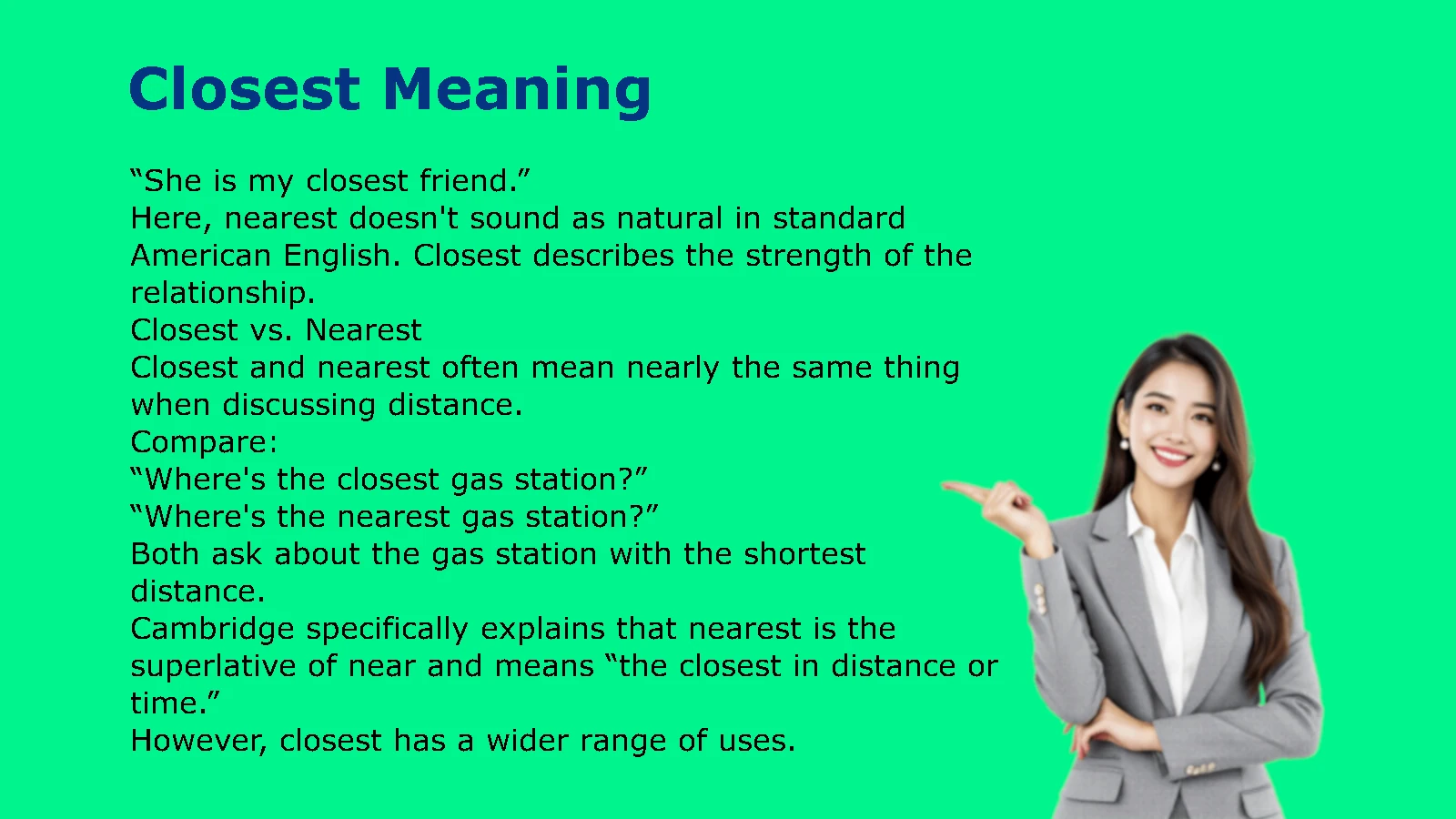
“She is my closest friend.”
Compare:
- “Where’s the closest gas station?”
- “Where’s the nearest gas station?”
Both ask about the gas station with the shortest distance.
Cambridge specifically explains that nearest is the superlative of near and means “the closest in distance or time.”
However, closest has a wider range of uses.
You can say:
“My closest friend.”
You wouldn’t normally replace that with:
“My nearest friend.”
You can also say:
“The closest match.”
But nearest match can sound more specific or technical depending on the context.
Closest vs. Close vs. Closer
These three words belong to the same comparison pattern.
| Word | Form | Meaning | Example |
| Close | Positive | Near | The station is close. |
| Closer | Comparative | Nearer than another | This station is closer. |
| Closest | Superlative | Nearest of the options | This is the closest station. |
Close
Use close when you simply describe proximity or similarity.
“The restaurant is close.”
There doesn’t have to be an explicit comparison.
Closer
Use closer when comparing two things or two situations.
“The second restaurant is closer than the first.”
Now the sentence establishes a comparison.
Closest
Use closest when identifying the option with the greatest degree of closeness.
“The third restaurant is the closest.”
There may be three or more restaurants under consideration.
A Quick Comparison
Think of three runners:
- Runner A is close to the finish line.
- Runner B is closer to the finish line.
- Runner C is the closest to the finish line.
It’s like zooming in on a map. Close tells you there’s little distance. Closer compares distances. Closest picks the winner.
Closest vs. Nearest
Although closest and nearest overlap, they don’t always behave in exactly the same way.
When they mean physical distance
Both can work:
“The closest store is downtown.”
“The nearest store is downtown.”
Both sentences identify the store with the shortest distance.
When they describe relationships
Closest is more natural:
“She’s my closest friend.”
The phrase describes emotional connection rather than physical distance.
When they describe similarity
Closest works naturally:
“This is the closest match.”
Nearest can also work in certain contexts:
“This is the nearest equivalent.”
Cambridge gives examples of nearest meaning the most similar thing, such as the “nearest equivalent.”
The practical rule is simple:
Use “closest” when you want a broad word that can describe distance, relationships, similarity, or degree. Use “nearest” especially when distance or time is the main idea.
How to Use “Closest” in a Sentence
The word appears in several useful sentence patterns.
The Closest + Noun
This is one of the most common structures.
Examples:
- “This is the closest hotel.”
- “That’s the closest exit.”
- “Where’s the closest ATM?”
- “She is my closest friend.”
- “We chose the closest option.”
The noun tells the reader what kind of closeness you’re describing.
Closest to + Noun
Use closest to when you want to identify what something is nearest to or most similar to.
Examples:
- “The house is closest to the river.”
- “Which color is closest to blue?”
- “This answer is closest to the truth.”
- “The deadline closest to today is Friday.”
The Person I’m Closest To
This structure commonly describes relationships.
“My brother is the person I’m closest to.”
The sentence means that the speaker has the strongest personal relationship with their brother.
You can also say:
- “Who are you closest to?”
- “She is closest to her mother.”
- “He became closest to his grandfather.”
Closest + Adverb or Prepositional Phrase
The word can also appear in expressions such as:
- “sit closest to the door”
- “live closest to the station”
- “arrive closest to noon”
- “stand closest to the entrance”
In these cases, closest identifies the position or time that comes nearest to a reference point.
Closest Examples in Sentences
Here are examples that show the main meanings clearly.
Physical distance
- “The closest supermarket is three miles away.”
- “Which airport is closest to the city?”
- “We stayed at the closest hotel.”
- “The closest parking lot was already full.”
- “The school is closest to the main road.”
Relationships
- “She is my closest friend.”
- “He has always been closest to his older brother.”
- “My closest colleagues attended the ceremony.”
- “They became close during college.”
- “Who are you closest to in your family?”
Similarity
- “This painting is the closest copy of the original.”
- “Which explanation is closest to the truth?”
- “That color is closest to dark blue.”
- “This option is closest to what we need.”
- “Her estimate was closest to the final result.”
Numbers and measurements
- “The answer closest to 50 is 49.”
- “Round the measurement to the closest inch.”
- “Which estimate is closest to the actual cost?”
- “The closest value is 101.”
- “Choose the number closest to the target.”
Time
- “Friday is the closest available date.”
- “The closest deadline is next Monday.”
- “The closest appointment is at 2 p.m.”
- “The closest event starts tomorrow.”
- “That was the closest election date to the announcement.”
Common Phrases With “Closest”
Several phrases with closest appear regularly in everyday English.
Closest Friend
A closest friend is someone with whom you have a particularly strong friendship.
“Maria is one of my closest friends.”
The phrase doesn’t necessarily mean you have only one close friend.
Closest Relative
A closest relative usually means a family member with a particularly close relationship or, in some contexts, the nearest relation by family connection.
“Her closest relatives attended the funeral.”
The exact meaning depends on context.
Closest Neighbor
A closest neighbor is the neighbor located at the shortest physical distance.
“Our closest neighbor lives across the street.”
Closest Location
A closest location is the branch, office, store, or facility that requires the least travel.
“The website showed the closest location.”
Closest Match
A closest match is the option that most closely resembles the target.
“The search engine returned the closest match.”
This phrase works particularly well for products, colors, answers, records, and descriptions.
Closest Thing
Closest thing to means something that resembles or represents another thing more than the available alternatives.
For example:
“This is the closest thing to a perfect solution.”
The sentence doesn’t claim that the solution is perfect. It says that, among the available choices, it comes nearest to perfection.
Closest to the Truth
When someone says an explanation is closest to the truth, they mean it most accurately reflects what actually happened.
“Of the three theories, the second is closest to the truth.”
Closest Meaning in Everyday English
In everyday conversation, closest usually appears in practical questions.
Imagine someone visiting an unfamiliar neighborhood. They might ask:
“Where’s the closest coffee shop?”
Someone comparing answers might ask:
“Which one is closest?”
A person talking about family might say:
“I’m closest to my sister.”
And someone discussing an estimate might say:
“Your guess was the closest.”
Notice how the same word moves easily between physical space, relationships, and accuracy.
That’s the key to understanding closest. Don’t memorize one translation and stop there. Look at the noun or idea that follows it.
Everyday Examples
Location:
“What’s the closest gas station?”
Relationship:
“Who are you closest to?”
Similarity:
“Which color is closest to this one?”
Accuracy:
“Your answer was closest.”
Time:
“When is the closest available appointment?”
Each sentence uses closest differently, yet the central idea remains minimal distance or difference.
Is “Closest” a Superlative?
Yes. Closest is the superlative form of close when close functions as a gradable adjective or adverb.
The basic pattern is:
close → closer → closest
For example:
“The library is close.”
“The bookstore is closer.”
“The school is the closest.”
The superlative identifies the item at the highest degree of closeness.
This is similar to:
- fast → faster → fastest
- small → smaller → smallest
- near → nearer → nearest
- close → closer → closest
However, closest and nearest aren’t simply interchangeable in every situation. Nearest specifically functions as the superlative form of near, while closest is the superlative form of close. Cambridge confirms that nearest means the closest in distance or time.
Is “Closest” an Adjective or Adverb?
Closest can function as an adjective or as an adverb depending on how it appears in a sentence.
Closest as an adjective
An adjective modifies or describes a noun.
Examples:
- “the closest store”
- “my closest friend”
- “the closest answer”
- “the closest match”
Here, closest describes a noun.
Closest as an adverb
An adverb can describe how or where an action occurs.
For example:
“She sat closest to the window.”
Here, closest modifies the verb phrase sat closest to the window.
Merriam Webster lists close as an adverb meaning “in a close position or manner,” with closest serving as its superlative form in comparison.
The grammatical role depends on what the word modifies.
Closest Word Forms
Understanding related forms makes the closest meaning easier to remember.
| Word | Part of speech | Basic meaning | Example |
| Close | Adjective/adverb | Near | The store is close. |
| Closer | Comparative adjective/adverb | More near | This store is closer. |
| Closest | Superlative adjective/adverb | Most near | This is the closest store. |
| Closely | Adverb | In a careful or connected way | Read the instructions closely. |
| Closeness | Noun | State of being close | Their closeness grew over time. |
Closest vs. Closely
These two words look similar, but they have different jobs.
Closest expresses the highest degree of closeness:
“This answer is the closest.”
Closely describes the manner of an action:
“Read the instructions closely.”
So don’t treat closest and closely as interchangeable.
Common Mistakes With “Closest”
Even though closest is a common word, a few mistakes appear regularly.
Confusing Close, Closer, and Closest
Incorrect comparison:
“This is close of the three options.”
Better:
“This is the closest of the three options.”
When comparing several choices, use the superlative form.
Using Closest When You Mean Next
Closest and next can refer to different relationships.
Suppose you have three restaurants listed in order.
If you say:
“The next restaurant is open.”
you mean the restaurant that comes after the current one.
If you say:
“The closest restaurant is open.”
you mean the restaurant with the shortest physical distance.
Cambridge distinguishes nearest from next in the same way: nearest identifies the shortest distance or time, while next identifies what follows in sequence.
Assuming Closest Always Means Physical Distance
It doesn’t.
“She is my closest friend.”
There’s no physical measurement involved.
Likewise:
“That answer is closest to the truth.”
The sentence describes accuracy or similarity.
Confusing Closest With Closely
Remember:
- closest = most near or most similar
- closely = in a careful, connected, or attentive way
Examples:
“This is the closest match.”
“The researchers examined the data closely.”
Closest Meaning in Formal and Informal English
Closest works in both formal and informal English.
In casual conversation, you might say:
“What’s the closest restaurant?”
In professional writing, you could write:
“The closest available facility is located approximately five miles from the site.”
The word itself isn’t inherently informal.
What changes is the surrounding vocabulary and sentence structure.
For example:
Casual:
“Which answer is closest?”
Formal:
“Which proposed explanation most closely corresponds to the available evidence?”
Both sentences communicate a similar basic idea, but the second uses more formal language.
A Practical Way to Understand the Closest Meaning
When you’re unsure what closest means in a sentence, ask one simple question:
Closest in what way?
The answer usually reveals the meaning immediately.
| Question | Meaning |
| Closest to what place? | Physical distance |
| Closest to what time? | Time |
| Closest to whom? | Relationship |
| Closest to which idea? | Similarity |
| Closest to which number? | Numerical accuracy |
| Closest to the original? | Resemblance |
| Closest to the truth? | Accuracy or similarity |
This approach works because closest always needs a reference point, either stated or understood.
If someone says:
“Which one is closest?”
you need the surrounding conversation to know whether they mean distance, time, similarity, or something else.
Case Study: How Context Changes the Closest Meaning
Consider the sentence:
“This one is closest.”
By itself, the sentence doesn’t tell you much.
Now place it in different conversations.
At a shopping mall:
“Which store is closest?”
Here, closest means shortest physical distance.
During a math test:
“Which answer is closest?”
Here, it means the answer with the smallest numerical difference.
During a discussion:
“Which explanation is closest?”
Here, it likely means the explanation that most closely matches the facts.
During a conversation about friends:
“Who are you closest to?”
Here, it describes emotional connection.
The word hasn’t changed. The context has.
That’s why understanding context matters more than memorizing a single synonym.
Facts About the Word “Closest”
A few useful language facts help clarify how the word works:
- Closest is the superlative form of close.
- Closer is the comparative form.
- Closest can describe physical distance.
- It can also describe time, relationships, similarity, accuracy, and degree.
- Nearest is the superlative form of near.
- Closest and nearest often overlap when referring to distance.
- Closest can function as an adjective or adverb.
- Closely is a different word with a different grammatical function.
- The meaning of closest depends heavily on its context.
- A thing can be the closest option even when it isn’t literally close.
Merriam Webster also records several extended meanings of close, including intimacy, precision, similarity to an original, narrow differences, and proximity.
Frequently Asked Questions About Closest Meaning
What is the simple meaning of closest?
Closest means nearest or most similar, depending on context. It can describe physical distance, time, relationships, accuracy, or similarity.
What is another word for closest?
The most common synonym is nearest, especially when discussing distance or time. Other alternatives include most similar, most closely related, nearest equivalent, and most connected, depending on context.
Is closest the same as nearest?
Often, yes. When talking about physical distance, closest and nearest can usually be used interchangeably.
For example:
“The closest store is two miles away.”
“The nearest store is two miles away.”
However, closest has additional uses, especially for relationships and similarity.
What is the comparative form of closest?
Closest is already the superlative form. Its comparative form is closer.
The sequence is:
close → closer → closest
What is the superlative form of close?
The superlative form is closest.
For example:
“Of all the stores, this one is the closest.”
How do you use closest in a sentence?
Use closest when you want to identify the person or thing that has the greatest degree of closeness.
Examples:
“This is the closest hotel.”
“She is my closest friend.”
“Which answer is closest to the correct one?”
What does closest to mean?
Closest to means nearest to, most similar to, or most closely connected with, depending on context.
Examples:
“The station is closest to the airport.”
“This answer is closest to the truth.”
What is the difference between close, closer, and closest?
Close describes proximity without making a comparison. Closer compares two things. Closest identifies the thing with the greatest degree of closeness among several options.
Can closest describe a relationship?
Yes. Closest commonly describes strong relationships.
“She is my closest friend.”
This means she is one of the people with whom the speaker has the strongest relationship.
Can closest mean most similar?
Yes.
“This explanation is closest to the truth.”
Here, closest means most similar to or most nearly matching the truth.
Final Takeaway: Closest Meaning
The simplest way to understand the closest meaning is to think of nearest or most similar.
The word can describe physical space:
“The closest store is five minutes away.”
It can describe time:
“Monday is the closest available date.”
It can describe relationships:
“She is my closest friend.”
It can describe similarity:
“This is the closest match.”
And it can describe accuracy:
“Your estimate was closest to the actual number.”
The central idea stays the same: closest identifies the person, thing, time, number, or idea that has the least distance or difference from a reference point.
Once you identify that reference point, the meaning becomes much easier to understand. When someone asks for the closest meaning, don’t look only for a single synonym. Look at the context first. That’s where the real meaning lives.