
What Is the Spelled Meaning?
Spelled is the past tense and past participle of spell in American English. It means to write or name the letters that form a word or to write a word correctly. In British English, spelt is also commonly used as an alternative past tense and past participle.
Examples:
- She spelled her name clearly.
- The teacher asked the students to spell the difficult word.
- In British English, spelt is also considered correct.
Many people also search for spelled definition, spelled pronunciation, spelled in a sentence, and spelled vs spelt because the two forms can be confusing. But here’s the kicker: using the wrong form or misunderstanding its meaning can make your writing less accurate, especially if you’re unsure whether to follow American English or British English conventions.
In this guide, you’ll learn the Spelled Meaning, discover the spelled definition, understand how to use spelled correctly, explore spelled examples in real sentences, and find out the difference between spelled vs spelt. You’ll also learn how to pronounce spelled, when each form is appropriate, and common mistakes to avoid.
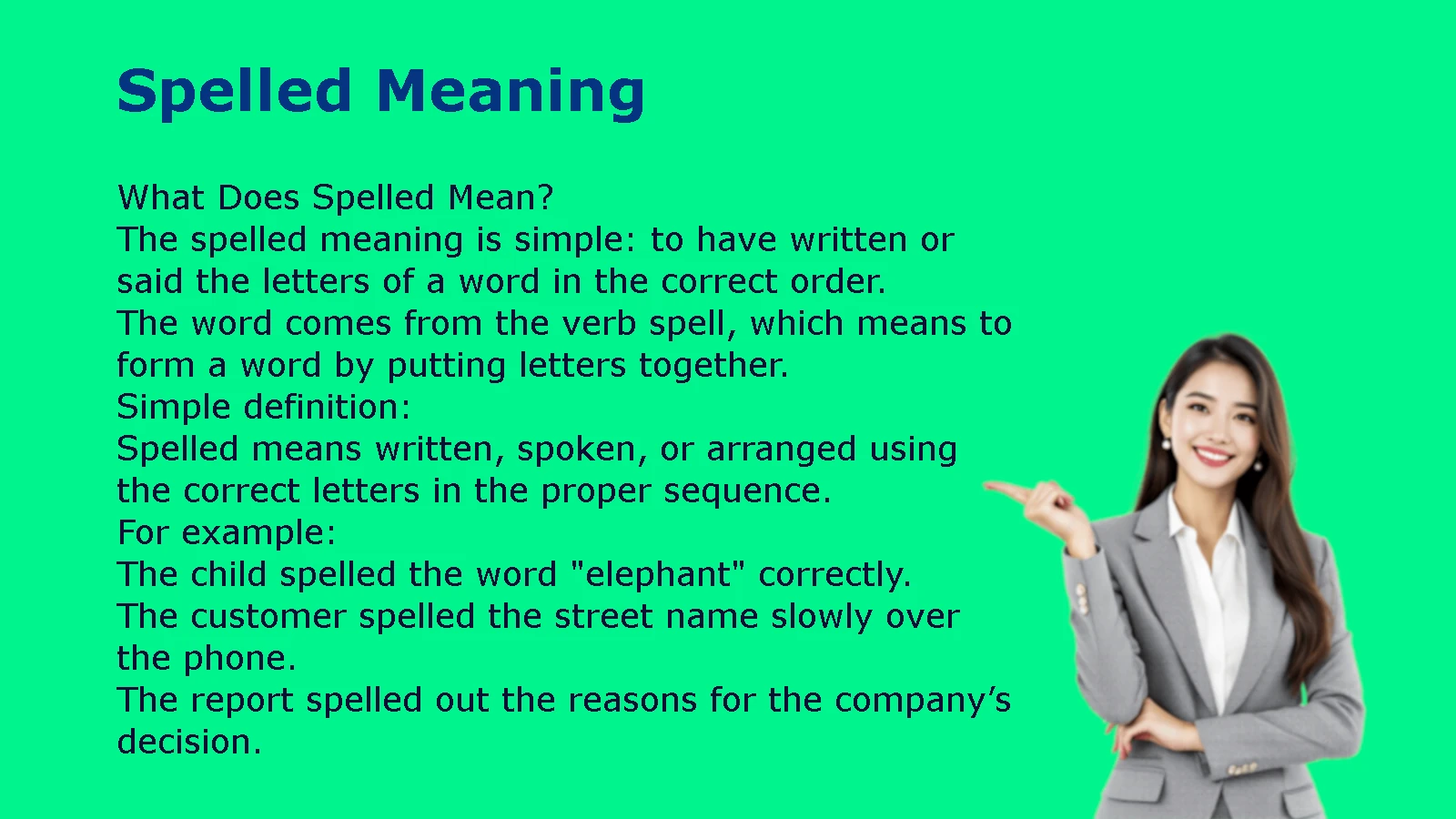
What Does Spelled Mean?
The spelled meaning is simple: to have written or said the letters of a word in the correct order.
The word comes from the verb spell, which means to form a word by putting letters together.
Simple definition:
Spelled means written, spoken, or arranged using the correct letters in the proper sequence.
For example:
- The child spelled the word “elephant” correctly.
- The customer spelled the street name slowly over the phone.
- The report spelled out the reasons for the company’s decision.
The meaning changes slightly depending on how it appears in a sentence.
| Usage | Meaning | Example |
| Spelled a word | Put letters together correctly | She spelled “beautiful” correctly. |
| Spelled a name | Said or wrote the letters of a name | He spelled his last name for the receptionist. |
| Spelled out | Explained something clearly | The manager spelled out the new rules. |
Spelled Definition in English Grammar
In English grammar, spelled is a verb form of spell. It works as both the simple past tense and the past participle.
Simple past tense:
The simple past tense describes something that happened in the past.
Examples:
- I spelled the word incorrectly yesterday.
- She spelled every answer correctly during the test.
- They spelled the instructions clearly in the email.
Past participle:
The past participle appears with helping verbs such as:
- have
- has
- had
- was
- were
Examples:
- I have spelled your name correctly.
- The word has been spelled differently in older dictionaries.
- The instructions were spelled out clearly.
What Is the Difference Between Spell and Spelled?
Many learners confuse spell and spelled because they describe the same action. The difference comes from time.
Spell refers to the present or general action.
Spelled refers to an action that already happened or has been completed.
Spell Meaning
Spell is the base form of the verb.
You use it when something happens now, happens regularly, or represents a general ability.
Examples:
- I can spell my name easily.
- Can you spell that word?
- Children learn how to spell new vocabulary words in school.
Spelled Meaning
Spelled shows that the spelling action happened in the past.
Examples:
- I spelled your name wrong earlier.
- She spelled all 20 words correctly.
- The student spelled the difficult word without help.
Spell vs. Spelled Comparison Table
| Word | Grammar Form | When to Use | Example |
| Spell | Present tense | Current or repeated actions | I spell my name carefully. |
| Spelled | Past tense | Completed action | I spelled my name for the clerk. |
| Spelled | Past participle | Used with helping verbs | I have spelled the word correctly. |
A quick trick:
- If the action is happening now, use spell.
- If the action already happened, use spelled.
How to Use Spelled Correctly in a Sentence
Using spelled correctly depends on the sentence structure. Since it describes a completed action, it usually connects with something that happened before the moment of speaking.
Using Spelled With a Subject
The most common structure looks like this:
Subject + spelled + object
Examples:
- Maria spelled her name correctly.
- The student spelled every vocabulary word.
- The employee spelled the customer’s address carefully.
The subject performs the action, and the object receives the action.
Using Spelled With Helping Verbs
The word spelled often appears with helping verbs to show completed actions.
Common combinations include:
- have spelled
- has spelled
- had spelled
- was spelled
- were spelled
Examples:
- You have spelled the answer correctly.
- The company name has been spelled incorrectly on the website.
- The instructions had been spelled out before the meeting.
Negative Sentences With Spelled
To make a negative sentence, add words like did not, has not, or have not.
Examples:
- She did not spell the word correctly.
Notice something important: after did not, use the base form spell, not spelled.
Incorrect:
❌ She did not spelled the word correctly.
Correct:
✅ She did not spell the word correctly.
Other examples:
- I have not spelled his name correctly before.
- They had not spelled the instructions clearly.
Questions Using Spelled
Questions usually use helping verbs before the subject.
Examples:
- Did you spell my name correctly?
- Have you spelled all the words?
- Had she spelled the answer before checking?
A common mistake is adding spelled after did.
Incorrect:
❌ Did you spelled the word?
Correct:
✅ Did you spell the word?
Spelled vs. Spelt: What’s the Difference?
One of the most common questions about spelled meaning is whether spelled and spelt mean the same thing.
The answer is yes. Both words are correct.
The difference mainly comes from regional English preferences.
Is Spelt a Correct Word?
Yes. Spelt is a correct past tense and past participle form of spell, especially in British English.
Examples:
- She spelt her name correctly. (British English)
- He spelt the word wrong during the competition. (British English)
However, American English usually prefers spelled.
Spelled vs. Spelt in American and British English
English changes depending on where people use it. Words like color/colour, center/centre, and spelled/spelt show these regional differences.
| Feature | Spelled | Spelt |
| American English | Most common | Less common |
| British English | Accepted | Very common |
| Formal writing | Correct | Correct in UK writing |
| Meaning | Same | Same |
Examples:
American English:
The student spelled every word correctly.
British English:
The student spelt every word correctly.
Neither sentence is wrong. The choice depends on your audience.
Which Should You Use: Spelled or Spelt?
For writers, students, and businesses targeting an American audience, spelled is usually the safer choice.
Use spelled when writing:
- American school assignments
- Business emails
- Websites targeting US readers
- Professional documents
- Academic papers
Use spelt when writing for audiences in places where British English is standard, such as:
- The United Kingdom
- Australia
- New Zealand
- Some other Commonwealth countries
A simple guideline:
If your readers expect American English, choose “spelled.” If they use British English, “spelt” may sound more natural.
Examples of “Spelled” in Sentences
Understanding the spelled meaning becomes easier when you see how people use the word in real situations. The word appears in classrooms, workplaces, conversations, and formal writing.
Below are examples from different settings.
Everyday Conversation Examples
In daily conversations, people often use spelled when asking about names, places, or unfamiliar words.
Examples:
- Can you tell me how you spelled your last name?
- I think I spelled that word incorrectly.
- She spelled the restaurant name so I could find it online.
- He spelled the address letter by letter over the phone.
- I forgot how you spelled your hometown.
When people communicate verbally, spelling becomes especially important because many words sound similar but look different when written.
For example:
- “Their” and “there”
- “Two,” “to,” and “too”
- “Your” and “you’re”
A person may pronounce these words correctly but still need to check how they are spelled.
Spelled Examples in School and Education
Students use the word spelled frequently because spelling is a key part of learning language skills.
Examples:
- The teacher praised Sarah because she spelled every vocabulary word correctly.
- The student lost points because he spelled several answers incorrectly.
- The class practiced words that were difficult to spell.
- The teacher explained how each word should be spelled.
- The spelling bee winner had spelled hundreds of challenging words before the final round.
In schools, correct spelling helps students develop:
- Reading skills
- Writing confidence
- Vocabulary knowledge
- Communication ability
A strong understanding of spelling also helps students recognize patterns in English, such as silent letters and common word endings.
Spelled Examples in Workplace Communication
Professional communication requires accuracy. A small spelling mistake in an email, report, or presentation can change meaning or make a message appear careless.
Examples:
- The manager noticed that the client’s name was spelled incorrectly in the contract.
- Please check that all employee names are spelled correctly.
- The company’s address was spelled incorrectly on the invoice.
- The instructions were spelled out clearly in the employee handbook.
- The report has been carefully spelled out to avoid confusion.
Businesses often double check:
- Customer names
- Product names
- Legal documents
- Website content
- Financial records
Correct spelling shows attention to detail.
Common Expressions That Use “Spelled”
The word spelled appears in many common phrases. Each phrase has a slightly different meaning.
Spelled Correctly Meaning
Spelled correctly means a word contains the right letters in the right order.
Examples:
- She spelled correctly every word on the test.
- Make sure your email address is spelled correctly before submitting the form.
- The website will not work if the username is not spelled correctly.
This phrase is common in education, technology, and everyday writing.
Spelled Wrong Meaning
Spelled wrong means a word contains incorrect letters or an incorrect letter arrangement.
Examples:
- I spelled wrong the name of the company in my email.
- The student noticed that he had spelled wrong several words.
However, in formal English, people usually say:
- spelled incorrectly
- misspelled
Examples:
- The name was spelled incorrectly.
- The customer’s address was misspelled.
Correctly Spelled Meaning
The phrase correctly spelled works as an adjective phrase describing something written accurately.
Examples:
- Please provide your correctly spelled name.
- The dictionary contains thousands of correctly spelled words.
- The form requires a correctly spelled address.
Misspelled Meaning
Misspelled means written with incorrect spelling.
Examples:
- I accidentally misspelled her name.
- The article contained a few misspelled words.
- The student corrected the misspelled vocabulary terms.
Common reasons people misspell words include:
- Confusing similar sounding words
- Forgetting silent letters
- Typing too quickly
- Learning a new language
- Relying too much on autocorrect
What Does “Spelled Out” Mean?
The phrase spelled out has two meanings.
The first meaning relates directly to letters. The second meaning relates to explaining something clearly.
Spelled Out Meaning: Writing Letters
When you spell out a word, you say or write each letter separately.
Example:
The receptionist asked me to spell out my name.
This means:
The receptionist wanted me to say each letter individually.
For example:
Name: Daniel
Spelled out:
D A N I E L
Spelled Out Meaning: Explained Clearly
The phrase spelled out can also mean explaining something in detail.
Examples:
- The teacher spelled out the assignment requirements.
- The contract spelled out the rules and responsibilities.
- The manager spelled out the company’s expectations.
In this meaning, nobody is talking about letters. Instead, the phrase means making something easy to understand.
Think of it like turning on a bright flashlight in a dark room. A complicated idea becomes clearer.
Spelled vs. Spelled Out: Key Difference
| Phrase | Meaning | Example |
| Spelled | Written using correct letters | She spelled the word correctly. |
| Spelled out | Said letters individually | He spelled out his name. |
| Spelled out | Explained clearly | The guide spelled out the instructions. |
Common Mistakes When Using “Spelled”
Although spelled seems simple, many people make grammar mistakes with it.
Understanding these mistakes helps you use the word naturally.
Mistake: Using Spelled After “Did”
One of the most common errors happens with past tense questions and negative sentences.
Incorrect:
❌ Did you spelled the word correctly?
Correct:
✅ Did you spell the word correctly?
Why?
The helping verb did already shows past tense, so the main verb stays in its base form.
More examples:
Incorrect:
❌ She did not spelled my name correctly.
Correct:
✅ She did not spell my name correctly.
Mistake: Confusing Spell and Spelled
People sometimes use spell when they need spelled.
Incorrect:
❌ Yesterday, I spell the word incorrectly.
Correct:
✅ Yesterday, I spelled the word incorrectly.
The word yesterday tells you the action happened in the past.
Mistake: Assuming Spelt Is Wrong
Some writers believe spelt is always incorrect. That is not true.
Both forms exist:
- She spelled the word correctly. (American English)
- She spelt the word correctly. (British English)
The important thing is consistency.
A document written in American English should usually use spelled throughout.
Mistake: Confusing Spelled With Pronounced
Spelling and pronunciation are connected, but they are not the same.
Spelling focuses on letters.
Pronunciation focuses on sounds.
Example:
The word colonel is:
- Spelled: C O L O N E L
- Pronounced: “kernel”
English has many words where spelling and pronunciation do not match perfectly.
Synonyms and Related Words for Spelled
Finding exact synonyms for spelled can be difficult because the word has a specific meaning. However, several related words work in certain situations.
Words Related to Spelled
| Word | Meaning | Example |
| Written | Put into text | She written the answer. |
| Lettered | Made using letters | The sign was lettered clearly. |
| Misspelled | Written incorrectly | He misspelled the word. |
| Typed | Entered using a keyboard | She typed the name correctly. |
| Recorded | Saved in written form | The information was recorded. |
Note: These words do not always replace spelled.
For example:
- “She spelled the word correctly” means she arranged letters correctly.
- “She wrote the word correctly” only means she put it on paper.
The meanings overlap but are not identical.
Grammar Rules for “Spelled”
Understanding the grammar behind spelled helps you avoid mistakes.
Spelled as a Past Tense Verb
Use spelled when describing a completed action.
Formula:
Subject + spelled + object
Examples:
- He spelled the difficult word.
- She spelled the customer’s name.
- They spelled every answer correctly.
Spelled as a Past Participle
Use spelled with helping verbs.
Examples:
- I have spelled the name correctly.
- The word has been spelled differently over time.
- The instructions were spelled out clearly.
Active Voice Examples With Spelled
Active voice makes sentences clearer because the subject performs the action.
Examples:
- The student spelled the word correctly.
- The author spelled the character’s name carefully.
- The assistant spelled the client’s information.
Passive Voice Examples With Spelled
Passive voice focuses on the action rather than who performed it.
Examples:
- The name was spelled incorrectly.
- The word was spelled differently in older versions.
- The instructions were spelled out in the document.
Passive voice can be useful when the person responsible is unknown or unimportant.
Subject Verb Agreement With Spelled
Because spelled is a past tense verb, it does not change based on the subject.
Examples:
- I spelled the word.
- You spelled the word.
- She spelled the word.
- They spelled the word.
Unlike present tense verbs, the past form stays the same.
Is “Spelled” a Verb or an Adjective?
The primary spelled meaning comes from its role as a verb. It is the past tense and past participle form of the verb spell.
However, in some sentences, spelled can function like an adjective because it describes a noun.
Spelled as a Verb
As a verb, spelled shows an action.
Examples:
- She spelled the word correctly.
- The student spelled all the answers.
- I have spelled your name exactly as requested.
In these examples, spelled describes something someone did.
Spelled as an Adjective
Although less common, spelled can describe something related to spelling.
Examples:
- The correctly spelled words received extra points.
- The worksheet contained clearly spelled examples.
- The document included properly spelled names.
Here, spelled works with another word to describe a noun.
For example:
The correctly spelled word was added to the dictionary.
The phrase correctly spelled describes the word.
Why Correct Spelling Matters
Correct spelling may seem like a small detail, but it plays a major role in communication. Words are the building blocks of ideas. When letters appear in the wrong order, readers may misunderstand your message.
Good spelling helps you:
- Communicate ideas clearly
- Build credibility
- Avoid confusion
- Write professionally
- Improve reading skills
Consider these two examples:
The company accepted the proposal.
The company excepted the proposal.
The spelling difference changes the meaning completely.
One small letter can change the entire message.
Real Life Examples Where Spelling Makes a Difference
Example: Professional Emails
Imagine sending a job application with the company name misspelled.
A hiring manager may wonder whether you paid attention to details.
Correct:
Dear Microsoft Hiring Team,
Incorrect:
Dear Microsft Hiring Team,
The mistake does not mean someone lacks ability, but careful spelling creates a stronger first impression.
Example: Online Searches
Search engines depend heavily on written words.
If you search for a misspelled term, you may:
- Find fewer results
- See unrelated information
- Miss important resources
Correct spelling improves your chances of finding accurate information.
Example: Names and Personal Information
Names are especially important because they represent identity.
A small spelling error can create problems with:
- Official documents
- Travel records
- School certificates
- Bank accounts
- Business agreements
That is why people often ask:
“How is your name spelled?”
rather than assuming.
Frequently Asked Questions About Spelled Meaning
Is “spelled” a real word?
Yes, spelled is a standard English word. It is the past tense and past participle form of spell.
Examples:
- She spelled the answer correctly.
- The word has been spelled incorrectly.
What does spelled mean?
Spelled means written or said using the correct letters in the correct order.
For example:
He spelled his name for the receptionist.
This means he said each letter of his name.
What is the past tense of spell?
The past tense of spell is usually spelled in American English.
Example:
Present:
I spell my name.
Past:
I spelled my name.
In British English, spelt is also commonly used.
Is spelled American English?
Yes. Spelled is the most common form in American English.
American writers usually use:
She spelled the word correctly.
British writers may use:
She spelt the word correctly.
Both forms are correct.
Is spelt wrong?
No. Spelt is not wrong.
It is a recognized English word and is widely used in British English.
The choice depends on your audience.
| Audience | Recommended Form |
| United States | Spelled |
| United Kingdom | Spelt or Spelled |
| International business writing | Usually Spelled |
How do you use spelled in a sentence?
Use spelled when talking about a completed spelling action.
Examples:
- I spelled the word correctly.
- She spelled my name wrong.
- They have spelled the instructions clearly.
What does “spelled out” mean?
Spelled out has two meanings:
- Saying letters individually.
Example:
Please spell out your email address.
- Explaining something clearly.
Example:
The teacher spelled out the rules before the exam.
Can you use spelled in formal writing?
Yes. Spelled works perfectly in formal writing.
Examples:
- The applicant’s name was spelled incorrectly.
- The terms were spelled out in the agreement.
- The report has spelled out the required procedures.
Quick Reference: Spelled Meaning Guide
| Question | Answer |
| Word type | Verb |
| Base form | Spell |
| Past tense | Spelled |
| Past participle | Spelled |
| British alternative | Spelt |
| Main meaning | Written with correct letters |
| Common phrase | Spelled correctly |
| Another phrase | Spelled out |
Key Takeaways About Spelled Meaning
The word spelled may look simple, but understanding its correct usage helps you communicate with confidence.
Here are the most important points:
- Spelled is the past tense and past participle of spell.
- It means writing or saying letters in the correct order.
- Use spell for present actions and spelled for completed actions.
- American English prefers spelled, while British English often uses spelt.
- The phrase spelled out can mean either saying letters individually or explaining something clearly.
- Avoid using spelled after did because the correct form is the base verb spell.
- Correct spelling improves clarity in school, work, and everyday communication.
Conclusion: Understanding the Meaning of Spelled
The spelled meaning connects to one of the most basic yet important parts of English: putting letters together correctly to create words.
Whether you are writing an email, completing a school assignment, filling out a form, or learning English, knowing how to use spelled correctly makes your communication stronger.
Remember the simple rule:
Spell describes what you do now.
Spelled describes what you already did.
For American English readers, spelled is the standard choice. If you understand when and why to use it, you can avoid common grammar mistakes and write with greater accuracy.