
Have you ever come across the term Crossword Meaning while solving a puzzle or reading an online clue and wondered what it actually means? You’re not alone. Many people search for the meaning of crossword, crossword definition, or the answer behind a tricky clue because crossword puzzles often use words in unexpected ways.
A crossword is a word puzzle in which players fill a grid with words based on clues. The words are arranged both across and down, crossing each other at shared letters. Crosswords are commonly found in newspapers, magazines, books, and online puzzle games.
Examples:
- I solve the crossword every morning with my coffee.
- She finished the difficult crossword puzzle in less than an hour.
The challenge is that a single crossword clue can have multiple answers depending on the puzzle’s theme, letter count, or context. And here’s the kicker: misunderstanding the crossword meaning can make even the easiest puzzle surprisingly difficult.
In this article, you’ll learn the Crossword Meaning, explore its definition, discover how crossword clues are interpreted, and understand the difference between a word’s everyday meaning and its crossword answer. You’ll also find crossword examples, common clue patterns, and tips for solving puzzles more confidently.
What Does Crossword Mean?
The crossword meaning is simple.
A crossword is a word puzzle in which you fill words into a grid of white squares by solving clues. The answers run horizontally (across) and vertically (down), and many letters are shared where the words intersect.
In modern English, people often use the words crossword and crossword puzzle interchangeably.
Quick Definition: A crossword is a word puzzle that requires players to complete intersecting words using written clues.
Unlike guessing games that rely on luck, crossword puzzles reward reasoning, vocabulary, spelling, and pattern recognition.
Crossword Meaning at a Glance
| Term | Meaning |
| Crossword | A puzzle made of intersecting words solved using clues. |
| Crossword Puzzle | The complete game that includes the grid and clue list. |
| Crossword Clue | A hint that helps the player find the correct answer. |
| Crossword Grid | The arrangement of white and black squares where answers are entered. |
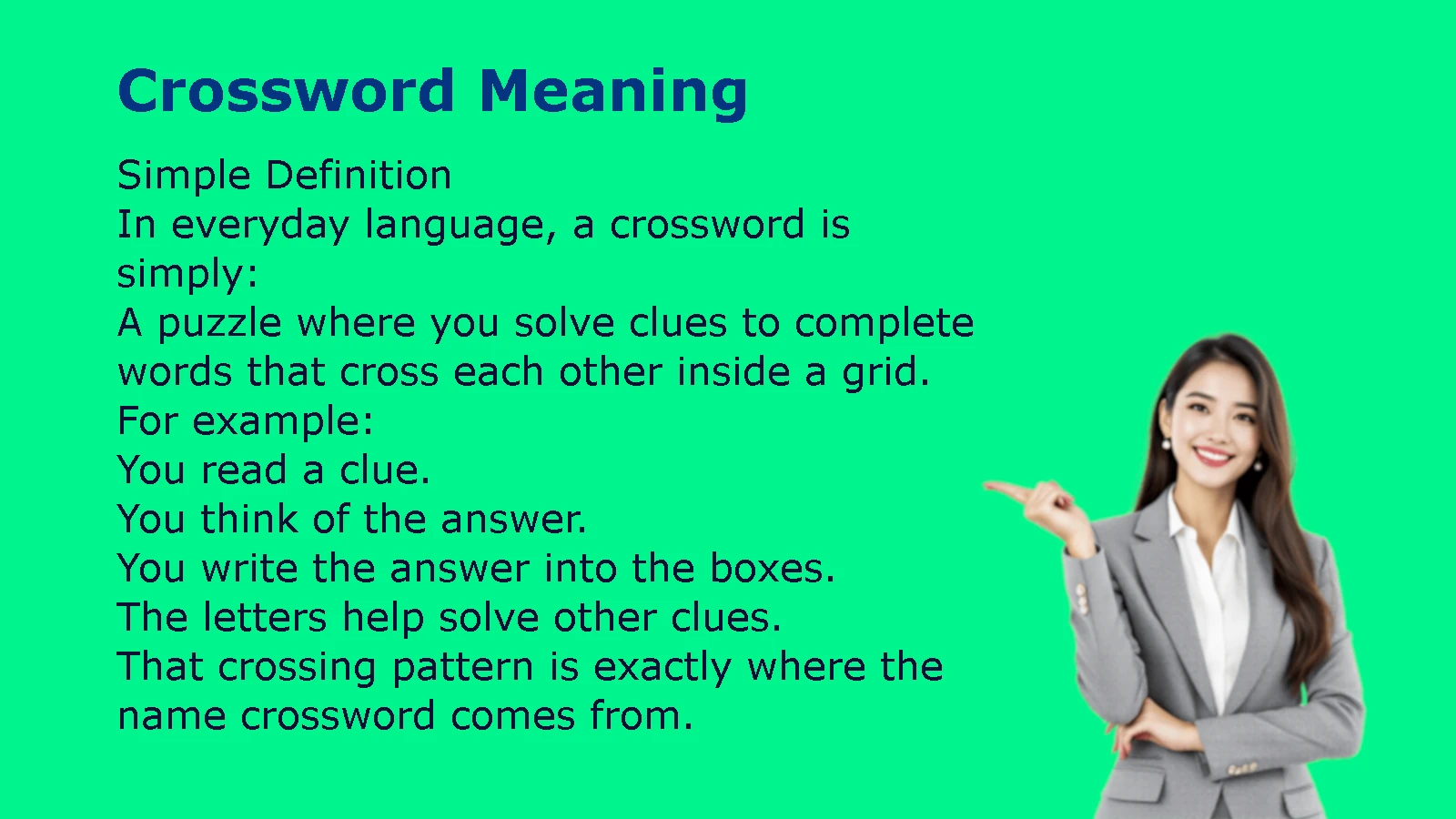
Simple Definition
In everyday language, a crossword is simply:
A puzzle where you solve clues to complete words that cross each other inside a grid.
For example:
- You read a clue.
- You think of the answer.
- You write the answer into the boxes.
- The letters help solve other clues.
That crossing pattern is exactly where the name crossword comes from.
Crossword Meaning in Simple Words
Imagine a giant tic-tac-toe board filled with empty boxes. Instead of writing X’s and O’s, you write words.
Each word connects with another word by sharing one or more letters.
For example:
C A T
A
R
The word CAT shares the letter A with CAR.
That shared letter helps players solve multiple clues at once.
This design makes crossword puzzles different from many other word games because every correct answer supports another answer somewhere else in the puzzle.
A Real-Life Example
Suppose you see this clue:
Across: A pet that says “meow.” (3)
The answer is:
CAT
Now another clue starts with the letter A from CAT.
Down: Flying vehicle. (9)
Because one letter is already filled in, finding the second answer becomes easier.
This interconnected system makes crossword puzzles both logical and satisfying.
Crossword Pronunciation
The word crossword is easy to pronounce once you divide it into two parts.
| Pronunciation | IPA |
| Crossword | /ˈkrɔːsˌwɝːd/ (American English) |
Syllable Breakdown
Cross • word
It sounds like:
KROSS-wurd
The first syllable receives the strongest emphasis.
Pronunciation Tips
Many English learners accidentally separate the word too much.
Instead of saying:
Cross…Word
Native speakers usually pronounce it smoothly as one word.
Practice saying:
- crossword puzzle
- daily crossword
- crossword clue
- crossword answer
Repeating these phrases naturally improves pronunciation.
Crossword Definition in Dictionaries
Major English dictionaries define crossword in nearly the same way.
Although wording varies slightly, every definition highlights three essential ideas:
- A puzzle
- Words intersect
- Clues help find the answers
Dictionary Comparison
| Dictionary | Definition Summary |
| Merriam-Webster | A puzzle consisting of numbered squares solved from clues. |
| Cambridge Dictionary | A word puzzle where answers fit into horizontal and vertical spaces. |
| Collins Dictionary | A puzzle made from crossing words solved using clues. |
| Oxford Languages | A puzzle in which words intersect inside a grid according to clues. |
Common Elements Found in Every Definition
Every trusted dictionary agrees that a crossword includes:
- Written clues
- A rectangular grid
- Across and down answers
- Shared letters
- Logical word placement
These common features distinguish crosswords from other puzzles.
Origin and History of Crossword Puzzles
The history of crossword puzzles is surprisingly fascinating.
Although people have enjoyed word games for centuries, the modern crossword puzzle is just over a hundred years old.
Who Invented the Crossword?
The modern crossword puzzle was created by Arthur Wynne, a British-born journalist.
He published the first known crossword puzzle on December 21, 1913, in the New York World newspaper.
Interestingly, Wynne originally called his puzzle a Word-Cross.
Later, due to a printing mistake, the title appeared as Cross-Word.
Readers liked the new name, and eventually it became Crossword.
What began as a single newspaper feature quickly became a worldwide phenomenon.
A Brief Timeline of Crossword History
| Year | Event |
| Before 1900 | Various word squares and letter puzzles existed. |
| 1913 | Arthur Wynne published the first modern crossword puzzle. |
| 1920s | Newspapers across America began publishing daily crosswords. |
| 1930s | Crossword books became bestsellers. |
| 1940s | Crosswords appeared in newspapers around the world. |
| Today | Digital crossword apps attract millions of daily users. |
Why Did Crosswords Become So Popular?
Crosswords spread rapidly because they offered something unique.
They were:
- Fun
- Affordable
- Educational
- Challenging
- Easy to print
- Suitable for all ages
Unlike many games, crossword puzzles required only paper and a pencil.
Families solved them together during breakfast.
Students used them to improve vocabulary.
Older adults enjoyed them as a relaxing mental exercise.
Today, smartphones have made crossword puzzles even more accessible.
Crosswords Around the World
Although crossword puzzles began in the United States, they quickly spread internationally.
Many countries now publish crosswords in their own languages.
Examples include:
| Country | Crossword Style |
| United States | Standard American crossword |
| United Kingdom | Cryptic and quick crosswords |
| Canada | American-style crosswords |
| Australia | Cryptic and themed puzzles |
| India | English newspaper crosswords |
| Japan | Adapted crossword formats using local writing systems |
Each country has developed its own traditions while keeping the same core concept of intersecting words and clues.
Why Is It Called a Crossword?
The name crossword describes exactly how the puzzle works.
The word combines two simple English words:
| Word | Meaning |
| Cross | To intersect or cross over another line. |
| Word | A meaningful group of letters. |
When placed together:
Cross + Word = Crossword
The answers cross each other inside the puzzle grid.
For example:
B I R D
O
G
The words share letters where they intersect.
Without those crossing points, the puzzle would simply be a list of unrelated words.
The intersecting design is what gives the crossword its unique identity.
Why Crossing Letters Matter
Shared letters make crossword puzzles easier and more challenging at the same time.
Suppose you’re unsure about one answer.
A crossing word may reveal the missing letter.
Likewise, entering one incorrect answer often creates problems elsewhere because every connected word depends on shared letters.
This clever design encourages careful thinking instead of random guessing.
Fun Fact: Many experienced solvers don’t complete clues in order. They fill the answers they know first, then use the crossing letters to solve the remaining clues.
How a Crossword Puzzle Works
At first glance, a crossword puzzle may look complicated.
Once you understand the basic structure, however, it becomes much easier to solve.
Every crossword consists of three main parts:
- The grid
- The clues
- The answers
Each plays an important role.
The Crossword Grid
The grid contains white and black squares.
- White squares hold letters.
- Black squares separate words.
The arrangement creates a network of horizontal and vertical answers.
Example:
⬜ ⬜ ⬜ ⬛ ⬜ ⬜
⬜ ⬛ ⬜ ⬜ ⬜ ⬛
⬜ ⬜ ⬜ ⬛ ⬜ ⬜
Although every puzzle looks different, the overall structure remains similar.
Across Clues
Across clues run from left to right.
Each clue begins at a numbered square.
For example:
1 Across: Opposite of cold. (3)
Answer:
HOT
Down Clues
Down clues begin at the same numbered squares but continue from top to bottom.
Example:
2 Down: Color of grass. (5)
Answer:
GREEN
Shared Letters
The most important feature of a crossword puzzle is that answers intersect.
Consider this simple example:
1 Across
C A T
│
2 Down
A P E
The shared A helps solve both words.
As more answers appear, solving the remaining clues becomes easier because each new letter provides another hint.
Crossword Puzzle Components
| Component | Purpose |
| Grid | Holds every answer |
| White Squares | Spaces where letters are written |
| Black Squares | Separate different words |
| Across Clues | Horizontal answers |
| Down Clues | Vertical answers |
| Numbers | Identify clue starting points |
| Clues | Hints that lead to answers |
| Answers | Words entered into the puzzle |
How People Usually Solve a Crossword
Most experienced solvers follow a simple strategy:
- Read all the clues first.
- Solve the easiest answers.
- Fill in known words.
- Use crossing letters to solve harder clues.
- Check spelling carefully.
- Review every answer before finishing.
This method reduces guessing and improves accuracy.
“A crossword isn’t just a puzzle. It’s a conversation between language, logic, and curiosity.”
The beauty of a crossword lies in its balance. Every clue invites you to think, every answer teaches you something new, and every completed grid delivers a genuine sense of accomplishment.
Types of Crossword Puzzles
Not every crossword puzzle looks or works the same way. Over the years, publishers and puzzle creators have developed several styles to suit different skill levels and interests.
Some crosswords focus on speed. Others challenge your vocabulary, logic, or wordplay. Knowing the different types helps you choose puzzles that match your experience.
Standard Crossword
The standard crossword is the most common type found in newspapers, books, and online puzzle platforms.
It includes:
- A square or rectangular grid
- Across and down clues
- Black squares that separate words
- Straightforward definitions or clues
This style works well for beginners and experienced solvers alike.
Best For
- Daily practice
- Vocabulary improvement
- Casual puzzle solving
Quick Crossword
A quick crossword uses simple clues with direct answers.
For example:
| Clue | Answer |
| Opposite of night | Day |
| Frozen water | Ice |
| Baby dog | Puppy |
Unlike more advanced puzzles, quick crosswords rarely use hidden meanings or wordplay.
Why People Like Them
- Easy to learn
- Fast to complete
- Great for children and English learners
Cryptic Crossword
A cryptic crossword is much more challenging.
Each clue contains two parts:
- A definition
- A hidden wordplay element
Instead of asking directly for the answer, cryptic clues require careful interpretation.
Example
Clue: Animal returned home (3)
The wording may involve reversing letters, abbreviations, or hidden words rather than providing a simple definition.
Because of their complexity, cryptic crosswords are especially popular in the United Kingdom.
American Crossword
The American crossword follows a distinctive design.
Common features include:
- Rotationally symmetrical grids
- Minimal black squares
- Every letter belongs to both an across and a down answer
- General knowledge and vocabulary clues
Many major newspapers publish daily American-style crosswords that increase in difficulty throughout the week.
British Crossword
British crosswords often include two formats:
- Quick crosswords
- Cryptic crosswords
They also tend to feature:
- More wordplay
- British spellings
- Local culture and history
- Clever linguistic tricks
For many puzzle enthusiasts, mastering British cryptic crosswords becomes a lifelong hobby.
Mini Crossword
Mini crosswords are exactly what they sound like.
They use small grids, often:
- 5 × 5
- 7 × 7
Because there are fewer clues, most people finish them in just a few minutes.
Mini crosswords are popular on mobile apps because they fit neatly into short breaks.
Themed Crossword
A themed crossword centers on one idea.
Possible themes include:
- Movies
- Sports
- Music
- Science
- Holidays
- Famous people
- Geography
For example, a holiday-themed crossword might include answers such as:
- Santa
- Reindeer
- Ornament
- Stocking
- Sleigh
The theme creates consistency and often helps solvers predict related answers.
Diagramless Crossword
A diagramless crossword removes one major advantage.
Instead of receiving a completed grid layout, players must determine where the black squares belong.
This style demands:
- Strong logic
- Careful planning
- Experience with crossword patterns
It is generally considered one of the most difficult crossword formats.
Crossword Types Comparison
| Type | Difficulty | Best For | Clue Style |
| Standard | Easy–Medium | Everyone | Direct definitions |
| Quick | Easy | Beginners | Simple clues |
| Cryptic | Hard | Experienced solvers | Wordplay |
| American | Medium | Daily practice | General knowledge |
| British | Medium–Hard | Language lovers | Direct and cryptic |
| Mini | Easy | Short sessions | Simple clues |
| Themed | Medium | Hobbyists | Topic-focused |
| Diagramless | Very Hard | Experts | Advanced solving |
Common Crossword Terms You Should Know
If you’re new to crossword puzzles, you’ll encounter certain words repeatedly.
Understanding these terms makes solving puzzles much easier.
Crossword Vocabulary
| Term | Meaning |
| Across | A clue answered from left to right |
| Down | A clue answered from top to bottom |
| Grid | The arrangement of puzzle squares |
| Clue | A hint leading to an answer |
| Entry | A completed answer in the grid |
| Fill | All the words placed in the puzzle |
| Theme | The central idea connecting answers |
| Rebus | Multiple letters placed inside one square |
| Check Letter | A letter shared by two intersecting words |
| Constructor | The person who creates the crossword |
| Solver | The person completing the puzzle |
Learning these terms helps you understand crossword instructions and discussions more easily.
What Is an Across Clue?
Across clues begin in a numbered square and continue horizontally.
Example:
5 Across: Opposite of old (3)
Answer:
NEW
Across clues always move from left to right.
What Is a Down Clue?
Down clues begin at numbered squares and continue vertically.
Example:
7 Down: Largest planet (7)
Answer:
JUPITER
Many answers become easier once several crossing letters are already in place.
What Is a Crossword Grid?
The grid forms the foundation of every crossword.
It includes:
- White squares
- Black squares
- Numbered starting points
- Intersecting words
Every answer fits into the available spaces without overlapping incorrectly.
What Is a Crossword Constructor?
The constructor designs the puzzle.
Their responsibilities include:
- Choosing a theme
- Creating clues
- Building the grid
- Checking word accuracy
- Balancing puzzle difficulty
Constructing a high-quality crossword often takes several hours or even days.
What Does a Crossword Clue Mean?
A crossword clue is a written hint that leads to the correct answer.
Good clues challenge the player without being unfair.
Some clues are straightforward.
Others require creative thinking.
Direct Clues
Direct clues simply define the answer.
Example:
| Clue | Answer |
| Red fruit | Apple |
| Flying mammal | Bat |
| Largest ocean | Pacific |
These clues are common in beginner puzzles.
General Knowledge Clues
These clues test what you know about the world.
Example:
| Clue | Answer |
| Capital of Italy | Rome |
| Chemical symbol for gold | Au |
| Fastest land animal | Cheetah |
General knowledge crosswords often include:
- History
- Geography
- Science
- Literature
- Sports
- Entertainment
Wordplay Clues
Wordplay clues involve puns, hidden meanings, abbreviations, or rearranged letters.
For example:
Instead of asking directly for “listen,” a clue may suggest rearranging the letters in silent.
These clues encourage lateral thinking rather than simple memorization.
Cryptic Clues
Cryptic clues combine:
- A definition
- A hidden puzzle
Example:
Mixed tea creates food. (3)
The clue may require rearranging letters before discovering the answer.
Cryptic clues often include:
- Anagrams
- Hidden words
- Reversals
- Homophones
- Letter substitutions
They reward careful reading and patience.
Crossword Meaning vs. Crossword Puzzle
Many people wonder whether these two terms mean exactly the same thing.
In everyday conversation, they usually do.
However, there is a subtle distinction.
| Crossword | Crossword Puzzle |
| Refers to the concept or type of word game | Refers to one complete puzzle with clues and a grid |
| Can describe the activity in general | Describes a specific puzzle |
| Often used informally | Slightly more precise |
Example
✅ I enjoy solving crosswords every morning.
✅ This crossword puzzle took an hour to finish.
Both sentences are correct.
Crossword vs. Other Word Puzzles
Crosswords belong to a larger family of word games.
Each puzzle type develops different skills.
Crossword vs. Word Search
| Crossword | Word Search |
| Requires clues | No clues needed |
| Words intersect | Words do not intersect |
| Builds vocabulary | Focuses on recognition |
| Requires reasoning | Requires observation |
Word searches are generally easier because the words are already hidden inside the grid.
Crossword vs. Scrabble
Although both involve words, they are very different.
| Crossword | Scrabble |
| Puzzle | Board game |
| Fixed clues | Players create words |
| One player or group | Competitive gameplay |
| Pre-designed answers | Unlimited strategies |
Scrabble emphasizes strategy and scoring, while crosswords emphasize clue-solving.
Crossword vs. Sudoku
These puzzles target different mental skills.
| Crossword | Sudoku |
| Uses letters | Uses numbers |
| Tests vocabulary | Tests logic |
| Language-based | Mathematics-based |
| Requires word knowledge | Requires pattern recognition |
Someone who enjoys one often enjoys the other because both encourage careful thinking.
Crossword vs. Fill-In Puzzle
Fill-in puzzles resemble crosswords but remove one important element.
| Crossword | Fill-In Puzzle |
| Includes clues | No clues provided |
| Requires solving | Requires fitting words |
| More challenging | More straightforward |
Without clues, fill-in puzzles become exercises in deduction rather than vocabulary.
Examples of Crossword in Sentences
Seeing the word used naturally makes its meaning easier to remember.
Here are several examples.
- I solve a crossword with my coffee every morning.
- My grandfather never misses the Sunday crossword.
- She completed the crossword before breakfast.
- The crossword clues became more difficult near the end.
- We worked together to finish the crossword puzzle.
- This crossword introduced several new vocabulary words.
- The newspaper publishes a fresh crossword every day.
- He enjoys solving cryptic crosswords during long flights.
- The crossword theme focused on famous inventors.
- My teacher created a crossword to review science terms.
- Completing a crossword helps improve spelling.
- She checked every crossword answer before submitting it.
- I downloaded a crossword app to practice English vocabulary.
- The mini crossword took less than five minutes.
- The crossword grid looked intimidating at first but became easier as the letters connected.
These examples demonstrate that crossword functions as a regular noun in English.
Synonyms and Related Words
There is no perfect synonym for the word crossword because it refers to a specific type of puzzle.
However, several closely related terms appear in dictionaries and everyday conversation.
Related Terms
- Crossword puzzle
- Word puzzle
- Puzzle
- Letter puzzle
- Vocabulary puzzle
- Brain teaser
- Logic puzzle
- Language puzzle
While these expressions are related, each describes a slightly different activity.
Vocabulary Associated with Crosswords
When reading about crossword puzzles, you’ll often encounter these words:
| Word | Connection |
| Grid | Layout of the puzzle |
| Clue | Hint for an answer |
| Solver | Person completing the puzzle |
| Constructor | Puzzle creator |
| Entry | Completed answer |
| Theme | Shared topic among clues |
| Vocabulary | Knowledge of words |
| Dictionary | Helpful solving reference |
| Pattern | Arrangement of letters |
| Intersect | Where words cross |
Building familiarity with this vocabulary makes it easier to understand puzzle instructions and improve your solving skills.
“Every crossword begins with empty squares, but each solved clue transforms uncertainty into understanding.”
That simple idea explains why crossword puzzles continue to captivate learners, students, and puzzle enthusiasts around the world.
Why Crossword Puzzles Are So Popular
Crossword puzzles have remained popular for more than a century, even as technology has transformed the way people spend their free time. Newspapers, magazines, websites, and mobile apps continue to publish new puzzles every day because they offer something few activities can match: entertainment combined with learning.
Unlike many games, crosswords don’t rely on speed or luck. They encourage you to think carefully, connect ideas, and expand your vocabulary while having fun.
Here are some of the biggest reasons people enjoy solving crosswords.
They Expand Your Vocabulary
Every puzzle introduces new words, phrases, abbreviations, and proper nouns.
For example, a crossword may teach you:
- Rare English words
- Historical figures
- Scientific terms
- Geographic locations
- Literary references
Over time, this repeated exposure naturally increases your vocabulary.
They Challenge Your Brain
Crossword puzzles encourage you to:
- Recall information
- Recognize word patterns
- Analyze clues
- Solve problems logically
Each completed clue builds momentum, making the puzzle increasingly satisfying.
They’re Relaxing
Many people solve crosswords as part of their daily routine.
Some enjoy one over breakfast. Others complete one before bed.
Because solving requires concentration, crosswords can provide a welcome break from everyday distractions.
They’re Suitable for All Ages
Crossword puzzles appeal to a wide audience.
- Children build spelling skills.
- Students improve vocabulary.
- Adults enjoy mental challenges.
- Older adults appreciate lifelong learning.
Publishers often create puzzles with different difficulty levels, making them accessible to nearly everyone.
Benefits of Solving Crossword Puzzles
Crosswords offer more than entertainment. They also help strengthen several language and thinking skills through regular practice.
Important: While crossword puzzles support mental engagement and learning, they should not be viewed as a treatment or guaranteed way to prevent medical conditions.
Improves Vocabulary
One of the most noticeable benefits is vocabulary growth.
Repeatedly encountering unfamiliar words encourages you to:
- Learn new definitions
- Understand synonyms
- Recognize antonyms
- Improve word recall
Even experienced readers discover new terms through crossword puzzles.
Strengthens Spelling
Correct spelling matters because every letter affects intersecting answers.
If one word is misspelled, several other clues may become impossible to solve.
As a result, crossword solvers naturally become more attentive to spelling accuracy.
Encourages Logical Thinking
Many clues require reasoning rather than memorization.
For example, you may know only part of an answer.
Using intersecting letters allows you to eliminate incorrect possibilities until only one solution remains.
This step-by-step process develops logical thinking.
Improves Pattern Recognition
Experienced solvers quickly recognize:
- Common letter combinations
- Word endings
- Prefixes
- Frequently used abbreviations
These patterns make future puzzles easier to solve.
Expands General Knowledge
Crossword puzzles regularly include questions about:
- History
- Geography
- Science
- Literature
- Sports
- Music
- Movies
- Nature
Even when you don’t know an answer, looking it up afterward becomes a valuable learning opportunity.
Supports Language Learning
Many English learners use crossword puzzles to practice:
- Vocabulary
- Reading comprehension
- Spelling
- Synonyms
- Idioms
Because clues appear in context, they often feel more engaging than memorizing word lists.
Encourages Patience and Persistence
Not every clue has an immediate answer.
Successful solvers often skip difficult clues, complete easier ones, and return later with fresh perspective.
This approach builds patience and problem-solving habits that extend beyond puzzles.
Crossword Skills and Their Benefits
| Crossword Activity | Skill Developed |
| Solving clues | Vocabulary |
| Filling the grid | Spelling |
| Using crossing letters | Logical reasoning |
| Recognizing themes | Pattern recognition |
| Looking up unknown answers | General knowledge |
| Completing daily puzzles | Consistency and focus |
Common Mistakes About the Meaning of Crossword
Although crossword puzzles are familiar to many people, misconceptions still exist.
Let’s clear up the most common ones.
Mistake: A Crossword Is the Same as a Word Search
These are completely different puzzle types.
A crossword requires solving clues before writing answers.
A word search asks you to locate words that are already hidden inside a grid.
Mistake: Every Crossword Is Cryptic
Many people assume all crossword clues contain hidden meanings.
In reality, most newspaper crosswords use direct clues that are much easier to understand.
Cryptic crosswords are only one specialized style.
Mistake: Crosswords Are Only for Experts
Modern crossword puzzles come in many difficulty levels.
Beginners can start with:
- Mini crosswords
- Quick crosswords
- Children’s crosswords
As vocabulary improves, more advanced puzzles become easier.
Mistake: You Need to Know Every Answer
No experienced solver knows every answer immediately.
Instead, they rely on:
- Crossing letters
- Logical deduction
- General knowledge
- Careful observation
That’s exactly how crossword puzzles are designed.
Case Study: How Daily Crosswords Improved Vocabulary
Background
Emma, a university student learning advanced English, wanted to improve her vocabulary without relying solely on textbooks.
Her Approach
She spent about 15 minutes each morning solving a quick crossword.
Whenever she encountered an unfamiliar word, she:
- Looked up its definition
- Wrote it in a notebook
- Used it in a sentence later that day
Results After Three Months
Emma noticed several improvements:
- She recognized more words while reading books.
- Her spelling became more accurate.
- She felt more confident completing vocabulary quizzes.
- She solved crossword clues faster than when she started.
The biggest lesson wasn’t that she memorized hundreds of words overnight. Instead, consistent exposure helped her remember vocabulary naturally through repetition and context.
Expert Insight
“Crossword puzzles reward curiosity. Every clue is an opportunity to learn something new, whether it’s a word, a historical fact, or a clever play on language.”
This explains why crossword puzzles have remained relevant for generations. They combine education with entertainment in a way that keeps learners engaged.
Tips for Solving Crossword Puzzles Faster
If you’re new to crosswords, these strategies can make the experience more enjoyable.
Start with Easy Clues
Build confidence by answering the clues you know first.
Each correct answer reveals more letters for neighboring words.
Look for Common Word Endings
Words ending in:
- -ING
- -ED
- -ER
- -TION
often become easier to identify once a few letters are visible.
Pay Attention to the Clue Length
Most crosswords tell you how many letters belong in the answer.
Use that information to eliminate unlikely choices.
Skip Difficult Clues
Don’t get stuck.
Move on to another clue and return later.
Fresh letters often reveal the answer naturally.
Practice Regularly
Like any skill, crossword solving improves with consistent practice.
Even solving one small puzzle each day can strengthen your vocabulary over time.
Frequently Asked Questions About Crossword Meaning
What does crossword mean?
A crossword is a word puzzle in which answers are written into a grid by solving clues. The words intersect horizontally and vertically.
Is crossword short for crossword puzzle?
Yes. In everyday English, crossword is commonly used as a shortened form of crossword puzzle.
Who invented the crossword puzzle?
The first modern crossword puzzle was created by Arthur Wynne and published in the New York World newspaper on December 21, 1913.
Why is it called a crossword?
The name comes from the way the answers cross one another inside the puzzle grid while forming complete words.
What is a crossword clue?
A crossword clue is a written hint that guides the solver toward the correct answer.
Are crossword puzzles good for learning English?
Yes. They can help learners expand vocabulary, reinforce spelling, and improve familiarity with synonyms, idioms, and common expressions.
What is the difference between a crossword and a word search?
A crossword requires solving clues before writing answers into a grid. A word search asks you to find words that are already hidden among random letters.
Can beginners solve crossword puzzles?
Absolutely. Many publishers create beginner-friendly crosswords with simple clues and smaller grids, making them ideal for new solvers.
Key Takeaways
- Crossword meaning refers to a word puzzle where intersecting answers are completed using written clues.
- The modern crossword puzzle was introduced by Arthur Wynne in 1913.
- Crossword puzzles come in several forms, including quick, standard, cryptic, themed, mini, and diagramless versions.
- Solving crosswords regularly helps improve vocabulary, spelling, logical thinking, and general knowledge.
- A crossword differs from other word games because every answer connects with another through shared letters.
- People of all ages enjoy crosswords because they combine learning, entertainment, and problem-solving in a single activity.
Conclusion
Understanding the crossword meaning goes beyond memorizing a simple dictionary definition. A crossword is a carefully designed word puzzle that blends language, logic, and creativity into an engaging challenge. Every clue encourages you to think critically, while every intersecting answer strengthens your understanding of words and their relationships.
From its beginnings in 1913 to today’s digital puzzle apps, the crossword has remained one of the world’s most enduring word games. Whether you solve a quick five-minute puzzle or spend an afternoon tackling a challenging cryptic grid, each completed crossword offers an opportunity to learn something new.
If you’re just getting started, begin with an easy puzzle and make it part of your routine. Over time, you’ll build a stronger vocabulary, sharpen your problem-solving skills, and gain a deeper appreciation for one of the most beloved language puzzles ever created.