
Have you ever done something quietly and wondered if anyone even noticed? While Unnoticed Meaning may seem simple, this word can describe more than something that goes unseen. It can refer to a person, action, change, feeling, or detail that exists without receiving attention or recognition.
Unnoticed is an adjective used to describe something that is not seen, observed, recognized, or given attention. It is often used when something happens without people becoming aware of it.
Examples:
- Her small act of kindness went unnoticed.
- The changes in the room were almost unnoticed.
The confusion is understandable. People often search for what does unnoticed mean, unnoticed meaning in a sentence, unnoticed meaning in text, or what does it mean to go unnoticed because the word can describe different situations depending on the context, tone, and subject
Unnoticed Meaning and Definition
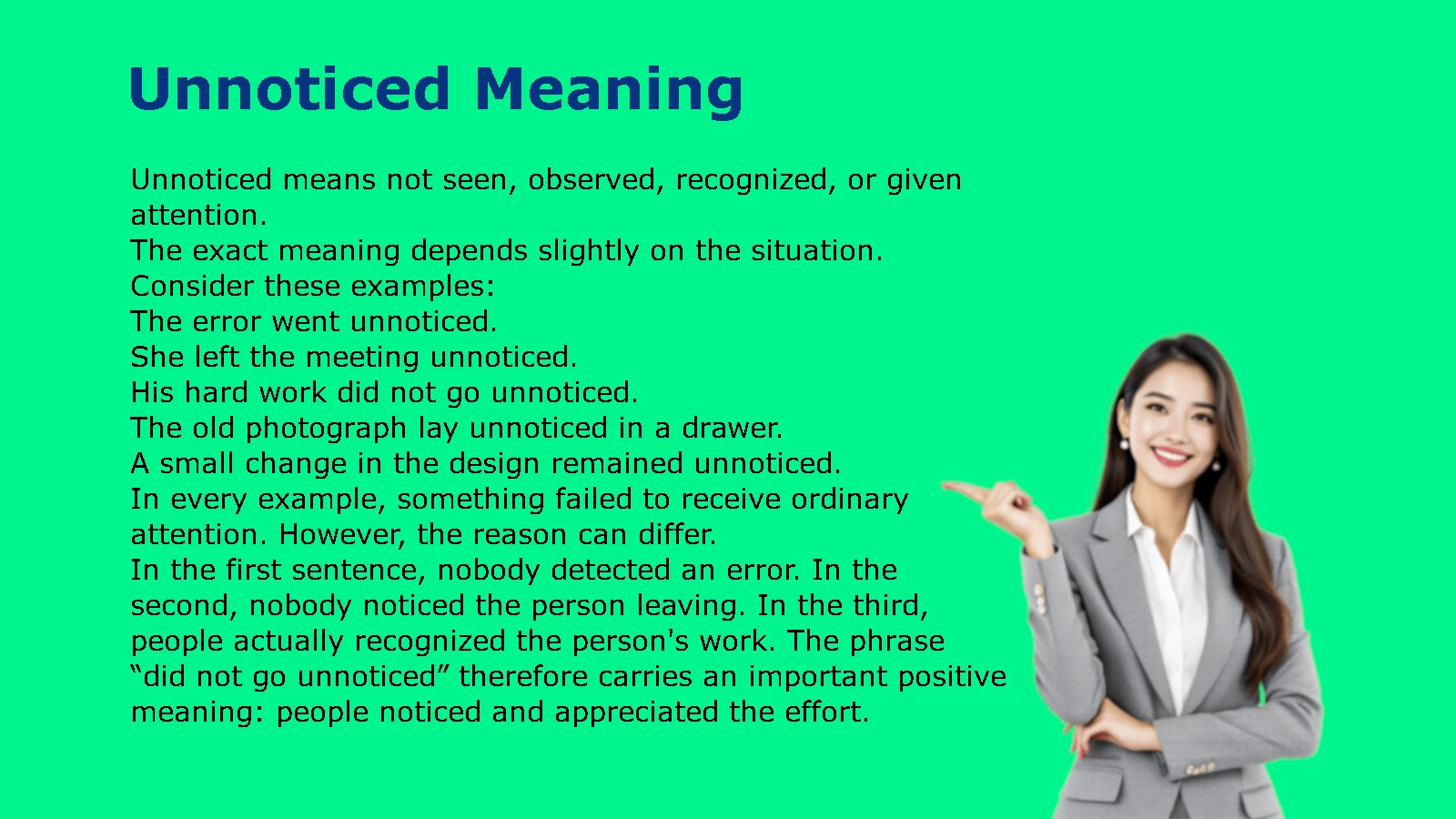
Unnoticed means not seen, observed, recognized, or given attention.
The exact meaning depends slightly on the situation. Consider these examples:
- The error went unnoticed.
- She left the meeting unnoticed.
- His hard work did not go unnoticed.
- The old photograph lay unnoticed in a drawer.
- A small change in the design remained unnoticed.
In every example, something failed to receive ordinary attention. However, the reason can differ.
Oxford gives examples such as a person’s kindness not going unnoticed, a death passing almost unnoticed, and a ticket lying unnoticed in a desk drawer. These examples show how broadly the word works in everyday English.
Simple Definition of Unnoticed
Unnoticed means not seen or noticed by someone.
You can think of it as the opposite of something that catches your attention.
Imagine a crowded room. A person wearing a bright red jacket may immediately attract attention. A tiny pencil lying under a chair probably won’t. If nobody sees the pencil, it remains unnoticed.
The important point is that unnoticed does not necessarily mean invisible.
Something can sit in plain sight and still go unnoticed.
What Does Unnoticed Mean in Simple English?
In simple English, unnoticed means that nobody notices something.
Here are a few easy examples:
| Sentence | What it means |
| The mistake went unnoticed. | Nobody saw the mistake. |
| She slipped away unnoticed. | Nobody noticed her leaving. |
| His kindness didn’t go unnoticed. | People noticed his kindness. |
| The letter remained unnoticed. | Nobody noticed the letter. |
| The change passed unnoticed. | Nobody paid attention to the change. |
This distinction matters because unnoticed describes the result of someone’s attention, not necessarily the nature of the thing itself.
A tiny mark might be hard to notice. Yet a large object can also remain unnoticed if everyone is distracted.
For instance:
The missing chair went unnoticed during the busy event.
A chair isn’t normally difficult to see. The surrounding activity simply distracted everyone.
Unnoticed Pronunciation
The US pronunciation of unnoticed is:
/ʌnˈnoʊ.t̬ɪst/
It sounds roughly like:
un-NOH-tist
The main stress falls on the second part, NOH.
Cambridge lists the US pronunciation as /ʌnˈnoʊ.t̬ɪst/ and the UK pronunciation as /ʌnˈnəʊ.tɪst/.
How to Say Unnoticed
Break the word into two parts:
- un
- noticed
The first part sounds like un, while the second comes from noticed.
In natural speech, the word often appears at the end of a phrase:
The small detail went unnoticed.
She quietly left unnoticed.
Is Unnoticed an Adjective or Adverb?
Unnoticed is primarily used as an adjective, although Cambridge also labels it as an adverb in its dictionary entry. Oxford’s learner dictionary classifies it as an adjective and marks it as a word that isn’t normally used before a noun.
This can seem confusing because unnoticed often appears after a verb.
Consider:
She left unnoticed.
Here, unnoticed describes the state in which she left. Nobody noticed her departure.
Another example is:
The problem remained unnoticed.
The word tells you the condition of the problem: nobody noticed it.
Why You Usually See Unnoticed After a Verb
Common structures include:
- go unnoticed
- remain unnoticed
- pass unnoticed
- lie unnoticed
- leave unnoticed
- slip away unnoticed
Oxford specifically lists verbs such as be, go, and lie among verbs commonly associated with unnoticed.
So instead of saying:
an unnoticed mistake
you can also say:
The mistake went unnoticed.
Both are correct, but the second structure emphasizes the fact that nobody detected the mistake.
How to Use Unnoticed in a Sentence
The easiest way to learn unnoticed is to look at the sentence patterns people actually use.
Go Unnoticed
Go unnoticed is one of the most common expressions.
It means that something happens or exists without attracting attention.
Examples:
- The spelling error went unnoticed.
- Her efforts often go unnoticed.
- The small change went unnoticed for several weeks.
- His contribution did not go unnoticed.
The expression works in both negative and positive contexts.
The mistake went unnoticed.
Here, unnoticed means nobody caught the mistake.
Her kindness did not go unnoticed.
Here, the speaker means people recognized her kindness.
Cambridge specifically uses the example “His contribution did not go unnoticed.”
Remain Unnoticed
Remain unnoticed means to continue without attracting attention.
For example:
The problem remained unnoticed for months.
This sentence suggests that the problem existed for a period of time while nobody recognized it.
You can also use the phrase when discussing objects:
The old photograph remained unnoticed in the drawer.
Oxford gives a similar example involving a ticket that remained unnoticed in a desk drawer for a week.
Pass Unnoticed
Pass unnoticed means to happen without people noticing or paying attention to it.
Examples include:
- The change passed unnoticed.
- Her birthday passed almost unnoticed.
- The mistake passed unnoticed during the first review.
- His absence passed unnoticed at first.
This expression often works well when something happens gradually or quietly.
Leave Unnoticed
You can also describe a person or thing as leaving without attracting attention.
She left the building unnoticed.
This means nobody noticed her departure.
The sentence doesn’t necessarily mean she deliberately hid. Perhaps everyone was busy. Perhaps she left quietly. The context determines the reason.
Slip Away Unnoticed
Slip away unnoticed has a slightly more vivid meaning.
It suggests that someone leaves quietly without attracting attention.
He slipped away unnoticed before the meeting ended.
Cambridge uses a similar construction in its example “We managed to slip away unnoticed.”
Unnoticed Examples in Sentences
Seeing the word in different contexts makes its meaning much easier to understand.
Everyday Examples
- The small crack in the window went unnoticed.
- She entered the room unnoticed.
- The note remained unnoticed on the table.
- His quiet smile went unnoticed.
- The missing book was unnoticed for several days.
- The change in the schedule passed unnoticed.
Workplace Examples
- The accounting error went unnoticed during the first review.
- Her extra effort didn’t go unnoticed.
- The manager noticed a problem that had previously gone unnoticed.
- His improvement in performance did not go unnoticed.
- A formatting mistake remained unnoticed until publication.
School Examples
- The teacher caught a detail that most students had left unnoticed.
- The missing page went unnoticed during the first check.
- Her careful research did not go unnoticed.
- A small error in the equation remained unnoticed.
Social Situations
- He left the party unnoticed.
- Her absence went unnoticed at first.
- She quietly helped everyone without seeking attention.
- His thoughtful gesture didn’t go unnoticed.
Writing and Literature
- The author included a small clue that went unnoticed on the first reading.
- The unusual detail remained unnoticed until the final chapter.
- A careful reader may notice details that others leave unnoticed.
These examples reveal an important pattern: unnoticed can describe objects, actions, mistakes, changes, contributions, people, and events.
“Go Unnoticed” Meaning
The phrase go unnoticed means to happen or exist without anyone noticing it.
It appears frequently in everyday speech and writing.
For example:
The typo went unnoticed.
This means nobody saw the typo.
Now compare:
Her hard work didn’t go unnoticed.
This means people did notice her hard work.
That second construction can confuse English learners because it contains the word unnoticed but communicates the opposite result.
Why “Did Not Go Unnoticed” Is Positive
Consider:
His efforts did not go unnoticed.
The phrase means:
People noticed his efforts.
It often implies appreciation or recognition.
You might use it when praising someone:
Your dedication hasn’t gone unnoticed.
Or in a workplace:
The team’s extra work did not go unnoticed by management.
The phrase can therefore be a warm way to acknowledge someone’s contribution without directly saying, “Everyone noticed what you did.”
“Pass Unnoticed” Meaning
Pass unnoticed means that something occurs without receiving attention.
For example:
The announcement passed unnoticed.
Nobody paid attention to it or recognized its importance.
The phrase often describes something that disappears into the background of a larger event.
Imagine a crowded meeting with dozens of comments. One useful suggestion might pass unnoticed because everyone focuses on a more dramatic argument.
That doesn’t mean the suggestion lacked value. It simply means that people didn’t recognize it at the time.
Unnoticed vs. Unnoticeable
These words look almost identical, but they aren’t interchangeable.
| Word | Meaning | Example |
| Unnoticed | Not noticed by someone | The error went unnoticed. |
| Unnoticeable | Difficult or unlikely to notice | The small mark was almost unnoticeable. |
The difference becomes clearer when you focus on the subject.
Unnoticed describes the outcome:
The mistake was unnoticed.
Nobody noticed it.
Unnoticeable describes the quality of the thing:
The difference was unnoticeable.
The difference was so small that it was difficult to detect.
Merriam Webster defines unnoticeable as something “not worthy or likely to be noticed” and gives examples involving tiny marks and subtle changes.
An Easy Way to Remember the Difference
Think of it this way:
Unnoticed = nobody noticed it.
Unnoticeable = it is hard to notice.
Something can be unnoticeable and therefore go unnoticed. However, something can also be perfectly noticeable yet still go unnoticed because nobody is paying attention.
For example:
The large sign went unnoticed because everyone was looking at their phones.
The sign wasn’t necessarily unnoticeable. People simply didn’t notice it.
Undetected often suggests that something hasn’t been discovered or identified.
| Word | Main idea | Example |
| Unnoticed | Nobody noticed it | The typo went unnoticed. |
| Undetected | Nobody detected or discovered it | The security flaw remained undetected. |
Merriam Webster defines undetected as something not observed, noticed, or detected.
The word undetected often appears in contexts involving problems, risks, flaws, illnesses, technical issues, or hidden activity.
For example:
The software bug remained undetected for months.
Meanwhile:
The typo remained unnoticed.
Both suggest that nobody caught something. The second sounds more general, while undetected places greater emphasis on discovery or detection.
Unnoticed vs. Ignored
Another important distinction is the difference between unnoticed and ignored.
If something is unnoticed, someone doesn’t notice it.
If something is ignored, someone may notice it but choose not to respond to it or give it attention.
Compare these sentences:
The warning went unnoticed.
This suggests that people didn’t see or recognize the warning.
The warning was ignored.
This suggests that people were aware of the warning but didn’t act on it.
The difference can be subtle, but it matters.
Quick Comparison
| Word | Was it noticed? | Was attention deliberately withheld? |
| Unnoticed | No | Not necessarily |
| Ignored | Usually yes | Often |
| Unseen | No | Not necessarily |
| Undetected | No | Not necessarily |
That’s why replacing unnoticed with ignored can change the meaning of a sentence.
Unnoticed vs. Unseen
Unseen generally emphasizes the fact that something wasn’t seen.
Unnoticed has a broader sense because noticing isn’t limited to eyesight.
For example:
The detail remained unnoticed.
Someone might have looked directly at the detail but failed to recognize its importance.
By contrast:
The detail remained unseen.
This more directly suggests that the detail wasn’t visually seen.
Merriam Webster defines unseen as “not seen or perceived.”
So, while the words overlap, unnoticed can involve attention, recognition, or awareness rather than simple eyesight.
Unnoticed vs. Unobserved
Unobserved is another close synonym.
Merriam Webster defines it as not noticed or perceived and gives examples involving people or objects that remain out of observation.
The difference often comes down to tone.
Unnoticed is common in everyday English:
The error went unnoticed.
Unobserved can sound more formal or deliberate:
The vessels left the harbor unobserved.
In scientific or academic writing, unobserved may also refer to something that researchers did not observe directly.
Synonyms for Unnoticed
The best synonym depends on the exact context.
- unseen
- unobserved
- unperceived
- undiscovered
- overlooked
- disregarded
- unheeded
- unremarked
- inconspicuous
- unobtrusive
- subtle
- inconspicuous
However, these words aren’t perfect substitutes in every sentence.
For example:
Her efforts went unnoticed.
You could say:
Her efforts went unrecognized.
That works in some contexts.
But:
The tiny mark went unnoticed.
Replacing unnoticed with unrecognized changes the emphasis. A mark isn’t necessarily something people recognize. They may simply fail to see it.
Merriam Webster lists related words such as unseen, unobserved, undiscovered, unperceived, overlooked, disregarded, and unheeded.
Antonyms of Unnoticed
The opposite of unnoticed depends on the context.
Common antonyms include:
- noticed
- seen
- observed
- recognized
- discovered
- perceived
- apparent
- obvious
- conspicuous
For example:
The mistake went unnoticed.
Opposite:
The mistake was immediately noticed.
Or:
Her contribution went unnoticed.
Opposite:
Her contribution was widely recognized.
The strongest antonym isn’t always simply noticed. In some contexts, recognized or observed communicates the intended contrast more accurately.
Common Collocations With Unnoticed
A collocation is a combination of words that commonly appears together in natural English.
Learning these combinations can make your writing sound more fluent.
Go Unnoticed
Small errors can go unnoticed.
Remain Unnoticed
The problem remained unnoticed for weeks.
Pass Unnoticed
The change passed unnoticed.
Largely Unnoticed
The shift went largely unnoticed.
This means that very few people noticed it.
Completely Unnoticed
The mistake remained completely unnoticed.
This strongly emphasizes the lack of attention.
Almost Unnoticed
The change happened almost unnoticed.
This suggests that someone eventually noticed it or that it came close to escaping attention entirely.
Previously Unnoticed
Researchers discovered a previously unnoticed pattern.
This phrase works particularly well in academic and research contexts.
Unnoticed by Someone
The change went unnoticed by most employees.
This construction identifies who failed to notice something.
Oxford lists adverbs such as completely, entirely, and totally as common modifiers for unnoticed.
Is Unnoticed Positive or Negative?
Unnoticed can be positive, negative, or neutral.
The surrounding context determines the tone.
Negative Use
The serious problem went unnoticed.
Here, failing to notice the problem creates a negative consequence.
Positive Use
She worked quietly and remained unnoticed.
This could be positive if she wanted privacy or didn’t want attention.
Positive Recognition Through a Negative Construction
His kindness did not go unnoticed.
This is clearly positive because it means people recognized his kindness.
Neutral Use
The small change went unnoticed.
There isn’t necessarily anything good or bad about it.
This flexibility makes unnoticed useful in many different types of writing.
Unnoticed Meaning in Different Contexts
The basic definition stays the same, but the practical meaning can change with context.
Unnoticed in Everyday Conversation
In casual conversation, unnoticed usually means that someone didn’t see or pay attention to something.
I thought everyone would notice, but it went unnoticed.
The speaker expected attention but didn’t receive it.
Unnoticed at Work
At work, the word often describes mistakes, contributions, improvements, or changes.
Her extra hours didn’t go unnoticed.
This sentence communicates appreciation.
On the other hand:
The accounting error went unnoticed.
Here, the lack of attention created a problem.
Unnoticed in Relationships
The word can describe small acts of care or changes in behavior.
His thoughtful gestures never went unnoticed.
Or:
Her growing frustration went unnoticed.
The second example shows why paying attention to small changes can matter.
Unnoticed in Research
Researchers may identify details that previous studies had overlooked.
The study revealed a previously unnoticed pattern.
Here, unnoticed doesn’t mean the pattern was invisible. It means earlier observers or researchers hadn’t recognized it.
Unnoticed in Literature
Authors sometimes place clues in stories that readers don’t immediately recognize.
The small clue went unnoticed during the first reading.
Later, after learning the ending, a reader might look back and realize that the clue was there all along.
That’s a good example of how something can be noticeable but unnoticed.
Case Studies: How Unnoticed Works in Real Situations
Case Study: The Small Typo
Imagine an editor reviews a five page report. The document contains hundreds of words, numbers, and formatting details. One letter in a company name is wrong.
The editor reads the report quickly and approves it.
The typo goes unnoticed.
Notice what happened: the typo wasn’t necessarily impossible to see. The reviewer simply didn’t detect it.
Later, another editor spots it immediately.
The first editor failed to notice the error. The second editor did.
Case Study: The Quiet Contributor
A team works late to finish a project. One employee spends several hours organizing files, checking details, and fixing small issues.
Nobody comments on the work.
If the effort truly receives no recognition, it could be described as having gone unnoticed.
However, the manager later thanks the employee.
Now the sentence changes:
Her contribution did not go unnoticed.
The same word therefore works in opposite sounding constructions depending on whether not appears before go unnoticed.
Case Study: The Hidden Clue
A mystery story contains a tiny detail near the beginning. Readers don’t think much about it.
The detail goes unnoticed.
At the end, the detective explains the clue and reveals its significance.
The clue wasn’t invisible. It simply didn’t attract enough attention when readers first encountered it.
This is one of the clearest ways to understand the difference between unnoticed and unnoticeable.
Can Something Be Unnoticed Even If It Is Visible?
Yes.
Visibility and attention aren’t the same thing.
Something may be directly in front of you and still remain unnoticed because you’re distracted, rushed, tired, or focused on something else.
Consider this sentence:
The large sign above the entrance went unnoticed.
The sign may have been perfectly visible. People simply weren’t paying attention to it.
This is why unnoticed can describe more than hidden objects.
It can describe:
- actions
- mistakes
- changes
- contributions
- emotions
- clues
- patterns
- events
- objects
- absences
- improvements
What Does “Did Not Go Unnoticed” Mean?
“Did not go unnoticed” means that someone noticed or recognized something.
It often expresses appreciation.
For example:
Your patience did not go unnoticed.
Meaning:
Your patience was noticed and appreciated.
Another example:
His improvement did not go unnoticed by his coach.
Meaning:
His coach noticed his improvement.
This construction is common when someone wants to acknowledge an effort without sounding overly dramatic.
What Does “Go Largely Unnoticed” Mean?
Go largely unnoticed means that most people don’t notice something, although a few people may.
For example:
The policy change went largely unnoticed.
This doesn’t necessarily mean that nobody noticed it.
Instead, it suggests that awareness remained limited.
Compare:
- went unnoticed = nobody noticed, or the sentence treats it as unnoticed generally
- went largely unnoticed = most people didn’t notice it
- went almost unnoticed = very few people noticed it
- did not go unnoticed = someone noticed it
These small modifiers can significantly change the strength of the statement.
Frequently Asked Questions About Unnoticed
What is the meaning of unnoticed?
Unnoticed means not seen, observed, or noticed by someone. It can describe something that fails to attract attention or recognition.
What is an example of unnoticed?
The small mistake went unnoticed.
This means nobody noticed the mistake.
What does “go unnoticed” mean?
Go unnoticed means to happen or exist without someone noticing it.
The change went unnoticed for several days.
Is unnoticed an adjective?
Yes. Unnoticed is commonly classified as an adjective. Cambridge also labels it as an adjective and adverb, while Oxford’s learner dictionary lists it as an adjective.
What is the difference between unnoticed and unnoticeable?
Unnoticed means nobody noticed something.
Unnoticeable means something is difficult or unlikely to be noticed.
The error went unnoticed.
The difference was almost unnoticeable.
What is the difference between unnoticed and ignored?
Unnoticed usually means someone failed to notice something.
Ignored usually suggests that someone knew about something but chose not to give it attention.
Is unnoticed the same as invisible?
No.
Invisible means something cannot normally be seen. Unnoticed means someone doesn’t notice it.
Something can be clearly visible but still go unnoticed.
What is a synonym for unnoticed?
Depending on the context, synonyms include unseen, unobserved, overlooked, unperceived, undiscovered, and unremarked.
What is the opposite of unnoticed?
Common opposites include noticed, seen, observed, recognized, discovered, and perceived.
Can unnoticed have a positive meaning?
Yes.
Her kindness did not go unnoticed.
This means people noticed and appreciated her kindness.
What does “pass unnoticed” mean?
Pass unnoticed means to happen without attracting attention.
The small change passed unnoticed.
What does “remain unnoticed” mean?
Remain unnoticed means to continue without being noticed.
The problem remained unnoticed for months.
Unnoticed Meaning: Key Facts at a Glance
| Feature | Details |
| Word | Unnoticed |
| Basic meaning | Not seen or noticed |
| Common part of speech | Adjective |
| US pronunciation | /ʌnˈnoʊ.t̬ɪst/ |
| Common phrase | Go unnoticed |
| Another common phrase | Pass unnoticed |
| Related phrase | Remain unnoticed |
| Opposite | Noticed |
| Related word | Unnoticeable |
| Typical context | Attention, observation, recognition |
| Common positive construction | Did not go unnoticed |
Merriam Webster records the first known use of unnoticed in 1660, showing that the word has been part of English usage for centuries.
Final Takeaway: What Does Unnoticed Mean?
The simplest unnoticed meaning is not seen or noticed by someone.
The word can describe something that people fail to see, recognize, observe, or pay attention to. It works for physical objects, mistakes, actions, contributions, changes, clues, and events.
The most useful expressions to remember are:
- go unnoticed = not get noticed
- remain unnoticed = continue without being noticed
- pass unnoticed = happen without attracting attention
- slip away unnoticed = leave without attracting attention
- did not go unnoticed = was noticed or recognized
- largely unnoticed = noticed by relatively few people
The most important distinction is between unnoticed and unnoticeable. Something unnoticed wasn’t noticed by someone. Something unnoticeable is difficult or unlikely to attract attention.
In everyday English, that difference can make a sentence much clearer. A typo can go unnoticed even though it isn’t necessarily unnoticeable. A contribution can go unnoticed until someone finally recognizes it. A tiny detail can remain unnoticed for years and later become the most important part of the story.
Sometimes, things don’t need to hide to escape attention. They simply slip through the cracks.