
Have you ever known someone who seems capable of doing much more but never quite reaches their full potential? While Underachiever Meaning may seem straightforward, the word can describe different situations depending on a person’s ability, performance, and circumstances.
An underachiever is a person who performs below the level that their abilities, skills, or potential suggest they could achieve. The term is often used in school, work, sports, or personal goals when someone’s actual results do not match their expected performance.
Examples:
- He was considered an underachiever because his grades were much lower than his academic ability suggested.
- She had plenty of talent but was labeled an underachiever after failing to reach her potential.
The confusion is understandable. People often search for what does underachiever mean, underachiever meaning in school, underachiever meaning in psychology, or what makes someone an underachiever because the word can sound more negative than it actually is. And here’s the kicker: being an underachiever does not necessarily mean someone is lazy or incapable.
In this guide, you’ll learn the complete Underachiever Meaning, its definition, pronunciation, synonyms, correct usage, and examples in sentences. You’ll also discover what underachiever means in school and at work, why someone may underachieve, and the difference between an underachiever, an overachiever, and someone who simply has low performance.
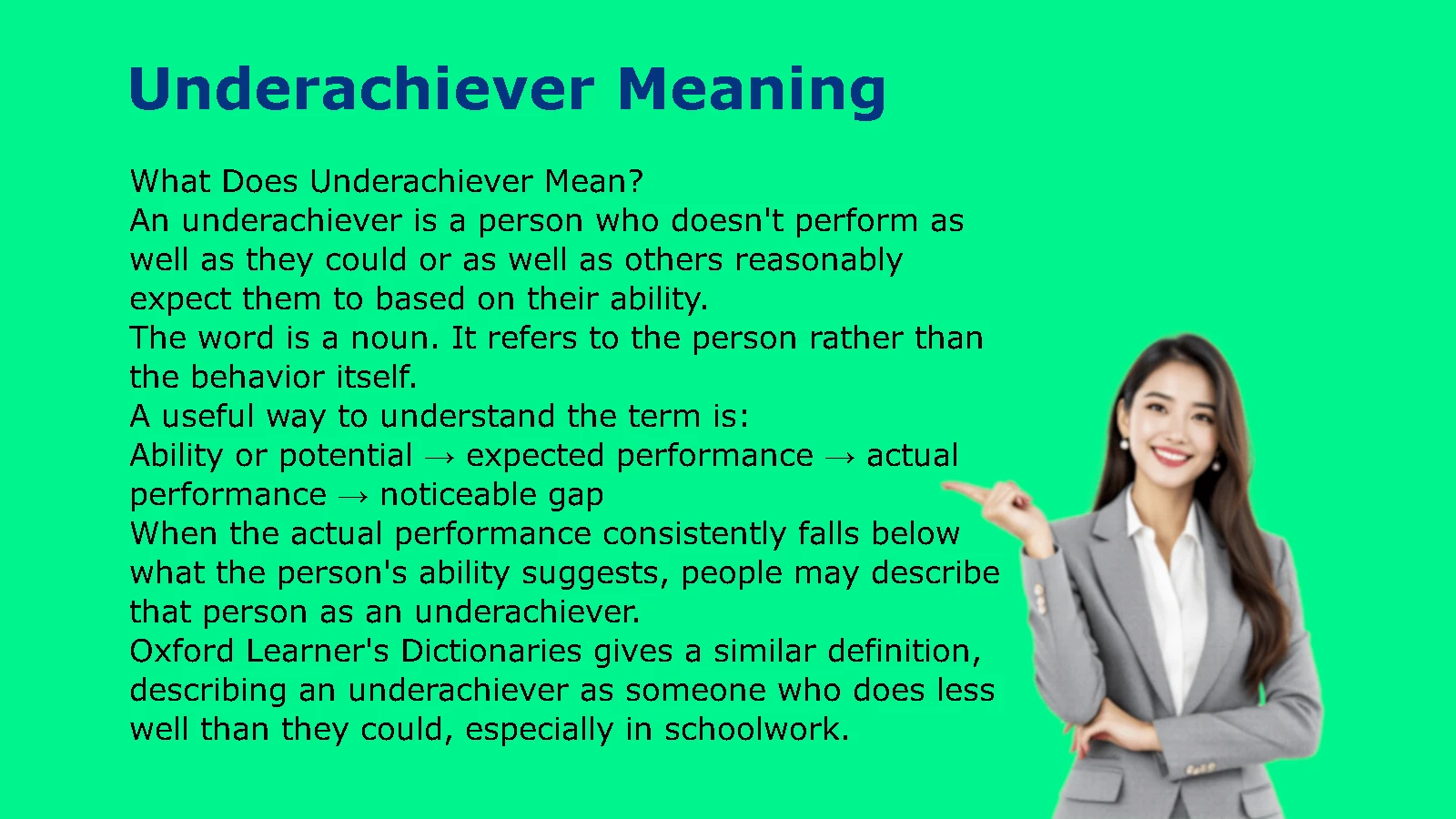
What Does Underachiever Mean?
An underachiever is a person who doesn’t perform as well as they could or as well as others reasonably expect them to based on their ability.
The word is a noun. It refers to the person rather than the behavior itself.
A useful way to understand the term is:
Ability or potential → expected performance → actual performance → noticeable gap
When the actual performance consistently falls below what the person’s ability suggests, people may describe that person as an underachiever.
Oxford Learner’s Dictionaries gives a similar definition, describing an underachiever as someone who does less well than they could, especially in schoolwork.
Simple Underachiever Definition
In simple English:
An underachiever is someone who could do better but doesn’t perform at the level their ability suggests.
For example:
- A talented student gets low grades despite understanding the material.
- A skilled employee regularly produces less than they’re capable of producing.
- A gifted athlete consistently performs below their demonstrated ability.
- A capable writer rarely finishes projects despite having strong writing skills.
The important word is could.
Someone doesn’t become an underachiever merely because they receive a low grade or have a disappointing day. The term usually suggests a broader pattern of performance that doesn’t match ability or expectations.
Underachiever Pronunciation
The American pronunciation of underachiever is:
/ˌʌn.dɚ.əˈtʃiː.vɚ/
You can think of it as:
un der uh CHEE ver
The stress falls on the “chee” sound in achiever. Cambridge provides both American and British pronunciations.
Underachiever Part of Speech
Underachiever is a noun.
Example:
Jordan is an underachiever despite having excellent analytical skills.
The related forms include:
- Underachieve — verb
- Underachieving — present participle or adjective
- Underachievement — noun
- Underachiever — noun
These forms describe the same basic idea from different grammatical angles.
What Is an Underachiever in Simple English?
Think of achievement as a target.
If someone’s ability suggests they could reasonably hit the target at a high level but their actual results repeatedly fall much lower, they may be an underachiever.
Consider two students.
Student A struggles with algebra, studies consistently, asks questions, and earns a C. The grade is low compared with some classmates, but there’s no clear evidence that the student is performing below their ability.
Student B understands algebra quickly, solves difficult problems correctly in class, rarely studies, skips assignments, and earns a C. Here, there is a clearer gap between ability and results.
Student B may be described as an underachiever.
The distinction isn’t about judging one student as “better.” It’s about comparing observed performance with demonstrated capability or expected performance.
That’s why the term can be misleading when people use it too casually. A single poor result doesn’t tell you enough.
Underachiever Examples
The word appears in several settings, although education is one of its most familiar contexts.
Example of an Academic Underachiever
An academic underachiever may have strong intellectual ability but consistently perform below that level in school.
For example:
Maya understands biology better than most students in her class, but she rarely completes her assignments and earns average grades. Her teacher considers her an academic underachiever.
The issue isn’t necessarily intelligence. The issue is the difference between ability and academic results.
Example of an Underachiever at Work
The word can also describe workplace performance.
Alex has excellent technical skills, but he regularly misses deadlines and completes fewer projects than his experience suggests he could handle.
In this situation, calling Alex an underachiever focuses on the gap between his capabilities and his results.
The term can also apply to businesses, teams, products, or other things in broader usage. Merriam-Webster, for example, includes contemporary examples in which organizations or products are described as underachievers because their performance falls below expectations.
Example of an Athletic Underachiever
Suppose an athlete has repeatedly demonstrated excellent speed, technique, and decision-making during training but performs poorly in competitions.
People might call that athlete an underachiever if the pattern continues.
Here, expectations usually come from previous performances, skill level, reputation, or potential.
Example of a Professional Underachiever
A professional might possess extensive knowledge, strong communication skills, and years of experience yet remain far below the level their abilities appear to support.
For example:
Despite having the skills to lead major projects, Daniel remains an underachiever because he avoids responsibility and rarely pursues opportunities for advancement.
Again, the label describes performance. It doesn’t necessarily explain why the performance is low.
Underachiever in a Sentence
Here are natural examples showing how underachiever works in different contexts:
- He was considered an underachiever in high school despite his strong academic ability.
- The talented player became known as an underachiever after several disappointing seasons.
- She isn’t an underachiever; she simply chose a career that matches her priorities.
- His manager believes he’s an underachiever because his results don’t reflect his skills.
- The teacher noticed that several capable students were underachievers.
- Calling someone an underachiever can sound judgmental if you don’t understand their circumstances.
- The company was once viewed as an industry underachiever.
- She stopped thinking of herself as an underachiever and began setting smaller, measurable goals.
Notice that the word can describe a person or, in broader usage, an entity whose results fall below expectations.
Underachiever vs. Underachieving
Although these words share the same root, they don’t perform the same grammatical job.
| Word | Part of Speech | Meaning | Example |
| Underachiever | Noun | A person who performs below potential or expectations | He is an underachiever. |
| Underachieve | Verb | To perform below one’s potential | She tends to underachieve at school. |
| Underachieving | Adjective/participle | Performing below expected ability or results | He is an underachieving student. |
| Underachievement | Noun | Performance below potential | Academic underachievement can have several causes. |
Oxford lists underachieve as an intransitive verb meaning to do less well than you could, especially in schoolwork.
Underachiever Example
Chris is an underachiever.
Here, underachiever identifies the person.
Underachieving Example
Chris is an underachieving student.
Here, underachieving describes the student’s performance.
Underachieve Example
Chris tends to underachieve when he loses motivation.
Here, underachieve describes the action or pattern.
Underachievement Example
The school is studying the causes of academic underachievement.
Here, underachievement names the condition or pattern.
Underachiever vs. Low Achiever
Underachiever and low achiever sound similar, but they don’t mean exactly the same thing.
A low achiever generally performs at a low level. The term doesn’t necessarily tell you that the person has greater unused ability.
An underachiever, however, implies a mismatch between actual results and expected or potential performance.
| Term | Main Idea |
| Underachiever | Performs below potential or expected ability |
| Low achiever | Generally achieves at a low level |
| Underperformer | Performs below an expected standard |
| High achiever | Consistently achieves at a high level |
| Overachiever | Performs beyond what is expected |
Cambridge distinguishes a low achiever from an underachiever by defining an underachiever specifically around being less successful than expected at school or work.
This difference is small but important.
A student who has always struggled with advanced mathematics may be a low achiever in that subject. A student who consistently demonstrates strong mathematical ability but produces surprisingly weak results may be more accurately described as an underachiever.
Underachiever vs. Overachiever
The easiest way to remember the difference is to look at the direction of the gap.
Underachiever: performance falls below expectations.
Overachiever: performance exceeds expectations.
For example, suppose someone is expected to score around 70% on an exam based on previous results.
- A score of 50% might indicate underperformance.
- A score of 70% matches expectations.
- A score of 90% might be described as exceptional or potentially overachievement.
However, overachiever doesn’t simply mean “successful.” The concept also involves a comparison with expectations, circumstances, or perceived ability.
Underachiever and Overachiever Compared
| Feature | Underachiever | Overachiever |
| Actual performance | Below expected level | Above expected level |
| Central idea | Unrealized potential | Exceeding expectations |
| Typical implication | Could do better | Does more than expected |
| Common contexts | School, work, sports | School, work, career, sports |
| Opposite term | Overachiever | Underachiever |
What Causes Someone to Become an Underachiever?
There isn’t one universal reason people underachieve.
A person may have strong ability but fail to convert that ability into consistent results for many different reasons. The label describes the performance gap; it doesn’t automatically explain its cause.
Lack of Motivation
Motivation plays a major role in turning ability into action.
Someone can understand a subject perfectly yet feel little reason to study it. Likewise, an employee can have excellent skills but feel disconnected from their work.
Ability without motivation is a bit like having a powerful car with no fuel. The capacity exists, but it doesn’t produce much movement.
Poor Study or Work Habits
Strong ability doesn’t automatically create strong habits.
A capable student may procrastinate, forget assignments, study only before exams, or struggle to manage several subjects at once.
At work, the same pattern can appear through:
- Missed deadlines
- Poor planning
- Disorganization
- Inconsistent effort
- Difficulty prioritizing
- Avoidance of demanding tasks
Over time, these habits can create a significant gap between capability and results.
Unrealistic Expectations
Sometimes expectations themselves contribute to underachievement.
When parents, teachers, managers, or coaches expect exceptional results all the time, a person may become afraid of making mistakes. Instead of attempting challenging work, they may choose easier tasks where failure feels less threatening.
The result can look like a lack of ambition even when the person actually cares deeply about succeeding.
Lack of Interest
A person doesn’t necessarily perform equally well in every area.
Someone might be brilliant at writing but uninterested in accounting. Another person might excel at engineering but struggle to stay engaged with public speaking.
That doesn’t automatically make the person a general underachiever.
Underachievement can be specific to a subject, role, environment, or goal.
Fear of Failure
Fear can quietly sabotage performance.
A student who worries about getting an answer wrong may avoid answering questions. An employee who fears criticism may avoid taking ownership of important projects.
Ironically, avoiding difficult situations can prevent someone from producing the results that would demonstrate their real ability.
Lack of Support
Performance doesn’t happen in a vacuum.
Teachers, managers, mentors, family members, training systems, resources, and workplace conditions can all affect results.
A capable person working in a poorly structured environment may perform below potential without being inherently unmotivated or careless.
That’s why the label underachiever shouldn’t become a shortcut for explaining complicated performance problems.
Environmental and Personal Factors
Life circumstances can also influence performance.
Changes in routine, difficult environments, competing responsibilities, or major disruptions can temporarily affect someone’s results.
A person who performs poorly for a short period isn’t necessarily an underachiever. Patterns matter more than isolated incidents.
Signs of an Underachiever
No single behavior proves that someone is an underachiever. However, several recurring patterns can indicate a mismatch between ability and performance.
Possible signs include:
- Consistently weak results despite demonstrated ability
- Strong performance in some situations but poor performance in others
- Avoidance of challenging tasks
- Frequent procrastination
- Inconsistent effort
- Regularly producing only the minimum required work
- Failing to use skills that have already been demonstrated
- Repeatedly missing reasonable performance expectations
- Showing stronger ability during practice than during evaluation
- Receiving results that don’t match previous evidence of capability
One poor test score doesn’t make a student an underachiever.
One missed deadline doesn’t make an employee an underachiever.
The stronger case involves a persistent and observable gap.
Is Being an Underachiever the Same as Being Lazy?
No.
Laziness may contribute to underachievement in some cases, but the two concepts aren’t synonyms.
A person may underachieve because of poor habits or low effort. Another person may underachieve because they lack motivation, don’t feel challenged, struggle with expectations, or aren’t working in an environment that allows their strengths to show.
Consider two employees.
One spends hours avoiding work because they simply don’t want to do it.
Another works hard but struggles because their role doesn’t match their strengths and their manager provides unclear priorities.
Both could produce disappointing results. Only one clearly involves what people commonly call laziness.
This distinction matters because underachiever describes an outcome or performance pattern, not a complete psychological explanation.
Underachiever Synonyms
There are several words related to underachiever, but they aren’t all perfect substitutes.
Closest Underachiever Synonyms
Depending on context, possible alternatives include:
- Underperformer
- Low achiever
- Poor performer
- Slacker
- Nonperformer
However, these words carry different shades of meaning.
Merriam-Webster’s thesaurus lists terms such as slacker, goldbrick, and goof-off among related words for underachiever.
Some of these are much more judgmental.
For example, slacker strongly suggests someone who avoids work or effort. Underperformer is broader and can apply to someone whose results simply fall below a required standard.
Therefore, replacing underachiever with slacker can change the meaning.
More Neutral Alternatives
If you want a professional or less judgmental expression, consider:
- Underperforming individual
- Person performing below expectations
- Person whose results don’t match their potential
- Someone not reaching their potential
- Employee performing below expectations
These alternatives can be useful when discussing performance without labeling someone’s entire identity.
Antonyms of Underachiever
The most direct opposite of underachiever is overachiever.
Other related terms include:
- High achiever
- Top performer
- High performer
- Successful performer
- Exceptional performer
However, context matters.
Someone can be highly successful without technically being an overachiever. The word overachiever specifically highlights performance that exceeds expectations.
Underachiever Word Forms and Related Words
Understanding the word family makes the term easier to use correctly.
| Word | Type | Meaning | Example |
| Underachiever | Noun | A person who performs below potential | He is an underachiever. |
| Underachieve | Verb | To perform below potential | She tends to underachieve. |
| Underachieving | Adjective/participle | Performing below potential | He is an underachieving student. |
| Underachievement | Noun | Performance below potential | The report examines academic underachievement. |
| Achievement | Noun | Something successfully accomplished | Winning the award was a major achievement. |
| Achieve | Verb | To successfully reach a goal | She worked hard to achieve her goal. |
Oxford identifies underachiever, underachieve, and underachievement as closely related words in the same word family.
Underachiever Etymology and Word Formation
The word underachiever combines three basic elements:
under + achieve + er
The prefix under- suggests a level below what is expected, required, or desired.
The verb achieve means to successfully reach or accomplish something.
The ending -er commonly forms nouns referring to people who perform an action.
So, in plain terms:
under + achieve + er = a person who achieves below the expected level
The related noun underachievement follows the same basic idea.
Merriam-Webster records the first known use of underachiever in 1952.
Is Underachiever a Negative Word?
Underachiever can sound negative, especially when it’s used as a label for a person.
Compare these two sentences:
He is an underachiever.
and:
His recent performance has fallen below expectations.
The first statement labels the person. The second describes a performance issue.
That difference can matter in schools, workplaces, and other settings.
Calling someone an underachiever may also imply that you know what that person is capable of doing. That’s not always easy to establish.
A more careful approach is to describe the evidence:
- Her recent grades don’t reflect her demonstrated ability.
- His current results are below his previous performance level.
- The employee hasn’t consistently met the expected performance standard.
- The student appears capable of stronger academic results.
These statements focus on observable performance rather than turning a temporary problem into an identity.
How to Use Underachiever Correctly
The noun generally appears after words such as an, the, or possessive expressions.
Using “An Underachiever”
He was an underachiever during his high school years.
She considers herself an underachiever in mathematics.
Using “An Underachieving Student”
The teacher noticed an underachieving student who performed much better during one-on-one sessions.
Here, underachieving modifies student.
Using “Underachieve”
Some students underachieve when they aren’t sufficiently challenged.
The verb describes the person’s performance.
Using “Underachievement”
The school introduced new strategies to address academic underachievement.
Here, underachievement describes the broader condition or pattern.
Underachiever in Different Contexts
Underachiever in Education
Education is one of the most common contexts for the word.
Teachers may use it when a student’s academic results don’t match their demonstrated skills, previous performance, or potential.
Academic underachievement can involve:
- Grades
- Test performance
- Assignment completion
- Classroom participation
- Consistency
- Use of demonstrated skills
Oxford specifically defines underachievement in relation to doing less well than one could, particularly in schoolwork.
Underachiever at Work
In a workplace, the comparison usually involves skills and job expectations.
An employee might be considered an underachiever when their actual output consistently falls below what their experience and demonstrated abilities suggest they can produce.
For example:
A highly experienced designer who consistently delivers work below the quality they have previously demonstrated might be described as an underachiever.
However, managers should examine the underlying circumstances before applying the label.
Poor performance can result from unclear responsibilities, inadequate training, unrealistic workloads, poor management, or a mismatch between the employee and the role.
Underachiever in Sports
Sports make the concept particularly easy to see because performance is often measured directly.
Athletes have statistics, previous results, rankings, records, and observable skills.
A player who repeatedly performs far below their established level may be called an underachiever.
This doesn’t mean the athlete lacks talent. In fact, the term often appears precisely because the person has significant talent.
Underachiever in Personal Goals
The term can also appear in informal conversations about personal goals.
Someone might say:
I feel like an underachiever because I haven’t used my skills the way I wanted to.
Here, the word becomes more subjective.
Unlike a test score or workplace metric, personal potential isn’t always measurable. A person’s idea of achievement can also change over time.
That makes underachiever a useful word for describing perceived unrealized potential, but not a precise measurement of someone’s worth.
Underachiever Meaning: Quick Comparison
The following table brings the most closely related terms together.
| Term | Core Meaning | Typical Implication |
| Underachiever | Person performing below potential or expectations | Could perform better |
| Underachieve | To perform below potential | Describes an action or pattern |
| Underachievement | Performance below potential | Describes the condition |
| Underachieving | Performing below expected ability | Describes a person or performance |
| Low achiever | Person who achieves at a low level | Doesn’t necessarily imply unused potential |
| Underperformer | Person or thing performing below a standard | Focuses on results |
| Overachiever | Person performing above expectations | Exceeds expectations |
| High achiever | Person who consistently achieves at a high level | Strong performance |
Case Study: Why Ability Alone Doesn’t Guarantee Achievement
Consider a fictional student named Ethan.
Ethan consistently solves difficult problems during classroom discussions. His teachers notice that he understands concepts quickly and often explains them clearly to other students.
Yet his report card tells a different story.
His grades remain average because he frequently misses assignments, procrastinates before tests, and doesn’t review his work. When he takes a major exam after preparing properly, his score jumps significantly.
Ethan could reasonably be described as an academic underachiever.
Why?
Not because every grade is low. Not because he lacks intelligence. And not necessarily because he’s lazy.
The stronger evidence is the consistent gap between demonstrated ability and actual academic results.
Now change the situation.
Suppose Ethan struggles with a subject he has never studied before. He works hard, attends tutoring, completes every assignment, and gradually improves from 50% to 70%.
Calling him an underachiever would be less appropriate. His results may still be below those of his classmates, but there isn’t necessarily evidence that he’s failing to use an established level of ability.
The difference is subtle, but it’s the heart of the underachiever meaning.
Common Misunderstandings About Underachievers
An Underachiever Isn’t Necessarily Unintelligent
Intelligence and achievement aren’t the same thing.
Someone can have strong reasoning skills and still perform poorly in a particular environment.
Achievement depends on more than raw ability. Habits, motivation, preparation, opportunity, goals, expectations, and circumstances can all influence results.
An Underachiever Isn’t Automatically Lazy
Low effort can contribute to underachievement, but the word itself doesn’t prove laziness.
Calling every poor performer lazy oversimplifies the situation.
One Bad Result Doesn’t Make Someone an Underachiever
A single disappointing result isn’t enough.
Performance can fluctuate because of preparation, circumstances, difficulty, stress, unfamiliarity, or simple bad luck.
The idea of consistent mismatch is much more important.
High Potential Doesn’t Guarantee High Performance
Someone may have considerable potential without turning that potential into achievement.
Potential is possibility.
Achievement is the result.
The two aren’t interchangeable.
Underachievement Can Happen in Adults
The term isn’t limited to children or students.
Cambridge explicitly includes both school and work in its definition.
An adult employee, professional, athlete, entrepreneur, or artist can also be described as an underachiever when their performance falls below what their demonstrated ability or expectations suggest.
Someone Can Underachieve in One Area and Excel in Another
This point often gets overlooked.
A person might be an exceptional writer but an average mathematician.
Someone else might be an excellent employee but a poor student.
Another person might perform brilliantly at work while struggling to pursue personal goals.
Underachievement isn’t necessarily a description of the whole person.
It can apply to a specific area.
Frequently Asked Questions About Underachiever
What is the meaning of underachiever?
An underachiever is a person whose performance is lower than expected based on their ability, potential, or demonstrated capability. The term commonly applies to students and employees.
What is an example of an underachiever?
A student who understands difficult material but consistently earns low grades because their results don’t reflect their demonstrated ability is an example of an academic underachiever.
Is underachiever a negative word?
It can be. Underachiever often carries a critical or judgmental tone because it labels a person according to a perceived gap between potential and performance.
In professional situations, phrases such as “performing below expectations” may sound more neutral.
What is another word for underachiever?
Possible alternatives include underperformer, low achiever, poor performer, and, in more informal contexts, slacker. These words aren’t exact equivalents, though. Slacker, for example, strongly suggests a lack of effort.
What is the opposite of underachiever?
The most direct opposite is overachiever. Other related terms include high achiever and high performer.
What is the difference between an underachiever and a low achiever?
A low achiever generally performs at a low level. An underachiever performs below what their ability or potential suggests they could achieve.
Does underachiever mean lazy?
No. Laziness may contribute to underachievement, but the word itself only describes a gap between expected or potential performance and actual results.
What is the verb form of underachiever?
The verb is underachieve.
Example:
Some students underachieve despite having strong academic abilities.
Oxford lists underachieve as an intransitive verb.
What does underachieving mean?
Underachieving means performing below what someone could reasonably achieve based on their ability or potential.
Example:
The underachieving student showed much stronger skills during individual assessments.
Can a successful person be an underachiever?
Yes.
Someone can be objectively successful while still being described as an underachiever relative to their demonstrated ability or unusually high expectations.
For example, a person might have a successful career but consistently perform below the level they previously demonstrated.
Can someone be an underachiever in one area but successful in another?
Absolutely.
A person may underachieve academically while excelling professionally. Someone else might perform poorly at work while achieving major success in sports or creative activities.
The term should therefore be understood in context.
Final Takeaway: Underachiever Meaning
The underachiever meaning centers on one important idea: a gap between potential and actual performance.
An underachiever is someone who doesn’t perform as well as they could or as well as their demonstrated ability suggests. Dictionaries commonly associate the word with school and work, although it can also describe performance in sports, professional life, business, and other areas.
The word family is straightforward:
- Underachiever = a person who underachieves
- Underachieve = to perform below potential
- Underachieving = performing below potential
- Underachievement = performance below potential
The biggest misconception is that underachiever automatically means lazy or unintelligent. It doesn’t.
A person can have impressive ability and still produce disappointing results. Motivation, habits, expectations, interest, support, environment, and many other factors can affect whether potential becomes achievement.