
Have you ever caught someone looking at you for a little too long and wondered what it meant? While Staring Meaning may seem simple, staring can communicate different feelings depending on the person, situation, facial expression, and context in which it happens.
Staring means looking at someone or something continuously for a period of time, often without looking away. It can happen because of curiosity, surprise, attraction, confusion, or simple interest. The meaning can change greatly depending on the circumstances.
Examples:
- She was staring at the painting for several minutes.
- Why are you staring at me?
The confusion is understandable. People often search for what does staring mean, staring meaning in text, staring meaning in body language, or what does it mean when someone stares at you because a stare can send a strong message without saying a single word. And here’s the kicker: the same look can feel friendly in one situation and uncomfortable in another.
In this guide, you’ll learn the complete Staring Meaning, its definition, pronunciation, correct usage, and examples in sentences. You’ll also discover staring meaning in body language, common reasons why people stare, what staring can mean in different situations, and the difference between staring, gazing, glancing, and looking.
What Does Staring Mean?
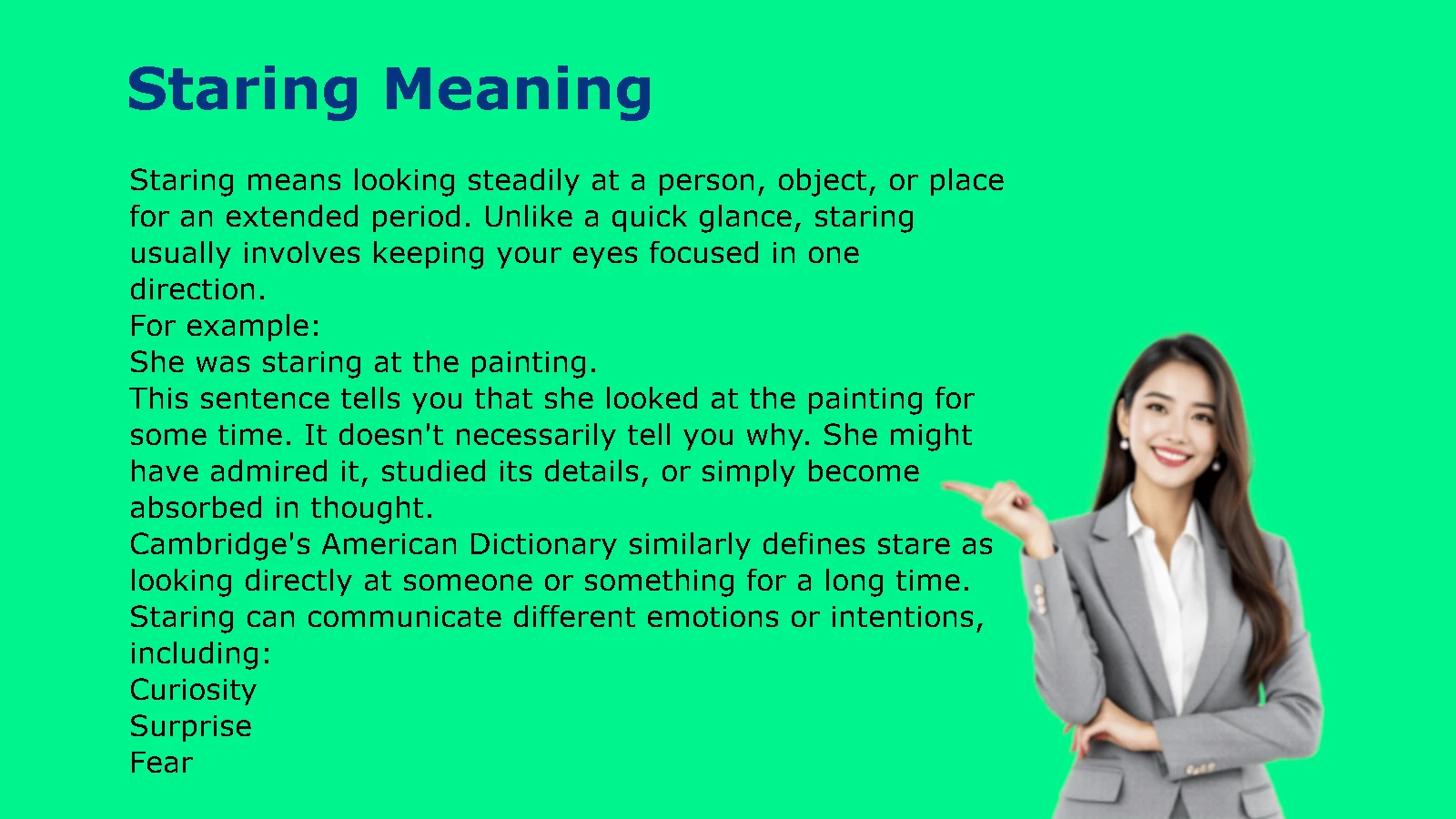
Staring means looking steadily at a person, object, or place for an extended period. Unlike a quick glance, staring usually involves keeping your eyes focused in one direction.
For example:
She was staring at the painting.
This sentence tells you that she looked at the painting for some time. It doesn’t necessarily tell you why. She might have admired it, studied its details, or simply become absorbed in thought.
Cambridge’s American Dictionary similarly defines stare as looking directly at someone or something for a long time.
Staring can communicate different emotions or intentions, including:
- Curiosity
- Surprise
- Fear
- Attraction
- Confusion
- Concentration
- Disapproval
- Anger
- Recognition
- Intimidation
However, you shouldn’t automatically assign one meaning to a person’s stare. Someone looking at you for several seconds might have noticed something unusual, recognized you from somewhere, or simply become distracted while looking in your direction.
Staring in Simple Words
In simple terms, staring is looking at something or someone for a noticeably long time.
Think of the difference this way:
Looking is a quick visit.
Staring is staying for a while.
A glance might last only a moment. Staring draws attention because the person’s gaze remains fixed.
Staring Definition
The word staring comes from the verb stare and commonly functions as its present participle. It can also function as an adjective when it describes something characterized by a fixed or intense look.
Staring as a Verb
As a verb, staring describes the action of looking steadily.
Examples:
- He is staring at the computer screen.
- She was staring out the window.
- The child kept staring at the bright lights.
- They were staring at the strange object.
In these sentences, staring describes an ongoing action.
Staring as an Adjective
Staring can also describe eyes or an expression that appears wide, fixed, or intense.
For example:
- The photograph showed a pair of staring eyes.
- He gave me a staring look.
- The animal stood there with wide, staring eyes.
Cambridge lists staring as an adjective meaning looking for a long time with the eyes wide open, particularly in situations involving surprise, fear, or thought.
Word Forms of Stare
| Form | Word | Example |
| Base form | stare | I stare at the screen. |
| Third person | stares | She stares at the painting. |
| Present participle | staring | He is staring at me. |
| Past tense | stared | They stared at the unusual sight. |
| Past participle | stared | She has stared at it for several minutes. |
The spelling follows a common English pattern: stare → staring. The final e drops before -ing.
Cambridge identifies staring as the present participle and stared as the past form of stare.
What Does It Mean to Stare at Someone?
To stare at someone means to look directly at that person for a relatively long time.
The phrase itself doesn’t tell you the person’s motive.
For example:
He was staring at me across the room.
That could mean several things. He might recognize you, find something about you interesting, want to speak with you, or simply be looking in your direction while thinking about something else.
The surrounding circumstances matter.
Common Reasons Someone May Stare
A person might stare because:
- They recognize you.
- They think they know you.
- Something about your appearance caught their attention.
- They’re surprised by something you did.
- They’re curious.
- They’re attracted to you.
- They’re confused.
- They’re angry.
- They’re trying to intimidate you.
- They’re distracted or lost in thought.
That’s why staring doesn’t automatically mean romantic interest. It can signal attraction, but the gaze alone isn’t enough to establish someone’s intention.
What Does It Mean When Someone Is Staring at You?
When someone is staring at you, the most accurate answer is often: you’ve caught their attention.
The reason remains uncertain until other clues provide context.
Consider these situations:
| Situation | Possible interpretation |
| Someone smiles while looking at you | They may be friendly or interested |
| Someone looks surprised | They may have recognized you |
| Someone looks angry | The stare may communicate disapproval |
| Someone repeatedly looks and then looks away | They may be curious or interested |
| Someone looks blankly | They may simply be distracted |
| Someone studies an unusual item you’re wearing | Curiosity may explain the attention |
These are possibilities, not rules.
Human behavior doesn’t work like a dictionary. A dictionary can define staring. It can’t tell you exactly what every individual person intends when they stare.
Is Staring Always Rude?
No. Staring isn’t always rude.
The social meaning depends heavily on where, how, and why someone stares.
Staring at a painting in an art gallery is perfectly normal. Staring at a stranger from only a few feet away for several minutes can feel uncomfortable.
Cambridge even gives staring at people as an example of behavior that can be considered rude.
When Staring May Be Harmless
Staring can happen naturally when someone:
- Examines artwork
- Watches a performance
- Studies an unfamiliar object
- Tries to recognize someone
- Watches an unexpected event
- Concentrates on a difficult task
- Looks into the distance while thinking
When Staring May Feel Uncomfortable
A prolonged stare can feel intrusive when someone:
- Maintains intense eye contact without speaking
- Continues after the other person looks uncomfortable
- Focuses repeatedly on someone’s body or appearance
- Uses an angry or threatening expression
- Follows someone with their eyes
The difference often comes down to social context and behavior surrounding the gaze.
Why Do People Stare?
There isn’t one reason people stare. Human attention gets pulled toward things that seem unusual, meaningful, emotionally important, or visually interesting.
Curiosity
Curiosity is one of the simplest explanations.
Imagine someone walks into a room carrying an object you’ve never seen before. Your eyes naturally move toward it. If you keep examining it, you might end up staring.
Example:
Everyone stared at the strange machine in the corner.
The stare here expresses interest rather than hostility.
Surprise
Surprise can produce an immediate, fixed gaze.
If someone suddenly hears unexpected news, sees something unusual, or encounters an unexpected event, they may stare for a moment while processing what happened.
Example:
She stared at the bill in disbelief.
The stare emphasizes her reaction.
Concentration
Staring doesn’t always involve another person.
The eyes remain fixed while the mind works.
Attraction
A person may stare because they find someone attractive. However, attraction represents only one possible explanation.
A prolonged look combined with other social signals can sometimes suggest interest, but the gaze itself doesn’t prove it.
Confusion
Confusion can also produce a blank stare.
For example:
I explained the instructions again, but he just stared at me.
Here, stared may suggest that the person didn’t understand what they had heard.
Anger or Intimidation
A hard stare can communicate hostility.
This becomes especially clear when someone combines prolonged eye contact with a tense expression or confrontational body language.
The phrase stare someone down takes this idea further. Cambridge defines it as trying to make another person look away through continual staring.
Staring vs. Looking: What’s the Difference?
Although staring and looking both involve using your eyes, they don’t carry the same meaning.
Looking is the broader and more neutral word. Staring emphasizes duration and fixed attention.
| Looking | Staring |
| General term | More specific |
| Can be brief | Usually lasts longer |
| Often neutral | Can feel intense |
| May involve moving your eyes | Usually involves a fixed gaze |
| Common in ordinary interactions | More noticeable |
Compare these sentences:
She looked at the clock.
This could describe a quick glance.
She stared at the clock.
Now the sentence suggests that she kept looking at it for some time.
The second sentence creates a stronger image.
Staring vs. Gazing: What’s the Difference?
Gazing and staring overlap, but they often create different impressions.
Gazing can sound calm, thoughtful, affectionate, or admiring.
Staring often sounds more intense, direct, or socially noticeable.
Compare:
He gazed at the stars.
This sounds peaceful and reflective.
He stared at the stranger.
This sounds more direct and potentially uncomfortable.
The distinction isn’t absolute. Context can soften or intensify either word.
Quick Comparison
| Word | Common impression |
| Looking | Neutral |
| Glancing | Brief |
| Watching | Paying attention to something happening |
| Gazing | Calm, thoughtful, or admiring |
| Staring | Prolonged and fixed |
| Glaring | Angry or hostile |
| Peering | Looking closely or with difficulty |
Staring vs. Watching: What’s the Difference?
The difference becomes clearer when movement enters the picture.
Watching usually means paying attention to something as it develops or moves.
Staring focuses more on the fixed nature of the gaze.
For example:
I was watching the children play.
The children are moving and the observer follows what they’re doing.
Now compare:
I was staring at the children.
This sentence emphasizes the observer’s fixed gaze. Depending on context, it could sound unusual or uncomfortable.
Staring Meaning in Different Contexts
The same word can take on different shades of meaning depending on what surrounds it.
Staring During a Conversation
Eye contact can be a normal part of conversation. However, continuous staring can make the interaction feel intense.
For example:
She stared at him without saying a word.
The silence makes the stare more significant. It might suggest anger, disbelief, uncertainty, or emotional tension.
Staring at a Stranger
A stranger may attract attention for countless reasons.
Someone might stare because they recognize the person, notice an unusual item of clothing, or simply become curious.
Still, prolonged staring can make the person being watched uncomfortable.
Staring in a Romantic Context
In a romantic situation, staring can sometimes suggest attraction or interest.
For example:
They kept staring at each other across the room.
The phrase each other creates a different feeling from:
He stared at her from across the room.
The first can suggest mutual attention. The second only establishes his behavior.
That distinction matters.
Staring During an Argument
A stare during an argument can feel confrontational.
He stared at her after she challenged his decision.
Here, the gaze may reinforce the tension of the conversation.
Staring at an Object
Staring doesn’t require another person.
She stared at the broken phone, wondering what had happened.
The stare represents concentration and thought.
Staring Into Space
Staring into space is a common expression for looking ahead without focusing on a particular object, often while thinking or becoming distracted.
Cambridge includes examples of people staring into the distance while thinking.
For example:
He sat quietly, staring into space.
The person may be daydreaming, thinking deeply, or simply mentally distracted.
Examples of Staring in Sentences
Here are natural examples showing different uses of the word:
- She was staring at the stars.
- Why are you staring at me?
- He stared at the message in disbelief.
- The child kept staring at the colorful balloon.
- They stood there staring at the damaged car.
- She stared out of the window during the entire journey.
- He was staring blankly at the wall.
- Everyone stared when the lights suddenly went out.
- She stared at the photograph and smiled.
- The students stared at the difficult question.
- He stared into space while thinking about his decision.
- Don’t stare at people you don’t know.
- She gave him a long stare but said nothing.
- The dog stared at the food on the table.
- He stared down his opponent.
- I caught my brother staring at the cake.
- She stared at the screen, waiting for a reply.
- The audience stared in surprise.
- He stood silently, staring at the ocean.
- She stared straight ahead and refused to respond.
Each example keeps the core meaning of prolonged or fixed looking, but the context changes the emotional effect.
Common Phrases With Staring
Several expressions regularly appear with staring.
Staring at Someone
This means looking directly at a person for an extended period.
Why are you staring at me?
The phrase can sound neutral, curious, defensive, or confrontational depending on tone.
Staring Into Space
This means looking ahead without an obvious focus.
He sat on the couch, staring into space.
It often suggests deep thought or distraction.
Staring Blankly
A blank stare suggests an expression that shows little visible emotion or response.
She gave me a blank stare when I asked the question.
The person may not understand, may feel shocked, or may simply not know how to respond.
Staring Down Someone
To stare someone down means to maintain a strong gaze in an attempt to make the other person look away or back down.
The two competitors stared each other down before the match began.
Staring Straight Ahead
This means keeping your eyes directed forward.
He sat quietly, staring straight ahead.
The expression doesn’t necessarily indicate emotion.
Staring in Disbelief
This describes looking at something because it seems shocking or difficult to believe.
She stared at the results in disbelief.
Staring Meaning in Texting and Social Media
In texting, staring generally keeps its normal meaning, but the surrounding words can change the tone.
Consider:
Why are you staring?
This may sound defensive or playful.
Now:
Why are you staring at me 😂
The emoji can make the message sound more teasing.
Another example:
I’m just staring at the screen.
Here, the person isn’t necessarily staring at another person. They’re simply looking at a screen for a prolonged period.
Common texting uses include:
- “Why are you staring?”
- “Stop staring at me.”
- “I caught you staring.”
- “I’m just staring into space.”
- “I’ve been staring at this question for ten minutes.”
- “He keeps staring at me.”
The word itself doesn’t create the entire meaning. Tone, punctuation, emojis, and context do much of the work.
Staring Meaning: Practical Case Studies
Rather than treating every stare as a secret message, consider the situation around it.
Case Study: The Classroom
A student stares at the teacher after receiving a difficult question.
Likely meaning: concentration or confusion.
The student may be processing the question rather than communicating anything hostile.
Case Study: The Restaurant
Someone notices a dish they’ve never seen before and keeps looking at it.
Likely meaning: curiosity.
The person isn’t necessarily judging the person eating it. The unfamiliar food simply caught their attention.
Case Study: The Social Gathering
Someone repeatedly looks across a room at another person and occasionally smiles.
Possible meaning: interest or curiosity.
However, the behavior still doesn’t prove romantic attraction. Other context would matter.
Case Study: The Argument
Two people disagree and maintain intense eye contact.
Possible meaning: confrontation, confidence, anger, or an attempt to intimidate.
The phrase stare someone down fits this type of interaction particularly well.
These examples show why interpreting a stare requires more than observing the eyes. Context turns a neutral gaze into a meaningful social signal.
Synonyms for Staring
Several words can replace staring in certain situations, but they don’t all mean exactly the same thing.
| Synonym | Meaning | Example |
| Gazing | Looking steadily, often calmly | She gazed at the ocean. |
| Glaring | Looking angrily | He glared at his opponent. |
| Watching | Paying attention to something | We watched the game. |
| Observing | Looking carefully | She observed the experiment. |
| Peering | Looking closely | He peered through the window. |
| Eyeing | Looking at something with attention | She was eyeing the dessert. |
| Glowering | Looking angrily or threateningly | He glowered at the intruder. |
| Gawping | Looking openly and often rudely | They were gawping at the celebrity. |
Why These Synonyms Aren’t Identical
Replacing staring with any synonym can change the sentence’s emotional meaning.
She gazed at him.
This may sound affectionate.
She glared at him.
This clearly suggests anger.
She watched him.
This suggests attention rather than necessarily a fixed gaze.
She stared at him.
This leaves more possibilities open.
That’s why choosing the right synonym matters.
Antonyms of Staring
The opposite of staring often involves looking away or using a brief form of visual attention.
Common opposites include:
- Glancing
- Looking away
- Avoiding eye contact
- Ignoring
- Turning away
For example:
He glanced at the clock.
The quick action contrasts with:
He stared at the clock.
The first suggests a short look. The second suggests sustained attention.
Staring: Grammar and Usage
Because staring is the present participle of stare, it commonly appears in continuous constructions.
Present Continuous
She is staring at the screen.
Past Continuous
He was staring out the window.
Present Perfect Continuous
They have been staring at the painting for several minutes.
As a Participle
The staring crowd made him uncomfortable.
The word can also appear after certain verbs:
I caught him staring at the photograph.
The structure stare at is especially common when you identify the person or thing receiving the gaze.
Common Mistakes With the Word Staring
Confusing Staring With Glaring
Staring doesn’t necessarily communicate anger.
Glaring usually does.
She stared at the painting.
Neutral attention.
She glared at her coworker.
Anger or disapproval.
Confusing Staring With Gazing
Gazing often has a softer emotional tone.
He gazed at the sunset.
This sounds calm.
He stared at the stranger.
This sounds more intense.
Using Staring When Watching Is More Accurate
If someone follows an event as it happens, watching may be the better word.
We watched the soccer match.
You can stare at the television screen, but you watch the game.
Assuming Staring Always Means Attraction
This is one of the biggest interpretation mistakes.
Someone might stare because they’re curious, surprised, confused, distracted, or trying to recognize you.
A stare alone doesn’t reveal someone’s complete intention.
Staring Meaning: Quick Comparison by Situation
| Situation | What staring may communicate |
| Looking at artwork | Interest or admiration |
| Looking at a stranger | Curiosity or recognition |
| Looking during an argument | Anger, confidence, or intimidation |
| Looking at a phone | Concentration |
| Looking into space | Thought or distraction |
| Looking after surprising news | Shock or disbelief |
| Looking at someone repeatedly | Curiosity or possible interest |
| Looking at an unfamiliar object | Attention or confusion |
The word may matters here. These interpretations describe possibilities rather than fixed rules.
Why Does Staring Feel So Noticeable?
Human interaction gives eye direction a special social role. When someone looks directly at you for longer than expected, you notice it because their attention appears focused on you.
That’s why the sentence:
Someone was looking at me.
sounds fairly ordinary.
But:
Someone was staring at me.
creates a stronger image.
The second sentence suggests sustained attention. It can make the reader wonder why the person kept looking.
This is one reason writers often use staring when they want to create tension, surprise, curiosity, or emotional intensity.
Staring Meaning in Writing and Storytelling
Authors use staring to show emotion without directly naming it.
Instead of writing:
He was angry.
A writer might describe:
He stared at her without saying a word.
The physical action lets the reader infer the tension.
Similarly:
She stared at the letter for several seconds.
can suggest shock or disbelief without explicitly saying, She was shocked.
This technique makes descriptions more vivid because the reader sees the character’s reaction rather than simply being told what it is.
Frequently Asked Questions About Staring
What does staring mean?
Staring means looking at someone or something for a long time while keeping your eyes focused on it. It often involves a fixed or direct gaze. The reason for the stare depends on context.
What does it mean when someone stares at you?
It usually means that you’ve caught the person’s attention. They might be curious, surprised, attracted, confused, recognizing you, or distracted. A stare alone doesn’t prove a specific intention.
Is staring the same as looking?
No. Looking is a broad term for directing your eyes toward something. Staring emphasizes prolonged, fixed attention.
Is staring rude?
It can be. Prolonged staring at another person may feel intrusive, especially when the person continues after noticing that the other person feels uncomfortable. However, staring at artwork, an object, or a distant view isn’t inherently rude.
What’s the difference between staring and gazing?
Gazing often sounds softer, calmer, or more thoughtful. Staring usually emphasizes a longer, more fixed, or intense look.
What’s the difference between staring and glaring?
Staring doesn’t necessarily express anger. Glaring usually involves an angry, hostile, or disapproving look.
What does staring into space mean?
Staring into space means looking ahead without focusing on a specific object. It often describes someone who is thinking deeply, daydreaming, or distracted.
What is the past tense of stare?
The past tense of stare is stared.
She stared at the painting yesterday.
Cambridge lists stared as the past simple and past participle form of stare.
What is the present participle of stare?
The present participle is staring.
He is staring at the screen.
Can staring mean attraction?
Yes, staring can sometimes indicate attraction, especially when other signs support that interpretation. However, staring can have many other causes, so you shouldn’t treat it as definite proof of romantic interest.
What does staring mean in texting?
In texting, staring usually means looking at someone or something for a prolonged period. Phrases such as “Why are you staring?” or “I’ve been staring at this screen” can take different tones depending on the surrounding conversation.
Final Takeaway: Staring Meaning
The staring meaning is straightforward: staring means looking steadily at someone or something for a relatively long time, often without moving your eyes away.
Yet the word carries more nuance than its basic definition suggests. A person can stare because they’re curious, surprised, frightened, attracted, confused, focused, angry, or simply lost in thought. Context determines the emotional meaning.
The easiest way to remember the distinction is this:
A glance is quick. A look is general. A gaze is often soft or thoughtful. A stare is fixed and prolonged. A glare usually carries anger.
So, when you encounter staring in a sentence, don’t stop at the idea of “looking.” Pay attention to who is looking, what they’re looking at, how they’re looking, and what happens around the stare. Those details reveal the meaning behind the word.