
Have you ever met someone who seems to think they are better than everyone else? While Snobbish Meaning may sound straightforward, this word can describe different attitudes depending on a person’s behavior, tone, and social context.
Snobbish is an adjective used to describe someone who believes they are superior to others, especially because of their wealth, social status, education, taste, or lifestyle. A snobbish person may look down on people they consider less important or less sophisticated.
Examples:
- She sounded snobbish when she criticized the restaurant.
- He has a snobbish attitude toward people who don’t share his interests.
The confusion is understandable. People often search for what does snobbish mean, snobbish meaning in text, snobbish meaning in a sentence, or what does it mean when someone is snobbish because the word can describe anything from mild arrogance to openly looking down on others. And here’s the kicker: someone can act snobbish without actually being wealthy or socially powerful.
In this guide, you’ll learn the complete Snobbish Meaning, its definition, pronunciation, synonyms, antonyms, and correct usage. You’ll also discover what a snobbish person is like, examples of snobbish behavior, how to use snobbish in sentences, and the difference between snobbish, arrogant, conceited, and pretentious.
Snobbish Meaning
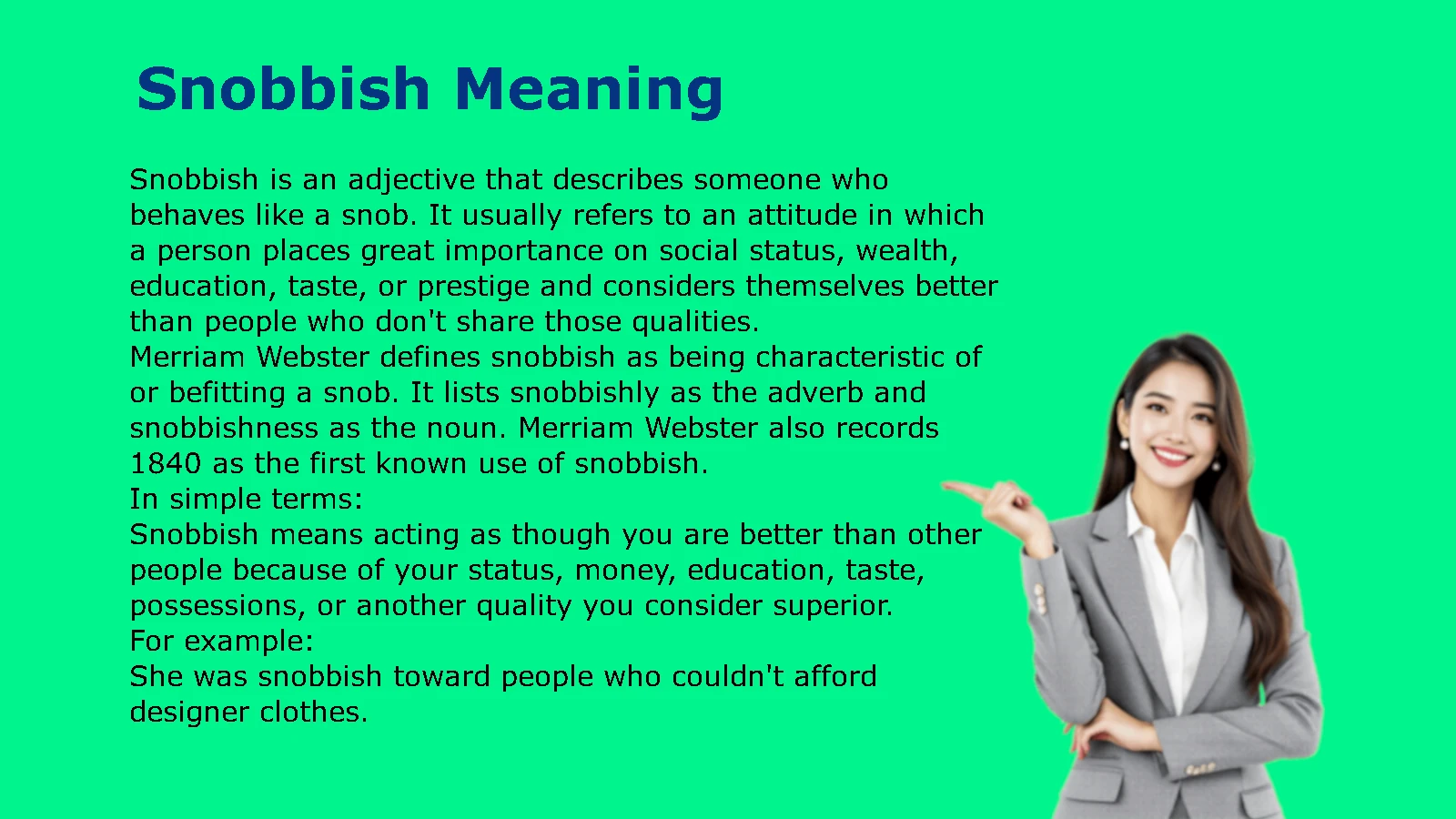
Snobbish is an adjective that describes someone who behaves like a snob. It usually refers to an attitude in which a person places great importance on social status, wealth, education, taste, or prestige and considers themselves better than people who don’t share those qualities.
Merriam Webster defines snobbish as being characteristic of or befitting a snob. It lists snobbishly as the adverb and snobbishness as the noun. Merriam Webster also records 1840 as the first known use of snobbish.
In simple terms:
Snobbish means acting as though you are better than other people because of your status, money, education, taste, possessions, or another quality you consider superior.
For example:
She was snobbish toward people who couldn’t afford designer clothes.
This sentence doesn’t merely say that she liked designer clothing. It suggests that she looked down on people who couldn’t afford it.
That distinction matters.
Someone can spend thousands of dollars on clothes because they appreciate the craftsmanship. That alone isn’t snobbish. The behavior becomes snobbish when the person uses expensive clothing as a reason to judge or exclude others.
Snobbish Definition at a Glance
| Word | Meaning |
| Snobbish | Showing an attitude of superiority toward people considered less important or less refined |
| Snob | A person who behaves in a snobbish way |
| Snobbery | The attitude or behavior associated with being a snob |
| Snobbishness | The quality or state of being snobbish |
| Snobby | An informal synonym for snobbish |
Cambridge lists snobby as an informal form of snobbish, while Oxford also identifies snobby as the informal alternative.
Snobbish Meaning in Simple Words
The easiest way to understand snobbish meaning is to think about how someone treats people who they believe are beneath them.
A snobbish person might think:
- “I’m better because I have more money.”
- “My school is better, so I’m smarter.”
- “My clothes are expensive, so my style is superior.”
- “I only associate with successful people.”
- “That restaurant is too ordinary for me.”
- “People who don’t understand this music have poor taste.”
The common thread is social or personal superiority.
Imagine two people who both enjoy luxury cars.
The first person loves expensive cars because they enjoy engineering, design, and performance. They don’t care what anyone else drives.
The second person laughs at people who drive inexpensive cars and refuses to speak with them because they believe their cars reveal their lower social status.
The first person has a preference.
The second person is behaving snobbishly.
That is the simplest way to separate ordinary taste from snobbery.
What Does Snobbish Mean in a Person?
When snobbish describes a person, it usually refers to an attitude that makes the person appear superior, selective, dismissive, or overly concerned with status.
Oxford specifically connects the word with the belief that high social class is important and with feeling better than others because of intelligence or uncommon tastes.
A snobbish person may:
- Judge people by their income
- Care excessively about social status
- Look down on ordinary jobs
- Brag about expensive possessions
- Reject people because of their background
- Mock inexpensive products
- Treat prestigious schools as proof of superiority
- Dismiss popular entertainment as inferior
- Consider certain neighborhoods beneath them
- Refuse to socialize with people outside their social circle
- Use specialized knowledge to make others feel ignorant
- Treat exclusive experiences as proof of personal worth
Signs of Snobbish Behavior
One behavior doesn’t always prove that someone is snobbish. Context matters.
For example, someone might decline an expensive restaurant because they don’t enjoy the food. That’s simply a preference.
But imagine someone saying:
“I wouldn’t eat there. That’s where ordinary people go.”
Now the issue isn’t food. The speaker has connected the restaurant with social worth.
That is much closer to snobbery.
| Situation | Snobbish? | Reason |
| Buying an expensive watch because you like its design | Not necessarily | Personal preference |
| Mocking people who wear inexpensive watches | Yes | The preference becomes social judgment |
| Attending a prestigious university | Not necessarily | Education isn’t automatically snobbish |
| Saying graduates from other schools are inferior | Yes | Status becomes a reason for superiority |
| Enjoying fine dining | Not necessarily | Taste isn’t the same as snobbery |
| Refusing to associate with people who eat inexpensive food | Yes | The behavior excludes others based on status |
| Knowing a lot about wine | Not necessarily | Expertise doesn’t equal superiority |
| Insulting people who don’t understand wine | Potentially | Knowledge becomes a tool for looking down on others |
Snobbish Examples in Sentences
Examples make the snobbish meaning easier to recognize in real conversations.
Here are some natural examples:
- He has a snobbish attitude toward people who shop at discount stores.
- She sounded snobbish when she criticized his inexpensive car.
- The manager came across as snobbish during the interview.
- Don’t be so snobbish about other people’s taste in music.
- Her snobbish comments made the new employee uncomfortable.
- He became increasingly snobbish after joining the exclusive club.
- She isn’t snobbish despite having expensive tastes.
- His snobbish behavior quickly annoyed his coworkers.
- The restaurant has a reputation for having a somewhat snobbish atmosphere.
- He gave me a snobbish look when I mentioned shopping at a thrift store.
Merriam Webster’s examples similarly show snobbish describing attitudes, glances, characters, institutions, and opinions.
Snobbish Example About Money
“She was snobbish about money and rarely talked to people she considered unsuccessful.”
The important word here is about. The sentence suggests that money influences how she evaluates people.
Snobbish Example About Education
“His snobbish attitude toward people without college degrees was obvious.”
The sentence doesn’t criticize education itself. It criticizes the idea that educational credentials determine someone’s worth.
Snobbish Example About Food
“He’s a little snobbish about coffee and refuses to drink instant coffee.”
This could be mildly humorous rather than deeply insulting. Context and tone determine how strongly the word is meant.
Snobbish Behavior Examples
Snobbish behavior can appear almost anywhere because people can attach status to many different things.
Social Status
Someone may only want friendships or relationships with people they consider socially important.
Example:
She was too snobbish to attend the neighborhood gathering.
The implication is that she considers the people or setting beneath her.
Wealth
Money is one of the most obvious sources of perceived snobbery.
Example:
His snobbish comments about people’s cars offended several guests.
The problem isn’t owning an expensive vehicle. The problem is judging people based on what they drive.
Education
Academic achievement can also become a status marker.
Example:
Her snobbish attitude toward students from less prestigious schools was difficult to ignore.
Someone can be proud of their education without being snobbish. Pride and superiority aren’t the same thing.
Fashion
Fashion often involves personal taste. Yet it can also become a social ranking system.
Example:
He was snobbish about clothing brands and refused to wear anything from ordinary stores.
Food and Restaurants
Food preferences can become another form of social distinction.
Example:
She sounded snobbish when she called inexpensive restaurants “places for people with no taste.”
Knowing about food doesn’t make someone snobbish. Using that knowledge to belittle others can.
Music and Books
Cultural preferences can also create snobbery.
Someone who enjoys classical music isn’t automatically snobbish.
Someone who says:
“People who listen to pop music have no taste.”
is making a judgment about other people based on their preferences.
That attitude is much more likely to be called snobbish.
Snobbish Synonyms
Several words can replace snobbish, but each carries a slightly different meaning.
Merriam Webster lists related terms including arrogant, snobby, snooty, elitist, pretentious, supercilious, smug, haughty, pompous, superior, stuck-up, and self-important.
| Synonym | Meaning | Best used when |
| Snobby | Informally snobbish | Casual conversation |
| Snooty | Acting superior or socially exclusive | Informal criticism |
| Arrogant | Having an exaggerated sense of importance | Someone boasts about their ability or importance |
| Haughty | Proud and dismissive | Describing a person’s manner |
| Pretentious | Trying to appear more important or sophisticated | Someone wants to seem impressive |
| Condescending | Treating someone as inferior | Someone talks down to another person |
| Elitist | Favoring an elite group | Social or political discussions |
| Pompous | Overly self-important | Formal speech or behavior |
| Supercilious | Showing contemptuous superiority | Formal writing |
| Smug | Excessively pleased with oneself | Self-satisfied behavior |
Closest Everyday Synonyms for Snobbish
If you’re having a normal conversation, snobby and snooty are especially close.
For example:
“That restaurant is so snobby.”
You could also say:
“That restaurant is so snooty.”
Both sound natural in casual American English.
Antonyms of Snobbish
The opposite of snobbish involves humility, openness, and a willingness to treat people without ranking them according to social status.
Useful antonyms include:
- Humble
- Modest
- Unpretentious
- Approachable
- Down to earth
- Friendly
- Inclusive
- Open minded
- Respectful
- Egalitarian
Merriam Webster’s thesaurus specifically lists democratic, egalitarian, humble, modest, unpretentious, egoless, and anti-elitist among antonyms and near antonyms.
Snobbish vs. Unpretentious
Compare these two attitudes:
Snobbish: “I only buy from the best stores. Everything else is beneath me.”
Unpretentious: “I like good quality, but I don’t care where something comes from.”
The second attitude shows that someone can have standards without using those standards to judge other people.
Snobbish vs. Arrogant
Snobbish and arrogant are related, but they don’t mean exactly the same thing.
Arrogant describes an exaggerated belief in one’s own importance, abilities, or qualities.
Snobbish more specifically involves superiority connected to social status, taste, education, wealth, prestige, or similar distinctions.
Consider these examples:
He is arrogant about his intelligence.
This means he thinks he is intellectually superior.
He is snobbish about his education.
This suggests he considers his educational background a reason to look down on other people.
A person can therefore be arrogant without being snobbish.
For example, a professional athlete who constantly claims to be better than everyone else may be arrogant. That doesn’t necessarily make the athlete snobbish.
Quick Comparison
| Snobbish | Arrogant |
| Often connected to status or taste | Broader sense of superiority |
| May involve wealth or class | May involve ability or achievement |
| Often judges other people’s preferences | Often exaggerates one’s own importance |
| Can involve social exclusion | Can appear in almost any situation |
Snobbish vs. Pretentious
These words are often confused because both can involve sophistication and social image.
Snobbish focuses on superiority.
Pretentious focuses on trying to appear more important, cultured, sophisticated, or impressive than one really is.
For example:
She is snobbish about wine.
She may look down on people who don’t appreciate expensive wine.
His pretentious way of speaking made a simple conversation exhausting.
He may be trying to sound more sophisticated than necessary.
A person can be both snobbish and pretentious, but the words point to different aspects of the behavior.
Snobbish = “I’m better than you.”
Pretentious = “I want you to think I’m more impressive than I am.”
That isn’t a perfect dictionary formula, but it is a useful way to remember the difference.
Snobbish vs. Condescending
Condescending describes the way someone treats another person as though that person is less intelligent, capable, experienced, or important.
For example:
“Don’t worry. I’ll explain it slowly so you can understand.”
Depending on the context and tone, this could sound condescending.
A snobbish statement might be:
“People like you wouldn’t understand this kind of art.”
The second statement combines dismissal with a sense of superiority.
So:
Condescending = talking down to someone.
Snobbish = looking down on someone, often because of status, taste, class, education, or another distinction.
Snobbish Meaning in Different Contexts
The basic meaning remains the same, but the specific form of superiority can change depending on the situation.
Snobbish Meaning in Social Situations
In social settings, snobbish often describes people who care strongly about status, connections, prestige, or exclusivity.
For example:
The club had a snobbish atmosphere that made newcomers feel unwelcome.
The sentence suggests that the environment favors people who fit a particular social image.
Snobbish Meaning in the Workplace
At work, snobbish behavior may involve treating people differently based on their title, salary, education, or position.
For example:
His snobbish attitude toward junior employees damaged his reputation.
A manager isn’t snobbish simply because they have authority. The word becomes appropriate when they use their position to treat others as inferior.
Snobbish Meaning in Education
Education can become a status marker when people use academic credentials to rank human worth.
For example:
She sounded snobbish when she dismissed anyone who hadn’t attended a prestigious university.
The problem isn’t attending a prestigious university. The problem is assuming that attendance automatically makes someone better.
Snobbish Meaning in Fashion
Fashion is full of personal preferences, but it can also create social boundaries.
A person might prefer designer clothing because they appreciate its construction or design.
That isn’t automatically snobbish.
However:
He was snobbish about clothing and mocked people who wore inexpensive brands.
Now the preference has become a judgment about people.
Snobbish Meaning in Food
Food is another common area for snobbery.
A person might study wine for years and develop a sophisticated palate. That’s expertise.
If that person says people who drink inexpensive wine are inferior, that’s snobbish.
Merriam Webster’s usage examples include snobbish in discussions of food, fashion, restaurants, and cultural taste.
Is Snobbish Always an Insult?
Usually, yes.
Cambridge labels snobbish as disapproving, and Oxford does the same.
Calling someone snobbish normally communicates criticism.
Compare the following:
“He’s particular about coffee.”
This sounds neutral.
“He’s snobbish about coffee.”
This suggests that his attitude toward coffee is excessive or involves superiority.
Still, the word doesn’t always sound extremely harsh.
Someone might jokingly say:
“I’m a little snobbish about coffee.”
In that context, the speaker may simply be admitting to having unusually strong preferences.
Tone matters.
Is Snobbish a Strong Word?
It can be mild or strong depending on the context.
Mild:
“She’s a little snobbish about restaurants.”
Moderate:
“His snobbish attitude is getting difficult to tolerate.”
Strong:
“Their snobbish treatment of local residents was insulting.”
The surrounding language determines how serious the criticism feels.
How to Use Snobbish in a Sentence
Because snobbish is an adjective, it commonly appears before a noun or after linking verbs.
Before a Noun
- a snobbish person
- a snobbish attitude
- a snobbish comment
- a snobbish remark
- a snobbish tone
- a snobbish restaurant
- a snobbish neighborhood
- a snobbish institution
After a Linking Verb
- He is snobbish.
- She seems snobbish.
- They became snobbish.
- His comments sounded snobbish.
- The atmosphere felt snobbish.
Snobbish About Something
One especially useful construction is:
snobbish about + noun
Examples include:
- She is snobbish about wine.
- He’s snobbish about cars.
- They are snobbish about restaurants.
- He can be snobbish about fashion.
- She’s surprisingly snobbish about music.
Cambridge itself gives the example “My brother is very snobbish about cars.”
Snobbish Word Forms
Learning related words helps you use snobbish accurately.
| Word | Part of Speech | Meaning | Example |
| Snob | Noun | A person who behaves with social or cultural superiority | “He’s a snob about cars.” |
| Snobbish | Adjective | Showing the characteristics of a snob | “She has a snobbish attitude.” |
| Snobby | Adjective | Informal form of snobbish | “That place seems snobby.” |
| Snobbery | Noun | The behavior or attitude of a snob | “His snobbery annoyed everyone.” |
| Snobbishness | Noun | The quality of being snobbish | “Her snobbishness was obvious.” |
| Snobbishly | Adverb | In a snobbish manner | “He spoke snobbishly about the neighborhood.” |
Oxford lists snobbishness as an uncountable noun describing the belief that high social class matters and the feeling of being better than other people.
What Is a Snob?
A snob is a person who places excessive importance on qualities such as social class, wealth, status, education, fashion, taste, or cultural knowledge.
Cambridge describes a snob as someone who respects and likes only people of high social class or someone with extremely high standards who isn’t satisfied by things ordinary people like.
A snob doesn’t necessarily have to be wealthy.
That’s an important point.
Someone can be a snob about almost anything:
- Food
- Wine
- Books
- Music
- Art
- Cars
- Clothing
- Technology
- Universities
- Travel
- Neighborhoods
- Sports
- Hobbies
Snob vs. Snobbish vs. Snobbery
These words are closely related but perform different grammatical jobs.
Snob refers to the person.
Snobbish describes the person’s attitude or behavior.
Snobbery refers to the attitude or practice itself.
A simple way to remember them is:
Person → snob
Description → snobbish
Behavior or attitude → snobbery
For example:
He is a snob.
He has a snobbish attitude.
His snobbery is obvious.
Common Phrases With Snobbish
Certain combinations sound especially natural in English.
Snobbish Attitude
His snobbish attitude made everyone uncomfortable.
This describes a person’s general outlook.
Snobbish Behavior
The company addressed the manager’s snobbish behavior.
This focuses on observable actions.
Snobbish Person
She isn’t a snobbish person despite her expensive taste.
This describes someone’s overall character.
Snobbish Remark
That was a snobbish remark.
This works well when criticizing one particular statement.
Snobbish Tone
His snobbish tone changed the mood of the conversation.
This focuses on the manner in which something was said.
Snobbish About Something
She’s snobbish about restaurants.
This construction identifies the subject around which someone displays superiority.
Case Study: Preference vs. Snobbery
Consider two fictional people, Alex and Jordan.
Jordan also loves expensive watches.
But Jordan behaves differently. Jordan laughs at people wearing inexpensive watches, refuses to attend social events where people don’t wear luxury brands, and assumes anyone wearing a basic watch has poor taste.
Both people have an expensive hobby.
Only Jordan clearly displays snobbish behavior.
Why?
Because Alex has enthusiasm.
Jordan has turned that enthusiasm into social superiority.
This example shows why the word snobbish shouldn’t be used simply because someone has expensive taste.
The Three Part Test
When deciding whether behavior is snobbish, ask:
- Is there a strong preference or status marker?
- Does the person use it to judge other people?
- Does that judgment suggest superiority or exclusion?
If the answer to all three is yes, snobbish is likely an accurate description.
Snobbish Pronunciation
In US English, snobbish is pronounced:
/ˈsnɑː.bɪʃ/
An easy pronunciation guide is:
SNAH bish
The first syllable receives the main stress.
Cambridge gives the US pronunciation as /ˈsnɑː.bɪʃ/ and the UK pronunciation as /ˈsnɒb.ɪʃ/.
The informal form snobby has the US pronunciation:
/ˈsnɑː.bi/
Snobbish vs. Snobby
Snobbish and snobby have essentially the same meaning.
The main difference is style.
Snobbish works comfortably in formal, academic, journalistic, and everyday writing.
Snobby sounds more casual.
Compare:
The article criticized the institution’s snobbish attitude.
with:
That restaurant seems really snobby.
Both sentences communicate a similar idea, but the second has a more conversational feel.
Cambridge explicitly identifies snobby as an informal and disapproving synonym of snobbish.
Snobbish vs. Elitist
Snobbish and elitist sometimes overlap, but elitist often has a broader social or institutional meaning.
An elitist attitude may involve the belief that a small group deserves greater power, influence, opportunities, or status.
Snobbery can be much more personal.
For example:
He’s snobbish about restaurants.
This describes an individual’s attitude toward dining.
The organization has been criticized for its elitist admission policy.
This suggests a broader system or institutional preference for an elite group.
Therefore, calling someone elitist can carry political or social implications that snobbish doesn’t necessarily have.
Snobbish vs. Haughty
Haughty describes someone who behaves as though they are superior to other people.
That makes it a close synonym of snobbish, but it tends to emphasize proud, dismissive behavior rather than a particular social preference.
For example:
She gave him a haughty look.
The emphasis is on her proud and dismissive manner.
She was snobbish about his background.
The emphasis is on social judgment.
Both words can describe superiority, but snobbish often tells you more about why someone feels superior.
Snobbish vs. Pompous
Pompous usually describes someone who takes themselves too seriously or behaves in an overly self-important way.
A pompous person might use unnecessarily complicated language, make grand statements, or act as though ordinary rules don’t apply to them.
A snobbish person might instead care deeply about social status, taste, or exclusivity.
Someone can be:
- Pompous but not snobbish
- Snobbish but not pompous
- Both pompous and snobbish
The words overlap, but they point to different behaviors.
Is Being Selective the Same as Being Snobbish?
No.
Being selective simply means choosing carefully.
Being snobbish involves an attitude of superiority or disdain.
Suppose someone chooses a restaurant because they care about food quality.
That’s selective.
Suppose someone chooses a restaurant because they want to avoid being seen with people who can’t afford it.
That’s snobbish.
The same distinction works with clothing, education, travel, cars, books, and almost every other area of life.
High standards don’t automatically equal snobbery.
What matters is whether those standards become a way to rank people.
Can Someone Be Snobbish About Anything?
In ordinary usage, almost any preference can become the subject of snobbery.
People can be snobbish about:
- Cars
- Coffee
- Wine
- Food
- Clothing
- Music
- Books
- Movies
- Art
- Architecture
- Schools
- Universities
- Neighborhoods
- Jobs
- Travel
- Technology
- Sports
- Hobbies
Cambridge’s examples include people being snobbish about cars, suburbs, sports, and other preferences, while Merriam Webster’s usage examples show the word appearing in discussions of food, fashion, literature, social class, and culture.
The subject can change, but the underlying idea remains:
“My preference or status makes me better than you.”
Common Mistakes When Using Snobbish
Mistake: Thinking Wealth Automatically Means Snobbery
Wealth doesn’t make someone snobbish.
A wealthy person can be generous, friendly, and completely down to earth.
The word describes attitude, not bank balance.
Mistake: Thinking Expensive Taste Is Automatically Snobbish
Expensive products don’t create snobbery by themselves.
Someone might buy an expensive camera because they value image quality. That doesn’t mean they look down on people who use cheaper cameras.
Mistake: Confusing Expertise With Snobbery
Knowing a lot about wine, art, fashion, music, or literature doesn’t make someone snobbish.
Expertise becomes snobbish when someone uses it to belittle other people.
Mistake: Using Snobbish as a Direct Synonym for Arrogant
The words overlap, but arrogant is broader.
A person can be arrogant about their intelligence or athletic ability without caring about social class or taste.
Mistake: Assuming Snobbish Only Describes People
You can describe several things as snobbish, including:
- A snobbish attitude
- A snobbish comment
- A snobbish tone
- Snobbish behavior
- A snobbish atmosphere
- A snobbish institution
- A snobbish approach
Frequently Asked Questions About Snobbish Meaning
What does snobbish mean?
Snobbish means behaving like a snob by showing superiority toward people because of social class, wealth, education, taste, status, or another valued quality.
Is snobbish a negative word?
Yes. Snobbish generally has a negative or disapproving meaning. Cambridge and Oxford both label the word as disapproving.
What is an example of being snobbish?
A person who refuses to associate with someone because they have less money and treats them as inferior is displaying snobbish behavior.
What is the difference between snobbish and arrogant?
Snobbish usually involves social status, taste, education, class, wealth, or prestige. Arrogant has a broader meaning and refers to an exaggerated sense of one’s own importance or abilities.
What is the opposite of snobbish?
Common opposites include humble, modest, unpretentious, approachable, down to earth, inclusive, and egalitarian.
What do you call a snobbish person?
A person who behaves this way is called a snob.
Is snobbish the same as pretentious?
No. Snobbish emphasizes superiority, often involving status or taste. Pretentious emphasizes trying to appear more sophisticated, important, or impressive than necessary.
Is snobbish the same as condescending?
No. Condescending means treating someone as though they are inferior in intelligence, ability, or importance. Snobbish more often involves social, cultural, financial, or status based superiority.
What is the noun form of snobbish?
The related nouns are snobbery and snobbishness. Oxford lists snobbishness as an uncountable noun.
Can snobbish describe behavior?
Yes. Natural phrases include snobbish behavior, snobbish attitude, snobbish remark, and snobbish tone.
Is snobby the same as snobbish?
Yes. Snobby has essentially the same meaning but is more informal. Cambridge lists it as an informal synonym for snobbish.
How do you use snobbish in a sentence?
A common construction is:
“He is snobbish about cars.”
You can also use it before a noun:
“She has a snobbish attitude.”
Key Takeaways About Snobbish Meaning
The snobbish meaning centers on superiority.
A snobbish person doesn’t simply have expensive possessions, unusual tastes, a prestigious education, or high standards. Instead, that person may use those things as a reason to look down on others.
Keep these distinctions in mind:
- Snobbish means showing the attitudes or behavior of a snob.
- Snob means a person who displays that attitude.
- Snobbery means the behavior or attitude itself.
- Snobbishness means the quality of being snobbish.
- Snobby is the informal version of snobbish.
- Arrogant describes a broader sense of excessive self importance.
- Pretentious describes someone trying to appear more impressive or sophisticated.
- Condescending describes treating someone as inferior.
- Elitist often describes preference for an elite group or social structure.
- Humble and unpretentious express attitudes that contrast with snobbery.
The most important distinction is simple: a preference isn’t automatically snobbish. You can love luxury, fine dining, designer clothing, classical music, prestigious universities, or expensive cars without looking down on anyone.
Snobbery begins when a preference becomes a measure of human worth.
That’s the heart of the word snobbish.