
Have you ever wondered what might happen in the future and tried to make an educated guess based on the information available today? That is where Forecasting Meaning comes into play. The word may sound technical, but its basic idea is quite simple: forecasting means predicting or estimating what is likely to happen in the future.
Forecasting is the process of using past data, current information, trends, patterns, and other relevant factors to make predictions about future events or conditions. It is commonly used in business, economics, weather, finance, science, and everyday decision making.
Examples:
- The company is forecasting higher sales next year.
- Weather forecasting helps people prepare for storms.
What Does Forecasting Mean?
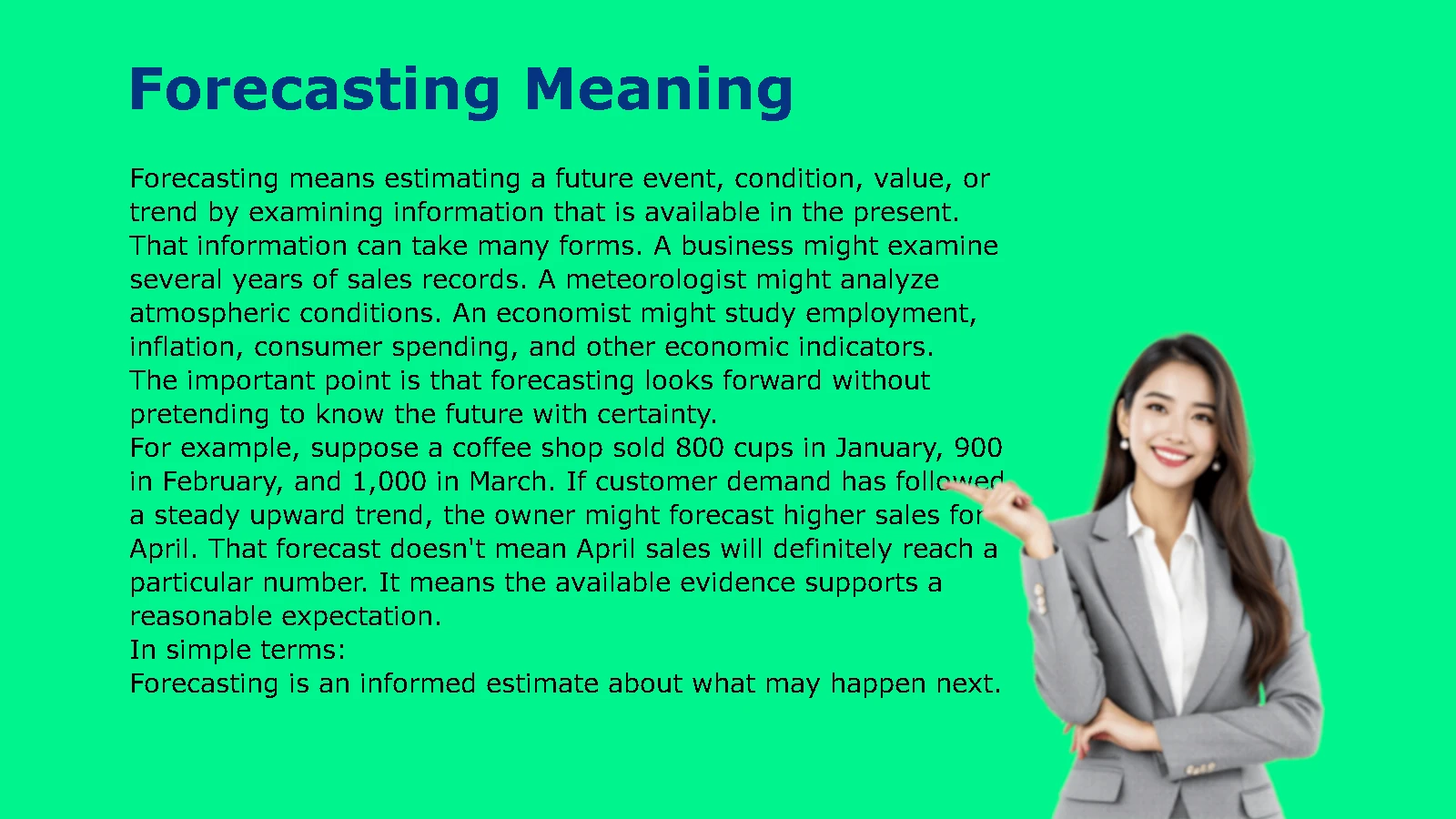
Forecasting means estimating a future event, condition, value, or trend by examining information that is available in the present.
That information can take many forms. A business might examine several years of sales records. A meteorologist might analyze atmospheric conditions. An economist might study employment, inflation, consumer spending, and other economic indicators.
The important point is that forecasting looks forward without pretending to know the future with certainty.
For example, suppose a coffee shop sold 800 cups in January, 900 in February, and 1,000 in March. If customer demand has followed a steady upward trend, the owner might forecast higher sales for April. That forecast doesn’t mean April sales will definitely reach a particular number. It means the available evidence supports a reasonable expectation.
In simple terms:
Forecasting is an informed estimate about what may happen next.
The term appears in phrases such as sales forecasting, economic forecasting, financial forecasting, demand forecasting, weather forecasting, and market forecasting.
Forecasting Definition in Simple Words
If you need the shortest possible explanation, use this:
Forecasting is the process of using current and past information to estimate future outcomes.
Think of it like looking through a windshield rather than a crystal ball. A windshield gives you useful information about the road ahead, but it can’t show every obstacle you’ll encounter.
For example:
- A store forecasts how many products customers may buy.
- A company forecasts next quarter’s revenue.
- A weather service forecasts tomorrow’s conditions.
- An economist forecasts economic growth.
- A household forecasts its monthly expenses.
- A manufacturer forecasts future production needs.
Each example uses available information to make a statement about the future.
Forecasting Meaning in Business
In business, forecasting helps organizations prepare for possible future conditions. Companies rarely have perfect information about what customers will buy, how costs will change, or how markets will behave. A forecast gives decision makers a structured way to estimate those outcomes.
A retailer, for example, might use historical sales to estimate holiday demand. If the company expects demand to rise sharply in December, it can adjust inventory before customers arrive.
Business forecasting can cover:
- Sales
- Revenue
- Customer demand
- Expenses
- Cash flow
- Inventory
- Production
- Staffing
- Market conditions
- Business growth
IBM describes business forecasting as a way to estimate customer demand, sales, growth, and expansion while supporting decisions about budgets, capital, and human resources.
Why Businesses Use Forecasting
Forecasting becomes valuable when an organization has to make decisions before the outcome is known.
Imagine a clothing company that expects to sell 50,000 winter jackets. If it produces only 30,000, it may lose sales because customers can’t find the product they want. If it produces 100,000 and demand reaches only 50,000, it may end up with excess inventory.
A useful forecast won’t eliminate this problem completely. It can, however, help the company make a more informed decision.
Businesses commonly use forecasts to:
- Set budgets
- Plan inventory
- Schedule production
- Estimate revenue
- Manage employees
- Prepare cash flow
- Allocate resources
- Identify potential risks
- Set sales targets
- Support strategic decisions
What Is an Example of Forecasting?
The easiest way to understand forecasting meaning is to see it in action.
Weather Forecasting
A weather forecast estimates future conditions such as temperature, rainfall, wind, or snow. If a weather service forecasts rain tomorrow, that forecast can help you decide whether to carry an umbrella or change outdoor plans.
Sales Forecasting
A company might review previous sales and current market conditions to estimate how much it will sell next month.
For example:
| Month | Actual Sales |
| January | 4,000 units |
| February | 4,300 units |
| March | 4,700 units |
| April | Forecast: 5,000 units |
The April figure represents a forecast, not a confirmed result.
Demand Forecasting
A grocery store may use previous sales, seasonal patterns, holidays, and other information to estimate how many products customers will purchase.
Financial Forecasting
A company might forecast future revenue, expenses, profits, or cash flow. Management can then use those estimates when making financial decisions.
Traffic Forecasting
Transportation systems can estimate future traffic based on historical traffic patterns, time of day, day of the week, and other factors.
These examples look different, but they share the same basic structure:
Past and present information → analysis → future estimate
How Does Forecasting Work?
Although forecasting methods vary, the process usually follows a logical sequence. IBM describes a general workflow that includes defining what to predict, gathering data, selecting a method, generating the forecast, verifying it, and presenting the results.
Define What You Want to Forecast
First, identify the target.
A vague goal such as “predict the future” isn’t useful. A company might instead ask:
How many units will we sell next month?
An energy provider might ask:
How much electricity will customers use tomorrow?
A finance team might ask:
What will our cash balance look like at the end of the quarter?
A clear target makes the rest of the forecasting process easier.
Gather Relevant Information
Next, collect the data needed to support the forecast.
Depending on the situation, this could include:
- Historical sales
- Prices
- Customer behavior
- Seasonal patterns
- Economic indicators
- Weather conditions
- Production records
- Website traffic
- Survey results
- Expert opinions
Good forecasting starts with relevant information. More data isn’t automatically better if the data doesn’t relate to the outcome being forecast.
Examine Patterns and Trends
The next step involves looking for meaningful patterns.
A data series might show:
- A long term upward trend
- A downward trend
- Seasonal changes
- Repeating cycles
- Sudden shifts
- Random variation
The National Institute of Standards and Technology explains that time series consist of ordered observations over time and can be used to understand underlying patterns and produce forecasts.
Choose a Forecasting Method
The method should fit the problem.
A company with years of reliable sales data might use a quantitative model. A business launching a completely new product may have little historical data, making expert judgment or market research more useful.
Generate the Forecast
Once the method and information are ready, the forecast is produced.
The output could be:
- A single number
- A range of possible values
- A probability
- A trend
- Several scenarios
For instance, instead of forecasting exactly 10,000 sales, an analyst might estimate a likely range of 9,000 to 11,000 units.
Check the Forecast
A forecast shouldn’t simply disappear into a spreadsheet.
Compare previous forecasts with actual outcomes. If a model repeatedly overestimates demand, analysts need to investigate why.
This process helps organizations improve future forecasts.
What Are the Main Types of Forecasting?
The two broad categories most commonly discussed are qualitative forecasting and quantitative forecasting.
| Type | Main basis | Useful when |
| Qualitative forecasting | Expert judgment, opinions, surveys | Historical data is limited |
| Quantitative forecasting | Numerical data and statistical methods | Reliable historical data exists |
Both approaches have a legitimate place. The right choice depends on the problem and the quality of available information.
Qualitative Forecasting
Qualitative forecasting relies primarily on human judgment rather than historical numerical data.
This approach becomes particularly useful when a company is dealing with something new. Suppose a technology company plans to launch a product in a market where it has never operated. Historical sales data for that exact product may not exist.
Instead, the company might gather information from:
- Industry experts
- Customers
- Sales teams
- Market researchers
- Executives
- Suppliers
IBM notes that qualitative forecasting can be useful when data is limited and can incorporate expert knowledge or unusual circumstances that numerical models may not capture well.
Delphi Method
The Delphi method uses structured rounds of questionnaires to gather expert opinions.
Experts typically respond independently. Their views are summarized and used to develop later rounds. This process can continue until the group reaches a useful level of agreement.
The method can be valuable when experts possess knowledge that isn’t available in a historical dataset.
Market Research
Businesses can also use customer surveys, interviews, focus groups, and other forms of market research to support forecasts.
For example, a company preparing to launch a new product could ask potential customers how likely they are to buy it. Those responses won’t guarantee actual purchases, but they can provide information for a broader forecast.
Strengths of Qualitative Forecasting
- Works when historical data is scarce.
- Uses specialized knowledge.
- Can account for unusual circumstances.
- Helps with new products and emerging markets.
- Can incorporate information that isn’t easily expressed as numbers.
Limitations of Qualitative Forecasting
- Human judgment can introduce bias.
- Experts can disagree.
- Recent events may receive too much attention.
- Opinions can be difficult to measure consistently.
- A confident expert isn’t necessarily an accurate forecaster.
Quantitative Forecasting
Quantitative forecasting uses numerical data, mathematical relationships, and statistical methods to estimate future outcomes.
This approach works particularly well when historical data contains useful patterns.
For example, a retailer with five years of monthly sales records can examine how demand changes over time. The business might identify seasonal patterns and use them to estimate future sales.
Common quantitative approaches include:
- Time series forecasting
- Moving averages
- Exponential smoothing
- Regression models
- Econometric models
- More advanced statistical and machine learning methods
IBM describes quantitative forecasting as an approach based on numerical data and mathematical or statistical methods.
Strengths of Quantitative Forecasting
- Uses measurable evidence.
- Produces consistent calculations.
- Can process large datasets.
- Makes forecasts easier to reproduce.
- Can identify patterns that aren’t obvious from casual observation.
Limitations of Quantitative Forecasting
Numbers don’t automatically create a good forecast.
A quantitative model can struggle when:
- Historical data is poor.
- The future differs sharply from the past.
- Important variables are missing.
- A major unexpected event occurs.
- The model relies on unrealistic assumptions.
A sophisticated model built on bad information can still produce a bad forecast.
Common Forecasting Methods
Different forecasting problems call for different methods. There isn’t one universal technique that works best for every situation.
Time Series Forecasting
Time series forecasting uses observations arranged chronologically to estimate future values.
Examples include:
- Daily temperature
- Monthly sales
- Quarterly revenue
- Hourly electricity demand
- Annual population figures
The NIST Engineering Statistics Handbook identifies time series forecasting as an important application across areas such as economic forecasting, sales forecasting, inventory studies, workload projections, and utility analysis.
A time series can contain several important components.
Trend describes the general direction of the data.
Seasonality describes repeating patterns linked to a regular calendar or time period.
Residual variation represents changes that remain after the major patterns have been accounted for.
NIST describes approaches that separate time series into trend, seasonal, and residual components.
Naive Forecasting
The naive method is one of the simplest forecasting approaches.
It assumes the next period will resemble the most recently observed value.
For example, if a store sold 1,200 units in March, a simple naive forecast might use 1,200 units as the forecast for April.
This approach may seem basic, but it can serve as a useful benchmark. A more complicated model should demonstrate that it improves on a simple baseline.
Moving Average
A moving average calculates the average of recent observations and uses that result as the forecast.
Suppose monthly sales were:
- January: 800
- February: 900
- March: 1,000
A three month moving average would be:
(800 + 900 + 1,000) ÷ 3 = 900
The average smooths short term fluctuations and provides a simple estimate based on recent history.
Moving averages can work well when a dataset contains random variation but doesn’t have complicated patterns.
Weighted Moving Average
A weighted moving average gives different importance to different observations.
Recent values may receive greater weight than older ones because recent conditions can be more relevant to the future.
This method provides more flexibility than a simple average.
Exponential Smoothing
Exponential smoothing gives progressively less weight to older observations while giving more weight to recent observations.
The approach can smooth noisy data while still responding to recent changes.
NIST lists exponential smoothing among established time series techniques, while IBM explains that exponential smoothing applies exponentially declining weights to older observations.
Regression Forecasting
Regression analysis examines relationships between variables.
For example, a business might investigate whether advertising spending relates to sales.
A simplified example could look like this:
Advertising spending → Sales
If historical data shows a meaningful relationship, the company can use expected advertising spending as one factor in estimating future sales.
Regression becomes especially useful when the variable being forecast may depend on factors beyond its own historical values.
Econometric Forecasting
Econometric models apply statistical methods to economic relationships.
They can incorporate variables such as:
- Interest rates
- Inflation
- Employment
- Consumer spending
- Income
- Production
- Market conditions
These models can become complex because economic variables often influence one another.
Forecasting in Business
Business forecasting isn’t limited to sales. Different departments may forecast different aspects of future activity.
Demand Forecasting
Demand forecasting estimates how much customers may want to purchase.
The distinction matters because demand and sales aren’t always identical. A business might have strong customer demand but record lower sales because products were unavailable.
Revenue Forecasting
Revenue forecasting estimates future income from sales or other business activities.
Management may use the forecast when preparing budgets and evaluating growth.
Financial Forecasting
- Revenue
- Expenses
- Profit
- Cash flow
- Capital requirements
- Future financial position
Inventory Forecasting
Inventory forecasting estimates how much stock a business will need.
Too little inventory can lead to stockouts. Too much can tie up money and increase storage costs.
Workforce Forecasting
A growing company may forecast how many employees it will need.
For example, if customer orders are expected to rise, management might estimate the additional staff required to handle that workload.
Forecasting in Economics
Economists use forecasting to estimate future economic conditions.
Common targets include:
- GDP growth
- Inflation
- Unemployment
- Consumer spending
- Interest rates
- Investment
- Trade
- Industrial production
Economic forecasts can influence government policy, business decisions, investment decisions, and household planning.
However, economic forecasting is difficult because economies contain many interacting variables. A change in one area can affect several others.
For example, higher interest rates can influence borrowing, housing activity, investment, and consumer spending. Those changes can then affect other parts of the economy.
This interconnectedness makes economic forecasting far more complicated than simply extending a line on a chart.
Forecasting vs. Prediction
The terms forecasting and prediction overlap, but they aren’t always used in exactly the same way.
| Forecasting | Prediction |
| Often focuses on estimating future outcomes from available information | Has a broader meaning |
| Common in business, economics, weather, and time series analysis | Used across many fields |
| Often relates to a defined future period | May refer to a future event or outcome more generally |
| Frequently uses structured forecasting methods | Can involve models, judgment, intuition, or other approaches |
In everyday language, you may see the terms used interchangeably.
The important distinction is that forecasting usually carries a stronger connection to systematic estimation of future conditions.
Forecasting vs. Forecast
The difference is simple.
Forecasting describes the process.
A forecast describes the result.
For example:
A retailer uses forecasting to estimate next month’s sales. The resulting sales estimate is its forecast.
Cambridge defines a forecast as a statement about what is judged likely to happen in the future.
This distinction becomes useful when discussing business activities.
You might say:
- “The company improved its forecasting process.”
- “The company’s latest sales forecast predicts higher demand.”
- “The analyst is responsible for forecasting revenue.”
- “Management revised the revenue forecast.”
Forecasting vs. Planning
Forecasting and planning work together, but they aren’t the same thing.
A forecast describes what may happen.
A plan describes what an organization intends to do.
Imagine a retailer forecasts that winter demand will increase by 20%. Management may then decide to increase inventory by 15%.
The forecast informed the plan. It didn’t create the plan.
This distinction matters because a forecast can change without automatically changing the organization’s goals.
What Makes a Forecast Reliable?
No forecast can guarantee the future. However, several factors can improve its usefulness.
Good Quality Data
The data should be relevant, reasonably accurate, and appropriate for the question.
If a company uses outdated sales records to forecast a rapidly changing market, the forecast may miss important changes.
Appropriate Method
A simple problem doesn’t always require a complex model.
Likewise, a complicated forecasting problem may require more than a basic average.
The method should match the data and the decision.
Suitable Time Horizon
Forecast accuracy often becomes more difficult as the forecast reaches farther into the future.
A retailer may have relatively useful information for tomorrow’s demand but face much greater uncertainty when estimating demand several years from now.
IBM similarly notes that shorter term forecasts can be more precise than long range forecasts.
Regular Evaluation
A forecast should be compared with what actually happened.
Suppose a company forecast 10,000 units but sold 7,500. The difference deserves attention.
Was the forecast too optimistic? Did prices change? Did a competitor launch a new product? Was there an unexpected disruption?
Forecast evaluation turns past mistakes into useful information.
Realistic Assumptions
Every forecast rests on assumptions.
A company might assume:
- Prices will remain within a certain range.
- Demand will follow historical patterns.
- Production capacity won’t change.
- Economic conditions will remain relatively stable.
When those assumptions break, the forecast may need revision.
What Are the Limitations of Forecasting?
Forecasting is useful, but it has clear limits.
The Future Can Break Historical Patterns
Past behavior doesn’t guarantee future behavior.
A company may have experienced steady growth for five years and then face a sudden market disruption.
Data Can Be Incomplete
A model can’t learn from information it doesn’t have.
If an important factor is missing from the dataset, the resulting forecast may overlook a major source of change.
Human Judgment Can Be Biased
Qualitative forecasting depends on people. People can become overly optimistic, pessimistic, or influenced by recent events.
Unexpected Events Can Change Everything
Natural disasters, regulatory changes, technological breakthroughs, supply disruptions, and sudden market shifts can make previous assumptions obsolete.
Long Range Forecasts Carry More Uncertainty
The farther into the future you look, the more opportunities there are for conditions to change.
That doesn’t make long range forecasting useless. It means the forecast should be treated as an estimate with uncertainty rather than a guaranteed outcome.
Case Study: How a Retailer Could Use Forecasting
Consider a fictional clothing retailer called Northline Apparel.
The company sells winter jackets and wants to estimate October demand.
Its historical sales show:
| Year | October Jacket Sales |
| Year 1 | 7,800 |
| Year 2 | 8,400 |
| Year 3 | 9,100 |
| Year 4 | 9,700 |
The business could begin by examining the upward trend.
However, historical sales aren’t the only information available. Management might also consider:
- Current inventory
- Product prices
- Competitor activity
- Weather expectations
- Marketing plans
- Consumer demand
- New product launches
Suppose the company forecasts 10,300 jackets for October.
That number becomes useful because management can now ask practical questions:
Do we have enough inventory?
Can suppliers provide additional units quickly?
How many employees will we need?
How much cash will inventory require?
The forecast doesn’t guarantee that 10,300 jackets will sell. Instead, it gives the business a working estimate around which it can make decisions.
That’s the real value of forecasting.
Forecasting Examples in Everyday Life
You don’t need to run a company to use forecasting.
You probably use basic forms of it more often than you realize.
Planning a Trip
You might check traffic conditions and historical travel times before deciding when to leave.
Managing a Budget
If your recent monthly expenses average $2,500, you may forecast a similar amount for the coming month.
Planning Groceries
If your family usually consumes two gallons of milk each week, you can use that pattern to estimate the next shopping requirement.
Checking the Weather
You use a weather forecast to estimate future conditions before deciding what to wear or whether to change your plans.
Estimating Project Time
If similar projects have taken between four and six weeks, you might forecast that a new project will fall within a similar range.
These examples show that forecasting doesn’t always require complicated mathematics. At its heart, it involves using available evidence to form a reasonable expectation about the future.
How to Use Forecasting in a Sentence
Understanding forecasting meaning also means knowing how to use the word naturally.
- The company is forecasting higher sales next quarter.
- Analysts are forecasting slower economic growth.
- Accurate forecasting helps businesses manage inventory.
- The team uses forecasting to estimate customer demand.
- Weather forecasting has become essential for travel planning.
- The new model improved demand forecasting.
- The finance department is forecasting higher operating expenses.
Notice that forecasting commonly appears before or after the subject of an activity. It can describe a formal business process or a broader activity involving future estimates.
Forecasting Synonyms and Related Words
Several words are closely related to forecasting, but they aren’t perfect substitutes.
| Word | Meaning | How it differs |
| Predicting | Saying what may happen | Broader and often less specific |
| Estimating | Calculating or judging an approximate value | Doesn’t always involve the future |
| Projecting | Extending an expected outcome into the future | Common in business and finance |
| Anticipating | Expecting something to happen | Often emphasizes expectation |
| Expecting | Believing something will happen | Can be informal or subjective |
| Planning | Deciding what you intend to do | Focuses on action rather than future estimation |
For example, forecasting sales and planning sales activities aren’t identical.
Forecasting asks:
How much might we sell?
Planning asks:
What will we do to achieve our goals?
That small difference can prevent a lot of confusion.
Forecasting Facts to Remember
Several basic facts capture the concept well:
- Forecasting deals with the future.
- Forecasts rely on available information.
- Forecasting can use numerical data, expert judgment, or both.
- A forecast is an estimate, not a guarantee.
- Shorter forecast horizons can generally involve less uncertainty than longer ones.
- Historical data can reveal useful patterns but cannot guarantee future results.
- Forecasting supports decisions rather than replacing judgment.
- Different forecasting problems require different methods.
- Forecast accuracy should be evaluated against actual outcomes.
- Qualitative and quantitative approaches can complement each other.
Frequently Asked Questions About Forecasting Meaning
What is the simple meaning of forecasting?
Forecasting means estimating what is likely to happen in the future using information available now. That information may include historical data, current conditions, trends, statistics, or expert judgment.
What is an example of forecasting?
A company estimating next month’s sales from previous sales records is an example of forecasting. Weather services estimating tomorrow’s temperature and rainfall also use forecasting.
What is forecasting in business?
Business forecasting is the process of estimating future business conditions such as sales, demand, revenue, expenses, cash flow, inventory needs, or staffing requirements.
What are the two main types of forecasting?
The two broad categories are qualitative forecasting and quantitative forecasting. Qualitative forecasting relies heavily on judgment and opinions, while quantitative forecasting uses numerical data and mathematical or statistical techniques.
Is forecasting the same as guessing?
No. A guess can be unsupported. Forecasting normally uses evidence, data, patterns, models, expert knowledge, or a combination of these. However, even a well constructed forecast can turn out to be wrong.
What is the difference between forecasting and prediction?
The terms overlap. Forecasting generally refers to a systematic estimate of future conditions, often using data and established methods. Prediction has a broader meaning and can refer to anticipating an outcome in many different contexts.
What is the difference between forecasting and a forecast?
Forecasting is the process of estimating the future. A forecast is the resulting estimate or statement about what is likely to happen.
Why is forecasting important?
Forecasting helps people and organizations make decisions before future outcomes become known. Businesses can use it to prepare inventory, budgets, staffing, production, and cash flow. Governments and economists can use it to assess possible economic conditions.
Can forecasting be 100% accurate?
No. A forecast describes what is expected or judged likely to happen. Unexpected events, changing conditions, incomplete information, and incorrect assumptions can all cause the actual result to differ from the forecast. Cambridge defines a forecast as a statement about what is judged likely to happen rather than a certainty.
What is time series forecasting?
Time series forecasting uses data collected in chronological order to estimate future values. Common examples include forecasting monthly sales, daily temperatures, quarterly revenue, or hourly electricity demand. NIST identifies time series forecasting as an application across areas including sales, economics, inventory, workload, and utility analysis.
What is qualitative forecasting?
Qualitative forecasting uses human knowledge, opinions, surveys, interviews, expert judgment, or structured approaches such as the Delphi method. It becomes especially useful when historical numerical data is limited or when a business is dealing with a new situation.
What is quantitative forecasting?
Quantitative forecasting uses numerical data and mathematical or statistical methods to estimate future outcomes. Examples include moving averages, exponential smoothing, regression models, and time series techniques.
Final Takeaway on Forecasting Meaning
The forecasting meaning is straightforward: forecasting is the process of using available information to estimate what is likely to happen in the future.
The concept appears everywhere. Businesses forecast sales and demand. Economists forecast economic conditions. Financial teams forecast revenue and cash flow. Weather services forecast atmospheric conditions. Even individuals use simple forecasting when they estimate future expenses, travel times, or household needs.
What makes forecasting different from a random guess is the use of evidence. Historical patterns, current conditions, statistical models, expert judgment, and other relevant information all help shape the estimate.
Still, forecasting isn’t a crystal ball. A good forecast manages uncertainty rather than pretending uncertainty doesn’t exist. The strongest forecasting process recognizes its assumptions, measures its errors, updates its estimates, and gives decision makers a practical view of what may lie ahead.
For that reason, the value of forecasting isn’t simply whether every number turns out to be perfect. Its real value lies in helping you make better informed decisions before the future becomes the present.