
Have you ever come across the last name Rodriguez and wondered what it means or where it comes from? While Rodriguez Meaning may seem straightforward, this popular surname has a long history connected to Spanish naming traditions, family lineage, and the meaning of a father’s name.
Rodriguez is a Spanish patronymic surname that traditionally means “son of Rodrigo.” The name Rodrigo comes from an older Germanic name associated with ideas such as fame, glory, and power. As a result, the Rodriguez Meaning can be understood as “son of Rodrigo” or, more broadly, a descendant of someone named Rodrigo.
Examples:
- Carlos Rodriguez means Carlos belongs to the Rodriguez family lineage.
- Maria Rodriguez carries a surname traditionally meaning “daughter or descendant of Rodrigo,” although the surname itself is not gender specific.
The curiosity is understandable. People often search for what does Rodriguez mean, Rodriguez meaning and origin, Rodriguez surname meaning, or where does the Rodriguez last name come from because surnames can reveal clues about family history, language, and ancestry. And here’s the interesting part: the ending “-ez” is a common feature of Spanish patronymic surnames and traditionally indicates “son of.”
In this guide, you’ll learn the complete Rodriguez Meaning, its origin, history, pronunciation, cultural background, and significance as a surname. You’ll also discover where the Rodriguez surname comes from, what the name Rodrigo means, how the “-ez” ending works, and why Rodriguez became one of the most widely recognized Spanish surnames.
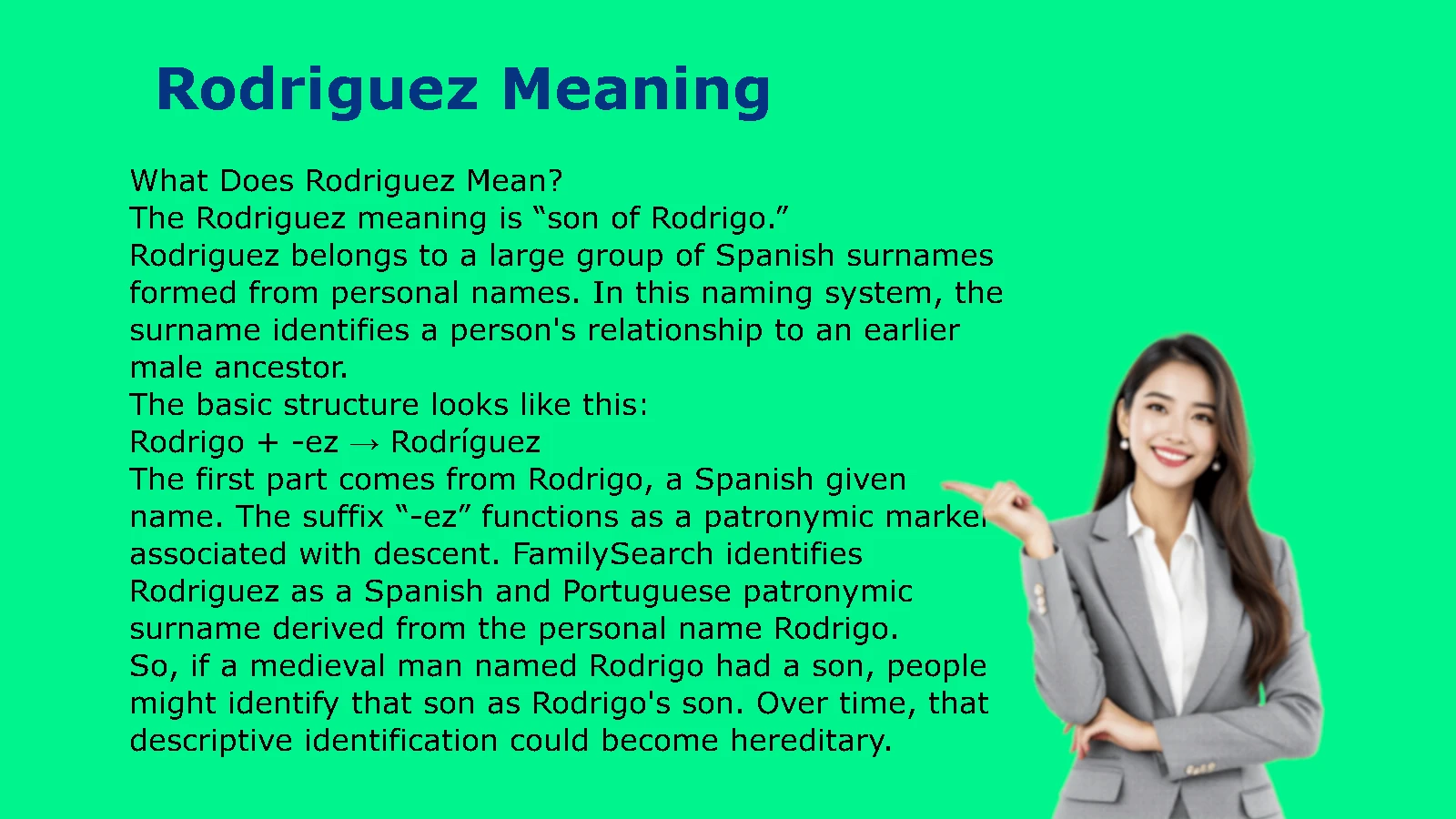
What Does Rodriguez Mean?
The Rodriguez meaning is “son of Rodrigo.”
Rodriguez belongs to a large group of Spanish surnames formed from personal names. In this naming system, the surname identifies a person’s relationship to an earlier male ancestor.
The basic structure looks like this:
Rodrigo + -ez → Rodríguez
The first part comes from Rodrigo, a Spanish given name. The suffix “-ez” functions as a patronymic marker associated with descent. FamilySearch identifies Rodriguez as a Spanish and Portuguese patronymic surname derived from the personal name Rodrigo.
So, if a medieval man named Rodrigo had a son, people might identify that son as Rodrigo’s son. Over time, that descriptive identification could become hereditary.
Rodriguez Meaning in Simple Terms
| Part | Meaning |
| Rodrigo | The personal name at the root of the surname |
| -ez | Patronymic ending associated with descent |
| Rodríguez | Son of Rodrigo |
| Surname type | Patronymic |
| Language tradition | Spanish |
| Related Portuguese form | Rodrigues |
That distinction matters because Rodriguez isn’t an occupational surname such as Baker or Smith. It doesn’t originally describe a trade. Nor does it primarily identify a place.
Instead, it points toward family descent through the name Rodrigo.
What Is the Origin of the Rodriguez Surname?
The Rodriguez surname origin lies in the Spanish naming tradition of the Iberian Peninsula. Historical sources connect Rodríguez with the personal name Rodrigo and with the medieval development of patronymic surnames in Spain.
The name Rodrigo itself has much older Germanic roots. It is related to forms such as Roderick, which developed from Germanic elements traditionally associated with fame or renown and power or rule.
That gives the surname two different layers of meaning:
- Literal surname meaning: “son of Rodrigo”
- Deeper name etymology: connected with ideas of fame, renown, and rule
These meanings shouldn’t be treated as identical. Saying that Rodriguez means “son of Rodrigo” explains the surname’s actual patronymic structure. Descriptions such as “famous ruler” relate to the older etymology of Rodrigo.
The Rodrigo Connection
Rodrigo became an established personal name in Iberia, where Germanic names remained influential after the Visigothic period.
One historically famous bearer was Roderic, the Visigothic king traditionally regarded as the last king of the Visigothic Kingdom before the Muslim conquest of Iberia in the early eighth century.
That historical connection helps explain why the Rodrigo name has such deep roots in the Iberian naming tradition. However, it would be a mistake to assume that every modern Rodriguez family descends from that king.
A famous ancient bearer of a personal name doesn’t establish a direct genealogical connection to everyone who later received a surname derived from that name.
Why Does Rodriguez End in “-ez”?
The “-ez” ending is one of the most recognizable features of Spanish patronymic surnames.
In surnames such as Rodriguez, González, Hernández, Fernández, and Martínez, the ending developed as a marker associated with descent. In simple terms, it can be understood as “son of.”
Consider the pattern:
| Surname | Root personal name | Basic interpretation |
| Rodríguez | Rodrigo | Son of Rodrigo |
| González | Gonzalo | Son of Gonzalo |
| Hernández | Hernando / Hernán | Son of Hernando or Hernán |
| Fernández | Fernando | Son of Fernando |
| Martínez | Martín | Son of Martín |
| Ramírez | Ramiro | Son of Ramiro |
The pattern makes Spanish surnames particularly interesting from a genealogy perspective. A surname can preserve evidence of an old naming relationship even after the original relationship has become many generations removed.
Does “-ez” Literally Mean Son?
The safest explanation is that “-ez” functions as a patronymic surname ending indicating descent.
Historical surname formation is more complicated than translating every suffix word for word. The modern interpretation “son of” is useful for understanding the naming pattern, but the development of Spanish patronymics took place over centuries.
That’s why the best explanation of Rodriguez is “a patronymic surname derived from Rodrigo” rather than treating the suffix as though medieval Spanish speakers used it exactly like the modern English word “son.”
The Etymology of Rodriguez
The Rodriguez etymology begins with Rodrigo.
Rodrigo developed from older Germanic naming forms. Sources commonly connect the name with elements associated with fame or glory and rule or power.
A simplified linguistic path looks like this:
Germanic name elements → Roderic/Roderick → Rodrigo → Rodríguez
The exact historical development of names can involve Latinization, regional pronunciation, spelling changes, and adaptation between languages. Medieval scribes also didn’t follow the standardized spelling conventions used today.
As a result, historical documents can contain several forms of the same or closely related name.
Rodrigo and Roderick
Rodrigo is the Spanish form associated with the Germanic name tradition represented by Roderick.
The name contains old elements connected with reputation or fame and authority or rule. This explains why some surname references describe Rodriguez with symbolic meanings such as “famous ruler.”
Still, the surname itself doesn’t literally mean that a Rodriguez person is a famous ruler.
The surname tells you something about ancestral naming, not personality.
Is Rodriguez a Spanish Last Name?
Yes. Rodriguez is a Spanish surname, and the standard Spanish spelling is Rodríguez, with an accent over the second “i.”
FamilySearch identifies Rodríguez as a Spanish patronymic surname derived from Rodrigo. It also notes a Portuguese connection, where Rodrigues represents the corresponding Portuguese form.
The surname became especially widespread in Spanish speaking regions. Today, it appears throughout:
- Spain
- Mexico
- Central America
- South America
- The Caribbean
- The United States
- Other countries shaped by Spanish migration and settlement
Its global distribution reflects centuries of movement rather than one single migration event.
Rodríguez vs. Rodriguez: What’s the Difference?
Rodríguez is the standard Spanish spelling, while Rodriguez is the common spelling without the accent.
The difference is orthographic rather than a completely different surname.
In Spanish, the accent mark helps indicate the word’s correct stress and pronunciation. When people move between languages, however, accent marks often disappear from official documents, databases, passports, immigration records, keyboards, or English language publications.
That’s why one family’s records might contain both:
- Rodríguez
- Rodriguez
Why Do Records Drop the Accent?
Several practical reasons can explain the difference.
For example, an English language database may store names without diacritics. An immigration record may have been created by an official who omitted the accent. A family member may later use the simplified spelling in an English speaking country.
As a result, Rodríguez and Rodriguez can refer to the same surname even when the spelling differs in historical records.
For genealogy research, it’s worth searching both forms.
Rodriguez Surname History in Medieval Spain
The Rodriguez surname history connects with the broader development of hereditary surnames in medieval Iberia.
Early surnames didn’t always function like modern surnames. A person might be identified by a father’s name, a place, an occupation, a nickname, or another distinguishing feature.
As populations grew, these identifiers gradually became more stable and hereditary.
A patronymic system offered an easy way to distinguish people:
Rodrigo has a son → people identify the son through Rodrigo → the patronymic eventually becomes a family surname.
That process didn’t necessarily happen once in one place. It could happen independently across different communities.
This point is crucial when researching ancestry.
One Rodriguez Family or Many?
There wasn’t necessarily one original Rodriguez household from which every modern Rodriguez descends.
Instead, different men named Rodrigo could have had descendants who became known by patronymic forms derived from Rodrigo.
That means two Rodriguez families living hundreds of miles apart may have completely different genealogical histories.
The shared surname establishes a linguistic connection. It does not, by itself, prove a shared bloodline.
Rodriguez and the Kingdom of Castile
Some historical surname references associate Rodríguez with Castile, a major medieval kingdom in the Iberian Peninsula.
Castile played a major role in the political and cultural development of what became modern Spain. Its expansion and changing borders also influenced the spread of names and surnames.
However, a historical association with Castile shouldn’t be interpreted as proof that every Rodriguez family originated from one specific Castilian village.
A surname can spread far beyond its earliest documented region.
For genealogy, the specific birthplace of an ancestor matters far more than a broad statement such as “the family came from Castile.”
How Common Is the Rodriguez Last Name?
The Rodriguez last name is extremely common, particularly in the United States and Spanish speaking countries.
The U.S. Census Bureau’s 2010 surname data recorded 1,094,924 people with the surname Rodriguez, making it the ninth most common surname in the United States in that dataset.
The Census Bureau’s surname database remains based on the 2010 decennial surname data for this ranking. Its current documentation notes that the dataset covers surnames occurring at least 100 times in the 2010 Census.
Rodriguez Surname Statistics
| Statistic | Figure |
| U.S. surname rank in 2010 | 9th |
| U.S. occurrences in 2010 | 1,094,924 |
| U.S. surname ranking source | U.S. Census Bureau |
| Global Rodriguez estimate from Forebears | About 9.21 million |
| Global rank reported by Forebears | 57th |
| Largest country by reported incidence | Mexico |
The global figures come from Forebears and use a different methodology and reference period from the U.S. Census. They shouldn’t be mixed as though they came from one unified census. Forebears reports about 9.21 million people with the accentless Rodriguez spelling and lists Mexico as the country with the highest incidence.
Why Is Rodriguez So Common?
Several historical forces helped spread the surname:
- Medieval patronymic naming
- Population growth in Spain
- Spanish settlement in the Americas
- Colonial expansion
- Migration from Spain to Latin America
- Migration between Latin American countries
- Immigration to the United States
- Continued population movement in the modern era
The result is a surname that appears in many countries and cultures.
Where Is the Rodriguez Surname Most Common?
Rodriguez is particularly widespread across Latin America and Spain.
Forebears’ distribution data lists substantial numbers in Mexico, Spain, Colombia, Venezuela, Cuba, Argentina, Peru, the Dominican Republic, and the United States.
The numbers vary depending on whether a database treats accented and unaccented forms separately. That’s one reason surname statistics from different databases can produce very different totals.
Rodriguez in the United States
The surname has become particularly prominent in the United States.
The Census Bureau reported Rodriguez as the ninth most common U.S. surname in 2010, with more than one million occurrences.
The Census Bureau also noted that Rodriguez and Martinez were among the Hispanic surnames appearing in the nation’s top ten in 2010.
This makes Rodriguez an excellent example of how immigration, population growth, and cultural history influence the American surname landscape.
Rodriguez Surname Variations and Spellings
Historical documents rarely provide the neat consistency of modern databases.
You may encounter forms that resemble:
- Rodriguez
- Rodríguez
- Rodriquez
- Rodrigez
- Rodrigez
- Rodreguez
- Rodrigues
- Rodriges
- Rodrigo
- Roderick
FamilySearch specifically lists forms including Rodiguez, Rodreguez, Rodriges, and Rodriquez among similar surnames.
Some of these represent established linguistic relatives. Others may reflect spelling variation, transcription errors, or historical record practices.
Why Did Spelling Change?
Before modern standardized records, spelling often depended on the person writing the document.
A priest, clerk, census taker, immigration official, or court recorder could spell a surname differently from the way a family spelled it elsewhere.
Even a single family might appear under different spellings in different records.
For genealogy, this means a search for Rodriguez shouldn’t stop when a record says Rodriquez.
Rodriguez and Rodrigues: Are They the Same?
Rodriguez is the Spanish form, while Rodrigues is the Portuguese equivalent associated with the same Rodrigo patronymic tradition. FamilySearch identifies the surname in both Spanish and Portuguese contexts.
The distinction becomes especially useful when researching families from the Iberian Peninsula.
If an ancestor lived in Portugal, Rodrigues deserves attention. If the family lived in Spain or Spanish speaking America, Rodríguez is the more expected form.
Even then, historical migration can blur these boundaries.
A Portuguese family could move to a Spanish speaking region. A Spanish family could settle in Portugal. Records might adapt the surname to local spelling conventions.
Rodriguez Coat of Arms and Family Crest
The subject of a Rodriguez family crest needs careful treatment because surname websites sometimes make the connection sound broader than the historical evidence supports.
A coat of arms traditionally belongs to a particular person or lineage, not automatically to everyone who happens to share the same surname.
That means a decorative Rodriguez coat of arms found online shouldn’t automatically be presented as the crest of every Rodriguez family.
Does Every Rodriguez Family Have the Same Coat of Arms?
No.
A surname is a broad identifier. Heraldry works differently.
Two unrelated Rodriguez families could have different heraldic histories. Another Rodriguez family might have no documented coat of arms at all.
This distinction is especially important for genealogy because a commercial surname crest doesn’t establish descent from the historical family associated with those arms.
For serious ancestry research, documentary evidence should come first:
- Birth records
- Baptismal records
- Marriage records
- Death records
- Wills
- Property records
- Military records
- Census records
- Immigration documents
A crest can be interesting. It isn’t a substitute for a family tree.
Rodriguez Family History and Genealogy
If you’re researching Rodriguez family history, the surname gives you a starting point rather than a finished answer.
Because Rodriguez is so common, researchers need more than the surname to identify the correct family.
The most useful clues include:
- Full name
- Birth date
- Birthplace
- Parents’ names
- Spouse’s name
- Children’s names
- Religious affiliation when documented
- Residence
- Immigration date
- Occupation
- Military service
- Property ownership
How to Trace a Rodriguez Family Tree
Start with the most recent person you can identify with certainty.
Then work backward one generation at a time.
A practical research path looks like this:
Known Rodriguez ancestor
↓
Birth or baptism record
↓
Parents identified
↓
Parents’ marriage record
↓
Earlier generation
↓
Census / church / civil records
↓
Immigration or migration evidence
↓
Older regional records
The key is to prove each relationship before moving backward.
Don’t leap from a modern Rodriguez family in Texas to a medieval Spanish Rodriguez family because the surnames match. The evidence needs to connect those generations.
A Simple Rodriguez Genealogy Case Study
Imagine a researcher knows only this:
Maria Rodriguez, born in Texas around 1940.
That information isn’t enough to identify her ancestry.
A stronger investigation might uncover:
- Maria’s 1940 birth record
- Her parents’ names
- Her parents’ marriage record
- A 1930 census entry
- Her father’s Mexican birthplace
- His parents’ names
- A Mexican church baptismal record
- His parents’ marriage record
Now the researcher has a documented chain.
Notice what made the investigation work: the surname alone didn’t solve the puzzle. The records did.
What Does Rodriguez Mean in Spanish?
In Spanish surname terms, Rodríguez means “son of Rodrigo.”
The name belongs to the same broad patronymic tradition as many familiar Spanish surnames ending in “-ez.”
If you encounter the surname in a Spanish language document, Rodríguez is the standard accented spelling.
The deeper etymology of Rodrigo connects to older Germanic elements associated with fame and rule.
Therefore, explanations such as “famous ruler” describe the older personal name’s etymological components. They aren’t the literal definition of the surname Rodríguez.
Famous People With the Rodriguez Surname
The widespread use of Rodriguez means many notable people carry the surname. Their careers also show how far the name has traveled across cultures and countries.
Alex Rodriguez
Alex Rodriguez, often known as A-Rod, played 22 seasons in Major League Baseball for the Seattle Mariners, Texas Rangers, and New York Yankees.
He finished his MLB career with 696 home runs, 3,115 hits, and 2,086 runs batted in. He also earned 14 All-Star selections and three American League MVP awards.
His career demonstrates the surname’s strong presence in the United States and its connection with families of Latin American heritage.
César Rodríguez
Spanish footballer César Rodríguez Álvarez became one of FC Barcelona’s most important forwards of his era.
FC Barcelona records him with five league titles, three Spanish Cups, three Eva Duarte Cups, and two Latin Cups. The club also notes that he remained Barcelona’s leading scorer in official matches for decades until Lionel Messi surpassed him.
His career also connects the surname directly to its Spanish historical setting.
Silvio Rodríguez
Cuban singer-songwriter Silvio Rodríguez became a leading figure in the Nueva Trova movement.
Born in 1946, he built a major career as a guitarist and songwriter, with songs such as “Ojalá” and “Unicornio” becoming important parts of Latin American popular music.
These examples illustrate an important point: a common surname can appear across completely different families, countries, professions, and historical periods.
Similar Surnames to Rodriguez
Several surnames can look or sound similar to Rodriguez.
| Surname | Relationship or distinction |
| Rodríguez | Standard Spanish spelling |
| Rodriguez | Accentless form |
| Rodriques | Historical or variant form |
| Rodriges | Related spelling |
| Rodriquez | Common variant spelling |
| Rodrigez | Variant spelling |
| Rodrigues | Portuguese equivalent |
| Rodrigo | Personal name at the root |
| Roderick | Related Germanic personal name |
FamilySearch lists several Rodriguez related forms, including Rodriquez, Rodiguez, Rodreguez, and Rodriges.
For genealogy research, these variations can be valuable search terms.
Is Rodriguez a Jewish Surname?
Rodriguez has primarily Spanish and Portuguese patronymic roots. However, surname history can become more complicated when families change religion, migrate, or adopt local surnames.
FamilySearch notes a Sephardic Jewish connection in which some families adopted Iberian surnames during conversion to Roman Catholicism, with some descendants later retaining those surnames after returning to Judaism.
This doesn’t mean Rodriguez is inherently a Jewish surname.
Instead, it shows how the same Iberian surname can appear in different religious and cultural communities over time.
Genealogy should therefore rely on individual records rather than assuming ancestry from the surname alone.
What Does the Rodriguez Surname Say About Ancestry?
The surname provides several useful clues, but it can’t answer every ancestry question.
What It Can Suggest
Rodriguez can suggest:
- A connection to Spanish naming traditions
- Descent terminology based on the name Rodrigo
- Historical ties to Iberian culture
- Possible Spanish or Latin American ancestry
- A potential connection to Portuguese naming traditions if the form is Rodrigues
What It Cannot Prove
The surname alone cannot prove:
- A specific Spanish town of origin
- Descent from a particular medieval family
- A specific coat of arms
- Descent from a famous historical Rodriguez
- A single shared ancestor for all Rodriguez families
- A specific ethnic or religious identity
That’s why surname meaning and genealogy should remain separate questions.
Key Facts About the Rodriguez Surname
| Fact | Detail |
| Primary meaning | Son of Rodrigo |
| Surname type | Patronymic |
| Spanish spelling | Rodríguez |
| Common English spelling | Rodriguez |
| Root personal name | Rodrigo |
| Patronymic marker | -ez |
| Older linguistic roots | Germanic |
| Related Portuguese form | Rodrigues |
| U.S. rank in 2010 | 9th |
| U.S. occurrences in 2010 | 1,094,924 |
| Major historical region | Iberian Peninsula |
| Major modern distribution | Spain and Spanish speaking countries |
The U.S. figures come from the Census Bureau’s 2010 surname data.
Rodriguez Meaning: Common Questions
What does Rodriguez mean?
Rodriguez means “son of Rodrigo.” It is a Spanish patronymic surname derived from the personal name Rodrigo.
Is Rodriguez a Spanish last name?
Yes. Rodriguez, or Rodríguez, is a Spanish surname with patronymic origins. It is now common throughout Spain, Latin America, the United States, and other parts of the world.
What does the “ez” in Rodriguez mean?
The “-ez” ending functions as a patronymic marker associated with descent. In Rodriguez, it forms a surname derived from Rodrigo.
Is Rodríguez different from Rodriguez?
No, not in the basic surname sense. Rodríguez is the standard Spanish spelling with an accent, while Rodriguez is the common unaccented form.
Is Rodriguez the same as Rodrigues?
They are related forms. Rodriguez belongs to the Spanish tradition, while Rodrigues is the Portuguese form associated with the same Rodrigo based patronymic tradition.
Is Rodriguez a common surname?
Yes. The U.S. Census Bureau ranked Rodriguez ninth among U.S. surnames in 2010, with 1,094,924 occurrences.
Does every Rodriguez family come from Spain?
Not necessarily. The surname has Spanish origins, but individual Rodriguez families have different migration histories. Some families may have lived in Spain for generations, while others developed their family history in Latin America or elsewhere.
Does every Rodriguez family share the same ancestor?
No. Because Rodriguez is a patronymic surname, different families could acquire it independently through ancestors named Rodrigo.
Does every Rodriguez family have the same coat of arms?
No. Sharing a surname doesn’t automatically establish a person’s right to a particular coat of arms. Heraldic arms traditionally relate to specific individuals or lineages.
How can you trace Rodriguez ancestry?
Begin with known relatives and work backward using birth, marriage, death, church, census, immigration, military, land, and probate records. Search spelling variations as well as Rodriguez and Rodríguez.
Final Thoughts on Rodriguez Meaning
The Rodriguez meaning is straightforward at its core: “son of Rodrigo.” The surname belongs to the long Spanish tradition of patronymic naming, where a family name could originate from a father’s or earlier ancestor’s given name.
Its deeper history reaches back through Rodrigo to older Germanic naming traditions associated with fame, renown, and rule. Over time, Rodríguez became firmly established in Spain and then spread widely through migration and the expansion of Spanish speaking communities.
Today, Rodriguez ranks among the most recognizable surnames in the United States and across the Spanish speaking world. The U.S. Census counted 1,094,924 people with the surname in 2010, placing it ninth nationally.
Yet perhaps the most important genealogy lesson is also the simplest: a surname is a clue, not a complete family tree.
If the goal is to discover a particular Rodriguez family’s history, the strongest path isn’t to search for a universal Rodriguez origin. Instead, start with a known ancestor, establish each generation through reliable records, account for spelling variations, and follow the evidence wherever it leads.
That approach turns Rodriguez surname meaning from a simple definition into a useful starting point for understanding real family history.