
Have you ever heard someone describe an idea, speech, or building as “grandiose” and wondered what they really meant? While Grandiose Meaning may sound positive at first, the word can describe something impressive and ambitious or something overly elaborate and unrealistic, depending on the context and tone.
Grandiose is an adjective used to describe something that appears very impressive, important, ambitious, or magnificent, often in a way that seems excessive or exaggerated. It can describe a person’s behavior, plans, ideas, language, or appearance.
Examples:
- He had grandiose plans to build the world’s largest library.
- Her grandiose speech made the simple project sound like a historic event.
The confusion is understandable. People often search for what does grandiose mean, grandiose meaning in a sentence, grandiose meaning in psychology, or grandiose meaning in text because the word can have both positive and negative shades of meaning. And here’s the kicker: calling something grandiose can suggest that it is wonderfully ambitious or ridiculously over the top.
In this guide, you’ll learn the complete Grandiose Meaning, its definition, pronunciation, synonyms, antonyms, and correct usage. You’ll also discover what grandiose means in different contexts, including everyday language and psychology, along with clear examples of grandiose in a sentence.
What Does Grandiose Mean?
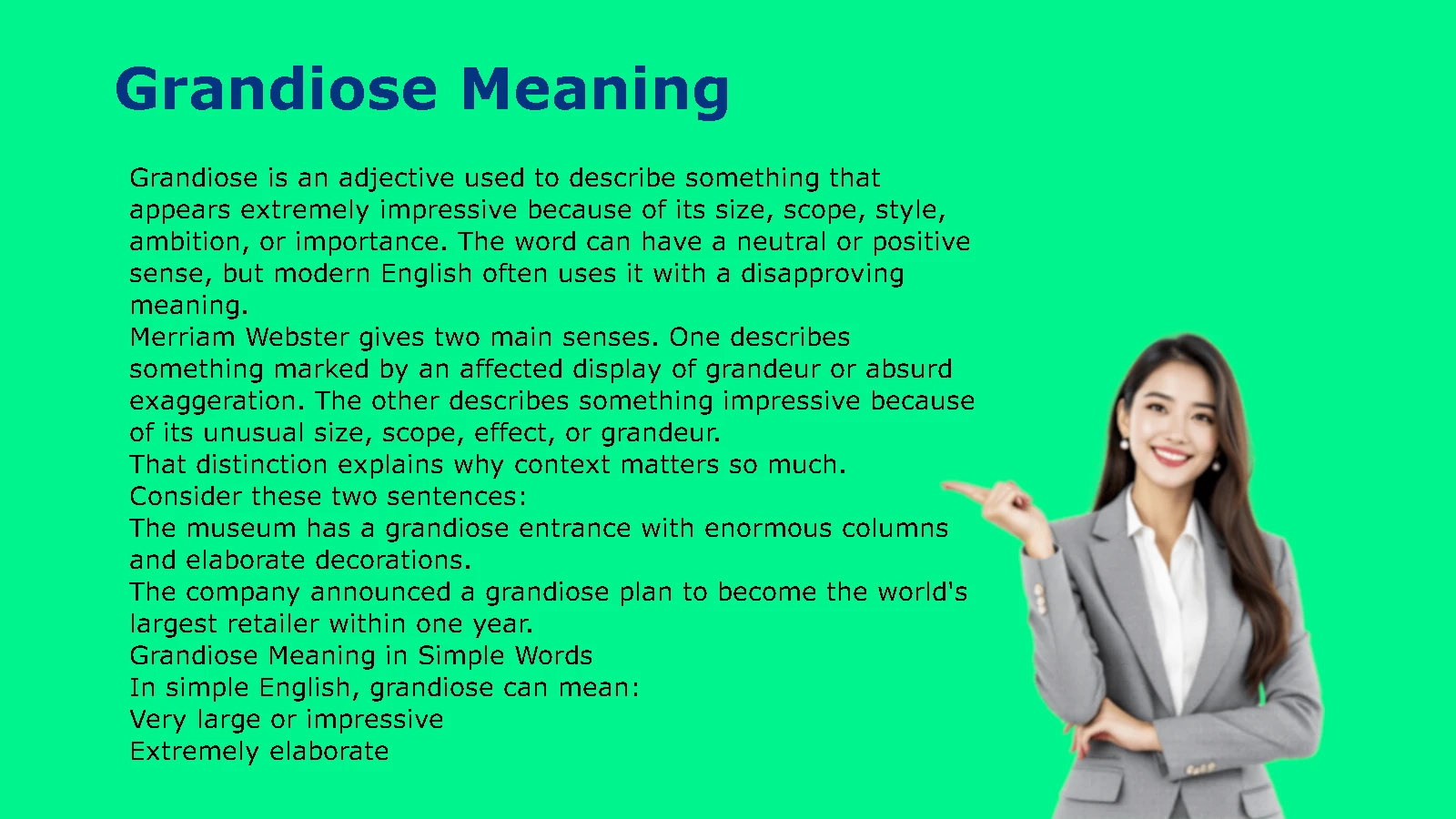
Grandiose is an adjective used to describe something that appears extremely impressive because of its size, scope, style, ambition, or importance. The word can have a neutral or positive sense, but modern English often uses it with a disapproving meaning.
Merriam Webster gives two main senses. One describes something marked by an affected display of grandeur or absurd exaggeration. The other describes something impressive because of its unusual size, scope, effect, or grandeur.
That distinction explains why context matters so much.
Consider these two sentences:
- The museum has a grandiose entrance with enormous columns and elaborate decorations.
- The company announced a grandiose plan to become the world’s largest retailer within one year.
The first sentence could simply emphasize the entrance’s impressive scale. The second suggests that the company’s goal may be excessive or unrealistic.
Grandiose Meaning in Simple Words
In simple English, grandiose can mean:
- Very large or impressive
- Extremely elaborate
- More complicated than necessary
- Excessively ambitious
- Intended to look important or powerful
- Unrealistic because of its enormous scope
- Pretentious or exaggerated
The exact meaning depends on what the word describes.
A useful way to remember the word is this:
Grandiose often means “grand, but perhaps too grand.”
Grandiose Definition and Core Meaning
The word grandiose sits close to several words such as grand, magnificent, imposing, ambitious, and pretentious. Yet it has its own flavor.
Its central idea involves grandeur that exceeds ordinary limits. Sometimes that excess creates awe. At other times, it creates skepticism.
| Meaning | What it suggests | Example |
| Very large | Unusual physical size | A grandiose palace |
| Very elaborate | Excessive detail or decoration | A grandiose interior |
| Extremely ambitious | A goal with enormous scope | A grandiose business plan |
| Exaggerated | Claims go beyond what seems reasonable | Grandiose promises |
| Pretentious | Someone tries to appear unusually important | Grandiose language |
| Impractical | The scale makes success unlikely | A grandiose construction scheme |
Cambridge specifically notes that grandiose can describe things that are very large or wonderful, while its primary dictionary entry marks the word as disapproving.
That negative shade becomes especially strong when grandiose describes claims, promises, schemes, ambitions, or ideas.
Is Grandiose a Positive or Negative Word?
Grandiose can be positive, neutral, or negative, but it most often carries a critical tone.
This is one of the most important points to understand about the word.
When someone calls a building grandiose, they may admire its size and beauty. When someone calls a person’s claims grandiose, however, they usually suggest that the claims are exaggerated.
Oxford labels grandiose as disapproving and defines it as seeming very impressive while being too large, complicated, expensive, or otherwise impractical.
When Grandiose Sounds Positive
The word can emphasize magnificence or unusual scale.
For example:
- The grandiose theater featured enormous arches and a richly decorated ceiling.
- The architect created a grandiose entrance for the new cultural center.
- The film uses grandiose scenery to create a sense of epic scale.
Here, the word focuses on grandeur. The writer may admire what they describe.
When Grandiose Sounds Negative
The critical meaning becomes clearer when the word describes ideas or behavior.
For example:
- His grandiose promises impressed investors at first but proved difficult to fulfill.
- The committee rejected the grandiose proposal because it had no realistic budget.
- She dismissed the plan as grandiose and impractical.
In these sentences, grandiose suggests that something sounds impressive on the surface but lacks proportion, practicality, or realism.
Why Context Changes the Meaning
Think of grandiose as a volume knob.
At a low level, it can mean large and impressive. Turn the volume up, and it begins to suggest excessive, exaggerated, or pretentious.
That subtle difference makes grandiose more precise than simply saying big or great.
Grandiose Pronunciation
The American pronunciation of grandiose is commonly represented as:
/ˈɡræn.di.oʊs/
An easy pronunciation guide is:
GRAN-dee-ohs
Merriam Webster also gives pronunciations beginning with gran-dee, while Cambridge lists the American form as /ˈɡræn.di.oʊs/.
The final sound resembles “ohs.”
Is Grandiose an Adjective?
Yes. Grandiose is an adjective.
That means it describes a noun.
For example:
- grandiose plans
- grandiose ambitions
- grandiose claims
- grandiose ideas
- grandiose designs
- grandiose buildings
- grandiose promises
- grandiose schemes
- grandiose lifestyle
- grandiose vision
The adjective usually appears before the noun, although English can use adjectives in other positions depending on sentence structure.
Grandiose Examples in Sentences
Seeing the word in different contexts makes its meaning much easier to understand.
Grandiose Plans
A grandiose plan usually has an unusually large scope and may seem difficult or impossible to carry out.
The startup had a grandiose plan to open offices in every major city within six months.
The sentence doesn’t merely say the plan is ambitious. It hints that the goal may be far too ambitious.
Grandiose Ideas
A grandiose idea often sounds exciting but may go beyond practical limits.
His grandiose idea involved turning an abandoned warehouse into an entire indoor city.
The word tells readers that the idea is more than simply creative. Its scale makes it seem excessive.
Grandiose Claims
This is one of the clearest negative uses.
The advertisement made grandiose claims about the product’s ability to solve every household problem.
Here, grandiose suggests that the claims sound much more impressive than the available evidence supports.
Grandiose Promises
The politician’s grandiose promises attracted attention but raised questions about how they would be funded.
The word suggests that the promises sound impressive but may not be realistic.
Grandiose Buildings
The grandiose courthouse features towering columns, marble floors, and an enormous central dome.
In this example, the word focuses primarily on architectural scale and elaborate design.
Grandiose Lifestyle
After years of living a grandiose lifestyle, he struggled to adjust to a simpler budget.
Here, grandiose describes a way of living marked by considerable display, expense, or luxury.
Grandiose Vision
The founder presented a grandiose vision for transforming the industry.
The sentence can sound neutral or skeptical depending on the surrounding paragraph.
Grandiose Language
The report uses grandiose language to describe a relatively small improvement.
This use is clearly critical. The writer thinks the language makes the achievement sound bigger than it really is.
Grandiose Synonyms
The best synonym depends on which part of the meaning you want to emphasize.
Merriam Webster lists related words including magnificent, imposing, majestic, grand, monumental, extravagant, impressive, luxurious, colossal, and splendid. It also explains that grandiose differs from these words because it often carries an implication of inflated pretension or exaggeration.
| Synonym | Best used when you mean |
| Grand | Large, impressive, or dignified |
| Magnificent | Exceptionally beautiful or impressive |
| Imposing | Impressive because of size or presence |
| Majestic | Grand, dignified, and powerful |
| Monumental | Extremely large or historically significant |
| Extravagant | Excessive in spending, detail, or scale |
| Pretentious | Trying too hard to seem important or sophisticated |
| Pompous | Excessively self important |
| Ostentatious | Showily displaying wealth or status |
| Lavish | Generous, elaborate, or expensive |
| Colossal | Extremely large |
| Ambitious | Aiming for a difficult or significant result |
Grandiose vs. Magnificent
Magnificent is strongly positive.
The cathedral has a magnificent interior.
The speaker admires it.
Grandiose, by contrast, can admire the scale while also suggesting that the design goes too far.
The cathedral has a grandiose interior.
The speaker may admire it, but the sentence can also imply excessive ornamentation.
Grandiose vs. Pretentious
These words overlap, but they aren’t identical.
Grandiose focuses on excessive grandeur, scale, ambition, or importance.
Pretentious focuses on an attempt to appear more important, intelligent, cultured, or sophisticated than one really is.
For example:
The company proposed a grandiose expansion.
The plan is excessively large.
He used pretentious language in the presentation.
The language tries too hard to sound sophisticated.
Something can be grandiose without being pretentious, especially when describing architecture or physical scale.
Grandiose Antonyms
The opposite of grandiose depends on the specific sense.
Useful antonyms include:
- Modest
- Humble
- Simple
- Practical
- Realistic
- Restrained
- Unassuming
- Ordinary
- Down to earth
- Reasonable
Consider the difference:
They proposed a grandiose redevelopment project.
The opposite might be:
They proposed a modest redevelopment project.
But if the issue involves unrealistic ambition, a better opposite might be:
They proposed a realistic redevelopment project.
If the issue involves unnecessary decoration, simple or restrained may work better.
Grandiose vs. Grand
Grand and grandiose share the idea of greatness, but their connotations differ.
Merriam Webster explains that both words can describe unusual size, scope, or effect. However, grandiose often suggests pretension or absurd exaggeration, while grand can carry ideas of dignity and attractiveness.
| Grand | Grandiose |
| Often positive or neutral | Often critical |
| Large and impressive | Excessively large or impressive |
| Can suggest dignity | Can suggest pretension |
| Usually doesn’t imply impracticality | Can imply impracticality |
| a grand staircase | a grandiose scheme |
Compare these sentences:
The university built a grand library.
This sounds complimentary.
The university proposed a grandiose expansion plan.
This sounds more skeptical.
The second sentence suggests that the expansion may be excessive or unrealistic.
A Simple Trick to Remember the Difference
Think of grand as impressive and grandiose as impressive with an extra dose of excess.
That doesn’t mean every grandiose thing is bad. It simply means the word makes readers more aware of scale, exaggeration, or pretension.
Grandiose vs. Ambitious
These words often appear together, but they aren’t interchangeable.
An ambitious person sets challenging goals. That’s not necessarily a problem.
A grandiose person or plan may set goals that appear excessively large, unrealistic, or disconnected from practical limits.
Compare:
She has an ambitious goal of expanding the company into five states.
The goal is difficult but potentially reasonable.
She has a grandiose goal of dominating every market on Earth within a year.
The second goal sounds wildly excessive.
This distinction matters because calling someone’s plan grandiose can be much more critical than calling it ambitious.
Grandiose vs. Pretentious
Grandiose and pretentious both can describe something that tries too hard to appear important. Still, their focus differs.
| Word | Main focus | Example |
| Grandiose | Excessive scale or grandeur | A grandiose development scheme |
| Pretentious | Trying to seem more important or sophisticated | Pretentious academic language |
| Pompous | Excessive self importance | A pompous speech |
| Ostentatious | Showy display, often of wealth | An ostentatious mansion |
A building can be grandiose because it is enormous and elaborate. A person can be pretentious because they use complicated language simply to appear intelligent.
Common Collocations With Grandiose
Certain nouns frequently appear with grandiose. Learning these combinations will help you use the word naturally.
Grandiose Plans
The board rejected his grandiose plans.
Grandiose Ideas
She was known for her grandiose ideas.
Grandiose Ambitions
His grandiose ambitions extended far beyond the company’s resources.
Grandiose Claims
Consumers should be cautious about grandiose claims.
Grandiose Schemes
The grandiose scheme collapsed after funding disappeared.
Grandiose Designs
The architect was famous for grandiose designs.
Grandiose Promises
The campaign attracted attention with grandiose promises.
Grandiose Vision
The founder presented a grandiose vision for the future.
Grandiose Lifestyle
The actor eventually abandoned his grandiose lifestyle.
Grandiose Statements
The report contains several grandiose statements about the project’s expected impact.
Oxford’s collocation information specifically identifies nouns such as ambition, claim, and idea as common partners for grandiose.
How to Use Grandiose Correctly
Using grandiose well means recognizing when scale and excess matter.
Use Grandiose for Excessive Scale
If something goes far beyond normal size or scope, grandiose may fit.
The hotel has a grandiose lobby with a massive chandelier.
The word emphasizes the dramatic scale.
Use Grandiose for Unrealistic Ambition
This is one of the most useful applications.
The entrepreneur developed a grandiose plan to revolutionize transportation overnight.
The goal sounds far too broad for the proposed time frame.
Use Grandiose for Exaggerated Claims
When someone makes statements that sound bigger than the evidence supports, grandiose can communicate skepticism without requiring a long explanation.
The company made grandiose claims about its new technology.
Use Grandiose for Excessive Detail or Complexity
Cambridge specifically includes the idea of something containing more detail than necessary.
For example:
The presentation turned into a grandiose display of charts, animations, and unnecessary statistics.
The criticism isn’t simply that the presentation was detailed. It was too elaborate for what it needed to accomplish.
When You Shouldn’t Use Grandiose
Don’t use grandiose as a generic replacement for good, great, or beautiful.
For example:
❌ She had a grandiose smile.
This sounds unnatural because a smile isn’t usually described in terms of excessive scale or grandeur.
Better choices might include:
She had a radiant smile.
Similarly:
❌ The meal was grandiose.
If you mean that the meal tasted excellent, use excellent, delicious, or magnificent depending on the intended tone.
However:
The restaurant served a grandiose seven course meal with elaborate decorations and theatrical presentations.
Now the word makes sense because the description emphasizes excessive elaboration and scale.
Grandiose in Different Contexts
The meaning becomes clearer when you see how the adjective works in different fields.
Grandiose in Everyday Conversation
The word sounds somewhat formal. In casual speech, people may use simpler expressions such as:
- over the top
- way too ambitious
- too elaborate
- unrealistic
- excessively fancy
- trying too hard
For example:
That plan is a little grandiose.
A casual speaker might instead say:
That plan is a little over the top.
Both communicate the idea of excess, but grandiose sounds more formal and precise.
Grandiose in Business
Business writing often uses grandiose when discussing ambitious strategies, forecasts, promises, or marketing claims.
For example:
The startup’s grandiose growth projections raised concerns among analysts.
The word signals that the projections may go beyond what the available resources or evidence can support.
A useful distinction is:
Ambitious target: difficult but supported by a credible strategy.
Grandiose target: extremely ambitious and potentially unrealistic.
Grandiose in Architecture
Architecture provides one of the clearest neutral or positive uses.
A building may be called grandiose because of:
- enormous dimensions
- elaborate decoration
- monumental entrances
- towering columns
- huge domes
- elaborate interiors
- dramatic symmetry
- expensive materials
Oxford gives grandiose opera house as an example.
Yet the word can still imply criticism if the building seems unnecessarily extravagant.
Grandiose in Literature
Writers can use grandiose to describe an inflated style, dramatic ambition, or exaggerated language.
For example:
The character spoke in grandiose terms about his destiny.
This tells the reader that the character doesn’t simply speak confidently. He describes himself in unusually important or dramatic terms.
Grandiose in Public Speech
Speeches can become grandiose when speakers use sweeping language about enormous goals or historical change.
For example:
The speech presented a grandiose vision of a completely transformed society.
The word doesn’t automatically say the vision is impossible. It tells readers that the vision is very large in scale and presented in elevated terms.
Grandiose Meaning in Psychology
The word also has a specialized psychological use, but everyday usage and clinical terminology shouldn’t be confused.
In general English, grandiose can describe someone who has an exaggerated view of their importance, abilities, status, or achievements.
For example:
The character displayed a grandiose sense of his own importance.
In clinical contexts, grandiosity can refer to an exaggerated sense of importance or ability. Merriam Webster’s medical definition includes grandiose in descriptions such as grandiose delusions.
That specialized meaning shouldn’t be casually applied to people based on ordinary behavior.
Calling someone’s business plan grandiose simply means the plan seems excessively ambitious. It doesn’t establish anything about that person’s mental health.
What Is Grandiosity?
Grandiosity is the noun form associated with being grandiose.
Merriam Webster defines grandiosity as the quality or state of being grandiose.
Examples include:
- The proposal was criticized for its grandiosity.
- The novel deliberately uses grandiosity to create a dramatic effect.
- The character’s grandiosity shapes the way he treats other people.
The word can describe exaggerated grandeur in ideas, language, behavior, or self perception.
Word Forms Related to Grandiose
Understanding related forms can help you use the word accurately.
| Word | Part of speech | Meaning |
| Grandiose | Adjective | Excessively grand, elaborate, impressive, or ambitious |
| Grandiosely | Adverb | In a grandiose manner |
| Grandioseness | Noun | The quality of being grandiose |
| Grandiosity | Noun | The quality or state of being grandiose |
Merriam Webster lists grandiosely and grandioseness as related forms and identifies grandiosity as a noun.
What Does Grandiosely Mean?
Grandiosely means in a grandiose manner.
For example:
The speaker grandiosely described the project as the beginning of a new era.
The adverb explains how the speaker described the project.
What Does Grandiosity Mean?
Grandiosity refers to the quality of being grandiose.
For example:
The grandiosity of the proposal made it difficult to evaluate its practical details.
The noun focuses on the quality of excessive grandeur rather than describing the thing itself.
Grandiose Word Origin
The history of grandiose connects the word to the broader idea of greatness.
Merriam Webster traces the English word through French grandiose, from Italian grandioso, which comes from grande, meaning “great,” ultimately related to Latin grandis. Merriam Webster records 1818 as the first known use of grandiose in English.
Oxford also traces the word through French and Italian and identifies its origin with grande, meaning “grand.”
This history makes sense because the modern word still revolves around greatness, size, grandeur, and excess.
Grandioso vs. Grandiose
Don’t confuse grandioso with grandiose.
Grandioso is an Italian musical direction meaning in a broad and noble style. Merriam Webster records its first known English use in 1836.
So:
- grandiose = excessively grand, impressive, elaborate, or exaggerated
- grandioso = a musical direction indicating a broad and noble style
They share historical roots, but they serve different purposes.
Common Mistakes With Grandiose
Mistake: Thinking Grandiose Always Means Wonderful
It doesn’t.
Although grandiose can describe something impressive, dictionaries commonly mark the word as disapproving.
If you simply mean “excellent,” choose excellent.
If you mean “beautiful and impressive,” magnificent may be better.
Mistake: Treating Grand and Grandiose as Identical
They overlap, but grandiose often adds a suggestion of excess.
a grand celebration
sounds positive.
a grandiose celebration
may suggest that the celebration has become excessively elaborate.
Mistake: Assuming Grandiose Always Means Unrealistic
Unrealistic is an important part of the word’s common use, but it isn’t the entire definition.
A grandiose building can be physically real and highly successful. The word may simply emphasize its unusual scale or elaborate design.
Mistake: Using Grandiose for Anything Large
Size alone doesn’t always make something grandiose.
A large warehouse is not automatically grandiose.
A warehouse with an enormous marble entrance, decorative columns, expensive sculptures, and an elaborate ceremonial hall might reasonably be described as grandiose because its design goes beyond ordinary practical needs.
Mistake: Confusing Grandiose With Grandiosity
Remember:
- grandiose = adjective
- grandiosity = noun
The plan is grandiose.
The plan’s grandiosity is obvious.
Grandiose Meaning: Quick Comparison With Related Words
| Word | Core meaning | Typical tone |
| Grandiose | Extremely grand, often excessively so | Often negative |
| Grand | Large, impressive, or dignified | Positive or neutral |
| Magnificent | Exceptionally impressive or beautiful | Positive |
| Imposing | Impressive because of size or presence | Neutral or positive |
| Majestic | Grand and dignified | Positive |
| Pretentious | Trying to appear more important or sophisticated | Negative |
| Pompous | Excessively self important | Negative |
| Ostentatious | Showily displaying wealth or importance | Negative |
| Ambitious | Aiming for a difficult or significant goal | Usually neutral or positive |
| Extravagant | Excessive in cost, detail, or scale | Often negative |
The key distinction is connotation. Merriam Webster notes that grandiose can overlap with grand, imposing, magnificent, majestic, and stately, but it commonly suggests inflated pretension or exaggerated scale.
A Practical Case Study: Grand vs. Grandiose
Imagine two companies planning new headquarters.
Company A announces:
We plan to build a modern headquarters with enough offices for our growing workforce, several meeting rooms, and an energy efficient design.
That sounds ambitious but practical.
Company B announces:
We will construct a 100 story headquarters with a private theater, indoor rainforest, luxury hotel, museum, and transportation hub before the end of the year.
If Company B has no credible funding, permits, workforce, or construction schedule, describing the plan as grandiose makes sense.
The difference isn’t simply size. It’s the relationship between scale and practicality.
That’s the heart of the word.
Another Case Study: Grandiose Language
Imagine a small community organization completes a modest renovation.
A straightforward report might say:
The renovation added new lighting, repaired the roof, and improved the meeting room.
A grandiose description might say:
This historic transformation has ushered in a revolutionary new era of community excellence.
The second version uses language that sounds far larger than the actual achievement.
That’s another important use of grandiose. The word can describe not only physical size but also inflated language.
How to Remember the Meaning of Grandiose
A simple memory trick can make the word stick.
Think:
Grand + extra = grandiose
Something grand is impressive.
Something grandiose often goes a step too far.
Imagine someone ordering a birthday cake.
A large, beautifully decorated cake might be grand.
A cake shaped like a three story castle with working lights, a miniature drawbridge, moving figures, and a smoke machine might be grandiose.
The second cake isn’t necessarily bad. It simply goes far beyond what most people need from a birthday cake.
That is the feeling the word often creates.
Grandiose Meaning in Everyday Examples
Here are additional examples that show the word’s range:
- The mansion had a grandiose entrance.
- His grandiose plans required far more money than he had.
- The presentation made several grandiose claims.
- She dreamed of creating a grandiose resort.
- The director gave the final scene a grandiose visual style.
- The proposal sounded grandiose but lacked practical details.
- The palace was built on a grandiose scale.
- His grandiose ambitions often exceeded his available resources.
- The speech was filled with grandiose promises.
- They rejected the grandiose design in favor of a simpler one.
- The writer uses grandiose language to portray the emperor’s power.
- The project began with a grandiose vision and ended with a modest result.
Frequently Asked Questions About Grandiose
What does grandiose mean in simple words?
Grandiose means very large, impressive, elaborate, or ambitious, often in a way that seems excessive or unrealistic.
Is grandiose a positive or negative word?
It can be either, but grandiose is most often used with a disapproving or critical tone. The negative meaning becomes especially clear when it describes plans, claims, promises, or ambitions.
What is an example of grandiose?
He had a grandiose plan to build a business empire in just one year.
The word suggests that the plan is unusually ambitious and probably unrealistic.
What is a synonym for grandiose?
Depending on the context, synonyms include grand, magnificent, imposing, majestic, monumental, extravagant, pretentious, and ostentatious. However, these words don’t all have exactly the same connotation.
What is the opposite of grandiose?
Common opposites include modest, simple, practical, realistic, humble, restrained, and unassuming.
The best choice depends on what grandiose means in the sentence.
Does grandiose mean unrealistic?
Sometimes. A grandiose plan or ambition often seems unrealistic because it is too large, complicated, expensive, or difficult to achieve. However, grandiose can also describe something genuinely impressive or elaborate without necessarily saying it is impossible.
What is the difference between grand and grandiose?
Grand usually means large, impressive, or dignified. Grandiose often means excessively large, elaborate, exaggerated, or pretentious.
In short:
Grand can praise. Grandiose often questions.
What does grandiose mean in psychology?
In psychological contexts, grandiose can describe an exaggerated sense of one’s importance, abilities, status, or achievements. Grandiosity is the corresponding noun. Specialized terms such as grandiose delusions have clinical meanings and shouldn’t be confused with the everyday use of the adjective.
Is grandiose a formal word?
Yes. Grandiose sounds more formal than everyday expressions such as over the top, too ambitious, or way too elaborate. It works especially well in essays, journalism, criticism, business writing, and formal descriptions.
Can grandiose describe a person?
Yes, but the meaning depends on the context.
For example:
He has a grandiose sense of his own abilities.
This usually suggests that he thinks too highly of himself.
In a specialized psychological context, grandiose can have a more specific meaning.
Can grandiose describe a building?
Yes. A building can be grandiose because of its enormous scale, elaborate design, expensive materials, or dramatic appearance.
The grandiose opera house dominated the city square.
The word may sound admiring or critical depending on the surrounding context.
What does grandiose mean in a sentence?
In a sentence such as:
The company announced a grandiose expansion plan.
Grandiose suggests that the plan is extremely ambitious or elaborate and may be larger than practical.
Final Takeaway: What Does Grandiose Mean?
The simplest way to understand grandiose meaning is to think of something that is extremely grand, impressive, elaborate, or ambitious, often to the point of excess.
The word has two closely connected sides. It can describe genuine grandeur, such as a huge and elaborate building. More often, especially when describing plans, ambitions, claims, promises, or ideas, it suggests that something has become exaggerated, impractical, or pretentious.
The distinction becomes clearer when you compare it with grand:
Grand = impressive, large, or dignified.
Grandiose = unusually grand, often with a sense that it goes too far.
That small difference carries a lot of meaning. If you understand the tone behind the word, you’ll know when grandiose is the right choice and when a simpler word such as grand, magnificent, ambitious, or pretentious would communicate your idea more accurately.
In one sentence: Grandiose describes something impressively large or elaborate, especially when its grandeur seems excessive, exaggerated, or impractical.