
Have you ever noticed someone looking at you with an angry, intense expression and wondered what that look was called? Glowering meaning describes a dark, angry, or displeased look that someone gives when they are upset, annoyed, or unhappy.
Glowering is the present participle of glower, which means to look at someone or something with a very angry or unfriendly expression. It usually suggests more than simply looking serious. A glowering person often communicates anger, irritation, hostility, or deep displeasure without saying a word.
Examples:
- She was glowering at him after the argument.
- The teacher stood at the door, glowering at the noisy students.
The confusion is understandable. People often search for what does glowering mean, glowering meaning in a sentence, glowering definition, or what does it mean when someone is glowering because the word describes both a facial expression and the emotion behind it. And here’s the kicker: a glowering look can say plenty without a single word being spoken.
In this guide, you’ll learn the complete glowering meaning, its definition, pronunciation, synonyms, and correct usage. You’ll also discover how to use glowering in a sentence, what a glowering expression looks like, and the difference between glowering, glaring, scowling, and other words used to describe an angry look.
What Does Glowering Mean?
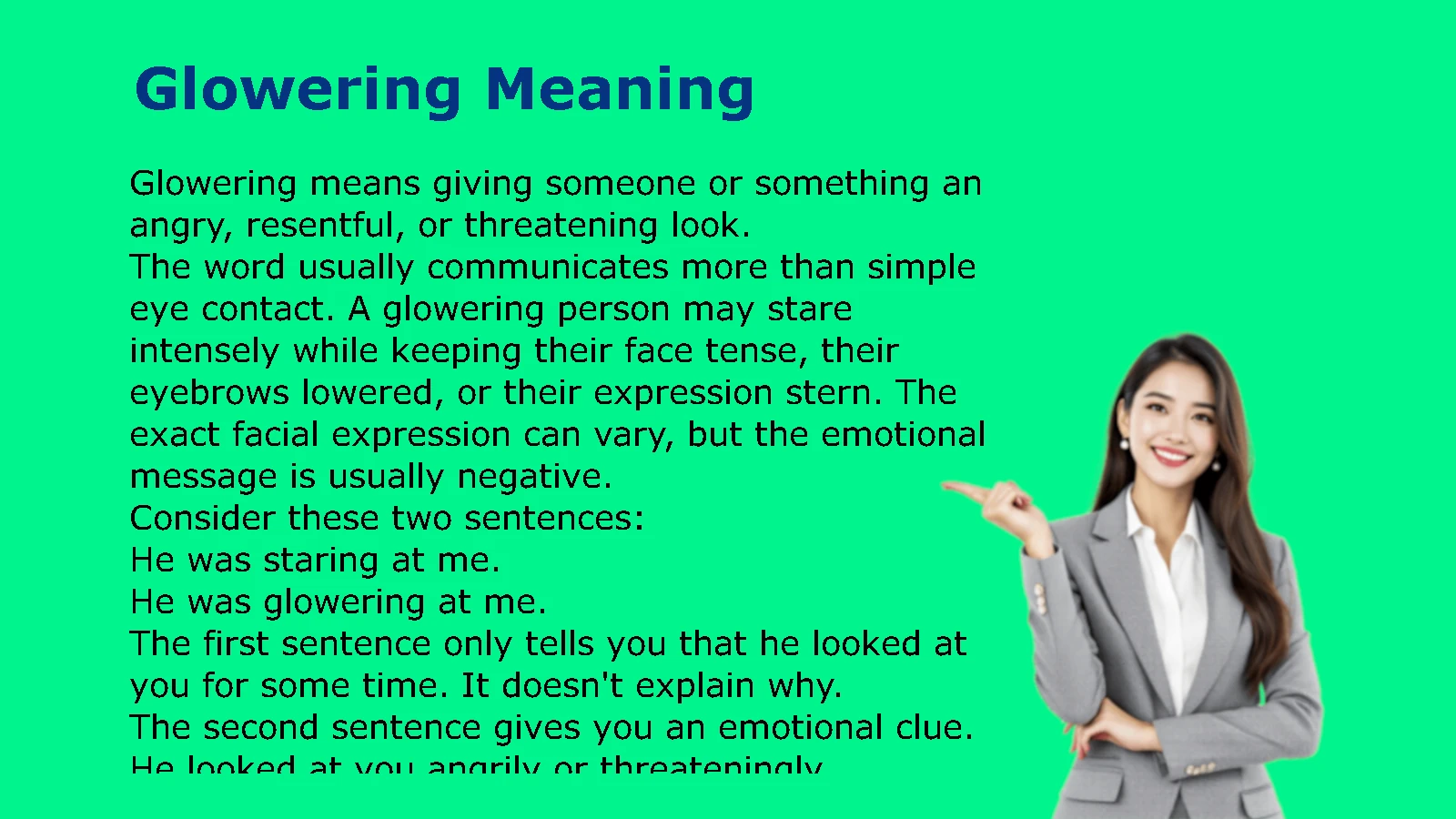
Glowering means giving someone or something an angry, resentful, or threatening look.
The word usually communicates more than simple eye contact. A glowering person may stare intensely while keeping their face tense, their eyebrows lowered, or their expression stern. The exact facial expression can vary, but the emotional message is usually negative.
Consider these two sentences:
- He was staring at me.
- He was glowering at me.
The first sentence only tells you that he looked at you for some time. It doesn’t explain why.
The second sentence gives you an emotional clue. He looked at you angrily or threateningly.
That distinction matters because glowering is a much more specific word than looking or staring.
Glowering meaning in simple words
In simple English, glowering means looking at someone angrily.
You might use it when someone:
- looks seriously annoyed
- stares at another person with anger
- seems hostile without saying anything
- gives someone a threatening look
- sits silently with an angry expression
- looks resentful after an argument
For example:
She was glowering at her brother after he took her seat.
The sentence suggests that she didn’t need to say, “I’m angry.” Her expression said it for her.
Glowering Definition at a Glance
| Word | Meaning | Grammar |
| Glower | To look or stare angrily | Verb |
| Glowering | Looking or staring angrily | Present participle; can also work as an adjective |
| Glowered | Looked or stared angrily | Past tense and past participle |
| Glowers | Looks or stares angrily | Third person singular |
| Glower | An angry or threatening look | Noun |
Cambridge lists glowering as the present participle of glower. The base verb can also function as a noun meaning an angry, annoyed, or threatening look.
Oxford similarly lists glowering as the -ing form of glower and gives the core meaning as looking in an angry or aggressive way.
Glowering Pronunciation
The US pronunciation of glowering begins with the same sound as glower.
It can be pronounced approximately as:
GLOW-er-ing
The dictionary pronunciation for glower is /ˈɡlaʊ.ɚ/ in US English. The vowel sound is similar to the sound in “cow” or “how,” not the long o sound in glow.
This can be confusing because the spelling starts with glow, but the pronunciation doesn’t sound like glowing.
Compare:
- glowing → related to light, warmth, health, or enthusiasm
- glowering → related to anger, annoyance, or menace
That small difference in spelling represents a completely different meaning.
What Does It Mean to Glower at Someone?
The phrase “glower at someone” means to look directly at that person in an angry, annoyed, aggressive, or threatening way.
The preposition at is especially common when glower has a specific target.
For example:
- He glowered at me from across the room.
- She was glowering at her coworker.
- The coach glowered at the players.
- I could tell that my brother was glowering at me.
- The customer glowered at the cashier after the delay.
Cambridge specifically records “glower at someone” as a collocation meaning to look at someone in a very angry, annoyed, or threatening way.
Oxford gives the same basic construction: glower at somebody/something.
Why “at” matters
Compare:
She was glowering.
This tells you that she had an angry or threatening look.
Now compare:
She was glowering at me.
This tells you who received the look.
The second sentence is more specific. It points the emotional force of the expression toward another person.
Glowering as a Verb vs. an Adjective
The word glowering can serve different grammatical roles depending on how you use it.
Glowering as the -ing form of “glower”
In a progressive verb construction, glowering acts as the present participle.
Examples:
- He is glowering at me.
- She was glowering across the table.
- They were glowering at each other.
- The teacher is glowering at the noisy students.
Here, glowering forms part of the verb phrase.
The structure is often:
subject + be + glowering + at + target
For example:
The manager was glowering at the employees.
Glowering as an adjective
The same form can describe a person, expression, object, or atmosphere.
Examples include:
- a glowering expression
- a glowering face
- a glowering man
- a glowering stare
- glowering eyes
- glowering clouds
In these cases, glowering helps describe the quality or appearance of something.
Cambridge notes that present and past participles can function as adjectives and provides examples of glowering used descriptively.
Glowering Examples in Sentences
The easiest way to understand glowering meaning is to see the word in different situations.
Everyday conversation
Why are you glowering at me?
He sat quietly, glowering after the argument.
She gave him a glowering look and walked away.
These examples show the word in ordinary interpersonal situations.
School or work
The teacher was glowering at the students who kept talking.
The manager sat at the end of the table, glowering at the team.
After the missed deadline, he spent the afternoon glowering at his computer.
The word can make a description more vivid than simply saying someone was angry.
Family and friends
My sister was glowering at me because I ate the last slice of pizza.
He glowered at his brother after the argument.
She walked into the room with a glowering expression.
Sometimes the situation is serious. Sometimes it isn’t. The word describes the look rather than determining how important the conflict is.
Fiction and storytelling
The villain stood in the doorway, glowering at the frightened crowd.
He lowered his head and gave the stranger a glowering stare.
A glowering figure watched from the corner of the room.
Writers often choose glowering because it lets them show emotion through behavior instead of simply telling readers that a character feels angry.
Compare:
The man was angry.
with:
The man stood silently, glowering across the room.
The second sentence paints a scene. You can almost see the expression.
Weather and nature
Glowering can also appear in figurative descriptions of nature.
Glowering clouds gathered above the city.
Here, the clouds obviously aren’t capable of feeling anger. The writer gives them a human quality.
Cambridge specifically records the figurative use of glower for large, dark rain clouds that appear likely to produce rain.
This creates a darker atmosphere than simply saying:
Dark clouds covered the sky.
The phrase glowering clouds suggests something more ominous and threatening.
What Does a Glowering Look Look Like?
There isn’t one required facial expression that makes a person glower. Instead, glowering describes the overall impression of an angry or threatening look.
A glowering expression may include:
- narrowed eyes
- lowered eyebrows
- a fixed stare
- a tense face
- tightly pressed lips
- a deep frown
- a rigid posture
- prolonged eye contact
- an expression of resentment or irritation
The important part is the emotional quality of the look.
Someone can stare at you because they’re curious. Someone else can stare because they’re distracted. A third person can stare because they’re angry.
Only the third situation naturally fits glowering.
A quick visual comparison
| Look | What it usually suggests |
| Staring | Intense or prolonged looking |
| Glaring | Strong, often angry or disapproving look |
| Glowering | Angry, resentful, or threatening look |
| Scowling | Angry facial expression, often with a frown |
| Frowning | Displeasure, worry, confusion, or concentration |
| Gazing | Soft, steady, or thoughtful looking |
These meanings overlap. English isn’t a collection of perfectly sealed boxes. Still, the emotional emphasis helps you choose the right word.
Glowering vs. Glaring
Glowering and glaring are close in meaning, and dictionaries often list glare as a synonym of glower. Oxford, for example, defines glower as looking in an angry or aggressive way and gives glare as a synonym.
However, the words can create slightly different impressions.
Glowering
Glowering strongly emphasizes anger, resentment, annoyance, or menace.
He was glowering at his rival.
The person appears angry and possibly hostile.
Glaring
Glaring can also describe an angry look, but it has broader uses.
She glared at him after the interruption.
The look is clearly intense and angry in this context.
Merriam Webster lists glare, scowl, stare, and frown among the synonyms of glower.
The easiest distinction
Think of it this way:
Glare = an intense look, often angry.
Glower = an intense look that especially suggests sullen anger, annoyance, or menace.
The difference is subtle. Context does much of the work.
Glowering vs. Scowling
Scowling and glowering are also closely related.
A scowl usually emphasizes the angry expression on someone’s face. A glower emphasizes the angry or threatening way someone looks at another person.
Compare:
He was scowling during the meeting.
This focuses on his facial expression.
He was glowering at the speaker.
This focuses more strongly on where his angry look was directed.
A person can easily do both at once:
She scowled and glowered at the man across the table.
Merriam Webster includes both scowl and glare among the synonyms of glower.
Glowering vs. Frowning
Frowning doesn’t always mean anger.
People frown when they’re:
- confused
- worried
- concentrating
- disappointed
- concerned
- annoyed
- unhappy
For example:
She frowned at the difficult question.
That doesn’t necessarily mean she was angry at anyone.
Now consider:
She glowered at the person who interrupted her.
This strongly suggests anger or hostility.
So, while both words can describe negative facial expressions, glowering carries a stronger sense of anger or menace.
Glowering vs. Staring
This is one of the most important distinctions.
Staring simply means looking at something or someone intently for a period of time. It doesn’t automatically tell you how the person feels.
For example:
He was staring at the painting.
There’s no obvious anger.
But:
He was glowering at the man beside him.
Now the look carries an emotional message.
Merriam Webster lists stare among the related synonyms of glower, but its definition adds the crucial idea of sullen annoyance or anger.
In other words, glowering is a type of intense looking with a negative emotional tone.
Synonyms for Glowering
The best synonym depends on exactly what you want to emphasize.
Strong anger
- glaring
- scowling
- looking daggers
- staring angrily
- looking hostile
- looking furious
Irritation or displeasure
- frowning
- looking annoyed
- looking displeased
- looking resentful
- looking sullen
Threatening appearance
- menacing
- hostile
- stern
- forbidding
- intimidating
Merriam Webster’s thesaurus includes glare, scowl, stare, frown, and “look daggers” among words associated with glower.
However, don’t treat every synonym as an exact replacement.
For example, menacing describes something that threatens danger. It doesn’t necessarily involve a stare. Likewise, frowning describes a facial expression but doesn’t always imply hostility.
Best synonym by context
| If you mean… | Try… |
| Angry stare | glaring |
| Angry facial expression | scowling |
| General displeasure | frowning |
| Threatening appearance | menacing |
| Intense look without a specific emotion | staring |
| Angry, sullen, threatening look | glowering |
Antonyms of Glowering
Because glowering usually communicates anger or hostility, its natural opposites describe positive or friendly expressions.
Some useful opposites include:
- smiling
- grinning
- beaming
- looking cheerful
- looking pleased
- looking friendly
- looking happy
Merriam Webster lists smile, beam, and grin among the near antonyms associated with glower.
Compare:
He was glowering at everyone.
with:
He was smiling at everyone.
The emotional atmosphere changes completely.
Glowering Word Forms
Knowing the related forms makes it easier to use the word correctly.
| Word form | Example |
| glower | I sometimes glower when I’m annoyed. |
| glowers | She glowers at anyone who interrupts. |
| glowered | He glowered at the referee. |
| glowering | They were glowering at each other. |
| glower noun | He gave me an angry glower. |
Oxford lists the principal forms as glower, glowers, glowered, and glowering.
“Glowered” meaning
Glowered is the past tense and past participle of glower.
He glowered at me yesterday.
It means that he looked at me angrily or threateningly.
Cambridge identifies glowered as the past simple and past participle of glower.
“Glowers” meaning
Glowers is the third person singular present form.
She glowers whenever someone challenges her.
“Glowering” meaning
Glowering is the present participle and -ing form.
He is glowering at his brother.
It can also function as an adjective:
He gave me a glowering look.
What Is a “Glower” as a Noun?
Although people often encounter glower as a verb, it can also function as a noun.
A glower is an angry, annoyed, or threatening look.
For example:
He gave me a glower and walked away.
She responded with a cold glower.
Cambridge defines the noun glower as an angry, annoyed, or threatening look. Oxford similarly describes it as the act of looking at someone or something in an angry or aggressive way.
This gives you two useful structures:
Verb:
He glowered at me.
Noun:
He gave me a glower.
The meaning remains closely connected, but the grammar changes.
Word Origin and History of Glower
The history of glower is surprisingly interesting.
Merriam Webster traces the word to Middle English Scots glowren and lists its first known use as a verb in the 15th century. It also notes connections with Middle Low German glūren, meaning “to be overcast,” and Middle Dutch gloeren, meaning “to leer.”
The meaning also changed over time.
According to Merriam Webster’s historical note, glower originally referred more generally to looking intently or staring in amazement. By the late 1700s, its use had become associated with angry looks rather than astonishment.
Oxford gives a related but cautious explanation, saying the word may have developed from a Scots variant of glore or from an obsolete form meaning “to stare,” with possible Scandinavian connections.
That history explains why the modern word feels so visually focused. At its core, glower has long been connected with intense looking. The modern sense adds anger and hostility.
Is Glowering a Negative Word?
Yes, in most contexts, glowering has a negative meaning.
It commonly suggests:
- anger
- annoyance
- resentment
- hostility
- aggression
- displeasure
- intimidation
- a threatening mood
For example:
The customer was glowering at the employee.
The sentence doesn’t merely describe eye movement. It creates tension.
However, the word doesn’t necessarily mean that the person will act violently. Someone can glower because they’re irritated, embarrassed, frustrated, or simply unhappy.
That’s an important distinction.
Glowering describes the look. It doesn’t prove what the person intends to do.
Can You Use Glowering for Objects or Nature?
Yes. Glowering can have a figurative meaning when writers describe something nonhuman as dark, gloomy, or threatening.
The most familiar example is weather:
Glowering clouds rolled across the sky.
The clouds aren’t literally angry. The writer uses human behavior to create an ominous image.
This is a form of personification, where something nonhuman receives a human quality.
Other literary examples might include:
A glowering mountain dominated the horizon.
The old building stood like a glowering shadow over the street.
These uses work because the object appears threatening or gloomy.
Cambridge explicitly records the figurative use of glower with large black rain clouds.
Common Sentence Patterns With Glowering
Learning common structures is more useful than memorizing a definition alone.
Subject + be + glowering
He was glowering.
This works when the target of the look isn’t important or isn’t mentioned.
Subject + be + glowering + at + target
She was glowering at me.
This is one of the most common patterns.
Glowering + noun
He wore a glowering expression.
A glowering figure stood nearby.
Here, glowering describes the noun.
Give + someone + a glower
She gave him a glower.
This uses glower as a noun.
Glowering + figurative noun
Glowering clouds gathered overhead.
This pattern creates a darker descriptive mood.
Common Mistakes With Glowering
Mistake: Calling every stare a glower
Not every intense look is a glower.
He stared at the painting.
This doesn’t suggest anger.
He glowered at his opponent.
This does.
The emotional context separates the two.
Mistake: Using “glowering” for a happy expression
You wouldn’t normally write:
She was glowering with delight.
That creates a contradiction unless you’re deliberately using irony.
For a positive expression, choose words such as smiling, beaming, grinning, or glowing.
Mistake: Confusing glowering with glowing
These words look similar, but their meanings are very different.
Glowing can mean:
- producing light
- shining
- looking healthy
- showing enthusiasm
- expressing praise
Glowering means:
- looking angry
- looking annoyed
- looking threatening
- appearing gloomy
A person can be glowing with happiness or glowering with anger, but those are very different moods.
Mistake: Forgetting “at”
When you identify the target, glower at is the standard construction.
She glowered at me.
not:
She glowered me.
Cambridge and Oxford both support the glower at someone/something construction.
Mistake: Assuming glowering only describes people
The figurative use extends beyond people.
Glowering clouds filled the sky.
That usage is established in dictionary examples.
Glowering vs. Glowing
The spelling makes this pair especially easy to confuse.
| Word | Meaning | Example |
| Glowing | Shining or appearing warm, healthy, or enthusiastic | She had a glowing smile. |
| Glowering | Looking angry, annoyed, or threatening | She was glowering at him. |
A simple memory trick can help:
Glowing = light.
Glowering = anger.
Think of a lamp when you see glowing. Think of an irritated person with narrowed eyes when you see glowering.
Is Glowering Formal or Informal?
Glowering works in both everyday and formal English.
You might hear it in conversation:
Why are you glowering at me?
You might also see it in a novel:
The old man sat in the corner, glowering at the visitors.
It can even appear in serious descriptive writing.
The word often sounds more vivid than simply saying angry because it describes a visible behavior.
Compare:
The man was angry.
with:
The man stood silently, glowering across the room.
The first sentence tells you his emotion. The second gives you a scene.
That makes glowering particularly useful in fiction, storytelling, journalism, descriptive prose, and everyday conversation.
Case Study: How Glowering Changes a Sentence
Consider a simple scene.
Version one
James was angry with his coworker.
This gives you information, but the picture remains fairly flat.
Version two
James was staring at his coworker.
Now you know where James was looking, but you don’t know exactly why.
Version three
James was glowering at his coworker across the conference table.
Suddenly, the tension is obvious.
The word glowering communicates anger through visible behavior. The phrase across the conference table adds physical context.
This is why precise vocabulary matters. One well chosen verb can carry more information than several ordinary words.
Short Examples of Glowering in Context
Here are additional examples showing different uses:
- He was glowering at me from across the room.
- She gave her brother a glowering look.
- The coach glowered at the players after the mistake.
- I could tell from his glowering expression that he was upset.
- The woman stood silently, glowering at the stranger.
- They sat across from each other, both glowering.
- The teacher glowered at the students until the room became quiet.
- He walked away without speaking, still glowering.
- A glowering figure appeared in the doorway.
- Glowering clouds gathered above the hills.
- She stopped smiling and began glowering at him.
- The manager gave the late employee a long glower.
- He sat in the corner with a glowering expression.
- She glowered at the screen after the computer crashed.
- The dark, glowering sky made the afternoon feel unusually gloomy.
Notice how the word works in both literal human situations and figurative descriptions.
Frequently Asked Questions About Glowering
What does glowering mean in simple words?
Glowering means looking at someone angrily, annoyedly, or threateningly. It usually describes an intense look that communicates displeasure without words.
Does glowering mean angry?
Usually, yes. Glowering strongly suggests anger, annoyance, resentment, or hostility. However, it describes someone’s appearance or behavior rather than proving exactly what they feel internally.
What is another word for glowering?
Common alternatives include glaring, scowling, staring angrily, frowning, and looking daggers. The closest choice depends on the context. Merriam Webster lists glare, scowl, stare, and frown among related synonyms.
Is glowering the same as glaring?
Not exactly, although the two words overlap. Glaring means looking intensely and often angrily. Glowering more strongly emphasizes a sullen, annoyed, aggressive, or threatening quality. Oxford lists glare as a synonym for glower.
What is the difference between glowering and frowning?
Frowning describes a facial expression that can result from anger, worry, confusion, concentration, or disappointment. Glowering usually involves an angry or threatening look directed toward someone or something.
What is the opposite of glowering?
Natural opposites include smiling, grinning, beaming, looking cheerful, and looking pleased. The best choice depends on the context.
How do you use glowering in a sentence?
A common structure is “glower at someone.”
She was glowering at me after the argument.
Another option is to use it as an adjective:
He gave me a glowering look.
Is glowering an adjective?
It can be. Glowering is grammatically the present participle of glower, but English participles can also function as adjectives.
For example:
a glowering expression
Here, glowering describes the expression. Cambridge’s entry includes adjective uses of the form.
What does “glowering at me” mean?
“Glowering at me” means looking at me in an angry, annoyed, aggressive, or threatening way. It suggests that the person’s expression communicates strong displeasure.
What does “glowering clouds” mean?
“Glowering clouds” means dark, threatening clouds that appear likely to bring rain or bad weather. This is a figurative use because clouds don’t literally feel anger. Cambridge records this use in its definition of glower.
What is the past tense of glower?
The past tense is glowered.
He glowered at me yesterday.
The present participle is glowering.
He was glowering at me.
Cambridge identifies glowered as both the past simple and past participle form.
Can glowering describe a person who isn’t speaking?
Absolutely. In fact, silence often strengthens the effect.
She said nothing. She simply sat there, glowering at him.
The lack of dialogue makes the facial expression carry the message.
Is glowering stronger than staring?
Generally, yes, when you’re talking about emotional meaning. Staring describes prolonged looking without necessarily expressing an emotion. Glowering specifically adds an angry, annoyed, aggressive, or threatening quality.
Final Takeaway: Glowering Meaning
The simplest way to remember the glowering meaning is this:
Glowering means looking or staring at someone with anger, annoyance, resentment, or a threatening attitude.
It comes from the verb glower, and its common construction is glower at someone or something. The word can also work as an adjective in phrases such as “a glowering expression” and “glowering clouds.”
The key difference is emotional. Staring tells you that someone is looking intensely. Glowering tells you that the look carries anger, displeasure, or menace.
If you remember only one example, make it this:
He was glowering at me from across the table.
You can immediately picture the scene: no argument is necessary, no explanation is required, and the look says plenty.
Quick reference
| Question | Answer |
| Glowering meaning | Looking or staring angrily, annoyingly, or threateningly |
| Base word | Glower |
| Part of speech | Present participle; can also function as an adjective |
| Past tense | Glowered |
| Common pattern | Glower at someone/something |
| Closest synonyms | Glaring, scowling, staring angrily |
| Opposites | Smiling, grinning, beaming |
| Common figurative use | Glowering clouds or skies |
| US pronunciation of glower | /ˈɡlaʊ.ɚ/ |
| Overall tone | Negative, angry, hostile, or threatening |
In short, glowering isn’t simply looking at someone. It’s looking in a way that makes the anger visible. That small difference gives the word its power and makes it useful whenever you want to describe tension without spelling out every emotion.