
What Is the Scarce Meaning?
Scarce means limited in quantity, difficult to find, or not available in enough amounts to meet demand. It is commonly used to describe resources, products, time, money, or opportunities that are in short supply.
Examples:
- Clean drinking water is scarce in some regions.
- Jobs became scarce during the economic downturn.
The confusion often comes from its broad use. Scarce can describe anything that’s in short supply, from natural resources and food supplies to time, money, and everyday opportunities. But here’s the good news: once you understand its meaning and context, it’s an easy word to use with confidence.
In this guide, you’ll discover the scarce meaning, scarce definition, how to pronounce scarce, how to use scarce in a sentence, and the difference between scarce vs rare. You’ll also explore scarce synonyms, scarce antonyms, and real-life examples to help you understand the word in everyday English.
What Is the Scarce Meaning?
The scarce meaning is straightforward:
Scarce means available in only small amounts or quantities or difficult to obtain because there isn’t enough of something.
It describes a situation where supply cannot fully meet demand. The word often appears when discussing resources, goods, services, or opportunities that people need but cannot easily find.
Dictionary-style definition
Scarce (adjective):
- Existing in limited quantities.
- Not easy to find or obtain.
- Insufficient to satisfy demand.
Simple definition
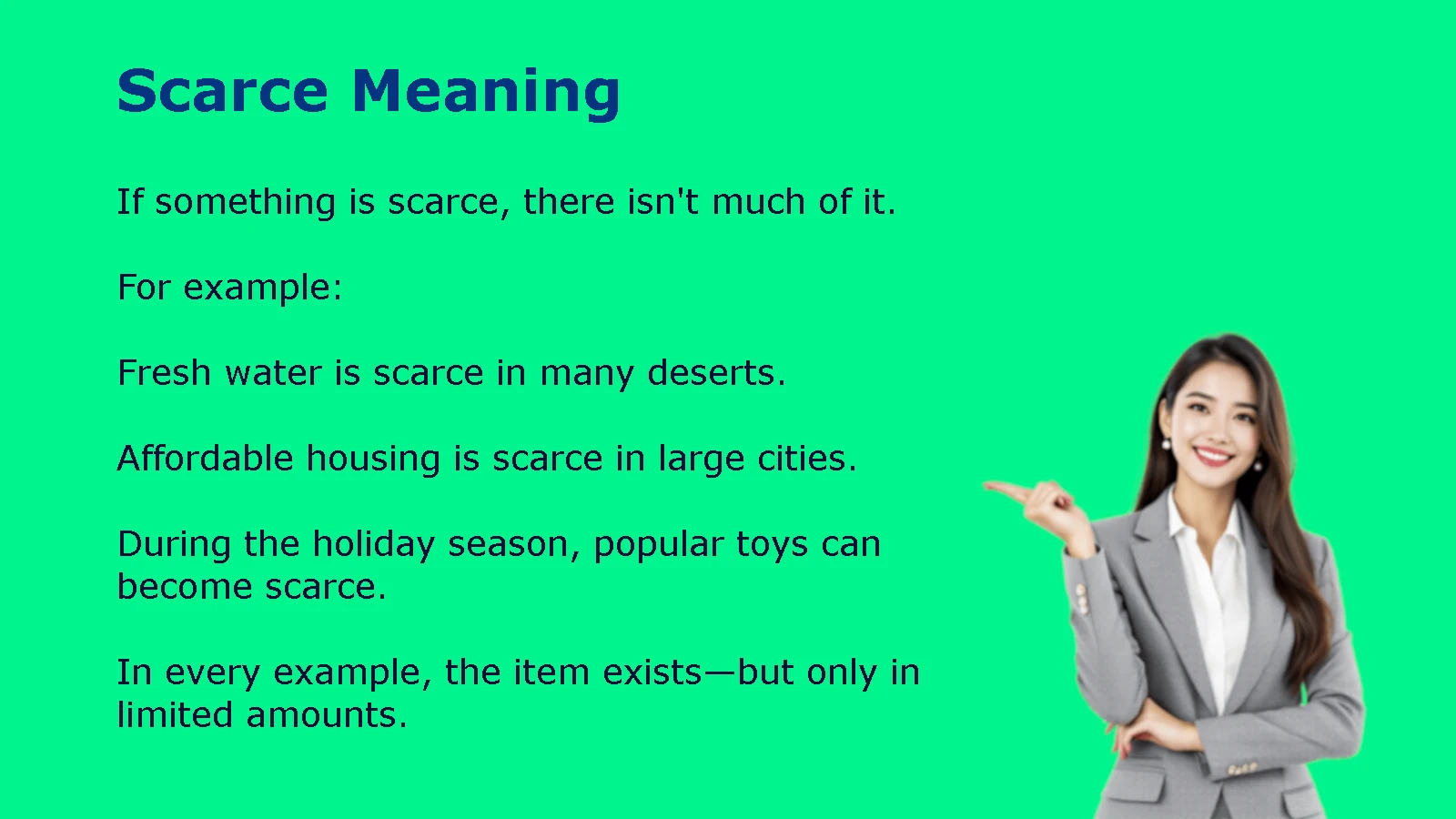
If something is scarce, there isn’t much of it.
For example:
- Fresh water is scarce in many deserts.
- Affordable housing is scarce in large cities.
- During the holiday season, popular toys can become scarce.
In every example, the item exists—but only in limited amounts.
What Does Scarce Mean in Simple Words?
Imagine walking into a grocery store hoping to buy fresh strawberries. You find only one small box left because many shoppers bought them earlier.
The strawberries aren’t gone forever. They’re simply scarce.
Here’s another example.
Think about parking spaces near a busy stadium before a championship game. Parking isn’t impossible to find, but available spaces are very limited. Parking becomes scarce.
A simple way to remember the scarce meaning is:
Scarce = Not enough to go around.
This idea applies to many situations, including:
- Food
- Water
- Money
- Time
- Employees
- Medical supplies
- Housing
- Natural resources
- Opportunities
Pronunciation of Scarce
Understanding pronunciation helps you use the word confidently in conversations.
| English Variant | Pronunciation | IPA |
| American English | skairs | /skerːs/ |
| British English | skairs | /skeəs/ |
One syllable
Scarce
It rhymes closely with words like:
- scarce
- fierce (similar ending sound)
- scarce isn’t pronounced like “scare-see.”
Part of Speech
The word scarce is an adjective.
Adjectives describe nouns by giving more information about them.
Examples
- scarce resources
- scarce supplies
- scarce opportunities
- scarce funding
- scarce rainfall
You can also use it after a linking verb.
Examples:
- Water is scarce.
- Jobs became scarce.
- Medical equipment remains scarce.
Literal and Figurative Meanings of Scarce
The word has both literal and figurative uses.
Literal meaning
The literal meaning refers to actual shortages.
Examples:
- Clean drinking water is scarce.
- Fuel became scarce after the storm.
- Snow is scarce in tropical regions.
These examples describe real shortages.
Figurative meaning
Sometimes people use scarce to describe abstract ideas.
Examples:
- Patience was scarce during the long meeting.
- Good leadership seems scarce these days.
- Free time has become scarce since she started college.
Here, the word describes something that isn’t a physical object but still feels limited.
How to Use Scarce Correctly
One of the easiest ways to master the scarce meaning is by learning common sentence structures.
Scarce + noun
This is the most common pattern.
Examples:
- scarce resources
- scarce funding
- scarce rainfall
- scarce opportunities
- scarce materials
Example sentences
- Many countries struggle with scarce water resources.
- Startups often operate with scarce funding.
- Farmers suffered because of scarce rainfall.
Be + scarce
Examples:
- Housing is scarce.
- Skilled workers are scarce.
- Fresh produce is scarce.
Become + scarce
Examples:
- Food became scarce after the flood.
- Masks became scarce during the pandemic.
- Jobs became scarce during the recession.
Grow + scarce
Examples:
- Resources grew scarce over time.
- Available tickets grew scarce before the concert.
- Firewood grew scarce during winter.
Remain + scarce
Examples:
- Affordable apartments remain scarce.
- Donations remain scarce.
- Medical specialists remain scarce in rural areas.
Common Sentence Patterns
The table below shows how native speakers naturally use the word.
| Pattern | Example |
| scarce + noun | scarce water |
| be scarce | Food is scarce. |
| become scarce | Jobs became scarce. |
| remain scarce | Affordable homes remain scarce. |
| grow scarce | Supplies grew scarce. |
| increasingly scarce | Clean water is increasingly scarce. |
| relatively scarce | Skilled labor is relatively scarce. |
Learning these patterns makes your writing sound more natural.
When Should You Use the Word “Scarce”?
Knowing the scarce meaning is only the first step. You also need to recognize the situations where the word fits naturally.
When supply is limited
Use scarce whenever something exists but not in large enough quantities.
Examples:
- Clean water
- Fresh food
- Electricity
- Medical supplies
When demand exceeds supply
Businesses frequently use the word to explain shortages.
Example:
Luxury homes are scarce because demand exceeds supply.
When discussing natural resources
Environmental reports often mention scarce resources.
Examples include:
- Freshwater
- Forest land
- Fossil fuels
- Rare minerals
When describing job markets
Companies often say skilled workers are scarce.
Example:
Cybersecurity experts remain scarce in many industries.
When talking about opportunities
Examples:
- Scholarships are scarce.
- Internship opportunities are scarce.
- Entry-level positions are scarce.
In academic writing
Researchers often write about:
- scarce evidence
- scarce historical records
- scarce data
- scarce documentation
Real-Life Examples of Scarce
Seeing the word in context makes it much easier to understand.
Everyday Life
- Parking spaces were scarce downtown.
- Ice cream became scarce during the festival.
- Affordable homes remain scarce.
- Free seating was scarce.
School
- Library copies were scarce before exams.
- Scholarships are scarce this year.
- Science equipment is scarce in some schools.
Business
- Skilled software engineers are scarce.
- Office space became scarce after expansion.
- Investment capital was scarce for new companies.
Healthcare
- Blood donations were scarce after the holidays.
- Hospital beds became scarce during the emergency.
- Nurses remain scarce in many rural areas.
Environment
- Rainfall has become scarce.
- Freshwater is scarce in arid climates.
- Wildlife habitats are becoming scarce.
Technology
- Computer chips became scarce because of supply chain disruptions.
- Certain graphics cards were scarce after high demand.
- Qualified AI engineers are scarce worldwide.
Agriculture
- Fertile farmland is becoming scarce.
- Water became scarce during the drought.
- Animal feed remained scarce throughout the season.
Travel
- Hotel rooms were scarce during the festival.
- Rental cars became scarce over the holiday weekend.
- Flight tickets were scarce just before departure.
Case Study: Why Water Becomes Scarce
Water provides one of the clearest examples of the scarce meaning.
Imagine a town with 100,000 residents.
Normally, nearby rivers provide enough water for everyone. However, after months without rain, river levels begin to fall.
At the same time:
- More people move into the town.
- Farms require additional irrigation.
- Businesses increase production.
- Temperatures rise.
The available water supply stays nearly the same while demand keeps growing.
Eventually:
| Factor | Impact |
| Less rainfall | Reduced water supply |
| Population growth | Higher demand |
| Agriculture | Increased water use |
| Industry | Greater consumption |
As a result, water becomes scarce.
This doesn’t mean there’s no water left. Instead, there isn’t enough water to comfortably meet everyone’s needs.
The same principle applies to many resources, including housing, electricity, healthcare workers, and raw materials.
“Scarcity isn’t the complete absence of something. It’s having less than people need or want.”
Common Collocations with Scarce
A collocation is a group of words that native speakers naturally use together.
Learning collocations improves both speaking and writing.
Scarce resources
One of the most common combinations.
Example:
Natural gas is a scarce resource in some countries.
Scarce supplies
Used during emergencies or shortages.
Example:
Medical supplies became scarce after the earthquake.
Scarce funding
Common in education, research, and nonprofit organizations.
Example:
Many charities operate with scarce funding.
Scarce rainfall
Frequently used in weather reports and environmental studies.
Example:
Scarce rainfall reduced crop production this year.
Scarce opportunities
Often used when discussing employment or education.
Example:
Good internships are scarce in small towns.
Scarce housing
A common phrase in real estate.
Example:
Affordable housing remains scarce across many metropolitan areas.
Scarce labor
Used in economics and business.
Example:
Construction projects slowed because skilled labor was scarce.
Scarce materials
Common in manufacturing.
Example:
Factories delayed production because raw materials became scarce.
Scarce evidence
Frequently appears in legal and academic writing.
Example:
Researchers found scarce evidence supporting the theory.
Scarce information
Used when little information is available.
Example:
Reliable information was scarce during the early hours of the crisis.
Most Common Collocations Table
| Collocation | Meaning | Example |
| scarce resources | Limited natural or economic resources | Water is a scarce resource in deserts. |
| scarce supplies | Small amount of available goods | Food supplies became scarce. |
| scarce funding | Limited financial support | The project struggled because of scarce funding. |
| scarce rainfall | Very little rain | Scarce rainfall hurt local farms. |
| scarce opportunities | Few chances available | Job opportunities were scarce. |
| scarce housing | Limited available homes | Affordable housing remains scarce. |
| scarce labor | Not enough workers | Skilled labor is scarce. |
| scarce materials | Limited raw materials | Manufacturers faced scarce materials. |
| scarce evidence | Little supporting proof | There was scarce evidence. |
| scarce information | Very little reliable information | Information remained scarce after the incident. |
Synonyms of Scarce
Many words share a similar meaning with scarce, but each one carries a slightly different nuance. Choosing the right synonym helps your writing sound more precise and natural.
The table below compares the most common alternatives.
| Synonym | Meaning | Best Used For | Example |
| Limited | Restricted in amount | General situations | The company has limited resources. |
| Insufficient | Not enough for a purpose | Formal writing | The evidence was insufficient. |
| Sparse | Thinly spread or scattered | People, vegetation, data | The forest has sparse vegetation. |
| Meager | Very small or poor in quality | Income, rewards, meals | They survived on a meager salary. |
| Rare | Uncommon or unusual | Events, objects, species | Snow is rare in this region. |
| Unavailable | Cannot be obtained | Products or services | Tickets are unavailable today. |
| Restricted | Controlled or limited | Access or use | Parking is restricted. |
| Deficient | Lacking something essential | Nutrition, skills, systems | The soil is deficient in nutrients. |
| Minimal | Very small amount | Quantities or effort | Damage was minimal. |
| In short supply | Difficult to obtain | Everyday English | Nurses are in short supply. |
Which Synonym Should You Choose?
The best word depends on your context.
Use scarce when something exists in limited amounts.
Clean water is scarce in the region.
Use limited when availability has boundaries but isn’t necessarily difficult to find.
We have limited seating.
Use insufficient when the amount fails to meet a need.
The funding was insufficient to complete the project.
Use rare when something doesn’t happen often.
Solar eclipses are rare events.
Although these words overlap, they don’t always replace one another naturally.
Synonyms in Different Contexts
Business
- Limited
- Restricted
- In short supply
- Insufficient
Example:
Skilled workers remain in short supply across the manufacturing industry.
Academic Writing
- Insufficient
- Deficient
- Limited
Example:
Researchers found insufficient evidence to support the hypothesis.
Everyday Conversation
- Hard to find
- Limited
- Difficult to get
Example:
Parking is hard to find on weekends.
Environmental Topics
- Scarce
- Limited
- Depleted
Example:
Freshwater is becoming increasingly scarce because of climate change.
Antonyms of Scarce
Antonyms express the opposite idea. Instead of describing limited availability, they describe abundance or plenty.
| Antonym | Meaning | Example |
| Abundant | Existing in large quantities | Wildlife is abundant here. |
| Plentiful | More than enough | Fresh fruit is plentiful during summer. |
| Ample | Enough or more than enough | There was ample parking. |
| Unlimited | Without limits | The plan offers unlimited storage. |
| Copious | Very large amount | The report contains copious notes. |
| Overflowing | Extremely full | The reservoir was overflowing after heavy rain. |
| Excessive | More than necessary | Excessive rainfall caused flooding. |
Comparing Scarce and Its Opposites
| Scarce | Opposite |
| scarce food | abundant food |
| scarce housing | plentiful housing |
| scarce opportunities | ample opportunities |
| scarce funding | generous funding |
| scarce rainfall | heavy rainfall |
Scarce vs. Rare: What’s the Difference?
Many English learners confuse scarce and rare, but they describe different ideas.
Scarce
Scarce focuses on availability.
There isn’t enough of something.
Examples:
- Affordable housing is scarce.
- Clean water is scarce.
- Skilled workers are scarce.
Rare
Rare focuses on frequency or unusualness.
Something doesn’t happen often or isn’t commonly seen.
Examples:
- A total solar eclipse is rare.
- Blue diamonds are rare.
- That bird is rare in North America.
Comparison Table
| Scarce | Rare |
| Describes limited supply | Describes uncommon occurrence |
| Focuses on availability | Focuses on frequency |
| Usually relates to resources | Usually relates to events, objects, or qualities |
| Often temporary | Can be naturally uncommon |
Examples
✔ Water is scarce in the desert.
White tigers are rare.
Fresh vegetables became scarce after the storm.
It’s rare to see snow here in July.
Notice that replacing one word with the other changes the meaning.
Scarce vs. Limited
Although these words overlap, limited is broader.
Scarce
Implies that demand exceeds supply.
Affordable apartments are scarce.
Limited
Simply means there are boundaries or restrictions.
Seating is limited.
The seats may still be easy to reserve.
Comparison
| Scarce | Limited |
| Suggests shortage | Suggests restriction |
| Stronger meaning | More general |
| Often involves demand | Doesn’t always involve demand |
Scarce vs. Shortage
People often think these words are interchangeable.
They’re not.
Scarce
An adjective.
Example:
Clean water is scarce.
Shortage
A noun.
Example:
There is a shortage of clean water.
Comparison Table
| Scarce | Shortage |
| Adjective | Noun |
| Describes something | Names the condition |
| Water is scarce. | There is a water shortage. |
Both sentences communicate similar ideas but use different grammar.
Is “Scarce” Positive or Negative?
The word itself is neutral.
Its emotional tone depends on the context.
Usually Negative
Most people associate scarcity with problems.
Examples:
- Scarce food
- Scarce medicine
- Scarce housing
- Scarce employment
These situations create challenges.
Neutral
Sometimes the word simply describes reality.
Examples:
- Rainfall is scarce in desert climates.
- Gold is scarce compared to iron.
These statements don’t express emotion.
Occasionally Positive
Limited availability can increase value.
Examples:
- Scarce collectibles often become valuable.
- Scarce vintage wines command higher prices.
Here scarcity creates exclusivity.
Common Mistakes When Using Scarce
Learning common errors helps you avoid awkward English.
Using Scarce Instead of Rare
Incorrect:
Tigers are scarce animals.
Better:
Tigers are rare animals.
Why?
The sentence describes how uncommon tigers are, not a shortage of them.
Using Scarce with Countable Items Incorrectly
Instead of saying:
There are scarce books.
Native speakers usually say:
Books are scarce.
or
Good books are hard to find.
Saying “Very Scarce” Too Often
Although it’s grammatically correct, stronger alternatives often sound better.
Instead of:
Water is very scarce.
Try:
Water is extremely scarce.
or
Water is increasingly scarce.
Confusing Scarce with Insufficient
Scarce describes availability.
Insufficient describes whether something meets a requirement.
Compare:
Medical supplies were scarce.
vs.
The medical supplies were insufficient for the emergency.
Using Scarce When You Mean Expensive
Scarce doesn’t automatically mean costly.
Something can be:
- scarce but inexpensive
- abundant but expensive
Price and availability aren’t always connected.
Common Phrases with Scarce
Native speakers regularly use these expressions.
| Phrase | Example |
| scarce resources | Water is a scarce resource. |
| scarce commodity | Time has become a scarce commodity. |
| scarce supply | Fuel remained in scarce supply. |
| scarce funding | The nonprofit relies on scarce funding. |
| scarce rainfall | Farmers struggled because of scarce rainfall. |
| scarce evidence | Investigators found scarce evidence. |
| scarce opportunities | Opportunities were scarce after graduation. |
| scarce housing | Affordable housing remains scarce. |
| scarce labor | Skilled labor is increasingly scarce. |
| scarce materials | Builders faced scarce materials. |
Examples in Everyday English
Business
Experienced accountants are becoming scarce.
Education
Scholarships remain scarce.
Healthcare
Organ donors are scarce.
Technology
AI specialists are scarce in many regions.
Construction
Building materials became scarce after the hurricane.
Travel
Hotel rooms were scarce during the festival.
Word Forms of Scarce
Learning related word forms expands your vocabulary.
| Word | Part of Speech | Meaning |
| Scarce | Adjective | Limited in quantity |
| Scarcely | Adverb | Barely or hardly |
| Scarcity | Noun | A shortage or lack |
| Scarceness | Noun (rare) | The state of being scarce |
Scarce
Describes limited availability.
Example:
Fresh water is scarce.
Scarcely
Means barely or hardly.
Examples:
I could scarcely believe the news.
They scarcely had enough food.
Notice that scarcely often means “almost not.”
Scarcity
This noun describes the condition of having too little of something.
Examples:
- water scarcity
- food scarcity
- housing scarcity
- labor scarcity
Example sentence:
Water scarcity affects millions of people worldwide.
Scarceness
Although correct, scarceness is uncommon.
Most professional writers prefer scarcity.
Less natural:
The scarceness of resources caused concern.
Better:
The scarcity of resources caused concern.
Grammar Tips for Using Scarce
Use Before Nouns
✔ scarce resources
scarce food
scarce opportunities
Use After Linking Verbs
✔ Water is scarce.
Jobs became scarce.
Funding remains scarce.
Avoid Incorrect Forms
❌ more scarcer
Correct:
✔ scarcer
Example:
Skilled workers are becoming scarcer every year.
Comparative and Superlative Forms
| Form | Example |
| Scarce | Fresh water is scarce. |
| Scarcer | Water became scarcer after the drought. |
| Scarcest | This region has the scarcest water supply in the country. |
Quick Reference Table
| Question | Answer |
| Part of speech | Adjective |
| Basic meaning | Limited in quantity |
| Opposite | Abundant |
| Common synonym | Limited |
| Common noun form | Scarcity |
| Common adverb form | Scarcely |
| Most common use | Describing shortages |
| Common contexts | Resources, housing, jobs, supplies, funding |
Etymology of the Word “Scarce”
Understanding where a word comes from often makes it easier to remember and use correctly. The history of scarce stretches back several centuries, and its meaning has remained surprisingly consistent.
The English word scarce entered the language through Old French. It comes from the Old French word escars, which meant limited, restricted, or insufficient. That term traces back to the Medieval Latin word excarpsus, meaning taken away, picked out, or reduced.
By the late Middle English period, scarce had become a common adjective used to describe things that were available only in small amounts. Writers used it when discussing food, money, land, and other resources that people depended on.
Over time, the meaning broadened. Today, scarce applies to both tangible resources, such as fuel or housing, and abstract concepts, such as opportunities, patience, or information.
Timeline of the Word
| Period | Development |
| Medieval Latin | Related to the idea of something being reduced or taken away |
| Old French | Escars meaning limited or insufficient |
| Middle English | Adopted as scarce |
| Modern English | Used to describe anything available in limited quantities |
Although English has changed dramatically over the centuries, the core scarce meaning has stayed remarkably stable.
Real-World Uses of the Word “Scarce”
The word scarce appears in many industries and everyday situations. Understanding these contexts helps you recognize why it remains such an important part of the English language.
Economics
Economics is built around the concept of scarcity. People have unlimited wants, but resources are limited.
Economists often discuss:
- Scarce resources
- Scarce labor
- Scarce capital
- Scarce land
For example:
A company must decide how to use its scarce resources to maximize profits.
Environmental Science
Environmental experts frequently use the word when discussing natural resources.
Examples include:
- Freshwater
- Fertile soil
- Forests
- Clean air in heavily polluted areas
Example:
Freshwater is becoming increasingly scarce in regions affected by prolonged drought.
Healthcare
Hospitals often experience scarcity during emergencies.
Examples:
- Hospital beds
- Blood supplies
- Donated organs
- Medical staff
Example:
Intensive care beds became scarce during periods of unusually high patient demand.
Business
Business leaders use scarce to explain limited supplies, workforce shortages, and market conditions.
Examples:
- Skilled employees are scarce.
- Investment opportunities are scarce.
- Office space is scarce.
Education
Schools and universities also encounter scarcity.
Examples:
- Scholarship funding
- Classroom space
- Research grants
- Qualified teachers
Case Study: How Scarcity Affects Housing
Imagine a city with 500,000 residents.
Each year:
- Thousands of new people move into the city.
- Only a small number of new homes are built.
- Demand rises faster than supply.
As a result:
| Factor | Effect |
| Population growth | Higher demand for housing |
| Limited construction | Fewer homes available |
| Strong demand | Rising home prices |
| Limited inventory | Housing becomes scarce |
When affordable homes become scarce, buyers compete for fewer properties. That competition often drives prices higher and makes renting more expensive.
This example shows that scarcity doesn’t always mean something disappears. Instead, it means demand outpaces supply.
Everyday Examples of “Scarce”
Here are additional examples that show how naturally the word fits into everyday English.
Home
- Storage space is scarce in small apartments.
- Quiet time became scarce after the new baby arrived.
- Parking is scarce near the stadium.
Work
- Experienced project managers are scarce.
- Meeting rooms were scarce during the conference.
- Skilled electricians remain scarce.
School
- Lab equipment became scarce during enrollment season.
- Library study rooms were scarce before final exams.
- Financial aid opportunities were scarce.
Shopping
- Popular sneakers became scarce after the product launch.
- Fresh flowers were scarce before Valentine’s Day.
- Holiday decorations became scarce in late December.
Travel
- Rental cars were scarce during peak vacation season.
- Beachfront hotel rooms were scarce all summer.
- Airline upgrades were scarce on holiday weekends.
Tips for Remembering the Scarce Meaning
If you struggle to remember vocabulary, these techniques can help.
Connect the Word to Everyday Situations
Think about common shortages you’ve experienced.
Examples:
- Parking spaces
- Concert tickets
- Time before a deadline
- Wi-Fi at a crowded event
- Popular products during holiday shopping
Each situation illustrates scarcity because demand exceeds supply.
Learn Common Word Partners
Instead of memorizing a single word, learn it with common collocations.
Examples:
- Scarce resources
- Scarce supplies
- Scarce evidence
- Scarce opportunities
- Scarce funding
Learning phrases improves both fluency and recall.
Practice with Your Own Sentences
Creating original examples helps reinforce new vocabulary.
For instance:
Free time has become scarce since I started my new job.
Affordable apartments remain scarce in downtown neighborhoods.
The more often you use the word, the more natural it becomes.
Mini Quiz: Test Your Understanding
Choose the best answer for each question.
Which sentence uses “scarce” correctly?
A. Snow is scarce in Antarctica.
B. Affordable housing is scarce in many cities.
C. The moon is scarce.
Answer: B
Housing exists but isn’t available in sufficient amounts.
Which word is the closest synonym?
A. Abundant
B. Limited
C. Endless
Answer: B
Which word is the opposite of “scarce”?
A. Sparse
B. Rare
C. Plentiful
Answer: C
Which sentence is correct?
A. Jobs are scarce.
B. Jobs are shortage.
C. Jobs scarcity.
Answer: A
Fill in the Blank
Complete each sentence using scarce.
- Fresh drinking water is __________ in desert regions.
- Tickets became __________ after the event sold out.
- Reliable information was __________ during the emergency.
Answers:
- scarce
- scarce
- scarce
Frequently Asked Questions About the Scarce Meaning
What is the meaning of scarce?
Scarce means available only in small amounts or difficult to obtain because there isn’t enough of something. It commonly describes resources, supplies, opportunities, or services that are limited.
Is scarce the same as rare?
No.
Scarce refers to limited availability, while rare refers to something uncommon or unusual.
For example:
- Clean water may be scarce during a drought.
- A total solar eclipse is rare.
Is scarce a positive or negative word?
The word itself is neutral, but it’s often used in negative situations because shortages can create challenges.
However, scarcity can sometimes increase value. Limited-edition collectibles, for example, often become more desirable because they are scarce.
Can scarce describe people?
Yes, but only in the sense of availability.
Examples:
- Skilled nurses are scarce.
- Qualified engineers are scarce.
It doesn’t describe a person’s personality or appearance.
What is the noun form of scarce?
The most common noun form is scarcity.
Example:
Water scarcity affects agriculture in many regions.
What is the adverb form of scarce?
The adverb is scarcely.
Example:
We scarcely had enough time to finish.
In many contexts, scarcely means hardly or barely.
Can scarce describe abstract ideas?
Yes.
Examples include:
- Time
- Patience
- Trust
- Reliable information
- Opportunities
Example:
Patience was scarce during the long delay.
What are the most common collocations with scarce?
Some of the most frequently used collocations include:
- Scarce resources
- Scarce supplies
- Scarce funding
- Scarce opportunities
- Scarce housing
- Scarce evidence
- Scarce rainfall
- Scarce labor
- Scarce materials
- Scarce information
Is “scarcer” a real word?
Yes.
Scarcer is the comparative form of scarce.
Examples:
- Skilled workers are becoming scarcer.
- Freshwater is scarcer than many people realize.
How do you pronounce scarce?
In American English, scarce is pronounced /skerːs/. It has one syllable and begins with the same sound as the word scare.
Key Takeaways
Here’s a quick summary of the most important points.
- Scarce means available only in small or limited amounts.
- It is an adjective that describes shortages or limited availability.
- The word commonly appears in discussions about resources, jobs, housing, funding, supplies, and opportunities.
- Scarce differs from rare because it focuses on supply rather than how unusual something is.
- The noun form is scarcity, while the adverb form is scarcely.
- Common collocations include scarce resources, scarce housing, scarce funding, and scarce opportunities.
- Learning common sentence patterns and collocations makes your English sound more fluent and natural.
Conclusion
Understanding the scarce meaning goes beyond memorizing a dictionary definition. It helps you recognize how English speakers describe limited resources, shortages, and situations where demand exceeds supply. From everyday conversations about parking spaces to global discussions about water scarcity and housing shortages, scarce is a practical word that appears across many topics.
The key is to remember that scarce doesn’t mean something is completely absent. Instead, it means there isn’t enough of it to meet current needs or demand. That distinction separates scarce from similar words such as rare, limited, and shortage.
As you continue building your vocabulary, practice using scarce in different contexts. Pair it with common collocations like scarce resources, scarce supplies, or scarce opportunities, and create your own sentences based on real-life situations. With regular practice, you’ll use the word naturally and confidently in both spoken and written English.
Whether you’re writing an essay, improving your business communication, preparing for an English exam, or simply expanding your vocabulary, mastering the scarce meaning will help you express ideas about limited availability with greater clarity and precision.