
Have you ever wondered why some animals seem to come alive after the sun goes down? That is where the Nocturnal Meaning comes in. While nocturnal may sound like a complicated word, it simply describes something that is active, happens, or exists mainly during the night.
Nocturnal is an adjective that means active or occurring at night rather than during the day. It is commonly used to describe animals, behaviors, activities, and events that take place after dark.
Examples:
- Owls are nocturnal animals that hunt at night.
- The city has a lively nocturnal atmosphere.
The confusion is understandable. People often search for what does nocturnal mean, nocturnal meaning in animals, nocturnal meaning in humans, or nocturnal meaning in a sentence because the word can be used in several contexts. And here’s the kicker: being nocturnal doesn’t simply mean staying awake late. It usually means being naturally or regularly active during the night.
In this guide, you’ll learn the complete Nocturnal Meaning, its definition, pronunciation, correct usage, and examples in sentences. You’ll also discover what nocturnal animals are, how nocturnal behavior works, and the difference between nocturnal, diurnal, and crepuscular.
What Does Nocturnal Mean?
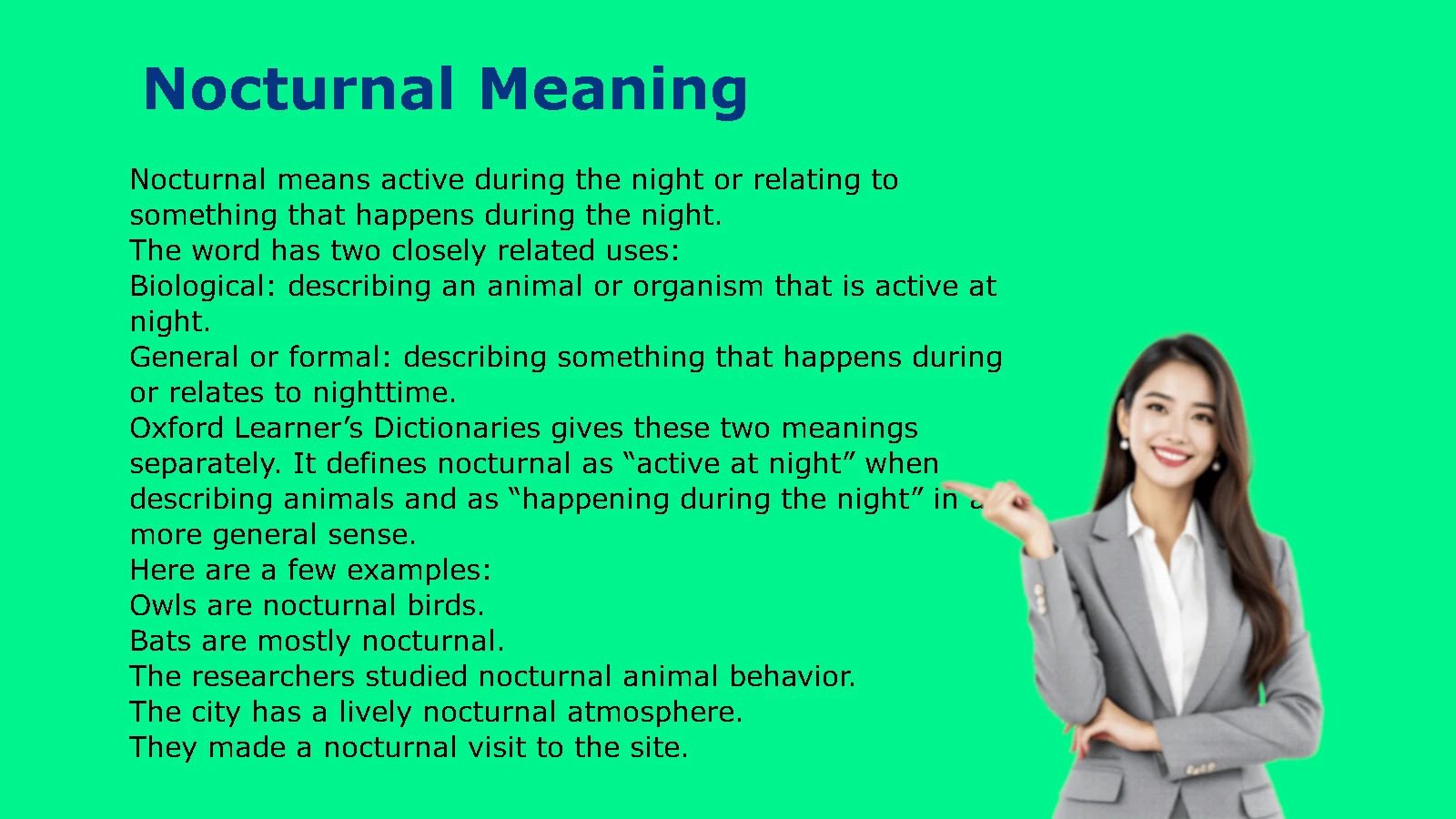
Nocturnal means active during the night or relating to something that happens during the night.
The word has two closely related uses:
- Biological: describing an animal or organism that is active at night.
- General or formal: describing something that happens during or relates to nighttime.
Oxford Learner’s Dictionaries gives these two meanings separately. It defines nocturnal as “active at night” when describing animals and as “happening during the night” in a more general sense.
Here are a few examples:
- Owls are nocturnal birds.
- Bats are mostly nocturnal.
- The researchers studied nocturnal animal behavior.
- The city has a lively nocturnal atmosphere.
- They made a nocturnal visit to the site.
The key idea is simple: think nighttime.
However, nocturnal doesn’t necessarily mean that something lasts all night. If an animal becomes active shortly after sunset and rests again before sunrise, it can still be described as nocturnal.
Nocturnal Meaning in Simple English
If you’re looking for the easiest possible definition, use this:
Nocturnal = active at night or happening at night.
Think about the difference between these sentences:
- “The owl is nocturnal.” → The owl is active at night.
- “The meeting is nocturnal.” → The meeting happens at night.
- “The dog sleeps during the day and is active at night.” → The dog has a nighttime activity pattern.
The first example is especially common because nocturnal frequently describes animals.
What Part of Speech Is Nocturnal?
Nocturnal is an adjective.
That means it describes a noun rather than naming an object, person, or action by itself.
For example:
| Phrase | What “nocturnal” describes |
| nocturnal animal | An animal active at night |
| nocturnal activity | Activity happening at night |
| nocturnal habits | Habits associated with nighttime |
| nocturnal behavior | Behavior occurring at night |
| nocturnal hours | Hours during the night |
| nocturnal visit | A visit made at night |
| nocturnal life | Activity or life associated with nighttime |
You wouldn’t normally use nocturnal as a noun by itself.
For example:
Correct: “The bat is nocturnal.”
Incorrect: “The nocturnal is flying around.”
The adjective needs something to describe, or the sentence needs to be restructured.
How Do You Pronounce Nocturnal?
In American English, nocturnal is pronounced approximately:
nok-TUR-nuhl
The dictionary pronunciation is /nɑːkˈtɝː.nəl/.
The main stress falls on the middle part:
noc-TUR-nal
Try saying it naturally rather than separating every syllable. The word may look complicated at first, but its pronunciation becomes straightforward with a little practice.
What Does Nocturnal Mean in Biology?
In biology, nocturnal describes organisms that are active primarily during the night.
This activity can include much more than simply moving around. A nocturnal animal may use nighttime hours for:
- Finding food
- Hunting
- Traveling
- Mating
- Caring for young
- Defending territory
- Avoiding predators
- Avoiding daytime heat
- Searching for water
Cambridge specifically labels this biological use as specialized and contrasts nocturnal behavior with activity during the day.
One important detail matters here: nocturnal doesn’t mean active every second of the night.
An animal can have periods of rest during nighttime and still be nocturnal. Likewise, some species commonly described as nocturnal may occasionally become active during daylight.
Animal behavior isn’t always as tidy as a dictionary definition makes it sound.
Why Are Some Animals Nocturnal?
Nighttime can offer several advantages depending on the species and its environment.
For some animals, darkness provides protection from predators. For others, it helps them avoid competition with animals that feed during daylight. In hot environments, nighttime activity can also reduce exposure to intense daytime heat.
Some nocturnal species have physical features that help them function in low light. These can include highly sensitive eyes, strong hearing, an excellent sense of smell, or specialized ways of navigating their surroundings.
The advantage isn’t always the same. Nocturnality is an activity pattern shaped by an animal’s biology and environment.
Examples of Nocturnal Animals
Some familiar examples include:
- Bats
- Owls
- Raccoons
- Hedgehogs
- Aardvarks
- Many moths
- Some frogs
- Many rodents
Bats and owls are among the clearest examples because people commonly encounter them in discussions of nighttime wildlife. Cambridge also uses bats and owls as standard examples of nocturnal animals.
Still, it’s worth avoiding a common oversimplification: an animal’s activity pattern can vary by species, location, season, food availability, predators, and other environmental pressures.
What Is a Nocturnal Animal?
A nocturnal animal is an animal that is primarily active at night.
During daylight hours, many nocturnal animals rest in places that provide shelter. At night, they become active and carry out behaviors such as feeding, hunting, traveling, or socializing.
Here’s a simple comparison:
| Animal | Typical nocturnal behavior |
| Bat | Flies and searches for food after dark |
| Owl | Hunts using vision and hearing adapted to low light |
| Raccoon | Forages and moves around mainly at night |
| Hedgehog | Searches for food after dark |
| Aardvark | Often emerges at night to forage |
| Many moths | Become active around nighttime |
The phrase “nocturnal animal” therefore tells you something about when an animal is generally active. It doesn’t tell you everything about its behavior.
For example, saying “a raccoon is nocturnal” doesn’t mean every raccoon follows exactly the same schedule every night.
Nocturnal vs. Diurnal
The clearest opposite of nocturnal is diurnal.
A diurnal organism is primarily active during the day, while a nocturnal organism is primarily active at night. Oxford explicitly identifies diurnal as the opposite of nocturnal.
| Term | Meaning | Simple example |
| Nocturnal | Mainly active at night | Many bats |
| Diurnal | Mainly active during the day | Humans |
| Crepuscular | Mainly active around dawn or dusk | Some mammals |
Think of a 24-hour cycle like this:
Day → Dusk → Night → Dawn → Day
- Diurnal: mostly active during the day
- Crepuscular: especially active around dawn and dusk
- Nocturnal: mostly active during the night
This distinction matters because these words describe different activity patterns.
Is Nocturnal the Opposite of Diurnal?
Yes.
In ordinary biological usage, nocturnal and diurnal describe opposing patterns of activity.
For example:
- “Owls are nocturnal.”
- “Many people are diurnal.”
- “The animal is normally nocturnal rather than diurnal.”
The contrast isn’t necessarily absolute. An animal classified as nocturnal can sometimes move around during the day. The classification describes its usual or predominant pattern, not an unbreakable rule.
Nocturnal vs. Crepuscular
Crepuscular is another word that often gets confused with nocturnal.
Crepuscular animals are most active around twilight, especially around sunrise and sunset.
That gives you a useful mental picture:
| Time | Activity pattern |
| Morning daylight | Diurnal activity |
| Dawn | Crepuscular activity |
| Daylight | Diurnal activity |
| Dusk | Crepuscular activity |
| Night | Nocturnal activity |
The difference may sound small, but it can matter when discussing animal behavior.
If an animal is most active after the sun has fully set, nocturnal may be appropriate. If its activity peaks around sunrise or sunset, crepuscular may be more accurate.
Some animals don’t fit neatly into one box. Wildlife behavior can shift according to food, temperature, predators, human activity, and seasonal changes.
Nocturnal vs. Nighttime
Nocturnal and nighttime are related, but they aren’t interchangeable in every sentence.
Nighttime generally refers to the period of night.
Nocturnal is an adjective that describes something associated with or occurring during that period.
Compare these examples:
- “I enjoy nighttime.”
- “Owls have nocturnal habits.”
- “The event takes place at nighttime.”
- “The researchers observed nocturnal activity.”
You wouldn’t normally replace one word with the other without changing the grammar.
Another useful distinction is tone. Nighttime is an ordinary everyday word. Nocturnal often sounds more formal, scientific, literary, or descriptive.
For example, “nighttime animals” is understandable, but “nocturnal animals” is the standard term in biology.
Nocturnal Meaning When Describing People
Although nocturnal is especially common with animals, you can also use it to describe a person’s schedule or lifestyle.
If someone regularly stays active at night and sleeps or rests during much of the day, you might casually describe that person as nocturnal.
For example:
“After working the night shift for years, he has become almost nocturnal.”
Here, nocturnal doesn’t suggest that the person is literally an animal. It’s a figurative comparison based on their schedule.
Another example:
“She’s practically nocturnal during the busy season and rarely goes to bed before sunrise.”
This use is easy to understand because it borrows the familiar animal meaning and applies it to human behavior.
Does Nocturnal Mean Someone Has Insomnia?
No.
This distinction is important.
Someone can have a nocturnal schedule without having insomnia. A night-shift worker may sleep during the day and work at night because their schedule requires it.
Likewise, someone who naturally prefers staying up late isn’t necessarily experiencing a sleep disorder.
So these statements don’t mean the same thing:
- “He has a nocturnal schedule.” → He is active mainly at night.
- “He stays awake because he can’t sleep.” → He may have difficulty sleeping.
- “He works a nocturnal shift.” → His work takes place at night.
The word nocturnal describes timing, not a diagnosis.
Examples of Nocturnal in a Sentence
Seeing the word in context makes its meaning much easier to understand.
Nocturnal Animal Examples
- Bats are nocturnal animals that become active after dark.
- Owls are well-known for their nocturnal hunting behavior.
- The researcher observed several nocturnal creatures near the forest edge.
- Some nocturnal animals avoid the heat of the day by remaining sheltered until evening.
Activity Examples
- The scientists recorded nocturnal activity in the area.
- The camera captured nocturnal movement near the water source.
- The researchers conducted a nocturnal survey of the habitat.
Lifestyle Examples
- Working nights has given him a completely nocturnal routine.
- The musician keeps a largely nocturnal schedule.
- During the summer, the teenager developed a temporary nocturnal routine.
Formal or Literary Examples
- The city has a vibrant nocturnal atmosphere.
- The explorers continued their nocturnal journey.
- The museum offered a special nocturnal tour.
- The poem creates a mysterious nocturnal setting.
Oxford and Cambridge both give examples involving nocturnal visits, hours, habits, activities, and wanderings, showing that the word isn’t limited to animals.
Common Phrases With Nocturnal
Certain word combinations appear naturally in English.
Nocturnal Animals
This is probably the most common phrase.
Meaning: animals that are active mainly at night.
Example:
“The zoo has a special exhibit featuring nocturnal animals.”
Nocturnal Activity
Meaning: activity that occurs during nighttime.
Example:
“The cameras detected significant nocturnal activity.”
Nocturnal Behavior
Meaning: behavior that occurs during the night, especially in animals.
Example:
“Researchers studied the bird’s nocturnal behavior.”
Nocturnal Habits
Meaning: regular nighttime patterns or behaviors.
Example:
“The animal’s nocturnal habits make it difficult to observe during the day.”
Nocturnal Hours
Meaning: nighttime hours.
Example:
“The observatory operates during the nocturnal hours.”
Nocturnal Shift
Meaning: a work shift that takes place at night.
Example:
“She works a nocturnal shift at the hospital.”
Nocturnal Visit
Meaning: a visit that takes place at night.
Example:
“The researchers made a nocturnal visit to the site.”
These combinations demonstrate an important point: nocturnal can describe both living behavior and events or activities associated with nighttime.
Nocturnal Synonyms
There isn’t one perfect synonym for nocturnal in every situation. The best alternative depends on what you’re describing.
Synonyms Related to Night
- Nighttime
- Nightly
- After-dark
- Night
- Of the night
However, these aren’t exact substitutes in every sentence.
For example:
“Owls are nocturnal.”
You could say:
“Owls are active at night.”
But replacing nocturnal with nightly would change the meaning. Nightly often means happening every night, while nocturnal means associated with or active during the night.
That’s a subtle difference, but it matters.
Nocturnal Synonyms by Context
| Nocturnal | Possible alternative | Important difference |
| Nocturnal animal | Animal active at night | Clearer but longer |
| Nocturnal activity | Nighttime activity | More conversational |
| Nocturnal event | Nighttime event | More natural in everyday speech |
| Nocturnal habits | Nighttime habits | Less formal |
| Nocturnal schedule | Night schedule | Simpler and more direct |
| Nocturnal visit | Nighttime visit | More conversational |
When clarity matters more than style, at night is often the easiest replacement.
Nocturnal Antonyms
The main antonym of nocturnal is diurnal.
Diurnal
Diurnal means active during the day.
For example:
- “Owls are generally nocturnal.”
- “Many songbirds are diurnal.”
You can also describe an activity as daytime activity, although daytime isn’t a direct grammatical opposite in the same way that diurnal is.
Nocturnal and Diurnal Examples
| Nocturnal | Diurnal |
| Active mainly at night | Active mainly during the day |
| Associated with nighttime | Associated with daytime |
| Common in many bats and owls | Common in many birds and humans |
| Opposite: diurnal | Opposite: nocturnal |
The simplest memory trick is:
Nocturnal = night.
Diurnal = day.
What Is the Origin of the Word Nocturnal?
The history of nocturnal explains why the word looks somewhat unusual.
Oxford traces it to the late 15th century. English borrowed it from Late Latin nocturnalis, which comes from Latin ** nocturnus **, meaning “of the night.” The Latin word ultimately connects with ** nox ** and ** noct- **, meaning “night.”
That same Latin connection helps explain related English words built around the idea of night.
The history also makes the spelling easier to remember:
nocturnal → nocturnus → night
So although nocturnal may look like a specialized scientific term, its basic idea is very old and straightforward: something connected with the night.
Nocturnal vs. Nocturnally
Example:
“Bats are nocturnal.”
It describes the bats.
Nocturnally
Nocturnally is an adverb meaning at night rather than during the day. Cambridge lists it as the adverbial form of nocturnal.
Example:
“The animals are active nocturnally.”
You can also write:
“The orchids are pollinated nocturnally.”
In everyday writing, however, at night often sounds more natural:
“The animals are active at night.”
The adverb nocturnally is useful when the context is formal, technical, or scientific.
Common Mistakes When Using Nocturnal
The word is simple once you know the core idea, but a few mistakes come up repeatedly.
Mistake: Treating Nocturnal as a Noun
Incorrect:
“The nocturnal came outside.”
Better:
“The nocturnal animal came outside.”
Or:
“The animal is nocturnal.”
Remember that nocturnal is an adjective.
Mistake: Thinking Nocturnal Means Awake All Night
Being nocturnal doesn’t necessarily mean staying awake from sunset until sunrise without interruption.
It describes a general pattern of nighttime activity.
An animal can sleep for part of the night and still be classified as nocturnal.
Mistake: Confusing Nocturnal With Nightly
These words overlap, but their meanings aren’t identical.
Nocturnal = associated with nighttime or active during nighttime.
Nightly = occurring every night.
Compare:
“Owls have nocturnal habits.”
with:
“The show airs nightly.”
The first describes when a type of activity occurs. The second emphasizes frequency.
Mistake: Confusing Nocturnal With Crepuscular
A nocturnal animal is mainly associated with nighttime.
A crepuscular animal is particularly active around dawn or dusk.
Those periods overlap with the edges of night, but they’re not the same activity pattern.
Mistake: Assuming Nocturnal Always Means Animal
It doesn’t.
You can use nocturnal with:
- Activities
- Habits
- Visits
- Hours
- Behavior
- Schedules
- Events
- Landscapes
- Atmospheres
- Human lifestyles
For example:
“The city has a fascinating nocturnal atmosphere.”
That’s perfectly understandable English.
Nocturnal Meaning in Different Contexts
The exact shade of meaning depends on the context.
| Context | Meaning of nocturnal | Example |
| Biology | Active mainly at night | “The species is nocturnal.” |
| Animals | Active during nighttime | “Owls are nocturnal.” |
| Work | Happening during night hours | “She works a nocturnal shift.” |
| Habits | Connected with nighttime routines | “He has nocturnal habits.” |
| Literature | Related to night | “The story has a nocturnal mood.” |
| Travel | Taking place at night | “They began a nocturnal journey.” |
| Urban life | Activity occurring after dark | “The city has a busy nocturnal scene.” |
| Science | A nighttime activity or process | “Researchers measured nocturnal activity.” |
This broader usage is why defining nocturnal simply as “an animal that sleeps during the day” isn’t enough.
That definition captures one common use, but it misses the word’s wider meaning.
A Simple Case Study: Understanding Nocturnal Behavior
Imagine researchers place motion-sensitive cameras in a forest.
During daylight, the cameras record very little movement from a particular mammal. After sunset, however, the cameras begin recording the animal repeatedly as it searches for food and moves between sheltered areas.
The researchers observe the pattern over multiple nights.
They could describe the animal as nocturnal because its activity is concentrated during nighttime hours.
Now imagine a different animal that appears mostly around sunset and just before sunrise. Calling it strictly nocturnal might oversimplify the pattern. Crepuscular may better describe its peak activity.
This example shows why the word refers to a pattern, not an absolute rule.
The same principle applies when people use nocturnal metaphorically. A person who works overnight may have a nocturnal schedule, even though that person isn’t biologically restricted to nighttime activity.
Why Nocturnal Behavior Can Be Useful for Animals
Nighttime activity can provide several ecological advantages, depending on the species.
Avoiding Daytime Heat
In hot environments, moving and feeding after sunset can reduce exposure to intense daytime temperatures.
Avoiding Certain Predators
Darkness can make some animals harder for visually oriented predators to detect.
Reducing Competition
If another species searches for the same food during the day, operating at night can reduce direct competition.
Finding Food
Many insects and other potential food sources become available or more active at night. Some predators have adapted specifically to exploit these nighttime opportunities.
Using Specialized Senses
Some nocturnal animals rely heavily on hearing, smell, touch, or highly sensitive vision to navigate and find food in low-light conditions.
These advantages don’t apply equally to every nocturnal species. Nocturnality is not a single survival strategy. Different animals adopt nighttime activity for different ecological reasons.
Does Nocturnal Always Mean Completely Night Active?
No.
Words such as mostly, primarily, and generally are useful when describing animal behavior because real-world activity patterns can be flexible.
Cambridge gives an example of an Ethiopian wolf that is mostly diurnal but can become nocturnal in areas where it faces persecution.
That example illustrates an important biological principle: behavior can respond to environmental pressure.
Food availability, temperature, predators, human activity, habitat conditions, and seasonal changes can all influence when animals move around.
Therefore, saying an animal is nocturnal usually communicates its typical pattern, not an absolute rule.
Quick Facts About the Word Nocturnal
| Fact | Detail |
| Word | Nocturnal |
| Part of speech | Adjective |
| Core meaning | Active at night or related to nighttime |
| Common biological use | Describes animals active mainly at night |
| Main antonym | Diurnal |
| Related term | Crepuscular |
| American pronunciation | /nɑːkˈtɝː.nəl/ |
| Word origin | Latin nocturnus, “of the night” |
| English history | Recorded in English from the late 15th century |
| Common phrase | Nocturnal animal |
| Adverb form | Nocturnally |
The core definitions, pronunciation, and etymology above are supported by Oxford and Cambridge dictionary entries.
Frequently Asked Questions About Nocturnal Meaning
What does nocturnal mean in simple words?
Nocturnal means active at night or related to the night. For example, bats and owls are commonly described as nocturnal animals.
What is an example of something nocturnal?
A bat is a familiar example of a nocturnal animal because many bats are active at night.
You can also use the word for activities:
“The researchers recorded nocturnal activity.”
Is nocturnal the opposite of diurnal?
Yes. Nocturnal generally refers to nighttime activity, while diurnal refers to daytime activity. Oxford lists diurnal as the opposite of nocturnal.
What is the difference between nocturnal and crepuscular?
Nocturnal means mainly active at night. Crepuscular refers to activity concentrated around dawn or dusk.
Can you describe a person as nocturnal?
Yes. You can use nocturnal informally to describe someone who is regularly active at night, especially if they work or live on a nighttime schedule.
For example:
“He has a nocturnal routine because he works nights.”
Does nocturnal mean someone doesn’t sleep?
No. It only describes the timing of activity.
A nocturnal animal still sleeps. It simply tends to be active during nighttime rather than daytime.
Is nocturnal a noun or adjective?
Nocturnal is an adjective.
You can say:
“The owl is nocturnal.”
You shouldn’t normally use nocturnal alone as a noun.
What is the synonym of nocturnal?
Depending on the sentence, possible alternatives include nighttime, after-dark, and of the night. However, these aren’t exact replacements in every context.
What is the antonym of nocturnal?
The main antonym is diurnal, which means active during the day.
What does nocturnally mean?
Nocturnally is an adverb meaning at night rather than during the day.
Example:
“The species feeds nocturnally.”
Is nocturnal a formal word?
It can be. The word is common in scientific and biological writing, although people also use it in general descriptions of nighttime activity.
In casual conversation, at night may sound simpler:
“Owls are active at night.”
In a scientific article, “Owls are nocturnal” is more concise.
Nocturnal Meaning at a Glance
Nocturnal means active at night or related to something that happens during the night.
Here are the essentials:
- Part of speech: Adjective
- Simple meaning: Active at night
- Common example: Bats are nocturnal.
- Biological meaning: Active mainly during nighttime
- Broader meaning: Happening during or relating to the night
- Opposite: Diurnal
- Related term: Crepuscular
- Adverb: Nocturnally
- Origin: Latin nocturnus, meaning “of the night”
- Common phrases: Nocturnal animal, nocturnal activity, nocturnal habits, nocturnal behavior
The easiest way to remember the word is this:
Nocturnal = night.
Diurnal = day.
Crepuscular = dawn or dusk.
Once that three-way distinction clicks, the meaning of nocturnal becomes much easier to recognize. Whether you’re reading about bats, animal behavior, nighttime work, or a city’s after-dark atmosphere, the word always points back to the same central idea: the night.