
Have you ever seen a story, image, or description that was so shocking, vivid, or graphic that it immediately caught your attention? While Lurid Meaning may seem straightforward, this word can describe something that is sensational, disturbing, or intensely vivid, depending on the context in which it is used.
Lurid is an adjective used to describe something that is very vivid, shocking, unpleasant, or sensational. It can refer to colors that look harsh or unnatural, as well as stories, descriptions, or details that are graphic or disturbing.
Examples:
- The newspaper published a lurid account of the crime.
- A lurid red glow filled the sky.
The confusion is understandable. People often search for what does lurid mean, lurid meaning in text, lurid meaning in a sentence, or what does lurid mean in English because the word can have slightly different meanings depending on how it is used. And here’s the kicker: lurid can describe something visually striking, emotionally disturbing, or wildly sensational.
In this guide, you’ll learn the complete Lurid Meaning, its definition, pronunciation, synonyms, correct usage, and examples in sentences. You’ll also discover what lurid means in different contexts, how to use it naturally, and the difference between lurid, vivid, graphic, and other similar words.
What Does Lurid Mean?
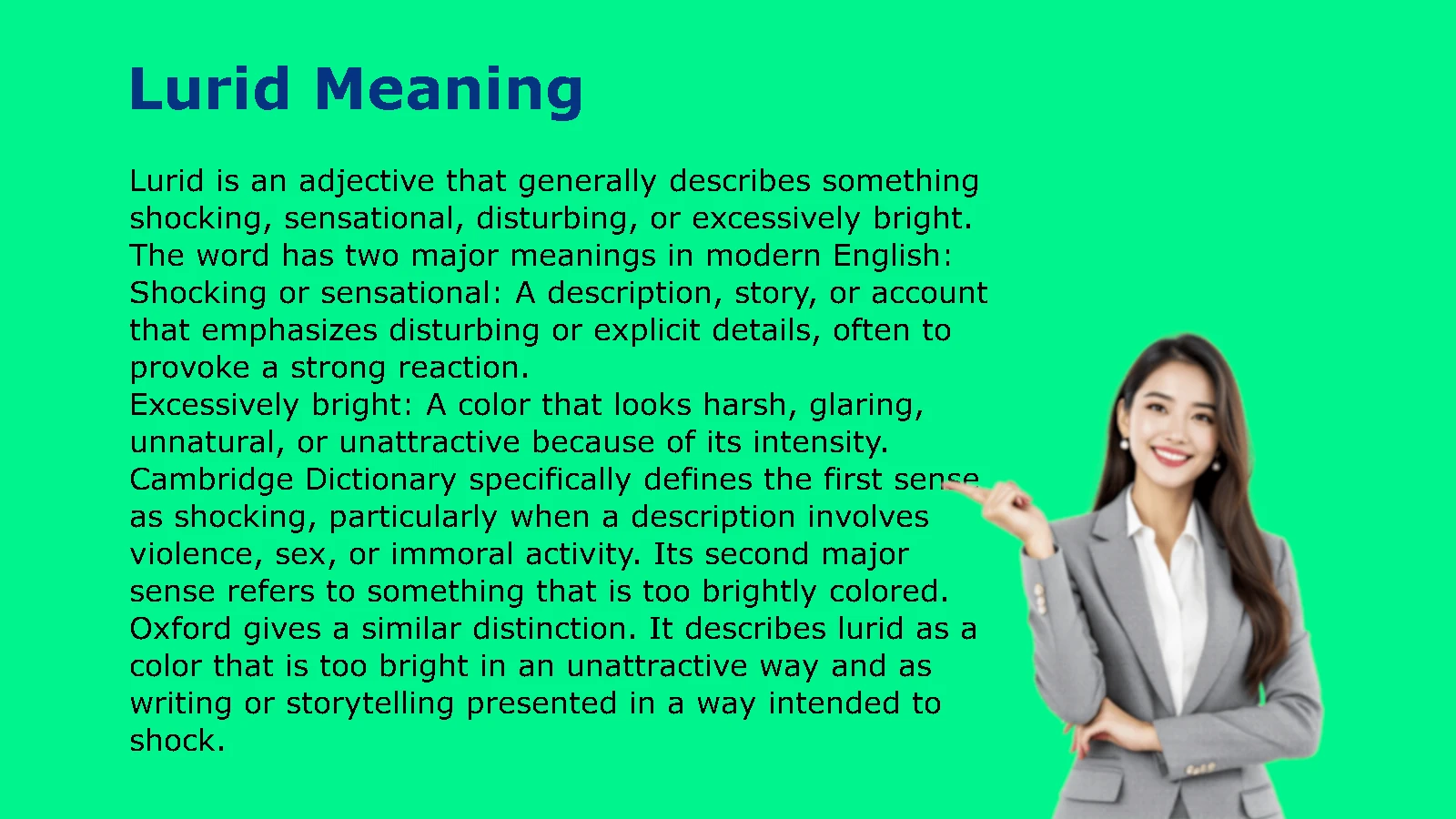
Lurid is an adjective that generally describes something shocking, sensational, disturbing, or excessively bright.
The word has two major meanings in modern English:
- Shocking or sensational: A description, story, or account that emphasizes disturbing or explicit details, often to provoke a strong reaction.
- Excessively bright: A color that looks harsh, glaring, unnatural, or unattractive because of its intensity.
Cambridge Dictionary specifically defines the first sense as shocking, particularly when a description involves violence, sex, or immoral activity. Its second major sense refers to something that is too brightly colored.
Oxford gives a similar distinction. It describes lurid as a color that is too bright in an unattractive way and as writing or storytelling presented in a way intended to shock.
Lurid Meaning in Simple Words
In simple English, lurid means shockingly intense or unpleasantly extreme.
Think about these examples:
The newspaper printed the lurid details of the crime.
Here, lurid means shocking and disturbing.
She wore a lurid orange jacket.
Here, lurid means extremely bright and harsh-looking.
The word usually carries a negative or disapproving tone. You normally wouldn’t call something lurid simply because it is interesting, colorful, or vivid. The word suggests that the intensity has crossed a line.
Lurid Definition
The exact meaning of lurid depends on the noun it modifies.
| Context | Lurid meaning | Example |
| Stories | Shocking or sensational | a lurid story |
| Details | Disturbing or explicit | lurid details of the crime |
| Headlines | Sensationalized or shocking | lurid headlines |
| Behavior | Shocking or outrageous | a lurid past |
| Colors | Excessively bright or harsh | a lurid green |
| Light | Eerie or unnatural | a lurid glow |
| Appearance | Pale, wan, or unnatural in some contexts | a lurid pallor |
Modern dictionaries recognize more than one shade of meaning. Merriam-Webster, for example, includes senses involving horror or disgust, sensationalism, lifeless pallor, and a red glow seen through smoke.
American Heritage also includes vivid or explicit descriptions intended to provoke or shock, shocking behavior, bright and intense color, and the less common sense of being sallow or pallid.
That range explains why lurid can appear in contexts that seem very different.
Lurid Pronunciation
In American English, lurid is pronounced:
LOOR id
Its US pronunciation is represented as /ˈlʊr.ɪd/ by Cambridge Dictionary.
The stress falls on the first syllable:
LU-rid
Don’t pronounce it like livid, which is a different word with a different pronunciation and meaning.
Lurid vs. Livid Pronunciation
These words look similar, but they aren’t interchangeable.
| Word | Pronunciation | Common meaning |
| Lurid | /ˈlʊr.ɪd/ | Shocking or excessively bright |
| Livid | /ˈlɪv.ɪd/ | Extremely angry or purple-blue in color |
For example:
- The article contained lurid details.
- She was livid after hearing the news.
Cambridge defines livid as meaning extremely angry in one common sense. It can also describe an unpleasant purple or dark blue color, especially when referring to marks on the skin.
What Does Lurid Mean in a Sentence?
The easiest way to understand lurid is to look at how it behaves in real sentences.
When the word appears beside story, details, account, headlines, or description, it usually refers to shocking or sensational content.
When it appears beside a color, it usually means excessively bright or harsh.
Lurid Meaning for Stories and Descriptions
A lurid story doesn’t simply contain unusual information. It usually presents disturbing material in a dramatic or sensational way.
Consider:
The magazine published a lurid story about the celebrity scandal.
The sentence suggests that the story focuses heavily on shocking or scandalous details.
Similarly:
The witness gave a lurid account of the attack.
The adjective tells you that the account contains disturbing or graphic details.
This distinction matters because lurid often says something about how information is presented, not merely what happened.
A factual report can describe a violent event without being lurid. A report that dwells on shocking details to attract attention can become lurid.
Lurid Meaning for Colors
When lurid describes a color, it usually suggests that the color is too bright, harsh, flashy, or unnatural.
For example:
The walls were painted a lurid yellow.
The sentence doesn’t simply mean that the walls were yellow. It suggests an intense yellow that may look unpleasant or overwhelming.
Oxford specifically defines this sense as being too bright in color in a way that isn’t attractive.
You might describe these as lurid:
- a lurid orange shirt
- a lurid green wall
- a lurid pink sign
- a lurid purple jacket
- a lurid blue poster
The word expresses judgment. Bright is neutral. Lurid usually isn’t.
Lurid Meaning for Light or Appearance
There is also an older or less common use connected with eerie light, pallor, or an unnatural appearance.
For example:
A lurid glow appeared behind the clouds.
Here, lurid suggests an unsettling or unnatural light.
Merriam-Webster includes a sense involving a red glow of fire seen through smoke.
This meaning works especially well in descriptions of:
- fires
- sunsets
- storm clouds
- volcanic scenes
- smoky skies
- eerie landscapes
- supernatural settings
It has a distinctly atmospheric quality.
Lurid Examples in a Sentence
Seeing several examples side by side makes the different meanings much easier to recognize.
Meaning “Shocking”
- The newspaper published lurid details about the murder.
- The documentary avoided the lurid descriptions that appeared in some tabloids.
- The witness gave a lurid account of what happened inside the building.
- The article attracted attention with its lurid headlines.
- The novel contains several lurid scenes involving violence.
- Reporters questioned whether the story relied too heavily on lurid details.
- The scandal produced a series of lurid stories across the media.
- The author became known for writing lurid tales of crime and betrayal.
- The magazine used a lurid description to attract readers.
- The biography reveals some lurid details about the politician’s past.
Lurid Meaning “Excessively Bright”
- She chose a lurid green for the bedroom walls.
- The costume featured a lurid shade of orange.
- The sign stood out because of its lurid pink lettering.
- He wore a lurid yellow jacket to the concert.
- The artist covered the canvas with lurid colors.
- The children’s toys came in lurid shades of blue and purple.
- The restaurant had a lurid red neon sign.
- Her dress was an unusually lurid purple.
- The poster used lurid colors to grab attention.
- The room looked almost cartoonish under the lurid lighting.
Examples of Lurid Meaning “Eerie or Unnatural”
- A lurid glow appeared along the horizon.
- Smoke turned the sunset into a lurid orange haze.
- The fire cast a lurid light across the abandoned street.
- Dark clouds gathered beneath a lurid sky.
- The flames created a lurid red glow through the smoke.
Examples in Everyday Conversation
You probably won’t use lurid in casual conversation as often as words such as shocking, bright, or weird. Still, it can sound natural when the situation calls for a stronger description.
- “That documentary got pretty lurid toward the end.”
- “Those curtains are a little lurid for my taste.”
- “The article included some lurid details.”
- “The sign is such a lurid shade of green.”
- “I don’t need all the lurid details. Just tell me what happened.”
Lurid Synonyms
The best synonym depends on which meaning of lurid you intend.
Synonyms for Lurid Meaning “Shocking”
Useful alternatives include:
- shocking
- disturbing
- sensational
- graphic
- gruesome
- horrifying
- scandalous
- outrageous
- ghastly
- macabre
However, these words don’t mean exactly the same thing.
Graphic emphasizes explicit detail. Gruesome focuses strongly on violence, blood, injury, or death. Sensational emphasizes attention-grabbing presentation. Lurid can combine these ideas while suggesting an unpleasant fascination with the material.
Merriam-Webster makes this distinction particularly useful. It notes that lurid can add the idea of a disturbing fascination to descriptions involving violent death or murder.
Synonyms for Lurid Meaning “Very Bright”
When lurid describes color, possible alternatives include:
- glaring
- garish
- gaudy
- vivid
- intense
- flashy
- brilliant
- fluorescent
- bright
- eye-catching
Again, context matters.
The American Heritage Dictionary defines garish as overly bright or excessively ornamented, particularly in a vulgar or tasteless way.
So garish and lurid can overlap when you’re discussing unpleasantly bright colors.
Lurid Antonyms
An antonym is a word with an opposite or contrasting meaning.
Because lurid has several meanings, it doesn’t have one perfect opposite.
Antonyms for the Shocking Meaning
Depending on context, useful opposites include:
- mild
- ordinary
- restrained
- understated
- moderate
- uneventful
- factual
- subdued
For example:
The first report was restrained, while the later article offered a lurid version of events.
Antonyms for the Bright Color Meaning
Possible opposites include:
- muted
- subdued
- dull
- soft
- neutral
- pale
- understated
Compare:
She replaced the lurid orange walls with a muted beige.
The contrast is clear. One color demands attention. The other quietly stays in the background.
Lurid vs. Vivid
Lurid and vivid can overlap, especially when describing color or descriptions. However, they carry different emotional tones.
Vivid usually means strong, clear, intense, or highly detailed. It can be positive, negative, or neutral.
Lurid usually suggests something excessive, shocking, harsh, disturbing, or unattractive.
American Heritage defines vivid in several positive or neutral ways, including bright color and clear, striking descriptions.
| Word | Typical tone | Example |
| Vivid | Neutral or positive | a vivid blue sky |
| Lurid | Usually negative | a lurid green wall |
| Vivid | Clear and detailed | a vivid memory |
| Lurid | Shocking or sensational | a lurid account of the crime |
The Easy Rule
If you mean strong and clear, choose vivid.
If you mean strong in a shocking, unpleasant, excessive, or sensational way, choose lurid.
Compare:
She gave a vivid description of the landscape.
This sounds neutral and perhaps complimentary.
She gave a lurid description of the accident.
This sounds disturbing and possibly excessive.
Lurid vs. Graphic
Graphic and lurid often appear in discussions of violence or disturbing material.
However, they emphasize different things.
Graphic means that something gives explicit, detailed information or imagery. Lurid suggests that the material is shocking, sensational, or presented in a way designed to provoke a reaction.
Consider:
The documentary contains graphic images of the accident.
This tells you that the images show explicit details.
Now compare:
The newspaper published a lurid account of the accident.
This suggests sensational treatment of the event.
A description can be graphic without being lurid. A description can also be lurid without being extremely graphic.
That’s an important distinction.
Lurid vs. Garish
The words lurid and garish overlap when they describe color.
Garish usually describes something excessively bright, flashy, showy, or tasteless. American Heritage specifically associates it with overly bright or excessively ornamented appearances.
Lurid can also describe an unpleasantly intense color, but it has a much broader range of meanings.
| Word | Main focus | Example |
| Lurid | Shocking, sensational, or excessively bright | a lurid green |
| Garish | Excessively showy or tasteless | a garish outfit |
| Vivid | Strong and clear | a vivid blue |
| Bright | High in light or color intensity | a bright yellow |
If you want to criticize the tastefulness of a design, garish may work better.
If you want to emphasize an unnaturally intense color, lurid may be the stronger choice.
Etymology and Origin of Lurid
The history of lurid is surprisingly interesting because its earliest meaning was quite different from the one many people know today.
The word comes from the Latin lūridus, meaning pale yellow, sallow, wan, or ghastly. Merriam-Webster traces the English word to this Latin source and gives its first known English use as 1603.
Oxford similarly identifies the word as dating from the mid-17th century in the sense of pale and dismal coloring and connects it with Latin luridus and luror, meaning wan or yellow color.
How the Meaning Changed
The semantic history looks roughly like this:
Latin lūridus
↓
pale, sallow, ghastly
↓
unnatural or eerie appearance
↓
glowing through smoke or darkness
↓
harsh or unnatural color
↓
shocking or sensational description
The transition makes sense when you consider the emotional effect of the original imagery.
A sickly face, a strange yellow pallor, or a disturbing glow can create a feeling of dread. Over time, the word moved beyond literal color and began describing things that produce the same emotional reaction.
Etymological records place the English word’s early use in the 1600s. By the 1700s, lurid could describe a strange glow associated with flames and smoke. Its figurative sense relating to sensational material appeared later, in the 19th century.
A Fascinating Connection Between Color and Emotion
The development of lurid shows how language often moves from a physical description to an emotional one.
First, the word described an unusual appearance.
Then it described the unsettling feeling associated with that appearance.
Eventually, it described stories and descriptions that create a similar reaction.
In other words, the word’s history connects color, atmosphere, fear, and sensationalism.
Lurid Word Forms
The main forms related to lurid include luridly and luridness.
| Word | Part of speech | Meaning |
| Lurid | Adjective | Shocking, sensational, or excessively bright |
| Luridly | Adverb | In a shocking or excessively bright way |
| Luridness | Noun | The quality or state of being lurid |
For example:
The incident was luridly described in the newspaper.
Here, luridly explains how the incident was described.
You can also say:
The luridness of the story made some readers uncomfortable.
Cambridge recognizes both luridly and luridness as related forms.
Common Collocations With Lurid
Some combinations appear naturally with lurid far more often than others.
Lurid Details
Lurid details is probably the most recognizable phrase.
It usually means disturbing, shocking, or explicit information.
The article revealed the lurid details of the scandal.
The phrase often appears in journalism, crime writing, biographies, and discussions of scandals.
Lurid Headlines
A lurid headline uses shocking or sensational language to attract attention.
The newspaper relied on lurid headlines to sell copies.
The phrase often carries criticism. It can suggest that the publication prioritizes attention over restraint.
Lurid Account
A lurid account gives a dramatic and disturbing description of events.
The witness gave a lurid account of the attack.
Lurid Story
A lurid story focuses on shocking or sensational material.
The novel tells a lurid story of betrayal and revenge.
Lurid Colors
When discussing visual design, lurid colors means unusually bright, harsh, or unnatural colors.
The artist deliberately used lurid colors to create an unsettling mood.
Lurid Glow
A lurid glow usually suggests an eerie, unnatural, or smoky light.
A lurid glow spread across the sky as the fire grew.
How to Use Lurid Correctly
Using lurid correctly isn’t difficult once you understand its tone.
Use Lurid for Shocking Content
Choose lurid when a description goes beyond ordinary detail and becomes shocking or sensational.
The report contained lurid details about the crime.
Use Lurid for Harsh Colors
Use it when a color looks excessively bright or unattractive.
The room was painted a lurid shade of pink.
Don’t Treat Lurid as a Perfect Synonym for Vivid
This is one of the most common mistakes.
You can say:
The sunset was vivid.
But:
The sunset was lurid.
The second sentence creates a darker impression. It suggests an unnatural, harsh, or eerie quality.
Pay Attention to Tone
Calling something lurid usually isn’t neutral.
If someone says:
“That’s a lurid description.”
They may be criticizing the writer for emphasizing shocking details.
Likewise:
“That’s a lurid color.”
The speaker probably doesn’t mean the color is beautifully bright. They likely think it’s too bright or unattractive.
Common Mistakes With the Word Lurid
Mistake: Using Lurid as a Simple Synonym for Bright
Not every bright color is lurid.
Bright blue can sound neutral.
Lurid blue suggests that the blue is unusually intense or unpleasant.
The word adds judgment.
Mistake: Assuming Lurid Always Means Violent
It doesn’t.
You can use lurid for:
- shocking scandals
- sexual material
- disturbing stories
- outrageous behavior
- intense colors
- eerie light
Cambridge specifically connects the shocking sense with descriptions involving violence, sex, or immoral activity, but the word isn’t restricted to crime or violence.
Mistake: Thinking Lurid Always Means Graphic
A lurid story can contain graphic details, but the two words aren’t identical.
Graphic focuses on explicit detail.
Lurid focuses more on shock, sensationalism, unpleasant intensity, or fascination.
Mistake: Confusing Lurid With Lucid
Lurid and lucid look somewhat similar, but their meanings have nothing to do with each other.
- Lurid = shocking, sensational, or excessively bright.
- Lucid = clear, understandable, or rational.
For example:
She gave a lucid explanation of the problem.
That means her explanation was easy to understand.
She gave a lurid description of the accident.
That means her description was shocking or disturbing.
Is Lurid a Negative Word?
Usually, yes.
The word commonly carries a negative, critical, or disapproving tone. Cambridge explicitly labels lurid as disapproving.
However, context can soften that judgment.
For example:
The filmmaker used lurid colors to create a disturbing atmosphere.
Here, the colors aren’t necessarily bad. The artist may have chosen them deliberately.
Still, the word tells the reader that the colors are intense and unnatural, rather than simply attractive.
Similarly:
The author uses lurid imagery to portray the chaos of war.
The word can describe a deliberate artistic technique without necessarily criticizing the author’s skill.
Can Lurid Describe a Person?
Yes, although the construction matters.
You can use lurid to describe someone’s behavior, history, reputation, or actions when those things are shocking or outrageous.
For example:
The biography revealed his lurid past.
This suggests a history involving shocking, scandalous, or disturbing events.
American Heritage includes the sense of behavior that is shocking or outrageous, giving the broader idea of a “lurid past.”
You generally wouldn’t say:
“He is a lurid person.”
That sounds unnatural because lurid usually describes a particular quality, action, history, description, or appearance.
Better choices include:
- a lurid past
- lurid behavior
- a lurid reputation
- lurid actions
- a lurid story about him
Lurid in Literature, Journalism, and Media
Few words demonstrate the relationship between language and attention better than lurid.
Journalists, novelists, filmmakers, and advertisers can use shocking details to capture attention. When those details become excessively sensational, lurid becomes a useful description.
Lurid Headlines
A headline such as:
SHOCKING SECRETS REVEALED!
may be described as lurid if it relies heavily on sensational language.
The criticism isn’t necessarily that the information is false. Instead, the presentation may seem designed to provoke curiosity, fear, disgust, or excitement.
Lurid Fiction
Crime fiction and horror often use lurid descriptions to create emotional intensity.
A writer might describe:
- a bloodstained room
- a disturbing discovery
- a violent confrontation
- a mysterious death
- a frightening confession
The goal may be to make the reader uncomfortable.
That discomfort is exactly where lurid can fit.
Lurid Colors in Art
The visual sense works similarly.
An artist might choose an unnaturally bright red or green to make a scene feel:
- disturbing
- surreal
- aggressive
- artificial
- dreamlike
- unsettling
In that context, lurid describes more than color intensity. It describes the emotional effect of that intensity.
A Simple Context Test for Lurid
If you’re unsure whether lurid is the right word, ask what the surrounding noun describes.
| If the phrase is… | Ask yourself… | Likely meaning |
| lurid details | Are the details shocking? | Sensational or disturbing |
| lurid story | Is the story meant to shock? | Sensational |
| lurid headline | Does it emphasize shock? | Sensationalized |
| lurid past | Is the history scandalous? | Shocking or outrageous |
| lurid color | Is the color harsh or excessive? | Extremely bright |
| lurid green | Does the green look unnatural? | Excessively bright |
| lurid glow | Does the light look eerie? | Unnatural or smoky |
| lurid sky | Does it have an unsettling appearance? | Eerie or intensely colored |
This simple test can prevent most usage mistakes.
Lurid Meaning: Quick Comparison
Here is the entire concept at a glance:
| Term | Meaning | Tone |
| Lurid | Shocking, sensational, or excessively bright | Usually negative |
| Vivid | Strong, clear, or intensely colored | Often neutral or positive |
| Graphic | Explicit and detailed | Neutral to negative |
| Garish | Excessively bright or showy | Negative |
| Sensational | Designed to attract attention through excitement or shock | Often negative |
| Gruesome | Horrifying because of violence or death | Strongly negative |
| Ghastly | Horrifying or deathlike | Strongly negative |
| Bright | Full of light or strong in color | Usually neutral |
| Muted | Soft or lacking strong intensity | Usually neutral |
Why Lurid Is Stronger Than “Shocking”
There is a subtle difference between shocking and lurid.
Shocking describes the reaction something causes.
Lurid can describe both the content and the way it is presented.
For example:
The accident was shocking.
This simply tells you that the accident caused shock.
The newspaper gave a lurid account of the accident.
Now the sentence says more. It suggests that the account emphasized disturbing details, possibly in a sensational way.
That extra layer makes lurid particularly useful when discussing media, writing, and storytelling.
Why Lurid Is Stronger Than “Bright”
The same principle applies to color.
She wore a bright red dress.
This is neutral.
She wore a lurid red dress.
Now the reader imagines a red that is almost aggressively intense.
The difference isn’t just brightness. It’s brightness plus judgment.
That’s why replacing lurid with bright can weaken a sentence considerably.
Lurid in Different Types of Writing
In Academic Writing
Use lurid carefully in academic writing because it carries an evaluative tone.
The newspaper used lurid descriptions to attract readers.
This works when you’re analyzing sensationalism.
In Journalism
The word can describe sensational presentation:
Critics accused the publication of using lurid headlines.
In Fiction
It can strengthen atmosphere:
A lurid glow flickered through the smoke.
In Reviews
It can describe an intentionally excessive style:
The film uses lurid imagery to portray its violent world.
In Everyday Writing
You can use it naturally when you want a stronger alternative to shocking or too bright:
I don’t need the lurid details.
Or:
That paint is far too lurid for the kitchen.
Frequently Asked Questions About Lurid
What does lurid mean in simple terms?
Lurid means shocking, disturbing, sensational, or excessively bright, depending on context. A lurid story is shocking or sensational, while a lurid color is extremely bright or harsh.
Does lurid mean shocking?
Yes. This is one of its most common modern meanings. It often describes shocking descriptions involving violence, sex, crime, scandal, or immoral behavior.
Does lurid mean bright?
Yes, but it means more than simply bright. A lurid color is usually excessively bright, harsh, glaring, or unattractive.
Is lurid a negative word?
Usually. The word commonly carries a disapproving or negative tone, especially when it describes sensational stories or unattractive colors.
What is a synonym for lurid?
For the shocking sense, useful synonyms include shocking, sensational, disturbing, graphic, gruesome, and horrifying. For the color sense, alternatives include garish, glaring, gaudy, vivid, and intense.
What is the opposite of lurid?
There isn’t one universal antonym. For shocking content, words such as mild, restrained, or understated can work. For color, muted, subdued, or soft may provide the right contrast.
What does “lurid details” mean?
Lurid details are shocking, disturbing, or sensational details. The phrase often appears when someone describes crime, scandal, violence, or other unpleasant events in an especially dramatic way.
How do you pronounce lurid?
In American English, pronounce it LOOR id, or /ˈlʊr.ɪd/.
What is the origin of lurid?
Lurid comes from the Latin lūridus, meaning pale yellow, sallow, wan, or ghastly. English adopted the word in the early modern period, and its meanings gradually expanded from unusual color and appearance to eerie light and eventually sensational or shocking descriptions.
What is the difference between lurid and vivid?
Vivid usually means strong, clear, or intensely colored without necessarily implying anything negative. Lurid usually suggests something excessive, shocking, harsh, or unpleasant.
What is the difference between lurid and graphic?
Graphic emphasizes explicit or detailed presentation. Lurid emphasizes shock, sensationalism, or disturbing intensity. A description can be graphic without being lurid.
What is the difference between lurid and garish?
Both can describe overly intense colors. Garish focuses on excessive showiness or poor taste, while lurid can describe an unnaturally intense color and also has completely different senses involving shocking stories and descriptions.
Final Takeaway: Lurid Meaning Explained
The easiest way to remember the lurid meaning is to connect the word with excessive intensity.
The word’s history makes these meanings less mysterious. English borrowed lurid from Latin lūridus, which referred to pale, sallow, or ghastly colors. Over centuries, the word expanded from strange physical appearances to strange light and eventually to shocking descriptions.
So, when you encounter lurid, look at the context.
Lurid details are shocking.
Lurid colors are excessively bright.
A lurid glow is eerie or unnatural.
A lurid past is shocking or scandalous.
That small context clue unlocks the word’s meaning and helps you use it naturally.