
Have you ever heard the word “substantiate” and wondered what it really means? While Substantiate Meaning may seem complicated at first, this useful verb has a simple meaning: to provide evidence or facts that prove something is true or valid.
Substantiate means to support a claim, statement, idea, or argument with evidence, facts, or other reliable information. It is often used in formal writing, academic discussions, legal contexts, business, and everyday situations when someone needs to prove that something is true.
Examples:
- You need evidence to substantiate your claim.
- The report substantiated her concerns about the project.
The confusion is understandable. People often search for what does substantiate mean, substantiate meaning in English, substantiate meaning in a sentence, or synonyms for substantiate because the word sounds formal and can be confused with words such as support, prove, and verify. And here’s the kicker: you don’t always need to completely prove something to substantiate it; providing solid evidence or support may be enough.
In this guide, you’ll learn the complete Substantiate Meaning, its definition, pronunciation, part of speech, correct usage, and examples in sentences. You’ll also discover common synonyms, antonyms, word forms, and how to use substantiate correctly in different contexts.
What Does Substantiate Mean?
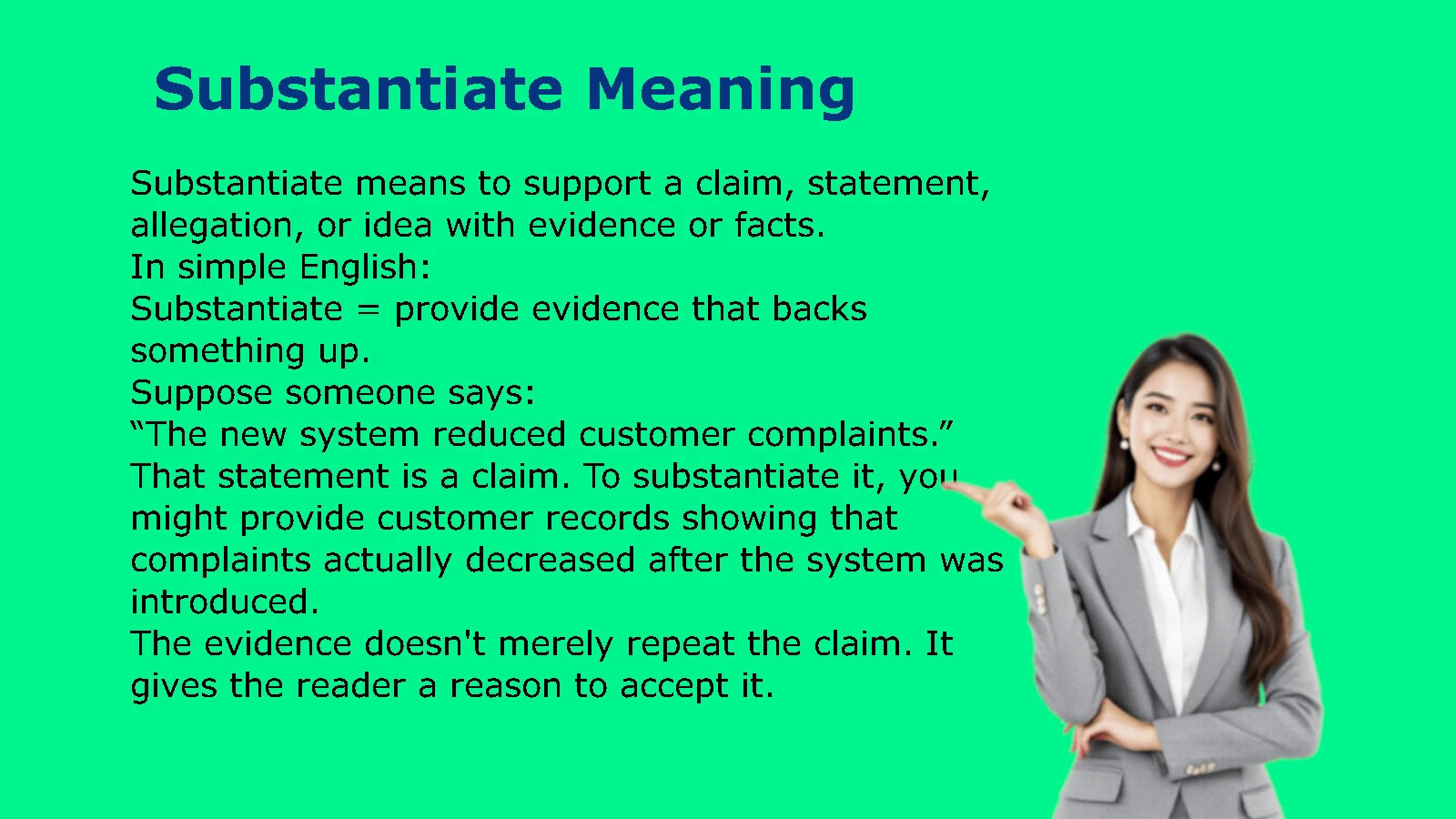
Substantiate means to support a claim, statement, allegation, or idea with evidence or facts.
In simple English:
Substantiate = provide evidence that backs something up.
Suppose someone says:
“The new system reduced customer complaints.”
That statement is a claim. To substantiate it, you might provide customer records showing that complaints actually decreased after the system was introduced.
The evidence doesn’t merely repeat the claim. It gives the reader a reason to accept it.
Substantiate Meaning in Simple Words
Here are several simple ways to understand the word:
- Substantiate means to back up something with evidence.
- It means to support a claim with facts.
- It means to provide proof that helps establish something as true.
- It means to give evidence that supports what someone has said.
A quick memory trick can help:
Claim + evidence = substantiation
For example:
Claim: The company improved delivery times.
Evidence: Delivery records show that the average delivery time fell from five days to three days.
Result: The evidence helps substantiate the claim.
That is the central idea behind the word.
Substantiate Definition
Major English dictionaries agree on the core meaning while giving slightly different wording.
Merriam Webster defines substantiate as establishing something through proof or competent evidence. It also lists another sense meaning to give something substance or form.
Cambridge defines the verb as showing something to be true or supporting a claim with facts. It labels the word formal, which is important when deciding where to use it.
Oxford’s Advanced Learner’s Dictionary similarly defines substantiate something as providing information or evidence to prove that something is true.
Dictionary Definitions at a Glance
| Source | Core meaning |
| Merriam Webster | Establish something through proof or competent evidence |
| Cambridge Dictionary | Show something to be true or support a claim with facts |
| Oxford Learner’s Dictionaries | Provide information or evidence to prove something is true |
The wording varies slightly. The basic idea stays the same: evidence gives a claim substance and support.
Is Substantiate a Verb?
Yes. Substantiate is a verb.
More specifically, dictionaries classify it as a transitive verb. That means it normally takes a direct object.
For example:
The evidence substantiated the claim.
Here:
- The evidence = subject
- substantiated = verb
- the claim = object
You can substantiate a claim, allegation, accusation, argument, theory, report, statement, or similar idea.
Common Sentence Structure
The basic pattern is:
Subject + substantiate + object
Examples:
- The records substantiated the complaint.
- The study substantiates the theory.
- The photographs substantiated his account.
- The evidence substantiated the allegations.
You can also mention the evidence used to support the claim:
The researcher substantiated her conclusion with data from three independent studies.
That structure makes the relationship between the claim and its supporting evidence clear.
What Does It Mean to Substantiate a Claim?
To substantiate a claim means to provide evidence that supports the claim and helps establish its truth.
This phrase appears frequently in academic, professional, legal, and journalistic writing.
Consider this example:
Claim: “The software increased productivity.”
That sentence tells readers what someone believes happened. It doesn’t explain why they should believe it.
Now add evidence:
“The company compared productivity records from six months before and after implementation. The data showed a 22% increase in completed tasks.”
The data can help substantiate the claim.
The important point is that substantiation depends on relevant evidence. A random fact won’t automatically substantiate a claim.
For instance, if someone claims that a restaurant has the fastest delivery service in a city, a photograph of the restaurant’s dining room doesn’t substantiate that claim. Delivery records or a properly designed comparison would be much more relevant.
What Can You Substantiate?
You can substantiate many kinds of claims or statements, including:
- a claim
- an allegation
- an accusation
- a statement
- an argument
- a theory
- a report
- a complaint
- a charge
- a conclusion
- a belief
- a prediction
- a story
- an account
Oxford specifically lists words such as accusation, charge, and claim among nouns commonly used with substantiate.
Substantiate Pronunciation
The American English pronunciation is:
/səbˈstæn.ʃi.eɪt/
An easier pronunciation guide is:
suhb-STAN-shee-ate
The strongest stress falls on STAN.
Cambridge and Oxford both provide pronunciation information for the word.
Pronunciation Breakdown
You can think of the word in three rough parts:
sub + stan + tiate
The natural spoken form is closer to:
suhb-STAN-shee-ate
Avoid saying it like sub-STAN-tee-ate with equal stress on every part. The middle syllable carries the main emphasis.
Substantiate Examples
The easiest way to understand substantiate is to see it working in real sentences.
Everyday Examples of Substantiate
I can’t substantiate that rumor.
This means there isn’t enough evidence to support the rumor.
The photographs substantiated his story.
The photographs provided evidence supporting his account.
Do you have anything to substantiate your claim?
This asks whether the person has evidence to support what they said.
The receipts substantiated her explanation.
The receipts provided evidence that supported her explanation.
Academic Examples
Academic writing frequently uses substantiate because researchers need to connect conclusions with evidence.
The researchers used survey data to substantiate their findings.
The study provides evidence that substantiates the original hypothesis.
Students should cite reliable sources to substantiate major claims in their essays.
The experimental results substantiated the researchers’ conclusion.
In academic writing, substantiation often involves data, studies, measurements, observations, citations, or other credible sources.
Workplace Examples
The word also fits naturally into professional communication.
Please provide documentation to substantiate the expense.
The sales figures substantiate the team’s recommendation.
Customer feedback substantiated the need for additional support staff.
The report substantiates the company’s decision to expand the service.
Notice the formal tone. You probably wouldn’t say this to a friend:
“Can you substantiate your claim that this pizza is amazing?”
You could say it as a joke. In ordinary conversation, though, “Can you back that up?” sounds more natural.
Legal and Investigative Examples
The word frequently appears when evidence matters.
Investigators could not substantiate the allegation.
The documents helped substantiate the complaint.
Prosecutors presented records that substantiated the charge.
The witness’s testimony helped substantiate the account.
In these contexts, the word carries an important distinction. Saying that an allegation was substantiated means the available evidence supported it. It doesn’t automatically mean every detail has been conclusively proven.
How to Use Substantiate in a Sentence
Once you know the basic meaning, sentence construction becomes straightforward.
Use Substantiate With a Claim
The research substantiates the claim.
This is one of the most common patterns.
Use Substantiate With an Allegation
Investigators found evidence that substantiated the allegation.
This works especially well in formal reporting.
Use Substantiate With a Theory
The latest findings substantiate the theory.
Here, the findings provide support for the theory.
Use Substantiate With a Statement
The documents substantiated his statement.
The documents provided evidence supporting what he said.
Use Substantiate With “With”
You can also explain what evidence someone used:
She substantiated her argument with data from a recent survey.
The company substantiated its complaint with photographs and invoices.
The researcher substantiated the conclusion with experimental results.
This construction is especially useful when you want to identify the evidence directly.
Substantiate vs. Prove
Substantiate and prove overlap, but they aren’t always interchangeable.
Prove generally has a stronger sense of establishing something as true.
Substantiate focuses on providing evidence that supports or establishes a claim.
Consider these two sentences:
The documents substantiated his claim.
The documents proved his claim.
The first emphasizes the supporting evidence. The second makes a stronger statement about what the evidence established.
Merriam Webster lists prove, establish, and demonstrate among the synonyms of substantiate. Its usage notes also distinguish related words according to how they establish truth or validity.
The Difference in Plain English
| Word | Main idea | Strength or focus |
| Substantiate | Support with evidence | Evidence backs the claim |
| Prove | Establish as true | Stronger claim of certainty |
| Support | Provide help or evidence | Broadest and most flexible |
| Verify | Check accuracy or truth | Focuses on checking |
| Corroborate | Strengthen with additional evidence | Often confirms an existing account |
A useful rule is this:
Substantiate asks, “What evidence supports this?”
Prove asks, “Has this been established as true?”
The distinction can be subtle. Context determines which word sounds most precise.
Substantiate vs. Support
Support is much more common in everyday English.
You might say:
The evidence supports his argument.
You could also say:
The evidence substantiates his argument.
Both sentences work. The second sounds more formal and puts stronger emphasis on evidence that establishes or validates the argument.
Compare these examples:
“The article supports the theory.”
“The article substantiates the theory.”
The first is broad. The second suggests that the article provides substantial evidence for the theory.
In casual conversation, support or back up will often sound more natural.
Substantiate vs. Verify
These words are closely related, but they describe different actions.
Substantiate means to provide evidence that supports a claim.
Verify means to check whether information, facts, or details are accurate or true.
For example:
The documents substantiated her account.
The documents provided evidence supporting what she said.
The editor verified the dates in the article.
The editor checked whether the dates were accurate.
Merriam Webster explains that verify focuses on establishing correspondence between actual facts and the details that were proposed or assumed.
Quick Comparison
Substantiate: “Here is evidence supporting the claim.”
Verify: “I checked whether the information is correct.”
That small difference matters in formal writing.
Substantiate vs. Corroborate
Corroborate means to strengthen or confirm something with additional evidence.
Merriam Webster explains that corroborate suggests strengthening something that is already partly established. By contrast, substantiate emphasizes offering evidence that sustains a claim or contention.
Consider this example:
The video substantiated the witness’s account.
The video provided evidence supporting the account.
Now imagine another witness gives a matching account:
A second witness corroborated the first witness’s story.
The second witness adds independent support.
A Simple Way to Remember the Difference
Think of substantiate as building the evidence base.
Think of corroborate as adding another piece to an existing evidence base.
The words overlap, but the emphasis differs.
Substantiate Synonyms
Several words can replace substantiate, but each carries a slightly different shade of meaning.
Common Synonyms for Substantiate
- prove
- establish
- demonstrate
- support
- confirm
- verify
- validate
- corroborate
- authenticate
- back up
Merriam Webster lists several of these as related synonyms while explaining their differences in emphasis.
Best Simple Synonyms
If you’re writing for a general audience, these are usually the easiest alternatives:
- prove
- support
- back up
- confirm
- show
Best Formal Synonyms
For academic or professional writing, consider:
- establish
- demonstrate
- validate
- corroborate
- verify
Don’t treat synonyms as interchangeable puzzle pieces. The best word depends on exactly what you want to say.
Substantiated Meaning
Substantiated is the past tense and past participle of substantiate.
It means supported by evidence or shown to be true.
Cambridge identifies substantiated as the past simple and past participle form of substantiate.
Examples:
The allegation was substantiated by the investigation.
Her concerns were eventually substantiated.
The report contained several substantiated claims.
The evidence substantiated his version of events.
The negative form is also common:
The allegation could not be substantiated.
This doesn’t necessarily mean the allegation was false. It means the available evidence wasn’t sufficient to support or establish it.
That distinction is important.
Unsubstantiated does not automatically mean false.
It means the claim lacks sufficient supporting evidence.
Substantiation Meaning
Substantiation is the noun form of substantiate.
It refers to the act, process, or evidence involved in supporting a claim.
Merriam Webster lists substantiation as the noun associated with substantiate.
For example:
The company requested substantiation for the expense.
Here, the company wants documentation or evidence supporting the expense.
Another example:
The article lacked sufficient substantiation for its claims.
This means the article didn’t provide enough evidence to support what it claimed.
Substantiate vs. Substantiation
| Word | Part of speech | Meaning |
| Substantiate | Verb | To support something with evidence |
| Substantiated | Past tense/adjective-like participle | Supported or established by evidence |
| Substantiating | Present participle | Providing supporting evidence |
| Substantiation | Noun | Evidence or the process of supporting a claim |
Oxford also lists substantiation among the related forms of substantiate.
Common Collocations With Substantiate
Certain words naturally appear with substantiate. Learning these combinations can make your writing sound more natural.
Common phrases include:
- substantiate a claim
- substantiate an allegation
- substantiate an accusation
- substantiate a charge
- substantiate a complaint
- substantiate a theory
- substantiate an argument
- substantiate a statement
- substantiate a report
- substantiate a conclusion
- substantiate a belief
- substantiate a story
- substantiate an account
- substantiate a prediction
Examples in Context
The researcher used historical records to substantiate the claim.
Investigators couldn’t substantiate the allegation.
The customer provided photographs to substantiate the complaint.
The new findings substantiate the theory.
The witness provided documents to substantiate her account.
These combinations are useful because they show how the verb behaves in natural formal English.
Is Substantiate a Formal Word?
Yes. Substantiate is generally considered a formal word.
Cambridge explicitly labels it formal, while Oxford also marks it as formal.
That doesn’t mean you should avoid it. It simply means you should choose it when the context calls for a more precise or professional tone.
Where Substantiate Works Well
You’ll often see it in:
- academic papers
- research reports
- legal writing
- investigative journalism
- business reports
- professional emails
- policy documents
- formal complaints
- scientific discussions
- evidence based arguments
Where a Simpler Word May Work Better
In casual conversation, these expressions may sound more natural:
- back up
- prove
- show
- support
- confirm
For example:
Formal:
Can you substantiate that claim?
Casual:
Can you back that up?
Both communicate the basic idea. The second sounds more conversational.
Common Mistakes With Substantiate
The word is easy to understand once you see the evidence connection. Still, several mistakes can make its use awkward or inaccurate.
Using Substantiate to Mean “Say”
Simply saying something doesn’t substantiate it.
Incorrect idea:
“I substantiate that I had a busy day.”
That sentence sounds unnatural because substantiate isn’t simply a formal replacement for say.
Better:
“The time records substantiate my claim that I worked late.”
Now the sentence identifies evidence supporting the claim.
Assuming Substantiate Always Means Absolute Proof
This is one of the most important distinctions.
If evidence substantiates a claim, the evidence supports or helps establish that claim.
That doesn’t always mean every possible doubt has disappeared.
For example:
The documents substantiated the employee’s account.
This means the documents supported the account. It doesn’t necessarily mean every detail of the account has been independently proven.
Confusing Substantiate With Verify
Remember:
Substantiate = support a claim with evidence.
Verify = check whether something is accurate or true.
A journalist might verify a source’s identity and then use documents to substantiate a claim.
Using It in Extremely Casual Situations
You can technically use the word in a joke:
“I need evidence to substantiate your claim that you make the world’s best pancakes.”
It works. It also sounds deliberately formal.
In everyday speech, you might simply say:
“Can you prove it?”
Or:
“Can you back that up?”
The context determines whether the formal word feels natural.
How Evidence Substantiates a Claim
Understanding the evidence process makes the meaning of substantiate much clearer.
Imagine a student writes:
“Reading every day improves vocabulary.”
That statement needs support if the student wants to present it as an evidence based claim.
The student could use:
- A credible research study
- Relevant data
- A properly designed experiment
- A reliable academic source
- Multiple independent sources
If the evidence directly supports the statement, the student can use it to substantiate the claim.
The process looks like this:
Claim → Evidence → Connection → Substantiation
The missing piece in weak arguments is often the connection between the evidence and the claim.
For example, a person might provide ten statistics that have nothing to do with the argument. More evidence doesn’t automatically mean better substantiation.
Relevant evidence matters more than sheer quantity.
A Practical Case Study: Substantiating a Business Claim
Imagine a company claims:
“Our new customer support system reduced response times.”
The company shouldn’t expect readers to accept that statement simply because it appears in a report.
To substantiate the claim, the company could provide:
| Evidence | What it shows |
| Average response time before launch | Baseline performance |
| Average response time after launch | New performance |
| Number of customer requests | Whether workload changed |
| Time period measured | Whether the comparison is meaningful |
| Customer service records | Supporting operational data |
| Independent analysis | Additional credibility |
Suppose the records show that average response time dropped from 18 hours to 7 hours while the number of requests remained roughly similar.
That evidence gives the original claim substance.
The company can now say:
“Customer service records substantiate our claim that the new system reduced average response times.”
The strength of the sentence comes from the evidence behind it.
A Practical Case Study: Substantiating an Academic Argument
Consider an essay arguing:
“Regular exercise can improve sleep quality.”
A weak paragraph might simply state the claim several times.
A stronger paragraph would explain the claim and support it with relevant research.
For example:
Researchers observed sleep patterns among participants over a defined period. The results showed measurable changes in sleep quality among participants who maintained regular physical activity.
The study doesn’t merely decorate the paragraph. It provides evidence that can substantiate the argument.
In academic writing, this is why citations matter. A claim without evidence may remain an unsupported assertion.
Substantiate in Professional Writing
The word can make formal writing more precise when used correctly.
Instead of:
“Please prove why you need the refund.”
A professional message could say:
“Please provide documentation to substantiate your refund request.”
Instead of:
“We need proof for this expense.”
You could write:
“We need documentation to substantiate this expense.”
The second versions sound more formal and are particularly suitable for administrative, financial, legal, or corporate settings.
However, don’t sprinkle substantiate everywhere simply to sound sophisticated. Clear writing beats fancy writing.
Substantiate in Academic Writing
Academic arguments depend heavily on evidence. That’s why substantiate fits naturally into research based writing.
You might write:
“The survey results substantiate the researchers’ conclusion.”
Or:
“The author cites three studies to substantiate this argument.”
Or:
“Additional evidence is needed to substantiate the proposed explanation.”
These examples show three different relationships between evidence and a claim:
- evidence does support the claim
- an author provides evidence
- evidence is still needed
That flexibility makes substantiate useful in analytical writing.
What Is the Opposite of Substantiate?
There isn’t one perfect opposite in every situation.
Depending on context, possible contrasting words include:
- disprove
- refute
- contradict
- undermine
- challenge
- invalidate
The best choice depends on what happens to the claim.
Substantiate vs. Disprove
Evidence substantiated the claim.
The evidence supported it.
Evidence disproved the claim.
The evidence showed that the claim was false.
Substantiate vs. Refute
The evidence substantiated the argument.
The evidence showed that the argument was wrong or unsupported.
Don’t assume that unsubstantiated means the same thing as disproved. A claim can remain unsubstantiated simply because there isn’t enough evidence available to establish it.
Word Forms of Substantiate
Knowing the related forms can help you recognize the word in different kinds of writing.
Substantiate
Verb
The evidence substantiates the claim.
Substantiated
Past tense and past participle
The claim was substantiated by the documents.
Cambridge confirms that substantiated is the past simple and past participle form of substantiate.
Substantiating
Present participle
The researcher is substantiating the argument with new evidence.
Substantiation
Noun
The report requires further substantiation.
Merriam Webster lists substantiation as the noun form.
Quick Word Form Table
| Form | Example |
| Substantiate | The records substantiate the claim. |
| Substantiates | The evidence substantiates her account. |
| Substantiated | The allegation was substantiated. |
| Substantiating | The study is substantiating the argument. |
| Substantiation | The claim lacks sufficient substantiation. |
The Origin of the Word Substantiate
The history of the word also explains why it carries the idea of giving something substance.
Oxford traces substantiate to a Medieval Latin form meaning “given substance”, from the verb substantiare. Oxford dates the English word to the mid-17th century.
Merriam Webster records its first known English use as 1610.
The historical connection to substance makes the modern meaning easier to remember.
A claim without evidence can feel thin.
Evidence gives it substance.
That is essentially what substantiate does.
Substantiate Meaning vs. Substantial
The words substantiate and substantial look related because they are historically connected. Their modern grammatical roles differ.
Substantiate is a verb:
The evidence substantiates the claim.
Substantial is an adjective:
The researcher found substantial evidence.
Don’t use substantial as though it were a synonym for substantiate.
You can have:
substantial evidence
and that evidence can:
substantiate a claim
The two ideas often appear together, but they aren’t the same word or part of speech.
Quick Reference: What Does Substantiate Mean?
| Question | Answer |
| What does substantiate mean? | To support something with evidence or facts |
| What part of speech is substantiate? | Verb |
| Is substantiate formal? | Yes |
| What is a simple synonym? | Support, prove, or back up |
| What is the noun form? | Substantiation |
| What is the past tense? | Substantiated |
| What is the opposite? | Depending on context, disprove or refute |
| What does substantiate a claim mean? | Provide evidence supporting the claim |
| What does unsubstantiated mean? | Not supported or established by sufficient evidence |
| How is it pronounced? | suh-b-STAN-shee-ate |
Frequently Asked Questions About Substantiate Meaning
What does substantiate mean in simple words?
Substantiate means to back something up with evidence. If you substantiate a claim, you provide facts, documents, data, or other relevant evidence that supports it.
What does it mean to substantiate a claim?
To substantiate a claim means to provide evidence that supports the claim and helps establish whether it is true.
For example:
The researcher used survey results to substantiate the claim.
Is substantiate the same as prove?
Not always. Substantiate emphasizes supporting a claim with evidence. Prove generally makes a stronger claim that something has been established as true.
Is substantiate a formal word?
Yes. Cambridge and Oxford both label substantiate as formal.
It works especially well in academic, professional, legal, and investigative contexts.
What is the best synonym for substantiate?
There isn’t one universal synonym. Support, prove, establish, demonstrate, verify, and corroborate can work depending on the context.
What is the noun form of substantiate?
The noun form is substantiation.
“The claim requires further substantiation.”
What is the past tense of substantiate?
The past tense is substantiated.
“The evidence substantiated her account.”
What does unsubstantiated mean?
Unsubstantiated means unsupported by sufficient evidence.
An unsubstantiated claim isn’t automatically false. It simply hasn’t been adequately supported or established by available evidence.
Can you substantiate an opinion?
You can substantiate an opinion when you provide evidence or reasoning that supports it.
For example:
“The city should expand public transportation because traffic data shows that congestion has increased steadily over the past five years.”
The opinion becomes more defensible because it includes relevant evidence.
What is the difference between substantiate and corroborate?
Substantiate means to provide evidence that supports a claim. Corroborate often means to strengthen an account or claim with additional independent evidence. Merriam Webster makes this distinction in its synonym guidance.
Final Takeaway: Substantiate Meaning
The simplest way to remember the substantiate meaning is:
To substantiate something means to support it with evidence or facts.
When you substantiate a claim, you don’t merely repeat it. You give people a reason to believe it.
The word is especially useful in formal writing because it captures a specific relationship between a statement and its supporting evidence. A researcher may substantiate a theory with experimental results. A journalist may substantiate a report with documents. A company may substantiate an expense with receipts. An investigator may substantiate an allegation with credible evidence.
Remember these four points:
- Substantiate is a verb.
- It means support or establish something with evidence.
- It is generally a formal word.
- Common alternatives include prove, support, establish, demonstrate, verify, and corroborate, although each has a slightly different emphasis.
If you need one everyday translation, use “back it up with evidence.”
That’s the heart of the word.