
What Is the Speculate Meaning?
Speculate means to form an opinion, make an educated guess, or think about something without having complete evidence or proof. People often speculate about future events, causes, or possible outcomes based on the information they have.
Examples:
- Experts speculate that interest rates may fall next year.
- Don’t speculate about the results until the official announcement.
The confusion often starts when trying to understand speculate definition, speculate pronunciation, or how to use speculate in a sentence. And here’s the kicker: confusing speculate with words like guess, assume, or predict can lead to misunderstanding what someone actually means.
In this guide, you’ll discover the complete Speculate Meaning, learn the definition of speculate, its correct pronunciation, part of speech, and see practical speculate examples in real-life sentences. You’ll also explore speculate synonyms, speculate vs assume, speculate vs predict, and when it’s appropriate to use the word in both casual and professional communication.
What Does Speculate Mean?
The word speculate is a verb that means to think about possible reasons, results, or explanations without having definite evidence.
When people speculate, they are not stating something as a proven fact. Instead, they are exploring what could be true.
Think of speculation like putting together puzzle pieces when some pieces are missing. You can create a possible picture, but you cannot be completely certain until you find the remaining pieces.
Simple Definition of Speculate
Speculate means to make a thoughtful guess about something that is unknown or uncertain.
Here are a few examples:
- Scientists speculate about how the universe began.
- Fans speculate about which team will win the championship.
- Journalists speculate about what a company’s next announcement might be.
- Investors speculate on future market changes.
In each example, people are considering possibilities rather than reporting confirmed facts.
Speculate Meaning in Different Contexts
The meaning of speculate can slightly change depending on the situation. The basic idea stays the same: someone is thinking about possibilities without complete certainty.
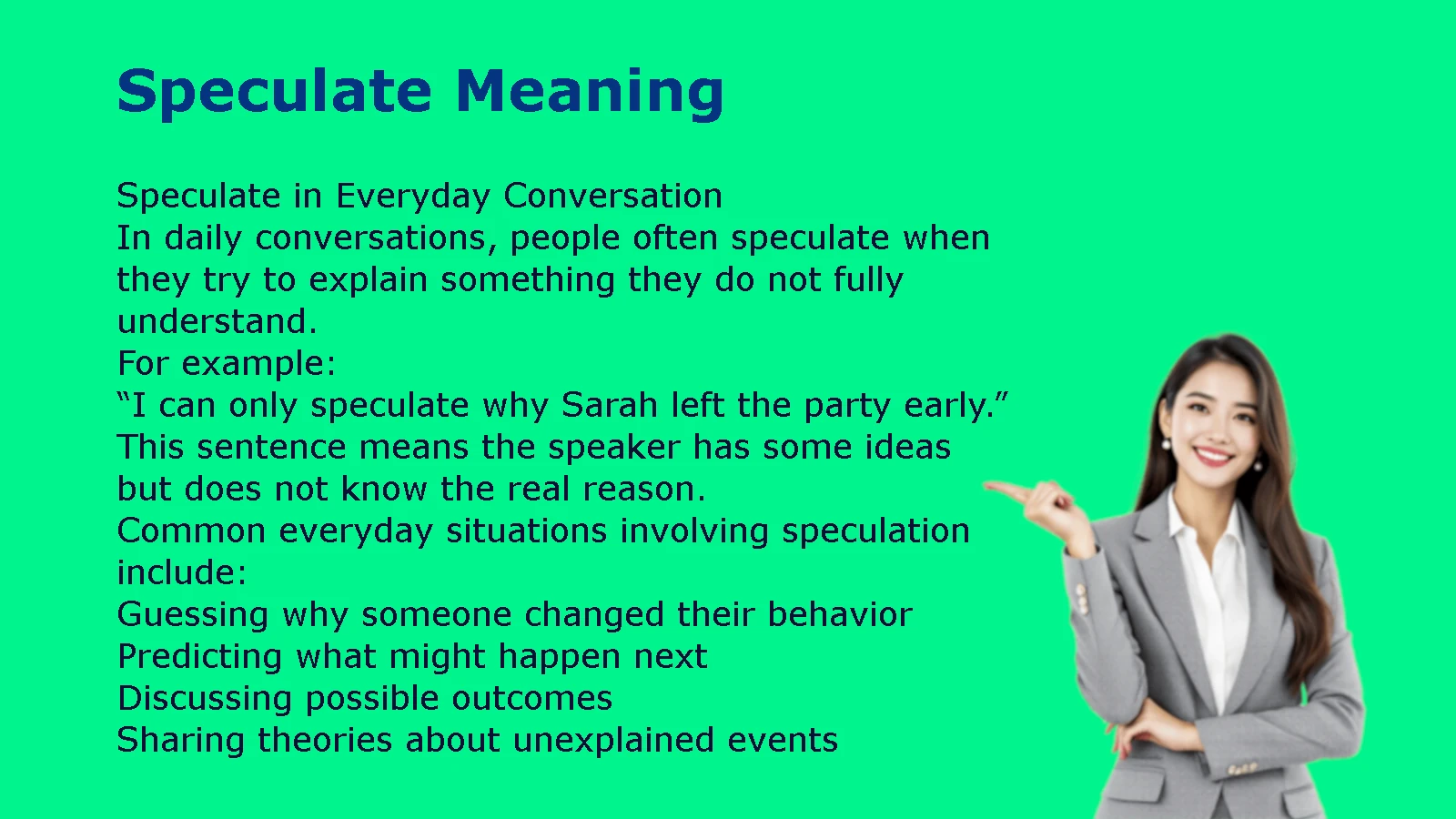
Speculate in Everyday Conversation
In daily conversations, people often speculate when they try to explain something they do not fully understand.
For example:
“I can only speculate why Sarah left the party early.”
This sentence means the speaker has some ideas but does not know the real reason.
Common everyday situations involving speculation include:
- Guessing why someone changed their behavior
- Predicting what might happen next
- Discussing possible outcomes
- Sharing theories about unexplained events
Example Sentences
- “Everyone is speculating about who will get promoted.”
- “I don’t want to speculate without knowing the full story.”
- “People started speculating after the celebrity deleted their social media posts.”
Speculate in Science
Scientists often use speculation as part of the discovery process. However, scientific speculation is usually based on observations, evidence, and existing knowledge.
A scientist may suggest a possible explanation before enough evidence exists to confirm it.
For example:
Scientists once speculated that tiny organisms might exist on other planets because conditions elsewhere in space could potentially support life. Later research continues to test these ideas.
Scientific speculation can lead to:
- New research questions
- Experiments
- Theories
- Discoveries
However, speculation alone does not become a scientific fact. Researchers need evidence to support their conclusions.
Speculate in News and Media
News outlets often use the word speculate when discussing information that has not been officially confirmed.
For example:
“Analysts speculate that the company may release a cheaper version of its product.”
The phrase does not mean the product release will definitely happen. It means experts believe it is a possible outcome based on available clues.
News writers use terms like:
- Speculate
- Suggest
- Predict
- Believe
- Expect
to show that information is not confirmed.
Speculate in Business and Finance
In finance, speculate has a more specific meaning. It refers to making risky investments based on predictions about future prices.
A person who speculates in the stock market may buy shares because they believe the price will increase.
For example:
- An investor buys cryptocurrency expecting its value to rise.
- A trader purchases property in an area expected to grow.
- A buyer invests in a new company hoping it becomes successful.
Unlike traditional investing, speculation often involves greater uncertainty and risk.
Investing vs Speculating
| Investing | Speculating |
| Usually focuses on long-term growth | Often focuses on short-term opportunities |
| Based on research and company performance | Based heavily on predictions and market movements |
| Usually involves lower risk | Often involves higher risk |
| Example: Buying shares in an established company | Example: Buying a new asset hoping its price increases quickly |
Speculate Definition and Pronunciation
Understanding the dictionary definition helps clarify how the word works.
Dictionary Definition of Speculate
Most dictionaries define speculate in two main ways:
- To form theories or opinions about something without having complete information.
- To invest money in something with the hope of making a profit, often involving risk.
The first meaning appears more often in everyday communication. The second meaning is common in financial discussions.
How to Pronounce Speculate
The correct pronunciation is:
SPEK-yuh-layt
Phonetic spelling:
/ˈspɛkjəˌleɪt/
The stress falls on the first syllable:
SPEK-yuh-late
Examples:
- “Experts speculate about future changes.”
- “Some traders speculate in unpredictable markets.”
Word Forms of Speculate
The word speculate has several related forms that appear in different types of writing.
| Word | Part of Speech | Meaning | Example |
| Speculate | Verb | To form an idea without complete proof | Researchers speculate about possible causes. |
| Speculation | Noun | An idea or theory without confirmation | The rumor was only speculation. |
| Speculative | Adjective | Based on uncertain ideas or risks | It was a speculative investment. |
| Speculator | Noun | A person who makes risky investments | The speculator hoped prices would rise. |
Examples in Sentences
Speculate:
“Scientists speculate that ancient civilizations may have existed beneath the ocean.”
Speculation:
“The report created speculation about future changes.”
Speculative:
“Buying unknown stocks can be a speculative decision.”
Speculator:
“The speculator earned money when the market unexpectedly increased.”
Examples of Speculate in a Sentence
Seeing the word in different situations makes its meaning easier to understand.
Everyday Examples
- “I don’t want to speculate about what happened until we hear the facts.”
- “Neighbors began to speculate about the reason for the construction.”
- “She speculated that the missing keys were inside the car.”
Workplace Examples
- “Employees speculated about upcoming changes in company policy.”
- “Managers should avoid speculating before receiving official information.”
Academic Examples
- “Historians speculate about the daily lives of ancient people.”
- “Researchers speculate that climate patterns influenced early settlements.”
Entertainment Examples
- “Fans are speculating about the next movie in the series.”
- “People speculated that the singer would release a new album soon.”
Business Examples
- “Investors speculated that the company’s profits would increase.”
- “Market experts continue to speculate about interest rate changes.”
What Is the Difference Between Speculate, Guess, and Assume?
Many people use speculate, guess, and assume as if they mean the same thing. Although they overlap, each word has a different purpose.
Understanding the difference helps you choose the right word.
| Word | Meaning | Level of Certainty | Example |
| Speculate | Consider possible explanations or outcomes | Low to medium | Experts speculate about future technology. |
| Guess | Give an answer without knowing for sure | Low | I guess the answer is five. |
| Assume | Believe something is true without checking | Medium | She assumed the meeting was canceled. |
Speculate vs Guess
Both words involve uncertainty, but speculate usually sounds more thoughtful or analytical.
A guess can happen quickly.
Example:
“I guess it will rain tomorrow.”
This is a casual opinion.
However:
“Meteorologists speculate that changing weather patterns may increase rainfall.”
This suggests analysis and consideration of evidence.
Speculate vs Assume
The biggest difference is that assumptions are often accepted as true, while speculation explores possibilities.
Example:
Assumption:
“He assumed the store was closed because the lights were off.”
The person accepted an idea without checking.
Speculation:
“He speculated that the store might be closed because the lights were off.”
The person considered one possible explanation but remained uncertain.
Speculate vs Predict
Although speculate and predict both involve thinking about the future, they are not exactly the same.
A prediction usually comes from evidence, patterns, or experience. Speculation can involve evidence too, but it often has more uncertainty.
| Word | Main Idea | Example |
| Speculate | Consider possible explanations or outcomes | Scientists speculate about what may exist beyond our galaxy. |
| Predict | State what is likely to happen based on information | Weather experts predict rain tomorrow. |
For example:
A weather expert may predict a storm because satellite data shows a developing system.
However, people may speculate about how severe the storm will become because the final outcome is still unknown.
Synonyms for Speculate
Several words have similar meanings to speculate, but each one carries a slightly different feeling.
Choosing the right synonym depends on the situation.
Guess
Guess means giving an answer or opinion when you do not know something with certainty.
Example:
“Can you guess the answer?”
This word feels casual and is common in everyday conversations.
Wonder
Wonder means thinking about something because you are curious.
Example:
“I wonder why the company changed its logo.”
Unlike speculate, wonder does not always involve creating a theory or explanation.
Hypothesize
Hypothesize means creating a possible explanation that can be tested.
This word is commonly used in science and research.
Example:
“Researchers hypothesize that sleep affects memory.”
A hypothesis usually requires investigation.
Theorize
Theorize means developing an explanation based on ideas, observations, or evidence.
Example:
“Historians theorize that trade helped ancient cities grow.”
The word often suggests deeper thinking than a simple guess.
Predict
Predict means saying what may happen in the future.
Example:
“Experts predict that electric vehicles will become more common.”
Prediction often relies on trends or data.
Suppose
Suppose means to imagine or accept a possibility.
Example:
“Suppose the company launches a new product next year.”
This word is often used when exploring an idea.
Estimate
Estimate means making an approximate calculation.
Example:
“Experts estimate that millions of people will attend the event.”
Unlike speculate, estimates usually involve numbers or measurable information.
Antonyms of Speculate
Antonyms are words with opposite meanings. The opposite of speculate involves certainty, proof, or confirmed information.
| Antonym | Meaning | Example |
| Know | Have clear understanding or information | I know the answer. |
| Confirm | Verify that something is true | The company confirmed the report. |
| Prove | Show evidence that something is true | Scientists proved the theory. |
| Verify | Check accuracy or truth | Officials verified the information. |
| Establish | Show something clearly through evidence | Researchers established the connection. |
| Determine | Find the exact answer | The investigation determined the cause. |
Example Comparison
Speculation:
“Experts speculate that the building may be hundreds of years old.”
Confirmed fact:
“Researchers determined that the building was constructed in 1720.”
The first sentence suggests uncertainty. The second provides a verified fact.
Common Phrases Using Speculate
The word speculate often appears with certain prepositions and phrases. Learning these combinations helps you use the word naturally.
Speculate About Meaning
The phrase speculate about means to think about possible reasons, explanations, or outcomes.
Examples:
- “People continue to speculate about the company’s future.”
- “Scientists speculate about the possibility of life on other planets.”
- “Fans are speculating about the next season of the show.”
This is the most common form used in everyday English.
Speculate On Meaning
The phrase speculate on has a similar meaning to “speculate about.” It often appears in formal writing, news articles, and professional discussions.
Examples:
- “Analysts speculated on the impact of the new policy.”
- “Experts refused to speculate on the possible outcome.”
The difference is small. Both phrases are usually correct.
Be Speculated To Meaning
The phrase be speculated to means people believe something might be true, but it has not been confirmed.
Examples:
- “The company is speculated to announce a new device.”
- “The actor is speculated to appear in the upcoming film.”
This phrase often appears in entertainment news and financial reports.
Is Speculate a Positive or Negative Word?
The word speculate is neutral. It does not automatically mean something good or bad.
The meaning depends on the situation and the speaker’s intention.
Positive Use of Speculate
Speculation can encourage curiosity, research, and innovation.
Example:
“Scientists speculate about new ways to treat diseases.”
Here, speculation represents creative thinking and exploration.
Other positive examples:
- Researchers speculate about future discoveries.
- Engineers speculate about new technology possibilities.
- Businesses speculate about future market trends.
Negative Use of Speculate
Speculation can become negative when people spread unsupported rumors or make claims without evidence.
Example:
“People speculated about the celebrity’s personal life without knowing the truth.”
In this situation, speculation may create misinformation.
Negative examples:
- Spreading rumors without proof
- Making accusations based only on assumptions
- Sharing unverified information online
How to Use Speculate Correctly in Writing
Using speculate correctly requires understanding uncertainty.
The word works best when something is possible but not proven.
Use Speculate When:
You are discussing possibilities
Example:
“Experts speculate that artificial intelligence could transform many industries.”
The statement does not claim certainty. It discusses a possible future.
Evidence exists but is incomplete
Example:
“Researchers speculate that climate changes affected ancient civilizations.”
Researchers may have clues, but they still need more evidence.
Discussing predictions or theories
Example:
“Analysts speculate that interest rates may decrease next year.”
The outcome remains uncertain.
Avoid Using Speculate for Confirmed Facts
Do not use speculate when something has already been proven.
Incorrect:
“Scientists speculate that water contains hydrogen and oxygen.”
This is not speculation because it is an established fact.
Better:
“Scientists know that water contains hydrogen and oxygen.”
Words Often Used With Speculate
Certain words commonly appear near speculate because they show uncertainty.
Common combinations include:
- Speculate that
- Speculate about
- Speculate on
- Continue to speculate
- Begin to speculate
- Experts speculate
- Analysts speculate
- People speculate
- Widely speculated
Examples:
- “Experts speculate that the economy may recover.”
- “Fans continue to speculate about the ending.”
- “Analysts speculated on possible market changes.”
Real World Examples of Speculation
Technology Industry
Technology experts often speculate about future innovations.
For example, before a major smartphone release, analysts may examine patents, supply chains, and company announcements. Based on those clues, they speculate about possible features.
However, until the company officially announces the product, those ideas remain uncertain.
Sports
Sports fans frequently speculate about player transfers, team strategies, and championship results.
Example:
Before a championship game, commentators may speculate about which team has the advantage.
They may consider:
- Recent performance
- Player health
- Team history
- Coaching decisions
Still, the final result cannot be known until the game ends.
History
Historians often use speculation when studying events with incomplete records.
Ancient civilizations left behind many unanswered questions. Researchers examine artifacts, documents, and cultural patterns to develop possible explanations.
For example:
Historians speculate about how ancient societies organized trade routes when written records are limited.
Case Study: How Speculation Can Lead to Discovery
A famous example of productive speculation comes from astronomy.
For many years, scientists speculated about the existence of planets outside our solar system. They noticed unusual movements in stars and wondered whether hidden planets might be responsible.
Later, improved technology allowed astronomers to confirm thousands of exoplanets.
This example shows an important point:
Speculation is not the same as guessing randomly. Good speculation creates questions that encourage investigation.
A useful process looks like this:
Observation
↓
Possible Explanation
↓
Speculation
↓
Research and Testing
↓
Confirmed Knowledge
Speculation often becomes the starting point for discovery.
Common Mistakes When Using Speculate
Mistake: Treating Speculation as Fact
Incorrect:
“The company will release a new product next month.”
if there is no official announcement.
Better:
“Analysts speculate that the company may release a new product next month.”
Mistake: Using Speculate for Simple Knowledge
Incorrect:
“I speculate that two plus two equals four.”
Better:
“I know that two plus two equals four.”
Mistake: Confusing Speculation With Lying
Speculation does not always mean someone is being dishonest.
A person can speculate honestly while admitting they do not know the complete answer.
Example:
“Based on current evidence, researchers speculate that the species evolved thousands of years ago.”
The statement recognizes uncertainty
Frequently Asked Questions About Speculate Meaning
Understanding the word speculate becomes easier when you see how people commonly ask about it. These questions cover the most common confusion around its meaning, usage, and related words.
What Is the Simple Meaning of Speculate?
The simple meaning of speculate is to think about or suggest a possible explanation when you do not have complete information.
In everyday language, it means making an informed guess.
For example:
“People speculate that the company will launch a new product soon.”
This means people believe it is possible, but nobody has confirmed it yet.
Speculation involves uncertainty. It leaves room for other possibilities.
Does Speculate Mean Guess?
Yes, speculate can mean guess, but the two words are not always interchangeable.
A guess is usually quick and casual. Speculation often involves more thought, evidence, or analysis.
Compare these examples:
Guess:
“I guess the package will arrive tomorrow.”
This is a simple personal opinion.
Speculate:
“Experts speculate that delivery times may improve because of new technology.”
This suggests careful consideration of available information.
A person can speculate without randomly guessing. Good speculation usually has some reasoning behind it.
Is Speculation Always Wrong?
No. Speculation is not always wrong.
Speculation can be useful when people clearly understand that an idea has not been proven yet.
Many discoveries begin with questions and possible explanations.
For example:
- Scientists speculate about new treatments before testing them.
- Researchers speculate about historical events with limited evidence.
- Businesses speculate about future consumer trends.
The problem happens when people present speculation as fact.
A helpful rule:
Speculation becomes valuable when it encourages investigation. It becomes harmful when it replaces evidence.
What Is the Noun Form of Speculate?
The noun form of speculate is speculation.
Examples:
- “The report caused speculation about future changes.”
- “There is widespread speculation about the company’s next move.”
- “The theory remains speculation until researchers find proof.”
Other related forms include:
| Word | Meaning |
| Speculate | To form a possible idea |
| Speculation | An uncertain idea or theory |
| Speculative | Based on uncertain possibilities |
| Speculator | Someone who takes risks, especially financially |
What Is the Opposite of Speculate?
The opposite of speculate is to know, confirm, prove, or verify something.
Examples:
Speculation:
“Experts speculate that the product may become popular.”
Certainty:
“Sales data confirms that the product became popular.”
Other opposite words include:
- Establish
- Determine
- Verify
- Demonstrate
- Confirm
- Prove
These words suggest that evidence exists.
Speculate Meaning in Academic and Professional Writing
The word speculate appears often in formal writing because it helps writers discuss possibilities without making unsupported claims.
In academic writing, researchers must separate facts from possible explanations.
For example:
Instead of writing:
“The disease developed because of environmental changes.”
A researcher might write:
“Scientists speculate that environmental changes may have contributed to the disease’s development.”
The second sentence is more accurate because it acknowledges that researchers are still studying the cause.
How Writers Use Speculate to Show Uncertainty
Good writing often requires careful language. Words like speculate help readers understand how certain a statement is.
Compare these levels of certainty:
| Certainty Level | Example Phrase |
| Certain | Research proves that the method works. |
| Strong evidence | Studies suggest that the method works. |
| Possible | Experts speculate that the method may work. |
| Very uncertain | Some people wonder whether the method works. |
Using the correct word prevents confusion.
Speculate Meaning in News Headlines
News organizations often use speculation carefully because they must avoid presenting rumors as facts.
Common headline phrases include:
- Experts speculate…
- Analysts speculate…
- Sources speculate…
- Observers speculate…
Examples:
“Analysts speculate that the company may expand internationally.”
The headline does not confirm expansion. It only reports a possible expectation.
This distinction matters because readers need to know the difference between:
- Confirmed information
- Expert opinions
- Rumors
- Predictions
Why People Speculate
Humans naturally try to understand unknown situations. When information is incomplete, people search for possible explanations.
People speculate because they want to:
Understand Events
When something unexpected happens, people look for reasons.
Example:
After a sudden company change, employees may speculate about the cause.
Predict the Future
People often think about what might happen next.
Examples:
- Will prices increase?
- Will a team win?
- Will technology change the way people work?
Solve Problems
Speculation helps people explore possible solutions.
For example:
A scientist may speculate about different causes of a problem before designing experiments.
The Difference Between Healthy and Unhealthy Speculation
Not all speculation has the same value.
Healthy Speculation
Healthy speculation:
- Uses available information
- Recognizes uncertainty
- Encourages research
- Considers multiple possibilities
Example:
“Researchers speculate that this material could improve battery performance, but more testing is needed.”
Unhealthy Speculation
Unhealthy speculation:
- Ignores evidence
- Spreads rumors
- Creates false confidence
- Makes unfair assumptions
Example:
“People online speculated about someone’s actions without knowing the facts.”
Tips for Using Speculate Naturally
If you want to use speculate correctly, keep these tips in mind:
Mention Uncertainty
Words like these often work well with speculate:
- May
- Might
- Could
- Possibly
- Perhaps
- Potentially
Example:
“Experts speculate that the technology could reduce energy use.”
Include the Source of Speculation
Good writing often explains who is making the speculation.
Examples:
- Scientists speculate…
- Analysts speculate…
- Researchers speculate…
- Observers speculate…
This adds credibility.
Avoid Overusing the Word
Although speculate is useful, repeating it too often can make writing feel unnatural.
Instead, sometimes use alternatives:
- Suggest
- Predict
- Consider
- Explore
- Hypothesize
- Estimate
Choose the word that best matches your meaning.
Speculate Meaning: Quick Reference Table
| Category | Answer |
| Part of speech | Verb |
| Pronunciation | SPEK-yuh-layt |
| Basic meaning | To form an idea without complete proof |
| Past tense | Speculated |
| Noun form | Speculation |
| Adjective form | Speculative |
| Opposite words | Confirm, prove, verify |
| Similar words | Guess, predict, theorize |
| Common phrases | Speculate about, speculate on |
Final Thoughts on the Meaning of Speculate
The word speculate describes the process of exploring possibilities when the full truth is not available yet. It allows people to discuss ideas, make predictions, and develop theories while recognizing that more information may be needed.
Whether you are reading a news article, studying science, discussing business trends, or having a casual conversation, understanding speculate meaning helps you recognize the difference between a possibility and a proven fact.
Remember this simple idea:
To speculate is to explore what might be true, not to claim what is definitely true.
Used correctly, speculation can spark curiosity, encourage research, and help people discover new ideas. The key is knowing when to explore possibilities and when to rely on verified facts.