
What Is the Reciprocate Meaning?
Reciprocate means to respond to someone’s action, feeling, or gesture by doing something similar in return. It is commonly used when talking about love, kindness, respect, help, or other mutual actions.
Examples:
- She reciprocated his kindness by helping him with his project.
- He didn’t reciprocate her feelings.
- Good friends always reciprocate support and respect.
The confusion often comes from its different uses. People frequently search for what does reciprocate mean, reciprocate meaning in English, how to pronounce reciprocate, and reciprocate in a sentence because the word can describe returning feelings, kindness, love, respect, or even actions. And here’s the kicker: misunderstanding it can change the meaning of what someone is trying to say.
In this guide, you’ll learn the complete Reciprocate Meaning, discover the reciprocate definition, understand how to use reciprocate in everyday conversations and writing, and explore practical reciprocate examples with easy-to-follow explanations. You’ll also learn the correct pronunciation of reciprocate, common synonyms, and when the word fits naturally in different situations.
What Does Reciprocate Mean?
The word reciprocate means to respond to an action, feeling, or favor by doing something similar in return.
Simply put, when someone does something for you and you give something back, you reciprocate.
The response can involve:
- Kindness.
- Respect.
- Love.
- Help.
- Support.
- Appreciation.
- Effort.
- Communication.
The important idea is that reciprocation involves a two way exchange. One person gives something, and another person responds with a similar gesture.
Simple Definition of Reciprocate
Reciprocate means to return something that someone has given, whether it is an action, emotion, favor, or behavior.
For example:
- Your coworker helps you finish a difficult task. You help them with their work later.
- Someone compliments you. You compliment them back.
- A friend invites you to dinner. You invite them to your home another time.
In each situation, the second person responds in a way that matches the first person’s effort.
Reciprocate Meaning in Simple Words
The easiest way to understand reciprocate meaning is to think of the phrase:
“Give back what you receive.”
However, reciprocating does not always mean giving the exact same thing.
For example, imagine your neighbor helps you carry heavy boxes into your house. You might not carry their boxes later. Instead, you may help them fix something in their yard. The action changes, but the intention remains the same.
You are returning their kindness.
Simple Words That Mean Reciprocate
| Word or Phrase | Meaning |
| Give back | Return something received |
| Return the favor | Do something helpful in response |
| Respond in kind | React with a similar action |
| Match | Provide an equal response |
| Repay | Return a benefit or kindness |
| Mirror | Reflect someone’s behavior |
Examples of Reciprocate in Everyday Language
- “She thanked me for my help, and I reciprocated by supporting her project.”
- “He showed respect toward his teammates, and they reciprocated that respect.”
- “The company appreciated customer loyalty and reciprocated with special rewards.”
Reciprocate Definition and Word Origin
Dictionary Definition of Reciprocate
The formal definition of reciprocate focuses on responding in a similar way to an action or feeling received from someone else.
Major dictionaries generally describe it as:
- Returning an action or favor.
- Responding with a similar feeling.
- Exchanging actions between two people or groups.
The word often appears when describing relationships where both sides contribute something.
For example:
“Mutual respect grows when people reciprocate kindness.”
This sentence means respect becomes stronger when people return kindness to each other.
Origin of the Word Reciprocate
The word reciprocate comes from the Latin word reciprocus, which means “moving back and forth” or “returning the same way.”
This origin explains why the word is connected with exchange and balance.
Think of a conversation:
- One person speaks.
- Another person responds.
- The interaction moves back and forth.
That same movement describes the idea of reciprocation.
The concept also connects with the broader idea of reciprocity, which describes a mutual exchange between people, groups, or societies.
How to Pronounce Reciprocate
The correct pronunciation of reciprocate is:
ri SIP ruh kate
Phonetic pronunciation:
/rɪˈsɪprəkeɪt/
The stress falls on the second syllable:
re-SIP-ro-cate
Breaking it down:
- ri → soft beginning sound.
- SIP → strongest syllable.
- ruh → quick middle sound.
- kate → final sound like “kate.”
Pronunciation Tip
Think of the phrase:
“I reciprocate kindness.”
Practice saying the word naturally inside a sentence instead of repeating it alone. This helps the pronunciation feel more conversational.
Reciprocate as a Verb
Reciprocate is mainly used as a verb. It describes an action where someone returns something they have received.
Unlike nouns that describe objects or ideas, verbs show actions. Since reciprocation involves doing something, reciprocate naturally functions as an action word.
Verb Forms of Reciprocate
| Form | Example |
| Base form | I reciprocate your kindness. |
| Past tense | She reciprocated his support. |
| Present participle | They are reciprocating the effort. |
| Past participle | Their kindness was reciprocated. |
Common Grammar Structures With Reciprocate
Knowing the correct sentence structure helps you use reciprocate naturally.
Reciprocate + Noun
This structure shows what action or feeling someone returns.
Examples:
- “She reciprocated his kindness.”
- “The organization reciprocated the community’s support.”
- “He reciprocated her honesty.”
Here, the noun after reciprocate identifies what was returned.
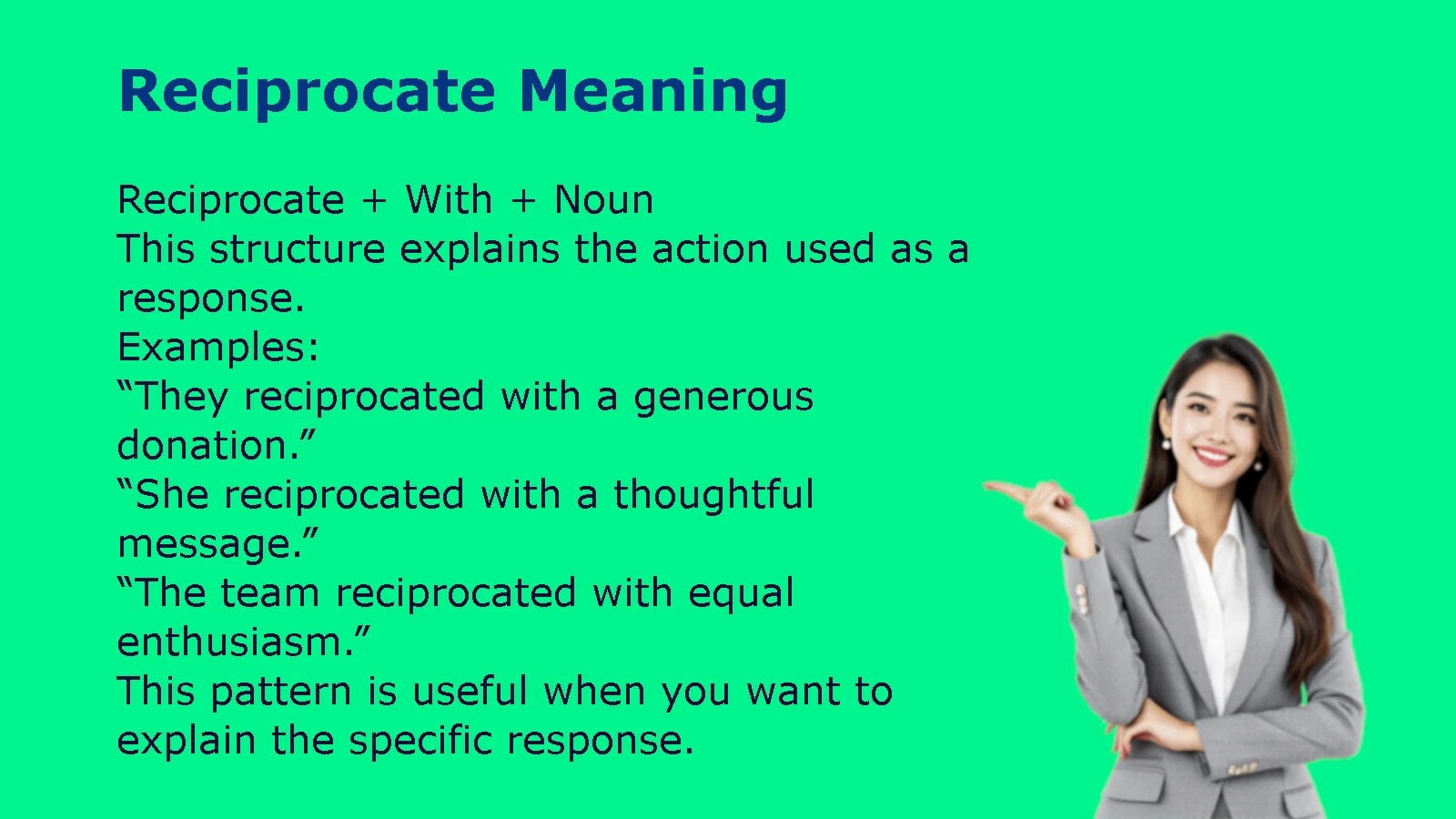
Reciprocate + With + Noun
This structure explains the action used as a response.
Examples:
- “They reciprocated with a generous donation.”
- “She reciprocated with a thoughtful message.”
- “The team reciprocated with equal enthusiasm.”
This pattern is useful when you want to explain the specific response.
Reciprocate Feelings or Emotions
One of the most common uses of this word involves emotions.
Examples:
- “She reciprocated his feelings.”
- “He did not reciprocate her interest.”
- “They both reciprocated their appreciation.”
In these examples, reciprocate describes whether emotions are shared equally.
What Does It Mean to Reciprocate Feelings?
When someone says a person reciprocated feelings, it means they felt the same way and expressed similar emotions in return.
This phrase often appears in romantic situations, but it can describe other emotional connections too.
For example:
- A person feels love and receives love in return.
- A friend shows appreciation and receives appreciation back.
- A teammate shows trust and receives trust.
Example: Romantic Context
Imagine Alex develops feelings for Taylor. After spending time together, Taylor begins to feel the same way.
You could say:
“Taylor reciprocated Alex’s feelings.”
This means Taylor returned those emotions.
However, if Taylor does not feel the same way, you might say:
“Taylor did not reciprocate Alex’s feelings.”
This means the feelings were not mutual.
Reciprocate vs Return the Favor
Many people use reciprocate and return the favor in similar situations. They overlap, but they are not always identical.
| Term | Meaning | Example |
| Reciprocate | Return an action, feeling, or behavior | She reciprocated his kindness. |
| Return the favor | Repay a specific helpful action | I’ll return the favor next week. |
| Respond | React to something generally | He responded to the message. |
When to Use Reciprocate
Use reciprocate when you want to emphasize balance or mutual exchange.
Example:
- “The employees reciprocated the manager’s trust.”
This sounds more formal and highlights a shared relationship.
When to Use Return the Favor
Use this phrase when someone helped you and you want to help them back.
Example:
- “Thanks for helping me move. I’ll return the favor someday.”
This sounds more casual and conversational.
Synonyms for Reciprocate
Finding the right synonym for reciprocate depends on the situation. Some words focus on returning kindness, while others highlight matching behavior, exchanging actions, or responding emotionally.
Although these words share similar meanings, they do not always work as perfect replacements.
| Synonym | Meaning | Example |
| Return | Give something back | She returned his kindness with appreciation. |
| Repay | Give back something received, often a favor | He repaid her help by supporting her later. |
| Give back | Return something received | They gave back to the community that helped them. |
| Respond in kind | React with a similar action | She responded in kind to their generosity. |
| Match | Equal someone’s effort or behavior | He matched her enthusiasm during the project. |
| Mirror | Reflect another person’s actions | The child mirrored his parents’ kindness. |
| Exchange | Trade actions or feelings between people | They exchanged ideas and support. |
Return
Return is one of the closest everyday alternatives to reciprocate.
However, “return” has a broader meaning. It can describe giving back an object, going back somewhere, or responding to an action.
Examples:
- “She returned his kindness.”
- “I returned the book to the library.”
The first example relates to reciprocation. The second does not.
Repay
Repay often involves returning a favor, debt, or benefit.
Examples:
- “She repaid her friend’s generosity.”
- “He repaid the loan within six months.”
The word can sound more practical or financial than reciprocate.
For example, you can repay a loan, but you usually do not say you “reciprocated a loan.”
Respond in Kind
The phrase respond in kind is a strong synonym because it directly means reacting with a similar action.
Examples:
- “The community responded in kind after receiving support.”
- “She responded in kind to his thoughtful gesture.”
This phrase works well when describing kindness, generosity, or behavior.
Antonyms of Reciprocate
Antonyms are words that express the opposite idea. Since reciprocate involves returning something, its opposites usually describe refusing, ignoring, or failing to respond.
| Antonym | Meaning | Example |
| Ignore | Pay no attention | He ignored her message. |
| Reject | Refuse something offered | She rejected his invitation. |
| Refuse | Decline to do something | They refused to help. |
| Withhold | Keep something back | He withheld his support. |
| Disregard | Ignore importance | The company disregarded customer feedback. |
Ignore
If someone ignores kindness, effort, or communication, they do not reciprocate.
Example:
“She offered friendship, but he ignored her attempts.”
The person receives an action but provides no similar response.
Reject
Rejecting is stronger than simply not reciprocating.
For example:
- Someone may not reciprocate romantic feelings because they do not feel the same way.
- Someone may reject those feelings by clearly saying no.
The difference comes down to intention and response.
Common Mistakes When Using Reciprocate
Although reciprocate is a common word, many people misunderstand how to use it. Avoiding these mistakes will make your writing and conversations more accurate.
Mistake: Using Reciprocate Without Mentioning What Is Returned
A sentence like:
“He reciprocated.”
is grammatically correct, but it leaves the reader wondering what happened.
A clearer version:
“He reciprocated her kindness.”
or:
“He reciprocated the support he received.”
Adding the object makes the meaning complete.
Mistake: Thinking Reciprocate Only Applies to Romance
Many people connect reciprocate with love or attraction because phrases like “reciprocate feelings” appear often in romantic conversations.
However, the word applies to many situations.
Examples:
- “The team reciprocated the coach’s trust.”
- “The company reciprocated customer loyalty.”
- “The neighbors reciprocated each other’s kindness.”
Romance is only one small part of the word’s meaning.
Mistake: Confusing Reciprocate With Copying
Reciprocating does not mean copying someone exactly.
Imagine a coworker stays late to help you complete a report. You do not need to stay late on the same day to reciprocate.
You might:
- Help them with another project.
- Share useful information.
- Offer support when they need it.
The goal is not identical action. The goal is a similar level of care or effort.
Real Life Examples of Reciprocity
Reciprocity appears in almost every part of human interaction. People naturally build connections through exchanges of support, respect, and trust.
Friendship
Strong friendships often depend on mutual effort.
One friend might:
- Listen during a difficult time.
- Offer advice.
- Celebrate achievements.
The other friend reciprocates by providing the same support when needed.
A friendship becomes stronger when both people contribute.
Workplace Relationships
Professional environments also rely on reciprocity.
For example:
A manager trusts an employee with an important responsibility. The employee reciprocates by working hard and showing reliability.
Another example:
A coworker helps you solve a difficult problem. Later, you assist them with a challenge they face.
This creates teamwork instead of competition.
Customer Service
Businesses often use the idea of reciprocity to build customer loyalty.
A company may:
- Provide helpful support.
- Offer rewards.
- Listen to customer feedback.
Customers may reciprocate by:
- Continuing to purchase products.
- Leaving positive reviews.
- Recommending the company.
This relationship works because both sides exchange value.
Communities
Communities grow stronger when people reciprocate kindness.
Examples include:
- Neighbors helping each other.
- Volunteers supporting local projects.
- Residents sharing resources during emergencies.
A small act of kindness can create a chain reaction.
One person helps another. That person helps someone else. The cycle continues.
Why Reciprocity Matters in Human Relationships
Reciprocity plays an important role in trust and cooperation.
When people feel that their efforts are appreciated, they are more likely to continue helping.
For example:
Imagine you always check on a friend, but they never ask how you are doing. Over time, the relationship may feel unbalanced.
Now imagine both friends make an effort:
- They listen.
- They support each other.
- They celebrate successes together.
That balance creates a healthier connection.
Benefits of Reciprocity
| Benefit | How It Helps |
| Builds trust | People feel valued and respected |
| Strengthens relationships | Mutual effort creates stronger bonds |
| Encourages cooperation | People become willing to work together |
| Improves communication | Both sides participate actively |
| Creates fairness | Efforts and support feel balanced |
Case Studies Showing Reciprocation in Action
Case Study: Workplace Support
A new employee struggles to understand a company system. A senior coworker spends time explaining the process and answering questions.
Months later, the senior employee faces a heavy workload. The newer employee offers help and shares useful shortcuts.
The newer employee reciprocated the original support.
The exchange did not happen immediately, but the relationship became stronger because both people contributed.
Case Study: Friendship and Emotional Support
Maria listens to her friend during a stressful period. She provides encouragement and checks in regularly.
Later, when Maria experiences challenges, her friend offers the same emotional support.
The friendship demonstrates emotional reciprocity because both people provide care.
Reciprocate Meaning in Different Contexts
The meaning of reciprocate stays the same, but the situation changes how people understand it.
| Context | Meaning | Example |
| Relationships | Return emotions or affection | She reciprocated his feelings. |
| Friendship | Return kindness or support | He reciprocated her friendship. |
| Workplace | Match effort or respect | Employees reciprocated the manager’s trust. |
| Business | Exchange value | The company reciprocated customer loyalty. |
| Society | Return help or generosity | Communities reciprocate support. |
How to Use Reciprocate in Professional Writing
The word reciprocate can add a polished tone to professional communication.
Instead of writing:
“We want to give back to our customers.”
You might write:
“We want to reciprocate the trust our customers have placed in us.”
The second sentence sounds more formal and emphasizes a relationship based on mutual value.
Professional Examples
- “We appreciate your continued partnership and hope to reciprocate your confidence through excellent service.”
- “The organization reciprocated the community’s support with additional outreach programs.”
- “Employees often reciprocate respect when leaders create a positive workplace culture.”
Reciprocate Meaning in Relationships
The word reciprocate appears frequently when people talk about relationships because strong connections usually depend on mutual effort. Whether it involves friendship, family, or romance, reciprocation shows that both people value the relationship.
A relationship feels balanced when both sides contribute. One person does not always have to give while the other only receives.
For example:
- A friend checks on you during a difficult week.
- You check on them when they face challenges.
- Both people show care and support.
That exchange represents reciprocity.
However, reciprocation does not mean every action must be perfectly equal. Relationships are not business transactions where every favor requires an exact repayment. Sometimes one person gives more during one season of life, while the other provides more support later.
Examples of Reciprocating in Relationships
Emotional Support
When someone listens to your problems, encourages you, or celebrates your achievements, you can reciprocate by offering the same emotional support.
Example:
“Sarah always supports her friends, and they reciprocate by being there for her when she needs help.”
Respect
Respect often grows through mutual behavior.
Example:
“The manager treated employees fairly, and the employees reciprocated that respect through dedication and honesty.”
Affection
In romantic relationships, reciprocating affection means showing similar feelings.
Example:
“After months of friendship, she realized she reciprocated his feelings.”
This means she developed the same romantic interest.
What Does It Mean to Not Reciprocate?
Not every action, feeling, or gesture receives a similar response. When someone does not reciprocate, they do not return the same effort, emotion, or behavior.
This can happen for many reasons.
For example:
- Someone may appreciate kindness but not know how to express it.
- Someone may not share the same feelings.
- Someone may be unable to provide the same level of support.
Examples of Not Reciprocating
Romantic situation:
“He liked her, but she did not reciprocate his feelings.”
Meaning: She did not feel the same romantic attraction.
Friendship situation:
“She always reached out, but her friend rarely reciprocated.”
Meaning: Her friend did not make the same effort.
Work situation:
“The employee expected recognition but did not reciprocate the team’s commitment.”
Meaning: The employee did not return the same level of dedication.
Reciprocate vs Mutual vs Reciprocal
These words are closely connected, but they serve different purposes.
| Word | Type | Meaning | Example |
| Reciprocate | Verb | To return an action or feeling | She reciprocated his kindness. |
| Reciprocal | Adjective | Describing a mutual exchange | They had a reciprocal relationship. |
| Mutual | Adjective | Shared by two or more people | They had mutual respect. |
Reciprocate
This word describes the action itself.
Example:
“He reciprocated the invitation.”
The person actively returned the gesture.
Reciprocal
This describes something that exists between two sides.
Example:
“They built a reciprocal partnership.”
The partnership benefits both parties.
Mutual
This focuses on something shared.
Example:
“They developed mutual trust.”
Both people have the same feeling of trust.
Reciprocate vs Appreciate
People sometimes confuse reciprocate with appreciate, but they have different meanings.
| Word | Meaning | Example |
| Appreciate | Feel grateful or recognize value | I appreciate your help. |
| Reciprocate | Return the action or feeling | I reciprocated your help. |
You can appreciate something without reciprocating it.
For example:
Someone gives you a thoughtful gift. You appreciate the gift, but you may not immediately give them something back.
Appreciation is an emotion. Reciprocation is an action.
Reciprocate vs Respond
Although these words are related, they are not identical.
Respond is a general word that means reacting to something.
Reciprocate is more specific because it involves returning something similar.
Compare:
“She responded to his message.”
This only means she replied.
“She reciprocated his kindness.”
This means she returned his kindness with similar kindness.
Every reciprocation is a response, but not every response is a reciprocation.
Examples of Reciprocate in a Sentence
Here are examples showing how to use reciprocate naturally.
Everyday Examples
- “I appreciate your help and hope to reciprocate someday.”
- “The children reciprocated their teacher’s kindness with a thank you card.”
- “She smiled at him, and he reciprocated with a smile.”
- “They exchanged gifts to reciprocate each other’s generosity.”
Workplace Examples
- “The employees reciprocated the company’s investment in training by improving their performance.”
- “The team reciprocated the leader’s trust by completing the project successfully.”
- “Good managers create environments where employees naturally reciprocate respect.”
Relationship Examples
- “She hoped he would reciprocate her feelings.”
- “Their friendship grew because they reciprocated each other’s support.”
- “A healthy relationship requires both partners to reciprocate love and understanding.”
Formal Examples
- “The organization reciprocated the community’s support through additional programs.”
- “The two nations agreed to reciprocate trade benefits.”
- “The company reciprocated customer loyalty with exclusive rewards.”
Common Phrases With Reciprocate
Certain phrases appear more often with this word.
Reciprocate Feelings
Meaning: Return someone’s emotions.
Example:
“He was happy to learn that she reciprocated his feelings.”
Reciprocate Kindness
Meaning: Return a good action.
Example:
“Small acts of kindness often inspire others to reciprocate kindness.”
Reciprocate Support
Meaning: Provide support after receiving it.
Example:
“The community reciprocated the organization’s support during difficult times.”
Reciprocate Efforts
Meaning: Match someone’s level of work or dedication.
Example:
“Successful partnerships happen when both sides reciprocate efforts.”
Reciprocate a Favor
Meaning: Return help received from someone.
Example:
“My neighbor helped me repair my fence, and I plan to reciprocate the favor.”
Frequently Asked Questions About Reciprocate Meaning
What does reciprocate mean in simple terms?
Reciprocate means to give something back in response to what someone has given you. It can involve kindness, feelings, help, respect, or effort.
Example:
“She helped me, and I reciprocated by helping her later.”
Is reciprocate a positive word?
Yes, reciprocate is usually viewed positively because it describes cooperation, kindness, and mutual exchange.
However, the context determines the feeling.
Positive example:
“He reciprocated her kindness.”
Neutral example:
“The countries reciprocated the trade restrictions.”
In the second example, the word simply describes a response.
Can you reciprocate feelings?
Yes. You can reciprocate feelings when you experience similar emotions toward someone.
Examples:
- “She reciprocated his love.”
- “He reciprocated her appreciation.”
However, people cannot always force themselves to reciprocate feelings. Emotions must be genuine.
What is the noun form of reciprocate?
The noun form is reciprocity.
Reciprocity means a mutual exchange or relationship where both sides contribute.
Example:
“Successful friendships often depend on reciprocity.”
This means both friends give and receive support.
What is the adjective form of reciprocate?
The adjective form is reciprocal.
Examples:
- “They developed a reciprocal relationship.”
- “The agreement created reciprocal benefits.”
It describes something shared or exchanged between two sides.
Quick Reference Guide: Reciprocate Meaning
| Question | Answer |
| Part of speech | Verb |
| Basic meaning | Return an action, feeling, or favor |
| Pronunciation | ri SIP ruh kate |
| Similar words | Return, repay, respond in kind |
| Opposite ideas | Ignore, reject, withhold |
| Noun form | Reciprocity |
| Adjective form | Reciprocal |
Final Thoughts on the Meaning of Reciprocate
The word reciprocate describes one of the most important parts of human interaction: giving something back.
When someone offers kindness, respect, support, or affection and you respond in a similar way, you reciprocate. The exchange does not have to be identical. It simply needs to show that you value what you received.
Understanding reciprocate meaning helps you communicate more clearly in everyday conversations, professional writing, and personal relationships.
The next time you want to describe returning a favor, matching someone’s effort, or sharing the same feelings, reciprocate is the precise word to use. It captures the idea of connection moving in both directions, like a conversation where both people take part.