
What Is the Negotiate Meaning?
Negotiate means to discuss or communicate with someone to reach an agreement or solve a problem. It is commonly used in business, contracts, salaries, prices, conflicts, and everyday conversations where two or more people try to find a mutually acceptable solution.
Examples:
- She negotiated a better salary with her employer.
- They negotiated a peace agreement after several meetings.
Understanding the negotiate meaning helps you use the word correctly in professional, academic, and everyday English while improving your communication skills.
The confusion is understandable. Many people search for the meaning of negotiate, negotiate definition, or how to use negotiate in a sentence because the word can have different meanings depending on the situation. And here’s the kicker: it’s not just about bargaining over a price—it can also refer to reaching agreements, resolving conflicts, or successfully handling difficult situations.
In this guide, you’ll learn the Negotiate Meaning, explore the definition of negotiate, discover its pronunciation, synonyms, and examples in sentences, and understand how to use it correctly in everyday conversations, business communication, and professional writing. You’ll also learn the difference between negotiating a deal, negotiating terms, and other common uses of the word.
What Does Negotiate Mean?
The word negotiate means to communicate with another person or group to reach a decision that both sides accept. It usually involves discussion, compromise, and problem solving.
When you negotiate, you do not simply demand what you want. Instead, you consider another person’s needs while explaining your own goals.
For example:
- A customer negotiates the price of a car with a seller.
- An employee negotiates a higher salary with an employer.
- Two companies negotiate a partnership agreement.
- A family negotiates vacation plans that everyone enjoys.
Negotiation works because people often have different goals. Through conversation and compromise, they can find common ground.
A useful way to understand negotiation is to think of it as building a bridge. Each side starts on a different shore, but communication creates a path that allows both sides to meet in the middle.
Meaning of Negotiate: To Discuss Terms and Reach an Agreement
The most common meaning of negotiate involves discussing terms to create an agreement.
In this situation, two or more parties usually have something they want. However, their expectations may not match at first.
For example:
A company wants to hire a skilled employee but hopes to stay within a certain budget. The employee wants a higher salary and better benefits. Both sides negotiate until they find an offer that satisfies everyone.
Common things people negotiate include:
- Prices
- Contracts
- Salaries
- Deadlines
- Business deals
- Payment terms
- Responsibilities
- Rules and conditions
Example Sentences:
- “The manager negotiated a new contract with the supplier.”
- “She negotiated her salary before accepting the job offer.”
- “The two companies negotiated an agreement that benefited both sides.”
In these examples, negotiation involves discussion followed by a decision.
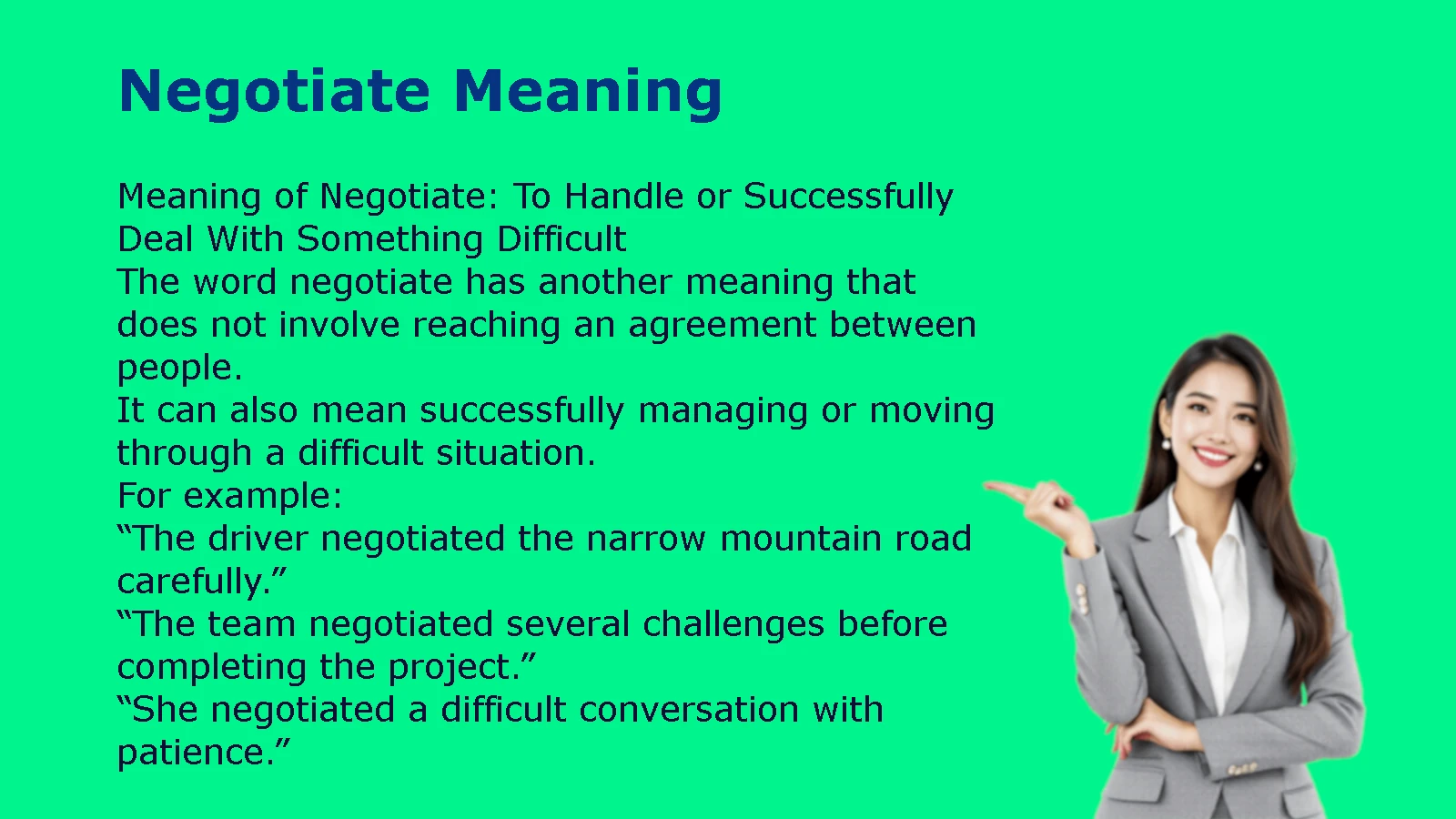
Meaning of Negotiate: To Handle or Successfully Deal With Something Difficult
The word negotiate has another meaning that does not involve reaching an agreement between people.
It can also mean successfully managing or moving through a difficult situation.
For example:
- “The driver negotiated the narrow mountain road carefully.”
- “The team negotiated several challenges before completing the project.”
- “She negotiated a difficult conversation with patience.”
Here, negotiate means to navigate, manage, or handle something successfully.
This meaning often appears when talking about obstacles, challenges, or complicated situations.
Compare These Two Uses:
| Sentence | Meaning of Negotiate |
| “They negotiated a business deal.” | Reached an agreement |
| “He negotiated the crowded streets.” | Successfully managed a difficult situation |
| “She negotiated a higher salary.” | Discussed terms |
| “The hikers negotiated the rocky trail.” | Handled a challenging path |
Both meanings share a common idea: dealing with something carefully to achieve a desired result.
Negotiate Definition and Word Origin
Dictionary Definition of Negotiate
The general definition of negotiate is:
To try to reach an agreement through discussion with another person or group.
A second definition describes negotiate as:
To successfully deal with or move through a difficult situation.
The first definition focuses on communication between people. The second focuses on skillfully handling circumstances.
For example:
- Negotiating a contract requires communication.
- Negotiating a complicated problem requires strategy.
Both involve careful decision making.
Origin of the Word Negotiate
The word negotiate comes from the Latin word negotiari, which means “to carry on business.”
The Latin term developed from two words:
- Nec meaning “not”
- Otium meaning “leisure”
Together, the idea referred to being involved in business activity rather than enjoying free time.
Over centuries, the meaning expanded. Instead of only describing business transactions, negotiate became associated with any process where people discuss terms, solve problems, and reach agreements.
Today, negotiation is considered an essential communication skill in many areas, including:
- Business management
- International relations
- Law
- Sales
- Leadership
- Personal relationships
How to Pronounce Negotiate
The correct pronunciation of negotiate is:
ni-GOH-shee-ayt
Phonetically:
/nɪˈɡoʊʃieɪt/
The word has four syllables:
ne • go • ti • ate
The stress falls on the second syllable:
ne-GO-ti-ate
Common Pronunciation Mistake
Some speakers pronounce the word too quickly and make it sound like “nego-shate.” While casual speech may shorten sounds, the clear pronunciation includes the “shee” sound:
✅ Correct: ni-GOH-shee-ayt
❌ Incorrect: NEG-oh-tate
Negotiate Meaning in Different Contexts
The meaning of negotiate changes slightly depending on where you use it. However, the main idea always involves finding a solution.
Negotiate Meaning in Business
In business, negotiation plays a major role in creating agreements between companies, customers, employees, and partners.
Businesses negotiate almost every day. A company may negotiate with suppliers to lower costs, with employees about contracts, or with investors about funding.
For example:
A restaurant owner wants fresh ingredients at a reasonable price. A supplier wants a profitable agreement. Through negotiation, both sides discuss pricing, delivery schedules, and quality expectations.
Common Business Negotiations Include:
| Type of Negotiation | Example |
| Contract negotiation | Agreeing on business terms |
| Price negotiation | Discussing costs |
| Partnership negotiation | Creating a collaboration |
| Supplier negotiation | Setting delivery and payment conditions |
| Merger negotiation | Combining companies |
Successful business negotiation requires more than simply asking for better terms. It involves understanding the other side’s goals.
A strong negotiator asks questions, listens carefully, and searches for solutions where both parties benefit.
Negotiate Meaning in the Workplace
Workplace negotiation happens when employees and employers discuss expectations, responsibilities, or benefits.
Many people think salary is the only thing employees negotiate. However, workplace negotiation covers many areas.
Employees may negotiate:
- Salary increases
- Remote work options
- Vacation time
- Project deadlines
- Job responsibilities
- Professional development opportunities
For example:
A graphic designer receives a job offer. Instead of immediately accepting, they discuss salary, working hours, and additional benefits with the employer. Both sides negotiate until they reach an agreement.
Workplace Negotiation Example:
“I appreciate the offer. Could we discuss the possibility of adjusting the salary based on my experience and skills?”
This approach works because it focuses on collaboration instead of confrontation.
Negotiate Meaning in Personal Relationships
Negotiation does not only happen in offices or business meetings. People negotiate in everyday relationships all the time.
Friends, couples, and families often have different opinions. Negotiation helps them find solutions without unnecessary conflict.
Examples include:
- Deciding where to eat
- Planning vacations
- Sharing household responsibilities
- Setting personal boundaries
- Managing schedules
Imagine two roommates. One prefers a quiet home while the other enjoys having friends over. Instead of arguing, they negotiate rules that respect both preferences.
Good personal negotiation depends on:
- Listening
- Respect
- Patience
- Understanding
- Willingness to compromise
Negotiate Meaning in Travel and Physical Situations
The word negotiate can also describe physically moving through a difficult place.
For example:
- “The driver negotiated the busy city traffic.”
- “The climbers negotiated the steep mountain path.”
- “The boat negotiated the rough waters.”
In these sentences, negotiate means handling something carefully and skillfully.
The person is not making a deal. Instead, they are using judgment and ability to overcome a challenge.
Examples of Negotiate in Sentences
Seeing negotiate meaning in real sentences makes it easier to understand how the word works in everyday communication. The word can describe formal agreements, casual decisions, and difficult situations.
Here are examples from different contexts:
| Sentence | Meaning |
| “The company negotiated a new contract with its suppliers.” | The company discussed terms to create an agreement. |
| “She negotiated a higher salary before accepting the position.” | She discussed pay and benefits with an employer. |
| “The buyer negotiated the price of the used car.” | The buyer tried to reach a better price. |
| “The countries negotiated a peace agreement.” | Leaders discussed terms to resolve a conflict. |
| “The hikers negotiated the steep mountain trail.” | The hikers carefully managed a difficult path. |
| “The team negotiated several obstacles during the project.” | The team successfully handled challenges. |
| “The landlord and tenant negotiated new lease terms.” | Both sides discussed rental conditions. |
| “Parents often negotiate rules with their children.” | They discuss boundaries and expectations. |
These examples show that negotiate does not always mean arguing or competing. In many cases, it represents cooperation and problem solving.
What Does It Mean to Negotiate Something?
The phrase “negotiate something” means to discuss a specific issue, item, or condition with the goal of reaching an agreement.
The word that follows negotiate usually represents the thing being discussed.
Common examples include:
- Negotiate a deal
- Negotiate a contract
- Negotiate a price
- Negotiate a settlement
- Negotiate a solution
- Negotiate an agreement
- Negotiate a deadline
For example:
“The company negotiated a better payment schedule with its clients.”
In this sentence, the company discussed payment conditions and reached an arrangement.
Another example:
“The couple negotiated a plan for dividing household chores.”
Here, the couple discussed responsibilities and created a solution.
Common Things People Negotiate
Negotiation appears in almost every area of life.
| Area | What People Negotiate |
| Business | Contracts, partnerships, prices, investments |
| Workplace | Salary, benefits, schedules, responsibilities |
| Real estate | Rent, purchase prices, repair costs |
| Sales | Discounts, payment terms, services |
| Family life | Rules, schedules, responsibilities |
| Government | Policies, agreements, international issues |
Whether the situation involves two people or two large organizations, the basic process remains similar: discuss, understand, adjust, and agree.
Different Forms of Negotiate
The word negotiate changes forms depending on how it appears in a sentence.
Understanding these forms helps you use the word correctly in speaking and writing.
| Word Form | Usage | Example |
| Negotiate | Base verb | “They negotiate business deals regularly.” |
| Negotiated | Past tense | “They negotiated a successful agreement last year.” |
| Negotiating | Present participle | “The companies are negotiating new terms.” |
| Negotiation | Noun | “The negotiation took several hours.” |
| Negotiator | Person who negotiates | “The negotiator helped both sides reach a solution.” |
Negotiate as a Verb
As a verb, negotiate describes the action of discussing or handling something.
Examples:
- “We need to negotiate the final price.”
- “The leaders will negotiate tomorrow.”
- “She negotiated with the supplier.”
The verb focuses on the process of finding a solution.
Negotiation as a Noun
The noun form negotiation refers to the actual discussion or process.
Examples:
- “The negotiation lasted three days.”
- “Successful negotiations require patience.”
- “The two sides entered negotiations.”
A negotiation can be short or extremely complex. Some negotiations finish within minutes while others continue for months or years.
Negotiator as a Person
A negotiator is someone who helps create agreements or resolve conflicts.
Professional negotiators often work in areas such as:
- Business
- Law
- Diplomacy
- Real estate
- Sales
- Labor relations
A skilled negotiator understands human behavior, communication techniques, and problem solving.
Common Phrases With Negotiate
The word negotiate often appears with specific phrases. Learning these combinations helps you sound more natural.
Negotiate a Deal
Meaning: To discuss terms and reach an agreement.
A deal usually involves an exchange where both sides want something valuable.
Examples:
- “The company negotiated a deal with a new partner.”
- “The buyer negotiated a deal before purchasing the property.”
A successful deal usually requires both sides to feel that the outcome is fair.
Negotiate Terms
Meaning: To discuss and decide the conditions of an agreement.
Terms may include:
- Prices
- Responsibilities
- Deadlines
- Rules
- Expectations
Example:
“The two businesses negotiated the terms of their partnership.”
This means they discussed the details before making the agreement official.
Negotiate a Contract
Meaning: To discuss the details of a formal written agreement.
Contracts often require careful negotiation because they involve legal responsibilities.
People may negotiate:
- Payment amounts
- Service requirements
- Time limits
- Confidentiality rules
- Cancellation conditions
Example:
“The athlete negotiated a new contract with the team.”
The athlete and team discussed conditions before signing the final agreement.
Negotiate a Price
Meaning: To discuss the cost of something and possibly reach a different price.
Price negotiation is common in:
- Car purchases
- Real estate
- Wholesale markets
- Business services
Example:
“The customer negotiated a lower price for the furniture.”
The customer and seller discussed the cost until they reached an acceptable amount.
Negotiate With Someone
Meaning: To discuss something with another person or group.
The phrase highlights the other party involved.
Examples:
- “The manager negotiated with employees.”
- “The government negotiated with international leaders.”
- “She negotiated with the seller.”
Synonyms for Negotiate
Several words have similar meanings to negotiate, but each one has a slightly different use.
Choosing the right synonym makes your writing clearer.
| Synonym | Meaning | Example |
| Discuss | Talk about ideas or issues | “They discussed possible solutions.” |
| Bargain | Try to get a better price or deal | “He bargained with the seller.” |
| Settle | Resolve a disagreement | “The two sides settled the dispute.” |
| Arrange | Organize an agreement | “They arranged a meeting time.” |
| Compromise | Both sides give something up | “They compromised to reach a decision.” |
| Mediate | Help others reach agreement | “The lawyer mediated the conflict.” |
| Resolve | Find an answer to a problem | “They resolved the issue peacefully.” |
Difference Between Negotiate, Bargain, and Compromise
Although these words overlap, they are not exactly the same.
Negotiate
Negotiate is the broadest term. It means discussing something to reach an agreement.
Example:
“The companies negotiated a partnership.”
The focus is on communication and agreement.
Bargain
Bargain usually focuses on price.
Example:
“She bargained with the seller to reduce the cost.”
Bargaining often happens when someone wants a better deal.
Common situations include:
- Markets
- Car sales
- Auctions
- Retail purchases
Compromise
Compromise means both sides give up something to reach a solution.
Example:
“They compromised by choosing a restaurant that both people liked.”
A compromise does not always involve money. It often involves preferences, opinions, or responsibilities.
Quick Comparison Table
| Word | Main Focus | Example |
| Negotiate | Reaching an agreement through discussion | Negotiating a contract |
| Bargain | Getting a better price or advantage | Bargaining over a purchase |
| Compromise | Finding middle ground | Compromising on a decision |
How to Use Negotiate Correctly in a Sentence
Using negotiate correctly depends on understanding its common sentence patterns.
Negotiate With Someone
Use this structure when you want to mention the person or group involved.
Pattern:
Negotiate + with + person/group
Examples:
- “The company negotiated with investors.”
- “She negotiated with her manager.”
- “The countries negotiated with each other.”
Negotiate Something
Use this structure when you mention the subject being discussed.
Pattern:
Negotiate + object
Examples:
- “They negotiated a contract.”
- “He negotiated a better deal.”
- “We negotiated new terms.”
Negotiate for Something
Use this structure when someone tries to obtain a specific benefit.
Examples:
- “She negotiated for higher pay.”
- “The workers negotiated for better conditions.”
This structure highlights the goal someone wants to achieve.
Common Mistakes When Using Negotiate
Mistake: Thinking Negotiation Always Means Conflict
Many people assume negotiation happens only during disagreements. However, negotiation can also happen during friendly discussions.
For example:
Two coworkers deciding project responsibilities are negotiating even though they are not fighting.
Mistake: Confusing Negotiation With Asking
Asking is simply requesting something.
Negotiation involves discussion and adjustment.
Example:
Asking:
“Can I have a discount?”
Negotiating:
“If I purchase three items, could we discuss a lower price?”
The second example creates a conversation.
Mistake: Using Negotiate When No Agreement Exists
Negotiation usually involves two or more sides working toward a result.
Simply explaining your opinion is not always negotiation.
Example:
- “She explained her idea.” → Not necessarily negotiation.
- “She discussed her idea and adjusted the plan with her team.” → Negotiation.
Real Life Examples of Negotiation
Understanding the negotiate meaning becomes easier when you see how negotiation works in real situations. People negotiate constantly, often without realizing it.
A negotiation does not always happen in a formal meeting with documents and handshakes. Sometimes it happens during a quick conversation in a store, a discussion with a coworker, or a decision made at home.
The purpose remains the same: finding an outcome that satisfies everyone involved.
Salary Negotiation
Salary negotiation is one of the most common examples of professional negotiation.
When an employer offers a job, the first offer is not always the final one. Employees may negotiate compensation based on their skills, experience, education, and the value they bring to the company.
Salary negotiation may include:
- Base salary
- Bonuses
- Health benefits
- Vacation time
- Remote work options
- Flexible schedules
- Professional development opportunities
For example:
A software developer receives a job offer with a salary of $80,000. After researching industry standards and discussing their experience, they negotiate and agree on a $90,000 salary with additional benefits.
The negotiation works because both sides understand each other’s needs.
The employer wants a talented employee. The employee wants fair compensation.
Effective Salary Negotiation Example:
“I’m excited about this opportunity. Based on my experience and the responsibilities of this role, I’d like to discuss whether there is flexibility in the compensation package.”
This approach keeps the conversation professional and collaborative.
Business Negotiation
Businesses negotiate every day to create partnerships, manage costs, and build long term relationships.
A company may negotiate with:
- Suppliers
- Customers
- Investors
- Competitors
- Employees
- Partners
For example, a retailer may negotiate with a supplier to receive better pricing for bulk orders. The supplier may agree because the retailer provides consistent business.
Both sides benefit.
Common Business Negotiation Goals
| Goal | Example |
| Reduce costs | Negotiating lower supplier prices |
| Increase revenue | Creating profitable partnerships |
| Improve conditions | Changing contract terms |
| Reduce risk | Adding protections to agreements |
| Build relationships | Creating long term cooperation |
Successful business negotiation is rarely about one side winning and the other losing. The strongest agreements often create value for everyone involved.
Real Estate Negotiation
Buying or renting property often requires negotiation.
A buyer may negotiate:
- Purchase price
- Repair requests
- Closing dates
- Included appliances
- Payment conditions
A renter may negotiate:
- Monthly rent
- Lease length
- Maintenance responsibilities
- Move in dates
For example:
A home buyer notices several repairs are needed after an inspection. Instead of canceling the purchase, they negotiate with the seller. The seller agrees to lower the price, and both parties complete the sale.
This shows how negotiation can turn a problem into a workable solution.
Everyday Negotiation
Many daily decisions involve negotiation.
You might negotiate when:
- Choosing a restaurant with friends
- Planning a family trip
- Dividing household chores
- Setting rules with children
- Deciding work priorities
- Managing time with others
For example:
Two friends want different weekend plans. One wants to go hiking while the other prefers watching a movie. They negotiate and decide to hike in the morning and watch a movie later.
No contract is signed. No formal meeting happens. Yet negotiation takes place.
Tips for Effective Negotiation
Good negotiation is a skill that improves with practice. Whether you are negotiating a business deal or a simple personal decision, certain strategies can help you reach better outcomes.
Prepare Before You Negotiate
Preparation gives you confidence.
Before starting a negotiation, understand:
- What you want
- What the other side wants
- Your available options
- Your limits
- Possible solutions
For example, before negotiating a salary, research typical pay ranges for similar positions. This information helps you make a stronger argument.
Preparation turns negotiation from guessing into a strategic conversation.
Understand the Other Side’s Needs
Strong negotiators do not focus only on their own goals. They try to understand the other person’s priorities.
Ask questions such as:
- “What matters most to you?”
- “What challenges are you facing?”
- “What would make this agreement work?”
Understanding another person’s perspective often reveals solutions you did not consider.
Communicate Clearly
Good negotiation depends on clear communication.
Avoid:
- Vague statements
- Emotional reactions
- Unclear expectations
Instead:
- Explain your needs
- Provide reasons
- Listen carefully
- Confirm important details
Clear communication prevents misunderstandings.
Stay Flexible
A rigid approach can make negotiation difficult.
Flexibility does not mean accepting everything. It means being open to different paths.
For example:
An employee may not receive the exact salary they requested, but they may negotiate extra vacation days or a flexible schedule instead.
Sometimes the best solution is not the first solution you imagine.
Focus on Solutions, Not Winning
The goal of negotiation is not always to defeat the other side.
A strong negotiation creates an agreement where both parties feel respected.
Think of negotiation like building a puzzle. Each person holds different pieces, and the goal is to arrange them into a complete picture.
Know When to Compromise
Compromise is an important part of negotiation.
However, compromise does not mean giving up everything you want.
A good compromise allows both sides to achieve something valuable.
Example:
A company wants a lower price, while a supplier wants a longer contract. They compromise by agreeing on a slightly lower price in exchange for a longer partnership.
Why Negotiation Skills Matter
Negotiation is one of the most valuable communication skills because it affects many areas of life.
People who negotiate effectively can:
- Solve problems faster
- Build stronger relationships
- Avoid unnecessary conflict
- Make better decisions
- Create valuable opportunities
According to many leadership and business studies, negotiation skills are among the most important abilities for managers, entrepreneurs, and professionals because they directly influence decision making and collaboration.
Negotiation is not about being aggressive. It is about understanding people, communicating clearly, and finding practical solutions.
Frequently Asked Questions About Negotiate Meaning
What Is the Simple Meaning of Negotiate?
Negotiate means to discuss something with another person or group to reach an agreement or solve a problem.
It can also mean successfully handling a difficult situation.
Example:
- “They negotiated a business agreement.”
- “She negotiated a difficult challenge.”
Is Negotiate a Positive Word?
Yes, negotiate is usually a neutral or positive word.
It often suggests cooperation, communication, and problem solving.
However, the result of a negotiation depends on the situation. A negotiation can succeed, fail, or lead to different outcomes.
For example:
- Positive: “The two companies negotiated a successful partnership.”
- Neutral: “The teams negotiated for several hours.”
What Is an Example of Negotiate?
A simple example is:
“The customer negotiated a lower price with the seller.”
This means the customer and seller discussed the price and reached an agreement.
Another example:
“The leaders negotiated a peace agreement.”
This means they discussed terms to resolve a conflict.
What Is the Difference Between Negotiate and Discuss?
Although negotiate and discuss are similar, they have different purposes.
| Word | Meaning | Example |
| Discuss | Talk about a topic or exchange ideas | “They discussed the project.” |
| Negotiate | Talk with the goal of reaching an agreement | “They negotiated project deadlines.” |
Every negotiation involves discussion, but not every discussion is a negotiation.
Can You Negotiate With One Person?
Yes, you can negotiate with one person.
For example:
- An employee negotiates with a manager.
- A buyer negotiates with a seller.
- A tenant negotiates with a landlord.
You can also negotiate with groups, companies, or governments.
Final Thoughts on Negotiate Meaning
The word negotiate represents one of the most important skills in communication: finding solutions through conversation.
The basic negotiate meaning is to discuss terms, resolve differences, or successfully handle challenges. Whether you are negotiating a contract, discussing your salary, deciding weekend plans, or navigating a difficult situation, negotiation helps you create better outcomes.
Remember these key points:
- Negotiate means reaching an agreement through discussion.
- Negotiation requires communication, understanding, and flexibility.
- People negotiate in business, relationships, and everyday situations.
- Good negotiation focuses on solutions rather than conflict.
Learning how to negotiate does not just help you make better deals. It helps you communicate with confidence, understand different perspectives, and handle challenges more effectively.