
Have you ever heard someone make a subtle, mocking remark and wondered what they really meant? If so, you may have encountered a snide comment. While Snide Meaning is often associated with rude or insulting remarks, the word can describe something more specific: a comment or attitude that expresses indirect criticism, sarcasm, or disrespect.
Snide is an adjective used to describe a remark, expression, or behavior that is mocking, insulting, or critical in an indirect way. Instead of openly saying something rude, a person may use a snide comment to make their criticism sound less direct.
Examples:
- She made a snide comment about my new haircut.
- He gave me a snide smile after I made a mistake.
The confusion is understandable. People often search for what does snide mean, snide meaning in text, snide meaning in a sentence, or what does it mean when someone is snide because the word can describe a tone that is not always obvious. A snide remark may sound harmless on the surface, but the speaker’s tone, intention, and context can reveal the insult underneath.
In this guide, you’ll learn the complete Snide Meaning, its definition, pronunciation, correct usage, and examples in sentences. You’ll also discover the difference between snide, sarcastic, sarcastic remarks, cynical, and condescending, along with examples of how snide is used in everyday conversations, texts, and social situations.
Snide Meaning
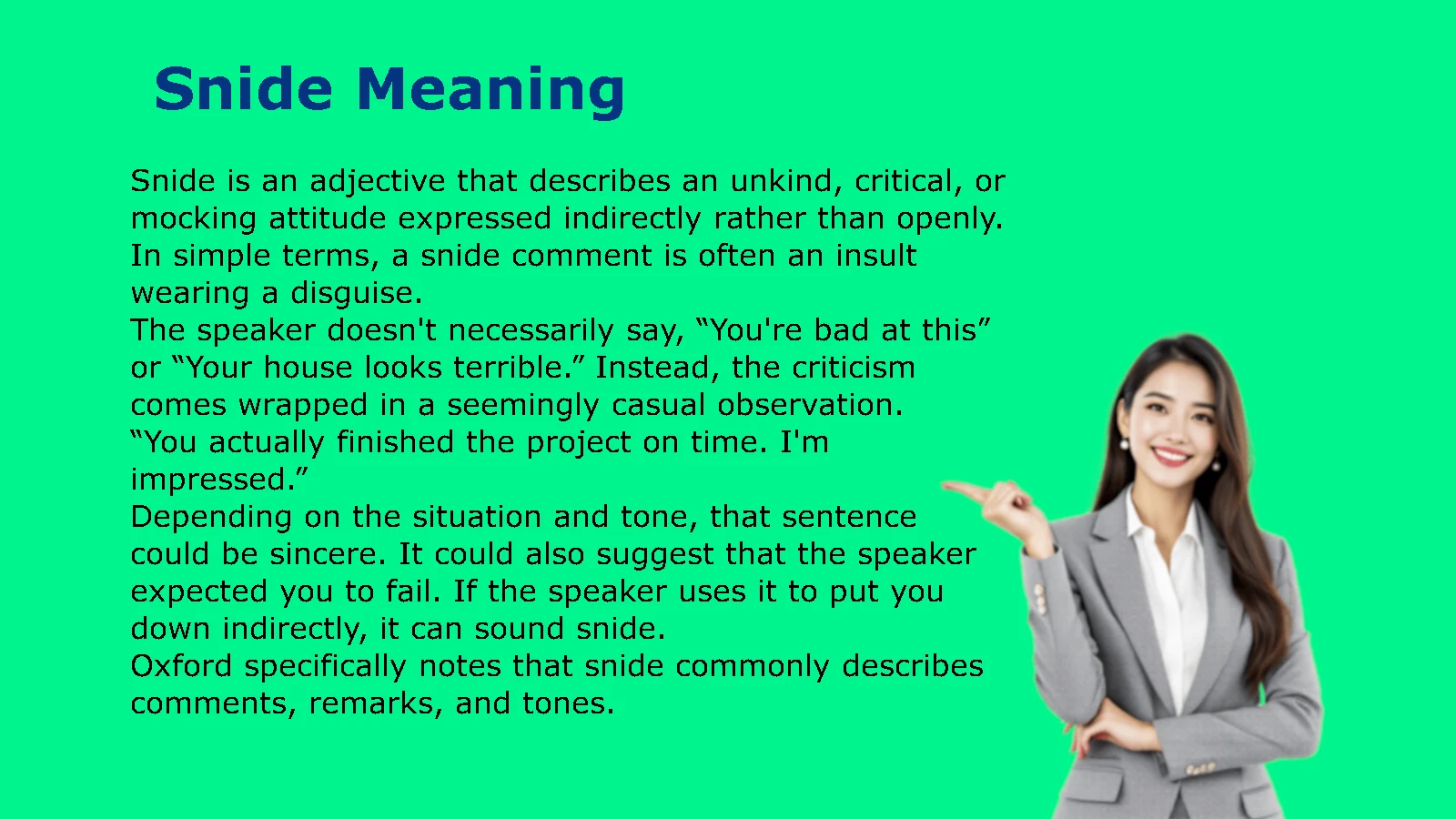
Snide is an adjective that describes an unkind, critical, or mocking attitude expressed indirectly rather than openly.
In simple terms, a snide comment is often an insult wearing a disguise.
The speaker doesn’t necessarily say, “You’re bad at this” or “Your house looks terrible.” Instead, the criticism comes wrapped in a seemingly casual observation.
“You actually finished the project on time. I’m impressed.”
Depending on the situation and tone, that sentence could be sincere. It could also suggest that the speaker expected you to fail. If the speaker uses it to put you down indirectly, it can sound snide.
Oxford specifically notes that snide commonly describes comments, remarks, and tones.
Simple Definition of Snide
A simple definition of snide is:
Indirectly unkind, critical, or insulting, often in a sly or mocking way.
The key word here is indirectly.
A direct insult is easy to identify:
- “You’re terrible at cooking.”
A snide version might sound like:
- “I guess we’re ordering pizza again.”
The second statement doesn’t directly call the person’s cooking terrible. Still, the criticism is easy to understand from the context.
What Does Snide Mean in Everyday English?
In everyday conversation, snide usually suggests that someone is being subtly mean.
The speaker may use:
- A sarcastic tone
- A backhanded compliment
- An unnecessary comparison
- A pointed question
- A dismissive comment
- A subtle insult
- A mocking observation
The comment doesn’t always sound openly hostile. That’s part of what makes it snide.
For example:
Sincere:
“Your presentation was much better this time.”
Snide:
“Your presentation was surprisingly good this time.”
The second sentence can imply that the speaker normally expects poor work.
Snide Pronunciation
Snide is pronounced:
/snaɪd/
It rhymes with:
- Hide
- Ride
- Wide
- Side
- Pride
- Tide
A simple pronunciation guide is “snyde.”
The word is generally used as an adjective.
Word Forms Related to Snide
The most useful related form is snidely, an adverb.
For example:
- “She smiled snidely.”
- “He snidely questioned my decision.”
- “They spoke snidely about his clothes.”
Cambridge lists snidely as an adverb meaning in a rude and critical manner.
Examples of Snide Remarks
The easiest way to understand snide meaning is to see the word in realistic situations.
Here are some examples:
| Snide remark | Hidden implication |
| “You look nice today.” | You usually don’t look nice. |
| “I didn’t expect you to finish that.” | You normally can’t finish things properly. |
| “That’s an interesting outfit.” | Your outfit looks strange or unattractive. |
| “You finally decided to join us.” | You were late or inconsiderate. |
| “Wow, you got promoted quickly.” | You may not deserve the promotion. |
| “I guess money isn’t a problem for you.” | You spend more than you should. |
| “You actually remembered this time.” | You usually forget things. |
| “That’s one way to do it.” | Your method is probably wrong or poor. |
Context matters, though. The same sentence isn’t automatically snide every time someone says it.
Tone, facial expression, relationship, timing, and the surrounding conversation can completely change the meaning.
Example of a Snide Comment About Appearance
Imagine someone arrives at a party wearing a new jacket.
A friend says:
“That’s a bold choice.”
That statement could be genuine admiration. However, if the person rolls their eyes and laughs, the comment may become a subtle criticism.
A more obvious example would be:
“I admire your confidence. I could never wear something like that.”
The speaker technically compliments the person’s confidence while indirectly criticizing the outfit.
That’s a classic backhanded compliment, which can overlap with a snide remark.
Example of a Snide Workplace Comment
Consider this exchange:
Employee: “I finished the report.”
Coworker: “Already? Maybe miracles really do happen.”
The coworker doesn’t directly say that the employee usually works slowly. The implication does the work.
That’s why the remark can sound snide.
What Makes a Comment Snide?
A comment usually sounds snide when several elements come together.
Indirect Criticism
The speaker doesn’t clearly state the criticism.
Instead of:
“Your work isn’t very good.”
They might say:
“Well, at least you finished it.”
The criticism sits underneath the words.
A Negative Implication
A snide remark often leaves the listener to figure out what the speaker really means.
For example:
“You look much better without glasses.”
The sentence may sound complimentary. Yet it can also imply that the person’s glasses make them look unattractive.
A Cutting Tone
Tone can turn an ordinary sentence into a snide one.
A speaker might emphasize certain words, pause dramatically, smirk, or use exaggerated enthusiasm.
Compare:
“You did a great job.”
with:
“You did a great job.”
Depending on context and delivery, the second version could communicate skepticism rather than praise.
A Desire to Undercut Someone
Snide comments often reduce someone’s confidence, status, achievement, or credibility.
The speaker may want to make another person feel:
- Embarrassed
- Inferior
- Inexperienced
- Unsuccessful
- Unattractive
- Unwelcome
That doesn’t mean every snide remark comes from serious hostility. Sometimes people make snide comments as jokes or habitual teasing. Still, the word itself carries a negative sense.
Snide Meaning in Different Contexts
A snide comment can appear almost anywhere people interact.
Snide Comments at Work
Workplaces provide plenty of opportunities for subtle criticism.
For example:
“Nice of you to finally send that email.”
The speaker may be criticizing someone’s delay without directly saying, “You sent the email too late.”
Another example:
“I didn’t realize you were handling that project.”
This could be a harmless question. In the right context, however, it could imply that the speaker doubts the person’s competence or authority.
Common workplace snide remarks include:
- “Interesting approach.”
- “That’s certainly one way to do it.”
- “I thought you knew how to use that system.”
- “You finished before the deadline? Impressive.”
- “I guess you have your own way of doing things.”
Professional settings require extra care because a subtle insult can damage trust even when the speaker never makes an openly hostile statement.
Snide Comments Between Friends
Friends sometimes use snide remarks while teasing each other.
For example:
“You remembered my birthday this year. I’m touched.”
If two close friends regularly joke this way, the comment may simply be playful teasing.
However, repeated remarks can cross a line.
If one friend constantly makes comments about another person’s appearance, intelligence, relationships, or money, calling those comments snide may be appropriate.
The relationship matters.
Snide Comments in Text Messages
Text messages make snide remarks especially tricky because they remove many vocal and visual clues.
Consider:
“Cool.”
That could mean genuine approval. It could also mean annoyance.
Or:
“Good for you.”
Depending on the conversation, it could sound supportive or dismissive.
Texting often forces the reader to infer tone from context. As a result, a message that wasn’t intended to be snide can sometimes come across as snide.
Snide vs. Sarcastic
Snide and sarcastic overlap, but they don’t mean exactly the same thing.
Sarcasm often involves saying something that differs sharply from what the speaker actually means, usually to mock or criticize.
Snide emphasizes indirect, unkind criticism.
| Word | Meaning | Main Focus |
| Snide | Indirectly unkind or critical | Hidden criticism |
| Sarcastic | Using irony to mock or criticize | Saying something contrary or ironic |
| Mocking | Making fun of someone or something | Ridicule |
| Snarky | Sharp, critical, often witty | Cutting commentary |
| Sneering | Showing contempt or scorn | Superior or contemptuous attitude |
A remark can be both snide and sarcastic.
For example:
“Oh, fantastic. Another meeting. Just what everyone wanted.”
That’s clearly sarcastic. If the speaker uses it to subtly criticize a particular person or decision, it could also be described as snide.
However, not every sarcastic remark is snide.
Someone might use sarcasm playfully among close friends without intending to insult anyone.
Snide vs. Snarky
The words snide and snarky often appear in similar conversations.
Snarky usually describes a sharp, cutting, or sarcastic style of commentary. Cambridge defines snark as critical comments made to hurt someone’s feelings.
The distinction is subtle:
- Snide emphasizes indirect and unkind criticism.
- Snarky emphasizes sharp, sarcastic, or cutting commentary.
For example:
“I see you’ve discovered spellcheck.”
That’s a snarky comment because it has a sharp, witty edge.
If someone says:
“Your emails are certainly more readable now.”
while clearly implying that they used to be terrible, the comment may sound snide.
Snide vs. Sincere
The opposite of a snide comment isn’t always simply a “nice comment.” Often, it’s a sincere or straightforward statement.
Compare these examples:
| Sincere | Potentially snide |
| “You look great today.” | “You look great today. What happened?” |
| “I’m glad you finished the project.” | “You actually finished the project.” |
| “That’s an unusual jacket.” | “That’s certainly an unusual jacket.” |
| “You got here early.” | “Look who decided to arrive early.” |
The second column doesn’t automatically contain snide remarks. Context determines the interpretation.
That point matters because snide describes the speaker’s manner and implied criticism, not simply a fixed group of words.
Snide Synonyms
Several words can describe behavior similar to snide, but each carries a slightly different shade of meaning.
Sly
Sly suggests cleverness or secrecy. It doesn’t always imply cruelty.
“He gave her a sly smile.”
Sneering
Sneering suggests contempt or scorn.
“His sneering tone made the conversation uncomfortable.”
Mocking
Mocking means making fun of someone or something.
“The students made mocking comments about his accent.”
Sarcastic
Sarcastic describes language that often uses irony to criticize or mock.
“Her sarcastic response made everyone laugh.”
Derisive
Derisive means expressing ridicule or contempt.
“The proposal received several derisive comments.”
Cutting
Cutting describes words that hurt because they are sharp or deliberately unkind.
“His cutting remark ended the conversation.”
Catty
Catty often describes spiteful remarks, particularly comments about another person’s personal life or appearance.
“The conversation became catty after they started discussing her clothes.”
Scornful
Scornful expresses strong contempt or a sense of superiority.
“She gave him a scornful look.”
Snide Antonyms
Words with meanings opposite to snide include:
- Sincere
- Genuine
- Kind
- Respectful
- Direct
- Straightforward
- Earnest
- Complimentary
- Supportive
- Friendly
Snide as an Adjective
Snide functions primarily as an adjective.
It commonly appears before nouns such as:
- Snide comment
- Snide remark
- Snide tone
- Snide joke
- Snide attitude
- Snide observation
- Snide suggestion
- Snide expression
Oxford specifically identifies snide comment and snide remark as common collocations.
Snide Comment
A snide comment is an indirectly insulting or critical statement.
“She made a snide comment about his new job.”
Snide Remark
A snide remark means essentially the same thing.
“He made a snide remark about the way I dressed.”
Both phrases are extremely common in everyday English.
Snide Tone
A snide tone describes the manner in which someone speaks.
“She used a snide tone when she asked whether I needed help.”
The words themselves might not contain an obvious insult. The speaker’s delivery creates the impression.
Snide in a Sentence
Here are natural examples showing how to use the word:
- “He made a snide remark about my new haircut.”
- “She couldn’t resist making a snide comment.”
- “His snide tone made the conversation uncomfortable.”
- “I ignored her snide remarks and continued working.”
- “The manager disliked the employee’s snide attitude.”
- “That sounded a little snide.”
- “Don’t make snide comments about someone’s appearance.”
- “He answered with a snide smile.”
- “Her response sounded more snide than helpful.”
- “The article included several snide observations about the proposal.”
- “I wasn’t trying to be snide.”
- “He made a snide joke about her mistake.”
- “She spoke snidely about her former colleague.”
These examples show an important pattern: snide usually describes how criticism is expressed, rather than simply saying that someone disagrees.
Common Phrases With Snide
Snide Remark
A snide remark is an indirect insult or criticism.
“He made a snide remark about my decision.”
Snide Comment
A snide comment has essentially the same meaning.
“She made a snide comment about his clothes.”
Snide Tone
A snide tone suggests that someone speaks with subtle mockery or contempt.
“There was a snide tone in his response.”
Snide Joke
A snide joke disguises criticism or mockery as humor.
“The joke sounded snide rather than funny.”
Snide Attitude
A snide attitude describes a person’s general tendency to make subtly insulting or contemptuous remarks.
“His snide attitude made collaboration difficult.”
Is Snide Always an Insult?
Snide usually carries a negative meaning, but context still matters.
A sentence can sound snide without containing an explicit insult.
For example:
“Well, you certainly look comfortable.”
Imagine someone says this while criticizing another person’s casual clothes at a formal event. The words themselves aren’t openly abusive. The context creates the negative implication.
That’s why dictionaries focus on indirect criticism rather than defining snide simply as “insulting.” Oxford describes the word as criticism expressed in an unkind and indirect way, while Cambridge emphasizes criticism that isn’t clearly stated.
Case Study: When a Compliment Becomes Snide
Consider two coworkers discussing a presentation.
Coworker A:
“Your presentation was excellent.”
Coworker B:
“Thanks!”
Now change the sentence:
Coworker A:
“Your presentation was actually excellent.”
That single word, actually, changes the possible implication.
It may suggest that Coworker A expected the presentation to be poor.
Now consider:
Coworker A:
“Wow. Your presentation was actually excellent. I didn’t expect that.”
The speaker has made the hidden criticism much clearer.
What Changed?
The basic subject stayed the same. The difference came from:
- Word choice
- Implied expectations
- Context
- Tone
- Relationship between the speakers
This illustrates why snide meaning depends heavily on context.
How to Recognize a Snide Comment
When you’re unsure whether someone made a snide remark, look beyond the literal words.
Ask yourself:
- Does the statement contain hidden criticism?
- Would the sentence sound different with a different tone?
- Does it imply that someone is inferior, foolish, unsuccessful, or unattractive?
- Does the speaker appear to be disguising an insult as a joke or compliment?
- Does the comment make more sense as criticism than as genuine praise?
- Does the surrounding conversation reveal a negative intention?
If several answers are yes, the remark may reasonably be described as snide.
How to Respond to a Snide Comment
You don’t always need to fight fire with fire.
If someone makes a snide remark, the best response depends on the situation.
Stay Calm
A simple response can prevent the exchange from becoming an argument.
“I’m not sure what you mean by that.”
This puts the speaker in a position where they must explain the implication.
Ask Directly
If the comment crosses a line, be straightforward.
“Are you criticizing my work?”
That question removes the protective layer of indirect language.
Set a Boundary
When someone repeatedly makes snide comments, say:
“I’d appreciate it if you didn’t make comments like that.”
Clear boundaries often work better than trading insults.
Use Humor Carefully
Sometimes a light response can defuse a minor remark:
“I’ll take that as a compliment.”
This works particularly well when the speaker’s comment is obvious but relatively harmless.
Don’t Overreact to Ambiguous Comments
Not every awkward statement deserves confrontation.
Someone might say something that sounds snide without intending it that way. If the intention isn’t clear, asking for clarification can prevent unnecessary conflict.
How to Use Snide Correctly
Use snide when you want to describe criticism that feels indirect, sly, mocking, or subtly insulting.
Natural constructions include:
- a snide comment
- a snide remark
- a snide tone
- a snide joke
- a snide observation
- a snide attitude
- a snide suggestion
- a snide response
For example:
“His snide comment made everyone uncomfortable.”
This sounds natural because snide directly describes the nature of the comment.
Avoid using snide as a general synonym for bad, rude, or angry. A person can be rude without being snide.
For instance:
“Get out of my office.”
That’s rude and direct.
It isn’t necessarily snide because the criticism isn’t hidden.
Snide vs. Direct Insults
The difference becomes clearer when you put the two side by side.
| Direct insult | Snide criticism |
| “Your work is terrible.” | “I guess this is the best you could do.” |
| “Your outfit looks bad.” | “That’s certainly an interesting outfit.” |
| “You’re always late.” | “Nice of you to join us.” |
| “You don’t understand this.” | “Do you need someone to explain it?” |
| “You’re spending too much money.” | “Money must be easy to come by for you.” |
The direct statements openly communicate criticism.
The snide statements make the listener infer the criticism.
That distinction is central to the snide meaning.
Is Snide the Same as Mean?
Not exactly.
Mean is a broad word. It can describe almost any unkind behavior.
Snide is more specific. It describes a particular style of unkindness: indirect criticism or mockery.
Someone can be mean in a direct way:
“I don’t like you.”
Someone can be mean in a snide way:
“I suppose some people are easier to like than others.”
The second statement leaves the insult partly unstated.
Is Snide the Same as Condescending?
They overlap, but they’re not identical.
Condescending behavior treats someone as though they are less intelligent, capable, or important.
Snide behavior uses indirect criticism or mockery.
A person can sound both condescending and snide.
For example:
“Don’t worry. This is probably too complicated for you.”
That’s condescending because it assumes intellectual superiority. It can also sound snide because the insult appears through an indirect statement.
Snide Meaning in Modern Communication
The word remains especially useful in conversations about social media, texting, workplace communication, and online comments.
Online communication makes subtle criticism easier to misunderstand because readers can’t hear tone of voice.
A comment such as:
“Interesting.”
could be genuine curiosity. It could also be a dismissive or snide reaction.
Similarly:
“Good luck with that.”
might be supportive in one conversation and deeply sarcastic in another.
The lesson is simple: words don’t always carry their full meaning without context.
Frequently Asked Questions About Snide
What does snide mean in simple words?
Snide means indirectly unkind or insulting, often in a sly or mocking way.
Is snide positive or negative?
Snide is generally negative. It usually describes criticism, mockery, or an unpleasant attitude.
What is an example of a snide comment?
“You actually look nice today.”
Depending on the context and tone, this can imply that the person normally doesn’t look nice.
Is snide the same as sarcastic?
No. Snide focuses on indirect, unkind criticism, while sarcastic often involves irony or saying something different from what you really mean. A statement can be both snide and sarcastic.
What is another word for snide?
Depending on the context, alternatives include sly, sneering, mocking, sarcastic, derisive, cutting, catty, and scornful.
What is the opposite of snide?
Possible opposites include sincere, genuine, kind, respectful, direct, straightforward, and complimentary.
Can a person be snide?
Yes. You can describe someone as snide when their behavior, remarks, or manner consistently shows indirect criticism or mockery.
For example:
“He can be quite snide when discussing other people’s choices.”
How do you pronounce snide?
Snide is pronounced /snaɪd/ and rhymes with hide, ride, and wide.
What is a snide remark?
A snide remark is an indirectly unkind or critical statement.
“She made a snide remark about his new job.”
What does it mean to say something snidely?
To speak snidely means to speak in a rude, mocking, or critical manner.
“He snidely questioned whether she understood the instructions.”
Key Takeaway
The simplest way to understand snide meaning is to think of an indirect insult.
A snide remark doesn’t always attack someone openly. Instead, it often hides criticism behind a joke, compliment, question, observation, or casual comment. That’s what gives the word its distinctive meaning.
Remember these key points:
- Snide is an adjective.
- It means indirectly unkind or critical.
- It often describes a remark, comment, tone, joke, or attitude.
- Snide remark and snide comment are especially common expressions.
- A snide comment can overlap with sarcasm, snark, mockery, or condescension, but these words aren’t exact synonyms.
- Context and tone matter because the same sentence can be sincere in one situation and snide in another.
- The pronunciation is /snaɪd/.
- Snidely is the related adverb.
When someone says something that sounds friendly on the surface but leaves a little sting behind, snide may be exactly the word you’re looking for.