
Have you ever heard someone make a sharp, mocking comment and wondered if they were joking or being sardonic? While Sardonic Meaning may sound complex, this word describes a type of humor or expression that is often mocking, cynical, or bitterly sarcastic.
Sardonic is an adjective used to describe a remark, smile, tone, or attitude that shows scorn or mockery, often with a dry or cynical sense of humor. It can suggest that someone finds a situation ridiculous rather than genuinely funny.
Examples:
- She gave a sardonic smile when he said everything would be easy.
- His sardonic comment made everyone realize he wasn’t taking the situation seriously.
The confusion is understandable. People often search for what does sardonic mean, sardonic meaning in text, sardonic meaning in chat, or what does sardonic mean in a sentence because the word can be closely related to sarcasm, irony, cynicism, and mockery. And here’s the kicker: a sardonic remark can sound funny on the surface while carrying a sharp or bitter message underneath.
In this guide, you’ll learn the complete Sardonic Meaning, its definition, pronunciation, origin, correct usage, and examples in sentences. You’ll also discover the difference between sardonic, sarcastic, cynical, and ironic, along with simple ways to understand and use sardonic in everyday English.
Sardonic Meaning in Simple Words
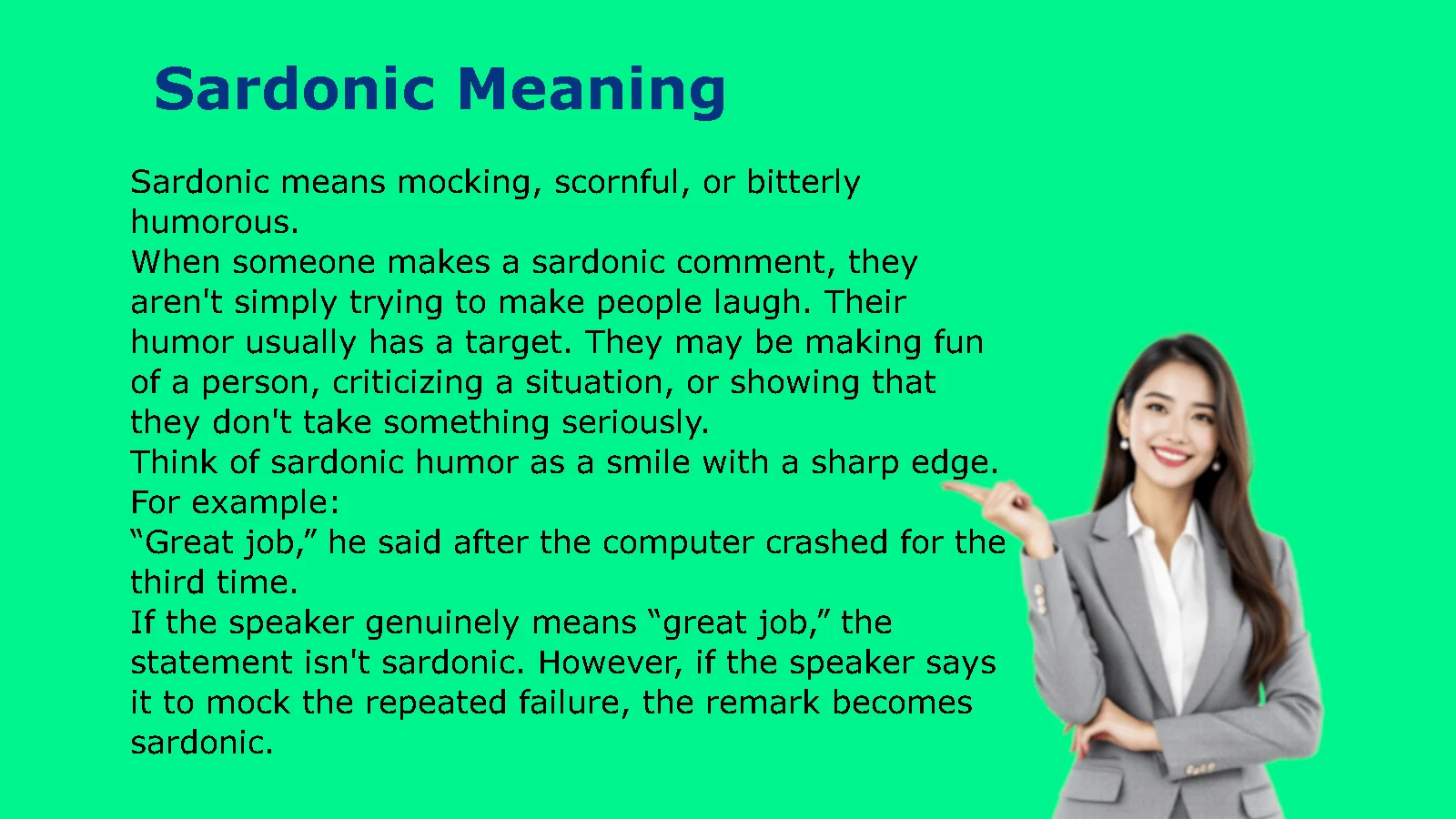
Sardonic means mocking, scornful, or bitterly humorous.
When someone makes a sardonic comment, they aren’t simply trying to make people laugh. Their humor usually has a target. They may be making fun of a person, criticizing a situation, or showing that they don’t take something seriously.
Think of sardonic humor as a smile with a sharp edge.
For example:
“Great job,” he said after the computer crashed for the third time.
If the speaker genuinely means “great job,” the statement isn’t sardonic. However, if the speaker says it to mock the repeated failure, the remark becomes sardonic.
Sardonic definition at a glance
| Word | Sardonic |
| Part of speech | Adjective |
| Basic meaning | Mocking or scornfully humorous |
| Common tone | Dry, bitter, cutting, dismissive |
| Often expresses | Scorn, criticism, disbelief, contempt |
| Common phrases | Sardonic smile, sardonic comment, sardonic humor |
| Adverb | Sardonically |
| Pronunciation | /sɑrˈdɑːnɪk/ in American English |
Oxford describes sardonic as a disapproving word for behavior that suggests someone thinks they are better than others and doesn’t take them seriously.
That disapproving element matters. A person can be funny without being sardonic. The word usually implies something sharper.
What Does Sardonic Mean?
The sardonic meaning becomes clearer when you look at the three ideas that usually come together:
- Humor
- Mockery
- Scorn or criticism
A sardonic remark may make you laugh, but it often leaves a sting behind.
Imagine someone arrives at a meeting 40 minutes late. Another person looks at the clock and says, “Nice of you to join us.”
The sentence sounds polite if you read it literally. In context, however, it mocks the person’s lateness. The speaker isn’t welcoming them warmly. They’re pointing out the problem through dry humor.
That’s what makes the remark sardonic.
Sardonic does not simply mean funny
This distinction prevents one of the most common misunderstandings.
A funny comment can be cheerful, playful, or harmless:
“I need coffee before I attempt anything requiring a brain.”
A sardonic comment usually carries more bite:
“Sure, because ignoring the problem worked so well last time.”
Both statements can produce laughter. Only the second clearly contains mockery or criticism.
Sardonic Pronunciation and Part of Speech
Sardonic is an adjective.
In American English, dictionaries give the pronunciation as approximately:
sar-DON-ik
The stress falls on the second syllable.
The related adverb is sardonically, which means “in a sardonic manner.” Oxford gives sardonically as the adverbial form used when someone acts or speaks in a mocking, dismissive way.
Examples of the word forms
- Adjective: She gave him a sardonic smile.
- Adverb: She smiled sardonically.
- Noun: Sardonicism is much less common in everyday English than sardonic itself.
The adjective is by far the most useful form in ordinary conversation and writing.
Sardonic Examples in Everyday English
The easiest way to understand sardonic meaning is to see the word in context.
Example 1: A workplace mistake
“Excellent planning,” Maya said with a sardonic smile after the team discovered that nobody had booked the conference room.
The comment isn’t genuine praise. Maya uses humor to criticize the team’s failure to plan.
Example 2: Bad weather
“What a beautiful day for a picnic,” he said sardonically as rain poured down.
The speaker means the opposite of the literal statement. The humor comes from the obvious contrast between the words and reality.
Example 3: Repeated excuses
“I’m sure the fifth excuse will finally convince them,” she said with a sardonic laugh.
The speaker doesn’t believe the excuse will work. The remark mocks the repeated attempts.
Example 4: A failed promise
“Well, that went exactly according to plan,” he said with a sardonic expression.
The phrase suggests that things went badly rather than according to plan.
Example 5: An obvious solution
“Brilliant idea,” he replied in a sardonic tone. “Let’s make the problem even bigger.”
Here, the speaker uses apparent praise to express criticism.
Example 6: An unfortunate coincidence
“Of course my phone dies right when I need directions,” she said with a sardonic smile.
The speaker recognizes the absurdity of the situation and responds with dry humor.
What Is Sardonic Humor?
Sardonic humor is humor that expresses mockery, scorn, skepticism, or criticism.
It often sounds dry rather than enthusiastic. The speaker may not laugh at all. Instead, a raised eyebrow, small smile, flat delivery, or carefully chosen phrase can communicate the humor.
Cambridge describes sardonic as an amused attitude that can suggest criticism without stating that criticism directly.
That indirect quality gives sardonic humor much of its power.
How sardonic humor works
A simple pattern looks like this:
Situation → Contradiction or observation → Dry comment → Implied criticism
For example:
Situation: Someone arrives two hours late.
Comment: “Right on time.”
Literal meaning: The person arrived on time.
Actual meaning: The person arrived very late.
Tone: Mocking and critical.
The humor comes from the gap between what the words literally say and what the speaker actually communicates.
Sardonic humor can be subtle
Not every sardonic remark sounds openly hostile.
Consider:
“I’m sure the printer will cooperate this time.”
If the printer has already failed six times, the sentence can express strong skepticism without directly saying, “This printer is terrible.”
That restraint often makes sardonic humor more effective.
Sardonic Smile Meaning
A sardonic smile is a smile that expresses mockery, scorn, disbelief, or amused contempt.
It isn’t the same as a warm smile.
For example:
He gave a sardonic smile when she claimed that the broken vase had nothing to do with her.
The smile suggests that he doesn’t believe her. He may find the explanation amusing or ridiculous.
Oxford specifically lists sardonic smile as a common use of the adjective.
What can a sardonic smile communicate?
Depending on context, it can signal:
- “I don’t believe you.”
- “That’s ridiculous.”
- “You really expect me to believe that?”
- “We both know how this will end.”
- “I’m amused by how badly this turned out.”
- “I’m not taking this seriously.”
Facial expressions matter because sardonic communication often depends on tone and body language as much as vocabulary.
Sardonic Comment Meaning
A sardonic comment is a mocking or scornful remark, usually delivered with dry humor.
For example:
“Another meeting that could have been an email. Wonderful.”
The speaker isn’t celebrating the meeting. The comment criticizes it.
Sardonic comments often appear when someone wants to express frustration without making a direct statement such as:
“This meeting was unnecessary.”
The sardonic version has more personality and bite.
Sardonic Tone Meaning
A sardonic tone describes a way of speaking that sounds dry, mocking, skeptical, or scornful.
Consider these two versions:
Neutral:
“The project didn’t go as planned.”
Sardonic:
“Well, the project certainly gave us some surprises.”
The second statement may sound understated. Yet the context can make its criticism obvious.
A sardonic tone often relies on understatement rather than dramatic language.
Common Phrases With Sardonic
Some combinations appear naturally in English.
| Phrase | Meaning |
| Sardonic smile | A smile showing mockery or scorn |
| Sardonic comment | A dry, mocking remark |
| Sardonic humor | Humor with a bitter or mocking edge |
| Sardonic tone | A mocking or dismissive way of speaking |
| Sardonic laugh | A laugh that conveys irony, scorn, or disbelief |
| Sardonic remark | A pointed, mocking statement |
| Sardonic wit | Clever humor with a sharp or cynical edge |
| Sardonic expression | A facial expression showing dry amusement or contempt |
| Sardonic attitude | A consistently mocking or scornful outlook |
| Sardonic voice | A manner of speaking that sounds dry and mocking |
Oxford’s usage information includes common combinations such as sardonic comment and sardonic smile.
Sardonic vs. Sarcastic
Sardonic and sarcastic overlap, but they aren’t perfect synonyms.
Sarcastic generally describes language that uses sarcasm, often to mock, taunt, or ridicule someone.
Sardonic emphasizes scorn, mockery, or derision expressed through words or facial expressions. Merriam Webster makes this distinction directly in its synonym discussion.
Sardonic vs. sarcastic comparison
| Feature | Sardonic | Sarcastic |
| Main idea | Scornful or mocking humor | Mockery through sarcasm |
| Can involve facial expression? | Yes | Yes |
| Can involve verbal irony? | Often | Often |
| Usually has a sharp edge? | Yes | Often |
| Must involve saying the opposite? | No | Often |
| Typical example | A sardonic smile | A sarcastic remark |
Consider this example:
“Oh, fantastic. Another software update.”
If the speaker means the update is annoying, the remark can be sarcastic.
If the delivery also conveys weary contempt toward the entire situation, it may be sardonic.
In real usage, the two words sometimes overlap. The distinction lies mainly in emphasis.
Sardonic vs. Ironic
Ironic and sardonic also overlap, but they describe different things.
Irony involves a contrast between appearance and reality, expectation and outcome, or literal words and intended meaning.
Sardonic describes a mocking or scornful attitude.
For example:
A fire station catches fire.
That’s an ironic situation because the outcome clashes sharply with expectations.
Now imagine someone sees the news and says:
“Well, that’s reassuring.”
If they say it to mock the situation, the remark is sardonic as well as potentially ironic.
The key difference
Irony describes a contrast.
Sardonic describes an attitude.
Merriam Webster similarly explains that ironic can involve saying the opposite of what is meant, while sardonic specifically implies scorn, mockery, or derision.
Sardonic vs. Cynical
These words frequently appear together, but they don’t mean the same thing.
Cynical describes distrustful or pessimistic beliefs about people’s motives, institutions, or situations.
Sardonic describes the mocking way someone may express an attitude.
For example:
“People only volunteer when there’s publicity involved.”
That’s a cynical belief about people’s motives.
Now imagine the person says:
“Nothing says selflessness like a camera crew.”
That’s sardonic because the speaker uses mocking humor to express the criticism.
Quick distinction
- Cynical: “I don’t trust their motives.”
- Sardonic: “I’ll make a dry joke about their motives.”
- Sarcastic: “I’ll mock them through sarcasm.”
A person can be cynical and sardonic at the same time. One describes the outlook; the other describes the manner of expression.
Sardonic vs. Satirical
Satirical and sardonic both involve criticism, but their purposes can differ.
Satire commonly uses humor, exaggeration, irony, or ridicule to expose flaws in people, organizations, social habits, or institutions.
Sardonic language doesn’t need a broader social target. Someone can make a sardonic remark about a single awkward moment.
For example:
“Excellent. The company has solved the problem by creating two new problems.”
That could be sardonic.
A longer work that repeatedly mocks corporate bureaucracy to expose its absurdity could be satirical.
Merriam Webster explains that satiric emphasizes ridicule intended as criticism or condemnation, whereas sardonic emphasizes scorn and mockery expressed verbally or through facial expression.
Sardonic vs. Wry
Wry is another close relative.
Wry humor is often dry, restrained, or subtly ironic. It doesn’t necessarily contain the same degree of contempt as sardonic humor.
Compare:
“Well, that could have gone better.”
This sounds wry if the speaker is calmly acknowledging failure.
Now consider:
“Brilliant. We somehow managed to make it worse.”
That sounds more sardonic because the remark carries stronger mockery.
The line between wry and sardonic can be thin. Context determines which word fits better.
Sardonic Synonyms
Several words can replace sardonic in certain contexts. However, they don’t all carry exactly the same shade of meaning.
Common synonyms for sardonic
- Sarcastic
- Mocking
- Scornful
- Derisive
- Caustic
- Biting
- Cutting
- Barbed
- Acerbic
- Wry
- Cynical
- Satirical
- Scathing
- Ironic
- Snarky
Merriam Webster’s thesaurus lists sarcastic, satiric, barbed, and acidic among its closest synonyms and includes many other related terms.
Sardonic synonym comparison
| Synonym | What it emphasizes |
| Sarcastic | Mockery through sarcasm |
| Mocking | Making fun of someone or something |
| Scornful | Contempt or lack of respect |
| Derisive | Ridicule and contempt |
| Caustic | Extremely sharp or biting criticism |
| Biting | Humor or criticism that stings |
| Wry | Dry, restrained humor |
| Cynical | Distrustful or pessimistic outlook |
| Satirical | Ridicule used to expose flaws |
| Snarky | Sharp, often sarcastic criticism |
The best synonym depends on what you want to emphasize.
If the person looks down on someone, scornful may fit better. If the person uses dry humor to criticize a situation, sardonic may be more precise.
Antonyms of Sardonic
The opposite of sardonic depends on the specific quality you’re contrasting.
Useful antonyms include:
- Sincere
- Respectful
- Kind
- Warm
- Earnest
- Good-natured
- Friendly
- Gracious
- Complimentary
- Approving
- Gentle
For example:
He gave her a sardonic smile.
The opposite might be:
He gave her a warm, sincere smile.
Likewise:
She made a sardonic comment about his mistake.
A more positive alternative would be:
She offered an encouraging comment about his mistake.
How to Use Sardonic Correctly
Because sardonic is an adjective, it normally describes a noun.
Correct examples
- He gave me a sardonic smile.
- Her sardonic humor made everyone laugh.
- His sardonic comment ended the conversation.
- She spoke in a sardonic tone.
- The writer has a sardonic view of modern politics.
- He looked at the proposal sardonically.
Common mistake
Don’t automatically use sardonic to mean funny.
This sentence doesn’t necessarily work:
“The comedian told a sardonic joke about pizza.”
The joke could be sardonic, but simply calling it funny or humorous doesn’t tell the reader whether it contains mockery or scorn.
A clearer example would be:
“The comedian made a sardonic joke about how expensive pizza had become.”
Now the reader can see the critical edge.
How to Tell Whether Something Is Sardonic
When you’re unsure whether sardonic fits, ask a few simple questions.
Does the comment contain mockery?
If someone uses humor to make fun of another person or situation, sardonic may fit.
Does it contain scorn?
Sardonic language often communicates that the speaker considers something foolish, absurd, disappointing, or unworthy of respect.
Is the humor dry or restrained?
Sardonic remarks often sound calm rather than wildly enthusiastic.
Is there an implied criticism?
A sardonic comment frequently says one thing while communicating a sharper judgment underneath.
Does the context change the meaning?
Absolutely.
Take:
“Fantastic.”
That word alone tells you almost nothing.
If someone wins a prize, it may express genuine excitement.
If someone’s laptop crashes immediately before a presentation, “Fantastic” may become sarcastic or sardonic.
Context is the key that unlocks the tone.
A Practical Case Study: Understanding a Sardonic Remark
Imagine a team has spent three weeks preparing a presentation. Five minutes before the meeting, someone discovers that the final file doesn’t work.
The manager looks at the screen and says:
“Well, this is exactly the level of preparedness I was hoping for.”
At first glance, the statement sounds complimentary. It isn’t.
The manager uses apparent praise to criticize the team’s lack of preparation.
What makes it sardonic?
| Element | What happens |
| Situation | The presentation file fails |
| Literal statement | The manager claims the preparation is excellent |
| Actual meaning | The preparation is clearly poor |
| Tone | Dry and mocking |
| Purpose | Criticism through humor |
| Result | The criticism feels sharper than a simple complaint |
This example demonstrates why tone, context, and intent matter when interpreting sardonic language.
Sardonic Meaning in Literature and Writing
Writers often use sardonic language to establish a character’s personality.
A sardonic character may appear intelligent, skeptical, detached, bitter, or amused by the absurdity around them. Instead of openly saying what they think, they may rely on dry observations.
For example:
The town celebrated its new traffic plan by immediately getting stuck in traffic.
A writer could describe this as a sardonic observation because the sentence highlights the absurdity of the situation with a mocking edge.
Sardonic writing can also create emotional distance. A character facing a difficult situation may use humor as a shield rather than openly expressing fear, disappointment, or anger.
That makes the tone especially useful in fiction, essays, commentary, and cultural criticism.
Sardonic Meaning in Everyday Conversation
People often use sardonic humor when reality doesn’t match expectations.
Common situations include:
- A long wait at a restaurant
- A computer crashing before a deadline
- Someone making the same mistake repeatedly
- A plan failing almost immediately
- A person making an obviously false excuse
- An organization creating unnecessary rules
- Someone arriving extremely late
- A machine malfunctioning at the worst possible moment
For example:
“Nothing like a reliable internet connection,” she said after the Wi-Fi disappeared.
The speaker isn’t praising the internet. The remark mocks its unreliability.
When sardonic humor works well
Sardonic humor can work particularly well among people who understand each other’s sense of humor. Friends may use it to joke about shared frustrations.
However, the same remark can sound rude in a workplace or unfamiliar social setting.
That’s because sardonic humor often depends on shared context.
Sardonic Humor vs. Insults
A sardonic remark isn’t automatically an insult.
An insult directly attacks someone.
A sardonic remark may criticize a situation through humor.
Compare:
“You’re incompetent.”
That’s a direct insult.
“I’m impressed by how consistently we find new ways to complicate simple tasks.”
That’s a sardonic criticism.
The second statement still has a sting, but it uses humor and indirect language.
This distinction matters because sardonic language can be critical without being openly abusive.
The Origin and Etymology of Sardonic
The history of sardonic reaches back centuries.
Oxford traces the word through French and Latin to Greek. It connects the history with the Greek term sardonios, which described bitter or scornful laughter.
Merriam Webster records the first known use of “sardonic” in 1638. Its etymology also traces the word through earlier forms connected to Greek terms describing bitter or scornful laughter.
The deeper origin isn’t completely straightforward. Historical explanations connect the Greek terminology with Sardinia and an ancient plant, but the exact etymological development remains uncertain. Etymology sources note that the history has been debated since antiquity.
So one fact remains especially useful for modern readers: the word has long been associated with bitter or scornful laughter.
That historical meaning fits its modern use remarkably well.
Sardonic Meaning vs. Sarcasm: A Quick Test
When two words seem interchangeable, try this simple test.
Ask:
Is the focus on sarcasm itself, or on scornful attitude and mockery?
If the emphasis is on saying something that means the opposite of the literal words, sarcastic may be the better choice.
If the emphasis is on a dry, contemptuous, mocking attitude, sardonic may be more precise.
Of course, a single remark can be both.
Example
“I’m sure your brilliant plan will work perfectly.”
This can be sarcastic because “brilliant” contradicts the speaker’s actual opinion.
If the speaker delivers it with a cold smile and obvious contempt, the remark can also be sardonic.
Sardonic Meaning Compared With Related Words
Here’s a quick reference for the most important distinctions:
| Word | Main idea | Example |
| Sardonic | Mocking, scornful humor | “A sardonic smile” |
| Sarcastic | Mockery through sarcasm | “A sarcastic comment” |
| Ironic | Contrast between meaning, expectation, or reality | “An ironic situation” |
| Cynical | Distrustful view of motives | “A cynical attitude” |
| Satirical | Ridicule used to expose flaws | “A satirical article” |
| Wry | Dry, understated humor | “A wry observation” |
| Caustic | Extremely sharp criticism | “A caustic response” |
| Derisive | Expressing ridicule or contempt | “A derisive laugh” |
| Snarky | Sharp, mocking, often sarcastic | “A snarky reply” |
These words can overlap. English rarely builds neat little fences around related concepts. Still, the table gives you a useful starting point.
Examples of Sardonic Sentences
Here are additional examples showing how naturally the word can appear in different contexts.
About work
“Another urgent task at 4:59 p.m. How thoughtful,” she said with a sardonic smile.
About technology
He gave the frozen computer a sardonic look.
About politics
The columnist took a sardonic view of the campaign promises.
About a failed plan
“Well, that worked beautifully,” he said sardonically.
About an excuse
She gave him a sardonic glance when he blamed the missing report on the weather.
About bad luck
“Of course it started raining after we finished setting up,” he said with sardonic amusement.
About a friend
“You remembered my birthday only three weeks late. I’m touched,” she said with a sardonic grin.
About an absurd situation
The novel takes a sardonic look at modern office culture.
Each example contains more than humor. The speaker or writer also communicates judgment, disbelief, mockery, or criticism.
Can Sardonic Be Positive?
Usually, sardonic has a negative or disapproving tone, but that doesn’t mean every sardonic remark is cruel.
Friends can use sardonic humor affectionately. A person might tease a close friend with a mock complaint that both people understand as playful.
For example:
“Thanks for arriving only twenty minutes late. Your punctuality continues to inspire me.”
Between close friends, this could be playful rather than genuinely hostile.
The word still describes the style of humor. The relationship determines how harsh the remark feels.
This is why tone and context matter so much.
What Does “Sardonically” Mean?
Sardonically is the adverbial form of sardonic.
It means in a mocking, scornful, or dryly humorous manner.
For example:
He smiled sardonically when his rival claimed that the mistake wasn’t his fault.
Here, sardonically explains how he smiled.
Another example:
“I’m sure that will solve everything,” she said sardonically.
The adverb tells the reader that she doesn’t genuinely believe the statement.
Common Mistakes With Sardonic
Using sardonic as a synonym for funny
Not every funny thing is sardonic.
Funny: Something that causes amusement.
Sardonic: Something that uses humor with mockery, scorn, or criticism.
Confusing sardonic with cynical
A cynical person may distrust people’s motives. A sardonic person may express criticism through dry humor.
Assuming every sarcastic statement is sardonic
Sarcasm and sardonic humor overlap, but sardonic emphasizes scorn and mocking attitude.
Ignoring tone
The sentence:
“Wonderful.”
could express excitement, sarcasm, or sardonic amusement depending on the situation.
Written language sometimes needs surrounding context to reveal that difference.
Why Sardonic Language Can Be Effective
Sardonic humor can communicate an opinion without stating it bluntly.
Compare:
“This plan is ridiculous.”
with:
“I’m sure this plan will go down in history as a masterpiece.”
The first statement delivers criticism directly.
The second lets the reader infer the criticism.
That indirect approach can make writing more memorable. It also gives the audience something to interpret.
In journalism, essays, fiction, reviews, and everyday conversation, sardonic language can add personality and bite without requiring a long explanation.
Frequently Asked Questions About Sardonic Meaning
What does sardonic mean in simple terms?
Sardonic means mocking or scornfully humorous. It describes words, expressions, or attitudes that often combine dry humor with criticism, disbelief, or contempt.
Is sardonic positive or negative?
Sardonic usually has a negative or disapproving tone because it involves mockery, scorn, or lack of respect. However, friends can sometimes use sardonic humor playfully without intending serious harm.
Is sardonic the same as sarcastic?
Not exactly. Sarcastic usually refers to sarcasm used to mock or ridicule. Sardonic emphasizes a scornful, mocking, or bitterly humorous attitude. The two words often overlap.
What is an example of a sardonic comment?
“Excellent timing,” she said after he arrived an hour late.
The speaker isn’t genuinely praising his timing. She uses dry humor to criticize his lateness.
What does a sardonic smile mean?
A sardonic smile suggests amusement mixed with mockery, disbelief, scorn, or contempt. It often communicates more than a straightforward smile.
What is sardonic humor?
Sardonic humor uses dry or bitter humor to express mockery, criticism, skepticism, or scorn.
Can a person be sardonic?
Yes. You can describe someone’s personality, manner, voice, humor, or attitude as sardonic.
For example:
“He has a sardonic sense of humor.”
What is the opposite of sardonic?
Depending on the context, opposites include sincere, warm, respectful, kind, earnest, friendly, good-natured, and gracious.
What is a synonym for sardonic?
Common synonyms include sarcastic, mocking, scornful, derisive, biting, caustic, barbed, acerbic, wry, and cynical. They aren’t exact substitutes in every sentence.
How do you pronounce sardonic?
In American English, sardonic is pronounced approximately sar-DON-ik, with the main stress on the second syllable. Cambridge gives the American pronunciation as /sɑrˈdɑː.nɪk/.
What does sardonically mean?
Sardonically means doing or saying something in a mocking, scornful, or dryly humorous way.
What does sardonic wit mean?
Sardonic wit refers to clever humor that carries a sharp, mocking, or scornful edge. It often relies on quick observations and understated criticism.
Is sardonic humor always cruel?
No. Sardonic humor can sound harsh, but context matters. Friends may use it playfully, while the same words could sound insulting in a professional or unfamiliar setting.
Final Takeaway on Sardonic Meaning
The simplest way to remember the sardonic meaning is this:
Sardonic describes humor, language, expressions, or attitudes that mock something while showing scorn, skepticism, or criticism.
A sardonic person doesn’t simply make jokes. Their humor often has a point.
The word also becomes easier to distinguish from related terms once you focus on its central quality:
- Sarcastic emphasizes sarcasm.
- Ironic emphasizes contrast.
- Cynical emphasizes distrust.
- Satirical emphasizes criticism through ridicule.
- Wry emphasizes dry, restrained humor.
- Sardonic emphasizes mockery, scorn, and dry humor.
So when someone smiles at an obvious failure and says, “Well, that couldn’t have gone better,” don’t take the words at face value. The speaker may be doing something much more specific.
They’re being sardonic.