
Have you ever spoken to someone who sounded short, abrupt, or a little too direct and wondered how to describe their behavior? That is where Brusque Meaning comes in. The word brusque describes a way of speaking or behaving that is brief, blunt, and sometimes unfriendly, especially when someone responds without showing much warmth or politeness.
Brusque is an adjective used to describe a person’s tone, manner, response, or behavior. It often suggests that someone gets straight to the point in a way that may seem rude, cold, or impatient.
Examples:
- His brusque response made the conversation uncomfortable.
- She gave me a brusque reply and walked away.
The confusion is understandable. People often search for what does brusque mean, brusque meaning in a sentence, brusque meaning in text, or brusque meaning in conversation because the word can describe simple directness or a noticeably unfriendly tone, depending on the context. And here’s the kicker: being brusque does not always mean someone is intentionally rude. A person may simply speak in a very short and direct manner.
In this guide, you’ll learn the complete Brusque Meaning, its definition, pronunciation, correct usage, synonyms, antonyms, and examples in sentences. You’ll also discover what brusque means when describing a person, tone, or response and how it differs from words such as blunt, curt, abrupt, and rude.
What Does Brusque Mean?
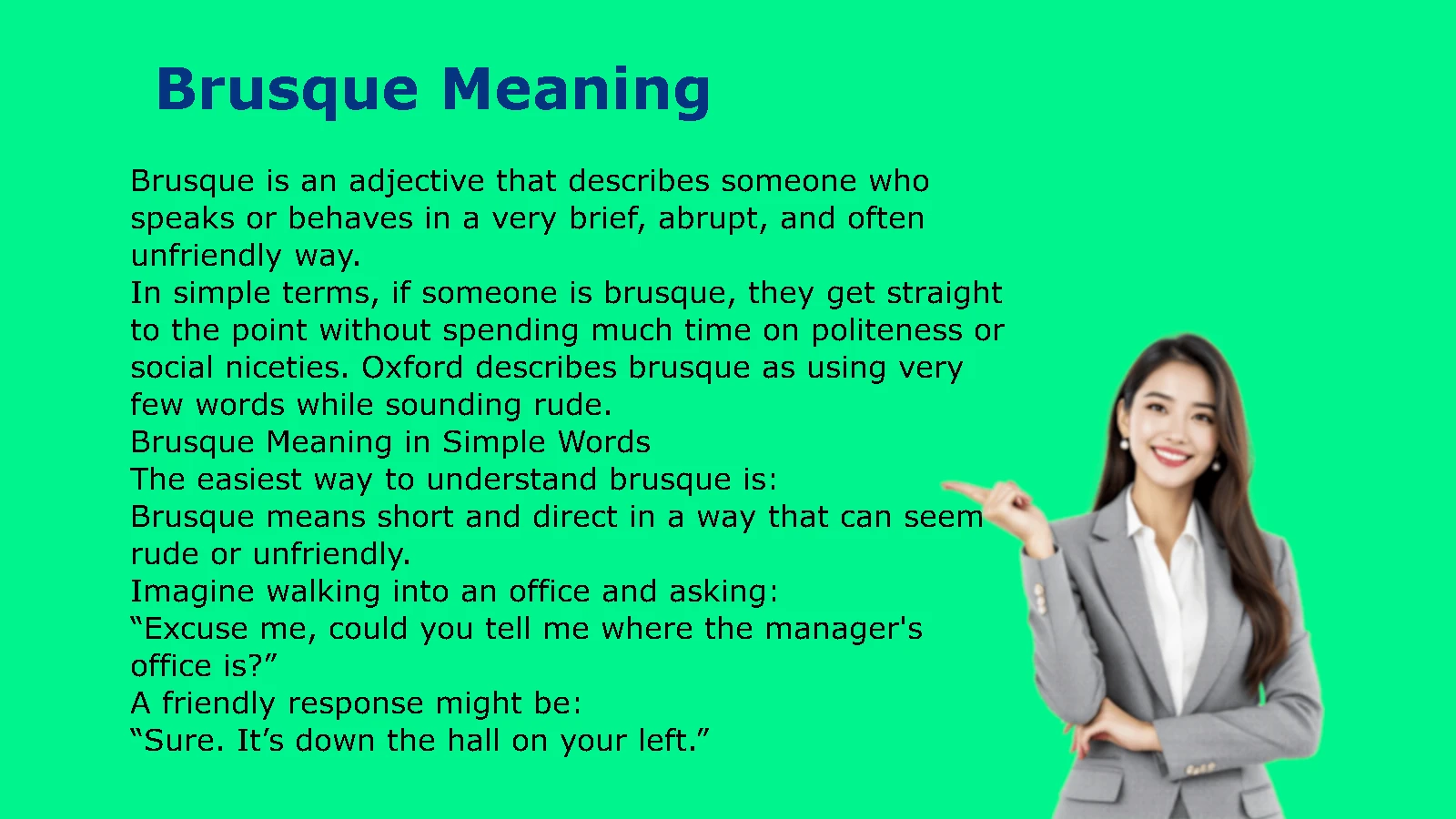
Brusque is an adjective that describes someone who speaks or behaves in a very brief, abrupt, and often unfriendly way.
In simple terms, if someone is brusque, they get straight to the point without spending much time on politeness or social niceties. Oxford describes brusque as using very few words while sounding rude.
Brusque Meaning in Simple Words
The easiest way to understand brusque is:
Brusque means short and direct in a way that can seem rude or unfriendly.
Imagine walking into an office and asking:
“Excuse me, could you tell me where the manager’s office is?”
A friendly response might be:
“Sure. It’s down the hall on your left.”
A brusque response could be:
“Down the hall.”
The second answer contains useful information, but the speaker gives it with almost no warmth. That’s what makes the response brusque rather than simply concise.
What Does Brusque Imply?
The word usually combines three ideas:
- Shortness: The person uses few words.
- Directness: The person gets to the point quickly.
- Unfriendliness: The delivery can sound rude, cold, or dismissive.
Not every short answer is brusque. Context matters.
If someone says, “Yes, absolutely!” after you ask a simple question, the response is short but friendly. If they simply say, “Yes,” while sounding impatient, the same brevity may come across as brusque.
Brusque Definition
Here is a quick reference for the word:
| Feature | Details |
| Word | Brusque |
| Part of speech | Adjective |
| Core meaning | Brief, abrupt, and often unfriendly |
| US pronunciation | /brʌsk/ |
| UK pronunciation | /bruːsk/ |
| Common synonyms | Curt, abrupt, blunt, short, gruff |
| Common antonyms | Polite, warm, friendly, courteous |
| Related forms | Brusquely, brusqueness |
| Typical uses | Manner, tone, reply, response, behavior, speech |
Merriam-Webster gives two closely related senses: “markedly short and abrupt” and being blunt in manner or speech to the point of ungracious harshness.
That distinction explains why the word can describe both a reply and a person’s manner.
How to Pronounce Brusque
In American English, brusque is pronounced:
/brʌsk/
An easy way to say it is:
brusk
In British English, the pronunciation is commonly:
/bruːsk/
Cambridge lists /brʌsk/ for US English and /bruːsk/ for UK English.
The spelling can look intimidating because of the final -que, but the word has only one syllable.
Is Brusque Pronounced Like “Brusk”?
Yes. In American English, brusque sounds like brusk.
The spelling contains -sque, but you don’t pronounce it as “brus-kway” or “brus-kee.” The final sound is simply /sk/.
Merriam-Webster also lists brusk as a less common spelling variant of brusque.
Brusque Part of Speech
Brusque functions as an adjective.
You use it to describe a person, manner, tone, reply, response, or similar form of communication.
Examples of Brusque as an Adjective
- She gave me a brusque reply.
- His brusque manner surprised the new employees.
- The receptionist sounded brusque on the phone.
- Her brusque tone ended the conversation quickly.
- The manager was brusque with customers.
- He gave a brusque refusal when they asked for help.
The word usually appears before a noun or after a linking verb.
Related Forms of Brusque
The two most useful related forms are brusquely and brusqueness.
Brusquely is an adverb. It describes an action performed in a brusque way.
“What do you want?” he asked brusquely.
Oxford defines brusquely as using very few words while sounding rude.
Brusqueness is a noun. It refers to the quality or behavior of being brusque.
Her brusqueness made the conversation uncomfortable.
Oxford defines brusqueness as the act or quality of using very few words while sounding rude.
| Word | Part of speech | Example |
| Brusque | Adjective | His brusque tone surprised me. |
| Brusquely | Adverb | She answered brusquely. |
| Brusqueness | Noun | His brusqueness offended the visitor. |
Brusque Examples in Sentences
The best way to understand brusque meaning is to see how the word works in different situations.
Everyday Conversation
“Are you coming with us?”
“No.”
If the speaker delivers that answer sharply and without any warmth, the response may sound brusque.
A warmer version would be:
“No, I don’t think I can make it tonight. Sorry.”
The information hasn’t changed. The manner has.
At Work
“Could you review this report before lunch?”
“No time.”
That response is brief and direct. Depending on the speaker’s tone and circumstances, it could sound brusque.
A more considerate version would be:
“I’m tied up this morning. Could I review it this afternoon?”
In Customer Service
“Could you help me find this product?”
“Aisle five.”
The employee technically answers the question. However, the lack of courtesy can make the interaction feel brusque.
In an Email
“Send the file again.”
That sentence may sound brusque because it gives an instruction without context or courtesy.
A softer version would be:
“Could you please send the file again? I wasn’t able to open the attachment.”
Written communication makes this distinction especially important because the reader can’t hear your voice or see your facial expression.
During an Argument
“Can we talk about what happened?”
“There’s nothing to discuss.”
That response can sound brusque because it shuts down the conversation immediately.
In a Medical Setting
A doctor might give a medically necessary answer in a concise way. If the delivery sounds cold or impatient, someone could describe the doctor’s manner as brusque.
This doesn’t necessarily mean the doctor intends to be rude. A busy environment, stress, or time pressure can influence how someone communicates.
Common Collocations With Brusque
Certain nouns naturally appear with brusque. Learning these combinations can help you use the word more naturally.
| Phrase | Meaning | Example |
| Brusque reply | A short, unfriendly answer | He gave a brusque reply. |
| Brusque response | An abrupt answer | Her brusque response ended the discussion. |
| Brusque manner | An abrupt or unfriendly way of behaving | His brusque manner put people off. |
| Brusque tone | A sharp, unfriendly way of speaking | She used a brusque tone. |
| Brusque attitude | An abrupt or dismissive attitude | His brusque attitude annoyed his coworkers. |
| Brusque refusal | A short, often unfriendly rejection | We received a brusque refusal. |
| Brusque question | A direct question that may sound rude | He asked a brusque question. |
| Brusque behavior | Abrupt or unfriendly conduct | Her brusque behavior surprised everyone. |
| Brusque speech | Speech that sounds short and blunt | His brusque speech made the room quiet. |
| Brusque greeting | A very short, unfriendly greeting | He offered only a brusque greeting. |
Oxford specifically identifies manner as a common noun used with brusque.
Brusque vs. Direct
These words overlap, but they aren’t interchangeable.
Direct usually describes communication that is clear and straightforward. It doesn’t automatically suggest bad manners.
Brusque, on the other hand, adds a negative judgment about the manner of communication.
Consider these examples:
“Please send the report by Friday.”
That’s direct.
Now compare:
“Send the report by Friday.”
That might be perfectly acceptable in some professional settings. However, depending on the relationship and tone, it can sound brusque.
The key difference is attitude and delivery.
| Direct | Brusque |
| Clear and straightforward | Short and abrupt |
| Doesn’t necessarily sound rude | Often sounds rude or unfriendly |
| Can be polite | Often lacks social warmth |
| Focuses on the message | Focuses partly on the manner |
| Can save time | Can make others feel dismissed |
A person can be direct without being brusque. That’s an important distinction.
Brusque vs. Curt
Curt is one of the closest synonyms for brusque.
Both words describe communication that uses very few words and may sound rude.
For example:
“I don’t know.”
could be a curt reply.
It could also be a brusque reply.
The difference is subtle. Curt places especially strong emphasis on the shortness or conciseness of the response. Brusque emphasizes the abrupt or ungracious manner.
Cambridge lists curt and short among the synonyms associated with brusque.
Brusque vs. Blunt
Blunt means direct and unwilling to soften what someone says.
For example:
“Your proposal isn’t realistic.”
That’s blunt.
It may also be brusque if the speaker delivers it abruptly and without courtesy.
The distinction looks like this:
- Blunt: Direct, sometimes painfully honest.
- Brusque: Abrupt and often unfriendly.
- Both: Can make communication uncomfortable.
A blunt person might spend ten minutes explaining an uncomfortable truth. A brusque person might communicate the same message in ten seconds and leave.
Merriam-Webster notes that blunt emphasizes direct expression without much regard for other people’s feelings, while brusque emphasizes sharpness or lack of graciousness.
Brusque vs. Abrupt
Abrupt can describe both actions and communication.
For example:
- an abrupt ending
- an abrupt change
- an abrupt departure
- an abrupt response
Oxford gives abrupt a broader meaning that includes something sudden or unexpected. It also uses the word for speech or behavior that seems rude and unfriendly.
Brusque focuses more specifically on a person’s manner or communication.
Compare:
“The meeting came to an abrupt end.”
Here, abrupt means sudden.
But:
“The manager gave an abrupt answer.”
Here, abrupt describes communication.
You could also say:
“The manager gave a brusque answer.”
That version places greater emphasis on the unfriendly quality of the response.
Brusque vs. Rude
Rude is broader and stronger in some contexts.
A person can be rude by:
- insulting someone
- interrupting
- ignoring someone
- using offensive language
- behaving disrespectfully
- speaking in a brusque way
So brusque behavior can be rude, but not every rude action is brusque.
For example, deliberately insulting someone’s appearance is rude. It isn’t necessarily brusque.
By contrast, saying:
“Move.”
instead of:
“Excuse me, could I get through?”
could be both brusque and rude.
Brusque vs. Brisk
Don’t confuse brusque with brisk.
They look and sound somewhat similar, and their histories are connected, but their modern meanings differ.
Brisk can describe something quick, energetic, or efficient. It can even have a positive sense.
For example:
“We took a brisk walk.”
Here, brisk means quick and energetic.
It can also describe a practical, confident manner:
“She gave the team a brisk update.”
That doesn’t necessarily mean she was rude.
Brusque, however, carries the idea of abruptness that can feel unfriendly or impolite. Merriam-Webster specifically discusses the overlap between brisk and brusque while distinguishing their modern uses.
| Word | Main idea | Usually negative? |
| Brisk | Quick, energetic, efficient | No |
| Brusque | Abrupt, short, often unfriendly | Yes |
| Curt | Very brief and potentially rude | Usually |
| Blunt | Direct without softening | Often |
| Rude | Lacking politeness or respect | Yes |
Synonyms for Brusque
The best synonym depends on exactly what you want to emphasize.
Closest Synonyms
- Curt
- Abrupt
- Blunt
- Short
- Gruff
- Rude
- Unceremonious
What Each Synonym Emphasizes
Curt emphasizes a very short response.
Abrupt emphasizes suddenness or a lack of smoothness.
Blunt emphasizes directness without softening.
Gruff often describes a rough, stern, or unfriendly manner.
Rude emphasizes a lack of politeness.
Short can describe a brief or impatient manner.
Unceremonious suggests a lack of politeness, formality, or the expected social courtesy.
Merriam-Webster groups words such as abrupt, blunt, gruff, curt, short, and rude among the synonyms of brusque.
Antonyms of Brusque
The opposite of brusque communication usually involves warmth, patience, politeness, and consideration.
Useful antonyms include:
- Polite
- Courteous
- Friendly
- Warm
- Gentle
- Patient
- Considerate
- Gracious
- Tactful
- Respectful
Compare:
Brusque: “What?”
Courteous: “Yes, how can I help?”
The difference is only a few words, but the second response creates a completely different impression.
Is Brusque Always Negative?
Generally, brusque has a negative or disapproving sense because it suggests that someone communicates in a way that seems rude, cold, or unfriendly. Cambridge and Oxford both connect the word with rude or unfriendly speech and manner.
However, calling someone brusque doesn’t necessarily mean that person has bad intentions.
That’s an important nuance.
Someone might be brusque because they’re:
- under pressure
- extremely busy
- tired
- distracted
- naturally reserved
- uncomfortable in social situations
- focused on completing a task
- communicating in a culture or setting where brevity is valued
For example, imagine a shy employee who answers questions with very few words. Coworkers might perceive that person as brusque even though the employee isn’t trying to offend anyone.
Merriam-Webster gives a similar example in which a person’s brusque manner could be mistaken for unfriendliness even though another factor explains the behavior.
The word therefore describes how the behavior comes across, not necessarily the person’s private intention.
Why Can Short Messages Sound Brusque?
Digital communication creates a special problem: readers can’t hear your voice.
Consider this text:
“Send it.”
It could mean:
“Whenever you get a chance, please send it over.”
But without additional context, the first version can feel demanding.
Now consider:
“Could you send it when you get a chance?”
The request remains simple, yet the second version sounds more cooperative.
Words That Can Soften a Brusque Message
Small additions often change the tone:
- Please
- Thanks
- Could you…
- Would you mind…
- When you have a chance…
- I appreciate it
- Sorry to bother you…
That doesn’t mean every message needs extra padding. Overexplaining can waste time. The goal is to be clear without sounding dismissive.
Brusque Communication in the Workplace
Workplaces often reward efficiency. That’s useful, but efficiency can sometimes drift into brusqueness.
Imagine a manager who says:
“Fix this.”
The manager may simply want the problem corrected quickly.
However, an employee could interpret the statement as disrespectful.
A more constructive version might be:
“Could you fix this section before the next review?”
The second version remains direct. It simply gives the request a more cooperative frame.
Case Study: The Two Managers
Consider two managers giving identical instructions.
Manager A:
“Get this done today.”
Manager B:
“Please get this done today. Let me know if anything is blocking you.”
Both communicate urgency.
Manager A may sound brusque because the statement offers no context or invitation for discussion.
Manager B sounds firm but supportive.
The lesson isn’t that every workplace message needs to become long and overly polite. Instead, effective communication balances clarity, urgency, and respect.
How to Use Brusque Correctly
The word commonly describes a person’s manner, tone, speech, reply, or response.
Natural constructions include:
- a brusque reply
- a brusque response
- a brusque tone
- a brusque manner
- a brusque attitude
- a brusque refusal
- a brusque question
- be brusque with someone
- sound brusque
- speak brusquely
Correct Examples
“She gave him a brusque reply.”
“His brusque manner made the interview uncomfortable.”
“The receptionist sounded brusque on the phone.”
“He was brusque with the customer.”
“She answered brusquely and returned to her work.”
A Common Meaning Mistake
Don’t use brusque simply to mean fast.
For example:
“He drove at a brusque speed.”
This isn’t a natural use of the word.
If you mean fast, use quick, rapid, or brisk, depending on the context.
Instead, use brusque when describing a manner that feels abrupt, short, or unfriendly.
Brusque in Different Contexts
A Brusque Reply
A brusque reply is a short answer that sounds abrupt or unfriendly.
“Did you finish the report?”
“Yes.”
The answer itself isn’t automatically brusque. Tone and context determine the impression.
A Brusque Manner
A brusque manner describes someone’s general way of interacting.
“His brusque manner made him seem unapproachable.”
This doesn’t necessarily mean the person is intentionally hostile.
A Brusque Tone
A brusque tone describes how someone’s voice sounds.
“She answered in a brusque tone.”
This expression focuses on delivery rather than the actual words.
A Brusque Response
A brusque response can be verbal or written.
“His brusque response ended the conversation.”
A Brusque Refusal
A brusque refusal is a rejection delivered with little explanation or courtesy.
“The company sent a brusque refusal to the request.”
Brusque in Literature and Formal Writing
Although brusque works in everyday English, it also appears frequently in descriptive and formal writing.
Writers can use it to characterize a person without explaining their entire behavior.
Instead of writing:
“He answered very quickly and used very few words, and his answer made everyone feel that he didn’t want to continue talking.”
A writer can say:
“He gave a brusque reply.”
One adjective does a lot of work.
That efficiency makes brusque especially useful when describing characters, officials, professionals, interview subjects, or tense conversations.
Cambridge’s corpus examples show the word appearing in contexts involving speech, musical passages, endings, and interpersonal behavior.
The Origin and Etymology of Brusque
The history of brusque is more colorful than its modern meaning suggests.
Merriam-Webster traces the English word through French and Italian. The Italian form brusco carried meanings connected with something sour, tart, rough, or sharp. The French form became brusque, which entered English in the 1600s. Merriam-Webster gives the first known English use at around 1639.
The history goes even further back. Merriam-Webster connects the Italian word with bruscus, a Medieval Latin term associated with butcher’s-broom, a plant with stiff, bristly stems.
The semantic journey is interesting:
bruscus → brusco → brusque → modern English brusque
The word’s earlier associations with sharpness and roughness fit surprisingly well with its modern figurative meaning. English initially used brusque in connection with the tartness of wine before the word developed its familiar sense of a harsh or abrupt manner.
Oxford likewise traces the word to French and Italian, giving the French sense as “lively, fierce” and the Italian brusco as “sour.”
Brusque vs. Brusk
Brusk is a less common spelling variant of brusque.
In American English, both forms correspond to the pronunciation /brʌsk/.
However, brusque is the spelling most readers will recognize. If you’re writing an article, essay, email, or professional document, brusque is generally the safer choice.
Merriam-Webster lists brusk as an alternative spelling rather than a different word with a different meaning.
Can Someone Be Brusque Without Being Rude?
Yes.
This distinction matters because brusque describes perceived manner, while intention can remain unknown.
Imagine a surgeon rushing between appointments. A patient asks a question, and the surgeon replies:
“The test was normal. Follow the instructions.”
The response may sound brusque. Yet the surgeon may not intend disrespect. Time pressure may explain the short delivery.
Likewise, someone who naturally speaks very directly may sound brusque to one listener while seeming efficient to another.
Context changes perception.
Still, because brusque normally carries a negative sense, you should use it when the communication genuinely seems abrupt or unfriendly rather than merely concise.
How to Make Your Communication Less Brusque
If people sometimes interpret your messages as cold or abrupt, small changes can make a noticeable difference.
Add Context
Instead of:
“Need this today.”
Try:
“Could you send this over today? I need it for the afternoon meeting.”
Use a Courteous Opening
Instead of:
“Send the document again.”
Try:
“Could you send the document again, please?”
Explain the Reason When Useful
Instead of:
“I can’t.”
Try:
“I can’t today because I’m working on a deadline.”
Keep the Message Direct
Being polite doesn’t require writing a novel.
A strong professional message can remain short:
“Could you send the updated file by 3 p.m.? Thanks.”
That’s concise, clear, and courteous.
Quick Comparison: Brusque and Related Words
| Word | Core meaning | Example |
| Brusque | Short, abrupt, and often unfriendly | She gave a brusque reply. |
| Curt | Very brief, often to the point of seeming rude | His curt answer ended the discussion. |
| Blunt | Direct without softening | She was blunt about the problem. |
| Abrupt | Sudden or unexpectedly short | His abrupt response surprised me. |
| Rude | Lacking politeness or respect | His rude comment offended her. |
| Gruff | Rough, stern, or unfriendly in manner | The gruff clerk answered the question. |
| Direct | Clear and straightforward | He gave a direct answer. |
| Brisk | Quick, energetic, or efficient | She gave a brisk explanation. |
The biggest trap is assuming these words are perfect substitutes. They aren’t.
Brusque sits in the middle of several related ideas: brevity, directness, abruptness, and a lack of warmth.
Facts About the Word Brusque
Here are the most useful facts to remember:
- Brusque is an adjective.
- It describes a manner, tone, response, speech, or behavior.
- The US pronunciation is /brʌsk/.
- The UK pronunciation is /bruːsk/.
- Brusquely is the adverbial form.
- Brusqueness is the noun form.
- Brusk is a less common spelling variant.
- The word generally has a negative or disapproving tone.
- Its meaning centers on being short and abrupt, often with an unfriendly quality.
- English adopted the word from French in the 1600s.
- Merriam-Webster records the first known English use at about 1639.
Frequently Asked Questions About Brusque Meaning
What does brusque mean?
Brusque means quick, brief, and direct in a way that often seems rude, unfriendly, or abrupt.
Is brusque a negative word?
Yes. Brusque usually carries a negative or disapproving meaning because it suggests that someone communicates without enough warmth or politeness.
Does brusque mean rude?
Not exactly. Brusque and rude overlap, but brusque specifically emphasizes a short, abrupt manner. Rude is broader and can describe many types of disrespectful behavior.
What is a synonym for brusque?
Common synonyms include curt, abrupt, blunt, short, gruff, and rude. The best choice depends on the exact meaning you want to emphasize.
What is the opposite of brusque?
Common antonyms include polite, courteous, friendly, warm, gentle, considerate, gracious, and tactful.
How do you pronounce brusque?
In US English, brusque is pronounced /brʌsk/, which sounds like “brusk.” In UK English, it is commonly pronounced /bruːsk/.
What is the difference between brusque and blunt?
Blunt focuses on directness without softening. Brusque focuses more on abruptness and a lack of graciousness.
What is the difference between brusque and curt?
Both describe short communication. Curt strongly emphasizes brevity, while brusque adds the idea of an abrupt or unfriendly manner.
Can a person be brusque without intending to be rude?
Yes. Stress, time pressure, personality, or communication habits can make someone sound brusque even when they don’t intend to offend anyone.
Is brusque formal or informal?
Brusque is standard English and works in both everyday and formal writing. You can use it in professional communication, journalism, essays, literature, and ordinary conversation.
Is brusk the same as brusque?
Yes. Brusk is a less common spelling variant of brusque. Merriam-Webster lists it as an alternative form.
What does brusquely mean?
Brusquely means doing or saying something in a short, abrupt, and often unfriendly way.
“He answered brusquely and walked away.”
What does brusqueness mean?
Brusqueness refers to the quality of being brusque, especially the habit of using very few words while sounding rude or abrupt.
Brusque Meaning: Quick Reference
| Category | Answer |
| Meaning | Short, abrupt, and often unfriendly |
| Simple definition | Direct and brief in a way that may seem rude |
| Part of speech | Adjective |
| US pronunciation | /brʌsk/ |
| UK pronunciation | /bruːsk/ |
| Closest synonym | Curt |
| Other synonyms | Abrupt, blunt, short, gruff |
| Opposites | Polite, warm, courteous, friendly |
| Adverb | Brusquely |
| Noun | Brusqueness |
| Alternative spelling | Brusk |
| Common phrases | Brusque reply, brusque tone, brusque manner, brusque response |
| Typical connotation | Negative or disapproving |
Final Takeaway on Brusque Meaning
The word doesn’t simply mean quick. It also doesn’t always mean rude. Instead, it captures the uncomfortable space between brevity and discourtesy.
A direct person might say:
“I disagree with that idea.”
A blunt person might say:
“That idea won’t work.”
A brusque person might say:
“No. That won’t work.”
A rude person might add an insult.
Those distinctions aren’t absolute, but they show why brusque is such a useful word. It lets you describe not only what someone says, but also how that communication feels.
In short: brusque means brief, abrupt, and often unfriendly.