
Have you ever watched something so interesting that you completely forgot about everything around you? That is where Riveted Meaning comes in. The word riveted describes being extremely interested, fascinated, or focused on something, as if you cannot look away or stop paying attention.
Riveted is commonly used to describe a person who is deeply absorbed in a story, movie, conversation, performance, or event. It can also have a literal meaning related to something being fastened with a rivet, a small metal pin used to join pieces together.
Examples:
- The audience was riveted by the speaker’s powerful story.
- I was riveted to the screen during the final scene.
The confusion is understandable. People often search for what does riveted mean, riveted meaning in text, riveted meaning in a sentence, or what does it mean to be riveted because the word can have both a figurative and literal meaning. In everyday English, however, riveted usually suggests that someone is completely captivated or unable to stop paying attention.
In this guide, you’ll learn the complete Riveted Meaning, its definition, pronunciation, origin, correct usage, and examples in sentences. You’ll also discover what riveted means in texting and conversation, common synonyms for riveted, and the difference between riveted, captivated, fascinated, and engrossed.
What Does “Riveted” Mean?
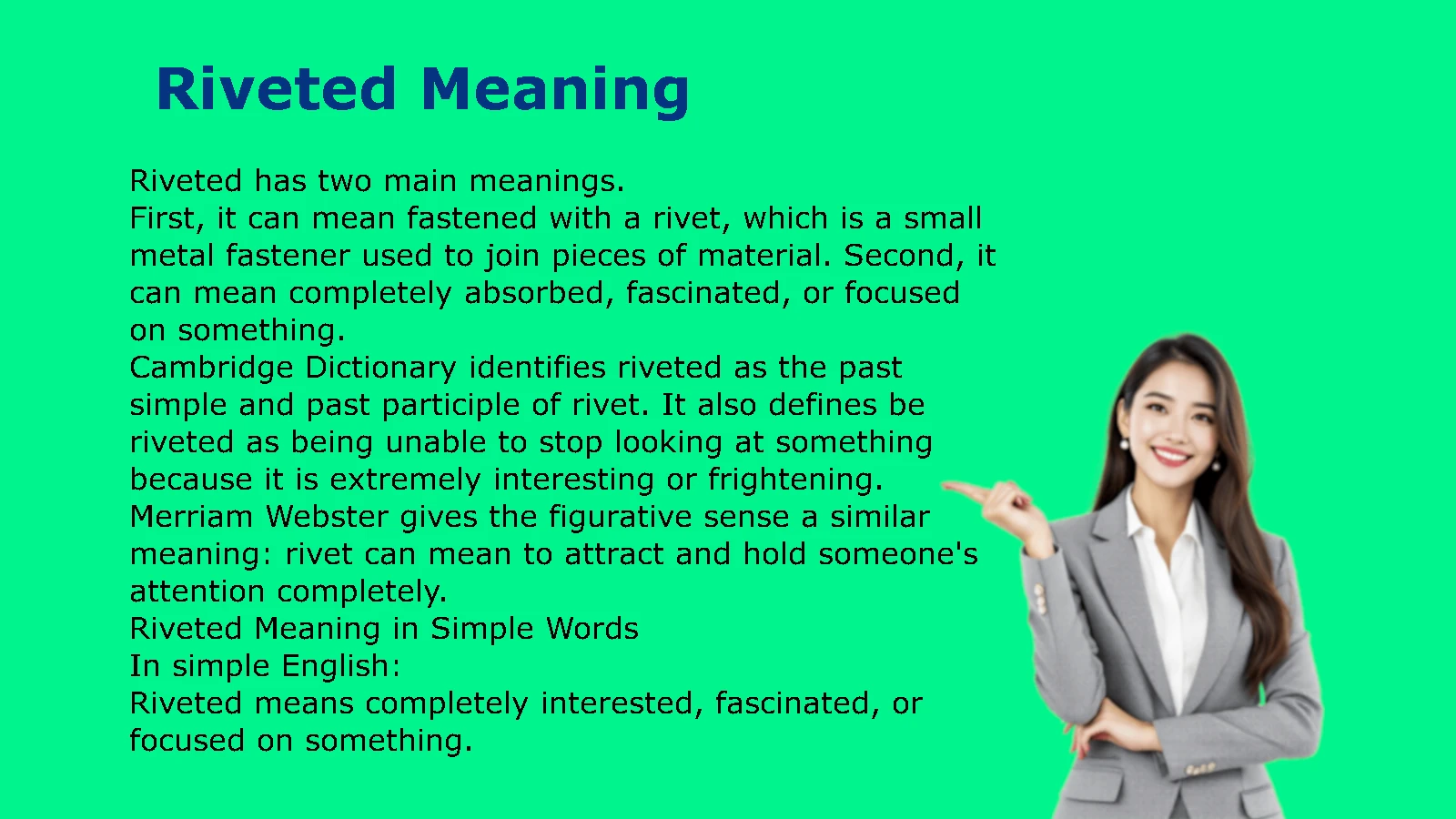
Riveted has two main meanings.
First, it can mean fastened with a rivet, which is a small metal fastener used to join pieces of material. Second, it can mean completely absorbed, fascinated, or focused on something.
Cambridge Dictionary identifies riveted as the past simple and past participle of rivet. It also defines be riveted as being unable to stop looking at something because it is extremely interesting or frightening.
Merriam Webster gives the figurative sense a similar meaning: rivet can mean to attract and hold someone’s attention completely.
Riveted Meaning in Simple Words
In simple English:
Riveted means completely interested, fascinated, or focused on something.
For example:
- I was riveted by the movie.
This means the movie held my attention completely. - The audience was riveted by her speech.
The audience listened with intense attention. - The steel plates were riveted together.
The plates were physically joined with rivets.
The first two sentences use the figurative meaning. The last sentence uses the literal meaning.
The Two Meanings of Riveted
| Meaning | Explanation | Example |
| Figurative | Completely absorbed or fascinated | I was riveted by the documentary. |
| Literal | Fastened with rivets | The metal sheets were riveted together. |
The figurative meaning is especially common when talking about movies, books, stories, performances, speeches, news, and surprising events.
Riveted as a Verb
Riveted is the past tense and past participle of the verb rivet. The verb has both a physical and a figurative use.
In its physical sense, rivet means to fasten materials with a rivet. Cambridge gives aircraft construction as one example of this use.
In its figurative sense, rivet means to attract and hold someone’s attention.
For example:
- The workers riveted the metal panels together.
- The documentary riveted viewers.
- Her performance riveted the audience.
- The unexpected announcement riveted everyone’s attention.
The basic word forms are:
| Form | Example |
| Rivet | They rivet the panels together. |
| Rivets | The machine rivets the pieces together. |
| Riveted | They riveted the panels together. |
| Riveting | The story is riveting. |
The figurative verb normally takes an object because something rivets someone.
The movie riveted me.
Here, the movie causes the reaction and me experiences it.
Riveted as an Adjective
Although riveted comes from a verb, it can also function as an adjective.
When it describes a person’s mental state, it means completely absorbed or intensely interested.
Consider these examples:
- She was riveted by the interview.
- We sat riveted to the screen.
- The students remained riveted throughout the demonstration.
- He listened, completely riveted.
In each case, riveted describes a person who has given something their full attention.
This use connects naturally to the original physical idea of something being fixed firmly in place. A person who is riveted by a story is figuratively unable to pull their attention away from it.
That connection gives the word its punch.
What Does “Be Riveted” Mean?
The phrase be riveted means to become so interested, fascinated, or frightened by something that you can’t easily stop watching or paying attention.
Cambridge specifically defines the phrase in terms of being unable to stop looking because something is very interesting or frightening.
For example:
I was absolutely riveted by the documentary.
The speaker doesn’t merely mean, “I liked it.” The sentence suggests that the documentary captured the speaker’s attention so strongly that looking away felt difficult.
Common Structures With “Be Riveted”
Be riveted by + something
Use riveted by when you want to identify what captured someone’s attention.
- I was riveted by the story.
- She was riveted by his explanation.
- Everyone was riveted by the performance.
- We were riveted by the final scene.
Be riveted to + something
Use riveted to when you want to emphasize where someone’s attention remains fixed.
- He was riveted to the screen.
- The children were riveted to the television.
- She sat riveted to her seat during the announcement.
Be riveted on + something
Riveted on can describe attention directed toward a particular person or thing.
- Her eyes were riveted on the stage.
- His attention was riveted on the speaker.
Cambridge also gives the expression “riveted to the spot,” which can describe someone who cannot move because of fear or shock.
Riveted Meaning in a Sentence
Context usually tells you which meaning of riveted applies.
Compare these sentences:
The workers riveted the metal sheets together.
This describes physical construction.
Now compare:
The workers were riveted by the unexpected announcement.
Here, riveted describes intense attention.
The surrounding nouns provide the clue. Words such as metal, steel, aircraft, plates, leather, construction, and panels usually point toward the literal meaning. Words such as story, movie, audience, speech, performance, viewer, and attention usually point toward the figurative meaning.
Examples of the Figurative Meaning
- I was riveted by the opening scene.
- The audience remained riveted throughout the performance.
- She was riveted by his story.
- We were riveted to the screen.
- The students were riveted by the experiment.
- Everyone listened, riveted by the unexpected news.
- He sat quietly, completely riveted.
- The courtroom audience was riveted by the testimony.
- The children were riveted by the magician’s performance.
- I became riveted by the book’s final chapter.
Examples of the Literal Meaning
- The steel plates were riveted together.
- Workers riveted the aircraft panels into place.
- The bridge used riveted joints.
- The leather pieces were riveted together.
- The old structure contained thousands of riveted connections.
What Does Riveted Mean in Everyday Conversation?
In everyday conversation, riveted usually describes strong interest.
Someone might say:
“I watched the whole series last night. I was riveted.”
That statement suggests more than casual enjoyment. The person found the series so compelling that it held their attention.
You can also use it to describe another person’s reaction:
“Everyone was riveted when she started telling the story.”
This means everyone paid close attention.
The word works particularly well when interested, focused, or fascinated doesn’t seem strong enough.
Natural Conversation Examples
Friend: “Did you like the documentary?”
Response: “Absolutely. I was riveted from the first few minutes.”
Or:
Friend: “How was the presentation?”
Response: “It was surprisingly good. Everyone seemed riveted.”
These examples sound natural because riveted emphasizes sustained attention, not simply approval.
Riveted vs. Riveting
One of the most common questions about this word is the difference between riveted and riveting.
The easiest rule is:
Riveted describes the person who feels intense interest. Riveting describes the thing that creates that interest.
Cambridge defines riveting as “extremely interesting.” Merriam Webster similarly defines it as having the power to fix someone’s attention.
Compare:
- I was riveted by the story.
- The story was riveting.
The first sentence describes my reaction.
The second describes the story.
Riveted vs. Riveting Table
| Word | Describes | Example |
| Riveted | A person’s reaction | I was riveted by the movie. |
| Riveting | Something that captures attention | The movie was riveting. |
A simple memory trick helps:
You are riveted. Something is riveting.
More Examples
- The audience was riveted by the speaker.
- The speaker gave a riveting presentation.
- We were riveted by the documentary.
- The documentary was riveting.
- She remained riveted throughout the interview.
- Her account was riveting.
Riveted vs. Interested
Interested and riveted aren’t quite the same.
If you’re interested in something, you want to know more about it. Your attention has moved toward it.
If you’re riveted, your attention is strongly fixed on it.
Think of the difference as a sliding scale:
curious → interested → fascinated → riveted
The exact intensity depends on context, but riveted usually suggests a particularly strong reaction.
Compare These Sentences
I was interested in the book.
You liked the subject and wanted to learn more.
I was riveted by the book.
The book captured your attention so completely that you found it difficult to put down.
That distinction matters when choosing the right word. If you simply enjoyed a short conversation, interested may sound more natural. If you couldn’t stop listening because every detail held your attention, riveted fits better.
Riveted Synonyms
Several words can replace riveted when it means intensely interested or focused.
Merriam Webster’s thesaurus includes alternatives such as focused, concentrated, centered, directed, fixated, and attended for the attention related sense.
Common conversational synonyms include:
- Captivated
- Fascinated
- Absorbed
- Engrossed
- Spellbound
- Transfixed
- Gripped
- Focused
- Concentrated
- Enthralled
However, these words don’t always carry exactly the same tone.
| Synonym | Typical nuance |
| Captivated | Strongly attracted by something |
| Fascinated | Extremely interested or curious |
| Absorbed | Deeply involved in something |
| Engrossed | Completely occupied by something |
| Spellbound | So fascinated that attention seems almost magical |
| Transfixed | Unable to look away or move |
| Gripped | Strongly affected or held by something |
| Focused | Concentrating attention on something |
| Enthralled | Completely delighted or fascinated |
For example, focused can sound more neutral and practical, while spellbound sounds more dramatic.
Antonyms of Riveted
When riveted means completely focused, its opposites include:
- Distracted
- Bored
- Uninterested
- Inattentive
- Disengaged
- Indifferent
- Unfocused
Consider the contrast:
The audience was riveted by the speaker.
versus:
The audience was distracted during the presentation.
The first sentence describes strong, sustained attention. The second describes attention that has moved elsewhere.
Literal Riveted Meaning in Construction and Manufacturing
The figurative meaning gets most of the attention in everyday speech, but the literal meaning remains important in technical and historical contexts.
A rivet is a metal pin used to fasten pieces of material together. Cambridge describes it as a metal pin used to fasten flat pieces of metal or other thick materials such as leather.
When something is riveted, workers have joined it using rivets.
For example:
The metal plates were riveted together.
The sentence doesn’t describe someone’s attention. It describes a physical connection.
Merriam Webster defines a rivet as a headed metal pin or bolt used to unite pieces by passing its shank through holes and forming another head on the opposite end.
Where You May See the Literal Meaning
The word can appear in discussions of:
- Aircraft
- Ships
- Bridges
- Metal structures
- Machinery
- Historical engineering
- Leather goods
- Industrial manufacturing
- Restoration projects
Older structures and machinery often feature riveted construction. Modern manufacturing frequently uses other joining methods as well, including welding, bolting, adhesives, and mechanical fasteners.
A Simple Physical Picture
Imagine two sheets of metal with matching holes.
A rivet passes through the holes. Its ends are then formed so the pieces stay together.
So when you read:
The plates were riveted together.
think “joined firmly with rivets.”
That physical idea also helps explain the figurative meaning. Something that rivets your attention figuratively holds it in place.
Riveted Word Forms
Understanding the word family makes riveted meaning easier to remember.
| Word | Function | Example |
| Rivet | Verb or noun | They rivet the panels together. |
| Rivets | Present tense verb or plural noun | The machine rivets the pieces. |
| Riveted | Past tense or past participle | The audience was riveted. |
| Riveting | Present participle or adjective | It was a riveting story. |
The key distinction is between riveted and riveting.
The audience was riveted.
The performance was riveting.
The audience experiences the reaction. The performance creates it.
Common Phrases With “Riveted”
Certain combinations appear naturally in English.
Riveted by the Story
Riveted by the story means completely absorbed by someone’s account or narrative.
We were riveted by the story of her journey.
Riveted by the Performance
This phrase commonly describes audiences.
The crowd was riveted by the dancer’s performance.
It suggests that the performance held everyone’s attention.
Riveted to the Screen
Riveted to the screen means watching a television, computer, or phone screen with intense concentration.
I was riveted to the screen during the final scene.
The expression is figurative. Nobody has physically attached themselves to the screen.
Riveted to the Spot
Riveted to the spot has a slightly different feel. It can mean being unable to move because of fear, shock, surprise, or intense attention.
Cambridge specifically includes this phrase in its explanation of be riveted.
The sudden noise left him riveted to the spot.
Riveted Attention
Riveted attention refers to extremely strong focus.
The speaker held the audience’s riveted attention.
This construction is more formal than simply saying:
Everyone was riveted.
Is Riveted Positive or Negative?
Riveted itself isn’t strictly positive or negative.
The word simply describes intense attention. The thing causing that attention determines the emotional tone.
Positive Context
The students were riveted by the fascinating science demonstration.
Here, the attention comes from curiosity and interest.
Negative Context
The viewers were riveted by the disturbing news report.
The viewers remain intensely focused, but the subject matter is unpleasant.
Frightening Context
She was riveted to the spot when she heard the crash.
Here, the word suggests shock or fear.
Cambridge explicitly notes that something can be interesting or frightening enough to leave someone riveted.
So riveted describes the strength of attention rather than whether the experience feels good.
Riveted Pronunciation
In US English, riveted is pronounced approximately:
RIV uh tid
The pronunciation is represented as /ˈrɪv.ɪ.tɪd/ in Cambridge’s entry.
The first syllable receives the main stress:
RIV uh tid
The base word rivet is pronounced approximately:
RIV it
Learning the pronunciation helps distinguish the word when speaking.
Common Mistakes With Riveted
Although riveted is straightforward once you understand the two meanings, a few mistakes appear regularly.
Confusing Riveted With Riveting
Incorrect:
The movie was riveted.
Better:
The movie was riveting.
The movie creates the reaction, so riveting works as the adjective.
Correct:
I was riveted by the movie.
Thinking Riveted Only Relates to Metal
The word originally connects to physical fastening, but English also uses it figuratively to describe attention.
She was riveted by the interview.
Nothing needs to involve metal.
Treating Riveted as Exactly the Same as Interested
Riveted usually suggests a much stronger level of attention.
I was interested in the lecture.
means something different from:
I was riveted by the lecture.
The second sentence suggests that the lecture held the speaker’s attention intensely.
Misunderstanding “Riveted to the Screen”
Someone who is riveted to the screen isn’t literally attached to it.
The phrase uses the physical image of something being firmly fixed in place to describe intense attention.
How to Use “Riveted” Correctly
A few sentence patterns cover most everyday uses.
Person + be + riveted + by + thing
Use this when something captures someone’s attention.
I was riveted by the documentary.
The audience was riveted by her speech.
Person + be + riveted + to + object
Use this when you want to emphasize where someone’s attention remains fixed.
He was riveted to the television.
They were riveted to the screen.
Person + rivet + object
Use the active verb when something captures someone’s attention.
The story riveted me.
Her performance riveted the audience.
Cambridge gives the same basic figurative structure: something can rivet someone by attracting and holding that person’s attention.
Material + be + riveted + together
Use the literal construction meaning.
The metal sheets were riveted together.
This pattern usually signals the physical meaning.
Riveted vs. Captivated vs. Fascinated
These words overlap, but each has its own flavor.
| Word | Main idea |
| Riveted | Attention is held completely |
| Captivated | Something strongly attracts and holds interest |
| Fascinated | Something creates intense curiosity or interest |
| Engrossed | Someone becomes deeply involved in something |
| Transfixed | Someone cannot look away or move |
| Focused | Someone concentrates attention deliberately |
For example:
I was fascinated by astronomy.
This suggests strong curiosity.
I was engrossed in the book.
This emphasizes deep involvement.
I was riveted by the documentary.
This emphasizes how completely the documentary held attention.
I was transfixed by the performance.
This sounds more dramatic and suggests that looking away was almost impossible.
A Quick Case Study: Understanding “Riveted” Through Context
Consider three sentences about the same event.
Sentence One
The audience was interested in the speaker.
The audience paid attention, but the level of interest isn’t especially intense.
Sentence Two
The audience was fascinated by the speaker.
The speaker captured their curiosity.
Sentence Three
The audience was riveted by the speaker.
The speaker held their attention completely.
The difference isn’t always absolute. Natural language has shades of meaning. Still, riveted generally carries a stronger sense of sustained attention than ordinary interested.
Facts About the Word Riveted
A few language facts help put the word into context:
- Riveted is the past tense and past participle of rivet.
- Rivet can function as both a noun and a verb.
- The noun rivet refers to a metal fastener used to join materials.
- The figurative verb rivet means to attract and hold attention strongly.
- Riveting means extremely interesting or capable of fixing someone’s attention.
- Merriam Webster traces the noun rivet to Middle English and French roots and records its first known use in the 15th century.
- Merriam Webster records riveting in the attention related sense as dating to the 17th century.
The word therefore has a useful bridge between a physical action and a mental reaction: something can be physically fixed in place, while attention can be figuratively fixed in place.
Riveted Meaning: Quick Comparison
| Question | Answer |
| What does riveted mean? | Completely absorbed, fascinated, or fastened with rivets, depending on context. |
| Is riveted a verb? | Yes. It is the past tense and past participle of rivet. |
| Can riveted be an adjective? | Yes. It can describe someone who is completely absorbed. |
| What does “I was riveted” mean? | Something held your attention completely. |
| What does “riveted to the screen” mean? | Watching a screen with intense attention. |
| What does “riveted together” mean? | Joined physically with rivets. |
| What is the difference between riveted and riveting? | Riveted describes the person. Riveting describes the thing that captures attention. |
| What are common synonyms? | Captivated, fascinated, absorbed, engrossed, transfixed, and focused. |
| Can riveted describe fear? | Yes. Someone can be riveted by something frightening or shocked into being unable to move. |
Frequently Asked Questions About Riveted
What does riveted mean?
Riveted usually means completely absorbed, fascinated, or focused on something. It can also literally mean fastened with rivets. Context determines which meaning applies.
Does riveted mean interested?
Yes, but riveted generally suggests a much stronger level of interest. If you’re riveted, something has captured and held your attention very strongly.
What does “I was riveted” mean?
“I was riveted” means something held your attention completely. For example, if you say, “I was riveted by the movie,” you mean the movie was so compelling that you couldn’t easily look away.
What is the difference between riveted and riveting?
Riveted describes the person experiencing intense interest.
Riveting describes the thing that creates that reaction.
I was riveted by the story.
The story was riveting.
Cambridge defines riveting as extremely interesting.
What does “riveted to the screen” mean?
It means someone watches a screen with complete or intense attention.
She was riveted to the screen during the final scene.
The phrase is figurative rather than literal.
Is riveted a past tense?
Yes. Riveted is the past tense and past participle of rivet.
For example:
Present: The story rivets me.
Past: The story riveted me.
What is a synonym for riveted?
Depending on the context, useful synonyms include captivated, fascinated, absorbed, engrossed, transfixed, gripped, and focused. The best choice depends on the exact shade of meaning you want.
Can riveted describe something frightening?
Yes. Someone can be riveted by something frightening. The word describes the intensity of attention rather than whether the experience feels pleasant. Cambridge specifically includes frightening situations in its definition of be riveted.
What does “riveted to the spot” mean?
It means someone is unable to move because of fear, shock, surprise, or intense attention.
The sudden explosion left him riveted to the spot.
What does “riveted together” mean?
Riveted together means physically joined using rivets.
The metal panels were riveted together.
This is the literal meaning of the word.
Final Takeaway: Riveted Meaning
The easiest way to remember riveted meaning is to think about something being held firmly in place.
In its literal sense, something riveted has been physically fastened with a rivet. In its figurative sense, a person who is riveted has their attention held so strongly that they can’t easily look away.
The most useful distinction is:
Riveted = completely absorbed or physically fastened.
When talking about attention, remember the difference between riveted and riveting:
- The movie was riveting.